
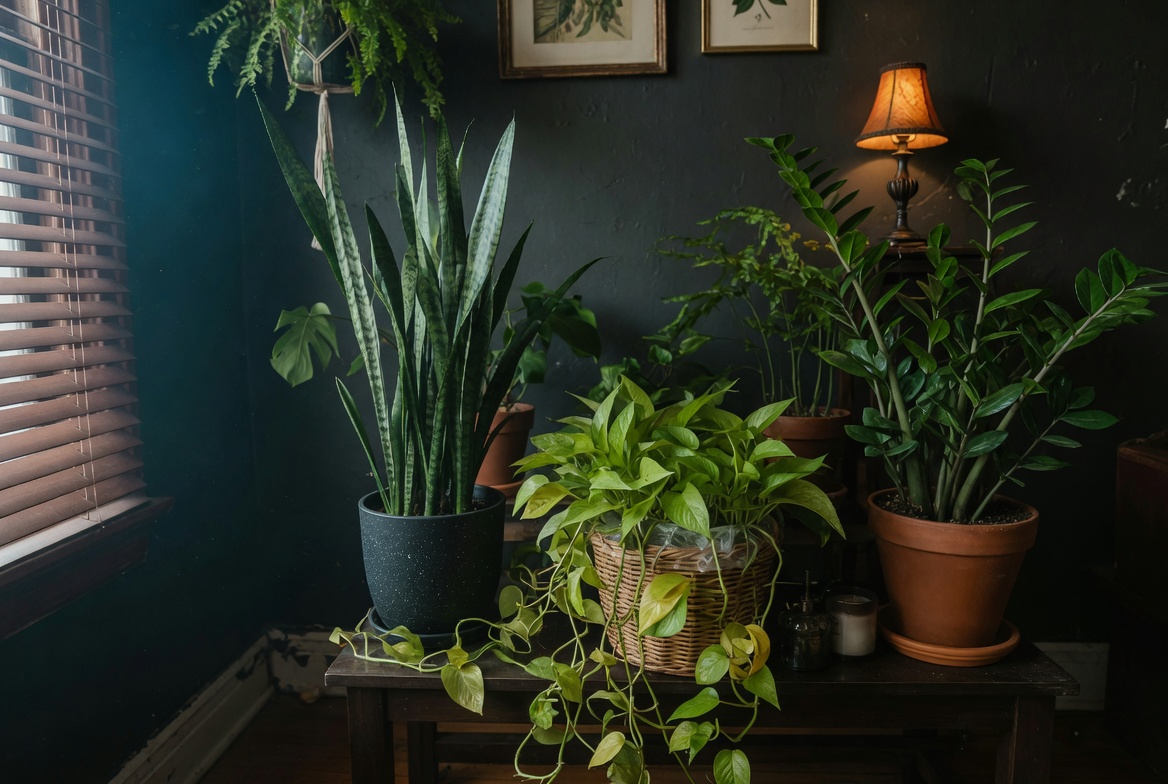
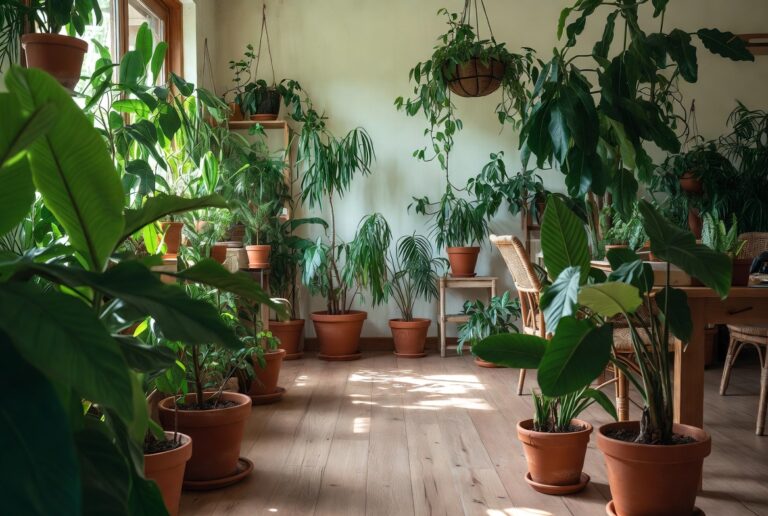
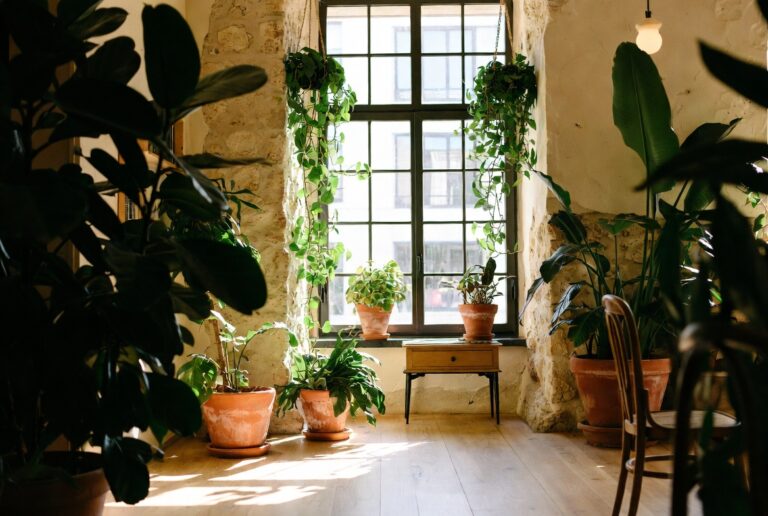
Not every home has a sun-drenched south-facing window — and that’s completely fine. Many of the most beautiful and easiest houseplants on the planet evolved under dense forest canopies where direct sunlight rarely reaches the ground. These plants don’t just survive in low light — they genuinely thrive in it, producing lush foliage and strong growth in the conditions that would kill a sun-loving plant within weeks. These indoor plants are ideal choices for low-light rooms.
This list covers 20 plants that perform reliably in rooms with limited natural light, north-facing windows, shaded corners, and spaces far from any window. Each entry includes honest information about how low the light can actually go, how to water correctly, and the specific mistake that most people make with that plant.
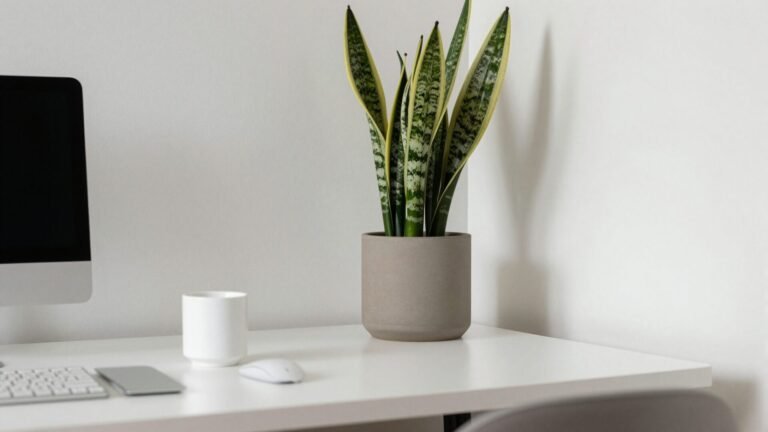
1. Snake Plant — Indoor Plants
These indoor plants require minimal care while still purifying the air in your home.
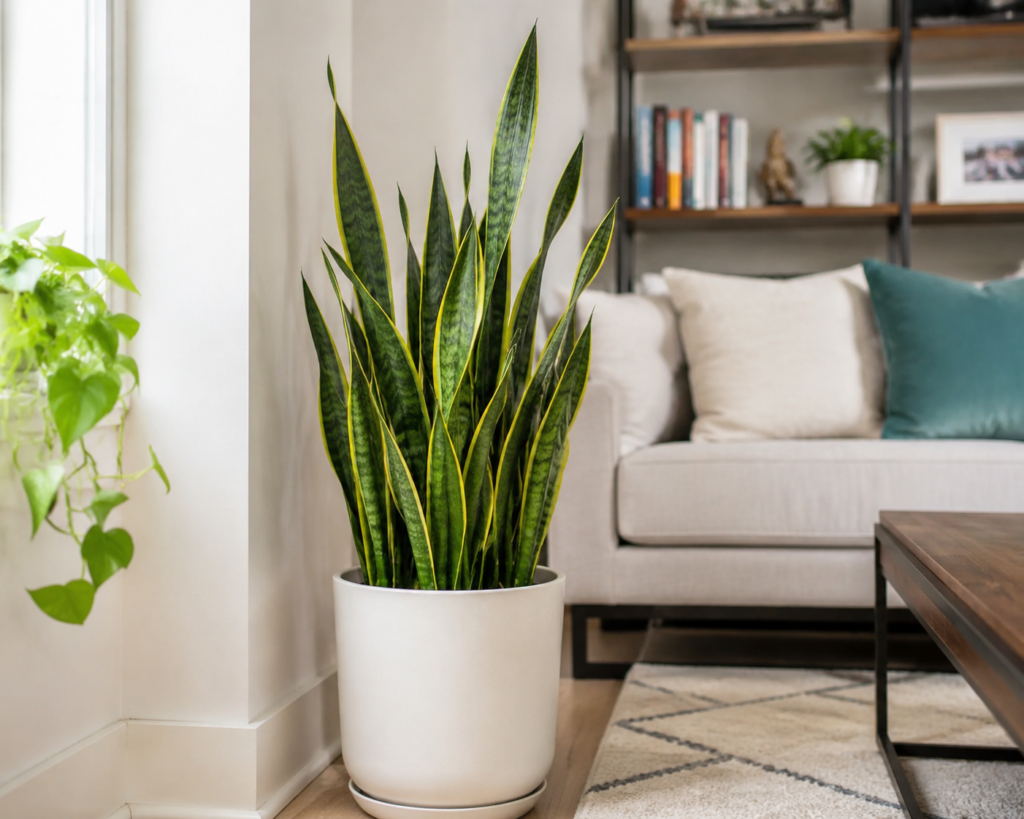
Best for: Any room in any light condition — the most forgiving houseplant available
The snake plant (Sansevieria, now reclassified as Dracaena trifasciata) is the definitive low-light houseplant. Its upright, architectural sword-shaped leaves look bold in a dark corner, a dim hallway, or a windowless bathroom. It tolerates neglect that would kill virtually every other plant — periods without water, low humidity, temperature fluctuations, and near-total darkness.
It won’t grow fast in very low light, but it won’t die either. It genuinely survives where other plants merely struggle.
Smart tip: Water a snake plant only when the soil is completely dry — not just the top inch, but dry all the way through. In low light conditions, this might mean watering only once every three to six weeks in winter. Overwatering is the only reliable way to kill a snake plant.
Mistake to avoid: Moving a snake plant from a dim room directly into bright outdoor sun. The sudden light change causes leaf scorch almost immediately. If you want to give it a light boost, move it gradually — to a brighter indoor spot first, then partial outdoor shade, over several weeks.
2. Pothos — Indoor Plants
Choosing the right indoor plants for a shaded room helps your space feel greener year-round.
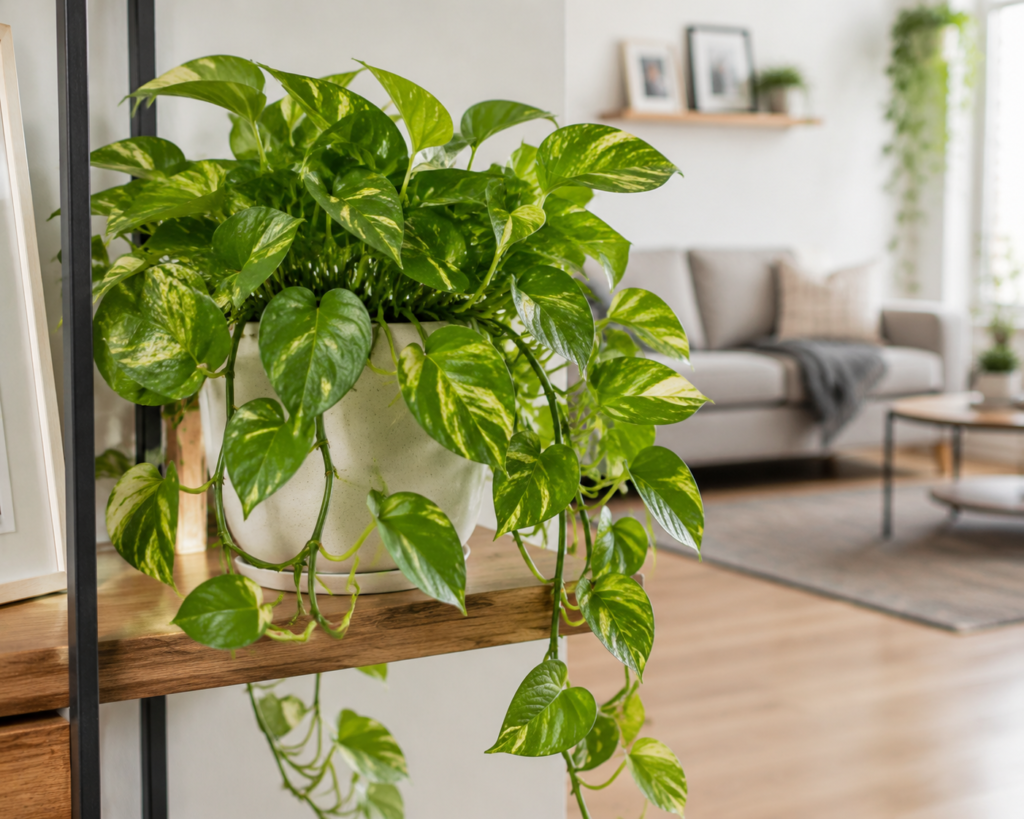
Best for: Trailing displays, high shelves, and hanging baskets in low to medium light spaces
Pothos (Epipremnum aureum) is perhaps the most popular houseplant in the world, and its popularity is entirely deserved. Its heart-shaped leaves trail beautifully from shelves and hanging pots, it tolerates a remarkable range of light conditions from bright indirect to quite dim, and it’s essentially impossible to kill through neglect.
In lower light, the variegated varieties lose some of their golden or white patterning and revert toward solid green — this is normal and harmless. The plant remains healthy and continues growing, just more uniformly green.
Smart tip: Let pothos vines trail long rather than constantly cutting them back. Vines of 3 to 4 feet or more create genuinely dramatic displays and show the plant’s natural trailing quality. Pinch the very tips occasionally to encourage side branching if a fuller, bushier appearance is preferred.
Mistake to avoid: Placing variegated pothos in very low light hoping to maintain the golden or white patterning. Variegation requires more light than solid green — in dim conditions, the plant produces more chlorophyll to compensate, and the variegation fades. For very low-light positions, choose the solid green ‘Neon’ or ‘Jade’ varieties that don’t rely on variegation for their visual appeal.
3. ZZ Plant — Indoor Plants
Indoor plants like these adapt well to a variety of light conditions and soil types.
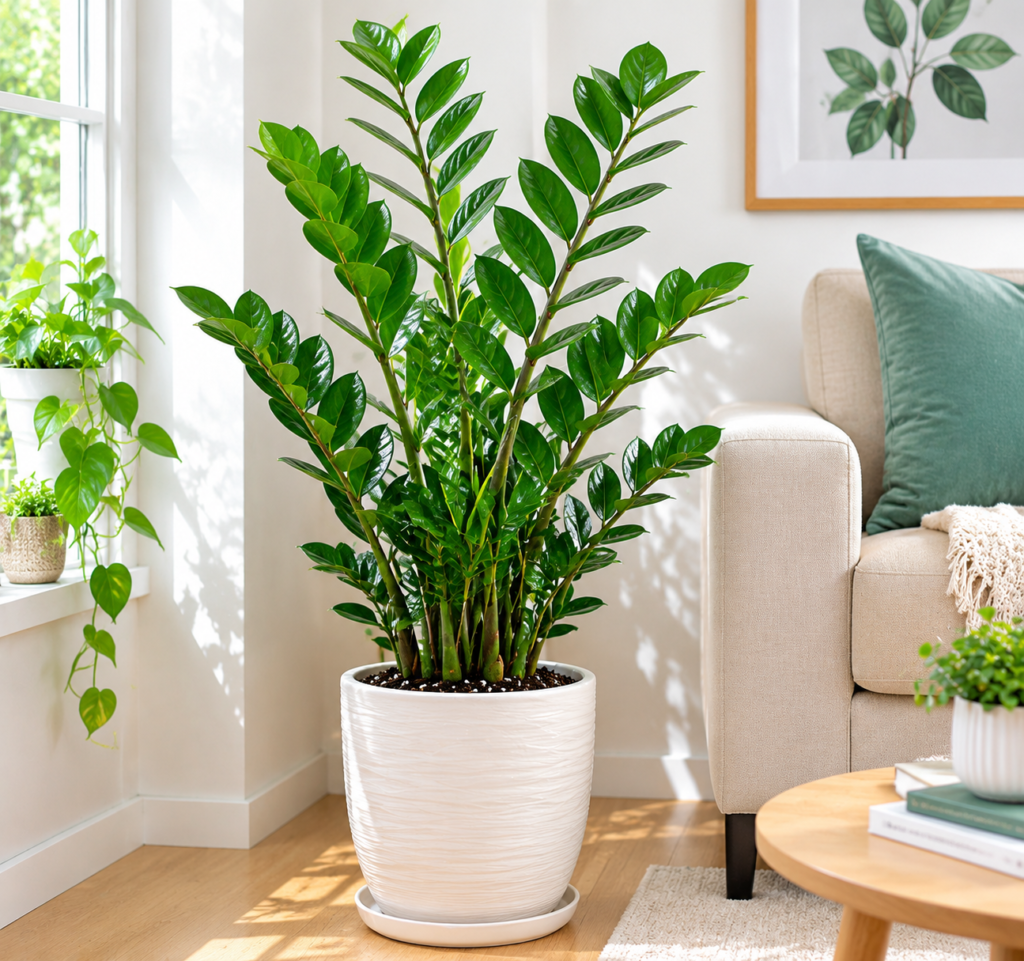
Best for: The darkest corners of any room — the extreme low-light specialist
The ZZ plant (Zamioculcas zamiifolia) survives in conditions so dim that few other plants can manage anything beyond bare survival. Its glossy, dark green oval leaves emerge from thick underground rhizomes that store water and nutrients — allowing the plant to go weeks or months without water and still recover fully.
It’s the right plant for a dim office with no windows, a dark hallway corner, or any position where every other plant has failed. It grows slowly in low light, but it grows — which is more than can be said for most plants in these conditions.
Smart tip: Choose a ZZ plant pot that’s only slightly larger than the root ball. ZZ plants perform better slightly pot-bound and are significantly more likely to develop root rot in a large pot with excess soil that retains moisture around the roots for extended periods.
Mistake to avoid: Assuming the ZZ plant needs more water because it’s in a dark spot. The opposite is true — in low light, the plant’s metabolism slows and it uses water far more slowly. Watering on the same schedule you’d use in a brighter location leads to root rot, the only common cause of ZZ plant death.
Loving These Ideas? Get the Step-by-Step Guide
Grab the full 5-day eBook and turn these ideas into a finished room.



4. Peace Lily — Indoor Plants
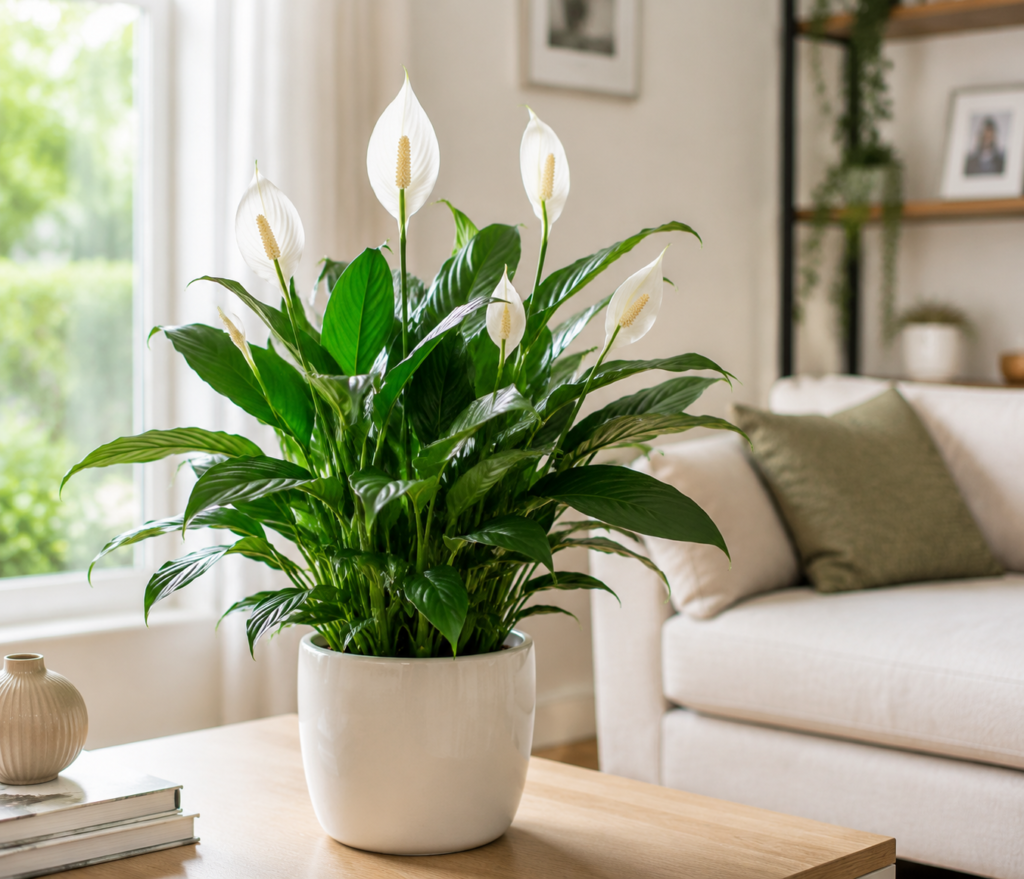
Best for: Rooms with moderate to low light that need both foliage and flowers
The peace lily (Spathiphyllum) is one of the very few flowering houseplants that genuinely performs in low light. Its elegant white blooms and deep green leaves suit both modern and traditional interiors, and it’s one of the most effective air-purifying houseplants available — removing formaldehyde, benzene, and ammonia from indoor air.
It communicates its needs clearly: when it needs water, its leaves droop noticeably. Water it at this signal and it recovers within hours. This self-reporting quality makes it genuinely easy to care for even for complete beginners.
Smart tip: Wipe peace lily leaves with a damp cloth every few weeks. The large, glossy leaves accumulate dust quickly, and dust blocks light absorption — already limited in a low-light environment. Clean leaves are measurably more efficient at photosynthesizing in dim conditions.
Mistake to avoid: Placing a peace lily in direct sunlight. Unlike most plants discussed here, the peace lily is genuinely harmed by direct sun — it causes yellow, scorched patches on the leaves within days. It’s one of the few plants that actually performs better with less light than more.
5. Cast Iron Plant — Indoor Plants
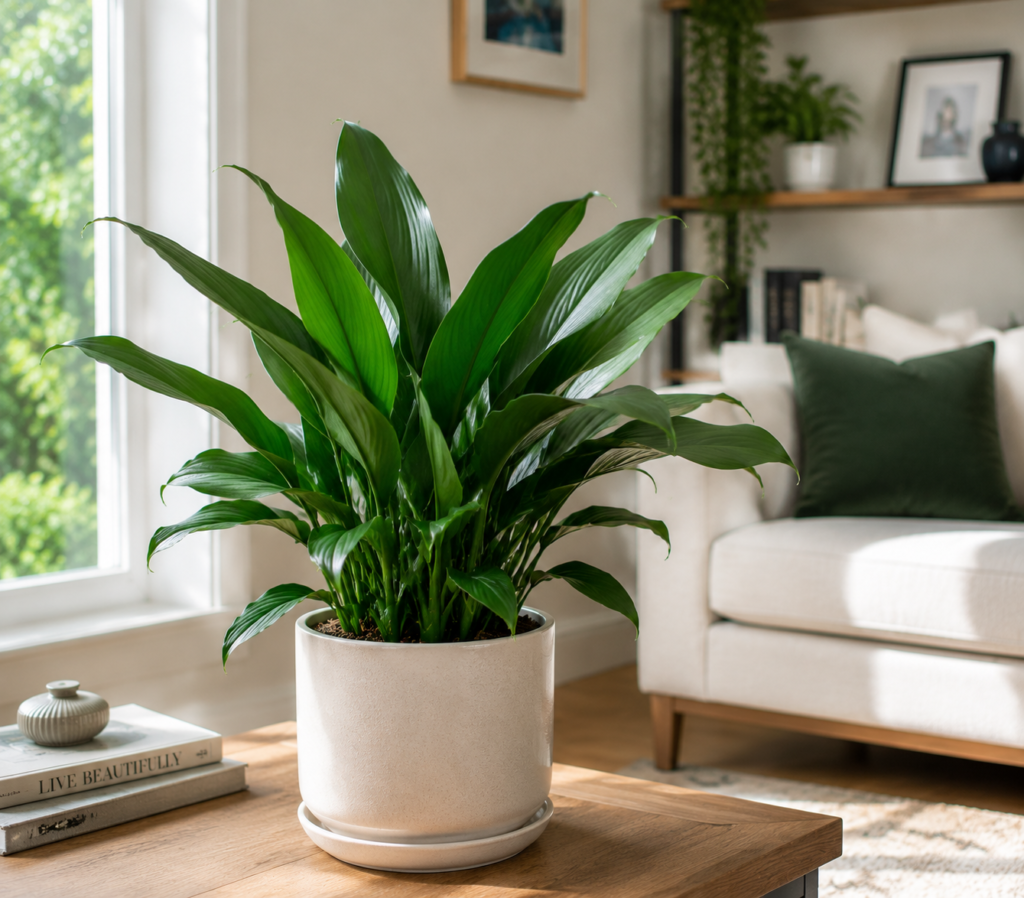
Best for: Extreme neglect situations — the toughest houseplant that exists
The cast iron plant (Aspidistra elatior) earned its common name honestly. It tolerates near-complete darkness, temperature extremes, irregular watering, dust, drought, and conditions that would kill any other commonly available houseplant. Victorian parlors used it extensively precisely because it survived the dim, gas-lit interiors that were fatal to other plants.
Its dark green strap-like leaves are not showy, but they’re consistently healthy and structurally interesting in a planting scheme. In a dark corner where nothing else will grow, the cast iron plant simply gets on with it.
Smart tip: Feed cast iron plants only once or twice per year with a diluted balanced fertilizer. This slow-growing plant doesn’t need — and actually doesn’t benefit from — frequent fertilizing. Too much nitrogen in particular produces soft, dark growth that’s more susceptible to the pests the plant is otherwise largely immune to.
Mistake to avoid: Repotting a cast iron plant unnecessarily. This plant actively prefers being slightly pot-bound and resents root disturbance. Repot only when roots are clearly growing through the drainage holes — and even then, move it to a pot only one size larger.
6. Chinese Evergreen — Indoor Plants
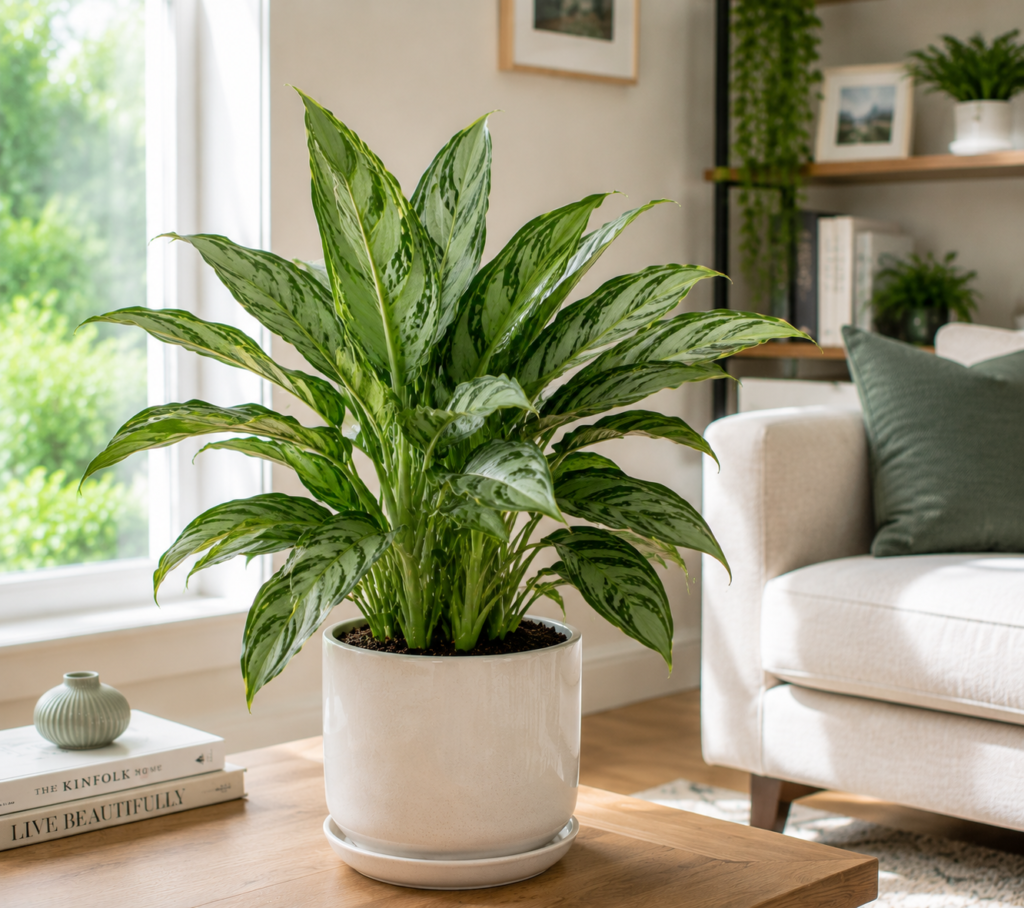
Best for: Anyone wanting color and pattern in a low-light space
The Chinese evergreen (Aglaonema) offers something most low-light plants don’t: genuine color variety. Available in green, silver, red, pink, and combinations of all of these, it brings the visual interest of colorful plants to spaces where most colorful varieties would quickly decline.
The darker-colored varieties — deep green and silver — tolerate the lowest light. The brighter varieties — red and pink — need slightly more light to maintain their color but are still far more tolerant of shade than most colorful houseplants.
Smart tip: Choose darker-colored Chinese evergreen varieties for the lowest light positions in your home. The green and silver varieties are the most shade-tolerant. Save the red and pink varieties for positions that receive at least a few hours of indirect light — in deep shade, these bright varieties lose their color and revert toward green.
Mistake to avoid: Letting Chinese evergreen sit in cold drafts or near air conditioning vents. It tolerates low light exceptionally well but is sensitive to cold temperatures — anything below about 60°F (15°C) causes brown leaf edges and declining growth. Keep it away from cold windows in winter and chilled air from cooling systems.
7. Heartleaf Philodendron
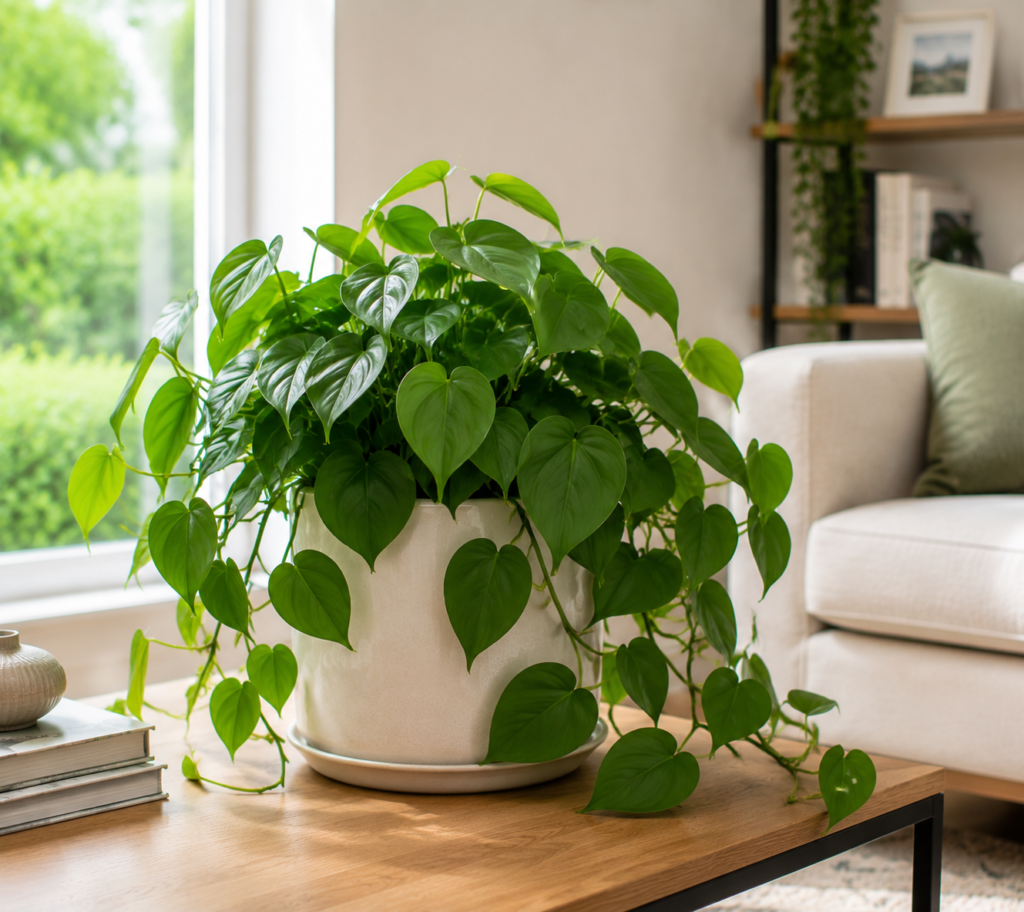
Best for: Fast-growing trailing or climbing displays in low to medium light
The heartleaf philodendron (Philodendron hederaceum) combines the low-light tolerance of pothos with a softer, more velvety leaf texture and a slightly faster growth rate. Its heart-shaped leaves trail readily from pots and shelves, or climb a moss pole or trellis when given support.
It’s one of the easiest houseplants to propagate — cuttings placed in water root within two to three weeks, making it an excellent plant to share and to multiply throughout the home at no cost.
Smart tip: Allow the heartleaf philodendron to climb rather than trail for the largest leaves. When given a moss pole to climb, the plant produces progressively larger leaves as it ascends — a mature climbing specimen produces leaves two to three times the size of a trailing plant of the same age.
Mistake to avoid: Confusing heartleaf philodendron with pothos and treating them identically. Both are similar in appearance and low-light tolerance, but philodendron leaves are darker green, softer, and more matte-surfaced. Philodendron also prefers to dry out slightly less between waterings than pothos — keeping it consistently moist (but never wet) produces better growth.
8. Spider Plant
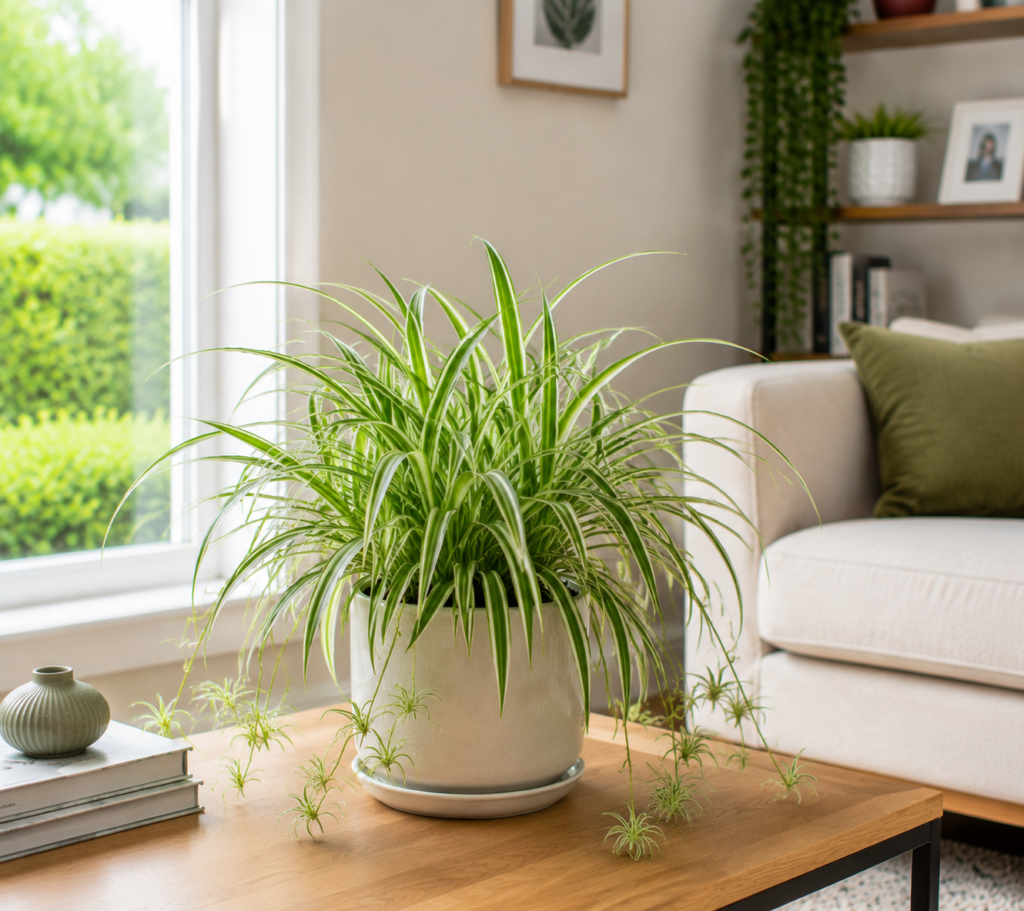
Best for: Hanging baskets, high shelves, and any position where the cascading babies can be appreciated
The spider plant (Chlorophytum comosum) produces long arching stems that dangle small plantlets — the “spiders” — which can be snipped and rooted as new plants. This self-propagating quality and genuine low-light tolerance have made it one of the most widely grown houseplants in history.
Its striped green and white leaves brighten dim spaces, and it’s one of the few variegated plants that maintains its patterning in low light — the white stripes are structural, not dependent on additional light production as with many variegated plants.
Smart tip: Remove the small plantlets when they develop roots of their own — pot them into small containers of moist potting mix. Each plantlet becomes a full-sized spider plant within a few months. A single spider plant can produce dozens of plantlets per season, providing an endless supply of free plants for filling other dim corners.
Mistake to avoid: Watering spider plants with fluoride-rich tap water. Spider plants are sensitive to fluoride, which accumulates in the soil and causes brown leaf tips — a very common and frustrating problem. Use filtered water, rainwater, or allow tap water to sit uncovered overnight before watering to allow some fluoride to off-gas.
9. Dracaena
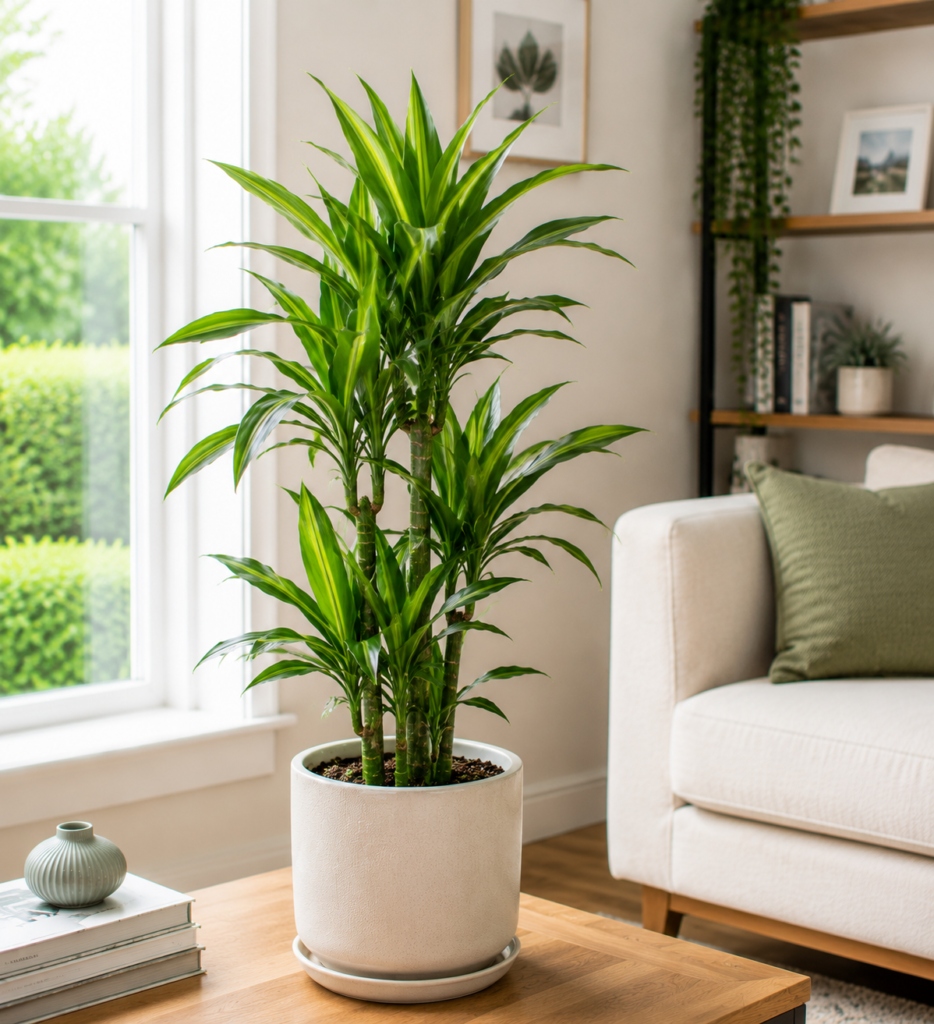
Best for: Adding height and architectural presence to low-light rooms
Dracaena encompasses a large genus of plants that range from compact tabletop varieties to floor plants reaching 6 feet or more. All share the characteristic of tolerating low light with minimal complaint, making them ideal statement plants for dim corners that need vertical interest.
The most commonly available varieties — Dracaena marginata (thin red-edged leaves), D. fragrans (corn plant, broad arching leaves), and D. sanderiana (lucky bamboo) — all perform reliably in indirect light and require watering only when the top half of the soil is dry.
Smart tip: Dracaena is one of the best plants for removing indoor air pollutants — particularly formaldehyde, which off-gases from furniture, flooring, and building materials. Placing a dracaena in a newly furnished or renovated room provides genuine air quality improvement alongside its decorative function.
Mistake to avoid: Overwatering dracaena, particularly in winter. This plant’s most common cause of death is root rot from excessive watering in low-light conditions where the soil dries very slowly. Reduce watering frequency significantly in winter — in a dim room, monthly watering may be sufficient.
10. Bird’s Nest Fern
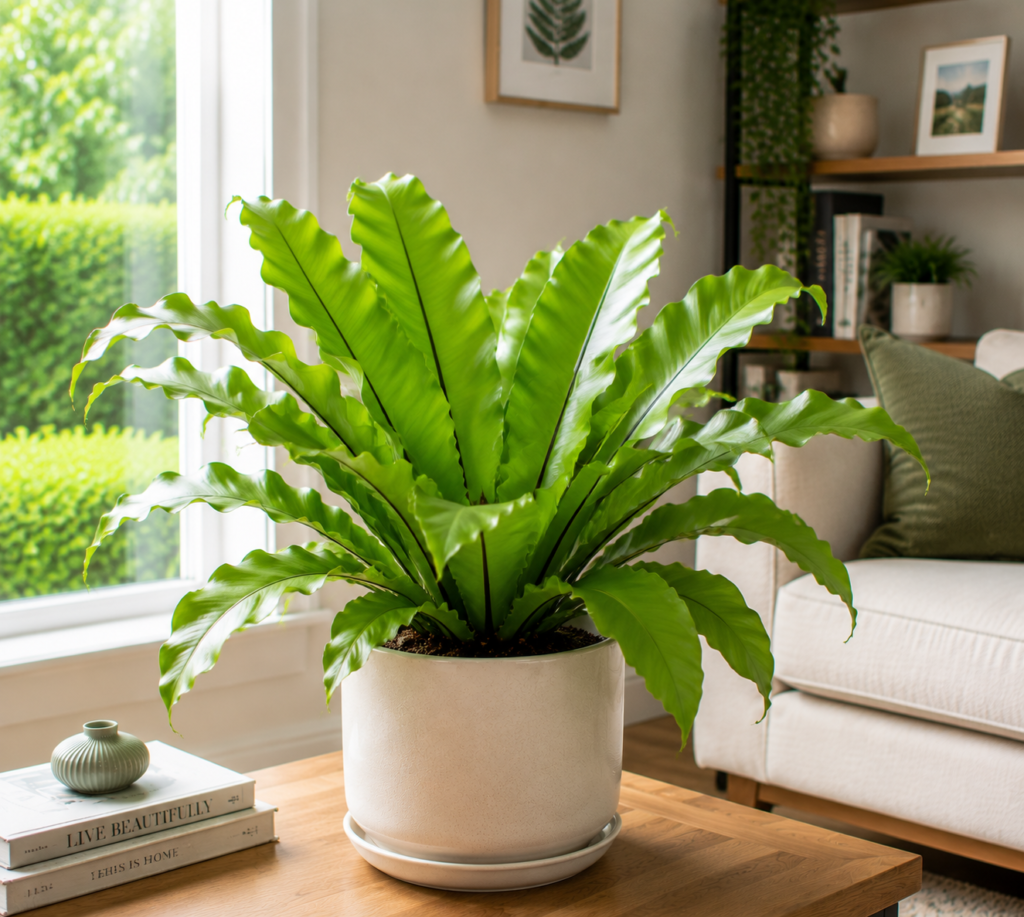
Best for: Bathrooms and other humid low-light spaces — this fern genuinely loves these conditions
The bird’s nest fern (Asplenium nidus) is the most low-light tolerant of the commonly available ferns, and its broad, bright green fronds add a lush tropical quality to dim spaces. Unlike most ferns, it doesn’t require consistently moist soil — it stores water in its central rosette and is more tolerant of drying out than typical ferns.
Its natural habitat is the dim, humid understory of tropical rainforests, making a shaded bathroom with a shower or bathtub one of its ideal indoor environments.
Smart tip: Water the bird’s nest fern at the base of the plant rather than into the central rosette. Water pooling in the center of the rosette causes rot at the crown — the one thing that reliably kills this otherwise tough plant. Direct water onto the soil surface around the outside of the plant.
Mistake to avoid: Touching or handling the emerging fronds. New fronds emerge from the center of the rosette in tight, delicate coils. Physical contact at this stage damages them permanently — the damage shows as brown marks or distorted growth on the mature frond. Resist the temptation to touch the emerging growth.
11. Calathea
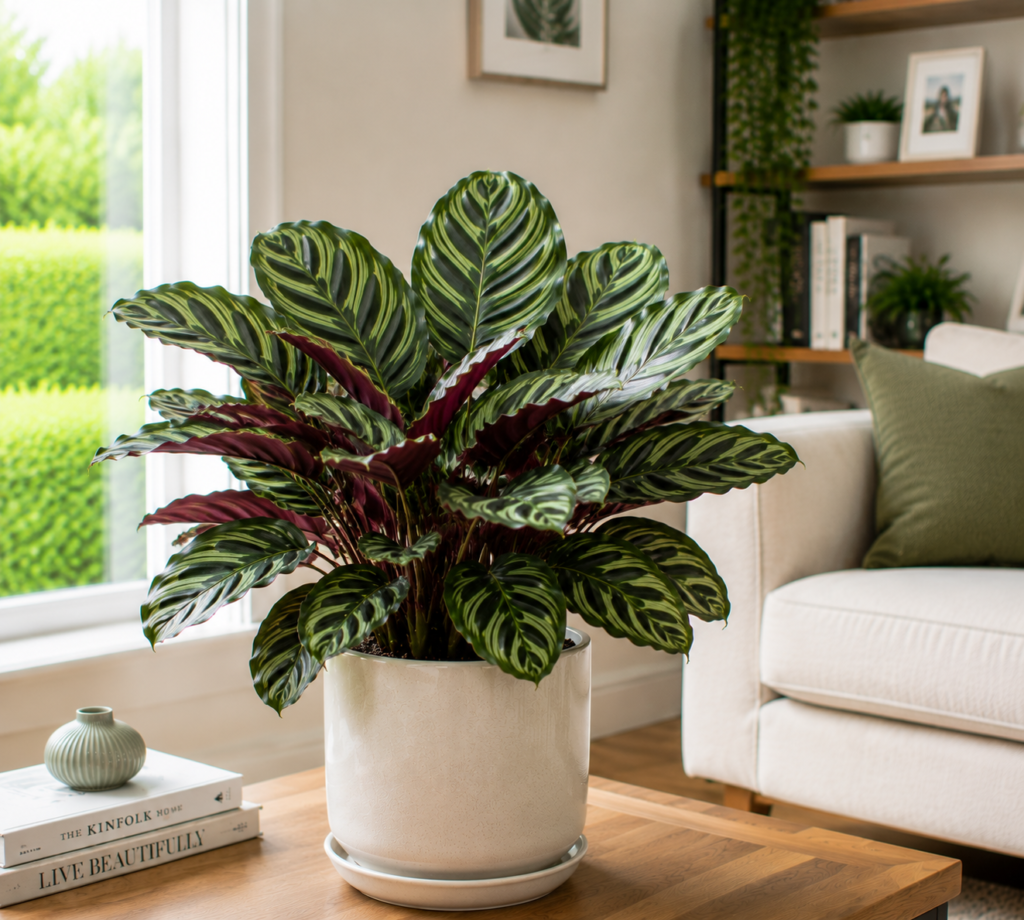
Best for: Anyone who wants the most dramatic patterned foliage in a low-light space
Calathea produces some of the most elaborately patterned leaves in the houseplant world — dark green with contrasting light green patterns, purple undersides, and markings that look painted. These patterns evolved specifically to function in low light — the complex markings are the plant’s way of maximizing light capture under a forest canopy.
It’s more demanding than most plants on this list, with specific preferences for humidity and watering — but the visual payoff for getting it right is extraordinary.
Smart tip: Group calathea with other tropical houseplants rather than growing it in isolation. Grouped plants create a microclimate of elevated humidity through collective transpiration — the humidity levels that calathea needs are much easier to maintain in a cluster of plants than around a single isolated specimen.
Mistake to avoid: Watering calathea with cold tap water. It’s sensitive to both the minerals in hard tap water and to water temperature — cold water causes leaf curling and brown edges. Use filtered water or rainwater at room temperature, and allow any tap water to reach room temperature before applying it.
12. Parlor Palm
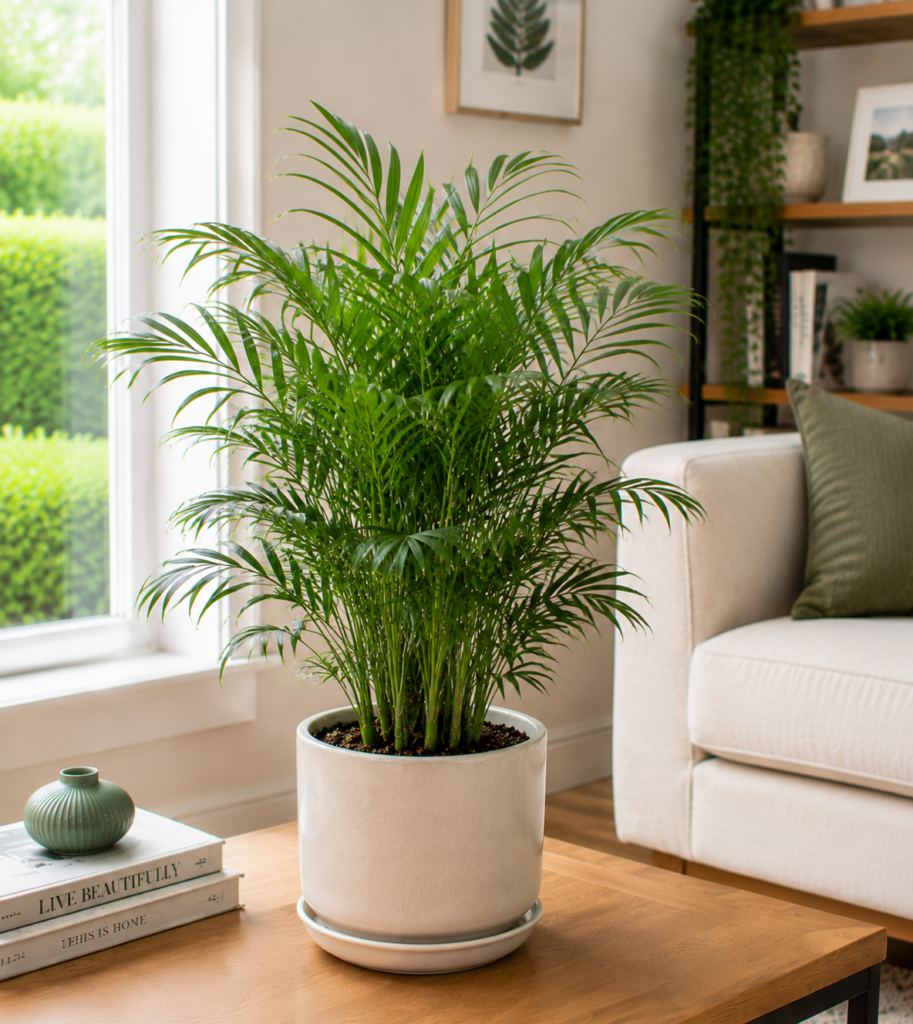
Best for: Adding height and a tropical feel to rooms with indirect light
The parlor palm (Chamaedorea elegans) is the most shade-tolerant palm available and one of the most elegant low-light houseplants. Its arching fronds of delicate leaflets create a genuinely tropical atmosphere in a shaded corner, and it’s completely non-toxic to cats and dogs — making it one of the few large statement plants safe for pet households.
It grows slowly — typically 4 to 6 inches per year — but reaches an impressive 4 to 6 feet at maturity, making it a long-term investment in a room’s atmosphere.
Smart tip: Mist the parlor palm’s fronds regularly or wipe them with a damp cloth to remove dust. The feathery fronds accumulate dust quickly, which dulls their appearance and reduces the light they can absorb. Clean fronds look significantly better and the plant performs measurably better in low-light conditions.
Mistake to avoid: Repotting a parlor palm into a significantly larger pot to encourage faster growth. Parlor palms prefer to be slightly root-bound and grow in clusters of stems naturally — a very large pot with excess soil retains moisture that causes root rot. Repot only when roots clearly outgrow the current container.
13. Prayer Plant
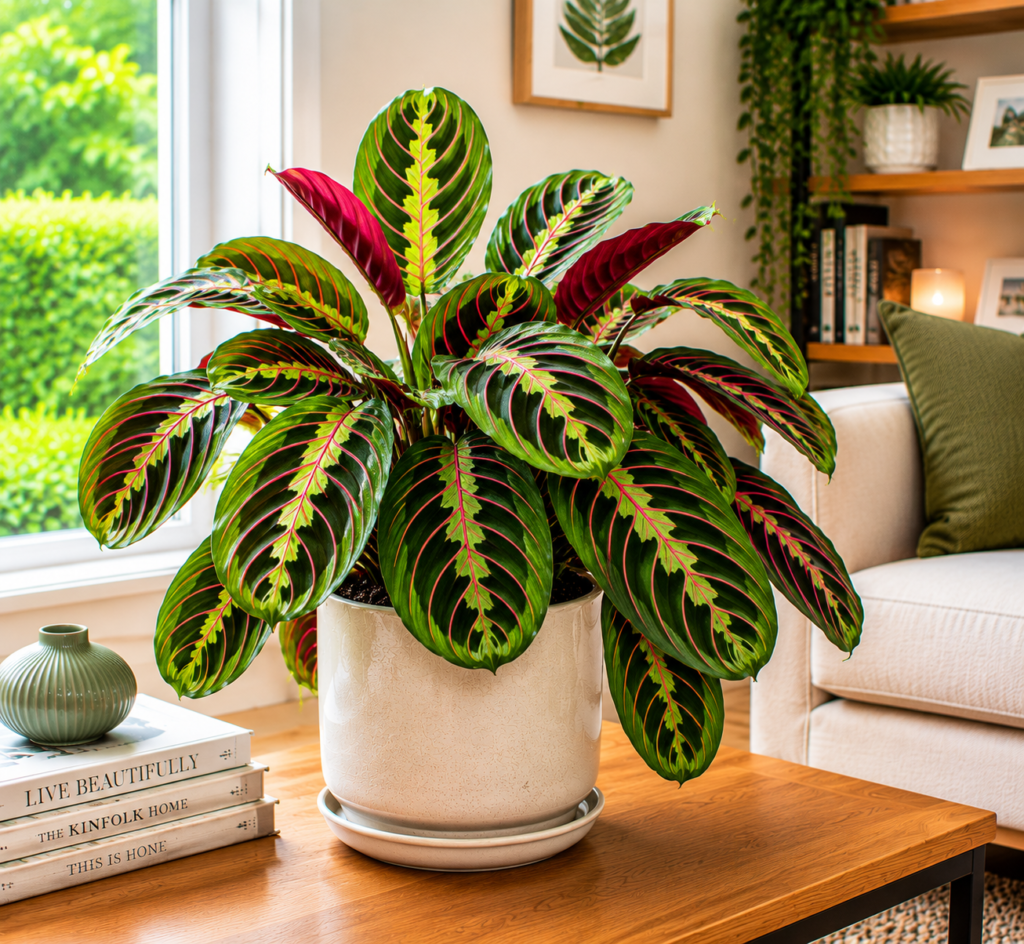
Best for: Anyone who wants a plant with active, visible movement throughout the day
The prayer plant (Maranta leuconeura) earned its name from the behavior of its leaves — they fold upward in the evening, resembling hands in prayer, and open flat again each morning. This movement is driven by changes in light and is one of the most engaging qualities any houseplant has. It’s genuinely interesting to observe.
Its boldly patterned leaves — typically dark green with red or pink herringbone patterns and purple undersides — suit a low-light position where the elaborate markings become a focal point.
Smart tip: The prayer plant’s leaf movement is a reliable health indicator. If the leaves stop folding at night, the plant is under stress — usually from incorrect watering, low humidity, or temperature issues. Observing this movement pattern makes early problem identification straightforward.
Mistake to avoid: Placing a prayer plant in direct sun. Direct sunlight causes rapid, severe leaf bleaching that’s irreversible. The bold patterns that make the plant attractive fade within days in direct sun. It’s not just low-light tolerant — it actively requires protection from direct light.
14. Peperomia
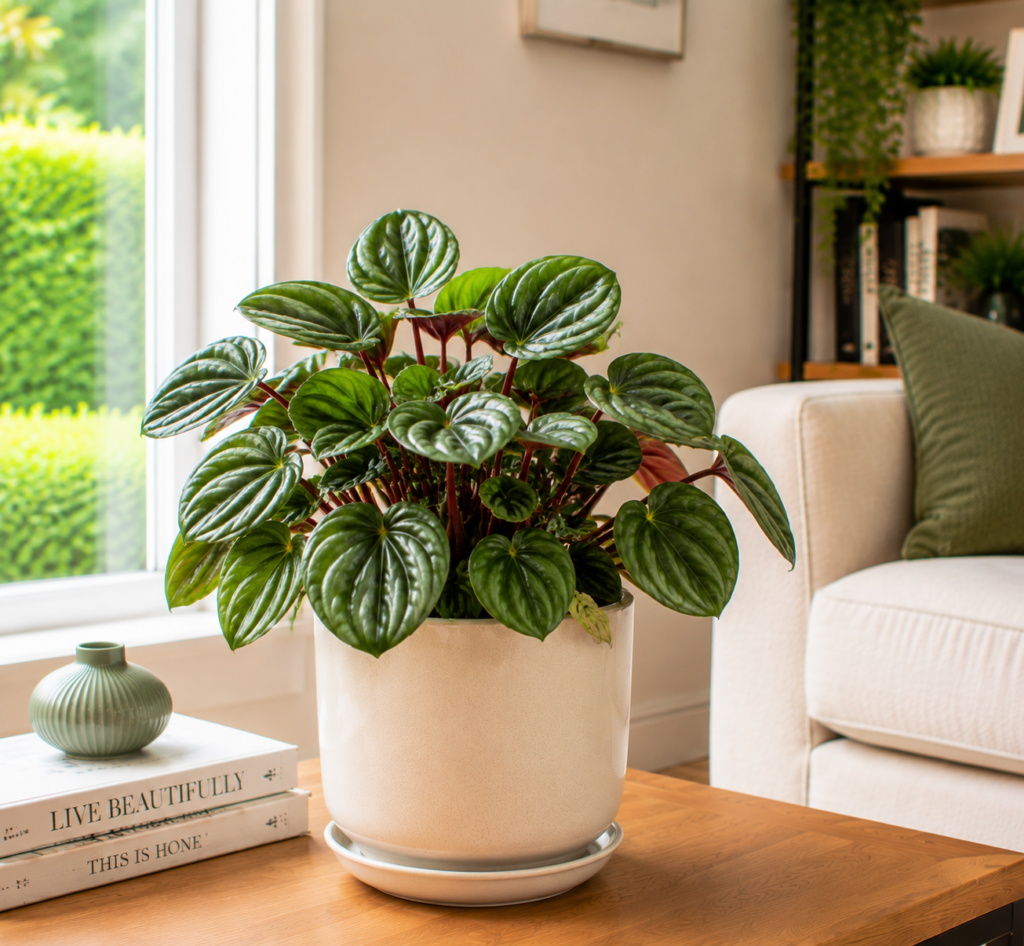
Best for: Small spaces, desks, and shelves — compact, varied, and genuinely low-maintenance
Peperomia is a genus of over 1,000 species, ranging from tiny rosette-forming varieties to upright bushy plants and trailing forms. What they share is tolerance for low light and infrequent watering — their thick, succulent-like leaves store water that sustains them through periods of neglect.
The variety available in the genus means there’s a peperomia for every aesthetic — round watermelon-patterned leaves, deeply ridged ripple leaves, elongated teardrop forms, and trailing varieties with small round leaves.
Smart tip: Peperomia thrives in the warm, indirect light near fluorescent or LED office lighting — one of the few plants that genuinely suits an office environment with no natural windows. If natural light is unavailable, a standard office ceiling light is adequate for peperomia where it would be insufficient for almost any other plant.
Mistake to avoid: Watering peperomia from the top repeatedly without ensuring adequate drainage. The succulent leaves store water efficiently, and a wet soil environment for extended periods causes the stems to rot at the base — a rapid and fatal condition. Water only when the top two inches of soil are thoroughly dry.
15. English Ivy
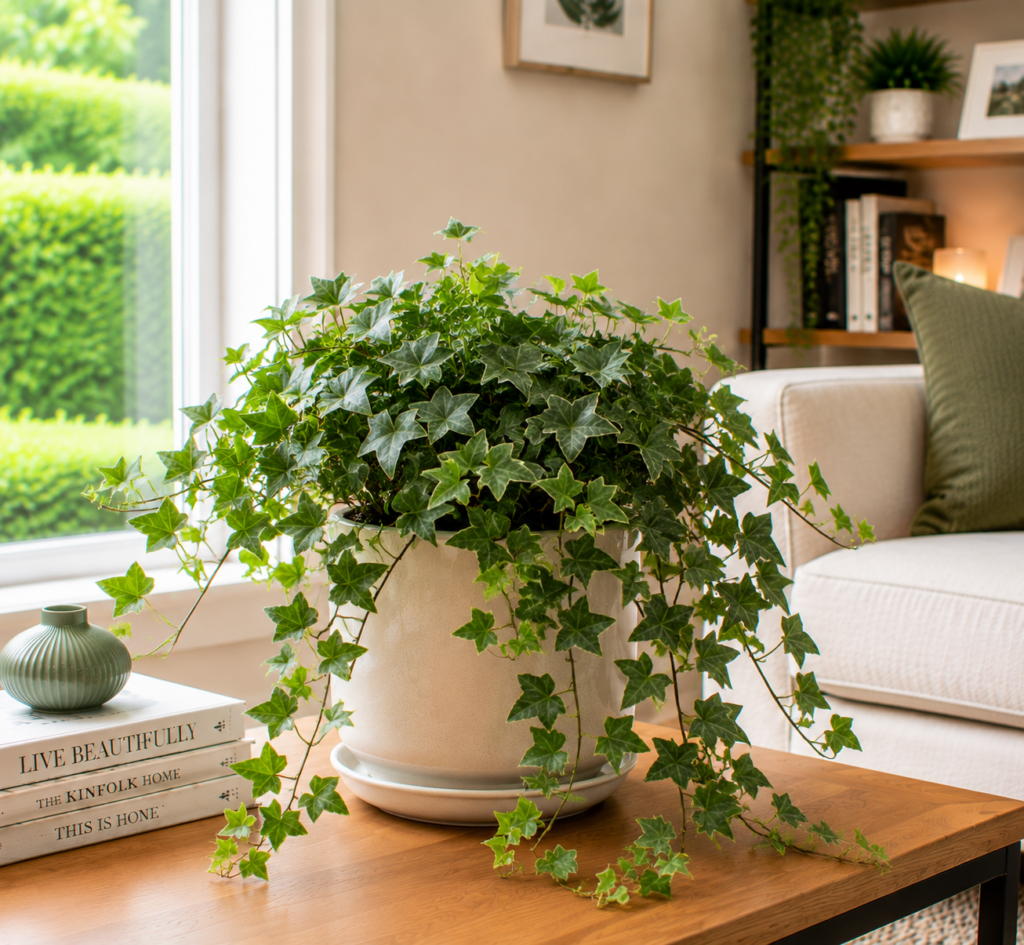
Best for: Trailing and climbing displays in cool, low-light rooms
English ivy (Hedera helix) is a vigorous trailing and climbing plant that tolerates quite low light while producing the dense, classic ivy coverage that suits both traditional and contemporary interiors. It trails beautifully from hanging pots and high shelves, or climbs a small frame or trellis with minimal encouragement.
It prefers cooler temperatures than most tropical houseplants — it thrives in the 50°F to 70°F range that many rooms maintain in winter, making it one of the best choices for cool, dim spaces where tropical plants struggle.
Smart tip: English ivy benefits from occasional outdoor time in a shaded spot during summer. A few weeks of natural air circulation and indirect outdoor light reinvigorates the plant significantly — the growth becomes fuller, the leaves larger, and the overall health visibly better than plants kept exclusively indoors year-round.
Mistake to avoid: Allowing ivy to dry out completely. Unlike the succulents and semi-succulents on this list, ivy has no water storage capacity in its leaves. Complete drying causes rapid, severe wilting that can permanently damage the plant if not corrected within a day or two. Keep ivy consistently moist but never waterlogged.
16. Monstera Deliciosa
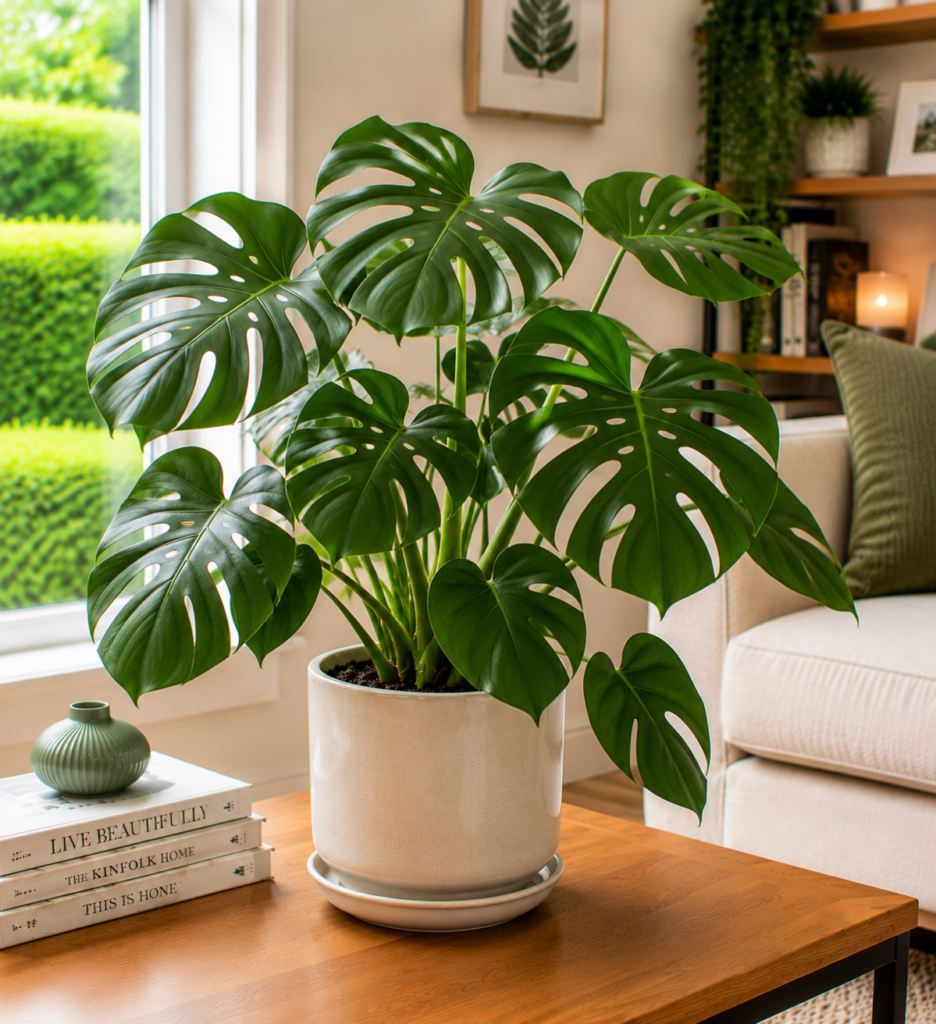
Best for: Creating a dramatic tropical statement in a low to medium light room
The monstera (Monstera deliciosa) has become one of the most photographed houseplants in the world, and its tolerance for indirect light makes it genuinely suitable for the dim, atmospheric settings it photographs so beautifully in. Its large, fenestrated (hole-punched) leaves create bold shadows and a tropical drama that few other plants match.
In lower light, it grows more slowly and produces smaller leaves with fewer or no fenestrations. This is normal — the perforations develop as the plant matures and receives adequate light. Even without fenestrations, young monstera leaves are attractive.
Smart tip: Wipe monstera leaves with a damp cloth monthly. The large leaf surface area accumulates dust rapidly, and in a low-light environment, dust significantly reduces the photosynthesis the plant can perform. Clean leaves are measurably more efficient — in a dim room, this maintenance step makes a real difference to the plant’s growth rate.
Mistake to avoid: Placing monstera in a very small pot expecting it to stay compact. Monstera grows continuously and will outgrow a small pot quickly. Restricting the root space doesn’t keep the plant small — it causes stress, yellowing, and declining health. Give it a pot proportional to its size and repot as it grows.
17. Air Plants
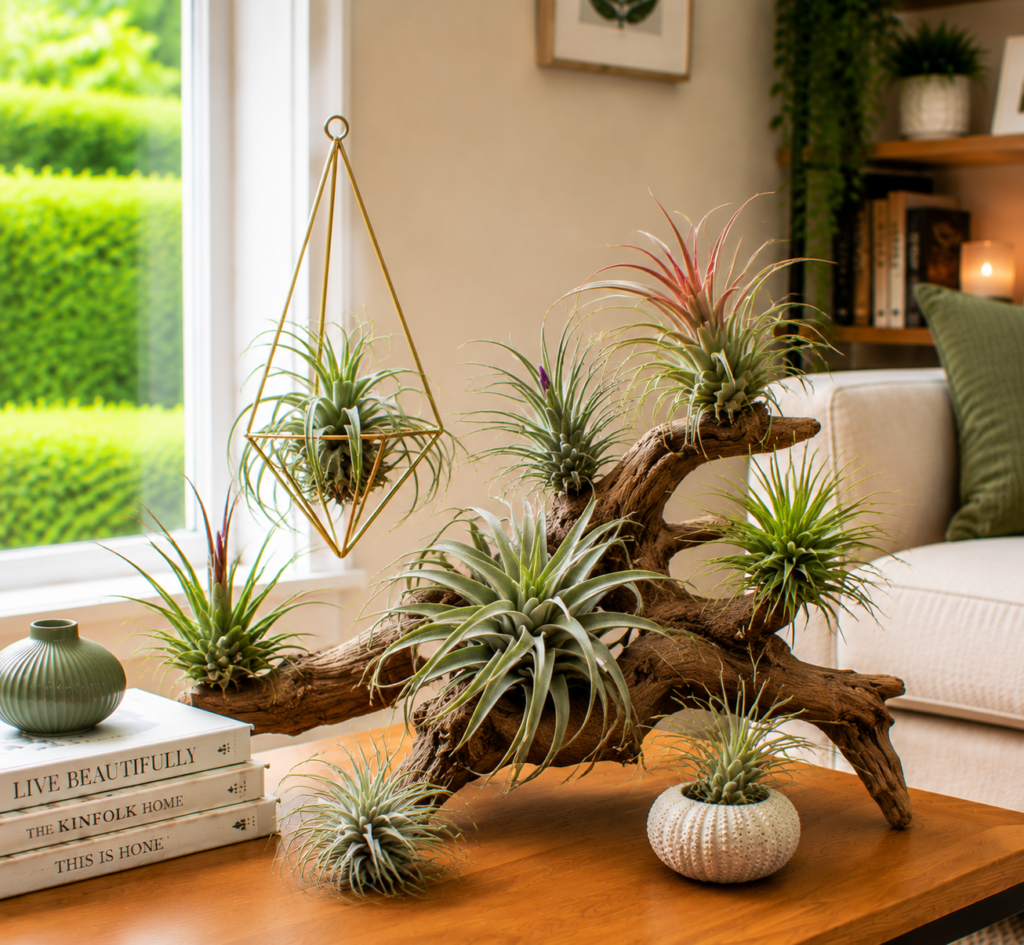
Best for: Unique displays in any light condition — the plant with no soil requirement
Air plants (Tillandsia) are epiphytes — plants that in nature attach to trees and rocks, absorbing moisture and nutrients from the air around them rather than from soil. This biology makes them the most display-versatile houseplant available: they can be placed in glass orbs, mounted on driftwood, arranged in shells or bowls, or attached to almost any surface.
They tolerate lower light than most flowering plants and require no soil, no pot, and minimal attention — a thorough soaking in water every one to two weeks is their primary care requirement.
Smart tip: Soak air plants completely submerged in water for 20 to 30 minutes every one to two weeks rather than misting them. Misting provides insufficient moisture for the plant to actually absorb — the thorough soaking ensures the trichomes (the tiny scales on the leaves) absorb the water they need. After soaking, shake off excess water and allow to dry completely before replacing in any enclosed display.
Mistake to avoid: Placing air plants in enclosed glass containers without ventilation. Air plants need air circulation to prevent rot after watering. A fully enclosed terrarium or glass sphere traps moisture and kills the plant within weeks. Use open-topped or well-ventilated displays only.
18. Staghorn Fern
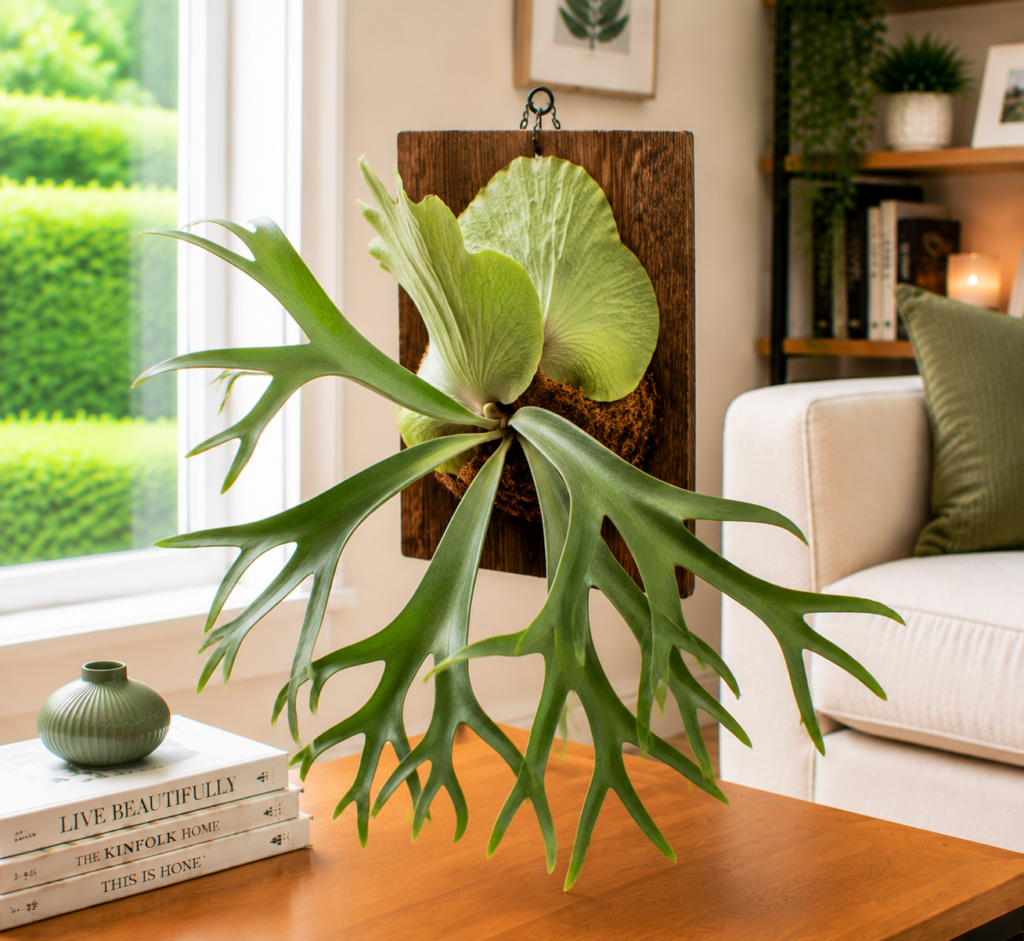
Best for: Wall mounting in a bathroom or humid room with indirect light
The staghorn fern (Platycerium) is one of the most architecturally distinctive houseplants available. Its antler-shaped fertile fronds are genuinely unusual and create a wall-mounted display that looks more like living sculpture than conventional houseplant. It’s an epiphyte — in nature it grows attached to trees — making it ideal for mounting on a wooden board and hanging on a wall.
Bathrooms suit it perfectly: the humidity from bathing and showering provides much of the moisture the plant needs, and the typically indirect light of a bathroom suits its shade-adapted nature.
Smart tip: Mount the staghorn fern on a cedar or redwood board rather than a pine board. These naturally rot-resistant woods last significantly longer in the humid conditions that suit the fern. Line the back of the mounting area with sphagnum moss before attaching the plant — the moss retains moisture and provides the organic material the roots need.
Mistake to avoid: Watering the staghorn fern at the wrong point. The flat, brown shield fronds at the base of the plant should not be removed — they’re a natural part of the plant’s structure that protects the roots. Water the root area directly by misting generously or submerging the entire mount in water monthly. Do not peel back or remove the brown shield fronds.
19. Chinese Money Plant
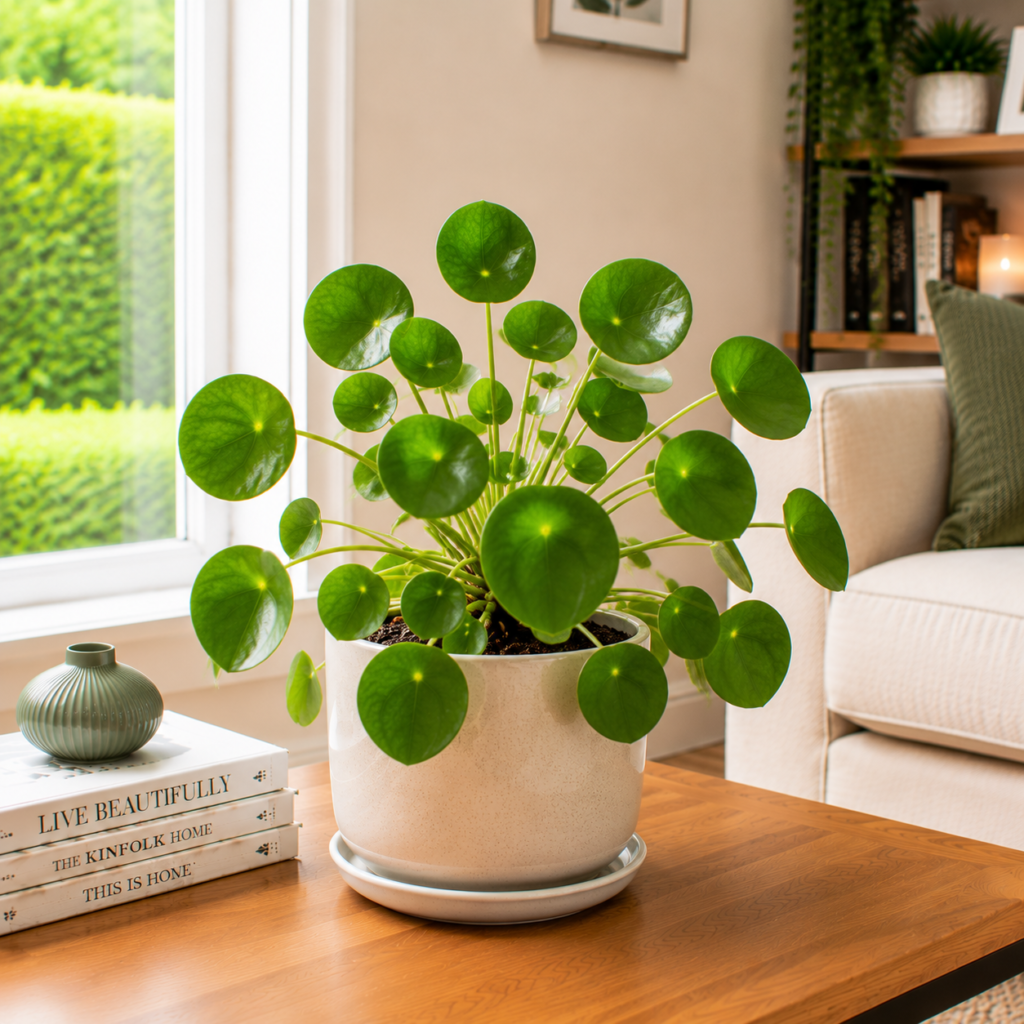
Best for: Desks, shelves, and any space that needs a cheerful, architectural small plant
The Chinese money plant (Pilea peperomioides) has become one of the most sought-after houseplants of the past decade — its round, pancake-shaped leaves on delicate stems have a graphic, almost designed quality that photographs exceptionally well and looks genuinely distinctive in person.
It tolerates indirect light well and grows at a satisfying pace, regularly producing small offsets at the base that can be separated and given away — earning it the nickname “the friendship plant” in Scandinavian plant culture where it was widely shared before commercial availability.
Smart tip: Rotate the Chinese money plant a quarter turn every few days. The round leaves are particularly prone to growing toward the light source, creating a lopsided plant if left in one orientation. Regular rotation produces a symmetrical, balanced plant that looks intentionally perfect rather than wind-bent.
Mistake to avoid: Overwatering Chinese money plant in winter. In low-light winter conditions, the plant’s growth slows significantly and water use drops correspondingly. A watering schedule that worked in summer becomes overwatering by November. Allow the soil to dry out more thoroughly between waterings as day length shortens.
20. How to Help Low-Light Plants Thrive
Best for: Every indoor gardener with a dim space — these principles apply to all plants on this list
Understanding why low-light plants succeed or fail makes the difference between a thriving collection and a series of slowly declining plants. The fundamentals are consistent across all the species on this list.
Light quality matters as much as quantity. Plants in low light can be significantly helped by cleaning windows to maximize the light that does enter, using light-colored walls and surfaces that reflect available light around the room, and removing any obstacles between the window and the plant. Watering must be adjusted for the light level. In low light, plants use water more slowly — the same watering schedule that works in a bright room causes overwatering in a dim one. Always check soil moisture before watering rather than watering on a fixed schedule.
Occasional rotation maximizes light exposure. Moving low-light plants to a brighter spot for a week every month — near a window, or temporarily outdoors in shade during summer — provides a light boost that sustains growth in permanently dim positions. Dust removal is more important in low light than in bright conditions. Every layer of dust on a leaf reduces the light that reaches the chlorophyll. In a bright room this is cosmetic. In a low-light room, dusty leaves are measurably less efficient and the plant’s health visibly suffers.
Smart tip: Consider supplementing with a grow light for even a few hours per day in the dimmest spaces. Modern LED grow lights are inexpensive, energy-efficient, and small enough to add unobtrusively to a shelf or corner. Even four to six hours of supplemental light dramatically improves plant performance in positions that would otherwise stress any plant.
Mistake to avoid: Moving low-light adapted plants suddenly to bright light as a “treat.” Plants adapted to shade conditions have developed leaf structures optimized for low light — these same structures make them vulnerable to the intense radiation of direct sun. Sudden exposure to bright light causes bleaching and scorching that permanent damages the foliage. Any light transition must be gradual.
Before You Start
- Assess your light levels honestly. A north-facing room receives no direct sun at all — choose the most shade-tolerant plants from this list. An east or west-facing room gets a few hours — you have more options. Knowing exactly what you’re working with prevents choosing the wrong plant.
- Start with snake plant or ZZ plant if you’re genuinely unsure about the light levels in your space. Both are tolerant enough to reveal whether the position has any growth potential before you invest in more demanding varieties.
- Don’t overwater. This applies to all houseplants, but especially to low-light varieties where soil dries much more slowly. When in doubt, wait another few days before watering.
- Clean your windows. Even a modest improvement in the light entering a room makes a meaningful difference to plant health.
Conclusion
Low light is not a barrier to a beautiful indoor plant collection — it’s simply a filter that determines which plants suit the space. The 20 plants on this list don’t merely survive in shade — they evolved for it. Given appropriate watering, occasional cleaning, and the simple adjustments described here, any of them will produce healthy, attractive growth in the dimly lit spaces where so many plant attempts have previously failed.
Continue Your Home Transformation
Explore the full collection of step-by-step eBooks and get the guide that fits the room you're working on.




4 Comments