
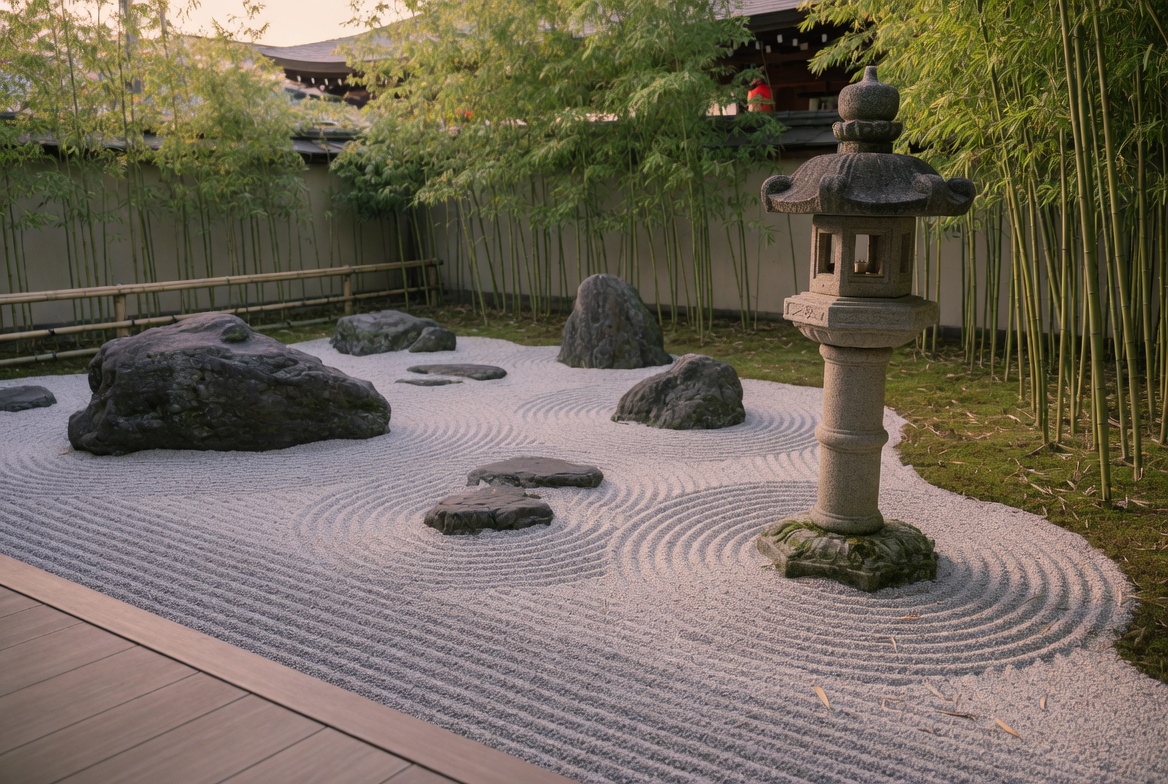
A zen garden is one of the most honest things you can do with outdoor space. It asks for nothing extravagant — no exotic plants, no elaborate structures, no constant maintenance — and gives back something that most gardens can’t: genuine stillness. The raked gravel, the placed stones, the single tree in a sea of pebbles — these aren’t decorative choices. They’re the result of a garden philosophy built over centuries around the idea that simplicity is more powerful than abundance.
You don’t need a large yard to create a zen garden, and you don’t need to follow every traditional rule. What you do need is a commitment to restraint — choosing less, placing carefully, and resisting the impulse to add more. These 20 ideas cover every element of zen garden design, from the foundational gravel bed to evening lantern lighting, with practical guidance on making each element work in a real residential garden.
1. Raked Gravel and Sand Garden
Best for: Any flat outdoor area — the raked gravel bed is the defining element of the traditional zen garden
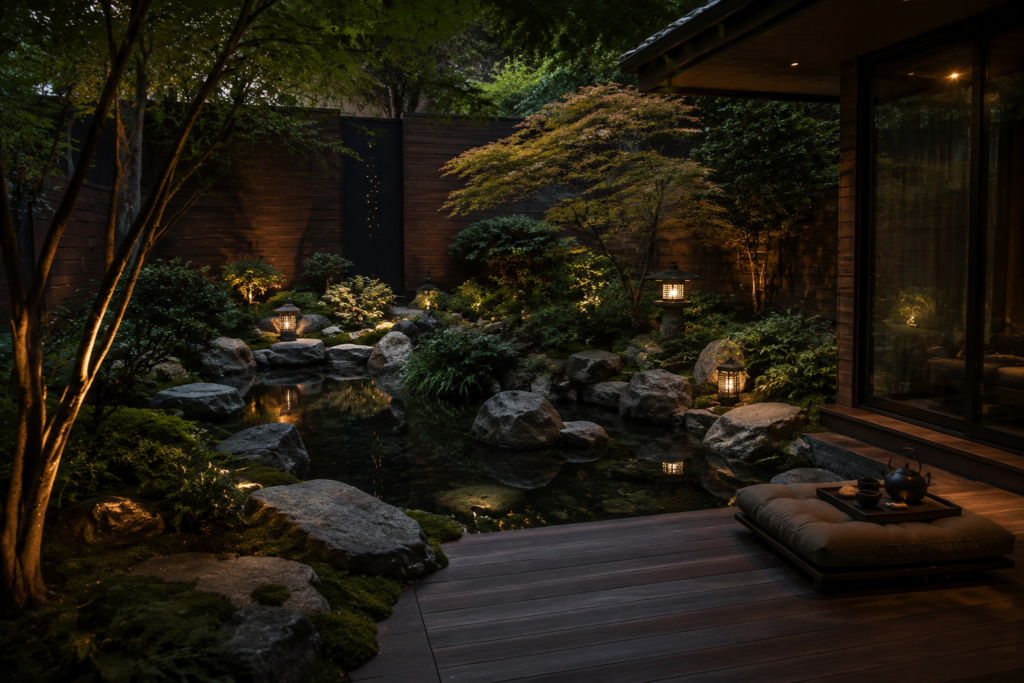
Raked gravel is where zen garden design begins. The repetitive act of raking — drawing parallel lines, concentric circles around rocks, wave patterns across the surface — is as much a meditative practice as the resulting garden is a visual one. The patterns represent water: flowing rivers, still ponds, ocean waves. The rocks that break the surface represent mountains or islands emerging from the sea.
Fine granite grit (3 to 5mm) holds raked patterns more clearly than larger gravel and has the refined, almost sand-like quality that suits the aesthetic. White or pale grey tones create the most striking contrast with dark rocks and green planting.
Smart tip: Rake the gravel in one direction first — parallel lines running the full length of the garden — then add the circular patterns around rocks. This sequence creates a background of order that makes the circular rock patterns read as distinct focal points rather than competing with the overall pattern.
Mistake to avoid: Creating a raked gravel garden beneath deciduous trees. Autumn leaf fall into fine gravel is nearly impossible to remove completely — leaves catch in the gravel and require laborious hand-picking. Position the raked gravel area in an open location away from trees that drop significant leaf litter.
2. Anchor Rock Arrangements
Best for: Every zen garden — stones are the structural and symbolic foundation of the entire design
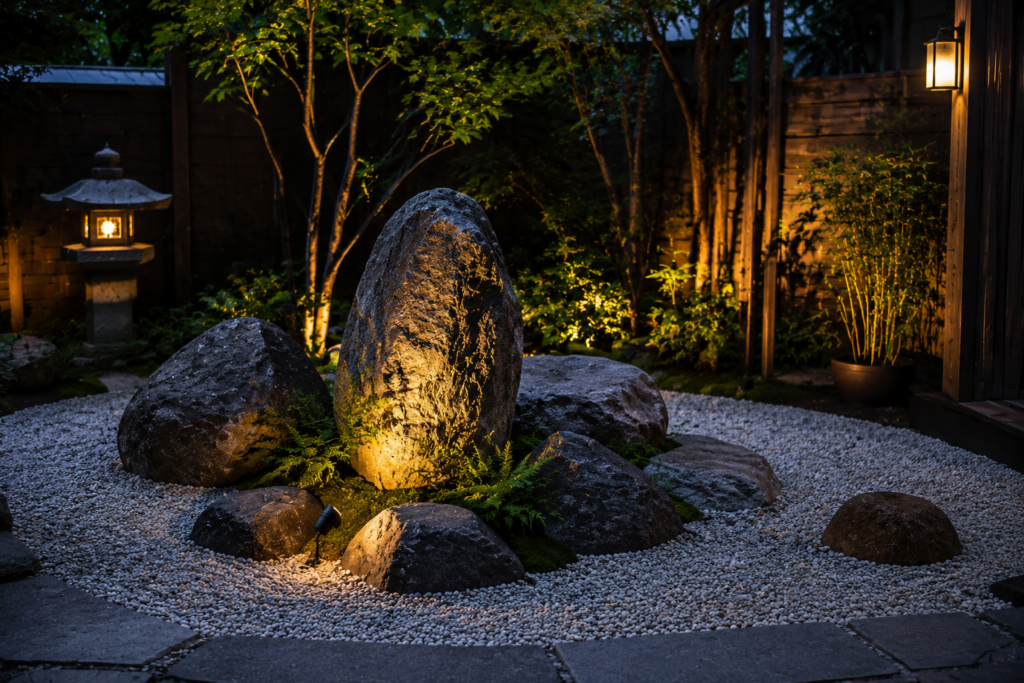
Stone placement is the most important design decision in a zen garden. Stones represent permanence and stability — mountains, islands, natural outcroppings. Their placement follows the principle of asymmetry: odd numbers of stones (three, five, seven) arranged in triangular groupings that create visual stability without symmetry.
The largest stone in any grouping establishes the group’s character. It should be placed first, slightly off-center from the main viewing position, with smaller stones positioned in relationship to it rather than independently.
Smart tip: Source stones from a single geological origin — a riverbed, a quarry, or a single region — for visual coherence. Stones from different sources vary in color, texture, and weathering quality in ways that create visual tension rather than harmony. A collection of stones that clearly belong together reads as placed; a collection of mismatched stones reads as gathered.
Mistake to avoid: Placing stones too symmetrically or too evenly spaced. Symmetrical stone placement creates a formal, Western garden aesthetic rather than the naturalistic asymmetry of zen design. Space stones unevenly, angle them slightly differently, and vary their heights to create the sense that they emerged from the ground rather than being positioned on top of it.
3. Bamboo Water Feature
Best for: Any zen garden — the sound of water is as important as the visual composition
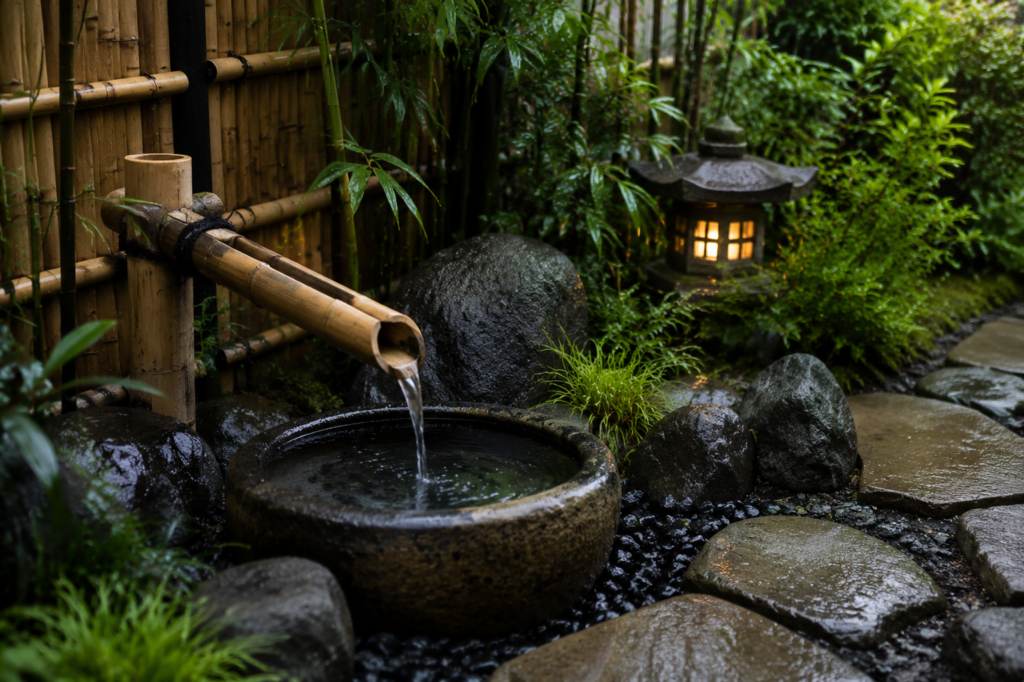
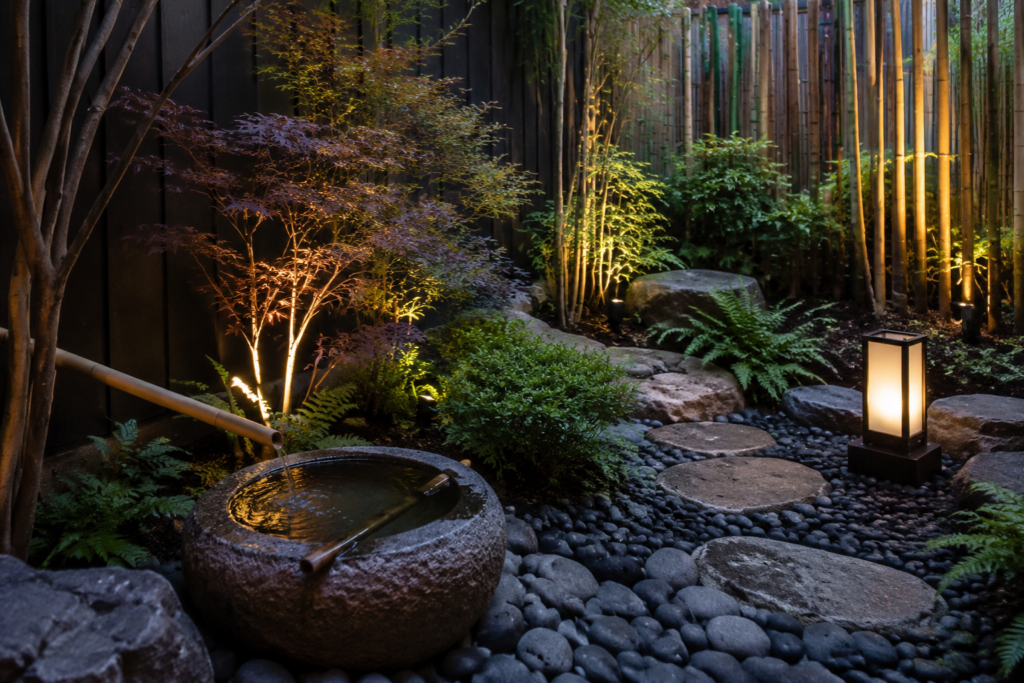
A shishi-odoshi — a traditional bamboo water feature where water fills a pivoting bamboo tube until it tips, empties into a stone basin with a hollow knock, then refills — is one of the most authentically Japanese garden elements available for residential gardens. The intermittent sound of bamboo on stone, the flow of water, and the rhythmic tipping movement create an experience that a static garden cannot provide.
Even a simpler bamboo spout over a stone basin — water flowing continuously rather than intermittently — captures the combination of bamboo, stone, and water that defines the zen water aesthetic.
Smart tip: Position the bamboo water feature where its sound is audible from the main sitting or viewing position in the garden. The sound is as important as the visual — a feature positioned too far away or obscured by other elements provides visual interest only, losing the meditative quality that moving water uniquely creates.
Mistake to avoid: Using a pump that creates gurgling or bubbling sounds rather than a smooth, quiet flow. Noisy pumps create an incongruous mechanical quality in a garden designed around natural sound. Choose a pump sized specifically for the water volume of the feature — oversized pumps move too much water too noisily.
4. Stone Pathway Through the Garden
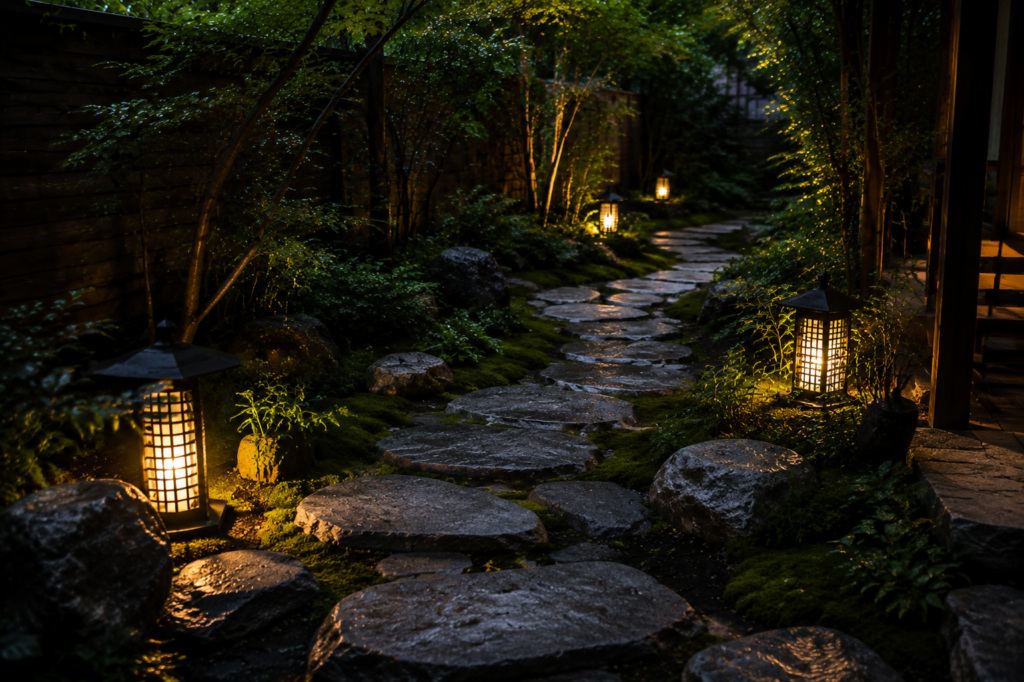
Best for: Any zen garden with multiple areas — the pathway creates deliberate, mindful movement through the space
A stone pathway through a zen garden — flat stepping stones placed at comfortable walking intervals — creates the experience of moving through the garden as a deliberate act rather than simply crossing it. The irregular, organic placement of the stones encourages slow, attentive walking that engages with the garden rather than passing through it.
Traditional zen garden paths use flat stones of varying sizes, placed at slightly irregular intervals — close enough for comfortable stepping, varied enough to require attention to each footfall.
Smart tip: Set stepping stones slightly below the surrounding gravel surface — flush or 5 to 10mm lower than the gravel level. Stones set at the same level as the gravel or above it appear to float on the surface; stones set slightly below it appear to be part of the ground, creating the sense that they’ve been there long enough to settle.
Mistake to avoid: Using perfectly uniform stepping stones at perfectly equal intervals. Mathematical regularity in stepping stone placement creates a mechanical, engineered quality that contradicts zen garden aesthetics. Vary the stone sizes, angles, and intervals — the slight irregularity is what creates the naturalistic quality that distinguishes zen garden paving from a formal stepping stone path.
5. Japanese Maple as Focal Point
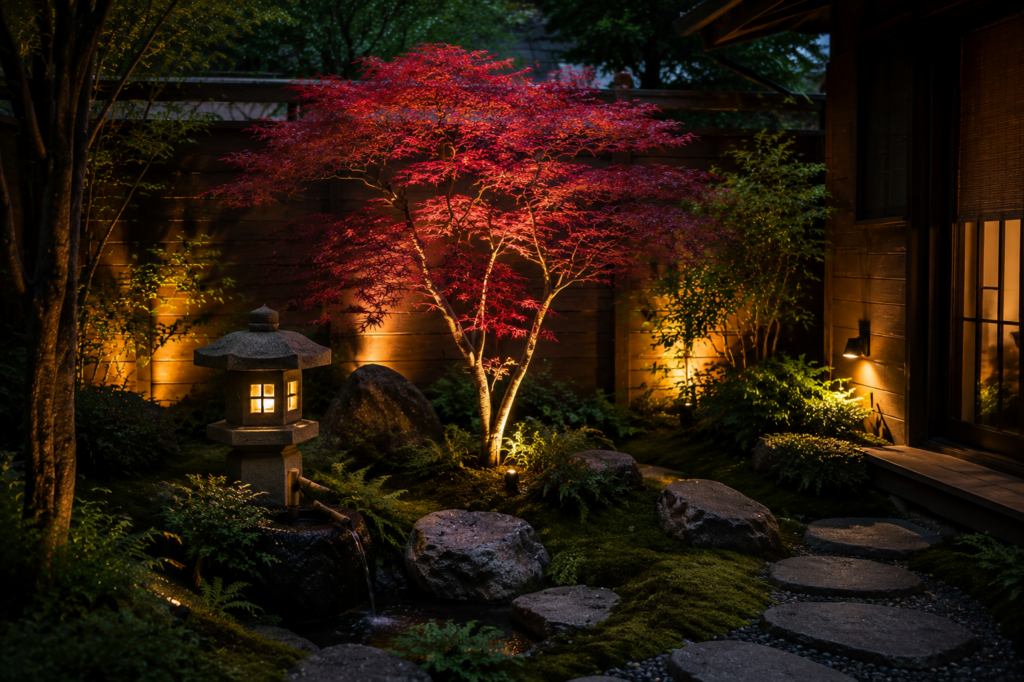
Best for: Any zen garden that needs a seasonal living focal point — the Japanese maple provides four-season interest
The Japanese maple (Acer palmatum) is the most important tree in zen garden design. Its delicate, deeply cut leaves emerge in spring in fresh greens and reds, deepen through summer, turn to spectacular scarlet and gold in autumn, and reveal elegant bare branching structure in winter. No other commonly available garden tree provides equivalent interest across all four seasons.
The tree’s naturally graceful, sculptural form requires almost no pruning to achieve its characteristic elegant profile — it grows into a naturally beautiful shape given adequate space.
Smart tip: Choose a Japanese maple variety proportional to the available space. Acer palmatum ‘Dissectum’ varieties are compact (typically 3 to 6 feet at maturity) and suit smaller garden areas; standard palmatum varieties reach 15 to 25 feet and suit larger spaces. Planting a full-size variety in a small garden creates maintenance and crowding problems within a decade.
Mistake to avoid: Planting Japanese maple in a position exposed to strong wind or late spring frost. Japanese maple leaves are delicate — wind causes tearing and browning that looks poor all season, and late frost kills emerging leaves that don’t fully recover. Position in a sheltered spot with morning sun and afternoon shade for the best foliage quality and most reliable performance.
6. Moss Garden Ground Cover
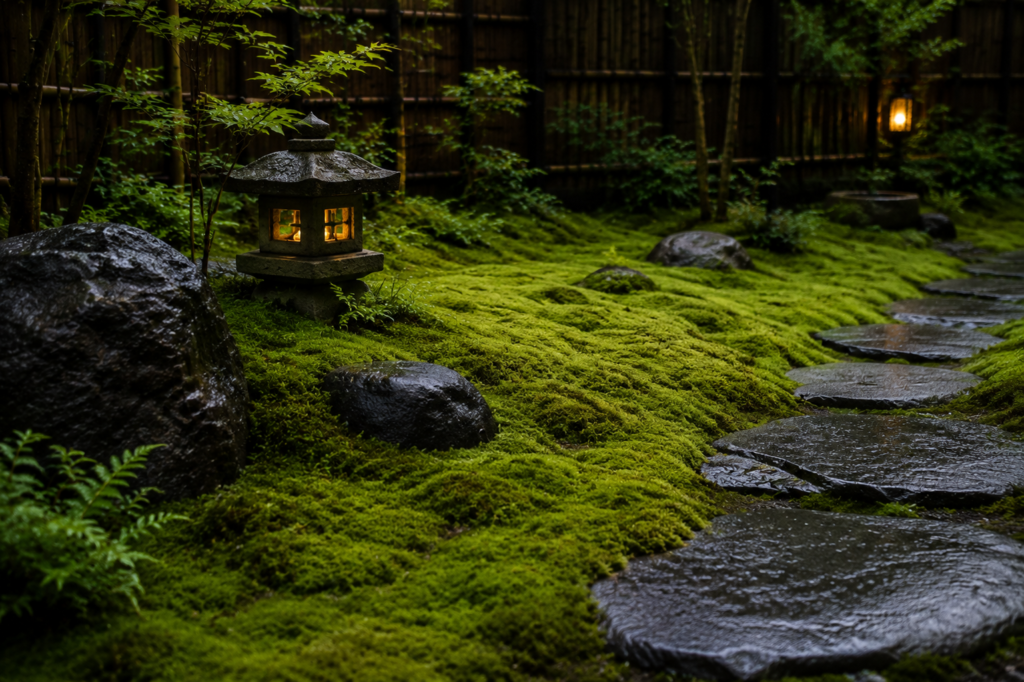
Best for: Shaded zen gardens where gravel would look wrong — moss creates an even more ancient, settled quality
Moss creates a ground covering of extraordinary subtlety — soft, velvety, uniformly green, and utterly quiet in visual quality. In a zen garden, moss suggests age and permanence: a garden that has been there long enough for moss to establish is a garden with history. It covers rocks, softens ground surfaces, and fills gaps between stepping stones with a quality of settled naturalness that no other ground cover achieves.
Moss thrives in shaded, moist conditions — exactly the conditions where gravel-based zen garden design is most challenged by wet ground and poor drainage.
Smart tip: Encourage moss establishment by applying a buttermilk and moss slurry (blend existing moss with buttermilk) to the areas where growth is desired. The mixture adheres to rocks and soil surfaces, providing the spores and growing medium for moss colonization. Keep the area moist for several weeks and avoid foot traffic while establishment occurs.
Mistake to avoid: Attempting to establish moss in a sunny, dry position. Moss requires consistent moisture and shade — it desiccates and dies in direct sun and dry conditions. If the available garden position is sunny, choose fine gravel rather than moss as the ground covering and accept that moss won’t establish successfully.
7. Stone Lanterns for Atmosphere
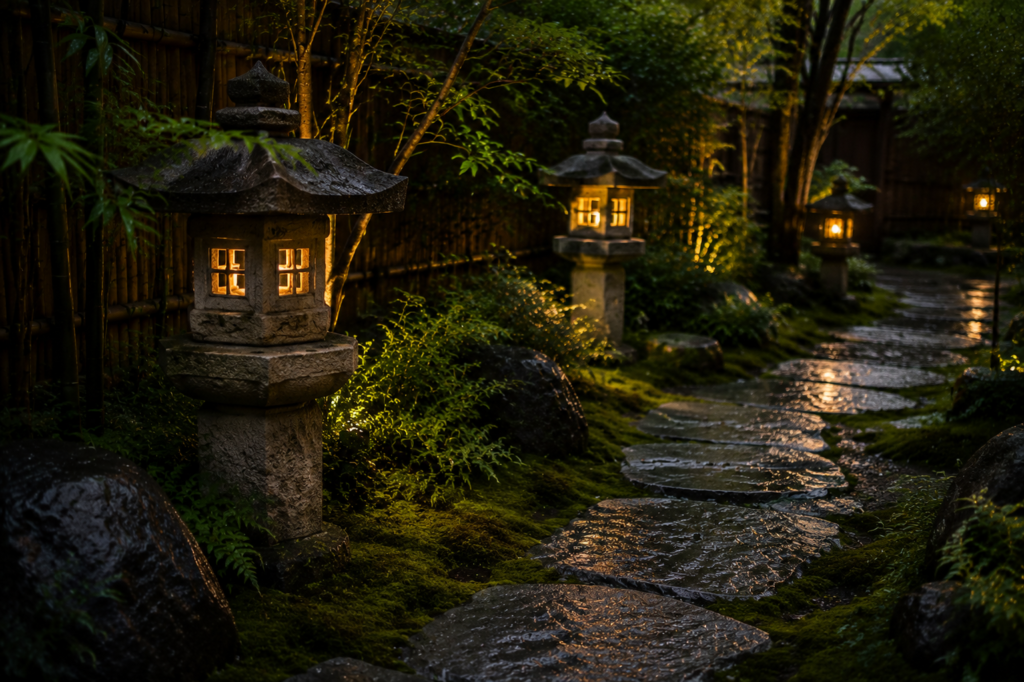
Best for: Any zen garden — stone lanterns are the most authentically Japanese garden ornament available
Stone lanterns (tōrō) originated in Japanese Buddhist temple gardens and have been a standard element of Japanese residential garden design for centuries. In the garden context they serve both functional (illumination) and symbolic (spiritual guidance) purposes. Their weathered stone quality — the patina that develops over years of outdoor exposure — suits the aged, settled aesthetic of zen garden design.
Traditional styles include the yukimi (snow-viewing lantern, with a wide hat-shaped cap that collects snow beautifully), the kasuga (tall, elegant form, originally used in shrine pathways), and the oki (smaller free-standing variety suited to residential gardens).
Smart tip: Position stone lanterns asymmetrically — beside a stone, near the water feature, or at a path junction — rather than symmetrically flanking an entrance. Symmetrical placement creates a formal, Western aesthetic; asymmetric placement suits the naturalistic character of zen garden design.
Mistake to avoid: Using concrete or resin reproductions that are too smooth and uniform to read as stone. Authentic granite or sandstone lanterns develop the weathering, surface variation, and moss growth over time that create genuine character. Smooth, uniform reproductions look like ornaments rather than ancient artifacts. The investment in genuine stone is worthwhile for this element specifically.
8. Koi Pond
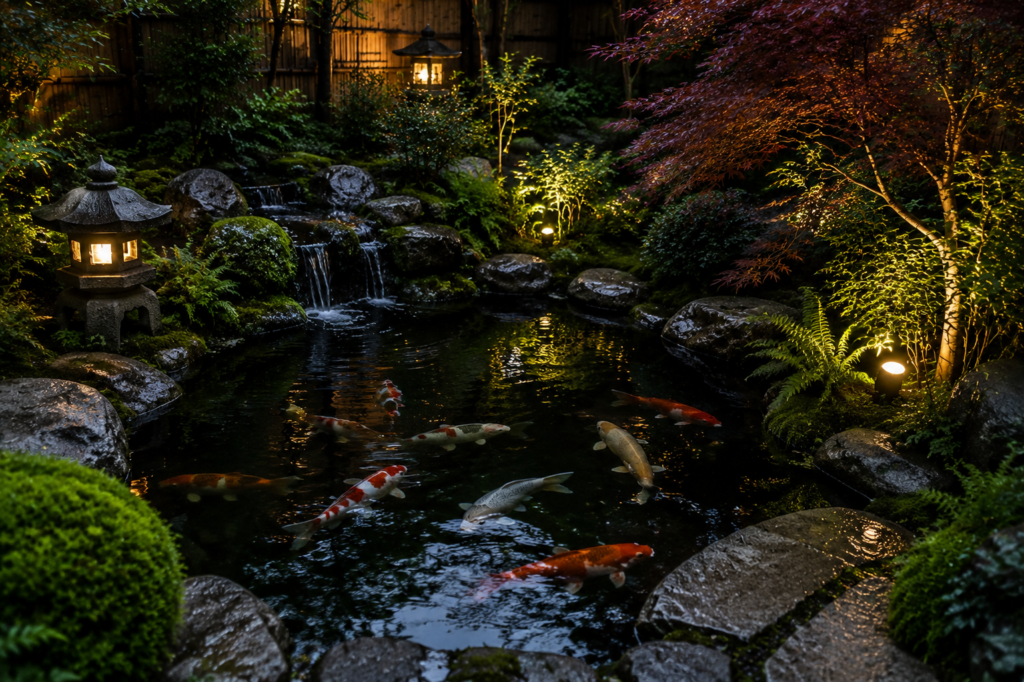
Best for: Larger zen gardens where a living water feature creates genuine depth and movement
Koi introduce living movement into a zen garden in a way that no other element provides — the flash of orange, white, and gold beneath the water surface, the movement toward the pond edge at feeding time, the way the fish reveal the water’s depth and clarity. A well-maintained koi pond becomes the most engaging element in any garden it occupies.
The pond’s design should reflect zen principles: simple, organic shape; natural stone edging; minimal aquatic planting; and water clear enough to see the fish at all depths.
Smart tip: Size the pond for the number of koi you intend to keep — a minimum of 1,000 liters (260 gallons) per adult koi is the standard guidance. Overcrowded koi ponds develop water quality problems that stress fish and cloud the water — removing the clarity that makes a koi pond beautiful. Start with fewer fish than the pond can accommodate and add gradually.
Mistake to avoid: Creating a koi pond without adequate filtration from the day it’s filled. Koi produce significant waste — a pond without biological filtration develops ammonia and nitrite levels that are lethal to fish within days. Install a properly sized biological filter before adding any fish and allow the filter to cycle (typically 4 to 6 weeks) before introducing koi.
9. Bamboo Privacy Screen
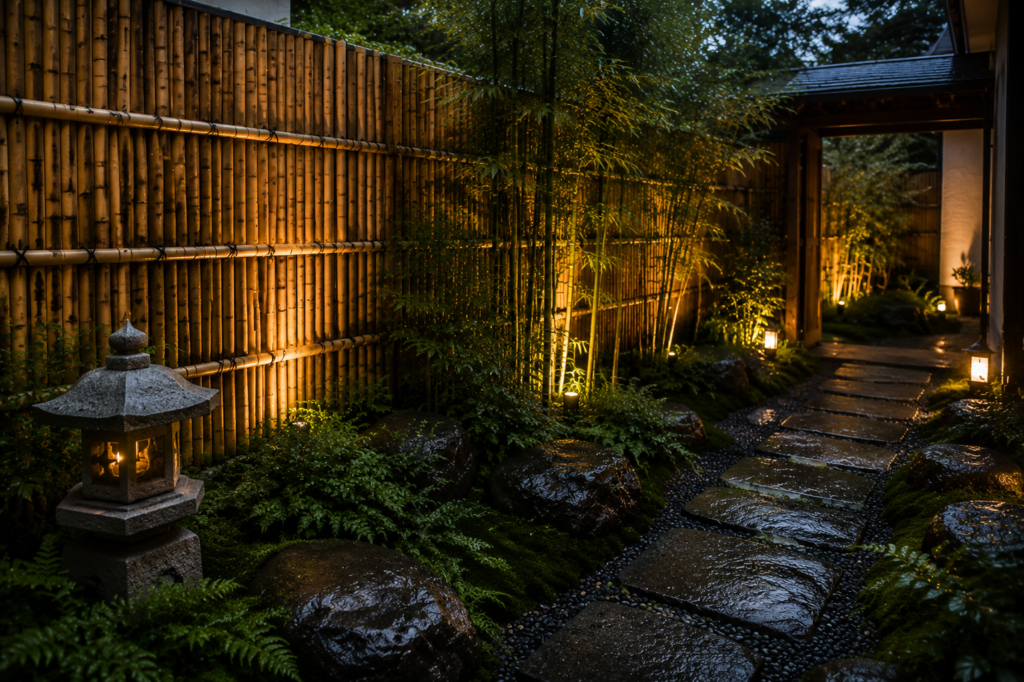
Best for: Zen gardens needing enclosure — bamboo creates the sense of a separate world within the broader garden
A bamboo screen — either living bamboo plants in a contained root barrier, or sections of cut bamboo assembled as a fence panel — creates the enclosed, separated quality that makes a zen garden feel like a distinct retreat rather than a section of the broader yard. The visual privacy of the bamboo screen and the sound of bamboo stalks moving in wind both contribute to the sense of separation from the surrounding environment.
Living bamboo in a root barrier provides year-round screening with the authentic, living quality of a growing plant. Cut bamboo fence panels provide immediate screening with lower establishment cost and zero risk of the spreading root problems that uncontained bamboo notoriously causes.
Smart tip: If planting living bamboo as a screen, install a heavy-duty root barrier to a depth of at least 60cm before planting. Bamboo rhizomes spread aggressively through soil and can emerge 10 to 15 feet from the parent plant — penetrating lawns, driveways, and even building foundations if uncontrolled. The root barrier is non-negotiable for living bamboo in a residential setting.
Mistake to avoid: Planting running bamboo species (Phyllostachys) rather than clumping bamboo (Fargesia) in a garden without a root barrier. Running bamboo spreads through underground rhizomes at a rate that quickly becomes unmanageable — it’s genuinely invasive in some climates. Clumping bamboo grows outward slowly from a central crown without spreading rhizomes, making it far safer for garden use.
10. Wooden Meditation Deck
Best for: Zen gardens used for sitting meditation, yoga, or quiet reading — a dedicated sitting surface completes the retreat
A low wooden deck — 4 to 6 inches above the garden surface, oriented toward the garden’s main composition — provides a dedicated sitting space that completes the zen garden’s function as a retreat. Without a comfortable sitting position, the garden can be viewed but not inhabited. The deck creates the destination that the garden’s pathway leads to.
The deck should be simple and uncluttered — a low platform with no railings, no furniture beyond a simple cushion, and dimensions suited to one or two people seated on the floor.
Smart tip: Orient the deck toward the garden’s primary composition — the main rock grouping, the water feature, or the Japanese maple — so the seated view encompasses the garden’s central elements. The deck’s orientation determines what the garden delivers as a meditative experience, so it should face what you most want to contemplate.
Mistake to avoid: Making the meditation deck too large. A large deck becomes a general outdoor living platform rather than a dedicated meditation space. The specific, contained quality of a small deck — large enough for one or two people to sit comfortably, no larger — creates the focused, purposeful atmosphere that suits quiet sitting.
11. Minimalist Bonsai Display
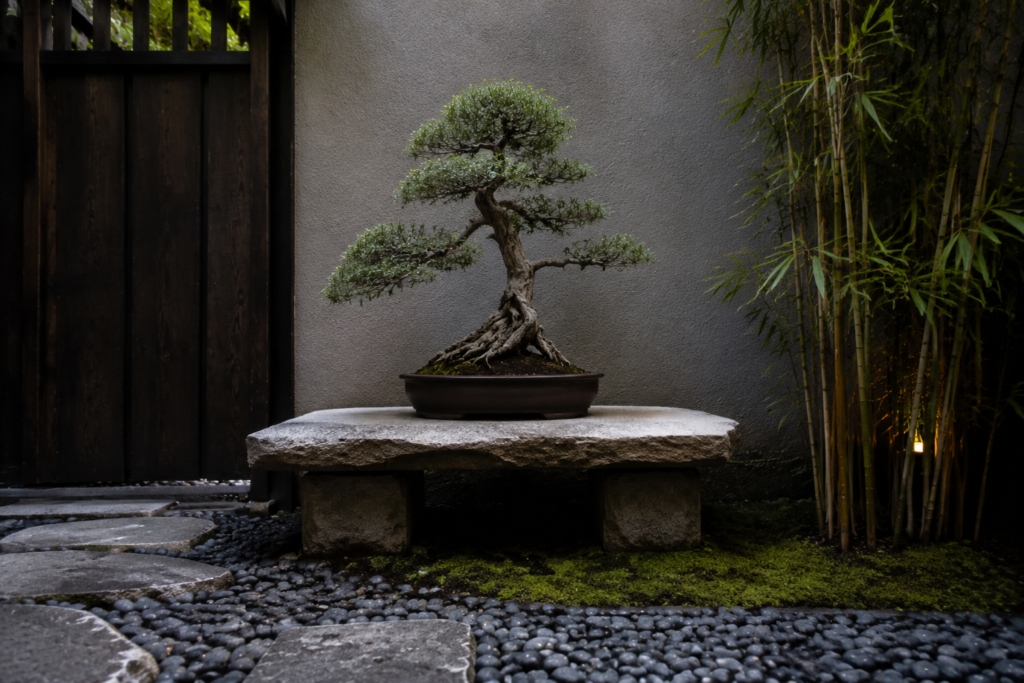
Best for: Zen gardens where a living art form suits the contemplative aesthetic
Bonsai — the art of cultivating miniature trees in shallow containers — is the most philosophically aligned living element with zen garden design. Each bonsai tree represents the form and character of a full-sized tree in miniature, requiring years of patient cultivation and the careful balance of restraint and growth that characterizes zen practice itself.
A simple display of one to three bonsai on a wooden bench or stone shelf in the garden — positioned where they receive appropriate light and can be observed at close range — adds a dimension of living artistry that distinguishes a considered zen garden from a purely hardscape composition.
Smart tip: Choose bonsai species suited to outdoor conditions in your climate rather than tropical indoor bonsai. Many commonly sold bonsai (ficus, serissa, fukien tea) are tropical species that don’t tolerate outdoor temperatures in temperate climates. Outdoor bonsai species — Japanese maple, juniper, pine, azalea — suit a garden display and require the outdoor temperature cycle to develop properly.
Mistake to avoid: Displaying bonsai in a position where they can’t be watered consistently. Bonsai in small shallow containers dry out extremely rapidly — often requiring daily watering in warm weather. A bonsai display position that’s difficult to reach for daily watering is a bonsai display that produces stressed, deteriorating trees within weeks.
12. Ornamental Grasses and Movement
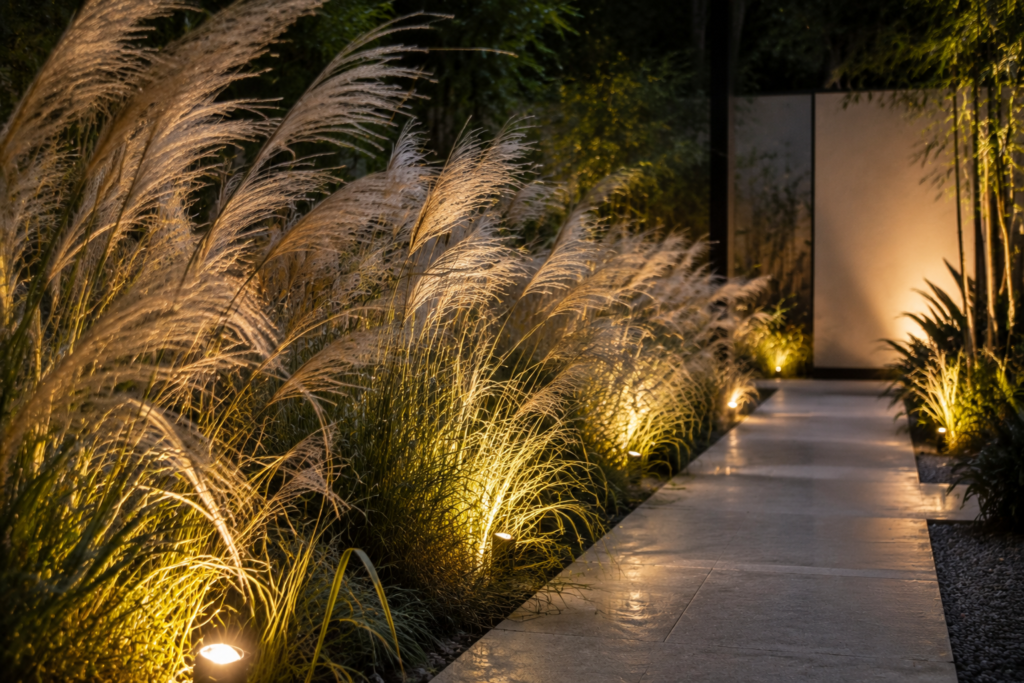
Best for: Adding movement and seasonal dynamism to a zen garden without introducing visual complexity
Ornamental grasses — particularly Japanese forest grass (Hakonechloa macra), blue fescue (Festuca glauca), and miscanthus varieties — bring two qualities to zen garden design that static elements can’t: movement in wind, and seasonal change. The grasses sway with every breeze, creating the suggestion of water movement and wind across the garden surface. Their color shifts through the season add visual interest without requiring the maintenance of flowering plants.
In a zen garden context, grasses work best as accents — one or two clumps in strategic positions — rather than as mass plantings that compete visually with the stones and gravel.
Smart tip: Position ornamental grasses where they’ll be backlit by the sun in morning or evening — the low angle light through grass leaves and seed heads creates a luminous, almost transparent quality that’s uniquely beautiful. A single clump of Hakonechloa backlit by morning sun is one of the most quietly beautiful garden moments available.
Mistake to avoid: Choosing vigorous grass species that outgrow their position within two to three seasons. Miscanthus sinensis can reach 6 feet with an equivalent spread — completely overwhelming in a small zen garden. Choose compact varieties specifically: Hakonechloa macra ‘Aureola’ (12 to 18 inches), Festuca glauca (8 to 12 inches), or dwarf miscanthus varieties for small garden applications.
13. Floating Stepping Stones
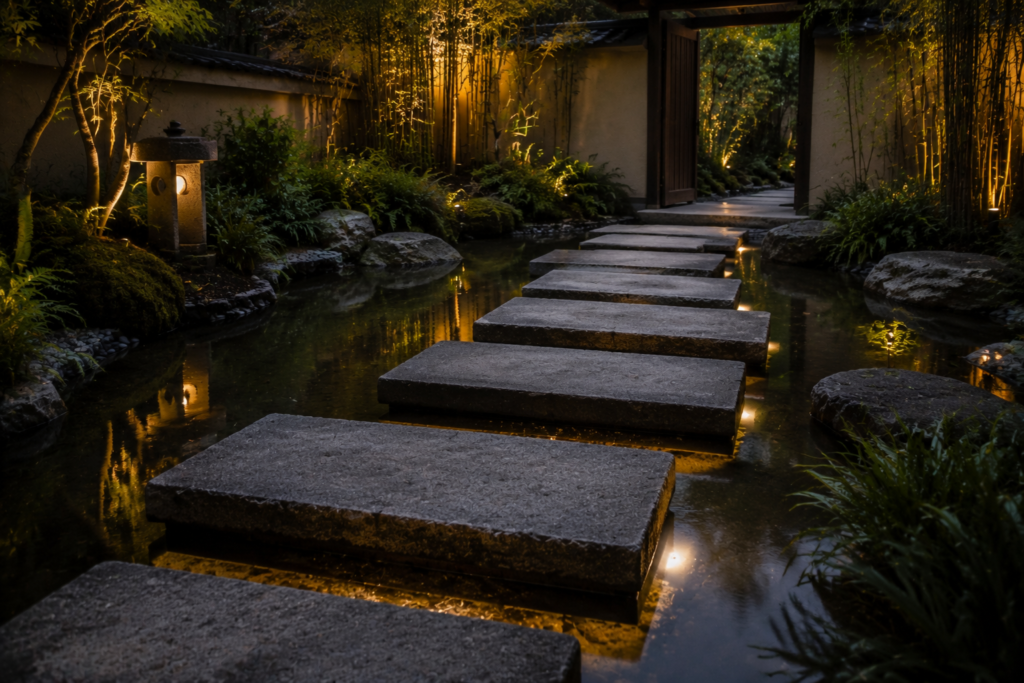
Best for: Zen gardens where a path appears to hover over the gravel surface — one of the most visually striking effects in Japanese garden design
Stepping stones set flush with or slightly above a gravel surface create the impression of floating over the sea of gravel — particularly effective when viewed from a distance or at low angle. The visual effect is precisely the symbolism that zen garden design employs: solid ground (enlightenment) accessible across the water (the uncertainty of life) through careful, deliberate stepping.
The stepping stones can cross the gravel field in a gentle curve, zigzag at right angles in the yatsuhashi tradition, or create a meandering path that reveals different garden views at each change of direction.
Smart tip: Use stepping stones large enough that each step lands centrally without careful aim — 18 to 24 inches across. Stepping stones that require precise foot placement create anxiety rather than mindfulness, defeating the contemplative purpose of the path entirely. Generous stone size allows relaxed, natural walking.
Mistake to avoid: Setting stepping stones so close together that the path feels like continuous paving. The gaps between stones — the gravel visible between each step — are as important as the stones themselves. The gaps create the rhythm of deliberate stepping and maintain the visual impression of crossing water. Stones spaced at comfortable but not cramped intervals produce the most effective result.
14. Garden Wall with Water Cascade
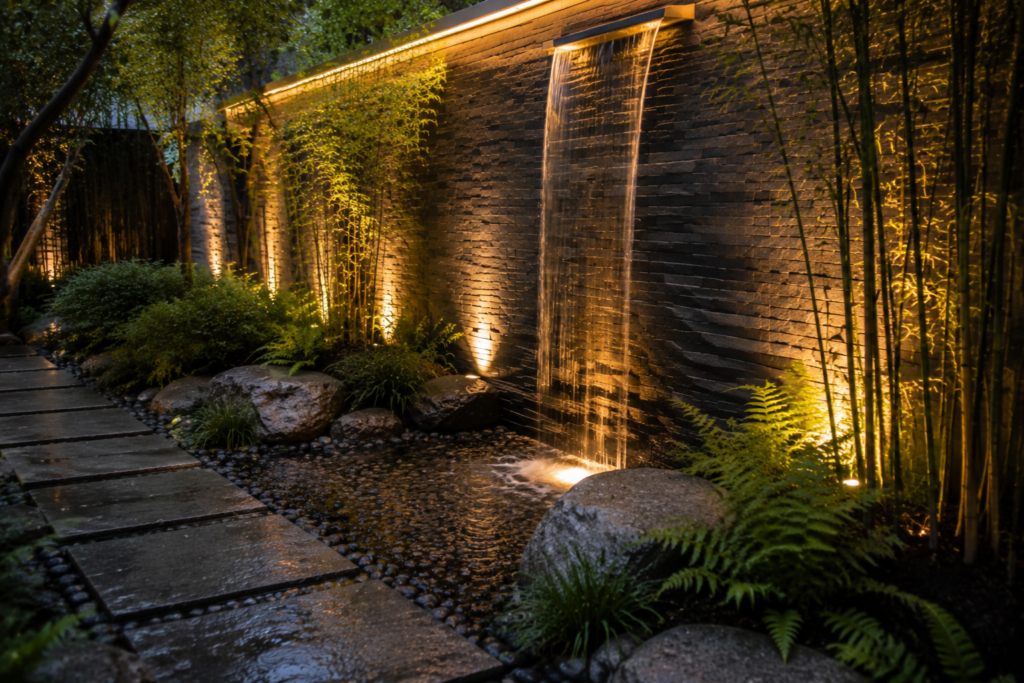
Best for: Zen gardens with an existing wall or fence — a wall-mounted water feature adds sound without requiring ground excavation
A water cascade mounted on a garden wall — water flowing down a textured stone or slate face into a stone basin below — creates the sound and visual quality of moving water within a compact footprint. The wall-mounted format suits gardens where ground excavation for a pond or stream isn’t practical, and the vertical presentation of water creates a visual focal point visible from across the garden.
Slate or rough-textured stone wall surfaces create the most naturalistic water flow — water finds its own path across the texture, creating variable, organic patterns rather than the uniform sheet that smooth surfaces produce.
Smart tip: Use a recirculating pump system that returns water from the basin to the top of the cascade continuously, with a reservoir capacity that accommodates evaporation and wind spray loss. Size the reservoir generously — a small basin in summer sun and wind evaporates faster than expected and a pump running dry damages rapidly.
Mistake to avoid: Placing a wall cascade where the water sound is inaudible from the sitting area. The cascade’s primary contribution is acoustic — the visual element is secondary. A feature too distant or too small to be heard from where the garden is enjoyed provides aesthetic interest only, losing the meditative sound quality that makes water features genuinely valuable in a zen garden.
15. Small Balcony Zen Garden
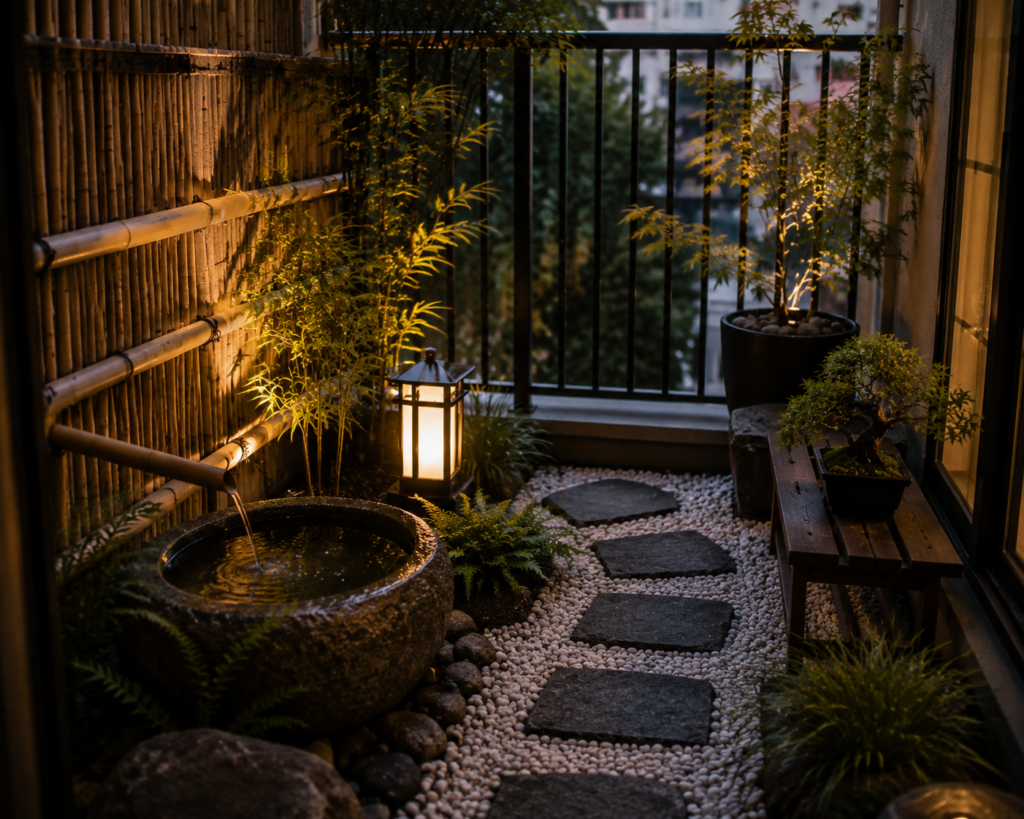
Best for: Apartments and homes without outdoor ground space — zen principles scale to any size
A balcony zen garden — a contained tray of fine sand with a small rake, several carefully chosen stones, and one or two compact plants — creates a genuinely contemplative space within the footprint of a balcony. The portable sand tray (30 to 60cm across) allows raking practice in a meditative context, and the careful selection of just two or three elements forces the restraint that is the heart of zen design.
A single bonsai or small Japanese maple in a container, one or two interesting stones, and the sand tray are sufficient for a balcony zen garden that captures the essential quality of the full-scale version.
Smart tip: Use a weathered wooden tray or slate frame for the balcony sand garden rather than a plastic or resin container. The material quality of the container contributes to the aesthetic — natural materials that age gracefully suit zen design’s emphasis on the beauty of impermanence and weathering.
Mistake to avoid: Overcrowding a balcony zen garden with too many elements. A balcony garden with seven plants, multiple statues, a water feature, stones, gravel, and wind chimes is a cluttered balcony, not a zen garden. The principle of restraint — choosing the minimum number of elements that create genuine beauty — applies especially strongly in small spaces where every addition is visible.
16. Wind Chimes and Sound Elements
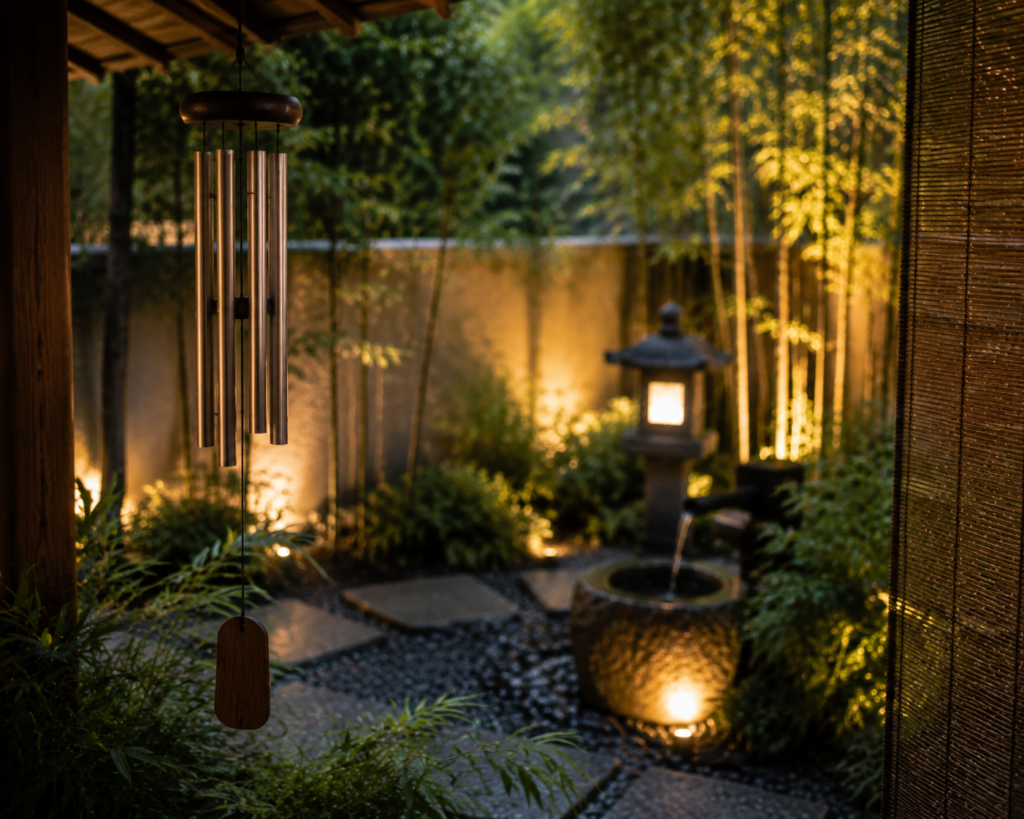
Best for: Zen gardens where sound enrichment complements the visual composition
Wind chimes add an acoustic dimension to the garden that responds to wind movement rather than requiring deliberate activation — the sound arrives unexpectedly, as the garden’s response to the environment rather than a mechanical feature. Traditional Japanese wind chimes (furin) use glass or metal construction that produces a clear, delicate tone quite different from Western wind chimes.
The sound of wind chimes in a zen garden contributes to the same meditative atmosphere as the bamboo water feature — intermittent, natural sound that marks the passage of time and the movement of air without demanding attention.
Smart tip: Choose wind chimes tuned to a pentatonic scale — the five-note scale common in East Asian music that avoids the clashing dissonances that Western diatonic scales can produce when random notes sound simultaneously. Pentatonic wind chimes create pleasing combinations regardless of which notes the wind activates.
Mistake to avoid: Hanging wind chimes in a position where they ring continuously rather than intermittently. Constant chiming becomes background noise rather than occasional punctuation — the meditative effect depends on the silence between sounds as much as the sounds themselves. Position chimes where they catch occasional gusts rather than steady wind.
17. Evergreen Structure Plants
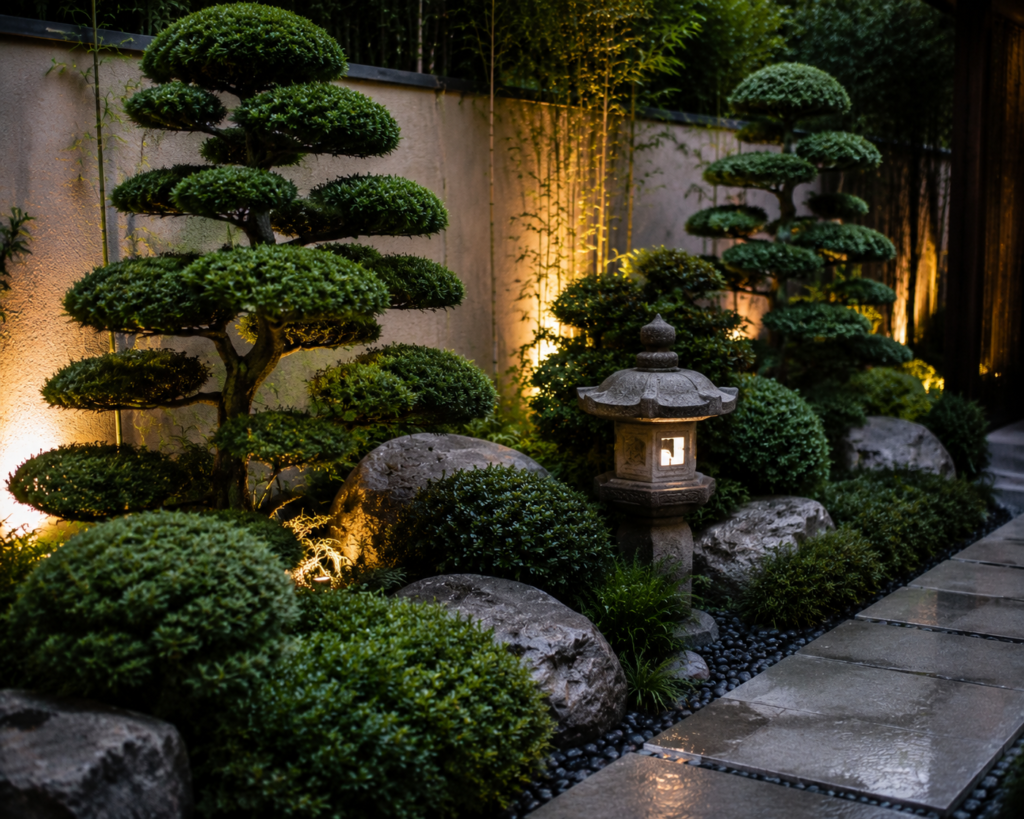
Best for: Providing the year-round framework that defines the zen garden’s composition in every season
Evergreen plants provide the structural backbone of a zen garden — they maintain the garden’s essential composition through winter when deciduous plants have no leaves, and they create the year-round green backdrop that makes stones, gravel, and water features readable in every season.
The most effective evergreens for zen garden use: Japanese black pine (Pinus thunbergii) — the quintessential zen garden tree, with dramatic silhouette and dark needles; dwarf mugo pine — compact, rounded, suitable for smaller gardens; juniper in clipped forms — geometric, structured, formal; and camellia — glossy dark leaves with seasonal flowers that suit the zen garden aesthetic.
Smart tip: Clip one or two evergreen shrubs into simple geometric or organic forms — not topiary animals or novelty shapes, but simple spheres, cylinders, or cloud-pruned (niwaki) forms. Clipped evergreens provide a human-designed element that contrasts with the naturalistic rocks and gravel, and the contrast between the two creates visual tension that makes both elements more interesting.
Mistake to avoid: Planting too many different evergreen species in a zen garden. Variety in plant species creates visual busyness that contradicts zen design’s emphasis on simplicity and clarity. Choose two to three evergreen species maximum and plant each in sufficient quantity to create coherent visual masses rather than a botanical collection.
19. Evening Lantern Lighting
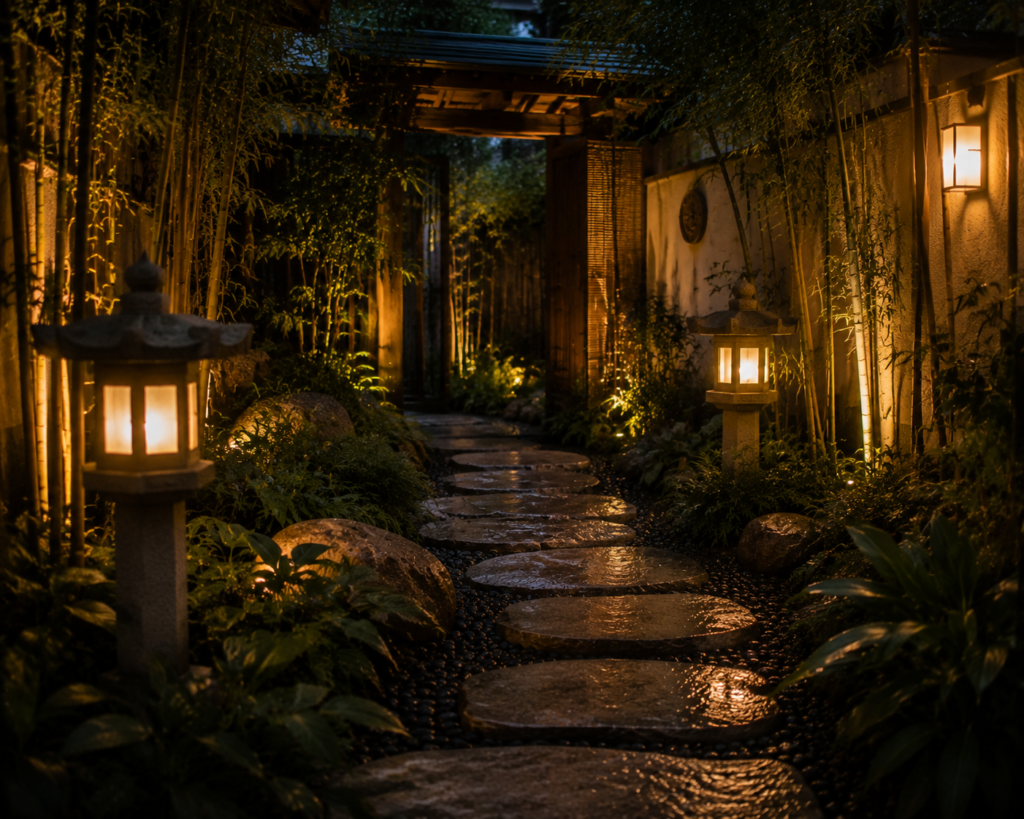
Best for: Zen gardens used in the evening — gentle lantern lighting transforms the nighttime garden completely
A zen garden lit in the evening by stone lanterns, low-voltage path lights, or LED fixtures hidden within planting creates an entirely different atmosphere from the daytime garden. The shadows cast by lantern light across raked gravel patterns reveal the texture of the raking in a way that flat daytime light doesn’t. The reflection of light in the koi pond or water feature creates a luminous quality absent in daylight.
Traditional stone lanterns with candles or LED candle inserts create the most authentic zen garden evening atmosphere. Modern solar-powered LED inserts eliminate the need for wiring while maintaining the traditional lantern form.
Smart tip: Use warm white LEDs (2700K) for all zen garden lighting. Cool white LEDs create a stark, institutional quality that works against the warm, intimate atmosphere of evening garden use. Warm light flatters stone, timber, and water — all the primary materials of a zen garden — in a way that cool light does not.
Mistake to avoid: Flooding the zen garden with bright even illumination at night. The atmospheric quality of a zen garden in the evening depends on the contrast between lit and unlit areas — the shadows are as important as the light. A single lantern casting gentle light across a portion of the garden creates more atmosphere than multiple fixtures illuminating every corner.
20. How to Design Your Own Zen Garden
Best for: Anyone beginning a zen garden project — these principles prevent the most common design mistakes
Designing a zen garden that achieves genuine tranquility rather than simply referencing Japanese aesthetics requires understanding a small number of consistent principles that underlie all successful zen garden design.
Simplicity above everything. The most common zen garden mistake is adding too many elements — too many plants, too many ornaments, too many materials. Each addition must justify its presence by contributing something the existing composition lacks. When in doubt, leave it out. Odd numbers and asymmetry. Place rocks, plants, and ornaments in groups of three, five, or seven — never two or four. Arrange them asymmetrically, with the eye finding balance through relationship rather than equality. Every element should feel placed rather than matched. Natural materials only. Stone, gravel, timber, water, and living plants are the vocabulary of zen garden design. Plastic, synthetic materials, and brightly colored ornaments contradict the material language that creates the garden’s atmosphere. Negative space is active. The empty areas of a zen garden — the unplanted gravel field, the space between stones — are not empty at all. They’re the visual rest that makes the placed elements meaningful. Protect this space from the impulse to fill it.
Smart tip: Visit the garden at different times of day and in different seasons before finalizing the design. Morning light, afternoon light, winter light, and evening light all reveal different qualities. A composition that looks right in flat midday light may look extraordinary in low morning sun — or the reverse. Understanding how the specific light of the space behaves across the day and year informs every placement decision.
Mistake to avoid: Designing a zen garden entirely from photographs without visiting an actual example. Photographs compress the spatial qualities that make zen gardens genuinely effective — the sense of enclosure, the experience of moving through the space, the acoustic quality of the water feature, the physical presence of the stones. If possible, visit a public Japanese garden or a botanical garden with a Japanese section before finalizing your own design. The experience of being in the space is irreplaceable.
Before You Start
- Start smaller than planned. A zen garden that exceeds its designer’s ability to maintain it loses the quality of careful tending that is part of its meaning. A small, perfectly maintained garden is more powerful than a large, neglected one.
- Choose materials from a single source. Stones from one quarry, gravel from one supplier, timber from one species — material consistency creates the visual coherence that makes zen gardens work.
- Plan for maintenance. Raked gravel requires raking after wind and rain. The moss needs moisture. The bonsai needs daily water. Design only what you’ll genuinely maintain.
- Accept impermanence. Zen philosophy embraces the impermanence of all things — a raked pattern that wind has disturbed, moss that has browned in drought, leaves that have fallen onto the gravel. These aren’t failures. They’re part of the garden’s life.
Conclusion
A zen garden succeeds not because of what it contains but because of what it doesn’t. The restraint that keeps the composition simple, the care that maintains each element, and the patience that allows the garden to develop over years — these are what create a space with genuine power to calm the mind and restore perspective. Start with the minimum, tend it carefully, and resist the impulse to add. The garden will do the rest.
