
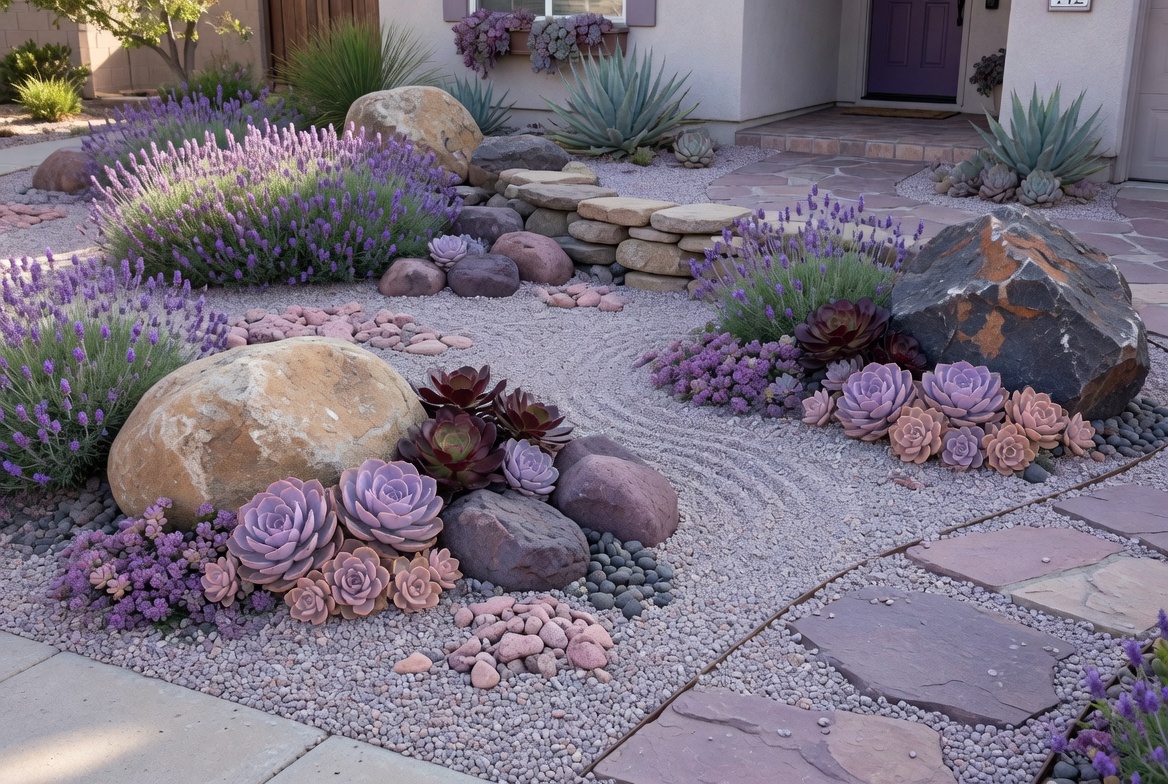
Xeriscaping is the most honest response to a changing climate that residential landscaping has produced. It reduces outdoor water use by 50 to 70 percent compared to a traditional lawn, eliminates most of the ongoing maintenance that conventional gardens require, and — when designed well — creates landscapes that are genuinely more beautiful than the grass they replace. The word combines the Greek “xeros” (dry) with landscaping, but modern xeriscaping isn’t about creating a barren yard of rocks and sand. It’s about choosing plants that thrive on rainfall rather than irrigation, using materials that work with the landscape rather than against it, and designing a yard that looks intentional rather than neglected.
These 20 ideas cover every application — from a complete front yard transformation to a single curb strip improvement — with specific plant recommendations, material choices, and the common mistakes that most xeriscape attempts make.
1. Replace Your Lawn with Native Grasses
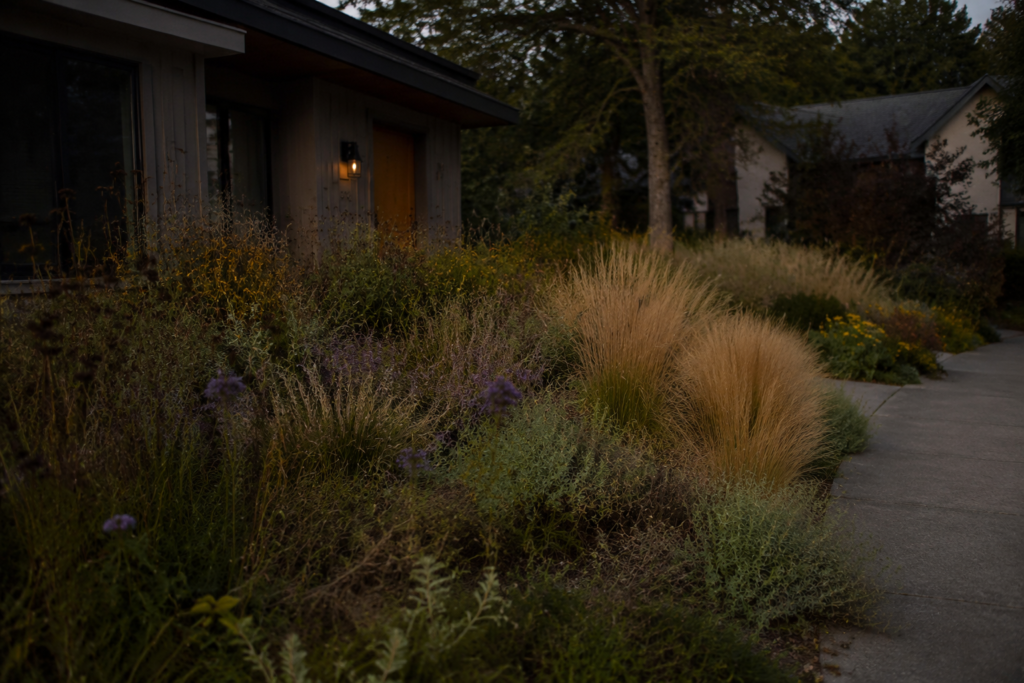
Best for: Homeowners who want the look of a lawn without the water bill — native grasses provide movement, seasonal color, and texture that turf cannot
Native grasses suited to your specific region provide ground coverage without irrigation requirements after the first establishment season. Blue Grama grass (Bouteloua gracilis) and Buffalo grass (Bouteloua dactyloides) are the most widely adapted native lawn replacements across the central and western US — both stay green through spring and summer with rainfall only, turn warm golden in autumn, and require mowing only one to three times per year.
The visual quality of a native grass meadow — the movement of seed heads in wind, the seasonal color progression — exceeds what a conventional turf lawn provides at any water use level.
Smart tip: Mow native grass replacement areas once in late winter or early spring to remove dead material and stimulate fresh growth. This single annual mowing is the primary maintenance requirement for established native grass areas — compared to weekly mowing through a full growing season for conventional turf.
Mistake to avoid: Planting native grasses from seed during drought conditions without temporary irrigation. Even drought-tolerant native plants require consistent moisture during their first establishment season — typically the first 6 to 12 months after planting. After establishment, they’re genuinely self-sufficient on natural rainfall in most of their native range.
2. Gravel Garden with Drought Perennials
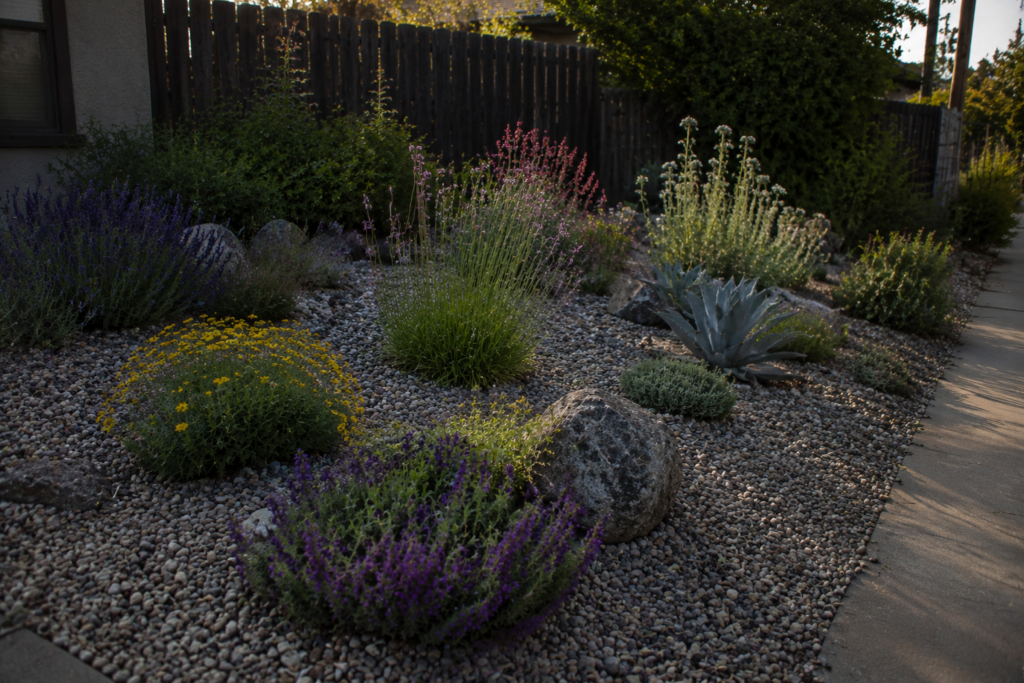
Best for: Any yard in a hot, dry climate — the combination of gravel mulch and drought-tolerant perennials creates year-round interest with minimal water
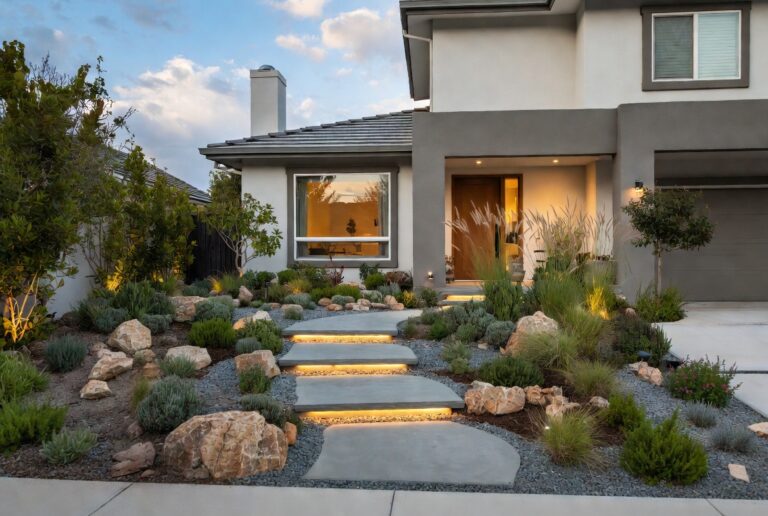
A gravel garden — drought-tolerant perennials planted through a ground layer of decorative gravel rather than bark mulch — is the most versatile and visually rich xeriscape approach available. The gravel suppresses weeds, retains soil moisture by reducing evaporation, moderates soil temperature, and provides the excellent drainage that most drought-tolerant plants require.
The plant palette for a gravel garden is extensive: lavender, salvia, echinacea, rudbeckia, gaillardia (blanket flower), sedum, ornamental grasses, and agave all perform brilliantly in this combination.
Smart tip: Use gravel that contrasts with the plant foliage for maximum visual impact. Pale limestone or white granite gravel against dark green foliage creates the sharpest contrast and the most visually striking result. Grey granite against silver-foliage plants (lavender, artemisia) creates a more restrained, sophisticated palette.
Mistake to avoid: Applying gravel over landscape fabric rather than directly onto amended soil. Fabric beneath gravel creates a barrier that prevents beneficial soil organisms from accessing the surface layer, prevents self-seeding of desirable plants, and eventually allows weeds to establish on top of the fabric as organic matter accumulates above it. Apply gravel directly to well-prepared soil without fabric.
3. Boulder Focal Point Design
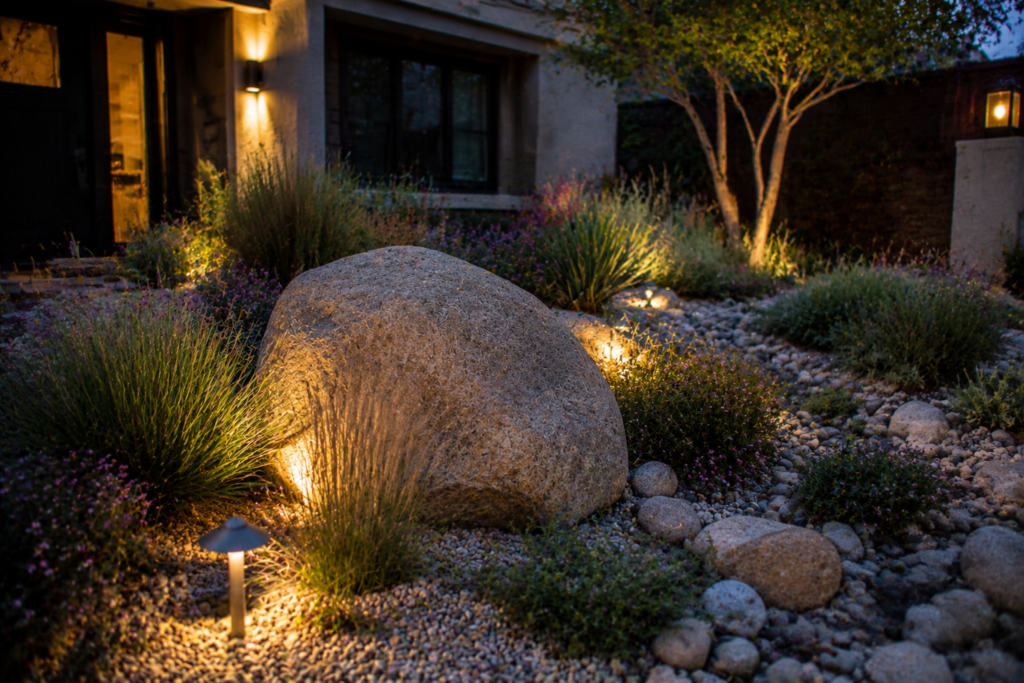
Best for: Any xeriscape needing visual anchoring — boulders create permanent structure that plants alone can’t provide
A large boulder or a thoughtfully arranged group of boulders serves as the structural backbone of a xeriscape design — providing permanent visual weight, creating a natural-looking focal point, and offering the sense of geological presence that makes xeriscape gardens feel rooted in the landscape rather than planted on top of it.
Boulders should be partially buried (30 to 40 percent below grade) to appear naturally embedded rather than simply placed. This buried portion is what creates the convincing impression that the boulder has always been there.
Smart tip: Use an odd number of boulders (one, three, or five) arranged in a triangular grouping rather than a straight line or symmetrical arrangement. The triangular grouping creates visual stability without the formal symmetry that looks engineered rather than natural. Vary the boulder sizes — one large anchor stone with smaller companions — for the most naturalistic result.
Mistake to avoid: Choosing boulders that don’t match the local geology. A granite boulder in a limestone landscape, or a sandstone boulder among basalt outcroppings, looks imported rather than indigenous. Source boulders from local quarries or landscape suppliers who provide regionally appropriate stone.
Loving These Ideas? Get the Step-by-Step Guide
Grab the full 5-day eBook and turn these ideas into a finished room.



4. Lavender Mass Planting
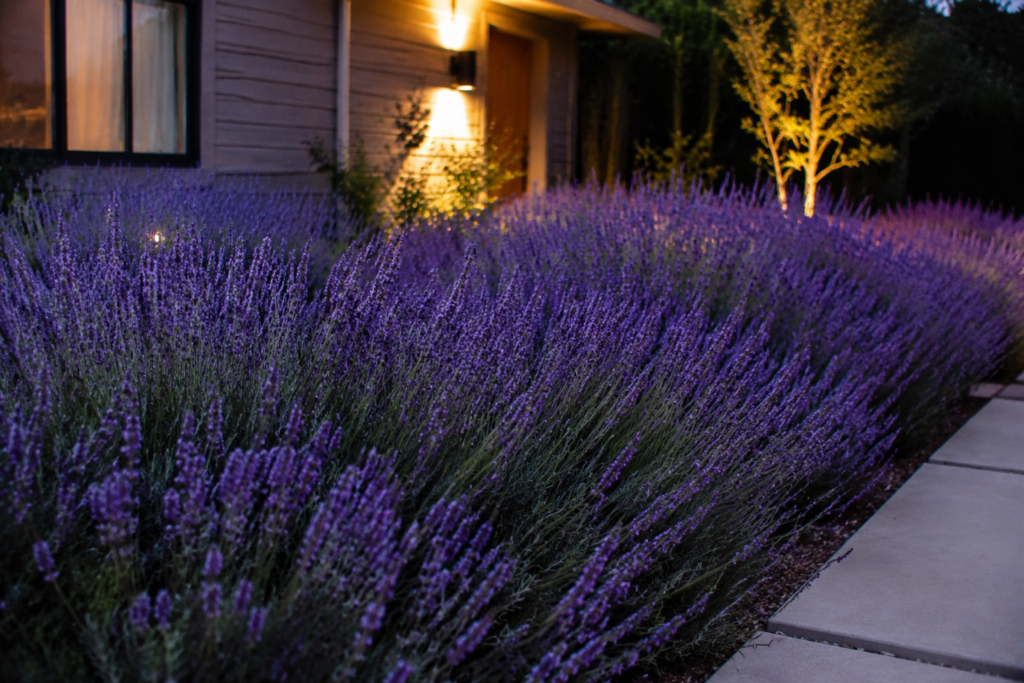
Best for: Sun-drenched slopes, front yard borders, and any position where fragrance, color, and pollinator value are all priorities
Lavender is the single most effective xeriscape plant for combining drought tolerance, visual beauty, fragrance, and wildlife value in one species. A mass planting of lavender — twenty, thirty, or fifty plants of the same variety in a sweeping drift — creates one of the most stunning landscape effects available in any garden style, and requires watering only once every one to two weeks after establishment in most dry climates.
The most drought-tolerant lavender varieties: Lavandula angustifolia (English lavender) — the hardiest and most drought-tolerant; Lavandula x intermedia (lavandin) — larger plants with longer flower spikes, suited to warmer climates; Lavandula stoechas (Spanish lavender) — shorter-lived but spectacular in bloom.
Smart tip: Plant lavender in groups of the same variety rather than mixing multiple varieties in the same bed. A mass of one lavender variety in identical color and height creates the sweeping visual impact that makes lavender planting genuinely dramatic. Mixed varieties create a patchy appearance where the individual plants compete rather than read as a unified composition.
Mistake to avoid: Planting lavender in heavy clay soil without amendment. Lavender requires excellent drainage — the root rot that kills more lavender than drought does is a direct result of waterlogged soil during wet seasons. Amend clay soil with grit or coarse sand before planting, or create raised planting mounds that improve drainage naturally.
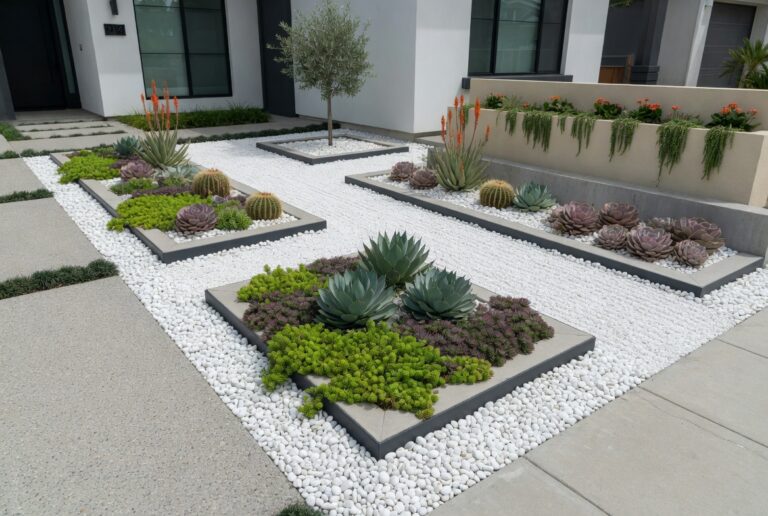
5. Succulent and Agave Garden
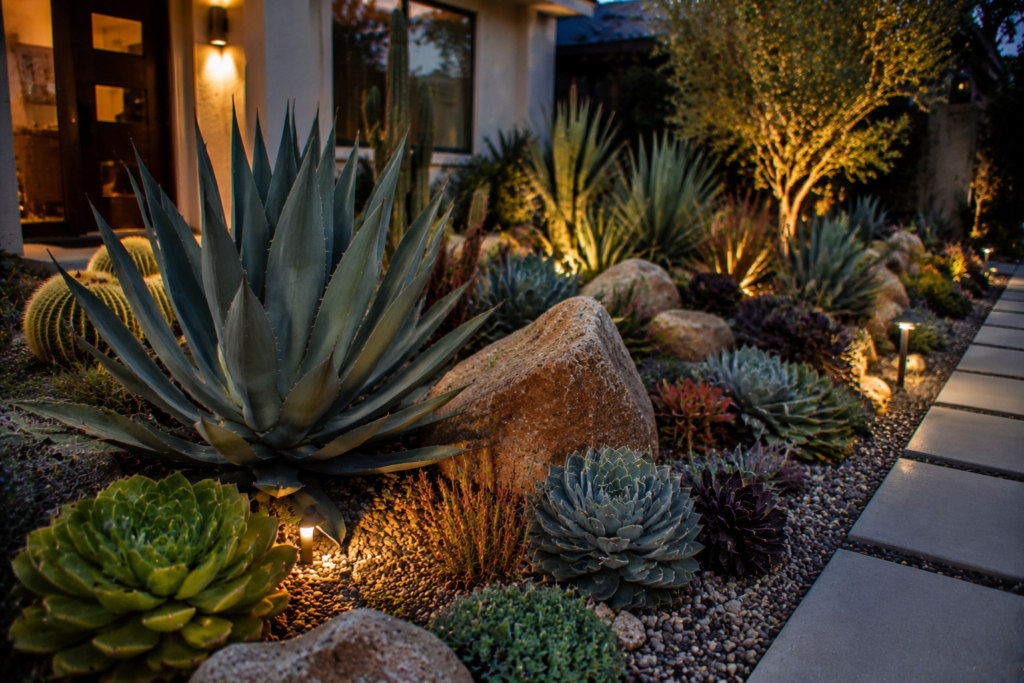
Best for: Hot, dry climates in the southwestern US, California, and similar Mediterranean climates — where succulents are genuinely appropriate to the environment
A succulent and agave garden creates the most drought-tolerant residential landscape available — plants that store water in their leaves and stems require almost no supplemental irrigation once established, and their architectural forms create visual drama that conventional gardens rarely achieve.
Agave americana, agave parryi, and blue agave provide the large-scale architectural structure. Echeveria, sedum, aloe, and smaller agave species fill the mid-level. Groundcover sedums and ice plant (Delosperma) cover the soil surface.
Smart tip: Use succulents with a variety of architectural forms — spiky agave, rounded echeveria rosettes, tall columnar cactus, low spreading sedum — for the most visually rich composition. A succulent garden with only one or two growth forms reads as monotonous regardless of species variety. The contrast between forms creates the visual interest that makes a succulent garden genuinely compelling.
Mistake to avoid: Planting succulents in climates where they’re not genuinely adapted. Many succulents are not frost-hardy — agave and echeveria suffer damage below approximately 20°F. In climates with cold winters, choose cold-hardy succulent species specifically rated for the minimum winter temperature of the planting location.
6. Dry Creek Bed Feature
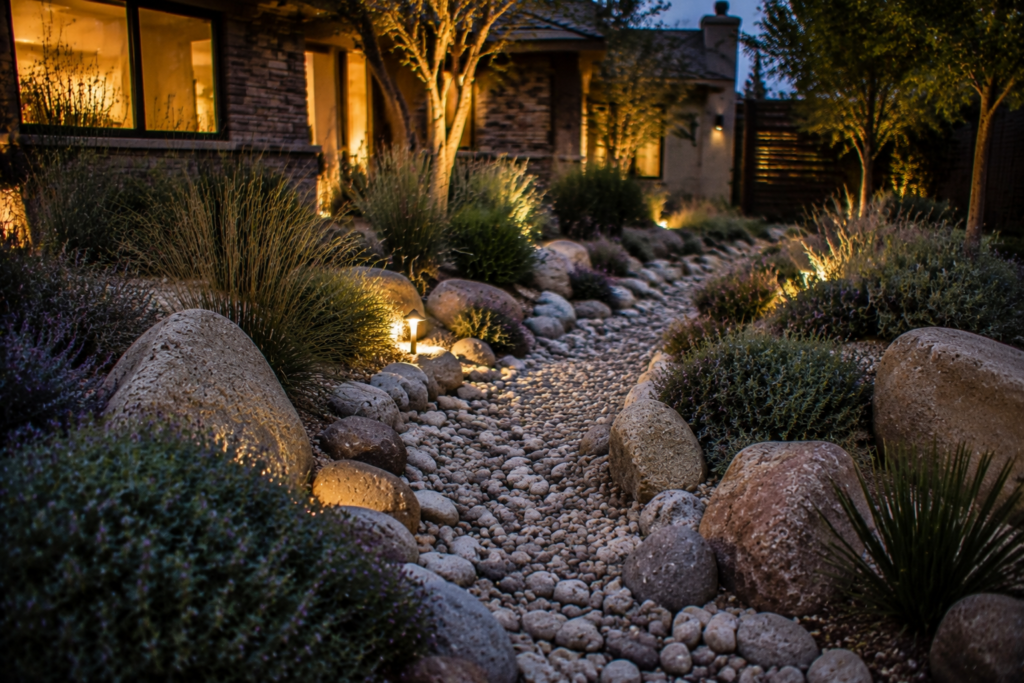
Best for: Any yard with drainage challenges — a dry creek bed solves drainage problems while creating the most naturalistic xeriscape feature available
A dry creek bed — smooth river stones arranged in a winding channel that mimics a seasonal stream — addresses the most common xeriscape challenge (managing rainfall that can’t be absorbed by dry ground quickly) while creating a landscape feature of genuine beauty. The creek directs water away from foundations and low points during rain events and reads as an attractive naturalistic feature in dry periods.
Drought-tolerant plants at the creek banks — ornamental grasses, salvia, drought-tolerant perennials — complete the stream bank naturalistic effect.
Smart tip: Make the dry creek bed curve gently rather than running straight. Natural watercourses always meander — they find the path of least resistance around obstacles. Even gentle curves create the naturalistic quality that makes a dry creek bed convincing. A straight channel looks engineered; a curving one looks found.
Mistake to avoid: Using angular crushed stone rather than smooth river rock for the creek bed. Angular stone has the appearance of construction material or road base — it reads as a drainage ditch rather than a stream bed. Smooth, rounded river stones of varying sizes create the convincing water-worn quality that makes the dry creek feature genuinely attractive.
7. Decomposed Granite Ground Cover
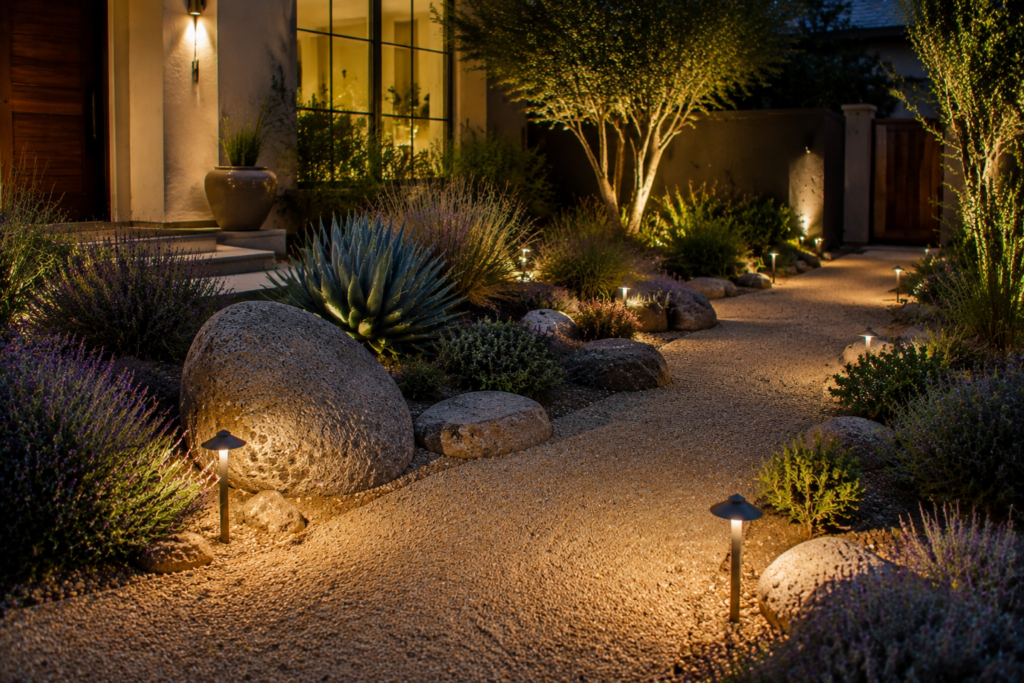
Best for: Pathways, open ground areas, and any surface needing permeable, low-maintenance coverage
Decomposed granite (DG) — crushed granite rock in a fine, gritty consistency — is one of the most practical and visually appealing xeriscape ground covers available. It suppresses weeds effectively, drains freely, provides a stable surface for foot traffic, and has a warm, natural appearance that suits most landscape styles.
Stabilized decomposed granite — DG mixed with a binding agent — provides a more solid, dust-free surface suitable for pathways, patios, and high-traffic areas while maintaining permeability.
Smart tip: Apply decomposed granite in a depth of 3 to 4 inches for effective weed suppression. Shallower applications allow wind-blown weed seeds to germinate in the DG layer itself. The deeper layer also provides better moisture retention for plants growing through it and a more stable walking surface.
Mistake to avoid: Using decomposed granite in shaded, moist positions where it stays continuously damp. In perpetually moist conditions, DG develops a surface crust of algae and moss that becomes slippery underfoot and looks poor. DG performs best in sunny, free-draining positions where it stays relatively dry between rain events.
8. Native Wildflower Xeriscape
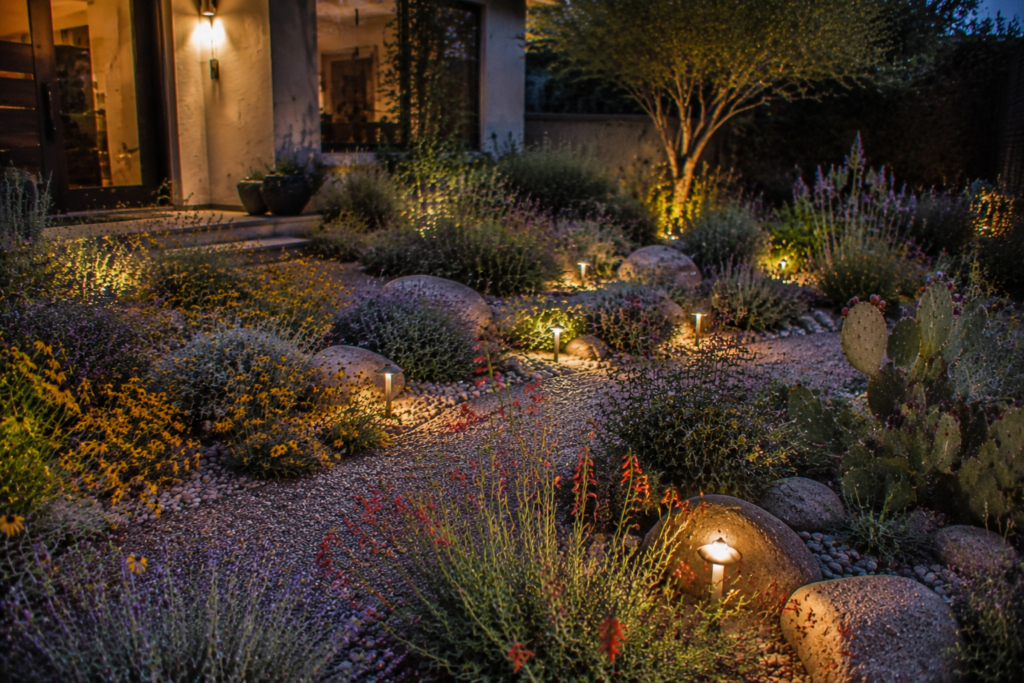
Best for: Large areas where diverse, seasonal color is the priority — native wildflowers create the most ecologically valuable xeriscape available
A native wildflower xeriscape — plants indigenous to the specific region, chosen for their adaptation to local rainfall patterns and soil conditions — provides the most self-sustaining, low-maintenance landscape available. Native plants have evolved with local insects, birds, and soil organisms over thousands of years, creating relationships that make them resilient without human intervention.
The best native wildflowers for xeriscape use: black-eyed Susan (Rudbeckia hirta), purple coneflower (Echinacea purpurea), blanket flower (Gaillardia), prairie dropseed grass (Sporobolus heterolepis), blue wild indigo (Baptisia australis), and native salvias appropriate to the region.
Smart tip: Research which plants are native specifically to your local area rather than purchasing plants labeled “native” without regional specificity. A plant native to the southeastern US is not adapted to the southwestern US — native plants perform best when matched to the specific climate and soil conditions of their native range.
Mistake to avoid: Planting a native wildflower xeriscape without eliminating existing weeds first. Native wildflowers are not inherently more competitive than weeds in their establishment phase — they need a clean starting point. Prepare the area thoroughly by smothering existing vegetation with cardboard and mulch for a full season before planting.
9. Mediterranean Herb Garden
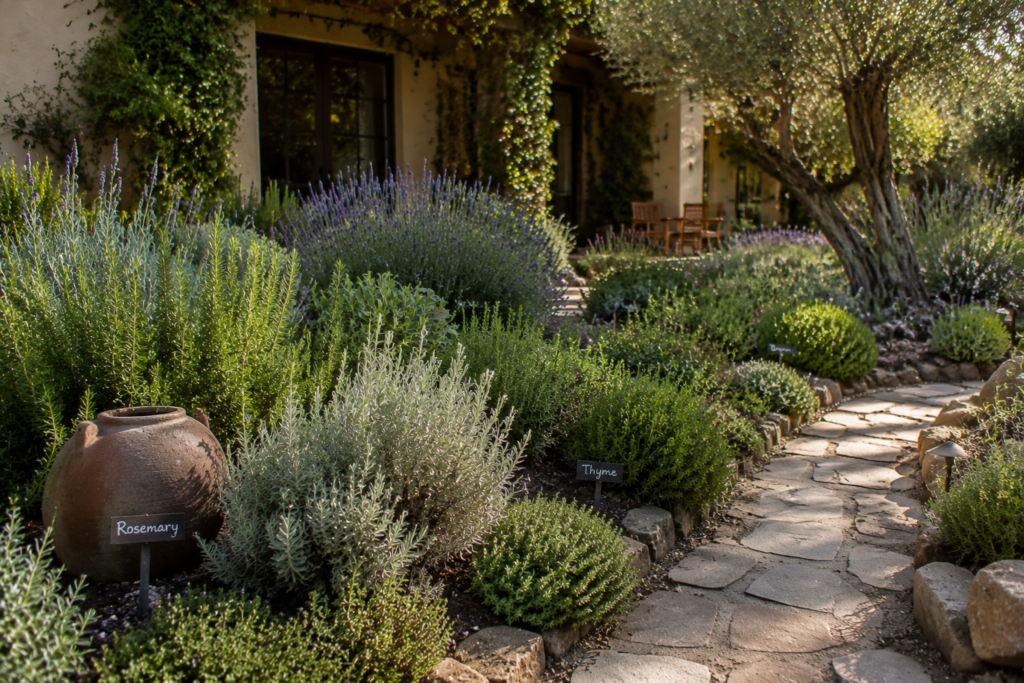
Best for: Sunny, dry gardens where edible and ornamental plants can be combined in a productive, beautiful xeriscape
Mediterranean herbs — rosemary, lavender, thyme, sage, and oregano — are among the most drought-tolerant plants available for temperate climates. They evolved in the dry summer, wet winter Mediterranean climate and are perfectly adapted to drought conditions that would stress most garden plants. They’re also productive: the same plants that look beautiful in a xeriscape provide fresh culinary herbs year-round.
A Mediterranean herb garden — these plants in generous masses, interspersed with gravel and stone, with a simple seating area — creates a sensory landscape of fragrance, texture, and color that requires virtually no irrigation after establishment.
Smart tip: Plant Mediterranean herbs in groups of five to seven rather than as single specimens. Massed planting of the same species creates the visual impact that individual specimens can’t achieve — a drift of lavender or a mass of rosemary reads as a designed landscape element. Single specimens look like isolated plants rather than a garden.
Mistake to avoid: Overwatering Mediterranean herbs after establishment. The most common cause of rosemary, lavender, and thyme death in residential gardens is overwatering — not drought. Once established, these plants prefer to dry out completely between waterings. In many climates, established Mediterranean herbs require no supplemental watering at all beyond natural rainfall.
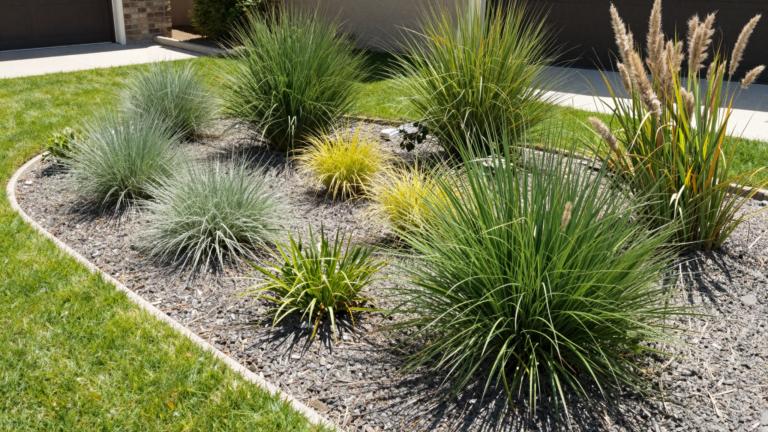
10. Ornamental Grass Xeriscape
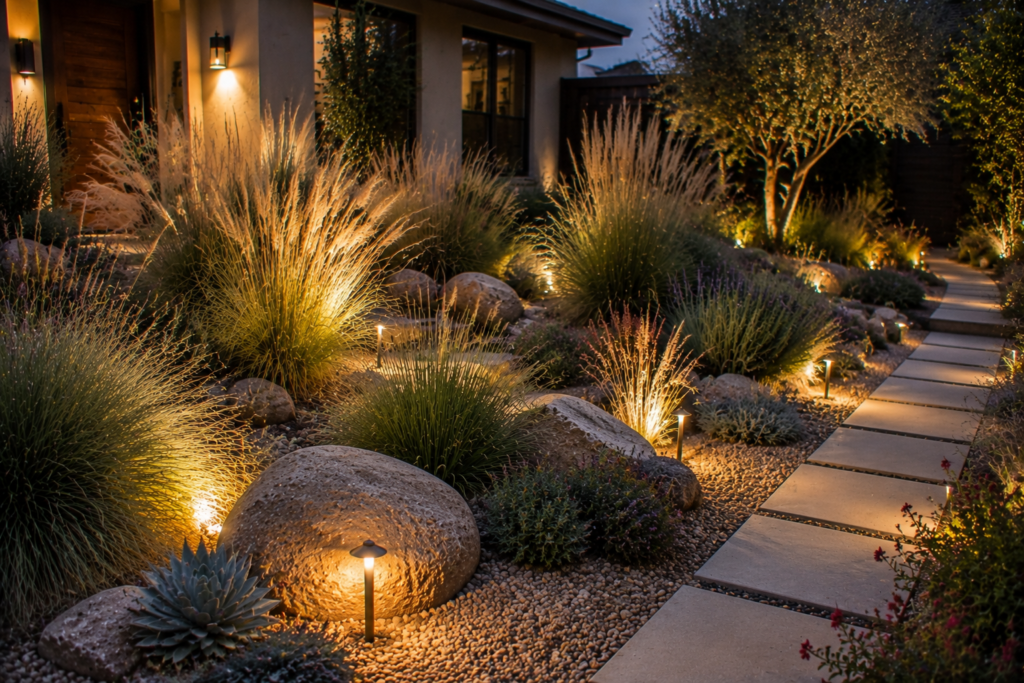
Best for: Large areas needing low-maintenance, year-round interest — grasses fill space beautifully with minimal water
Ornamental grasses are among the most effective xeriscape plants for large-scale use. Many species are highly drought-tolerant once established, they provide interest in every season (fresh growth in spring, full flower in summer, seed heads in autumn, structure in winter), and their movement in wind creates a dynamic, living quality that static plants can’t match.
The most drought-tolerant ornamental grasses: blue oat grass (Helictotrichon sempervirens) — steel blue, extremely drought-tolerant; prairie dropseed (Sporobolus heterolepis) — fine texture, fragrant flowers, outstanding drought tolerance; feather reed grass (Calamagrostis x acutiflora) — upright, sturdy, highly adaptable; little bluestem (Schizachyrium scoparium) — native, brilliant autumn color.
Smart tip: Plant ornamental grasses in large, sweeping drifts of three to five or more plants rather than as isolated specimens scattered through the garden. Massed grasses create visual impact that reads as landscape design; scattered individual grass plants read as unplanned. The drift of one species is more powerful than a collection of different grasses at the same scale.
Mistake to avoid: Cutting ornamental grasses to the ground in autumn. The standing seed heads and winter foliage of ornamental grasses provide winter interest, wildlife habitat, and weather protection for the crown. Cut grasses back hard in late winter or early spring before new growth begins — not in autumn when the plant is still providing value and beginning its winter rest.
11. Flagstone Patio with Low-Water Planting
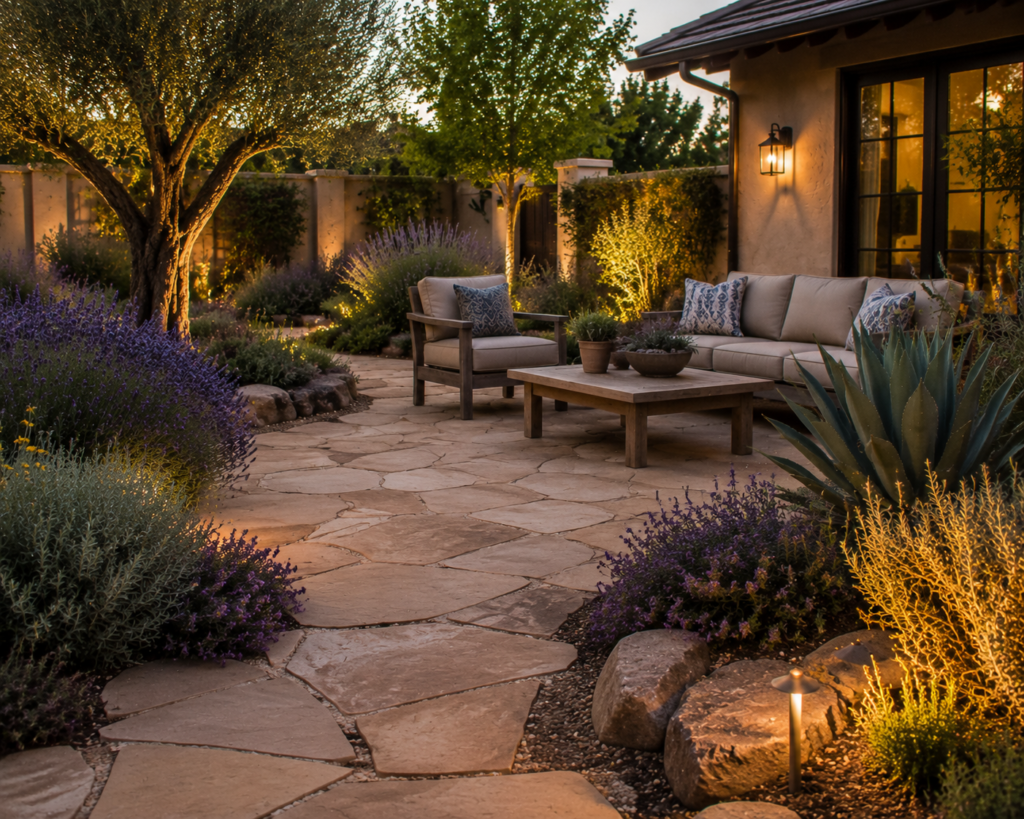
Best for: Outdoor living areas that need to be both functional and water-wise — permeable paving with drought-tolerant planting achieves both
A flagstone patio — irregular natural stone pieces laid with gaps between them — combined with low-growing drought-tolerant plants in the gaps creates an outdoor living surface that is both functional and visually rich. Creeping thyme, sedum, and creeping phlox grow happily in flagstone gaps, releasing fragrance when stepped on and providing seasonal flower color across the patio surface.
The permeable gaps between flagstones also allow rainfall to infiltrate directly into the ground rather than running off — reducing the stormwater management challenges that impermeable concrete or asphalt patios create.
Smart tip: Choose flagstone plants that tolerate occasional foot traffic rather than purely ornamental groundcovers. Creeping thyme (Thymus serpyllum) is the best gap plant for a frequently used flagstone patio — it tolerates being stepped on regularly, stays low, blooms in summer, and releases a pleasant fragrance underfoot.
Mistake to avoid: Setting flagstone directly on sand without a compacted gravel base in regions with freeze-thaw winters. Sand beneath flagstone in cold climates heaves with frost, causing uneven settling and trip hazards within two to three seasons. A compacted crushed gravel base provides stability through freeze-thaw cycles that sand can’t maintain.
12. Terraced Slope Xeriscape
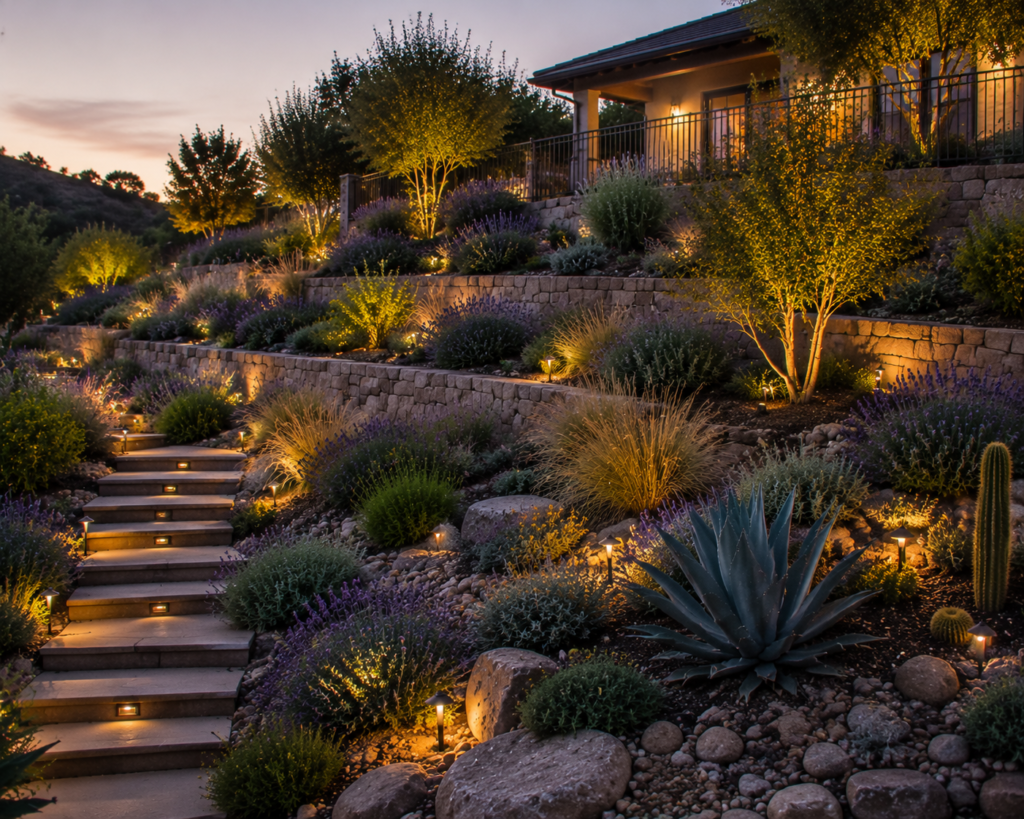
Best for: Sloped properties where erosion and water runoff are problems — terracing with drought-tolerant plants solves both
A sloped yard presents two xeriscape challenges simultaneously: water runs off rather than soaking in, reducing the benefit of any rainfall; and erosion removes topsoil progressively. Terracing — creating level steps across the slope with low retaining walls — captures rainfall on each level, allowing it to penetrate the soil rather than run off, while drought-tolerant groundcovers stabilize the soil surface between rain events.
The visual quality of a terraced xeriscape slope — multiple levels of planting, stone retaining edges, and groundcover spilling over the terrace faces — creates one of the most attractive slope treatments available.
Smart tip: Use drought-tolerant groundcovers with deep root systems for slope terrace planting — deep roots stabilize slope soil more effectively than shallow-rooted plants. Ice plant (Delosperma), crown vetch (Coronilla varia), and drought-tolerant native groundcovers all develop the deep root systems that provide genuine erosion control on slopes.
Mistake to avoid: Building terraces without ensuring adequate drainage within each terrace level. If terrace soil becomes waterlogged during heavy rain because drainage within the terrace is poor, the plants suffer from root rot in a supposedly drought-tolerant planting. Each terrace needs some drainage provision — a slight back slope, drainage gravel at the terrace base, or weep holes in the retaining structure.
13. Drip Irrigation System
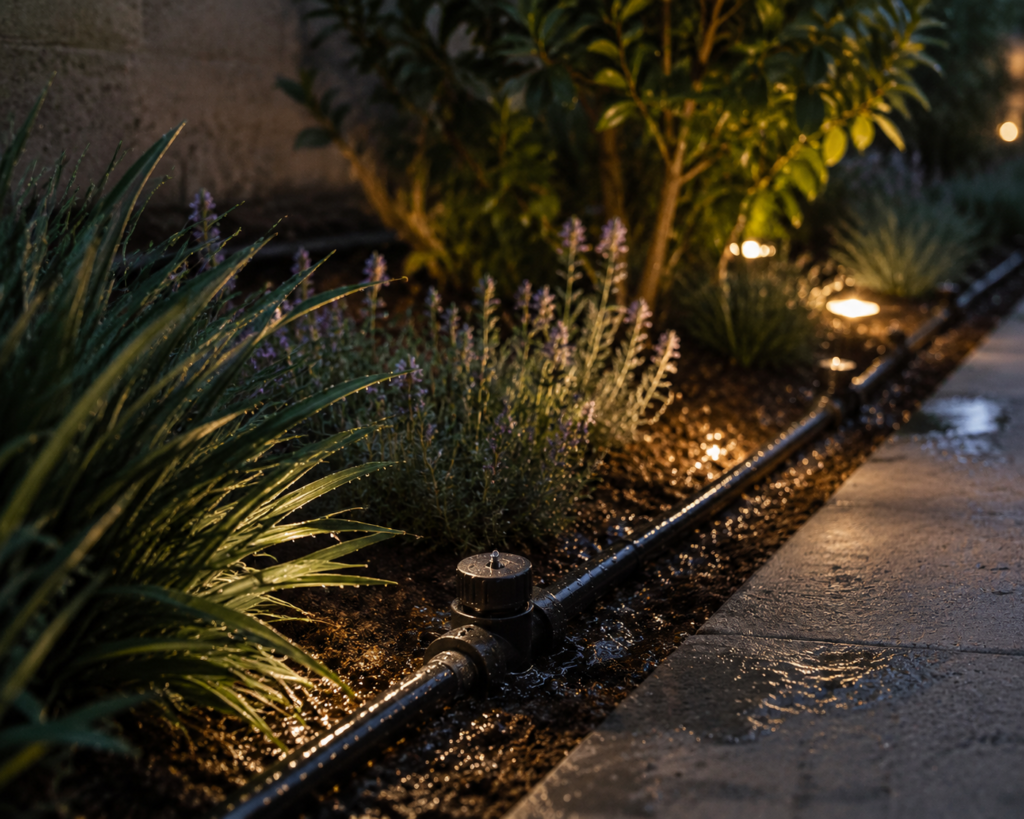
Best for: Every xeriscape — efficient irrigation is one of the seven principles of xeriscaping and the most impactful single water-saving improvement
A drip irrigation system — small emitters that deliver water directly to individual plant root zones rather than spraying across the surface — uses 30 to 50 percent less water than conventional sprinkler irrigation for the same plant coverage. The water goes exactly where roots are, with almost no loss to evaporation and no water applied to bare soil between plants where it evaporates without benefit.
A drip system combined with a timer and a soil moisture sensor — which prevents the system from running when soil is already adequately moist — can reduce irrigation water use by 50 to 70 percent compared to a time-scheduled sprinkler system.
Smart tip: Install the drip system during the initial xeriscape installation before mulch is applied. Running drip tubing under an established mulch layer is difficult and disruptive. Planning the drip system as part of the initial installation allows the tubing to be positioned correctly and covered with mulch cleanly from the beginning.
Mistake to avoid: Running drip irrigation on a fixed time schedule regardless of recent rainfall and current soil moisture. A drip system on a fixed schedule waters regardless of whether plants need it — providing the same water during a wet week as during a dry one. A soil moisture sensor that overrides the timer when soil is adequately moist is the most effective water-saving upgrade available for any irrigation system.
14. Cactus and Rock Garden
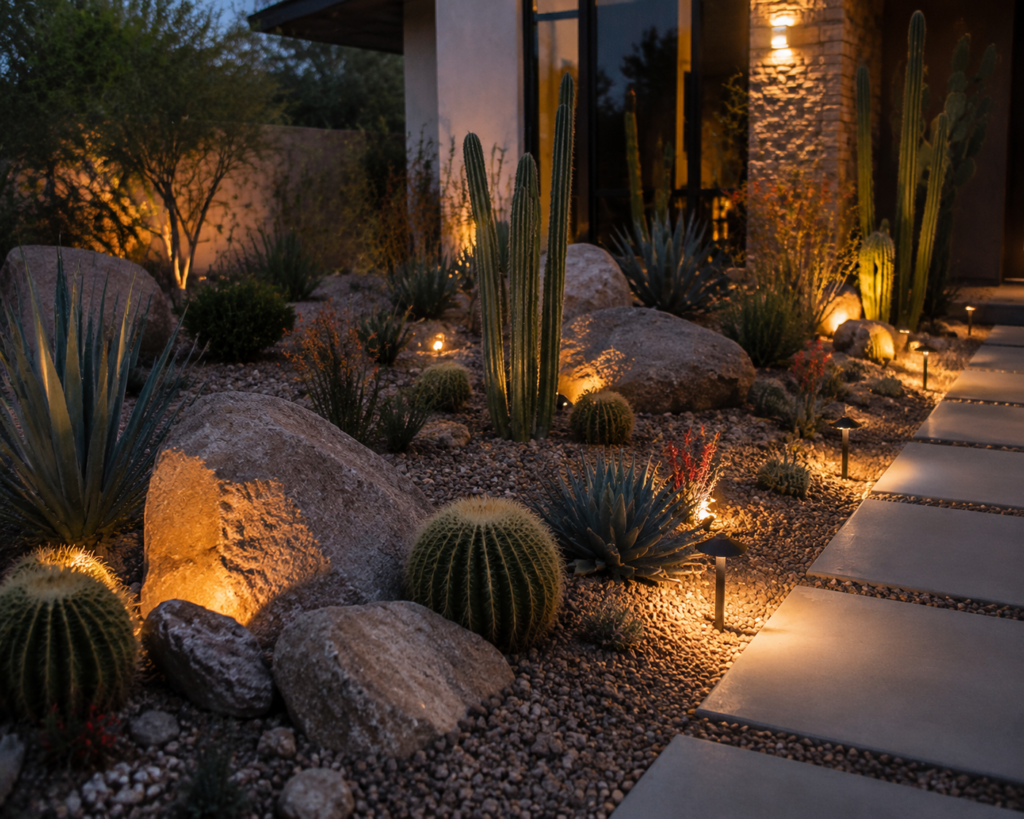
Best for: Arid climates in the southwestern US where cacti are genuinely indigenous — the most drought-tolerant planting possible
A cactus and rock garden — various cactus species arranged among boulders and gravel — creates the most water-efficient residential landscape available. Established cacti survive on rainfall alone in most of the arid southwestern US, and their dramatic forms — columnar, barrel-shaped, paddle-shaped, spherical — create sculptural displays of considerable visual power.
The golden barrel cactus (Echinocactus grusonii), saguaro (Carnegiea gigantea), prickly pear (Opuntia), and cholla (Cylindropuntia) provide the range of form and scale needed for a visually complete cactus garden.
Smart tip: Wear heavy leather gloves and use folded newspaper or cardboard to handle cacti during planting — not thin rubber gardening gloves. Cactus spines penetrate light materials easily and are genuinely painful to remove from skin. A piece of folded newspaper provides adequate protection for most non-barbed cactus handling.
Mistake to avoid: Planting cacti in a climate where they’re not hardy. Many commonly sold cacti are not cold-hardy — they’re species from frost-free desert regions that will be killed by temperatures below 28 to 32°F. Check the cold hardiness rating of each cactus species for the minimum winter temperature of your location before purchasing.
15. Recirculating Water Feature
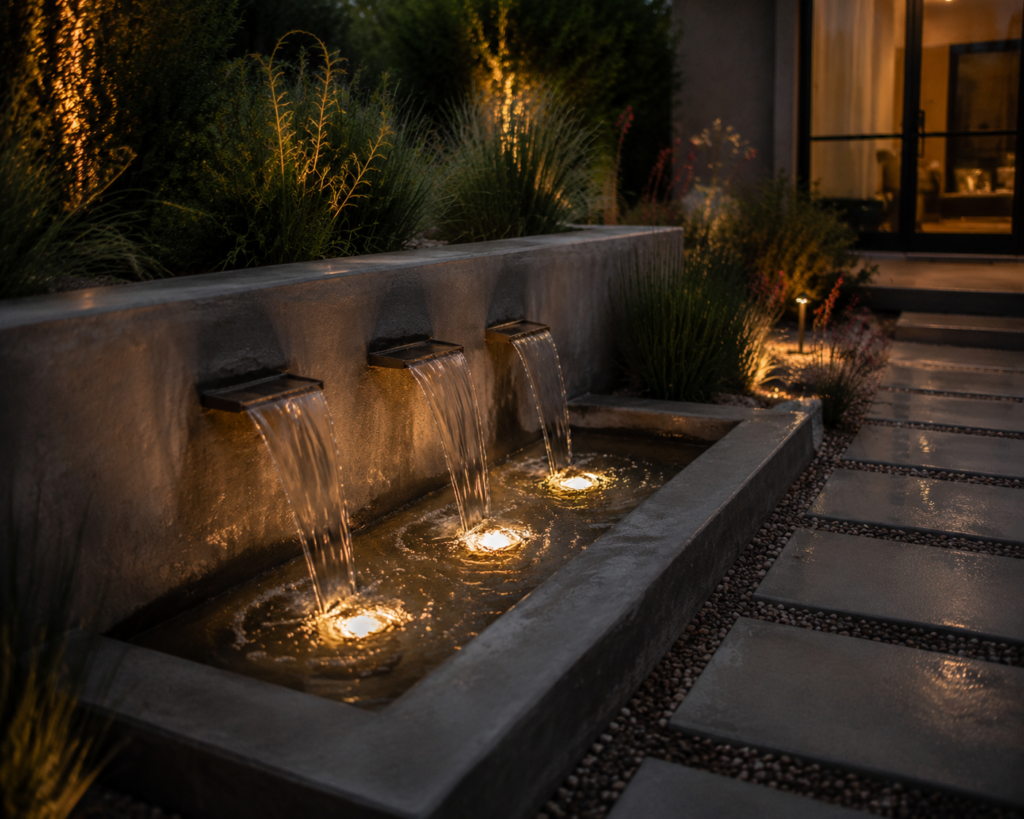
Best for: Xeriscapes that benefit from the sound and visual quality of water without significant water consumption
A recirculating water feature — a small fountain or water cascade where the same water cycles continuously — provides the sensory quality of water in a xeriscape without consuming significant quantities. The system uses only the water lost to evaporation (typically a few gallons per week in warm weather) rather than the continuous flow of a non-recirculating feature.
The contrast between a dry, water-wise landscape and a small water feature creates a particularly effective visual and acoustic focal point — the water appears more precious and intentional in a water-wise landscape than it would in a conventional garden.
Smart tip: Use a solar-powered pump for a small recirculating xeriscape water feature. Solar pumps eliminate electrical installation costs and ongoing electricity use — and they naturally operate only when sunlight is available, matching the feature’s activity to the times when people are most likely to be in the garden.
Mistake to avoid: Installing a water feature that’s out of scale with the surrounding xeriscape. A large, elaborate water feature in a minimalist xeriscape garden looks incongruous — it contradicts the water-wise message of the surrounding design. A simple stone basin with a small spout, or a single recirculating stone sphere, suits xeriscape scale better than an elaborate multi-tiered fountain.
16. Pollinator Xeriscape Garden
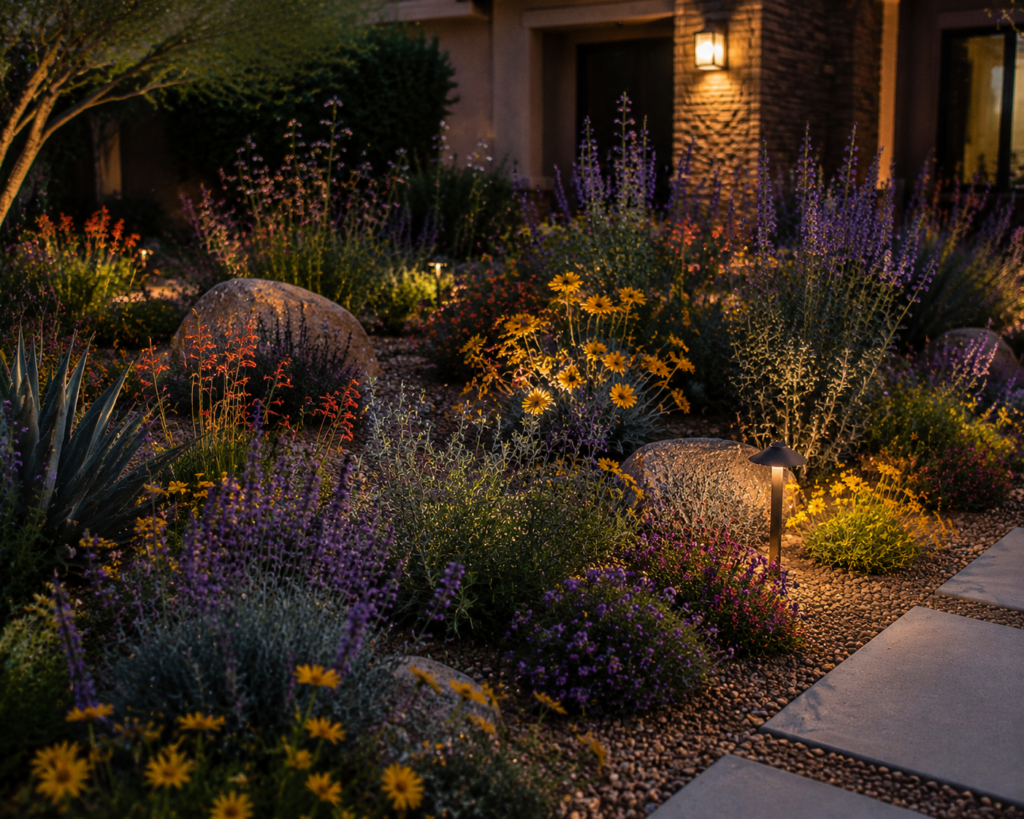
Best for: Homeowners who want their water-wise landscape to also support bees, butterflies, and beneficial insects
Drought-tolerant flowering plants and pollinator habitat are not competing priorities — many of the most valuable pollinator plants are also highly drought-tolerant. A xeriscape designed with pollinator value in mind creates a landscape that’s beautiful, water-wise, and ecologically active simultaneously.
The best drought-tolerant pollinator plants: lavender (outstanding bee plant); salvia (bees and hummingbirds); echinacea (bees and butterflies); rudbeckia (bees and butterflies); agastache (hummingbirds and bees); native grasses (provides cover and nesting for ground-nesting bees).
Smart tip: Choose single-flowered varieties of all pollinator plants rather than double-flowered cultivars. Double flowers — with extra petals replacing the reproductive structures — produce little or no pollen and nectar. Pollinators cannot access or benefit from double flowers. Stick to species-type or single-flowered cultivars for genuine pollinator value.
Mistake to avoid: Deadheading all flowers at the end of the season. Seed heads of coneflower, rudbeckia, and grasses provide food for birds through winter. Leaving seed heads standing until late winter serves wildlife while also providing visual interest in the garden through the colder months.
17. Container Xeriscape Garden
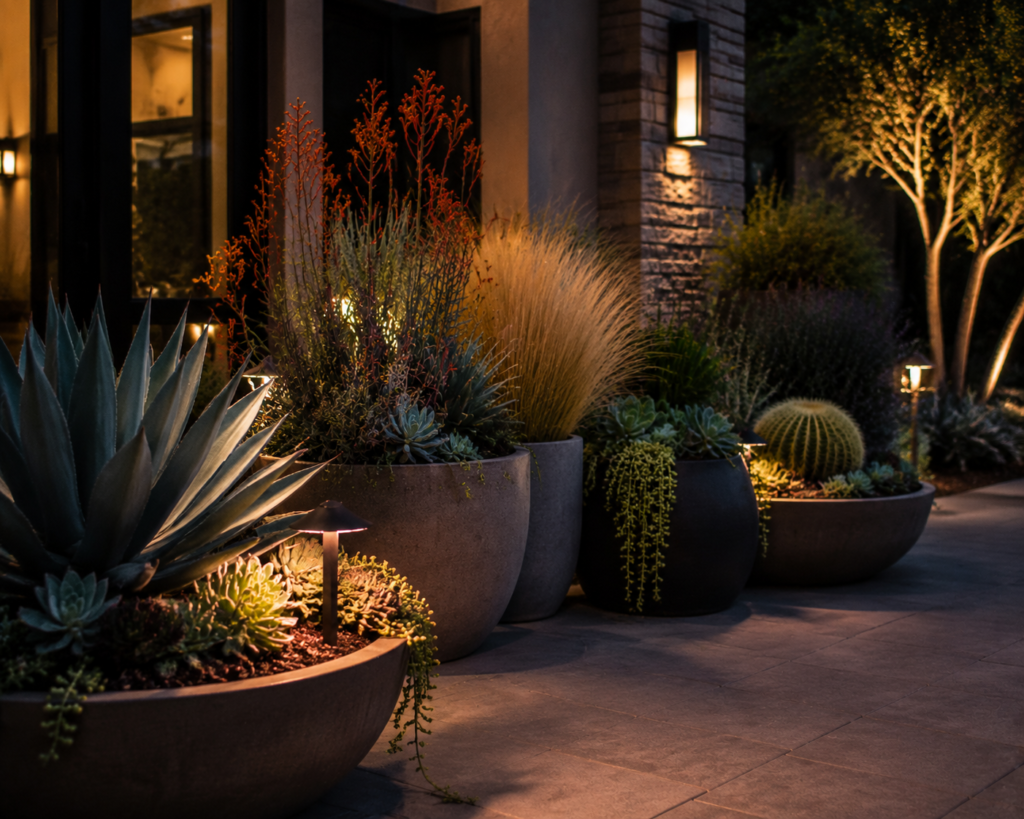
Best for: Small spaces, patios, balconies, and renters who can’t modify the ground — container xeriscaping applies water-wise principles to portable plantings
A container xeriscape — drought-tolerant plants in pots with excellent drainage, filled with a free-draining growing medium — brings xeriscape principles to spaces where ground planting isn’t possible. Large containers with agave, lavender, rosemary, or ornamental grasses create visual impact while requiring significantly less water than conventional container plantings.
The key difference from conventional container gardening: the growing medium (half potting mix, half coarse grit or perlite for most drought-tolerant plants) and the watering discipline (allowing complete drying between waterings rather than watering on a schedule).
Smart tip: Group containers together to create a collective visual impact rather than placing them individually. A collection of five to seven containers with drought-tolerant plants reads as a designed xeriscape composition; scattered individual pots look like plant storage rather than a garden. Group by height — taller plants at the back, cascading plants at the front.
Mistake to avoid: Using standard potting mix for succulents and cacti in containers. Standard potting mix retains moisture far too long for cacti and succulents — root rot develops rapidly in containers where the medium stays moist for extended periods. Use a cactus and succulent mix specifically, or create your own from 50% standard potting mix and 50% coarse grit or perlite.
18. Curb Strip Xeriscape
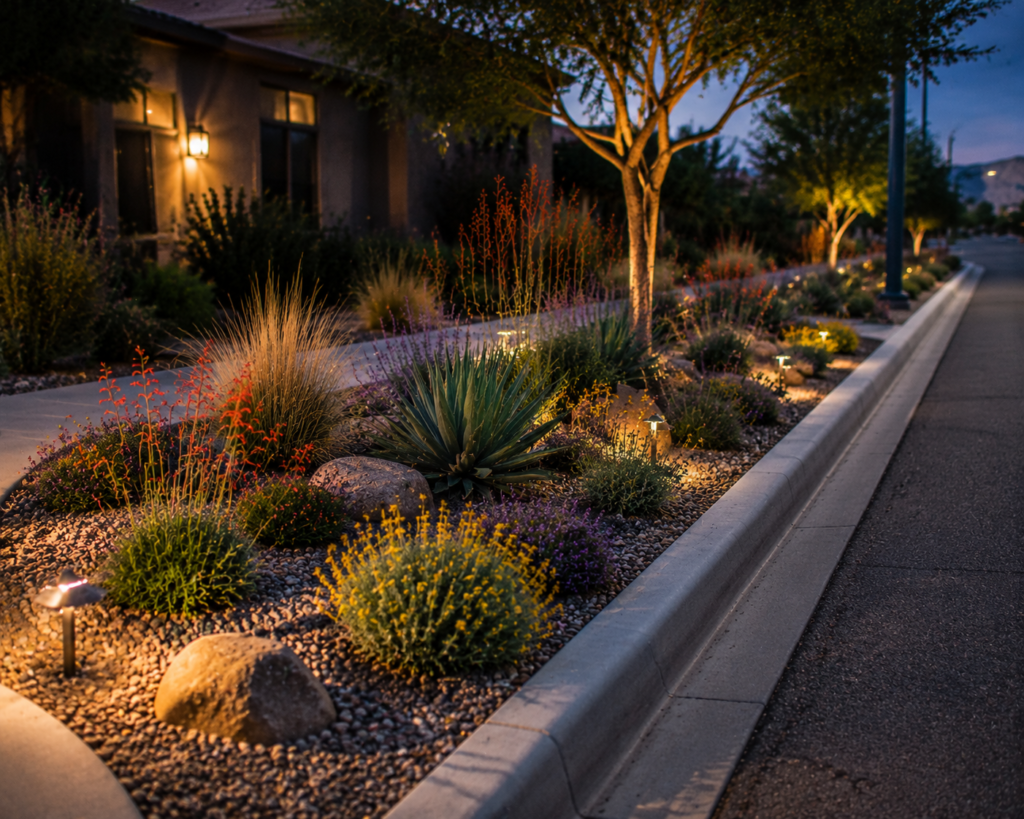
Best for: The narrow strip between the sidewalk and street — one of the most water-consuming and most neglected areas of any residential property
The curb strip — the narrow lawn area between sidewalk and street — is the most inefficient use of irrigation water in most residential landscapes. It’s too narrow for efficient sprinkler coverage, receives runoff from the road surface, and is often too hot and compacted for conventional lawn grass to thrive. Converting it to a xeriscape planting of drought-tolerant ground covers and low perennials eliminates its irrigation requirement completely while dramatically improving its appearance.
Low prairie zinnia (Zinnia grandiflora), yarrow (Achillea), creeping thyme, and blue fescue are all appropriate curb strip plants that stay low, tolerate drought, and require no supplemental irrigation after establishment.
Smart tip: Check local municipal regulations before converting a curb strip to xeriscape planting. Many cities have specific requirements for curb strip plantings — plant height limits, species restrictions, and maintenance standards. Some cities actively encourage curb strip xeriscaping with rebate programs; others have regulations that need to be understood before any conversion.
Mistake to avoid: Planting tall or spreading plants in a curb strip without considering sight line requirements at intersections. Plants that grow taller than 24 inches or spread into the pedestrian path of the sidewalk create safety issues and code violations in most municipalities. Choose specifically low-growing and compact species for curb strip applications.
19. Rainwater Harvesting System
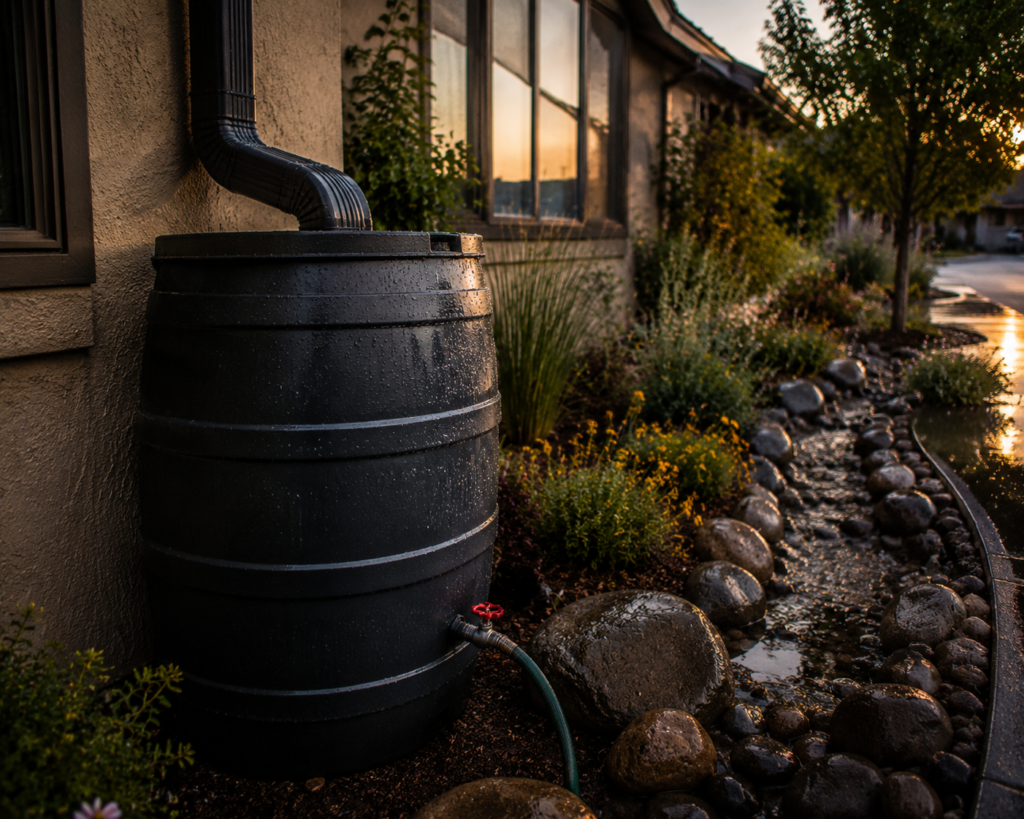
Best for: Any xeriscape — capturing rainfall for supplemental irrigation extends the benefit of every rain event
A rainwater harvesting system — collecting roof runoff in storage tanks and using it for garden irrigation — extends the water-wise benefits of xeriscaping by making use of the rain that does fall rather than letting it run off the property. A 1,000 square foot roof surface captures approximately 600 gallons of water from a single inch of rainfall — enough to meaningfully supplement irrigation for a residential xeriscape through dry periods.
Simple systems connect gutters to one or more storage barrels (50 to 100 gallons each). More elaborate systems use large cisterns (500 to 5,000 gallons) connected to the property’s drip irrigation system.
Smart tip: Connect the rainwater harvesting system overflow outlet to the dry creek bed or a planted drainage swale rather than to the street. Overflow during heavy rain events reaches the garden rather than the storm drain, providing additional irrigation benefit and reducing stormwater runoff simultaneously.
Mistake to avoid: Installing a rainwater harvesting system without first checking local regulations. Some states and municipalities restrict rainwater collection — historically some western US states had laws limiting collection on the grounds that all water rights were allocated. Most of these restrictions have been relaxed, but check the current regulations for your specific location before installation.
20. How to Plan a Successful Xeriscape
Best for: Anyone beginning a xeriscape project — proper planning prevents the most common and most costly xeriscape failures
The seven principles of xeriscaping, developed by Denver Water in the 1980s, remain the most reliable framework for xeriscape planning: planning and design; soil improvement; efficient irrigation; appropriate plant selection; use of mulches; limited turf areas; and appropriate maintenance.
Of these, plant selection is where most xeriscape attempts succeed or fail. Choosing plants genuinely adapted to your specific climate, soil type, and sun exposure — rather than plants that look attractive in a catalog — is the single most important xeriscape decision. A plant rated as drought-tolerant in southern California may not be drought-tolerant in Colorado. Research every plant’s specific needs for your region before purchasing.
Hydrozoning — grouping plants with similar water requirements in the same irrigation zone — allows the irrigation system to deliver exactly the water each group needs without overwatering some plants to satisfy others. A well-hydrozoned xeriscape with efficient drip irrigation uses a fraction of the water that a conventional sprinkler system delivers to a mixed planting.
Smart tip: Start the xeriscape conversion in phases rather than converting the entire yard at once. Convert one area per year — the most visible section first — learning what works in your specific conditions before committing to the full yard. This phased approach also spreads the cost and allows plant establishment to progress while the next area is being prepared.
Mistake to avoid: Expecting a xeriscape to be completely maintenance-free. Xeriscaping dramatically reduces maintenance compared to a conventional lawn — no weekly mowing, no fertilizing schedule, dramatically reduced watering. But it’s not zero maintenance. Weeding is still required, especially in the establishment phase. Mulch needs periodic replenishment. Plants need occasional pruning. Plan for light, infrequent maintenance rather than no maintenance.
Before You Start
- Assess your water situation honestly. Is water conservation a financial necessity, a regulatory requirement, or an environmental choice? The answer affects how completely you convert and which elements you prioritize.
- Test your soil. Most drought-tolerant plants prefer well-draining soil. Clay-heavy soil needs amendment before xeriscape planting will succeed — good drainage is more important than any other soil factor for drought-tolerant species.
- Choose plants for your specific region. A plant that’s drought-tolerant in Arizona may not be hardy in Colorado. Research each plant for your USDA hardiness zone and local rainfall pattern.
- Check rebate programs. Many water utilities in dry climates offer significant rebates for lawn removal and xeriscape conversion. California, Nevada, Arizona, Colorado, and Texas utilities have offered rebates of $1 to $3 per square foot of lawn removed — potentially covering a substantial portion of conversion costs.
Conclusion
A well-designed xeriscape is not a compromise between sustainability and beauty — it’s a demonstration that the two are compatible. The most beautiful residential landscapes in dry climates are xeriscapes: the sweeping lavender fields, the dramatic agave gardens, the native wildflower meadows that turn hillsides purple and gold each summer. These landscapes look the way they do because the plants are genuinely adapted to the conditions — they’re not being maintained against the climate, they’re thriving within it. That alignment between plant and place is what makes xeriscape gardens look effortless and what makes them genuinely sustainable.
Continue Your Home Transformation
Explore the full collection of step-by-step eBooks and get the guide that fits the room you're working on.


One Comment