
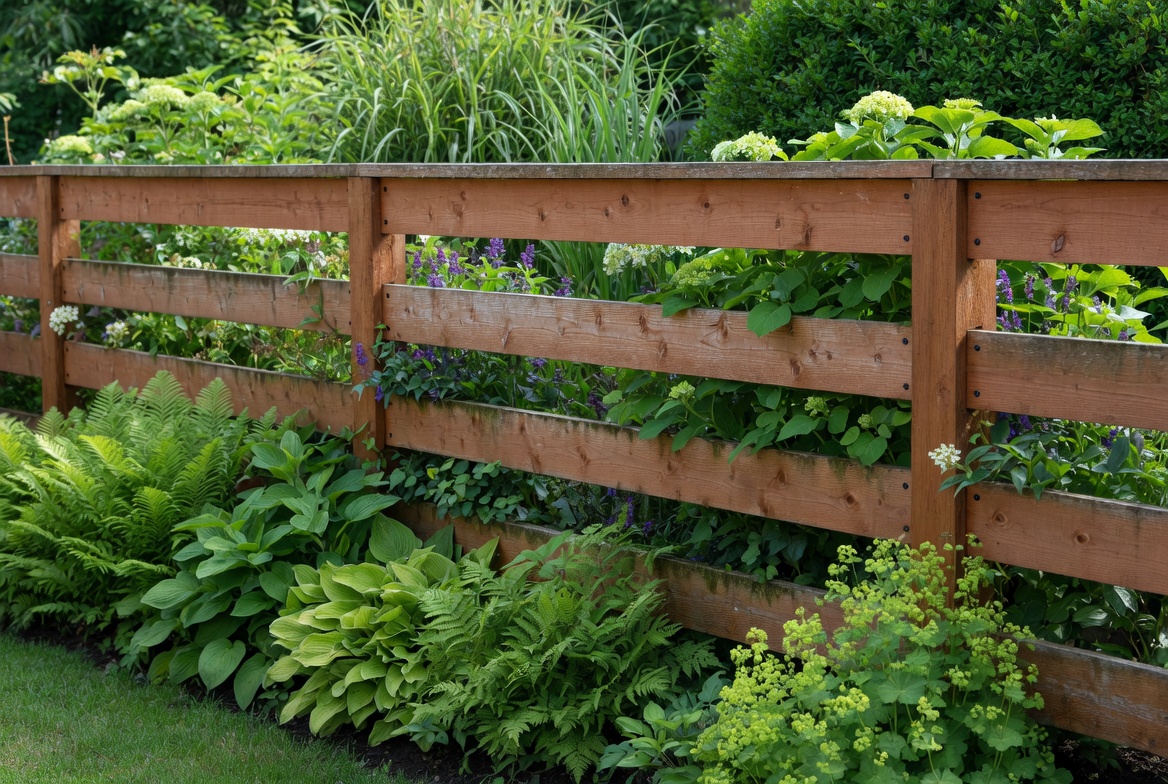
20 Wood Fence Ideas to Enhance Privacy and Curb Appeal
A wood fence does more than mark a boundary. It frames the property, establishes the visual tone of the outdoor space, provides privacy where it’s needed, and — when chosen and installed correctly — adds genuine value to a home. Wood remains the most popular fencing material in North America because it’s versatile, natural-looking, and workable for both professionals and capable DIYers. The range of wood fence styles available is wider than most homeowners realize — from the spare geometry of horizontal slat designs to the cottage charm of a picket fence to the raw character of reclaimed timber. These 20 ideas cover every style, every level of privacy, and every aesthetic from traditional to contemporary.
1. Classic Board-on-Board Privacy Fence
Best for: Full backyard privacy, any property where complete visual screening from neighbors is the priority
A board-on-board fence — alternating vertical boards on each side of the horizontal rails so that boards on one side cover the gaps between boards on the other — provides complete privacy from any angle while allowing air to circulate through the overlapping gaps. Unlike a solid panel fence that stops all airflow, a board-on-board design reduces wind load and creates a more comfortable microclimate in the yard.
The standard height for a privacy fence is 6 feet — enough to screen adults from view while complying with most residential zoning regulations. Some jurisdictions allow 8-foot fences with a permit.
Smart tip: Install boards on both sides of the rails rather than one side only. A fence that looks complete from inside the yard but shows raw rail backs to the neighbor reads as inconsiderate and devalues the neighbor relationship. Board-on-board looks identical from both sides.
Mistake to avoid: Spacing the boards so far apart that the offset doesn’t achieve full privacy. The overlap between boards on opposite sides of the rail should be at least 1 to 2 inches. Test by placing a board on each side before setting the spacing permanently.
2. Horizontal Slat Cedar Fence
Best for: Modern, contemporary, and minimalist homes — the most popular contemporary fence style
Horizontal wood fences have dominated residential design for a decade and continue to be the first choice for homeowners who want a fence that reads as designed rather than standard. The horizontal lines visually extend the yard width and create a clean, intentional aesthetic that suits modern architecture immediately.
Cedar is the preferred material for horizontal slat fences because its natural oils resist rot without chemical treatment, it’s dimensionally stable (less prone to warping than pine), and it weathers to an attractive silver-grey if left unfinished. The warm reddish-brown of fresh cedar also stains beautifully to any desired color.
Smart tip: Leave gaps of 1 to 2 inches between horizontal slats — enough for air circulation and partial views through while maintaining privacy at a normal standing distance. A completely solid horizontal fence with no gaps looks like a wall rather than a fence and creates significant wind load on the posts.
Mistake to avoid: Using horizontal boards without adequate vertical post spacing. Horizontal boards span between posts — as span increases, boards deflect and sag under their own weight. Posts for horizontal fences should be no more than 6 feet apart, and 4 feet apart provides better long-term results.
3. Classic White Picket Fence
Best for: Front yards, cottage and traditional home styles, any property where an open, welcoming aesthetic is preferred over privacy
The white picket fence is one of the most recognized residential design elements in American architecture — instantly readable as welcoming, well-maintained, and domestically comfortable. It provides boundary definition and decoration without blocking light or views, which makes it ideal for front yards where visual connection to the street is desirable.
Standard picket fences run 3 to 4 feet in height — visible enough to define the boundary without creating an imposing barrier. Picket spacing of 3 to 4 inches provides a traditional look; wider spacing creates a more open, airy effect.
Smart tip: Repaint a white picket fence every 4 to 6 years — or more frequently in climates with strong UV. White paint shows weathering and yellowing more clearly than any other color. A fresh coat of white paint on an existing picket fence has immediate impact on front yard appearance.
Mistake to avoid: Using standard square-cut pickets when pointed or decorative-top pickets are available at minimal additional cost. Decorative picket tops — gothic (pointed), dog-eared (diagonal cut), or French gothic (curved) — add character to a standard fence for virtually no extra effort.
4. Shadowbox Fence Design
Best for: Shared property boundaries, situations where both sides of the fence should look equally finished
A shadowbox fence — boards alternating on each side of the central rail, with gaps between each board — creates a fence that looks identical from both the inside and outside while providing meaningful privacy (blocking direct sightlines) without completely blocking light and airflow.
The alternating board pattern creates a subtle three-dimensional shadow effect as light moves through the day — the fence has depth and visual interest that a flat panel fence doesn’t.
Smart tip: Shadowbox fences are particularly appropriate for shared boundaries with neighbors because they look finished from both sides. A board-on-board fence can look complete from your side while presenting raw rail backs to your neighbor — a shadowbox eliminates this issue entirely.
Mistake to avoid: Building a shadowbox fence and expecting complete privacy. The offset boards provide privacy at a direct viewing angle, but views through the gaps are visible from oblique angles. For complete privacy from all angles, a board-on-board or solid panel design is more appropriate.
5. Dark Stained Wood Fence
Best for: Modern homes, properties with strong landscaping, any fence where the structure should recede rather than dominate
A dark-stained wood fence — charcoal, espresso, deep brown, or near-black — does something unexpected: it makes itself less visible. Dark colors absorb light and recede visually, which means a dark fence makes the garden planting in front of it the dominant visual element rather than the fence itself.
Against a dark fence, green plants look intensely green, flowers look more vivid, and the entire garden composition gains contrast and depth. This is why dark fences are popular in landscape photographer and garden designer work — they’re backgrounds, not subjects.
Smart tip: Apply a dark exterior stain rather than paint to a wood fence. Stain penetrates the wood fiber and doesn’t form a surface film that can crack and peel. When it needs reapplication (every 3 to 5 years), a new coat can be applied over the existing stain with minimal preparation.
Mistake to avoid: Using very dark fence stain in a small, shaded garden. Dark colors absorb light — in a garden that’s already dim, a dark fence can make the space feel oppressive. Dark stains work best in gardens with strong sunlight or generous planting that counteracts the darkness with color.
6. Reclaimed Wood Rustic Fence
Best for: Cottage, farmhouse, and naturalistic garden styles — fences where character matters more than uniformity
Reclaimed timber — salvaged barn wood, old railway sleepers, pallet boards, or weathered structural timber — creates fences with a quality of authenticity that no new material replicates. The varied weathering, nail holes, saw marks, and patina of genuinely aged wood tell a history that newness erases.
Reclaimed wood fences suit gardens that embrace imperfection — cottage gardens, wildflower gardens, vegetable gardens where the fence is a backdrop for abundant, informal planting.
Smart tip: Mix board widths deliberately in a reclaimed wood fence — the variety of widths from different timber sources creates a more authentic, less assembled appearance than uniform boards would. Irregular board spacing adds to the casual authenticity.
Mistake to avoid: Using reclaimed timber with unknown treatment history near vegetable gardens or children’s play areas. Some old timber was treated with arsenic-based preservatives or creosote — both harmful in food-growing environments. Research the timber source before using reclaimed wood in sensitive applications.
7. Split Rail Fence with Plants
Best for: Rural and semi-rural properties, large yards, any space where open boundaries are more appropriate than privacy barriers
A split rail fence — two or three horizontal rails spanning between rustic posts, with significant open space between rails — is the most open wood fence style available. It defines a boundary without blocking anything, and its casual, unpretentious character suits rural and semi-rural settings where an open relationship with the surrounding landscape is appropriate.
Split rail fences work best when combined with planting — climbing roses, native shrubs, or ornamental grasses growing through and around the rails blur the line between fence and garden.
Smart tip: Plant climbing roses on a split rail fence for one of the most classically beautiful combinations in garden design. Rosa ‘New Dawn’, ‘Climbing Iceberg’, or ‘American Pillar’ all climb readily through split rail structures and create a fence that’s genuinely spectacular in flower.
Mistake to avoid: Using a split rail fence where privacy or security is the actual requirement. This is a boundary marker, not a privacy or security structure. Anyone can step through or over the rails. If privacy or containment is needed, this isn’t the right fence choice.
8. Wood and Metal Hybrid Fence
Best for: Contemporary homes, properties where durability and design quality are both priorities
Combining wood and metal — typically cedar or hardwood boards with steel or aluminum posts and framing — produces a fence with the warmth of timber and the structural durability of metal. The steel posts don’t rot, don’t lean, and provide excellent long-term stability. The timber boards provide the warmth and natural texture that all-metal fences lack.
This combination also allows creative material mixing — wood boards alternating with steel mesh panels, wood-framed sections alternating with metal panel sections, or wood boards attached to a steel subframe at angles that wouldn’t be structurally possible with wood posts alone.
Smart tip: Use galvanized or powder-coated steel for all metal components in a wood-metal hybrid fence. Untreated steel rusts in outdoor conditions, staining adjacent timber and deteriorating structurally. The coating premium is a small fraction of total project cost.
Mistake to avoid: Allowing direct timber-to-metal contact without a barrier. Metal and timber expand and contract at different rates with temperature changes. Direct contact points create stress that can crack timber and loosen connections. Use rubber gaskets or spacers between metal and timber elements.
9. Lattice Top Privacy Fence
Best for: Gardens where full solid privacy is too visually heavy, situations where light and partial views at the top are desirable
A fence with a solid lower section (typically 4 to 5 feet) and a lattice panel at the top (adding 1 to 2 feet) provides meaningful privacy from seated and standing view heights while allowing light and partial views through the lattice at the top. The overall fence height is taller than a solid 6-foot fence without the visual weight.
Lattice tops also provide a structure for climbing plants — roses, clematis, and annual climbers growing through lattice panels create a fence that softens and decorates itself over the growing season.
Smart tip: Choose square or diagonal lattice pattern based on the fence’s overall aesthetic. Square lattice suits contemporary designs; diagonal lattice suits traditional and cottage styles. Both are functionally identical — the choice is purely visual.
Mistake to avoid: Using thin plastic lattice panels in a wood fence. Plastic lattice fades, becomes brittle, and looks cheap against timber. Use timber lattice panels that match the fence’s other wood components in species and finish.
10. Arched Top Decorative Fence
Best for: Traditional and formal front yards, gardens where the fence is a decorative feature as much as a functional structure
An arched top fence — boards cut with a gentle curve at the top, either individually or as a continuous arch between posts — transforms a standard privacy fence into an architectural garden feature. The arch adds elegance and movement to what is otherwise a rectangular structure.
Individual arched boards create a scalloped top profile when viewed as a fence run — graceful and slightly Victorian in character. A full panel arch between posts creates a stronger architectural statement, particularly effective when combined with decorative post caps.
Smart tip: Ensure the arch profile is consistent across the entire fence run. Even small variations in the arc between panels create a fence that looks improvised rather than designed. Use a template for cutting arched boards to ensure uniformity across the full length.
Mistake to avoid: Using a very deep arch (going from tall at posts to short in the middle) on a tall privacy fence. A deep arch in a 6-foot fence brings the center of each panel below an effective privacy height. Keep arches shallow — 6 to 8 inches difference between the height at posts and the lowest point of the arch — to maintain both privacy and visual grace.
11. Vertical Garden Fence
Best for: Small gardens, urban properties, any fence where green coverage is preferred over exposed timber
Planter boxes or trellis panels attached to a fence structure allow plants to grow on and over the fence itself, converting a timber barrier into a living garden wall. At full coverage, the fence disappears beneath foliage and flowers, and the garden boundary becomes part of the planting.
Planter boxes mounted at the base of fence panels hold soil for climbing plants. Trellis panels attached to the fence face provide structure for vines. Both approaches work simultaneously for maximum green coverage.
Smart tip: Choose evergreen climbers for at least some of the vertical garden coverage to ensure the fence looks green year-round rather than bare for half the year. Trachelospermum (star jasmine), Hedera (ivy), and Lonicera (honeysuckle) provide year-round coverage in most climates.
Mistake to avoid: Allowing climbing plants to damage the fence structure. Some vigorous climbers — particularly ivy and wisteria — can work their way under boards and into joints, eventually causing structural damage. Keep climbers on a trellis system attached to the fence face rather than growing directly into the fence structure.
12. Sloped Yard Stepped Fence
Best for: Properties with grade changes along the fence line, sloped yards
A fence on a sloped property must address the change in grade between posts. There are two approaches: a stepped fence (each panel drops by a step at each post, following the grade in increments) or a raked fence (fence boards follow the slope continuously, with the top and bottom of the fence running parallel to the ground slope).
Stepped fences create a cleaner, more architectural appearance and are easier to build with standard rectangular panels. Raked fences follow the slope more naturally and suit informal garden styles better.
Smart tip: On a sloped property, use the stepped fence approach for formal gardens and the raked approach for informal or naturalistic gardens. The choice reflects the overall aesthetic of the outdoor space rather than a practical difference in function.
Mistake to avoid: Creating steps so large that significant triangular gaps appear between the bottom of each fence panel and the rising ground. Gaps larger than about 4 inches at the base of a fence panel look unfinished and allow small animals through. Use smaller, more frequent steps to keep base gaps minimal.
13. Hog Wire and Wood Frame Fence
Best for: Modern farmhouse, industrial-chic, and contemporary rustic styles — one of the most popular current fence trends
A hog wire fence — welded wire mesh panels (originally used in agriculture for animal containment) set within timber frames — creates a fence with a distinctly modern-rustic character. The wire allows views through, provides minimal visual barrier, and creates a structure that climbing plants grow through naturally over time.
The timber frames — typically 4×4 or 4×6 posts with horizontal rails — provide the warm, natural quality. The galvanized wire provides the contemporary, slightly industrial detail.
Smart tip: Use 2-inch square welded wire mesh rather than the larger 4-inch agricultural mesh for a cleaner, finer-textured appearance. The 2-inch grid reads as a designed material rather than a farm supply item and suits residential applications more convincingly.
Mistake to avoid: Using untreated mild steel wire mesh. Standard mild steel wire rusts relatively quickly in outdoor conditions, staining the adjacent timber frames and deteriorating structurally. Specify galvanized or vinyl-coated welded wire for long-term appearance and performance.
14. Cape Cod Style Fence
Best for: Coastal and New England-inspired homes, cottage and traditional residential styles
The Cape Cod fence is a variation of the picket fence with taller boards (typically 4 to 5 feet) and slightly decorative top profiles — pointed, rounded, or angled — that give it more height and character than a standard picket. It combines the openness and charm of a picket fence with a bit more presence and privacy.
Its coastal associations make it particularly appropriate for homes with shingles, weatherboard, or traditional architectural detailing.
Smart tip: Paint a Cape Cod fence in the same white as the house trim for a cohesive, coordinated appearance. The fence reads as part of the house’s design language rather than a separate garden element — a quality that enhances rather than clutters the property’s overall appearance.
Mistake to avoid: Spacing Cape Cod fence boards too far apart. The taller boards of a Cape Cod design look proportionally correct with narrower gaps (2 to 3 inches) than a standard picket fence. Wider gaps on taller boards create a fence that reads as unfinished or sparse.
15. Fence with Built-In Planters
Best for: Small gardens where every surface is an opportunity for planting, urban properties
Window-box style planters mounted at the top or face of a fence panel turn the fence into a vertical garden without climbing plant infrastructure. Each planter holds soil for seasonal flowers, herbs, trailing plants, or evergreen shrubs.
The combination of fence and planting creates a garden boundary that’s more interesting, more colorful, and more alive than a plain timber fence, particularly in urban gardens where the fence is often the most visible surface.
Smart tip: Mount planters at the outside face of the fence — visible to the street — as well as the inside. Planters visible from the street contribute significantly to curb appeal. Planters visible only from inside the garden contribute to the owner’s enjoyment. Both faces can carry planters simultaneously.
Mistake to avoid: Using planters too small to sustain meaningful plant growth. Small planters (under 8 inches wide) dry out in a single day in summer and require daily watering to keep plants alive. Use planters of at least 12 inches width and depth for practical, sustainable planting.
16. Decorative Panel Carved Fence
Best for: Gardens where the fence is a design statement, high-visibility applications
Wooden fence panels with carved or laser-cut patterns — geometric designs, botanical motifs, abstract forms — create a fence that functions as outdoor art rather than just a boundary. The pattern creates shadow play as the sun moves through the day, casting changing shapes on the ground and adjacent surfaces.
Carved or patterned panels suit high-visibility applications — a feature wall visible from the living room, a garden entry, or the end wall of a garden seen from the house.
Smart tip: Use patterned fence panels as accent sections within a plain fence run rather than across the entire fence length. One or two decorative panels flanked by plain sections creates a focal point. An entire fence of the same pattern becomes repetitive and loses the special-feature quality.
Mistake to avoid: Using intricate carved patterns in a fence that’s difficult to maintain. Carved timber with deep detail traps moisture, debris, and organic matter that accelerates rot. Simple geometric patterns with open geometry are both visually strong and far more practical to maintain.
17. Fence with String Lights
Best for: Entertaining gardens, outdoor living spaces used in the evening
String lights mounted on a fence transform evening outdoor space — the warm glow along the fence line creates the enclosed, atmospheric quality of an outdoor room. A fence that’s a functional background during the day becomes a defining design element at night.
String light options: bulb-style Edison lights (warm, amber-toned, highly atmospheric), commercial-grade LED strings (cooler but more energy-efficient), battery-powered solar strings (no electrical installation needed), or hardwired low-voltage LED strips along the fence top rail.
Smart tip: Mount string lights on the inside face of the fence at the top rail rather than hanging them between posts. Lights mounted at a consistent height along the fence create a clean, intentional effect. Lights hanging in varying arcs between posts look casual — appropriate for some settings, less so for others.
Mistake to avoid: Using indoor extension cords or non-weatherproof lights outdoors. Any electrical installation on an outdoor fence must be rated for outdoor use — IP44 minimum, IP65 for exposed installations. Non-weatherproof lights and cords are safety hazards and degrade rapidly in outdoor conditions.
18. Horizontal Fence with Black Posts
Best for: Contemporary homes, modern landscaping, high-contrast design aesthetics
The combination of warm cedar or timber horizontal boards with matte black steel posts is one of the sharpest visual combinations available in residential fencing. The black posts provide clean vertical punctuation, the timber boards add warmth, and the contrast between the two materials creates a fence that reads as deliberately designed from the street.
This combination is particularly effective against a light-colored house exterior or adjacent to light-toned hardscaping — the black posts anchor the composition visually.
Smart tip: Specify powder-coated steel posts in matte black rather than gloss. Gloss black shows scratches, dust, and fingerprints more clearly and looks more industrial than the matte finish. Matte black suits residential applications and ages more gracefully.
Mistake to avoid: Mixing the black post aesthetic with traditional or rustic fence styles. Black steel posts are a contemporary design element — they suit horizontal board, hog wire, and geometric fence styles. Against a picket fence or a split rail, black posts create a jarring material conflict.
19. Fence with Climbing Plants
Best for: Any fence where softening and natural coverage is preferred over bare timber
Climbing plants on a fence are the most natural fence enhancement available — they convert a hard boundary into a garden feature and, at full coverage, replace the visual presence of the fence with a wall of foliage and flower. The fence becomes infrastructure rather than design element.
The best climbing plants for fence coverage: roses (the classic choice — fragrant, colorful, effective; suited to informal and cottage styles); clematis (fast-growing, varied flower color, suited to most fence styles); hydrangea petiolaris (climbing hydrangea — exceptionally beautiful but slow to establish; suited to shaded fence positions); and honeysuckle (fragrant, fast-growing, tolerant of most conditions).
Smart tip: Train climbing plants onto a trellis panel attached to the fence face rather than directly onto the fence boards. This creates a small air gap between plant and fence that allows the timber to dry after rain — significantly reducing rot risk — and makes fence maintenance possible without removing established plants.
Mistake to avoid: Planting vigorous climbers like wisteria directly against a timber fence without controlling their growth. Wisteria stems become genuinely woody and powerful over several seasons — they can work their way under fence boards, around posts, and through lattice panels, causing structural damage. Always train wisteria on a separate trellis system rather than into the fence structure.
20. Choosing the Right Wood for Fences
Best for: Anyone at the planning stage — timber choice determines fence longevity and maintenance more than any other decision
The right timber for a fence depends on the application, budget, maintenance commitment, and aesthetic priority. Understanding the differences before purchasing saves significant expense and frustration.
Cedar (western red cedar): naturally rot-resistant, attractive appearance, weathers to silver-grey, no chemical treatment needed. Ideal for visible decorative fences where appearance matters. Mid-range price.
Redwood: superior natural rot resistance, beautiful color, very durable. Expensive and limited availability outside the western US. Best for high-end installations where longevity justifies cost.
Pressure-treated pine: most affordable, widely available, ground-contact rated for posts. Requires periodic maintenance. Best for functional fences and post installation where appearance is less critical.
Ipe (Brazilian hardwood): extremely dense and durable, very resistant to rot and insects, beautiful grain. Expensive. Best for premium fences where maximum longevity is the priority.
Composite: wood fiber and recycled plastic mix. Consistent appearance, virtually zero maintenance, 25-year expected life. More expensive upfront, lowest lifetime cost. Best for anyone prioritizing low maintenance.
Smart tip: Whatever timber is used for fence boards, always use pressure-treated or naturally rot-resistant timber for fence posts. Posts are in direct ground contact where moisture and microorganisms are most active. A fence with beautiful cedar boards on treated pine posts will outlast the same fence on untreated pine posts by decades.
Mistake to avoid: Choosing fence timber based on initial cost alone. The cheapest timber that needs replacement in 8 years costs more over 20 years than quality timber that lasts 25 years. Calculate total cost of ownership — including installation labor for replacement — before deciding that the cheapest option is the most economical.
Before You Start
- Check local regulations. Most jurisdictions have height limits for residential fences — typically 4 feet in front yards and 6 feet in back yards. HOA rules may be more restrictive. Check before ordering materials.
- Locate the property boundary precisely. Building a fence even 6 inches over the property line can require expensive removal and rebuilding. Have the boundary surveyed if there’s any uncertainty.
- Call before you dig. Underground utilities — water, gas, electrical, cable — can run anywhere in a yard. Contact your local utility notification service before digging any post holes.
- Plan for gates. Every fence needs at least one gate — plan gate placement and width before finalizing the fence layout. A gate that’s too narrow for a wheelbarrow or lawn mower creates a permanent frustration.
- Choose posts before boards. The post specification — size, spacing, depth — determines the structural adequacy of the entire fence. Get the posts right before worrying about the decorative elements.
Conclusion
A wood fence chosen thoughtfully for the property’s style, the owner’s maintenance commitment, and the actual functional requirements serves a property well for decades. The decisions that matter most happen before a single board is purchased: the timber species, the post specification, the height, and the style. Get these right and the fence looks good, lasts long, and requires minimal intervention. Rush these decisions and even an attractively designed fence becomes a maintenance problem within a few seasons.
