
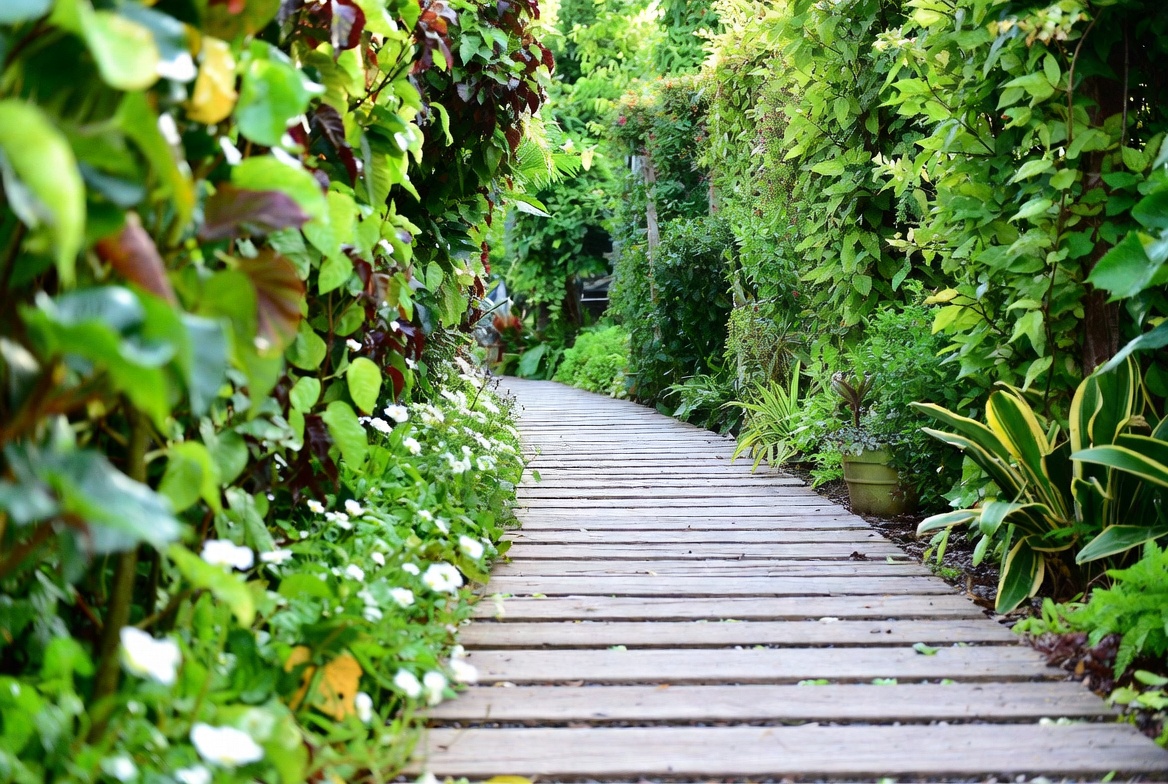
IN THIS ARTICLETable of Cont20 Wooden Walkway Ideas for Charming Garden Pathways
A garden path does more than connect two points. It determines how the garden is experienced — whether you move through it quickly or slowly, whether you notice the planting on either side or look ahead to the destination, whether the journey feels considered or purely functional. A wooden walkway does this with more warmth and natural character than stone, concrete, or brick. Wood connects visually with planting, softens hard garden layouts, and can be built by anyone with basic carpentry skills. These 20 ideas cover every scale and style of wooden garden path, from a simple line of reclaimed boards to a pergola-covered walkway that becomes the defining feature of the garden.
1. Classic Straight Deck Walkway
Best for: Connecting two specific points directly — house to shed, gate to front door, patio to garden seating area
A straight decked walkway — boards laid perpendicular to the direction of travel on a low timber frame — is the most structurally sound and longest-lasting wooden path option. The raised frame keeps the boards above ground contact, dramatically improving longevity compared to boards laid directly on soil.
Standard width: 36 inches for comfortable single-person walking; 48 inches for two people to walk comfortably side by side; 60 inches where the path will see significant traffic or furniture movement.
Board options: pressure-treated pine (most affordable, ground-contact rated for the frame; above-ground rated acceptable for the decking boards themselves), cedar (natural rot resistance, attractive appearance), composite (virtually zero maintenance, consistent appearance over decades).
Smart tip: Orient deck boards perpendicular to the walkway direction for the cleanest visual effect and easiest construction. Boards running parallel to travel direction require more complex framing and produce a less intuitive visual line.
Mistake to avoid: Building the frame too close to grade. Deck boards need airflow beneath them to dry after rain. A frame with the bottom chord less than 2 inches from soil level stays permanently damp, significantly shortening board life. Aim for at least 4 inches of clearance beneath the frame.
2. Curved Garden Path
Best for: Informal and naturalistic gardens, any path where the destination is less important than the journey
A curved wooden path through a garden slows movement naturally — curves invite pausing and looking sideways in a way that straight paths don’t. The curve also creates a sense of discovery, obscuring the destination and making the garden feel larger than its actual dimensions.
Achieving curves with wooden boards requires either thin flexible boards (1-inch thickness bends readily around gentle curves), a series of short straight sections angled to approximate a curve, or curved section framing that follows the path line.
Smart tip: Mark the desired curve with a garden hose before committing to any construction. A hose is infinitely adjustable and allows you to walk the curve, assess it from inside the house, and refine it until the line looks right. Photograph the hose layout for reference during construction.
Mistake to avoid: Making a curved path that curves arbitrarily with no relationship to garden features. A curve that goes around nothing — no tree, no bed, no feature — looks random rather than intentional. Every curve in a garden path should have a reason: it goes around a bed, reveals a view, or follows a natural contour.
3. Floating Deck Stepping Path
Best for: Gardens where a continuous deck path would feel too heavy, informal cottage and country gardens
A floating deck stepping path — individual square or rectangular deck panels placed at stride intervals through a lawn or planting area — creates a path that touches the garden lightly. Each panel is a small freestanding deck section (typically 24×24 or 24×36 inches) sitting directly on compacted gravel or pavers, with grass or ground cover growing between them.
The gaps between panels allow planting to flow through the path — creeping thyme, chamomile, or low grasses growing between stepping sections create a path that feels woven into the garden rather than imposed on it.
Smart tip: Space panels at comfortable stride intervals — 18 to 24 inches from the end of one panel to the start of the next, depending on the height and stride length of the primary users. Walk the proposed path barefoot to find the natural stride before fixing any spacing.
Mistake to avoid: Making individual stepping panels too small. A panel under 18 inches square requires precise foot placement and doesn’t feel like a path — it feels like an obstacle course. Panels of 24 inches or larger allow relaxed, natural walking without focusing on foot placement.
4. Reclaimed Pallet Wood Walkway
Best for: Budget-conscious gardeners, rustic and farmhouse aesthetic gardens, temporary paths
Disassembled pallet boards create genuinely attractive rustic paths at minimal material cost. The varied weathering, nail holes, and imperfections of pallet timber give the path character that new timber takes years to develop.
The critical safety check: only use pallets stamped HT (heat treated) — not MB (methyl bromide, a chemical treatment). HT pallets are safe for garden use; MB pallets have been treated with a fumigant that is not safe in food-growing environments and should never be used in gardens.
Smart tip: Seal or stain pallet boards before laying them. The weathered surface of old pallet timber absorbs moisture readily and degrades faster than sealed timber. A coat of exterior decking oil significantly extends the path’s usable life.
Mistake to avoid: Laying pallet boards directly on bare soil without a weed-suppressing layer beneath. Without landscape fabric or gravel underneath, weeds push through between boards within one season, and the boards sit in permanently damp conditions.
5. Wood Slice Stepping Stones
Best for: Woodland gardens, informal cottage paths, short garden connections
Cross-sections cut from tree trunks — typically 3 to 4 inches thick, from 12 to 24 inches in diameter — create stepping stones with genuine natural character. Each slice is unique in size, grain pattern, and shape, and the collection creates a path that looks as though it grew from the garden rather than being installed in it.
The practical challenge: wood slices in ground contact decay relatively quickly — typically 3 to 7 years depending on wood species, climate, and drainage. This makes them a medium-term solution rather than a permanent path, but their visual quality and low cost often justify the maintenance cycle.
Smart tip: Use hardwood slices (oak, ash, elm) rather than softwood (pine, spruce) for significantly longer life. Treat cut faces with a penetrating wood preservative before installation and annually thereafter to slow decay. Set slices on a bed of compacted gravel rather than directly on soil.
Mistake to avoid: Using very large, heavy slices without stable bases. A 24-inch oak slice 4 inches thick is extremely heavy and tends to rock on uneven ground. Compact a stable gravel base, check for level, and ensure each slice is completely stable before using the path regularly.
6. Boardwalk Style Through Garden
Best for: Wet or boggy gardens, coastal and beach-influenced aesthetics, paths through meadow or wildflower areas
A boardwalk — a continuous plank path raised 6 to 18 inches above grade on a timber frame — is the solution for gardens where the ground is too wet, too soft, or too planted to allow a path at grade. It passes through the garden without disturbing the ground below and allows visitors to experience plantings closely from an elevated perspective.
The raised construction keeps boards in moving air, which significantly improves drying time after rain and extends board life.
Smart tip: Add a non-slip surface to boardwalk boards in wet climates. Smooth decking boards become genuinely slippery when wet — particularly in shade where algae growth accelerates. Non-slip decking strips, sand mixed into the final coat of decking oil, or grooved anti-slip boards solve this directly.
Mistake to avoid: Building a boardwalk with inadequate structural support at the posts. Post bases must be secure — either driven into firm ground, set in concrete, or on helical anchors in soft ground. A boardwalk that moves or sways underfoot is both unpleasant and potentially dangerous.
7. Raised Wooden Bridge Path
Best for: Gardens with streams, dry creek beds, water features, or significant grade changes
A small garden bridge — spanning a dry creek bed, crossing a stream, or bridging a low point in the garden — is one of the most characterful features a wooden path can include. Even a modest bridge of 4 to 6 feet creates a moment of transition that makes the garden feel larger and more adventurous.
Simple garden bridges can be built from two parallel timber beams (the structural elements) with deck boards spanning across them. Low handrails on both sides improve safety and complete the visual effect.
Smart tip: Design the bridge width generously — at least 36 inches, ideally 48. A narrow bridge feels precarious and diminishes the experience. Width contributes to both safety and the feeling of confident transition.
Mistake to avoid: Building a garden bridge without considering the load it must support. A bridge carrying two adults and a wheelbarrow is under significant load. Size the structural beams for the expected use — not just for visual effect.
8. Wood and Gravel Combination
Best for: Contemporary and Japanese-inspired gardens, paths with a clean, designed aesthetic
Alternating timber sections with gravel panels creates a path with rhythm and visual interest — the regularity of the pattern creates a path that feels designed rather than simply functional. The gravel panels drain freely and the timber sections provide comfortable, dry footing in wet conditions.
The combination also suits gardens where the strict formality of a continuous wooden path would be too heavy — the gravel breaks it into a lighter, more permeable composition.
Smart tip: Use the same gravel in path panels as in adjacent garden beds for visual continuity. A path using one gravel type and surrounding beds using another creates visual discontinuity. Consistent material throughout the garden makes both the path and the beds look more intentional.
Mistake to avoid: Using fine gravel (under 10mm) in wood-and-gravel path panels. Fine gravel scatters onto the timber sections with every step and is tracents ▼
