
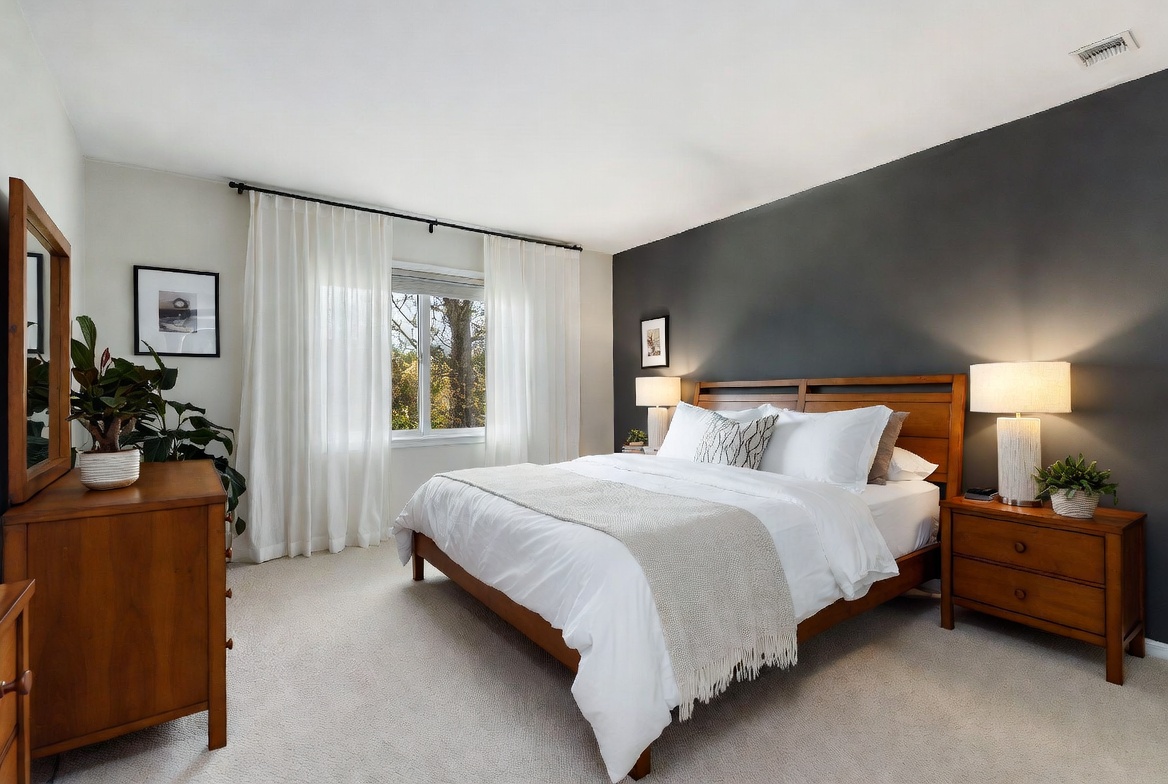
20 Bedroom Ideas for a Restful and Stylish Retreat
The bedroom is the one room in the house that exists entirely for you. It doesn’t need to impress visitors, host dinner parties, or function as a workspace. Its single purpose is to help you sleep well, wake up calmly, and feel at ease in the hours between. Yet most bedrooms are treated as afterthoughts — furnished with whatever fit the budget at the time, never quite finished, always slightly uncomfortable. These 20 ideas address every dimension of a bedroom that works: color, light, storage, furniture, and the smaller sensory details that determine whether a room feels restful or merely functional.
1. Choose a Calming Color Palette
Best for: Any bedroom — this is the foundation of everything else
Color affects mood in a bedroom more directly than in any other room because you experience it in a half-conscious state — as you fall asleep and as you wake. The colors that consistently produce restful bedrooms share a quality: they’re muted, slightly desaturated versions of their base color rather than bright or fully saturated ones.
Sage green (grey-green, not bright green), warm white (cream or off-white rather than stark white), dusty blue, soft terracotta, and warm greige are the bedroom colors that appear most consistently in genuinely restful spaces. They reflect light gently, don’t demand attention, and don’t create the visual noise that stronger colors produce.
Smart tip: Paint the ceiling the same color as the walls, or one shade lighter. A white ceiling above colored walls creates a sharp visual edge that the eye registers even at rest. A ceiling in the same palette as the walls makes the room feel enclosed in the best way — like a cocoon.
Mistake to avoid: Choosing a bedroom color based on how it looks in a brightly lit paint store or on a screen. Bedroom colors are experienced in low evening light and in darkness. Take large samples home and look at them in lamplight, not just daylight.
2. Invest in a Statement Headboard
Best for: Any bedroom — the headboard is the most impactful single piece of bedroom furniture
The headboard anchors the entire bedroom composition. Every other element in the room — lamps, artwork, cushions, curtains — is positioned in relation to it. A headboard that’s too small, too plain, or simply absent leaves the bed floating in the room without visual weight.
Upholstered headboards in linen, boucle, or velvet are the most versatile because the soft material adds warmth and absorbs sound — both relevant qualities in a room designed for sleep. A headboard that extends to around two-thirds the height of the wall behind the bed has the most impact without overwhelming the room.
Smart tip: Mount the headboard directly to the wall rather than attaching it to the bed frame. A wall-mounted headboard stays perfectly positioned, doesn’t move when you read or sit up in bed, and creates a cleaner look without the headboard-bracket assembly visible at the base.
Mistake to avoid: Choosing a headboard that’s the same width as the mattress. A headboard should be at least as wide as the bed frame on each side — ideally extending 2 to 4 inches beyond. A headboard exactly the width of the mattress looks as though it was sized to fit rather than chosen for the room.
3. Layer Bedding for Texture and Warmth
Best for: Any bed — layered bedding looks more considered and feels more comfortable than a single duvet
The difference between a bed that looks inviting and one that looks merely made is almost always in the layering. A single duvet in a matching cover, pulled flat and tucked in, looks like a hotel bed without the hotel service. Layered bedding — a fitted sheet, a flat sheet folded back over the duvet at the top, a lighter throw across the foot, two sleeping pillows plus two larger Euro squares behind — creates depth, texture, and the sense that the bed is a destination rather than just furniture.
The material combination matters: linen for breathability, cotton percale for crispness, waffle-weave or chunky knit for texture. Mixing two or three complementary materials in the same tonal range creates a layered look without visual chaos.
Smart tip: Wash all new bedding before putting it on the bed. New bedding often has sizing (a stiffening chemical used in manufacturing) that prevents it from feeling soft. A wash removes this and reveals the material’s actual texture — which is almost always better than the stiff, crackling feel of new bedding straight from the packaging.
Mistake to avoid: Using bedding in too many competing colors or patterns. The most restful beds use a maximum of two colors and one pattern (or one color with varied textures). Three colors and two patterns look like the bed hasn’t been made rather than that it’s been styled.
4. Get Bedroom Lighting Right
Best for: Every bedroom — lighting is the element that most determines the room’s atmosphere at night
Most bedrooms are lit by a single central ceiling light that illuminates everything from directly above, creates harsh shadows, and is entirely wrong for a room designed for rest. The ceiling light is a functional light for getting dressed and cleaning — it should not be the only light source and should never be the one you use in the evening.
The correct bedroom lighting layers three sources: ambient (a ceiling fixture with a dimmer for general illumination), task (bedside reading lights — ideally wall-mounted to free up nightstand surface), and accent (a table lamp on a dresser, LED strips behind a headboard, or a floor lamp in a corner that adds warm, low-level glow).
Smart tip: Install a dimmer on every bedroom light switch if you’re doing any electrical work in the room. The ability to reduce light levels gradually from early evening to bedtime supports the body’s natural circadian rhythm in a way that switching between full bright and complete darkness does not.
Mistake to avoid: Using cool white LED bulbs (above 4000K) in bedroom lamps. Cool light suppresses melatonin production and makes falling asleep harder. Use warm white (2700K to 3000K) for all bedroom lighting — the warmth feels right for a room associated with rest and the color rendering is more flattering.
5. Create a Reading Nook
Best for: Bedrooms with a spare corner, anyone who reads before sleep
A reading nook in the bedroom is one of the most personally satisfying additions to a home — a dedicated, comfortable spot for one of the best activities available before sleep. It doesn’t require much space: a well-chosen armchair, a small side table at the right height, and a directed reading light are sufficient.
The armchair should be genuinely comfortable for extended sitting — deeper than a dining chair, softer than an office chair, with arm height that supports a book at a comfortable reading angle. Wingback chairs and tub chairs both suit bedroom reading nooks because their contained form creates a sense of enclosure that suits focused reading.
Smart tip: Position the reading nook with a window to one side for daytime reading, and a dedicated reading light at eye level for evening reading. A light that shines from directly above creates shadows on the page; a light positioned to the side of the reading position illuminates the page without glare.
Mistake to avoid: Using the bedroom reading nook as a dumping zone when not in use. A chair in a bedroom that permanently holds tomorrow’s outfit, yesterday’s clothes, and a pile of things without a better home doesn’t function as a reading nook — it’s just a flat surface. The reading nook only works if it’s kept clear for its intended purpose.
6. Use Dark and Moody Tones
Best for: Bedrooms that need drama and a sense of enclosure, any room where the occupant prefers sleeping in complete darkness
The counterintuitive truth about dark bedrooms is that they often feel more restful than light ones. Dark walls — deep navy, forest green, charcoal, rich burgundy — absorb light rather than reflecting it, which reduces the visual stimulation that keeps the mind alert. A dark bedroom at night feels enclosed and safe in a way that a light-colored bedroom doesn’t.
The secret to making dark bedrooms work during the day: contrast. Dark walls need warm lighting (not cool), light or textured bedding that stands out against the wall, and enough natural light during the day to prevent the room from feeling oppressive in daylight hours.
Smart tip: Use a dark color on all four walls and the ceiling for maximum cocoon effect. Dark on three walls with a white ceiling looks unresolved. Full commitment to the dark palette — including ceiling — creates the enveloping quality that makes dark bedrooms exceptional.
Mistake to avoid: Combining dark walls with dark furniture and dark bedding without any light contrast. A completely dark bedroom with no light elements feels oppressive rather than cozy. Introduce light-colored or textured bedding, pale artwork, or metallic hardware to create the contrast that makes dark walls look designed.
7. Add a Bedroom Bench or Ottoman
Best for: The foot of the bed — this is the most underused surface in most bedrooms
The foot of the bed is a specific problem area in bedroom design — it’s visible from the door, from the bed itself, and from any seating in the room, but most beds leave it bare or use it as a landing zone for clothes and bags. A bench or ottoman at the foot of the bed solves this visually and practically.
Functionally: a bench is where you sit to put shoes on, where a throw blanket lives when not in use, where the decorative pillows go when you turn down the bed. Visually: it completes the bed composition and provides a horizontal element that grounds the bed frame.
Smart tip: Size the bench to roughly two-thirds the width of the bed rather than the full width. A bench exactly as wide as the bed makes both look like they were measured to match. A slightly shorter bench looks more deliberately chosen and less fitted.
Mistake to avoid: Using an ottoman with a lid that opens for storage at the foot of the bed if the bedroom is small. In a tight space, lifting a storage ottoman lid requires stepping around it awkwardly. In small bedrooms, a simple upholstered bench without storage is easier to use daily.
8. Hang Curtains High and Wide
Best for: Any bedroom with windows — this is the single change that most dramatically improves how windows look
Curtains hung just above the window frame make the window look small and the ceiling look low. Curtains hung just below the ceiling line with the rod extending 8 to 12 inches beyond the window frame on each side make the same window look dramatically larger and the ceiling feel higher.
This is the most common curtain mistake in residential bedrooms and one of the easiest to fix. It requires only moving the rod higher and either buying longer curtains or adding a length extender.
Curtains should reach the floor — ideally just touching it or with a very slight break of 1 to 2 inches. Curtains that stop short of the floor look as though they shrank in the wash.
Smart tip: For a bedroom where complete darkness is important for sleep, use blackout lining behind decorative curtains. Decorative curtains alone rarely block enough light for quality sleep, particularly in summer when mornings are early. Blackout lining can be attached to existing curtains without replacing them.
Mistake to avoid: Choosing curtain fabric that’s too heavy for the window size. Thick velvet curtains on a small window make the window look smaller and the room more oppressive. Light linen or cotton in a bedroom with modest windows — even in dark colors — keeps the window reading as an opening rather than a heavy element.
9. Add Greenery and Indoor Plants
Best for: Bedrooms that feel stark or impersonal, anyone wanting to improve air quality naturally
Plants in a bedroom do more than look attractive — they add the organic warmth and visual softness that hard surfaces like furniture, walls, and flooring can’t provide. Even one plant changes the atmosphere of a bedroom from assembled to lived-in.
The best bedroom plants tolerate low light and don’t require daily attention: snake plants (release oxygen at night rather than during the day), pothos (trails beautifully from a high shelf, very low maintenance), peace lily (one of the best air-purifying plants, tolerates deep shade), and ZZ plant (virtually indestructible in low-light bedrooms).
Smart tip: Position a trailing plant on a high shelf or wardrobe top where the vines can cascade downward. A trailing plant at ceiling height adds vertical interest and draws the eye upward in a way that a pot plant on a nightstand doesn’t.
Mistake to avoid: Using strongly fragrant plants in the bedroom. Gardenia, jasmine, and heavily scented flowers may be pleasant in a living room but can be overwhelming in a bedroom where the scent concentrates in the enclosed air overnight. Stick to unscented or very lightly scented varieties.
10. Use a Bedroom Area Rug
Best for: Any bedroom with hard flooring — this is the most immediately effective comfort upgrade available
The moment bare feet touch a soft rug on a cold morning is the test of whether a bedroom is genuinely comfortable. A rug beside the bed is not a decorative addition — it’s a daily comfort that changes the experience of waking up every single morning.
The rug should be large enough for both sides of the bed to have rug underfoot when getting up. In a standard double bedroom, a rug of at least 200 x 300 cm placed under the lower two-thirds of the bed — with rug extending 45 to 60 cm on each side and at the foot — provides adequate coverage.
Smart tip: Choose a rug with a pile height of at least 1.5 cm for maximum underfoot comfort. Very flat rugs look good but feel hard underfoot — the softness comes from pile depth. A medium-high pile rug in a bedroom provides both visual warmth and genuine physical comfort.
Mistake to avoid: Choosing a rug too small for the bed. The most common bedroom rug mistake is a rug that fits only in front of the nightstands but leaves the foot of the bed on bare floor. When in doubt, go larger — a too-large rug looks better than a too-small one in virtually every bedroom context.
11. Maximize Bedroom Storage
Best for: Any bedroom where clothes, books, and personal items create clutter on visible surfaces
A bedroom that’s visually calm requires adequate storage — not just technically sufficient storage, but storage that makes putting things away easier than leaving them out. The friction of storage determines whether it gets used: a wardrobe that requires precise folding to fit everything in will be left open with items piled on the floor. One with a place for everything is maintained naturally.
Under-bed storage (rolling drawers or bed frames with integrated lift-up storage) is the most underused bedroom storage opportunity — the volume beneath a standard bed frame is roughly equivalent to a large wardrobe. Ottoman beds with lift-up access maximize this volume.
Smart tip: Store items you use seasonally (spare bedding, out-of-season clothing) under the bed, and keep daily-use items at accessible height in the wardrobe. This frees wardrobe space for the things you reach for every day without losing any total storage capacity.
Mistake to avoid: Using the top of the wardrobe as permanent visible storage. Items stored on top of wardrobes collect dust, look untidy from anywhere in the room where you can see above eye level, and gradually accumulate beyond the wardrobe’s original footprint. If you need that storage, add a proper lid or basket to contain it.
12. Create a Gallery Wall
Best for: Bare walls, bedrooms that need personality, anyone who has artwork or photographs worth displaying
A gallery wall in a bedroom — typically on the wall behind the bed or on the wall facing the bed — creates a focal point that adds character in a way that single large artwork sometimes can’t. The collection of smaller pieces at varying heights creates a composed, personal display that tells a story about the room’s occupant.
The key to a gallery wall that looks designed rather than random: a consistent framing style (all black frames, all natural wood, or all white), enough variation in image size to create visual movement, and a composition that’s centered on the wall rather than drifting to one side.
Smart tip: Plan the gallery wall layout on the floor before hammering any nails. Arrange the frames on the floor in the intended composition, photograph it, and compare the photo to the wall space before committing to any holes. This prevents the gradual accumulation of nail holes from an evolving arrangement.
Mistake to avoid: Hanging the gallery wall too high. The center of the overall composition should sit at approximately eye level — around 57 to 60 inches from the floor. Gallery walls hung higher than this feel disconnected from the furniture below and from the people in the room.
13. Try a Four-Poster or Canopy Bed
Best for: Bedrooms with high ceilings, anyone wanting a genuinely dramatic bedroom focal point
A four-poster or canopy bed is one of the most transformative furniture choices available in bedroom design. It creates a room within a room — a defined, enclosed sleeping space that feels architecturally intentional regardless of what else is in the bedroom.
Modern four-poster beds don’t require heavy timber and ornate carving. Minimalist metal four-poster frames in black or brass suit contemporary bedrooms. Simple wooden post frames in natural oak suit Scandinavian and transitional aesthetics. The posts don’t need fabric draped between them to create the effect — even bare posts define the sleeping space clearly.
Smart tip: In a bedroom with low ceilings (below 8 feet), choose a four-poster with relatively low posts — around 70 to 80 inches — rather than full ceiling-height posts. Very tall posts in a low-ceilinged room make the ceiling feel lower, not higher.
Mistake to avoid: Adding heavy, full-length fabric canopy panels to a four-poster in a small bedroom. Fabric canopies visually enclose the sleeping space and make a small room feel much smaller. In compact bedrooms, sheer or minimal fabric, or no fabric at all, maintains the architectural effect without enclosing the space.
14. Add Mirrors to Open Up Space
Best for: Small bedrooms, dark bedrooms, any room that feels smaller than it is
A large mirror in a bedroom does two things simultaneously: it reflects light and doubles the perceived depth of the room. A full-length mirror on a wall perpendicular to the window reflects natural light back into the room and creates the visual impression of a second window or doorway.
A full-length leaning mirror — a large format rectangular mirror leaning against the wall rather than hung — is the most flexible option because it can be repositioned and requires no drilling. Proportions that work: at least 60 inches tall and 24 inches wide for a single standing mirror in a standard bedroom.
Smart tip: Place a mirror where it reflects something attractive — a window with garden view, a well-styled corner, or a beautiful lamp. A mirror that reflects a blank wall or the back of a door adds light but no visual interest. Position it to reflect the most photogenic element in the room.
Mistake to avoid: Placing a large mirror directly facing the bed. Many people find waking to their own reflection disorienting or disturbing. Mirrors perpendicular to the bed or on a wall visible from standing but not from lying down work better for most bedrooms.
15. Style a Beautiful Nightstand
Best for: Any bedroom — the nightstand is the most personal surface in the room
The nightstand is the last thing you see before sleeping and the first thing you see when waking. Its contents and styling have an outsized effect on the bedroom’s overall feel, particularly because it’s at eye level when lying down.
A well-styled nightstand has: a lamp at the right height for reading (the bottom of the shade at roughly shoulder height when sitting in bed), one book or a small stack, one personal object that means something, and enough clear surface to put a glass of water and your phone without anything falling off.
Smart tip: Match the nightstand height to the mattress height. The nightstand surface should sit at roughly the same level as the top of the mattress — not significantly higher, not lower. The reach from lying down to the nightstand surface should be effortless.
Mistake to avoid: Using a nightstand that’s too small for its contents. A tiny nightstand overloaded with a lamp, a stack of books, a water glass, a phone charger, and miscellaneous items looks chaotic even when each individual item is attractive. Size the nightstand generously enough to hold what you actually need with space to spare.
16. Use Wallpaper as a Feature Wall
Best for: The wall behind the headboard — the most impactful single surface in the bedroom
A feature wall behind the bed — papered in a pattern, texture, or bold color while the remaining walls are plain — creates a designed quality that paint alone rarely achieves. The bed is positioned against this wall, so it acts as a permanent backdrop for the room’s focal point.
Botanical prints, geometric patterns, textured grasscloth, and large-scale abstracts all work well as bedroom feature wallpapers. The choice should relate to the rest of the room’s palette — the wallpaper’s colors should appear in at least one other element (bedding, cushions, curtains) for the room to feel cohesive.
Smart tip: For renters or anyone wanting a reversible option, removable peel-and-stick wallpaper has improved dramatically in quality and now offers genuinely convincing results at a fraction of the cost of traditional wallpaper. It removes cleanly without damage to the wall surface.
Mistake to avoid: Using a very busy, high-contrast wallpaper pattern on the bedroom feature wall. The bedroom is a room for rest, and a wall of intense visual pattern behind the bed can be stimulating rather than calming. Choose patterns with organic forms, soft color contrast, or tonal variation rather than hard-edged graphic designs.
17. Scent the Bedroom Intentionally
Best for: Any bedroom — scent is the most underused element in bedroom design
Scent is processed by the limbic system — the part of the brain most directly associated with emotion and memory — without going through the rational filter that visual and auditory experiences pass through. This means the right scent in a bedroom works on a level deeper than conscious awareness, directly influencing the state of relaxation.
Lavender is the most researched sleep-supporting scent — studies consistently show reduced heart rate and improved sleep quality with lavender exposure before and during sleep. Vetiver, cedarwood, and sandalwood also have documented calming effects. These work best as room sprays, diffuser oils, or a small sachet inside the pillowcase.
Smart tip: Use a consistent scent in the bedroom and only in the bedroom. The brain forms strong associations between scent and place — a scent used exclusively in the bedroom over weeks becomes a genuine sleep cue that signals the transition into rest mode.
Mistake to avoid: Using scented candles as the primary bedroom scent source and burning them until sleep. Never leave a candle burning unattended or fall asleep with one lit. Use candles for the pre-sleep atmosphere and transition to a diffuser or room spray before actually getting into bed.
18. Declutter for Genuine Calm
Best for: Any bedroom — this is the most impactful free improvement available
Research consistently links bedroom clutter to disrupted sleep. The visual stimulation of objects without a home — clothes on chairs, items on floor surfaces, surfaces covered with miscellaneous things — registers as unfinished business, and the brain processes it as mild but persistent stress even while the person is trying to sleep.
Decluttering a bedroom doesn’t require minimalism — it requires that everything in the room has a designated home and that the surfaces used for rest (the bed, the nightstand, the floor around the bed) are kept clear.
Smart tip: Do a nightly 3-minute bedroom reset as part of a pre-sleep routine. Hang or put away anything that came off during the day, clear the floor, return items to their homes. Three minutes is enough to maintain a decluttered bedroom indefinitely if done consistently. The alternative — occasional major decluttering sessions — never quite catches up with daily accumulation.
Mistake to avoid: Storing work-related items in the bedroom. Laptops, files, notebooks, and work bags in the bedroom create an unconscious association between the sleep space and the stress and alert state of work. Even stored out of sight, work items in a bedroom can affect sleep quality. Keep work outside the bedroom if at all possible.
19. Small Bedroom Layout Tips
Best for: Bedrooms under roughly 130 square feet where furniture placement determines everything
In a small bedroom, the layout is the design. A poorly arranged small bedroom — furniture pushed against every wall, a bed blocking the door, a wardrobe that opens into the walking route — feels smaller than it is. The same room, arranged thoughtfully, feels workable and even comfortable.
The single most important small bedroom decision: bed placement. In most small bedrooms, the best position is with the head against the wall and one side against the wall or a very low piece of furniture. This leaves the maximum floor space clear and creates a defined sleeping zone without the bed floating in the center.
Floating furniture — pieces with legs rather than floor-length bases — makes a small bedroom feel less cluttered because you can see the floor beneath, which reads as more space even when the total floor area is identical.
Smart tip: In a very small bedroom, use wall-mounted lighting instead of table lamps on the nightstand. Wall-mounted reading lights free up the entire nightstand surface and eliminate the visual clutter of lamp bases in a tight space.
Mistake to avoid: Using oversized furniture in a small bedroom in pursuit of storage. A wardrobe that fits every item of clothing but fills an entire wall creates a room that feels like a closet rather than a bedroom. Prioritize proportional furniture over maximum storage capacity — the bedroom experience matters more than maximizing storage volume.
20. Make the Bed the Focal Point
Best for: Every bedroom — this is the principle that ties all other ideas together
Every decision in a bedroom should serve one goal: making the bed the undisputed focal point of the room. The bed is where the room’s purpose is most completely expressed. Everything else — the lighting, the color, the furniture, the textiles — exists to support and frame it.
This means the largest, most beautiful, most considered elements of the bedroom should be associated with the bed: the headboard, the bedding, the lighting on either side, the artwork above. Secondary elements — the wardrobe, the dresser, the seating — should be quieter, less assertive, stepping back visually rather than competing.
When this hierarchy is in place — bed as clearly the most important element, everything else in support — the bedroom works. When it’s absent and multiple elements compete for attention, no amount of styling makes the room feel resolved.
Smart tip: If the bedroom feels visually unsettled and you can’t identify why, photograph it. The camera flattens the three-dimensional space and reveals the visual hierarchy (or lack of it) more clearly than looking at the room in person. The photo will usually show clearly which element is competing with the bed for attention.
Mistake to avoid: Hanging large artwork on a wall that competes with the headboard wall. Two walls each with a large, dominant element create competing focal points that make the room feel unresolved. Reserve the most prominent wall treatment for the bed wall, and keep the facing wall quieter.
Before You Start
- Fix the layout first. If the current layout doesn’t work — bed blocking a door, wardrobe that won’t open fully, no natural traffic route through the room — no decorative improvement will resolve it. Layout before aesthetics.
- Assess the light. Walk through the bedroom at different times of day and evaluate where natural light falls, how bright it is, and what the artificial lighting currently achieves. Lighting decisions should follow from honest assessment.
- Identify the one thing that bothers you most. Usually one element is responsible for most of the dissatisfaction with a bedroom: the duvet cover, the curtains, the lighting, the clutter. Start with that.
- Sleep quality is the success metric. A bedroom that looks beautiful but doesn’t support good sleep has failed. Every decision should be tested against whether it helps the room feel calmer, darker, quieter, and more conducive to rest.
Conclusion
A bedroom that genuinely works asks very little of you daily — it’s calm when you arrive, easy to keep tidy, and reliably supportive of sleep. Getting there requires decisions made thoughtfully rather than quickly: a color chosen for how it looks in lamplight, curtains hung at the right height, a rug that’s actually large enough. None of these are expensive changes, but each requires a moment of genuine thought rather than accepting the first option.
Start with whatever bothers you most about your current bedroom. Fix that one thing well. The cumulative effect of a few genuinely considered improvements is a room that finally feels like it was made for you.
