
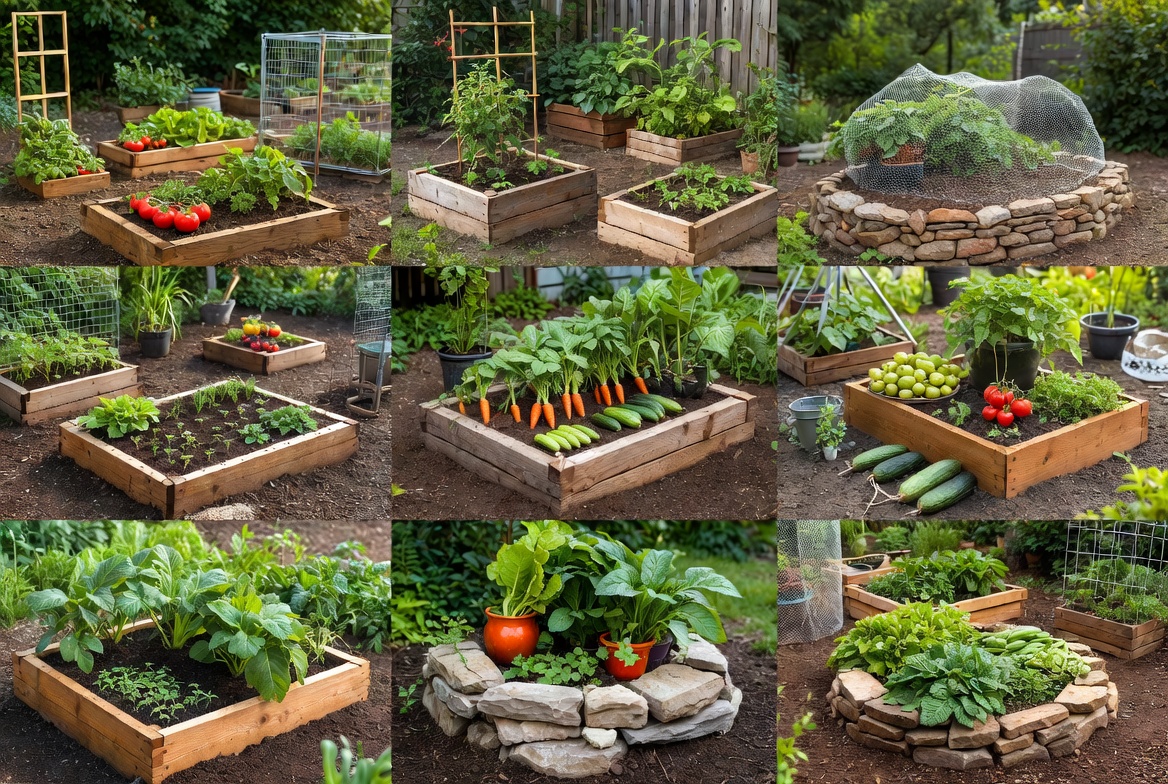
20 Vegetable Garden Ideas for Fresh Homegrown Produce
Growing your own food changes how you think about eating. A tomato harvested twenty minutes before it reaches the table tastes completely different from one that spent a week in cold storage and a day on a supermarket shelf. The same is true of lettuce, herbs, beans, and most other vegetables — freshness is a quality that commercial supply chains cannot replicate. Starting a vegetable garden doesn’t require a large space, specialized knowledge, or significant investment. It requires good soil, adequate sun, reliable water, and the willingness to observe and respond to what the plants need. These 20 ideas cover every aspect of a productive vegetable garden — from layout to soil to specific crops — with practical guidance at every step.
1. Start with Raised Beds
Best for: Any garden, especially those with poor native soil, limited space, or drainage problems
Raised beds are the most reliably successful starting point for a vegetable garden because they solve the most common problems simultaneously. They provide complete control over soil quality, drain freely regardless of what the ground beneath them does, warm up faster in spring, and make weeding, planting, and harvesting easier because you’re working at a more comfortable height.
A standard raised bed is 4 feet wide — the maximum distance you can comfortably reach to the center from either side without stepping in. Length can be anything practical. Depth of at least 12 inches is adequate for most vegetables; 18 inches suits root vegetables and gives more resilience in dry weather.
Materials: untreated timber (rot-resistant hardwoods like cedar or redwood last 15 to 20 years), galvanized steel (modern, durable, long-lasting, heats up more in summer), or concrete blocks (very permanent, suits more formal layouts).
Smart tip: Fill raised beds with a mix of 60% topsoil, 30% compost, and 10% horticultural grit or perlite. This combination drains freely while retaining enough moisture and nutrients for productive growing. Pure compost settles and compacts; pure topsoil doesn’t drain adequately.
Mistake to avoid: Making raised beds too wide. A bed wider than 4 feet requires stepping into it to reach the center, which compacts the soil — the main thing you’re trying to avoid. 3.5 to 4 feet is the maximum practical width for accessible raised bed gardening.
2. Grow Tomatoes the Right Way
Best for: Any sunny vegetable garden — tomatoes are the most rewarding summer crop for most gardeners
Tomatoes are the most grown home vegetable for good reason: the quality difference between home-grown and shop-bought is more dramatic than almost any other crop. A tomato grown in good soil, allowed to ripen fully on the plant, and eaten the same day tastes like a different vegetable from what most people buy.
The key decisions: indeterminate (vining) varieties grow tall and produce continuously until frost — they need staking and regular side-shooting (removing the shoots that grow between the main stem and a branch). Determinate (bush) varieties grow to a fixed size and produce most of their fruit at once — easier to manage, better for processing.
Smart tip: Remove sideshoots from indeterminate tomatoes consistently throughout the season. A sideshoot left to grow becomes a full branch — the plant then puts energy into growing rather than fruiting. Pinch sideshoots out when they’re small (under 2 inches) by snapping them cleanly at the base with thumb and forefinger.
Mistake to avoid: Watering tomatoes inconsistently. Irregular watering — dry for several days followed by heavy watering — causes blossom end rot (a calcium deficiency triggered by inconsistent moisture uptake) and fruit splitting. Water consistently, ideally daily in hot weather, keeping soil evenly moist rather than alternating wet and dry.
3. Use Vertical Growing Structures
Best for: Small gardens, anyone wanting to maximize yield per square foot
Growing vegetables vertically — up trellises, canes, nets, or wire frames — multiplies the productive space of a given area. A 4-foot-wide raised bed with a 6-foot trellis at the back can grow climbing beans, cucumbers, or peas on the vertical surface while keeping the bed available for lower crops at the front.
Vertical structures also improve air circulation around plants (reducing fungal disease), make harvesting easier (no bending to pick), and create visual interest in the vegetable garden — a wall of climbing beans or sweet peas is genuinely attractive.
Smart tip: Position vertical structures at the north end of a bed (in the northern hemisphere) or the south end (in the southern hemisphere) so they don’t cast shade on lower-growing crops. A trellis positioned on the wrong side of a bed will shade everything it’s adjacent to for most of the day.
Mistake to avoid: Using insufficient support for heavy crops. Climbing cucumbers, squash, and tomatoes can produce significant weight on a trellis by midsummer. A cane pushed 6 inches into soft soil will topple. Secure vertical structures firmly into the ground (at least 12 inches) or attach them to a solid fence or wall.
4. Plant a Dedicated Herb Section
Best for: Any vegetable garden — herbs are the highest-value crops per square foot available
Fresh herbs change the quality of cooking more dramatically than almost any other ingredient, and they’re among the easiest and most productive plants to grow. A small dedicated herb section — even a 3-foot by 4-foot raised bed or a collection of pots — provides a year-round supply of the most-used kitchen herbs.
The distinction between perennial herbs (rosemary, thyme, sage, chives, mint — come back year after year) and annual herbs (basil, coriander, dill — must be regrown each season) determines how to plan the herb section. Keep perennials in a permanent position; grow annuals in the spaces between them or in adjacent containers.
Smart tip: Plant mint in its own container rather than in a shared bed. Mint spreads aggressively through underground runners and will colonize the entire herb section within one growing season if planted in the ground. A buried pot or a container keeps it contained while allowing it to grow productively.
Mistake to avoid: Planting all herbs together without considering their different needs. Basil (needs heat, moisture, shelter) and rosemary (needs sun, drought, good drainage) have almost opposite requirements. Grouping by need — Mediterranean drought-tolerant herbs together, moisture-loving herbs together — produces significantly better results.
5. Try Companion Planting
Best for: Any vegetable garden — companion planting improves pest control, pollination, and soil health
Companion planting — growing certain plant combinations together for mutual benefit — is one of the most evidence-supported organic gardening techniques. The classic combinations work reliably: basil planted alongside tomatoes deters aphids and whitefly; nasturtiums planted near brassicas attract aphids away from the crop (a trap crop); borage near strawberries improves fruit set by attracting bees.
The Three Sisters combination — corn, climbing beans, and squash grown together — demonstrates companion planting at its most practical. Corn provides a climbing frame for beans; beans fix nitrogen from the air into the soil; squash’s large leaves shade the ground, suppressing weeds and retaining moisture for all three.
Smart tip: Phacelia, borage, and calendula sown in or around the vegetable garden attract pollinators that improve fruit set on tomatoes, cucumbers, squash, and beans. A row of phacelia alongside a bed of climbing beans can increase bean yield measurably.
Mistake to avoid: Planting fennel in or near the vegetable garden. Fennel is allelopathic — it produces chemicals that inhibit the growth of most other vegetable plants. Tomatoes, peppers, and beans are particularly affected. Keep fennel completely separate from the main vegetable garden.
6. Grow Salad Leaves for Daily Harvest
Best for: Any garden including small containers and windowboxes — this is the highest-return vegetable crop available
Salad leaves are the most immediately rewarding vegetable crop: they grow from seed to harvest in as little as 21 days for fast varieties, they can be harvested as cut-and-come-again crops for months, and the quality difference between fresh garden salad and shop-bought is immediately apparent. A 12-inch container on a sunny patio can produce a family’s salad several times a week throughout the growing season.
The key technique: cut-and-come-again harvesting. Rather than pulling whole plants, use scissors to harvest the outer leaves, leaving the growing center intact. The plant regrows and can be harvested again within 7 to 10 days. This extends the productive life of a single sowing dramatically.
Smart tip: Sow a small patch of salad leaves every 3 weeks from early spring through early autumn rather than one large sowing at the start of the season. This succession sowing provides continuous harvest without the glut-and-gap cycle that single large sowings produce.
Mistake to avoid: Letting salad leaves bolt (go to flower). Once a lettuce or salad leaf plant flowers, the leaves become bitter and inedible. Harvest regularly, keep plants watered consistently, and sow new plants before the current batch starts to bolt.
7. Succession Sowing for Continuous Crops
Best for: Anyone who has experienced the frustration of a single massive harvest followed by nothing
Succession sowing — making multiple small sowings of the same crop at 2 to 3 week intervals rather than one large sowing — produces a steady stream of harvest rather than a single overwhelming glut. One large sowing of lettuce produces 20 lettuces ready to harvest simultaneously; four small sowings spaced 3 weeks apart produces 5 lettuces every 3 weeks for 12 weeks.
This principle applies to beans, peas, radishes, carrots, beetroot, and most salad crops. Tomatoes, peppers, and squash don’t suit succession sowing because they have long growing seasons — but most fast-maturing crops benefit from it.
Smart tip: Keep a simple sowing calendar — even a piece of paper pinned in the shed. Mark each sowing date and the date it was ready to harvest. After one season you have a precise record of timing for your specific climate and conditions that’s more useful than any general advice.
Mistake to avoid: Succession sowing too late in the season. Most vegetables need a minimum number of days to mature, and autumn comes faster than expected. Check the days-to-maturity figure on seed packets and count back from your expected first frost date to establish the latest date you can sow a final succession.
8. Build a French Potager Style Garden
Best for: Gardeners who want a vegetable garden that’s also a beautiful garden feature
A potager is a French kitchen garden that combines vegetables, herbs, edible flowers, and occasionally fruit in a formally structured but visually rich layout. Where a conventional vegetable garden is purely functional, a potager is designed to be as beautiful as it is productive — the structure (paths, edging, trained plants) and the planting work together as a composed space.
The classic potager layout: geometric beds (squares, rectangles, or diamonds) separated by narrow paths, with a focal point at the center (a standard rose, a clipped bay, or a topiary ball), and each bed planted densely with a mix of vegetables chosen as much for their visual qualities — deep red chard, blue-green leeks, purple basil — as for their culinary value.
Smart tip: Low box hedging around potager beds is the traditional edging material and defines the structure beautifully. If box isn’t available or appropriate (due to box blight in some regions), lavender cotton (Santolina), wall germander (Teucrium), or even low-growing herbs like thyme provide similar structure.
Mistake to avoid: Designing a potager with beds too small for productive growing. The beauty of a potager must come second to its function — beds that are too small or paths too wide reduce the growing area to the point where the garden produces more visual pleasure than food.
9. Grow Vegetables in Containers
Best for: Balconies, patios, small gardens, anyone without ground-level growing space
Container vegetable growing has one significant limitation (limited root volume requires consistent watering and feeding) and several significant advantages (complete soil control, mobility, ability to grow in any outdoor space). Many vegetables grow successfully in containers — the key is choosing varieties developed or suited for confined root space.
Best vegetables for containers: tomatoes (bush varieties specifically — ‘Tumbling Tom’, ‘Balcony’, ‘Maskotka’); lettuce and salad leaves (cut-and-come-again varieties in window boxes); runner and dwarf beans (in 12-inch pots minimum); courgettes (in large 20-liter containers); peppers and chillies (do very well in pots, often better than in ground in cool climates); herbs (almost all herbs in pots).
Smart tip: Water container vegetables daily in warm weather — often twice daily for large tomatoes in high summer. The limited soil volume dries out much faster than ground planting. A drip irrigation system on a timer solves this problem completely and significantly reduces the work of container vegetable growing.
Mistake to avoid: Using garden soil in containers. Garden soil compacts in containers, drains poorly, and often contains weed seeds and pathogens. Use a good-quality peat-free multipurpose compost mixed with 20% perlite for drainage. The investment in proper compost pays back immediately in plant performance.
10. Add a Compost System
Best for: Every vegetable garden — compost is the foundation of productive soil
Compost is the single most important input in a vegetable garden. It improves soil structure (making heavy clay more workable and light sandy soil more moisture-retentive), feeds plants slowly and continuously, supports soil biology, and reduces the need for bought fertilizers. A vegetable garden fed with good compost produces noticeably better yields than one fed with chemical fertilizers alone.
Making compost requires: a container or open pile to accumulate material; a mix of green materials (vegetable scraps, grass clippings, fresh plant material) and brown materials (cardboard, paper, dried plant stems, autumn leaves) in roughly equal proportions; moisture; and time.
Smart tip: Shred or chop compost materials before adding them. Whole woody stems, large cardboard pieces, and unshredded autumn leaves take much longer to break down than the same materials cut into pieces. A few minutes with scissors or a shredder speeds the composting process by weeks.
Mistake to avoid: Adding cooked food, meat, fish, or dairy to a standard compost bin. These materials attract rats and other pests and create unpleasant smells. A standard open compost bin should receive only uncooked plant material and cardboard.
11. Install Drip Irrigation
Best for: Any vegetable garden — irrigation is the most impactful time-saving improvement available
A drip irrigation system connected to a tap timer is the single most effective way to improve vegetable garden productivity and reduce the time it requires. Consistent watering — which a timer provides regardless of whether you remember — produces significantly better yields than irregular hand watering. Plants under water stress produce less, taste worse, and bolt faster.
A basic drip system for a raised bed: a main supply line from the tap, with small drip emitters positioned near each plant. The system runs for a set duration each day automatically. Setup costs are modest (£30 to £80 for a basic system covering two or three beds) and the time saving is immediate.
Smart tip: Set the irrigation timer to water in the early morning rather than the evening. Morning watering allows foliage to dry during the day, which reduces fungal disease. Evening watering leaves foliage damp overnight — the conditions that fungal pathogens require to establish.
Mistake to avoid: Installing drip irrigation and never adjusting it seasonally. A watering duration that’s correct in June is too short in July and August when temperatures are higher and plants are larger. Check soil moisture periodically and adjust the timer duration accordingly.
12. Grow Climbing Beans and Peas
Best for: Any vegetable garden with vertical growing space — these are among the most productive crops available
Climbing beans (runner beans, French climbing beans) and peas are among the most productive and satisfying crops in a temperate vegetable garden. A single row of runner beans on a 6-foot wigwam or trellis produces an almost overwhelming harvest from late July through October. Peas produce earlier in the season, providing harvests from June onward.
Both are nitrogen-fixing crops — their roots host bacteria that convert atmospheric nitrogen into a form plants can use. This means they actually improve soil fertility as they grow, leaving the bed richer for whatever follows them in the rotation.
Smart tip: Harvest climbing beans and peas every 2 to 3 days when they’re in full production. Both crops go from perfect to tough and stringy quickly in warm weather. Regular harvesting also signals the plant to continue producing rather than putting energy into seed development.
Mistake to avoid: Letting peas or beans dry on the plant during the season. Once a pod is left to mature fully, the plant registers seed production as complete and slows new pod formation significantly. Keep harvesting consistently to maintain the plant in active production.
13. Use Mulch to Reduce Weeding
Best for: Every vegetable bed — mulching is the most effective time-saving technique in vegetable growing
A 2 to 3-inch layer of mulch applied around plants — leaving a small gap immediately around each stem — suppresses weed growth, retains soil moisture, moderates soil temperature, and gradually improves soil structure as it decomposes. A mulched bed requires a fraction of the weeding and watering of an unmulched one.
Mulch options for vegetable gardens: compost (most beneficial — feeds soil while mulching), straw (inexpensive, very effective for weed suppression), wood chip (excellent for paths between beds but ties up nitrogen as it decomposes — not ideal directly in vegetable beds), and grass clippings (effective but apply thinly to prevent matting).
Smart tip: Apply mulch after watering, not before. Mulch slows moisture evaporation from the soil surface — which is the point — but it also slows moisture penetration if soil is already dry. Water first, then mulch to lock that moisture in.
Mistake to avoid: Using mulch that contains weed seeds. Immature compost, fresh grass clippings from a weedy lawn, and straw from some sources can introduce significant weed seeds. Use properly composted material and weed-seed-free straw specifically sold for mulching.
14. Grow Zucchini and Summer Squash
Best for: Any sunny garden with reasonable space — these are the most productive summer vegetables available
Zucchini (courgette) is the most reliable and prolific warm-season vegetable in a temperate garden. Two to three well-positioned plants produce enough fruit for a family throughout summer and into autumn — often more than enough. The plant is essentially unstoppable once established in warm weather.
The key to good zucchini growing: plant after all frost risk has passed (they’re frost-tender), position in full sun in the most fertile spot in the garden, and water consistently. The main challenge is that zucchini grows from picking size (15 to 20 cm) to marrow size (50+ cm) within a few days in warm weather.
Smart tip: Harvest zucchini when they’re 15 to 20 cm long — they taste best at this size, and harvesting at this stage encourages continuous production. A zucchini left to become a marrow signals the plant to stop producing new fruit. Check plants every two to three days in peak season.
Mistake to avoid: Planting zucchini too early. Plants put in before the soil has warmed to at least 18°C sit sulking in cold soil and are often overtaken within weeks by plants put in later in genuinely warm conditions. Wait until the soil is warm, even if it means planting later than feels right.
15. Plant Edible Flowers with Vegetables
Best for: Gardens where beauty and productivity can work together
Edible flowers grown among vegetables serve multiple purposes: they attract pollinators that improve fruit set on beans, tomatoes, and cucumbers; some deter or distract pests (nasturtiums as a trap crop for aphids; calendula for whitefly); and they can be harvested for use in salads, as garnishes, and in cooking.
The most useful edible flowers for a vegetable garden: nasturtium (all parts edible — flowers, leaves, and seeds; peppery flavor; deters aphids on brassicas), calendula (petals used like saffron; attracts hoverflies whose larvae eat aphids), borage (sky-blue flowers with mild cucumber flavor; exceptional bee attractor), and violas/pansies (mild flavor, perfect as garnishes).
Smart tip: Deadhead edible flowers regularly to keep them producing continuously. A nasturtium or calendula that goes to seed stops producing new flowers within a fortnight. Removing spent flowers extends the productive season by months.
Mistake to avoid: Assuming all flowers are edible. Many garden flowers are toxic — foxglove, delphinium, sweet pea flowers, and many bulb flowers are poisonous. Only harvest and eat flowers you have specifically identified as edible. Never eat unidentified flowers.
16. Extend the Season with Cold Frames
Best for: Any vegetable garden in a temperate climate — season extension means more growing time
A cold frame — a low, lidded box placed over plants or a bed — acts as a miniature unheated greenhouse. It traps heat from the sun during the day and insulates plants from frost at night, typically adding 4 to 6 weeks to both ends of the growing season. In practical terms, it means harvesting in November what would otherwise be finished in September, and sowing in February what would otherwise wait until April.
Cold frames can be purchased or built simply from old timber and a sheet of glass or polycarbonate. Even a piece of horticultural fleece draped over a bed provides meaningful frost protection for 2 to 3 degrees.
Smart tip: Ventilate cold frames on warm, sunny days. Temperatures inside a closed cold frame can rise to damaging levels on a sunny day even in early spring. Prop the lid open during the day when temperatures are above about 15°C and close it before evening.
Mistake to avoid: Leaving cold frames completely closed for extended periods. Plants inside need air circulation — stagnant humid air encourages fungal disease that can destroy seedlings rapidly. Even in cold weather, brief ventilation on mild days is beneficial.
17. Grow Root Vegetables from Seed
Best for: Beds with deep, loose, stone-free soil or deep raised beds
Root vegetables — carrots, parsnips, beetroot, turnips, radishes — must be direct sown into their final growing position. They cannot be transplanted because any disturbance to the taproot at the seedling stage causes forked, deformed roots. This makes them different from most other vegetables, which can be started in trays and moved.
Carrots are the most demanding: they need a deep, loose, stone-free soil to develop long, straight roots. Stones and compaction cause forking. Beetroot and radishes are considerably more forgiving and suit beginners well.
Smart tip: Sow carrot seed thinly and precisely — a pinch of 3 to 4 seeds every 3 inches — rather than broadcasting seed along a row. This minimizes thinning later and reduces competition. Thinning carrots releases a scent that attracts carrot fly, so thinning less is always better.
Mistake to avoid: Sowing parsnips too late. Parsnips need a long growing season and must be sown earlier than most vegetables — from late February to April is ideal. Late-sown parsnips don’t develop adequate root mass before the season ends. They’re one of the few vegetables where early sowing genuinely matters.
18. Design a Small Space Vegetable Garden
Best for: Urban gardens, small plots, anyone with limited growing space
A small vegetable garden — even a single 4×4-foot raised bed — can produce a meaningful and satisfying harvest if planted and managed thoughtfully. The key is choosing crops that give the best return per square foot: salad leaves, climbing beans, herbs, tomatoes (in one corner with vertical support), and courgette (one plant fills a quarter of the bed).
Square foot gardening — a method of intensive planting that maximizes yield per square foot by eliminating wasted space — suits small plots particularly well. Each square foot is planned for maximum productivity: 1 tomato plant, 4 lettuce plants, 9 spinach plants, or 16 carrot plants per square foot, depending on the crop’s mature size.
Smart tip: Use every vertical surface available in a small garden. A fence that borders the vegetable area can support climbing beans, cucumbers, and peas — tripling the productive surface without taking any additional floor space.
Mistake to avoid: Trying to grow space-hungry crops (pumpkins, winter squash, large brassicas, sweet corn) in a small garden. These crops need significant space per plant and produce returns that don’t justify the footprint in a compact garden. Focus on high-yield compact crops and leave large crops for when the garden grows.
19. Attract Pollinators to Improve Yields
Best for: Any vegetable garden — pollinator activity directly affects fruit and seed crop yields
Many of the most productive vegetable crops — tomatoes, cucumbers, courgettes, beans, peas, and all squash family plants — require pollination to set fruit. In a garden with good pollinator populations, this happens naturally. In a garden with few pollinators, fruit set is poor and yields are disappointing even from healthy plants.
The most effective pollinator attractors for a vegetable garden: phacelia (fast-growing, vivid blue, exceptional bee attractor), borage (long flowering, loved by bumblebees), calendula (continuous flowering, attracts a wide range of pollinators), sweet alyssum (low-growing, edging plant, attracts hoverflies), and lavender (bumblebee magnet near the vegetable garden boundary).
Smart tip: Avoid all pesticide use in and around the vegetable garden during flowering periods. Even organic pesticides can harm pollinating insects. If pest control is necessary, apply after flowers have closed for the day when pollinating insects are less active.
Mistake to avoid: Growing only one pollinator-attracting plant in one season. A single plant of phacelia contributes; a mix of several different plants that flower at different times through the season provides consistent pollinator habitat from spring through autumn — which is when your vegetable crops need it.
20. Keep a Garden Journal
Best for: Any vegetable gardener — this is the most underused productivity tool in vegetable growing
A garden journal — even a simple notebook — transforms each growing season into data for improving the next. Recording what was sown, when, where, how it performed, what pest or disease problems appeared, and what was harvested builds a cumulative record that becomes more valuable with every season.
The specific information that makes a garden journal useful: sowing dates and germination rates; first harvest date for each crop; pest and disease problems and what resolved them; what grew well in each bed position; weather events that affected growing; and varieties tried with notes on their performance.
Smart tip: Take photographs throughout the season and include them with journal notes. A photograph of a diseased plant dated and noted alongside what the problem was and how it was treated is more useful than a written description alone. Most smartphones make this effortless.
Mistake to avoid: Keeping a journal inconsistently. A garden journal that has detailed notes for April and May but nothing from July through October when most of the harvest and problems occur is only partially useful. Brief notes written immediately are better than detailed notes you plan to write later and don’t.
Before You Start
- Choose the sunniest spot. Most vegetables need 6 to 8 hours of direct sunlight daily. A vegetable garden in partial shade will produce a fraction of what the same effort produces in full sun. This is the single most important siting decision.
- Test your soil. A simple pH test (available at any garden centre for a few pounds) tells you whether your soil is acid or alkaline. Most vegetables prefer a slightly acid to neutral pH (6.0 to 7.0). Significantly outside this range, nutrients become unavailable and plants struggle regardless of feeding.
- Start smaller than you think. A 4×8-foot raised bed managed well produces more food than a large neglected plot. Start with a manageable area, succeed completely, and expand if you want to. An overly ambitious first garden often becomes overwhelming and abandoned.
- Water reliably from the start. More vegetable gardens fail from inconsistent watering than from any other cause. Plan your watering system before planting, not after things start to wilt.
Conclusion
A vegetable garden rewards consistent attention more than occasional heroic effort. Ten minutes in the garden daily — checking plants, harvesting, watering, removing a few weeds — produces better results than an hour once a week. The garden tells you what it needs when you look at it regularly; it surprises you with problems when you don’t. Start with what you like to eat, grow it well, and build from there. The satisfaction of eating something you grew yourself doesn’t diminish with repetition.
