
20 Zen Garden Ideas for a Tranquil Backyard Retreat
A zen garden works on a principle that most Western garden design ignores: less is more, and empty space is not wasted space — it’s the space where attention rests and the mind quiets. The karesansui (dry landscape garden) tradition that originated in Japanese Buddhist temples uses a handful of materials — gravel, rock, moss, a carefully chosen tree — to create spaces of extraordinary visual serenity. You don’t need a large yard, a large budget, or specialist knowledge to apply these principles. You need restraint, intention, and the willingness to remove things rather than add them. These 20 ideas cover every element of a zen garden, from the foundational gravel and rock arrangement to the small details that complete the experience.
1. Start with Raked Gravel or Sand
Best for: Any zen garden — this is the foundational element of the traditional dry landscape style
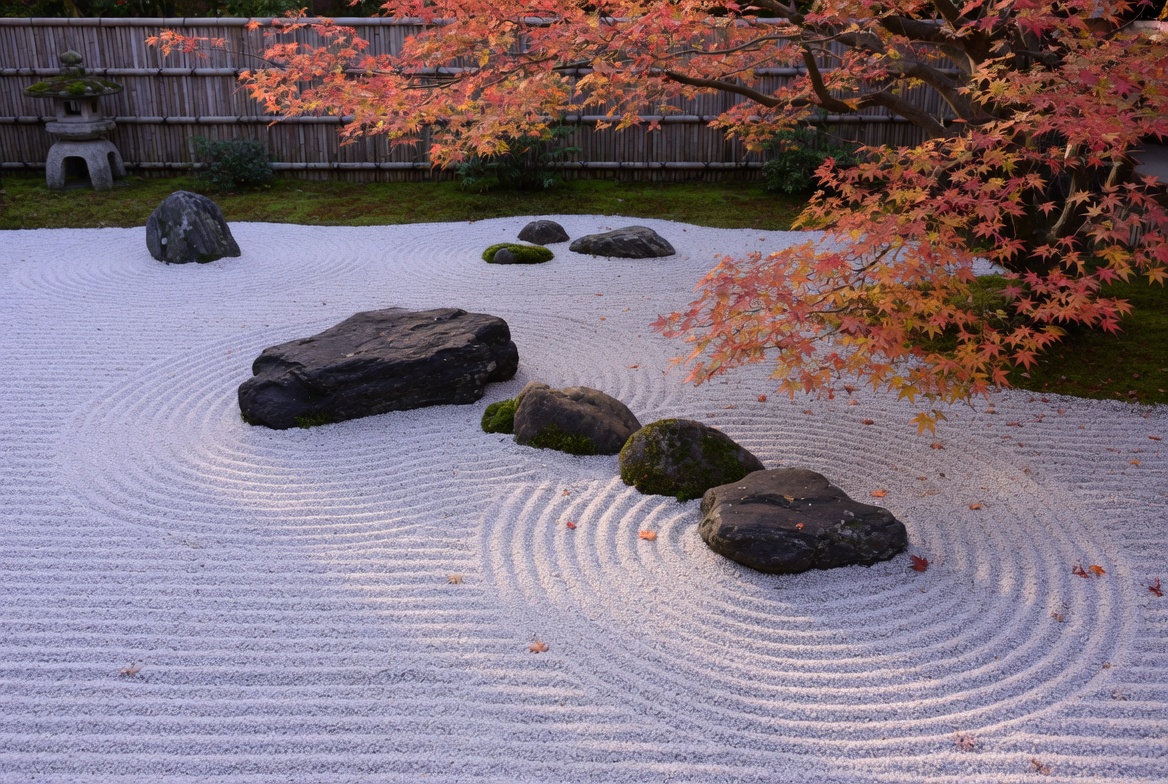
Raked gravel is the defining visual element of a zen garden. The patterns — concentric circles around rocks, parallel lines suggesting flowing water, wave forms — represent water in motion, and the act of raking them is itself a meditative practice. Every time you rake the gravel, you reset the garden’s visual element and engage in a deliberate, focused physical activity.
Use fine granite grit (3 to 6mm) rather than coarser garden gravel for authentic raked patterns. Fine grit holds raked lines clearly, dries quickly after rain, and has a refined texture that coarser gravel can’t replicate. White or pale grey tones are traditional — they brighten shaded spaces and create the strongest contrast with dark rocks.
Smart tip: Rake the gravel in the early morning when low-angle sunlight emphasizes the texture and pattern most strongly. The same pattern looks dramatically different in morning, midday, and evening light — part of the zen garden tradition of experiencing the same space differently across time.
Mistake to avoid: Using decorative colored gravel. Blue, red, or mixed-color decorative gravel is available and visually arresting — but it’s incompatible with the zen aesthetic, which is specifically about muted, natural tones. Stick to natural white granite, grey pea gravel, or buff sand.
2. Place Rocks as Focal Points
Best for: Every zen garden — rocks are the primary structural element
In a zen garden, rocks represent mountains, islands, and the enduring elements of nature. Their placement is the most deliberate and consequential design decision in the garden — each rock’s position, orientation, and relationship to adjacent rocks creates the compositional logic of the entire space.
The Japanese principle of odd-number groupings: three rocks of different heights arranged in a rough triangle create a more natural-feeling composition than two rocks of equal height placed symmetrically. The triangle creates a dominant rock, a secondary rock, and an accent rock — hierarchy that the eye reads as natural.
Smart tip: Bury rocks partially (20 to 30% of their volume) in the gravel rather than sitting them on top of the surface. A rock that’s sitting on gravel looks placed. A rock that appears to emerge from the gravel looks as though it belongs — as though it has always been there and the gravel has settled around it.
Mistake to avoid: Using too many rocks. More rocks in a zen garden do not create more interest — they create visual noise that works against the meditative quality. Three to five well-chosen rocks in a modest garden, or five to nine in a large garden, are more effective than a dozen scattered without hierarchy.
3. Add a Japanese Stone Lantern
Best for: Zen gardens where evening atmosphere and traditional Japanese character are desired
A stone lantern (toro) is one of the most recognized elements of Japanese garden design. Originally placed in temple gardens to light pathways for evening rituals, they now serve as sculptural focal points as much as light sources. The traditional mushroom-shaped yukimi-doro (snow-viewing lantern) and the tall oki-doro (pedestal lantern) are the most versatile forms for residential gardens.
Stone lanterns suit positions near water features, at path junctions, or beside specimen plants — positions where the lantern reads as intentional rather than decorative. A single lantern placed correctly commands more attention and respect than several placed casually.
Smart tip: Choose a lantern in a material and style that relates to the existing stone in the garden. A granite lantern in a garden with granite rocks creates material coherence. A limestone lantern among granite rocks creates a material conflict that reduces the sense of intentional design.
Mistake to avoid: Installing a lantern without any planting around its base. A stone lantern sitting in bare gravel with no surrounding context looks as though it arrived without invitation. Low moss, a small fern, or a few carefully placed pebbles around the lantern’s base integrates it into the landscape.
4. Plant a Japanese Maple
Best for: Any zen garden that has space for a specimen tree — this is the single most valuable plant addition
The Japanese maple (Acer palmatum) is the tree most associated with Japanese garden design, and its qualities explain why: the deeply dissected leaves create an extraordinarily fine texture; the seasonal changes — spring green, summer burgundy or green, autumn flame, and winter structural branching — provide a different garden experience across all four seasons; and the mature form of a well-grown Japanese maple has a quality of age and character that no other garden tree achieves in a comparable timeframe.
Varieties for different positions: ‘Bloodgood’ (upright, deep burgundy, reliable — the most widely planted variety); ‘Dissectum Garnet’ (weeping form, deeply dissected burgundy foliage, spectacular in autumn); ‘Sango Kaku’ (coral bark — the branches are vivid coral red in winter, providing color when the tree is leafless).
Smart tip: Position the Japanese maple where it will be seen against a simple background — a wall, a fence, a dark hedge, or the sky. The tree’s complex form and fine texture are most readable against a simple backdrop. Against a busy planting scheme, the maple disappears into the visual noise.
Mistake to avoid: Planting a Japanese maple in full afternoon sun in a hot climate. Most Japanese maples prefer morning sun and afternoon shade — leaf scorch (brown, crispy leaf edges) results from full afternoon sun in warm regions. In cool climates, full sun is tolerated; in warm climates, shade protection from 2 PM onward is important.
5. Create a Stepping Stone Path
Best for: Zen gardens where the space needs to be walked through, not just viewed — paths slow movement and direct attention
A stepping stone path through a zen garden changes the experience from passive observation to active participation. The act of choosing each footfall on irregular stones slows the pace of movement, brings attention to the present moment, and creates the mindful quality of movement that Japanese stroll garden design intends.
Use irregular, natural-looking stones — flat-topped for safe footing, with varied sizes and spacing. Space stones at natural stride intervals (18 to 22 inches between centers for adult stride) and allow them to be placed with slight asymmetry rather than in a perfectly straight line.
Smart tip: Allow moss to grow between stepping stones over time. Moss between stones is one of the most beautiful textural details in a zen garden — it softens the transition between stone and gravel, looks ancient, and adds a layer of green that contrasts with the surrounding pale gravel. Encourage it by keeping the path slightly damp and shaded.
Mistake to avoid: Making the path too direct and straight. A straight path through a zen garden creates urgency — the eye and body move quickly to the destination. A path with a gentle curve or one that angles between rocks creates pauses, changes perspective, and encourages the slower, more attentive movement that the garden intends.
6. Add a Water Feature
Best for: Zen gardens where sound is as important as visual design, any garden space near noise pollution
Moving water adds a dimension to a zen garden that no other element provides — the sound of water is genuinely and measurably calming, masks background noise (traffic, neighbors, air conditioning), and adds movement to a space that is otherwise still. The sound of water in a garden gives the space a quality of aliveness that static materials alone can’t achieve.
Traditional options: a bamboo water spout (shishi-odoshi) that fills and tips, creating a rhythmic knocking sound; a stone basin (tsukubai) with a continuous trickle of water; or a simple recirculating fountain in a stone basin surrounded by smooth pebbles.
Smart tip: Choose a water feature whose sound suits the garden’s scale. A large cascading waterfall in a small courtyard is overwhelming — the sound fills the space and becomes intrusive rather than calming. Match the water volume and drop height to the garden size: small spaces need subtle, gentle sounds; larger spaces can accommodate more pronounced water sounds.
Mistake to avoid: Installing an electrically powered water feature without waterproof outdoor-rated electrical installation. Any pump and electrical connection near water must be rated for outdoor and wet conditions. A standard indoor extension cord run to an outdoor water feature is a safety hazard.
7. Use Bamboo as a Screen
Best for: Zen gardens needing privacy, enclosure, or a natural green background
Bamboo provides the enclosure and privacy that a zen garden needs to feel separated from the surrounding world — a quality the Japanese call miegakure (hide and reveal). A bamboo screen behind the garden creates a green backdrop against which rocks and gravel read with maximum clarity, and the gentle movement of bamboo leaves in breeze adds the quality of living nature to what is otherwise a largely static composition.
Bamboo fencing panels — pre-made panels of split bamboo woven onto wire frames — provide immediate screening without the establishment time of living bamboo and without the invasive spreading that makes living bamboo so problematic.
Smart tip: If using living bamboo, always install a physical root barrier (heavy-gauge HDPE sheet buried to 60cm depth) around the entire planting to contain its spread. Running bamboo species can spread 10 to 15 feet per year through underground rhizomes and colonize neighboring properties. The barrier is non-negotiable.
Mistake to avoid: Planting bamboo without a root barrier and then dealing with the spread consequences. Removing established running bamboo from a garden is one of the most labor-intensive garden tasks available — the rhizomes run deep and far and regrow from any fragment left in the ground. Install the barrier before planting, not after the problem develops.
8. Grow Moss Between Stones
Best for: Shaded zen gardens, any garden where the path or rock areas need softening
Moss is the ground cover most associated with Japanese garden aesthetics — its soft, uniform, intensely green texture creates a quality of age, permanence, and quiet that no other plant achieves. A stone lantern or rock arrangement surrounded by moss looks as though it has been there for decades, regardless of when it was installed.
Moss grows naturally in shaded, moist conditions — it can be encouraged in appropriate positions by keeping the area damp and removing competing plants. In drier or sunnier positions, moss can be transplanted or encouraged with a buttermilk-and-water mixture brushed onto the intended surface.
Smart tip: Collect moss from different locations and combine several species in the same area for the most natural-looking result. Different moss species have different textures — some are fine and cushion-like, others are coarser — and a mix of textures looks more like naturally occurring woodland moss than a single species uniformly applied.
Mistake to avoid: Expecting moss to establish in full sun or drought conditions. Moss requires consistent moisture and protection from direct afternoon sun to establish. Attempting to grow it in inappropriate conditions produces patches that brown and die rather than establishing. Match the moss to the conditions — or adjust the conditions to suit the moss.
9. Add a Dry River Bed
Best for: Zen gardens without actual water, slopes where drainage is also a practical concern
A dry river bed — a channel of smooth river pebbles and larger stones arranged to suggest the flow of water — is one of the most elegant features of Japanese dry landscape design. It represents water without requiring any actual water, and its arrangement — the largest boulders at the channel edges, smaller cobbles in the center flowing line, finest pebbles at the sides — captures the logic of a real watercourse in stone.
Traditional Japanese garden design places the dry river running from east to south to west — following the path of the sun. This east-to-west orientation creates a connection between the symbolic river and the daily movement of light across the garden.
Smart tip: Include a few large boulders partly submerged at the dry river’s edge, as if exposed by the water running past them. The combination of partially buried boulders at the bank and smaller smooth pebbles in the channel creates a convincing suggestion of actual water flow without any water present.
Mistake to avoid: Using angular crushed stone in a dry river bed. Crushed stone has sharp edges that look like construction aggregate rather than water-worn river stone. Use smooth, rounded river pebbles — the smooth surface that water wear creates is what makes the dry river bed convincing.
10. Plant a Cherry Blossom Tree
Best for: Zen gardens where seasonal drama is as important as year-round calm
The flowering cherry (Prunus) is the most celebrated tree in Japanese culture — its brief, spectacular spring flowering is the occasion for hanami (flower viewing), one of Japan’s most important seasonal traditions. A cherry blossom tree in a garden provides one of the most beautiful garden experiences available for its 2 to 3 weeks of flowering, and a distinctive silhouette of bare branches through winter.
Varieties suited to garden scale: ‘Yoshino’ (large, vigorous, white flowers — the classic roadside cherry); ‘Kanzan’ (strongly upright, deep pink double flowers — the most commonly seen garden cherry); ‘Amanogawa’ (fastigiate columnar form — ideal for narrow spaces); ‘Kiku-shidare-zakura’ (weeping form with deep pink flowers — exceptional in a small garden).
Smart tip: Position the cherry blossom tree where it can be seen from inside the house during flowering. Cherry blossom lasts 2 to 3 weeks, and much of the viewing happens from indoors — looking out at the flowering tree through a window is one of the most valued experiences in Japanese garden culture. Align the tree’s position with the most-used interior view.
Mistake to avoid: Choosing a cherry blossom tree without checking its mature size. ‘Yoshino’ cherries reach 30 to 40 feet — entirely inappropriate for a small garden. Research the specific mature dimensions before purchasing and choose a variety scaled to the available space.
11. Create a Meditation Seating Area
Best for: Any zen garden intended for actual use rather than purely visual appreciation
A zen garden without a place to sit and experience it is a garden designed for others to appreciate rather than for the gardener’s own use. A simple stone bench, a wooden platform, or a low chair positioned to face the garden’s main composition creates a place for the daily practice of quiet observation that the garden is designed to support.
The seating position determines which elements are seen and in what relationship — it should be chosen before finalizing the placement of rocks, lanterns, and planting. Design the garden from the seated viewpoint, not from a standing or overhead perspective.
Smart tip: A simple flat stone or a section of large boulder makes a more authentic and visually integrated seating element than any purchased garden furniture. Japanese gardens traditionally use a natural stone slab or a simple wooden plank across two stones as a garden seat — the material continuity with the garden’s other stone elements is part of the aesthetic.
Mistake to avoid: Positioning the seating facing the garden’s least interesting aspect. Walk the garden from multiple positions and identify the view that shows the composition at its most balanced and interesting. This is where the seating should go — even if it means the seating faces away from the house, or into a corner.
12. Add Ornamental Grasses
Best for: Zen gardens where movement and fine texture are needed alongside the static elements of rock and gravel
Ornamental grasses add a quality to the zen garden that no other plant provides: movement. While rocks, gravel, and stone elements are completely static, grasses respond to even the lightest breeze with constant, gentle motion — the kind of movement that draws attention and invites watching. This dynamic quality is particularly valuable in a zen garden context, where the interplay between stillness and movement is part of the meditative experience.
Best grasses for zen gardens: Hakonechloa macra (Japanese forest grass — cascading, bright green or golden, excellent in shade); Festuca glauca (blue fescue — fine-textured, blue-grey, compact mounds); Miscanthus sinensis (tall, architectural, spectacular autumn seed heads); Pennisetum (fountain grass — graceful arching form).
Smart tip: Plant ornamental grasses in groups of odd numbers — three or five — rather than as individuals or in pairs. Groups create a colony-like visual effect that reads as natural. Individual grass plants placed arbitrarily across a gravel area look decorative rather than composed.
Mistake to avoid: Choosing grasses that spread invasively in your climate. Some ornamental grasses — particularly certain Miscanthus and Pennisetum varieties — self-seed prolifically in warmer climates and become difficult to control. Research invasiveness for your specific region before planting.
13. Build a Small Wooden Bridge
Best for: Zen gardens with water features, dry river beds, or simply as a symbolic transition element
A wooden bridge in a zen garden creates a moment of transition — a deliberate pause between two parts of the garden that changes the experience of moving through the space. In traditional Japanese gardens, a bridge represents the journey between different states of being. In practical garden terms, it creates a visual focal point and a moment of heightened experience within the garden walk.
A simple flat bridge — two parallel timber beams with planks across — spanning even a modest dry river or gravel section 3 to 4 feet wide creates a genuinely effective garden feature. The bridge doesn’t need to be functional (wide enough to walk) — even a narrow symbolic crossing adds architectural interest and visual focus.
Smart tip: Use timber for a wooden bridge that matches or complements the other timber elements in the garden — decking, fencing, pergola. Material continuity throughout a garden creates cohesion; introducing a different timber species or finish in the bridge creates a visual inconsistency.
Mistake to avoid: Building a bridge that’s disproportionately large for the crossing it spans. A wide, heavily constructed bridge over a narrow dry river looks incongruous. Scale the bridge modestly — a span that’s slightly longer and wider than the crossing it bridges, not dramatically so.
14. Use a Buddha or Statue Focal Point
Best for: Zen gardens where a contemplative focal point is desired at the garden’s center or end
A Buddha figure, abstract stone sculpture, or simply a dramatically shaped natural rock used as a sculptural focal point gives the garden a specific place for the eye to rest and for attention to settle. Traditional Japanese gardens use Buddha figures in temple settings; in residential gardens, any stone figure that invites contemplation — a serene face, an abstract form, a natural boulder with an interesting silhouette — serves the same purpose.
Position the statue where it will be seen from the garden’s main seating position, set slightly into surrounding planting or gravel rather than placed on a conspicuous pedestal.
Smart tip: Choose a statue in a material that will weather naturally — stone, concrete cast from stone molds, or terracotta. A statue that develops moss, lichen, and weathering over seasons looks more appropriate in a zen garden than one that remains perfectly pristine. The Japanese aesthetic values age and the evidence of time.
Mistake to avoid: Using resin figurines that look artificial under outdoor light. Resin figures that are convincing in a garden center display look obviously synthetic outdoors in natural light. Use natural or stone-cast materials that hold up to close outdoor inspection.
15. Grow a Bonsai Collection
Best for: Zen gardeners who want to practice horticultural art within the garden aesthetic
Bonsai — the art of growing and shaping miniature trees in containers — is one of the most direct expressions of zen garden philosophy: restraint, attention, patience, and the acceptance that the work is never finished. A collection of bonsai positioned on a display bench or stone shelf within the zen garden adds scale variation, living interest, and a practice dimension that changes the relationship between gardener and garden.
Beginning bonsai: juniper (Juniperus) and Chinese elm (Ulmus parvifolia) are the most forgiving species for beginners — both tolerate some neglect and recover well from mistakes. Japanese maple (Acer palmatum) is more demanding but produces some of the most beautiful bonsai specimens.
Smart tip: Position bonsai at eye level when seated — the height at which their form is most appreciable and their detail most visible. Bonsai placed on the ground lose their impact because the viewing angle is wrong. A simple stone or timber bench at 60 to 70 cm height is the ideal display surface.
Mistake to avoid: Treating bonsai as low-maintenance garden decoration. Bonsai require consistent attention — daily watering in summer, regular shaping, appropriate feeding, and winter protection for tender species. A bonsai placed outdoors and forgotten will die. This is an active practice, not a decorative addition.
16. Enclose the Space with a Low Fence
Best for: Any zen garden that currently feels exposed to the surrounding yard or to neighboring properties
Enclosure is essential to the zen garden experience — the sense of entering a defined, separate space is part of what makes the transition from everyday life to contemplative space feel meaningful. A low bamboo fence, a simple timber rail, a stone wall, or even a closely clipped low hedge creates the boundary that signals you have entered a different space.
The enclosure doesn’t need to be tall — a fence of 18 to 24 inches physically defines the space without visually blocking anything. The psychological effect of crossing even a low boundary into a defined area is meaningful.
Smart tip: Use the same natural materials for the enclosure as appear elsewhere in the garden — bamboo if bamboo is used elsewhere, stone if the garden has stone elements, timber if timber features are present. An enclosure that introduces a new material into the garden’s palette creates visual inconsistency.
Mistake to avoid: Using a fence that’s too decorative or too prominent. The enclosure of a zen garden should be understated — a quiet boundary that defines without dominating. Ornate decorative fencing calls attention to itself in a way that’s incompatible with the minimalist aesthetic.
17. Add Wind Chimes for Sound
Best for: Zen gardens where the sound environment is as important as the visual — gardens near traffic or other noise
Wind chimes add a sound element to the zen garden that complements the visual composition. The irregular, unpredictable sound of wind chimes — unlike a water feature’s continuous sound — responds to the environment and creates moments of sound within silence rather than a continuous background.
Traditional Japanese wind bells (furin) are made from glass or metal with a paper clapper — their sound is delicate and high-pitched, quite different from heavy Western wind chimes. The furin aesthetic suits a zen garden; large, heavy bamboo or metal Western wind chimes are less appropriate in scale and sound character.
Smart tip: Hang wind chimes where they will catch the prevailing breeze without being in direct, consistent wind. Chimes in constant wind create constant sound — exhausting rather than meditative. Chimes positioned to catch occasional breezes create intermittent sound within silence, which is the more appropriate zen garden soundscape.
Mistake to avoid: Using multiple wind chimes of different tones in the same garden. Multiple chimes sounding simultaneously in different pitches create cacophony rather than the contemplative sound the garden intends. One set of chimes, well-positioned, is significantly more effective than several sets competing.
18. Create a Small Zen Garden Corner
Best for: Gardens without space for a full zen garden, apartments and small urban properties
A zen garden principle applies at any scale — including a corner of an existing garden, a balcony section, or even a tray on a table. A 4-foot by 6-foot area of raked fine gravel with two or three carefully placed rocks, a small Japanese maple in a container, and a stone lantern creates a complete zen garden experience in a very modest footprint.
The principles remain the same regardless of scale: restraint in material selection, deliberate placement of each element, negative space as important as occupied space, and regular maintenance that keeps the composition simple and clean.
Smart tip: A corner position — two existing walls or fences creating a natural enclosure — is ideal for a small zen garden installation. The enclosure is already partially provided by the existing boundaries, the garden fits naturally into the corner space, and the inward-facing orientation creates a sense of a contained world within the larger garden.
Mistake to avoid: Scaling down the elements but keeping the same number. A small zen garden needs fewer elements than a large one, not the same number of elements in miniature. Two rocks instead of five, one plant instead of three, one lantern instead of two — simplify proportionally with the space.
19. Use Night Lighting for Atmosphere
Best for: Zen gardens used or viewed in the evening, any garden visible from interior rooms at night
A zen garden seen from inside the house in the evening — lit by warm, low-level light that emphasizes the texture of raked gravel and casts long shadows from rocks and lanterns — is a genuinely beautiful experience. Evening lighting transforms the garden into a different composition from its daytime appearance.
Low-voltage LED uplights positioned at the base of rocks illuminate their surfaces dramatically. A light inside the stone lantern (battery-powered LED candle or small solar light) creates the warm glow for which lanterns are traditionally known. LED strip lights along a path edge create gentle wayfinding without disrupting the garden’s atmosphere.
Smart tip: Use warm white LEDs (2700K) throughout a zen garden lighting scheme. Cool or daylight LEDs create a clinical, blue-white light that works against the atmospheric warmth that evening garden lighting should create. Warm white suits the natural materials and creates the most flattering light for stone and timber.
Mistake to avoid: Over-lighting the zen garden. A brightly lit garden at night loses the quality of shadow and contrast that makes evening lighting valuable. Use the minimum number of fixtures needed to make the garden visible and atmospheric — not enough to illuminate everything equally. Zones of shadow are as important as zones of light.
20. Keep It Simple and Uncluttered
Best for: Every zen garden — this is the principle that makes all other ideas work
The single quality that distinguishes a zen garden from a Japanese-inspired garden with too much in it is restraint. Every element added to a zen garden should be necessary — performing a function that no other element performs and contributing to the overall composition rather than competing with existing elements. When in doubt, remove rather than add.
The Japanese concept of ma — the meaningful empty space between elements — is the quality that makes a zen garden feel calm rather than busy. An empty area of raked gravel is not a gap waiting to be filled; it is a positive design element as important as the rocks that emerge from it.
Smart tip: After completing the garden, remove one element and live with the result for a week before deciding whether to replace it. Very often the garden is better with one fewer thing. The exercise of removal — counterintuitive to most Western garden thinking — is one of the most effective design tools available in zen garden creation.
Mistake to avoid: Adding to the garden every season as you would a conventional garden. Zen garden design resists seasonal additions. The garden is established, maintained, and allowed to evolve slowly through the natural processes of plant growth and weathering — not refreshed with new purchases. Resist the impulse to add; practice the discipline of leaving it as it is.
Before You Start
- Choose the right location. A zen garden needs to be in a position where it can be viewed from a comfortable seated position — ideally from inside the house or from a garden bench placed specifically for this purpose. Design the garden from the viewpoint, not from above.
- Start with gravel and rocks only. Establish the foundational dry landscape composition before adding any plants, lanterns, or additional elements. Many zen gardens are most effective with only gravel and rock.
- Embrace impermanence. The raked gravel pattern changes with every rake, every footstep, every rainstorm. This is not a flaw — it’s the garden’s most important quality. The garden is never the same twice.
- Plan for maintenance. Raking gravel, removing fallen leaves, keeping the composition clean and uncluttered — these are regular tasks. A zen garden that isn’t maintained loses its defining quality quickly.
- Research your climate. Japanese maples, cherry blossoms, and bamboo all have specific climate requirements. Choose plants suited to your actual conditions rather than those that appear in Japanese garden photographs.
Conclusion
A zen garden succeeds when it creates a space where the mind settles, the pace slows, and the ordinary world feels temporarily distant. This happens not through elaborate installation or expensive materials but through the quality of attention brought to each element’s placement and the discipline to leave space empty. Start with gravel and a few well-chosen rocks. Add one element at a time. Sit with what you have before adding more. The garden that asks the least of you to look at will ultimately give you the most.
