
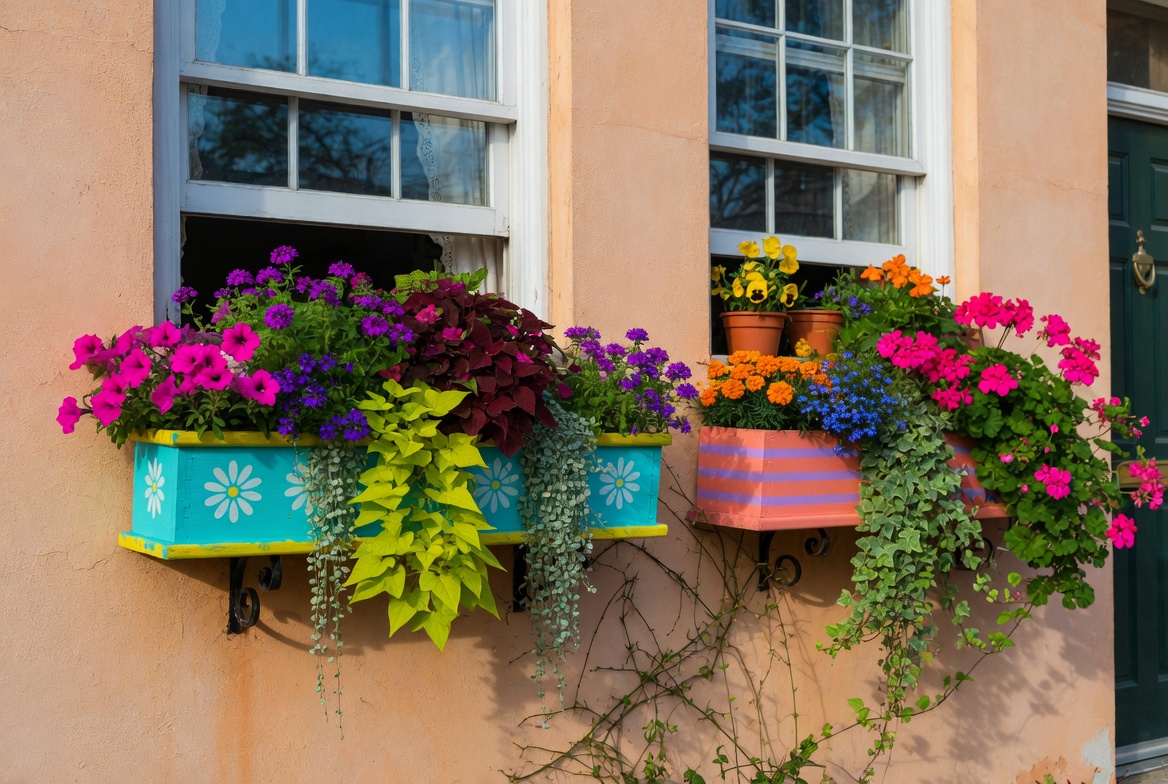
Window boxes are the fastest and most affordable exterior improvement available to most homeowners. A well-planted window box transforms a plain window into a garden feature, adds color visible from the street, and creates the impression of a cared-for, personalized home that no coat of paint achieves as quickly. Yet most window boxes underperform — planted once with whatever was available at the garden center, watered inconsistently, and left to look progressively worse through the season. A window box that looks genuinely good requires three things: the right plants chosen for the actual light conditions, enough plants to create the full, abundant look that makes window boxes beautiful, and regular watering to sustain continuous performance. These 20 ideas cover every style, every season, and every light condition. A window box is a simple way to add color and charm to your home’s facade.
1. Use the Thriller Filler Spiller Formula — Window Box
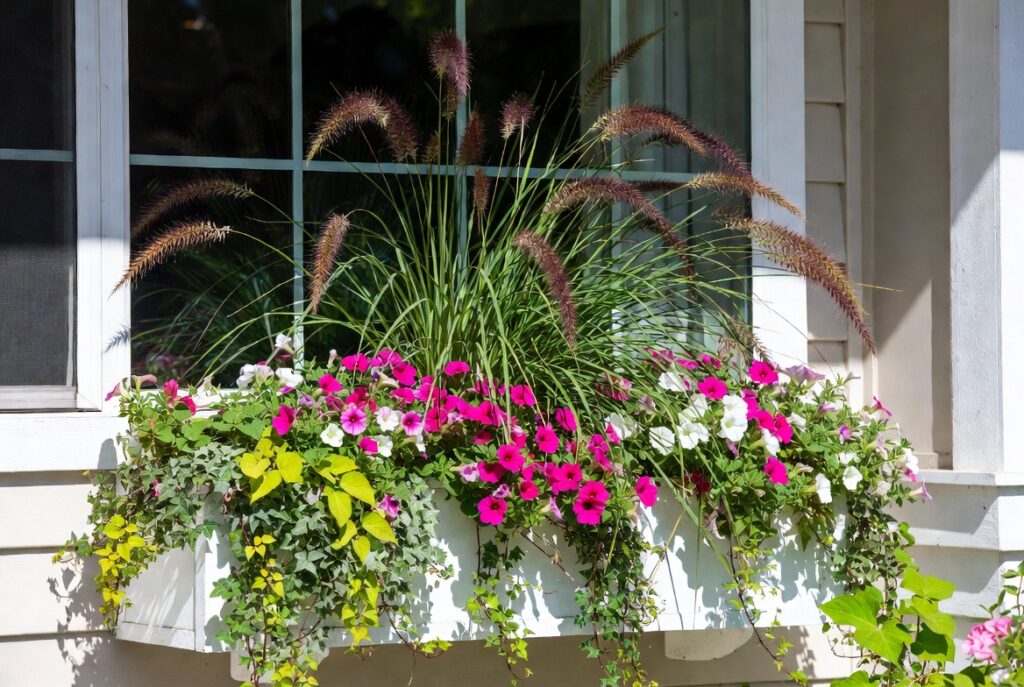
Best for: Any window box — this is the planting formula that produces consistently beautiful results
The thriller-filler-spiller formula is the design framework behind virtually every professionally planted window box and container. It works because it addresses all three dimensions of a window box simultaneously: the thriller provides height and drama at the center or back; the filler provides the dense, colorful mass that gives the box its full, abundant quality; and the spiller trails over the edge and down the box face, softening the hard container line and creating the cascading effect that makes window boxes look dramatic.
Thriller examples: upright grasses, dracaena spikes, tall calibrachoa, salvia, snapdragon. Filler examples: petunias, impatiens, begonias, lobularia (sweet alyssum), zinnias. Spiller examples: trailing ivy, creeping Jenny (Lysimachia nummularia), sweet potato vine, bacopa, trailing lobelia, dichondra.
Smart tip: Use at least one plant per category in every window box, and plant significantly more densely than the spacing on the label suggests. Window boxes are planted for immediate impact — plants spaced at their recommended garden spacing look sparse and unfinished. Pack plants in at roughly half the recommended spacing and accept that they’ll compete for space as the season progresses.
Mistake to avoid: Planting only upright plants without any trailing element. A window box with no spillers looks like a pot sitting on a ledge rather than a designed garden element. The trailing plants that fall over and down the box face are what give the window box its characteristic visual impact from the street.
2. Classic Summer Geranium Window Box
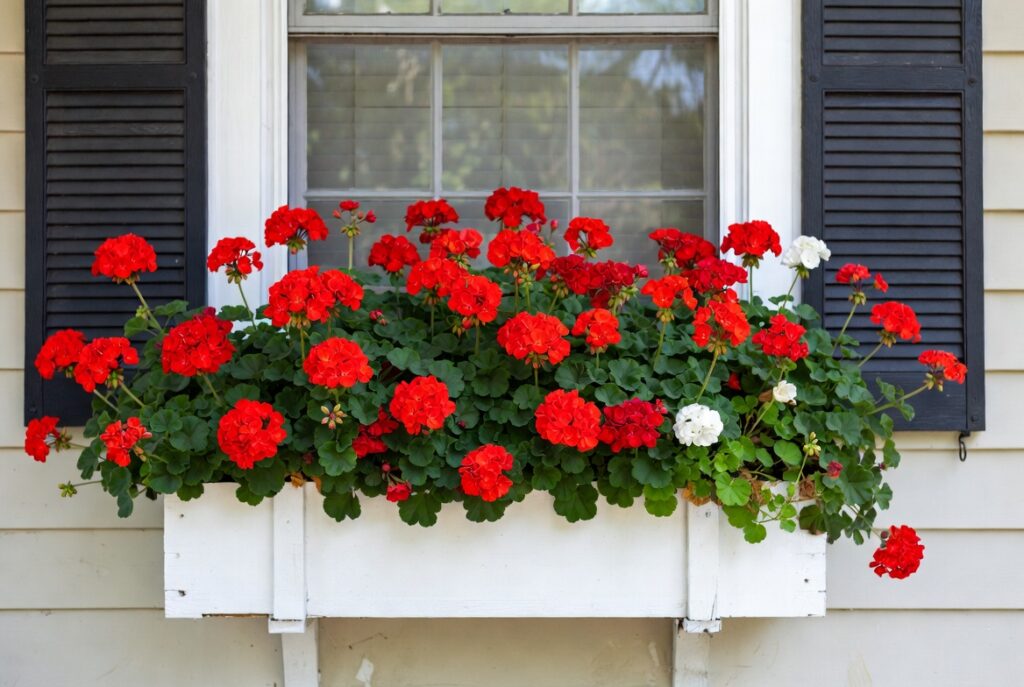
Best for: Traditional and cottage-style homes, sunny window boxes, anyone wanting reliable summer-long color
The geranium (Pelargonium) window box is a classic for good reason: geraniums produce abundant color from late spring through the first frost, tolerate some drought, don’t require deadheading to continue blooming, and look spectacular massed in a window box. The combination of geraniums with trailing ivy has furnished European window boxes for centuries.
The classic recipe: red, pink, or white trailing geraniums as the primary planting, combined with variegated ivy as the spiller and sweet alyssum or bacopa as the filler. The result is the quintessential cottage window box — abundant, colorful, and unmistakably welcoming.
Smart tip: Choose trailing or ivy-leaved geranium (Pelargonium peltatum) varieties specifically for window box use rather than the more common upright zonal geraniums. Trailing geraniums produce a cascading growth habit that suits window boxes far better — the stems trail naturally over the edge rather than growing upright out of the box.
Mistake to avoid: Underwatering geraniums in a window box during hot weather. Geraniums are more drought-tolerant than many window box plants but still need consistent moisture in a contained planting. A window box in full sun may need watering daily in midsummer. Plants that wilt repeatedly — even if they recover — produce fewer flowers and shorter bloom seasons.
3. All-White Elegant Window Box
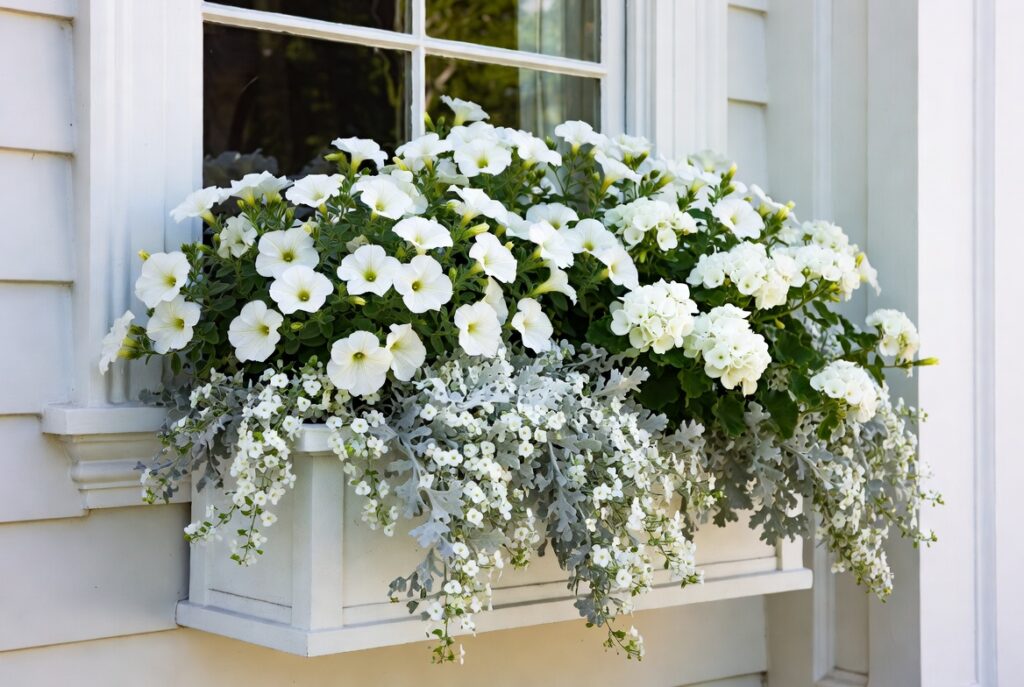
Best for: Any house color — white window boxes are universally compatible and create a sophisticated impression
An all-white window box — white flowers against silver or grey-green foliage — creates an elegant, restrained curb appeal that suits every house color and every architectural style from contemporary to traditional. The white-on-silver palette photographs beautifully and looks particularly striking in the evening when white flowers glow in low light.
The best all-white combination: white petunias or white calibrachoa as the primary flower; dusty miller (Senecio cineraria) as the silver foliage accent that prevents the arrangement from looking flat; and white alyssum (Lobularia maritima) as the trailing filler with honey fragrance.
Smart tip: Add one silver-foliage plant (dusty miller, artemisia, silvery dichondra) to any white window box. Pure white flowers without a foliage contrast read as flat and one-dimensional. Silver foliage creates depth and makes the white flowers appear brighter by contrast — the same principle as wearing a grey background behind white flowers in a photograph.
Mistake to avoid: Using too many different white flower forms in the same white window box. Three or four different white flower shapes (round petunia, daisy, star-shaped alyssum) competing in the same box creates visual busyness rather than the refined elegance that the all-white palette is capable of. Limit to two flower forms maximum and let the foliage provide texture variation.
Loving These Ideas? Get the Step-by-Step Guide
Grab the full 5-day eBook and turn these ideas into a finished room.
4. Herb and Edible Window Box
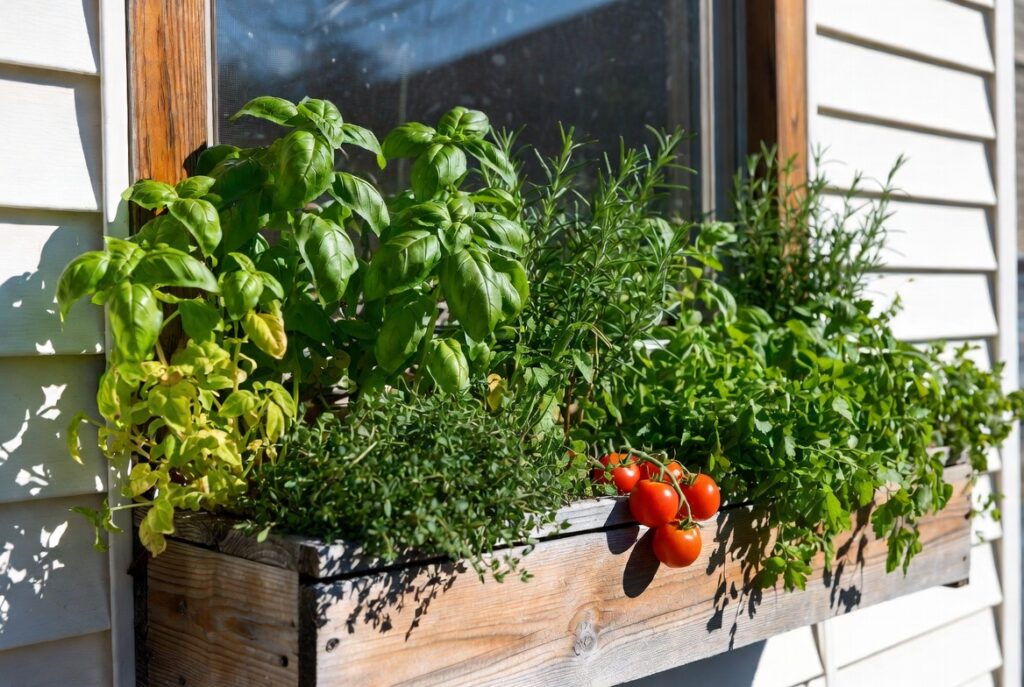
Best for: Kitchen windows, sunny exposures, anyone wanting a practical as well as beautiful window box
A window box of kitchen herbs serves simultaneously as decoration and a constantly accessible herb supply. A kitchen window box planted with basil, parsley, thyme, chives, and trailing nasturtiums provides fresh herbs within arm’s reach — improving the experience of cooking in a way that a garden herb bed further from the kitchen can’t replicate.
The practical consideration: kitchen herbs have varying growth rates and sizes. Basil grows fast and large; thyme stays small and compact; chives produce excellent vertical interest; nasturtiums trail beautifully while providing edible flowers and leaves. Spacing and choosing varieties of similar vigor prevents faster-growing herbs from overwhelming smaller ones.
Smart tip: Plant basil in its own container or at the end of the herb window box rather than mixed with other herbs. Basil grows rapidly and can shade out smaller herbs within a few weeks in good conditions. Keeping it contained or at the edge allows it to develop freely without reducing the performance of adjacent plants.
Mistake to avoid: Using the same potting compost for a herb window box as for a flowering display. Most herbs prefer lean, free-draining soil rather than the nutrient-rich multipurpose compost suited to flowering annuals. Mix standard potting compost 50/50 with horticultural grit for most herbs. Mediterranean herbs (thyme, rosemary, sage) particularly need excellent drainage to perform well in containers.
5. Shade-Loving Window Box
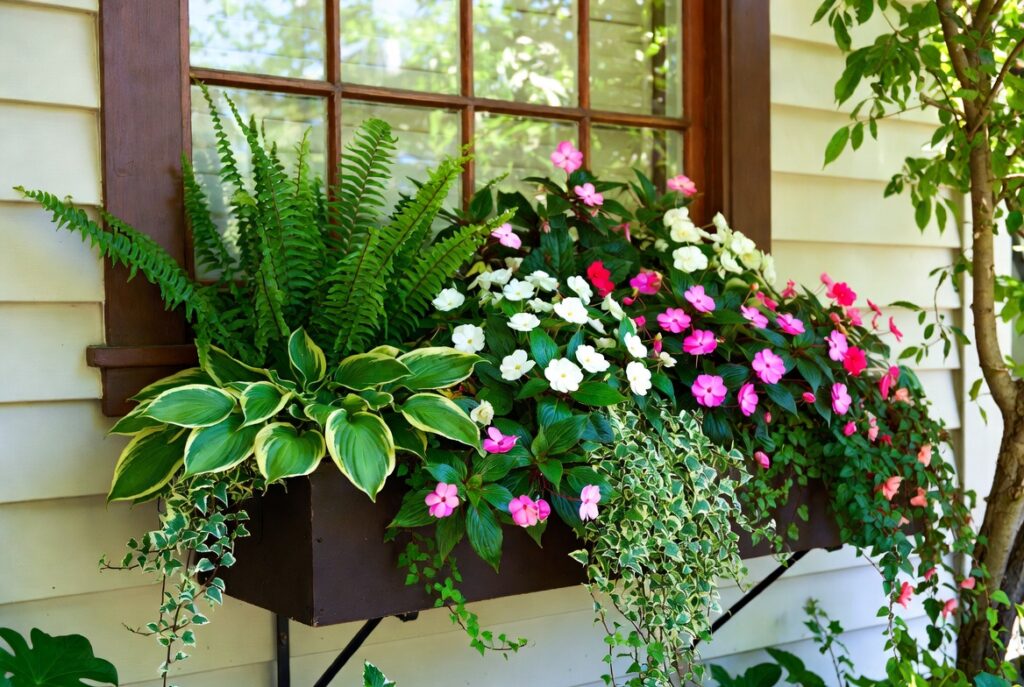
Best for: North-facing windows, windows under porches or overhanging eaves — any position with less than 4 hours of direct sun
Shade is the most common window box challenge — and the one most often solved incorrectly by planting sun-loving species that struggle and decline in the available light. Genuine shade-tolerant plants, planted in the right conditions, produce window boxes as beautiful and abundant as any sun-loving display.
Best plants for shaded window boxes: New Guinea impatiens (Impatiens hawkeri) — continuous flowering in deep shade, vivid colors; standard impatiens (Impatiens walleriana) — the most reliable shade flower available, available in every color; begonias (Begonia semperflorens) — continuous blooming in shade, low maintenance; fuchsias — spectacular pendulous flowers, suits cooler shaded positions; coleus — grown for foliage rather than flowers, extraordinary color range in shade.
Smart tip: New Guinea impatiens are the single best choice for a shaded window box that needs reliable, continuous color all season. They flower continuously from planting until frost with essentially no deadheading, tolerate deep shade better than most flowering plants, and come in vivid colors that maintain their impact even in low-light conditions.
Mistake to avoid: Planting petunias, geraniums, or calibrachoa in a shaded window box. These are among the most sun-dependent window box plants — they require 6 hours of direct sun to flower properly. In shade, they produce leggy growth with few flowers and look poor throughout the season.
6. Trailing Cascade Window Box
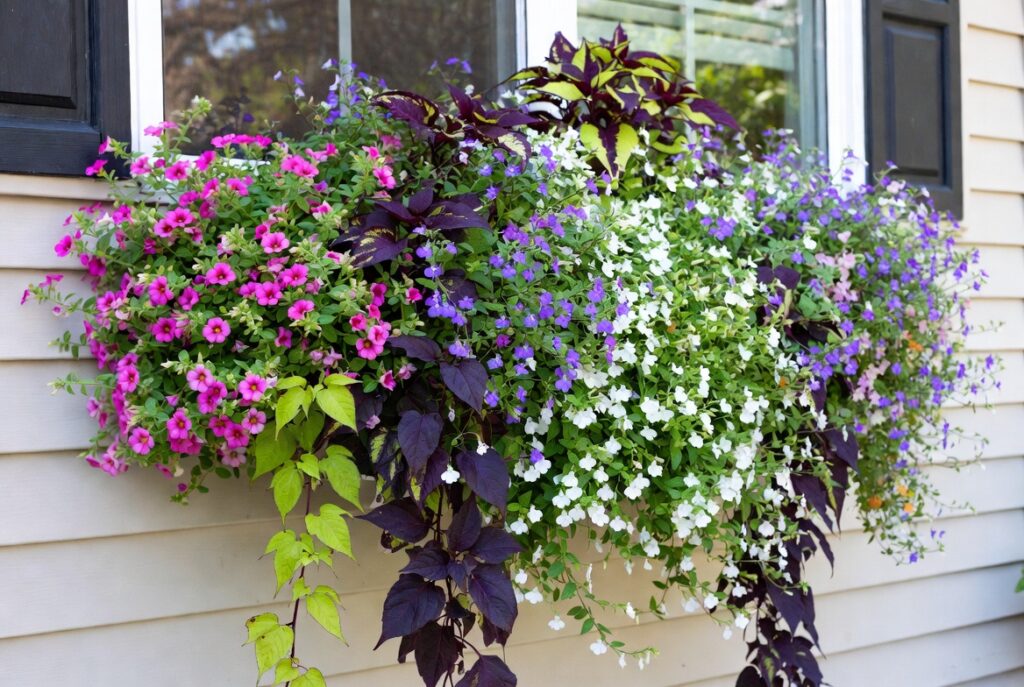
Best for: Second-story windows and elevated positions where the trailing element is viewed from below
A window box planted primarily with trailing and cascading plants — where the plants fall dramatically over the edge and trail several feet down the face of the box — creates a curtain of color that has exceptional visual impact from below. This style suits elevated window boxes where the box itself is less visible than the plants cascading from it.
The best trailing plants for a cascade window box: million bells/calibrachoa (Calibrachoa) — the best trailing window box plant available, produces thousands of small flowers all season, available in every color; trailing petunias (Petunia ‘Wave’ series) — vigorous, weather-tolerant, dramatic trails; bacopa (Sutera cordata) — delicate small white or pink flowers, extremely long trails; creeping Jenny (Lysimachia nummularia ‘Aurea’) — golden-lime foliage, vigorous trailer.
Smart tip: Calibrachoa is the most reliable single plant for a trailing window box. It produces trails of 12 to 24 inches by midsummer, requires no deadheading, tolerates heat and moderate drought, and produces more flowers per plant than virtually any other window box plant. If choosing only one plant type for a cascade box, calibrachoa in a single color is the most impactful choice.
Mistake to avoid: Not providing adequate support for heavy trailing plants on elevated window boxes. Calibrachoa and petunias become quite heavy when fully established — a box with mature trailing plants can weigh significantly more than when planted. Ensure window box brackets are rated for the fully planted weight, not just the empty box weight.
7. Seasonal Rotation Window Box
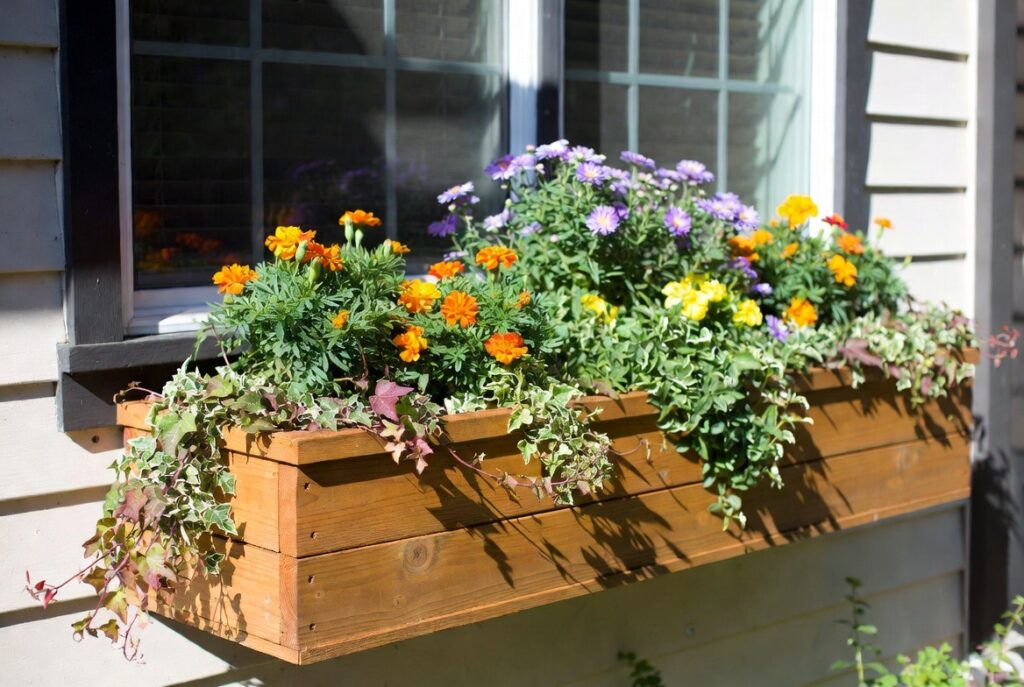
Best for: Any window box — this approach ensures continuous curb appeal throughout all four seasons
Most window boxes look good for 3 to 4 months and then sit bare or declining for the rest of the year. A seasonal rotation approach — replanting with different species suited to each season — maintains continuous curb appeal year-round and creates a home exterior that responds visually to the changing seasons.
The seasonal rotation: spring (March to May) — pansies, violas, primroses, spring bulbs; summer (May to September) — annual flowers, herbs, trailing plants; autumn (September to November) — chrysanthemums, ornamental kale, small pumpkins, late asters; winter (November to March) — evergreen branches, holly, ivy, ornamental cabbage, structural plants.
Smart tip: Keep the window box frame in place year-round and change only the planting. A consistent box style with changing seasonal planting creates a cohesive, curated impression that shows the house is cared for throughout the year — not just during the main summer season.
Mistake to avoid: Attempting the seasonal rotation without a storage plan for plants between seasons. Pansies pulled out in May to make room for summer plants can be held in a sheltered spot and replanted in September for autumn use. Planning the seasonal rotation with cost efficiency in mind — reusing plants between seasons where possible — reduces the total investment significantly.
8. Succulent and Drought-Tolerant Box — Window Box
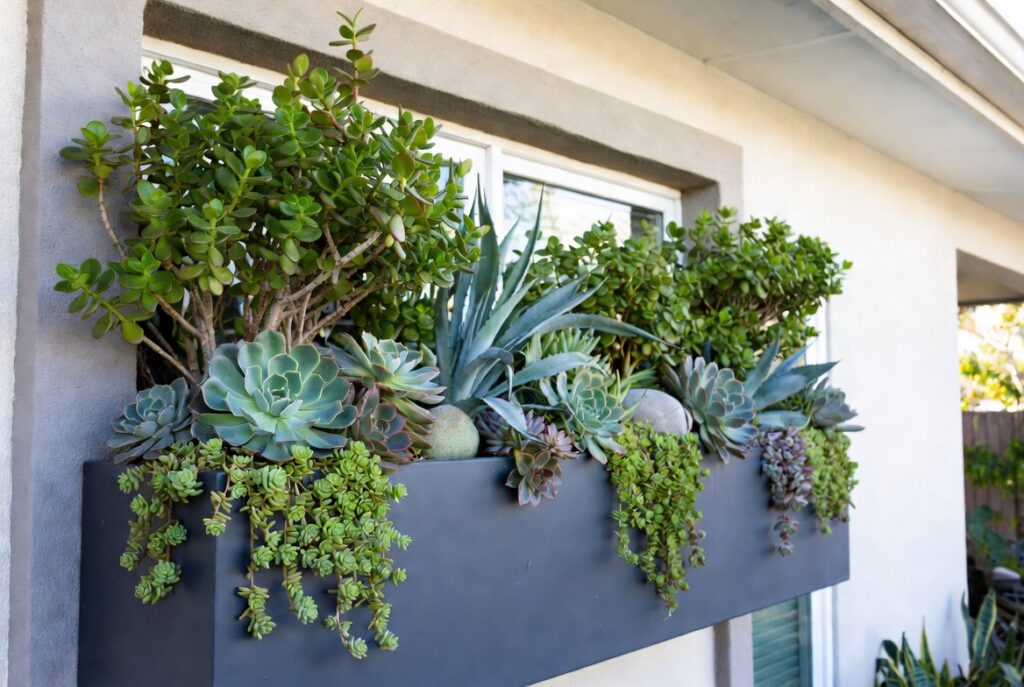
Best for: Hot, sunny positions, vacation homes, anyone who can’t water window boxes regularly
A window box planted with succulents and drought-tolerant plants requires watering once a week or less even in hot conditions — compared to the daily watering that high-performance annual window boxes often need in summer heat. For window boxes in challenging positions or for homeowners with irregular schedules, this is the most practical approach available.
Best succulents and drought-tolerant plants for window boxes: sedum (Sedum acre and related species) — low, mat-forming, drought-tolerant; echeveria — architectural rosettes, spectacular when massed; aloe — dramatic, very drought-tolerant; lavender — fragrant, grey-silver foliage, extraordinary drought tolerance; and Sempervivum (houseleeks) — virtually indestructible, interesting rosette forms.
Smart tip: Use free-draining gritty compost for a succulent window box — the standard potting mixes retain too much moisture and cause root rot in succulents over time. A mix of 50% standard potting compost and 50% horticultural grit or perlite provides the rapid drainage that succulents require.
Mistake to avoid: Combining succulents with standard annual flowers in the same window box. The watering requirements are incompatible — succulents need infrequent deep watering while annuals need frequent watering. The combination results in either succulents rotting from overwatering or annuals failing from drought. Plant succulents in their own dedicated box.
9. Spring Bulb Window Box
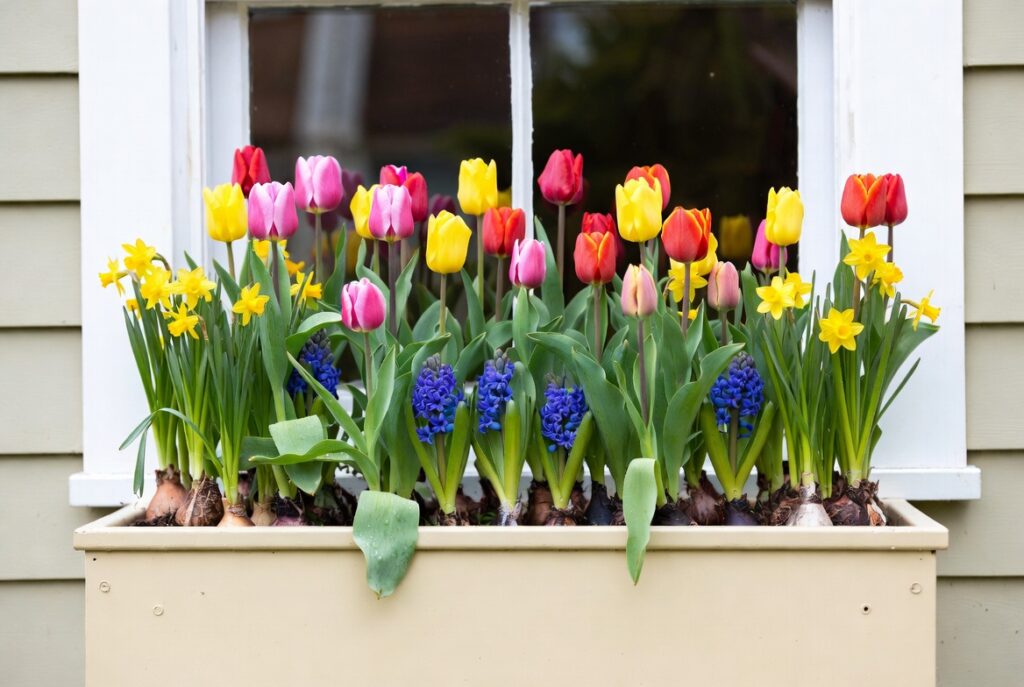
Best for: Providing early-season curb appeal when most window boxes are bare
A spring bulb window box — planted in autumn with tulips, daffodils, grape hyacinths, and crocuses — produces some of the most spectacular window box displays of the year in a period when little else is flowering. The combination of early-emerging spring bulbs with overwintered pansies or violas creates a rich, layered display from late February through May.
The layered bulb technique: plant a layer of large bulbs (tulips, daffodils) at the base of the window box at the recommended planting depth, then fill with compost and plant smaller bulbs (grape hyacinths, crocuses) above them at their appropriate depth. The layering allows multiple bulb types to flower in sequence from the same box.
Smart tip: Choose tulip varieties with similar bloom times when planning a spring window box — early, mid-season, and late tulips can extend the display by 4 to 6 weeks if chosen deliberately. Using only one bloom-time category produces a spectacular but short-lived display; mixing three produces a sustained spring performance.
Mistake to avoid: Leaving tulip bulbs in the window box after flowering to use in subsequent years. Unlike garden-planted tulips that may return reliably, window box tulips planted in limited compost volume rarely perform adequately in a second season. Remove them after flowering and plant fresh bulbs in autumn for reliable results each year.
10. Pollinator-Friendly Window Box
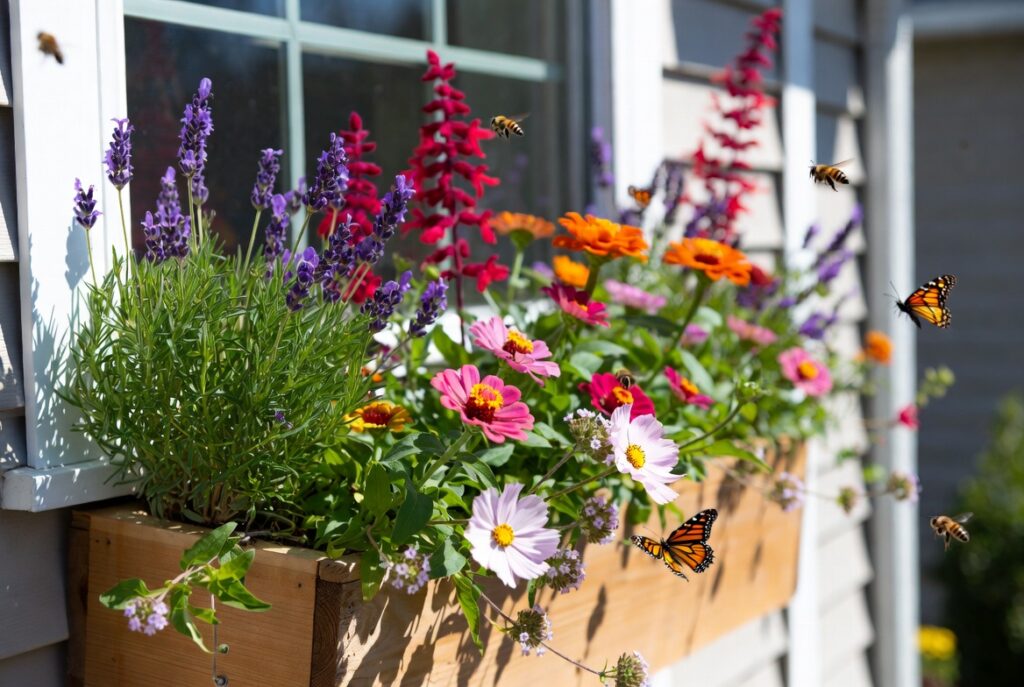
Best for: Anyone wanting to support bees and butterflies while creating a beautiful curb appeal display
A window box planted specifically to support pollinators — bees, butterflies, and beneficial insects — brings wildlife interest to the front of the house while creating a beautiful planting. The combination of fragrant, nectar-rich flowers visible from the street signals a house that cares about its environment.
Best pollinator window box plants: lavender (Lavandula) — the most bee-attracting plant available per square inch of growing space; sweet alyssum (Lobularia maritima) — honey-fragrant, continuous flowering, excellent hoverfly plant; dwarf zinnias — outstanding butterfly plant, available in compact forms suited to window boxes; salvia — long-blooming, excellent for bees.
Smart tip: A window box of lavender alone — three or five lavender plants of the same variety massed in a box — creates one of the most fragrant and bee-attractive window box displays available. The uniformity of a single-plant lavender box looks sophisticated and architectural, and the fragrance drifts into the house through open windows throughout summer.
Mistake to avoid: Using double-flowered varieties in a pollinator window box. Double flowers — with extra petals replacing the stamens and pistils — produce little or no pollen and nectar. Choose single-flowered varieties specifically, even when more showy double versions of the same species are available.
11. Ornamental Grass Window Box
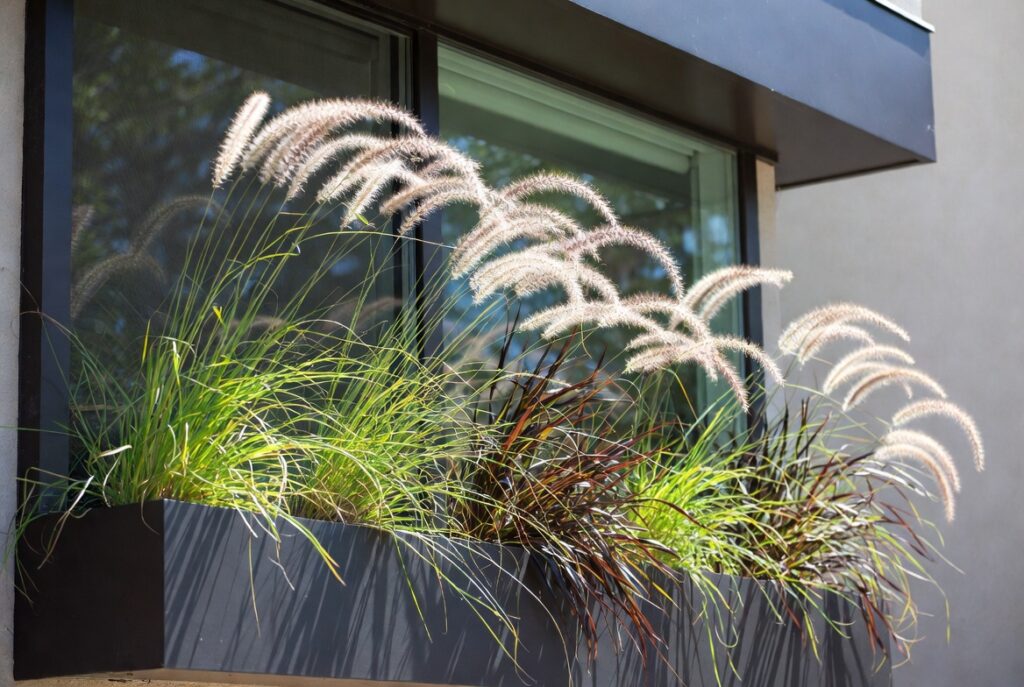
Best for: Contemporary and modern homes, architectural window boxes, anyone wanting movement and texture over color
A window box planted primarily with ornamental grasses — blue fescue, Japanese forest grass, fountain grass, or purple millet — creates a sophisticated, modern curb appeal that suits contemporary homes particularly well. The movement of grass in breeze changes through the day and creates a dynamic quality that static flowering plants can’t replicate.
Best ornamental grasses for window boxes: blue fescue (Festuca glauca) — steel blue, compact, intensely colored; Japanese forest grass (Hakonechloa macra ‘Aureola’) — golden-variegated, cascading naturally over the box edge; purple fountain grass (Pennisetum setaceum ‘Rubrum’) — dramatic burgundy-purple foliage, feathery flower plumes; fiber optic grass (Isolepis cernua) — fine, arching, contemporary.
Smart tip: Combine one tall grass as the thriller, one mid-size grass as the filler, and one cascading grass as the spiller — applying the standard thriller-filler-spiller formula with grasses exclusively. The result is a window box that reads as composed and intentional while providing the movement and texture that grass combinations uniquely offer.
Mistake to avoid: Using aggressive or invasive grass species in a window box. Some ornamental grasses (particularly Pennisetum setaceum) are invasive in warm climates when their seeds spread from containers. Research invasiveness for your specific region before planting any grass species in an outdoor container.
12. Evening Fragrance Window Box
Best for: Windows near outdoor seating, front door window boxes, any position experienced in the evening
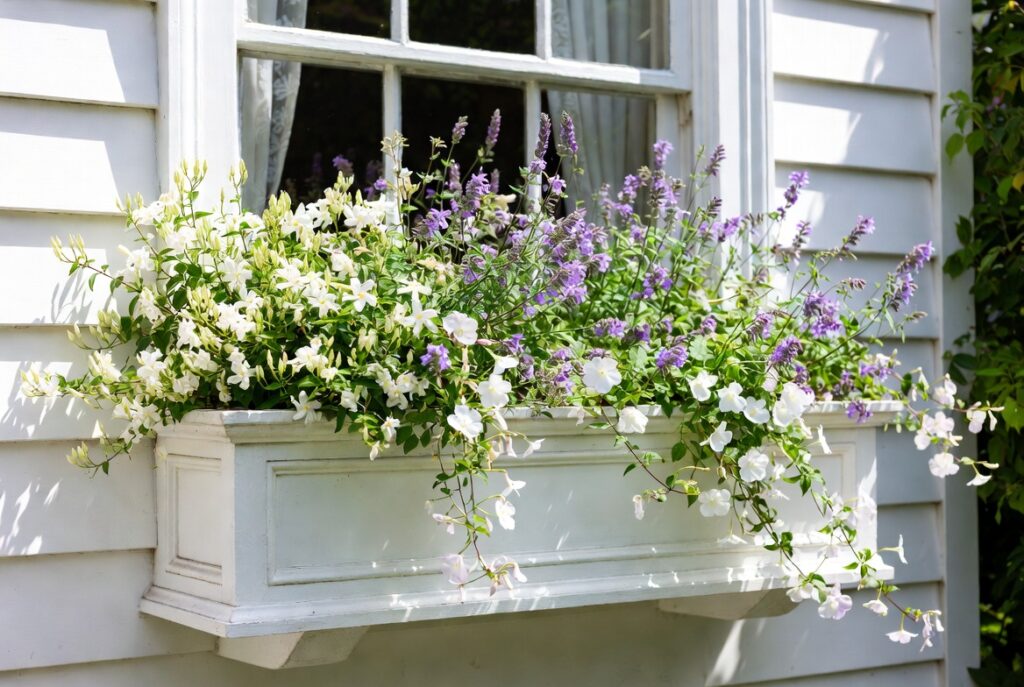
A window box planted for evening fragrance creates an experience that purely visual plantings can’t provide. Many of the most fragrant flowers release their scent primarily at dusk and after dark — specifically to attract night-pollinating moths. A window box of these plants makes the entrance to the house genuinely welcoming after dark in a way that no lighting can replicate.
Best evening-fragrant window box plants: night-scented stock (Matthiola longipetala) — unremarkable by day, intensely clove-fragrant after dark; sweet alyssum (Lobularia maritima) — honey-fragrant continuously but strongest in evenings; white petunia varieties — particularly fragrant in the evening; and heliotrope (Heliotropium arborescens) — vanilla-scented, beautiful purple flowers.
Smart tip: Night-scented stock is the single most impactful fragrance plant for an evening window box. Plant it generously — it’s not particularly ornamental during the day — but by evening its fragrance transforms any outdoor sitting area near the window box. Combine with more visually attractive plants for daytime interest.
Mistake to avoid: Planting evening fragrance plants in a position that can’t be experienced in the evening — a window box on a part of the house that’s never occupied after dark, or one set too high to smell from ground level. Position fragrance plants where their scent can actually be experienced: near the front door, beside outdoor seating, or at a height that puts the flowers at nose level.
13. Native Wildflower Window Box
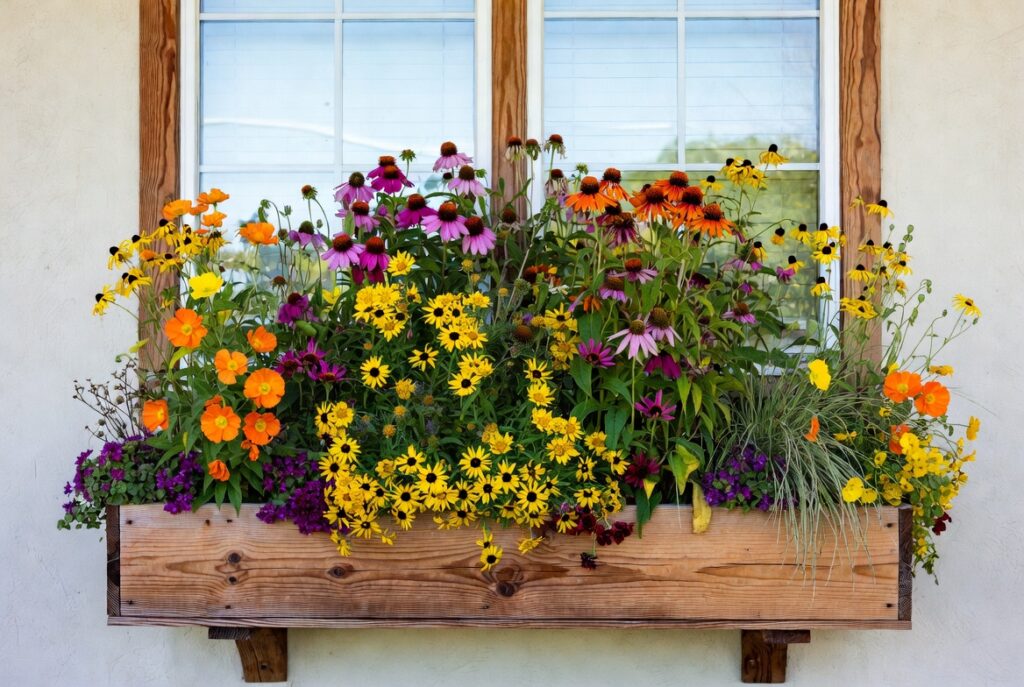
Best for: Gardens committed to sustainability, properties wanting a naturalistic curb appeal
A window box planted with dwarf native wildflowers — compact varieties of black-eyed Susan, coneflower, native aster, and ornamental native grasses — provides pollinator value and regional character that generic annual plantings can’t achieve. Native window boxes look different from conventional ones: less uniform, more dynamic, with the slightly wild quality that native plants carry even in contained form.
Dwarf native wildflower varieties suited to window boxes: ‘Little Goldstar’ rudbeckia (18 inches, compact black-eyed Susan); ‘Magnus Superior’ echinacea (18 to 20 inches, compact coneflower); ‘Wood’s Pink’ aster (12 to 15 inches, compact native aster); and blue fescue (native grass for the spiller position).
Smart tip: Native plants in window boxes establish more slowly than annual cultivars — they spend their first weeks developing root systems rather than producing immediate color. Be patient through the first month and resist the impulse to replace them with faster-performing annuals. By midsummer they catch up and outperform most annuals in terms of wildlife value.
Mistake to avoid: Using native plant varieties with the same vigor as their full-size wild relatives in a window box. Full-size purple coneflower reaches 4 to 5 feet — completely inappropriate for a window box. Research the specific dimensions of compact or dwarf varieties before purchasing.
14. Evergreen Year-Round Window Box
Best for: Low-maintenance situations, vacation homes, anyone wanting year-round structure without regular replanting
An evergreen window box — planted with dwarf box (Buxus sempervirens), small-leaved euonymus, dwarf conifer, or clipped ivy — provides year-round structure and green without the seasonal maintenance of a flowering display. Evergreen window boxes require watering during dry periods and occasional trimming to maintain shape, but no seasonal replanting.
The visual quality of an evergreen window box: more architectural and restrained than a flowering display, signaling attention to detail and permanence. Dwarf box in a window box looks instantly established and sophisticated, and improves with age as the plants develop a more defined form.
Smart tip: Supplement a permanent evergreen window box with seasonal color by tucking in bulbs (which can be removed after flowering) or small annual plants that complement the evergreen structure. The evergreen provides the year-round bones; seasonal additions provide color punctuation at appropriate times without requiring full replanting.
Mistake to avoid: Planting box (Buxus) in a region where box blight (Cylindrocladium buxicola) is prevalent without using resistant varieties. Box blight has devastated many box plantings in affected regions — check whether it’s a significant issue in your area and consider alternatives (dwarf euonymus, Japanese holly/Ilex crenata, or dwarf pittosporum) if blight is a local problem.
15. Tropical Statement Window Box
Best for: Hot climates, frost-free regions, anyone wanting an exotic, high-impact curb appeal display
In frost-free climates or during the long warm season in temperate climates, tropical and sub-tropical plants create window boxes of extraordinary visual impact — vivid colors, dramatic foliage, and a lushness that temperate-climate window boxes struggle to match.
Best tropical window box plants: mandevilla — climbing shrub with large trumpet flowers in pink, red, or white; caladium — spectacular foliage in combinations of white, pink, red, and green; croton (Codiaeum variegatum) — extraordinary foliage in orange, yellow, red, and green; angelonia — continuous flowering in heat, long bloom season.
Smart tip: Mandevilla is the most impactful single plant for a tropical window box in a sunny position. Train it up a small obelisk or stake within the box and it creates a vertical element that draws the eye from street distance. Its large, glossy leaves and trumpet-shaped flowers are visible from much farther away than most window box plants.
Mistake to avoid: Planting tropical window boxes too early in spring in temperate climates. Tropical plants suffer damage at temperatures below about 10°C (50°F) and fail entirely after frost. Plant tropical window boxes only after all frost risk has passed and night temperatures are reliably warm — typically late May or early June in most temperate climates.
16. Autumn Harvest Window Box
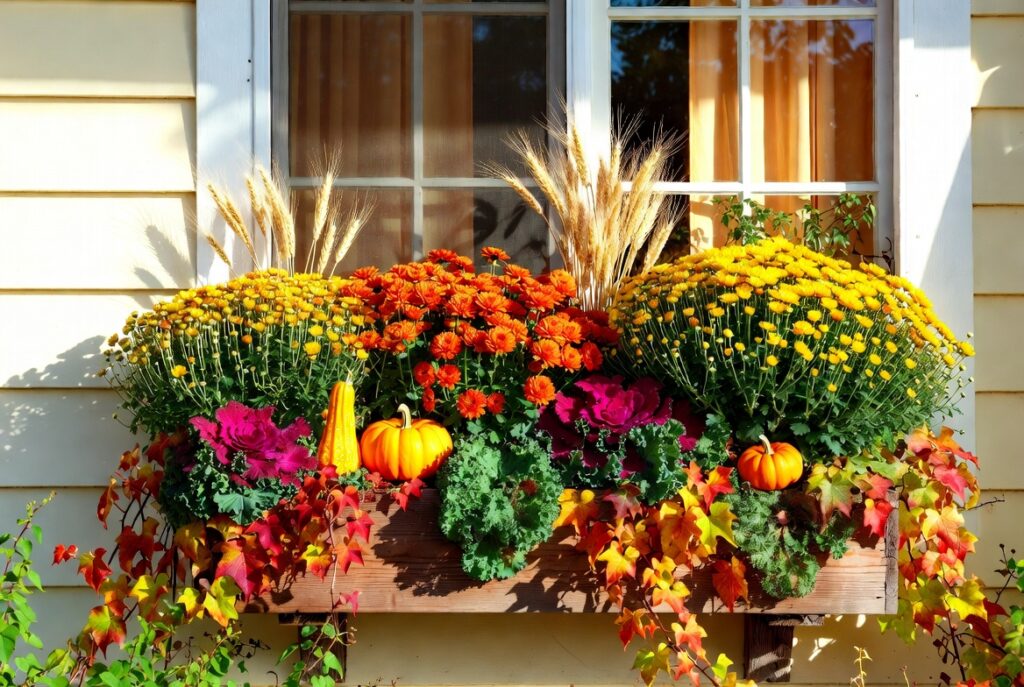
Best for: Extending the window box season beyond summer, creating seasonal curb appeal in autumn
An autumn window box — planted in September with chrysanthemums, ornamental kale, small pumpkins or gourds, and ornamental peppers — keeps window boxes looking intentional and abundant through October and November when summer annuals have finished.
The colour palette of autumn window boxes: burnt orange, deep burgundy, golden yellow, cream, and the blue-green of ornamental kale — a naturally harmonious colour scheme that suits the season without requiring careful colour coordination.
Smart tip: Use ornamental kale as the central structural element of autumn window boxes. Its cabbage-like rosettes in white, pink, and purple with green or blue-green outer leaves are extraordinarily beautiful, tolerant of frost, and provide bold visual impact at street distance. Surround with chrysanthemums and trailing ivy for a complete autumn composition.
Mistake to avoid: Planting standard chrysanthemums (florist varieties) in outdoor autumn window boxes expecting them to survive frost. Florist chrysanthemums are bred for indoor use and are not frost-hardy. For outdoor autumn window boxes, use specifically outdoor-rated hardy chrysanthemums — these tolerate several degrees of frost and continue flowering well into autumn.
17. Winter Evergreen Window Box
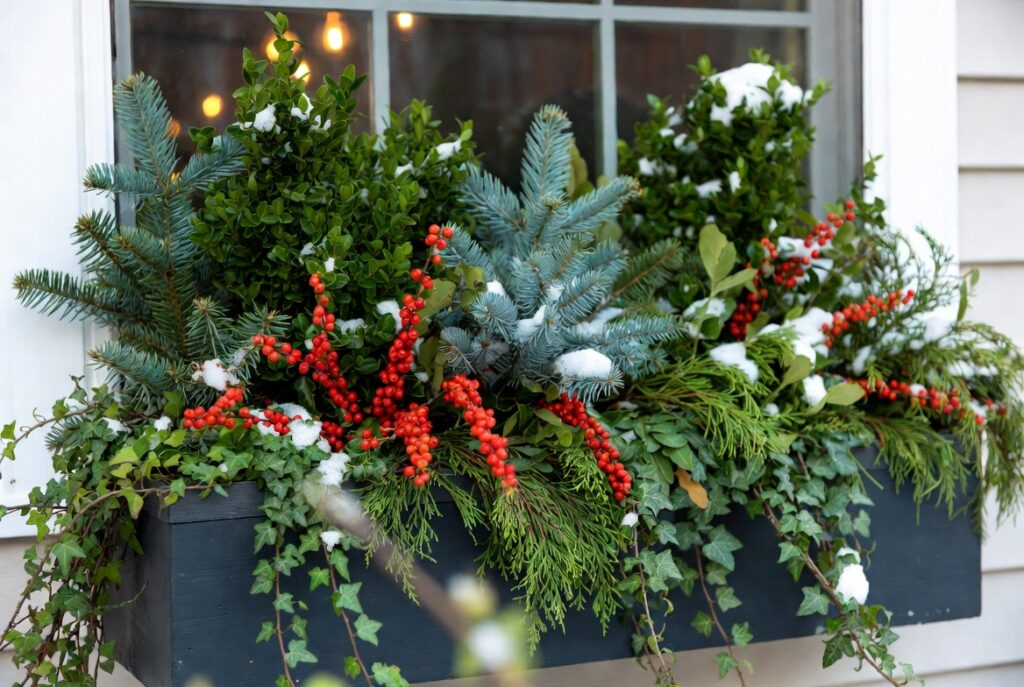
Best for: Maintaining curb appeal through the winter months when most plantings are bare
A winter window box — filled with cut evergreen branches, pinecones, holly berries, and structural elements — keeps the home’s exterior looking cared-for and festive through the coldest months when most window boxes are bare. This approach treats the window box as a three-dimensional arrangement rather than a planted container.
Materials for a winter window box: cut branches of evergreen (pine, spruce, cedar, eucalyptus); stems of holly with red berries; bare-branched twigs of birch or dogwood for structural interest; pinecones wired to stems; and ribbon or other decorative elements appropriate to the season.
Smart tip: Cut evergreen branches from the garden or purchase from a florist in quantity — they last 4 to 8 weeks in winter conditions, far longer than cut flowers. Refresh the arrangement by replacing any that begin to look brown and adding new material. The total cost for a winter window box arrangement is typically lower than a planted one.
Mistake to avoid: Using exclusively artificial plants and elements in a winter window box for apparent convenience. Artificial greenery looks synthetic in outdoor light in a way it doesn’t indoors, and it looks worse as it weathers and accumulates dust. Natural cut materials — even if they need refreshing — look genuine and appropriate in a way that plastic alternatives don’t.
18. Choose the Right Window Box Material
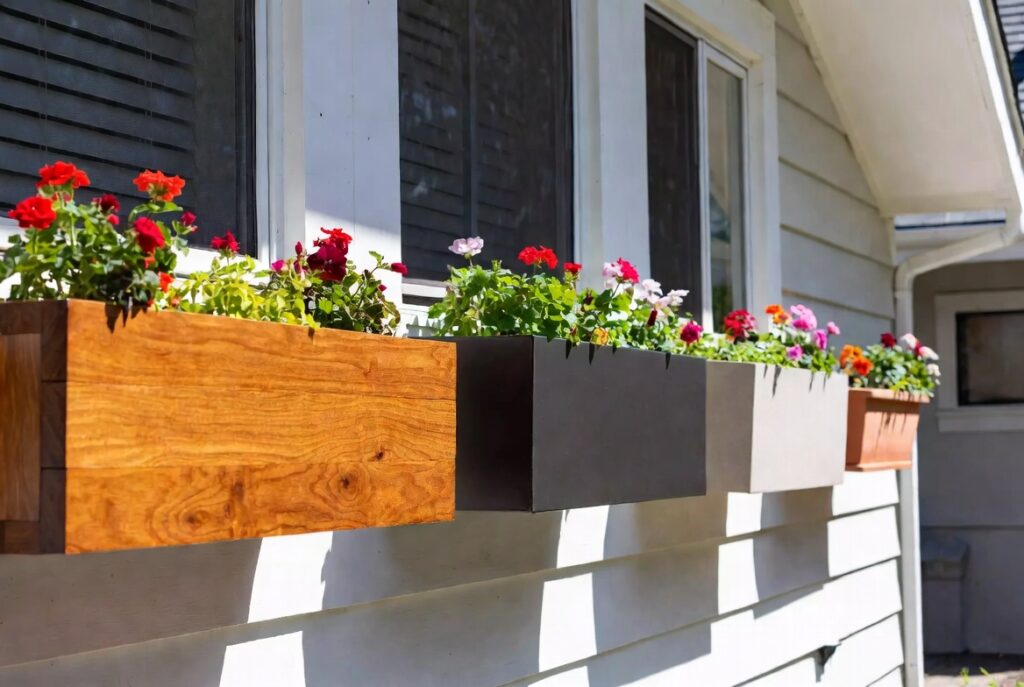
Best for: Anyone selecting or replacing window boxes — material determines appearance, longevity, and weight
The window box material determines how the box ages, how much it weighs (a significant concern for upper-story windows), how well it insulates plant roots from temperature extremes, and how it looks against the house exterior. Different materials suit different house styles and different practical requirements.
Materials by characteristic: timber (most attractive natural appearance, suits traditional homes, requires maintenance — painting or staining every 2 to 3 years — to prevent rot); fibreglass (lightweight, very durable, can be made to look like any other material including stone and terracotta); metal (zinc and galvanized steel age beautifully to a patina that suits contemporary homes); plastic (lightest, most affordable, least attractive — fades and becomes brittle in UV over several years); concrete or terracotta (heavy, authentic-looking, requires very secure mounting due to weight).
Smart tip: Fibreglass window boxes that convincingly replicate the appearance of lead, zinc, or terracotta are the most practical choice for most applications — they look like more expensive materials, weigh a fraction as much (critical for upper-story installation), and last indefinitely without maintenance.
Mistake to avoid: Choosing window boxes without considering their weight when fully planted. A large terracotta or concrete window box filled with damp compost and mature plants can weigh 50 to 80 pounds. The wall or window frame it’s mounted on, and the brackets supporting it, must be capable of safely carrying this weight. Always check the load rating of mounting hardware before installing heavy boxes.
19. Match the Box to the House Style — Window Box
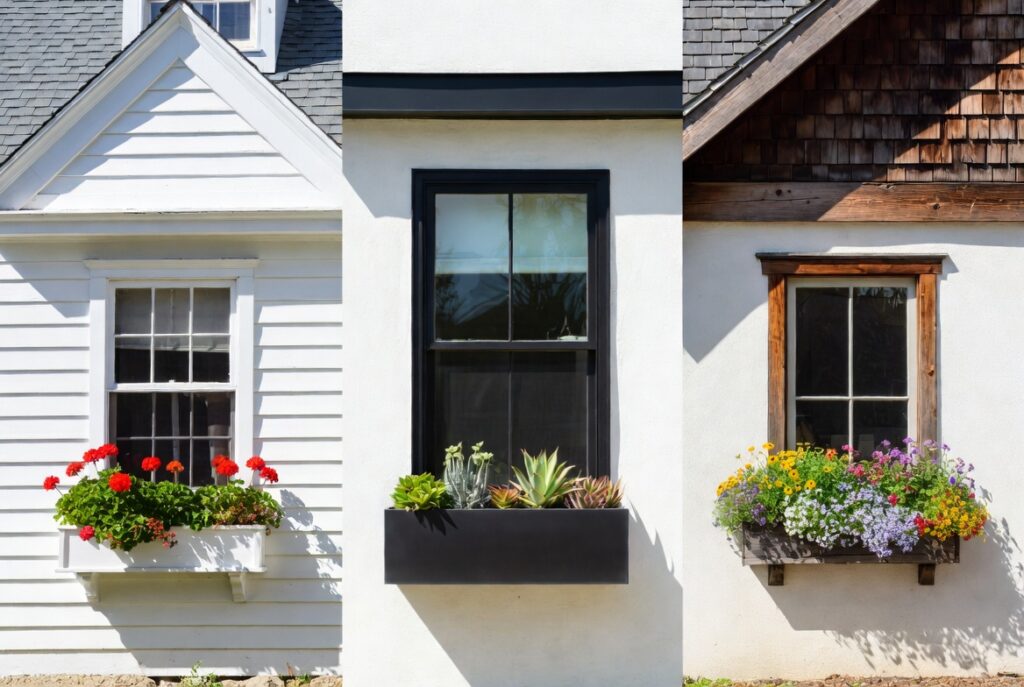
Best for: Any home — the visual relationship between window box style and house architecture determines whether the box looks designed or added on
A window box that suits the house’s architectural style looks as though it belongs — as though the house was designed with the window box in mind. A window box that clashes with the style (ornate Victorian ironwork on a minimalist contemporary house, or a plain plastic box on a traditional timber-frame cottage) looks like an afterthought regardless of how well it’s planted.
Style matching by house type: traditional timber-frame, cottage, or colonial — painted timber boxes in white or in the house trim color; contemporary and modern — zinc, Corten steel, or fibreglass in charcoal or dark green; Georgian or Federal — simple timber or metal boxes with clean lines in dark colors; Mediterranean or Spanish — terracotta-toned fibreglass or genuine terracotta.
Smart tip: Match the window box color to an existing house color rather than introducing a new one. A box painted to match the window trim, the front door, or the shutters reads as part of the house’s design. A box in an unrelated color looks added rather than integrated.
Mistake to avoid: Using boxes of different styles and colors on the same house exterior. Visual consistency across all window boxes — same style, same material, same color — creates the impression of deliberate design. Mixed styles, even if each is attractive individually, create visual confusion rather than cohesion.
20. Window Box Care and Maintenance
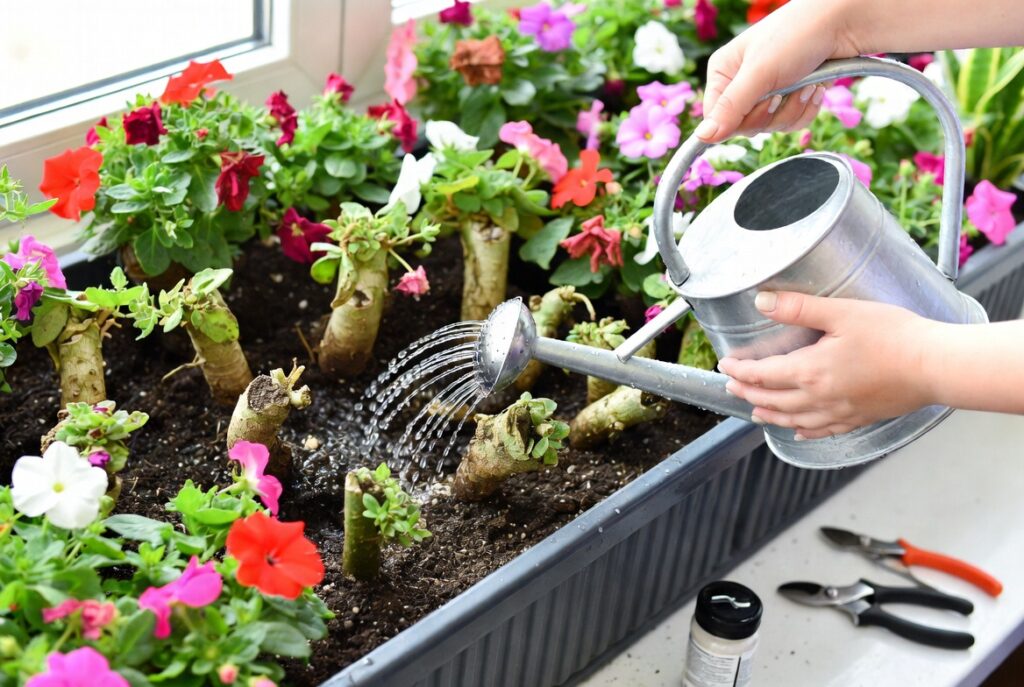
Best for: Anyone with window boxes — maintenance determines whether they look beautiful throughout the season or decline after the first few weeks
A window box that’s well-maintained through the season looks consistently attractive from planting until frost. One that’s under-maintained declines progressively — plants become leggy, flowers stop, and the display that looked beautiful in June looks poor by August. Most window box decline is caused by three things: insufficient watering, insufficient feeding, and inadequate deadheading.
Watering: window boxes dry out faster than garden plants because the limited soil volume can’t buffer against periods without moisture. Check daily in hot weather — a window box in full sun with mature plants may need watering twice daily in midsummer. The test: push a finger 2 inches into the compost — if it’s dry at that depth, water immediately.
Smart tip: A self-watering window box — with a reservoir at the base that plants draw from as needed — dramatically reduces watering frequency and the risk of plants drying out during hot weather or short absences. The initial cost is higher than a standard box, but the reduction in maintenance and plant failure more than compensates over a single season.
Mistake to avoid: Watering window boxes on a fixed schedule regardless of conditions. A schedule suited to July (daily watering) leaves plants overwatered in cool, wet June conditions and underwatered during an August heat wave. Water in response to plant and soil condition — not calendar — for best results.
Before You Start — Window Box
- Assess the light conditions honestly. Hold your hand at the window box position at different times of day and note how many hours of direct sun the position receives. Full sun (6+ hours), partial shade (3 to 6 hours), and shade (under 3 hours) require completely different plant selections.
- Check the structural capacity. Upper-story window boxes, fully planted, are heavy. Ensure the wall, window frame, and brackets can safely support the weight.
- Choose box size for the window. A box that’s the full width of the window (or within 6 inches either side) looks proportional. A box significantly narrower than the window looks like an afterthought.
- Plan for watering access. A window box that requires a ladder to water won’t be watered consistently. Install upper-story boxes only if watering is realistically manageable, or use self-watering boxes with accessible reservoirs.
Conclusion
A window box that performs well throughout the season requires the right plants for the actual conditions, enough of them to create the dense, full effect that makes window boxes beautiful, and consistent watering and feeding through the growing season. Get those three things right and a window box transforms a house exterior more quickly and more affordably than any other garden improvement available.
Continue Your Home Transformation
Explore the full collection of step-by-step eBooks and get the guide that fits the room you're working on.

One Comment