
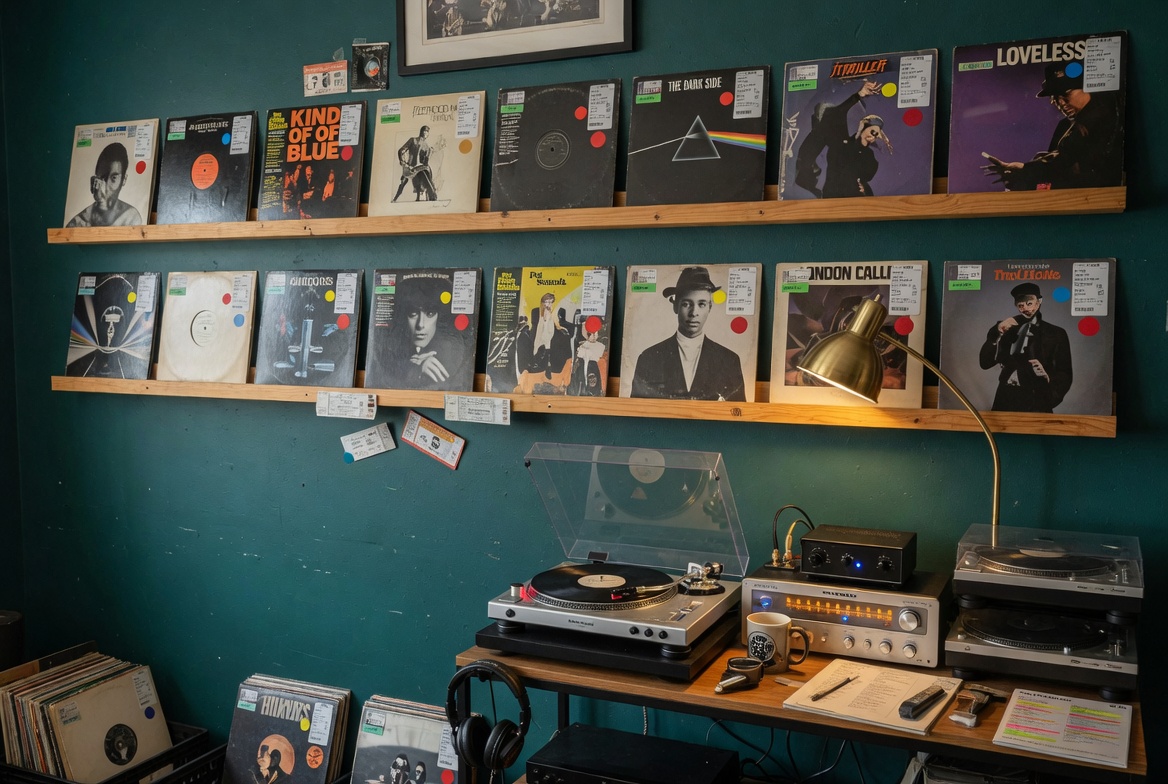
Vinyl records occupy a unique position among home possessions: they’re objects of genuine beauty, objects that carry music and memory simultaneously, and objects that require specific storage conditions to remain playable. A collection of 100 records weighs roughly 80 pounds. A collection of 500 needs the structural support of purpose-built furniture and a room with adequate floor load capacity. And all vinyl — regardless of collection size — warrants vertical storage, consistent temperature, and protection from UV light to preserve both the records themselves and the cover artwork that’s often as significant as the music inside. These 20 ideas address the full spectrum of vinyl storage and display: from a first-time collector’s starter setup to a serious library for a collection of thousands, and from practical hidden storage to the display-forward approaches that treat album covers as the art they genuinely are.
1. IKEA KALLAX Shelving System
Best for: Collections of 50 to 500+ records — the most widely used and most practical vinyl storage solution available at any price
The IKEA KALLAX unit is the default choice of serious vinyl collectors worldwide for a straightforward reason: its internal cube dimensions (13 inches square) are essentially perfect for 12-inch LP storage. Each cube holds approximately 50 to 80 records depending on jacket thickness, stands upright without warping, and allows easy browsing and retrieval. The unit comes in configurations from a single 2×2 cube to a 5×5 grid of 25 cubes.
The KALLAX’s visual quality is also genuinely attractive — it reads as intentional furniture rather than improvised storage, suits both minimalist and mid-century modern interiors, and works as a room divider as well as a wall-placed unit.
Smart tip: Reinforce KALLAX shelves with additional support for large vinyl collections. Records are significantly heavier than books — a fully loaded KALLAX cube holds 40 to 50 pounds. The KALLAX is designed for this weight, but the middle dividers (the shorter ones between cubes) are less robust than the full-width boards. Store records on the full-width boards rather than the shorter dividers for maximum structural support.
Mistake to avoid: Overloading a single KALLAX cube with too many records without using dividers. When too many records are packed into one cube without internal dividers, the pressure of the weight causes leaning — records in the middle begin to tilt, which stresses the album covers and can cause warping to the records at the bottom of the leaning section over time.
2. Wall-Mounted Record Shelves
Best for: Any room — wall-mounted shelves provide accessible, attractive storage without using floor space
Wall-mounted record shelves — shelves with a front lip that holds records upright, mounted directly on the wall — provide vinyl storage at any level of the room without requiring floor furniture. The visual effect is of the records displayed as an element of the wall’s decoration — particularly effective when the visible spines and occasional cover-forward displays create a textured, curated wall surface.
Dedicated vinyl wall shelves are designed with an internal lip (typically 2 to 3 inches) that holds records upright without the need for the record to lean against anything. This lip design prevents the slow forward tilt that flat shelves produce over time.
Smart tip: Vary the heights of wall-mounted record shelves across the wall for visual interest — a uniform horizontal band of shelves at one height looks like a storage installation; shelves at varying heights and different lengths create a gallery-like composition that integrates the records into the room’s visual design more naturally.
Mistake to avoid: Mounting record shelves on a wall without verifying that the wall fixings can carry the load. A shelf of 50 records weighs approximately 40 pounds — a weight that requires wall anchors into studs (in timber-framed walls) or appropriate masonry anchors (in brick or block walls). Standard drywall anchors rated for decorative items are insufficient for vinyl shelf loads.
3. Frame Album Covers as Wall Art
Best for: Collectors who want to display specific albums as art — album cover design is one of the most significant graphic art forms of the 20th century
The album cover as art form — from the dark surrealism of Pink Floyd’s The Wall to the photographic intensity of Miles Davis’s Kind of Blue — represents some of the most significant graphic design and photography of the past 70 years. Framing and displaying album covers as wall art treats them with the respect their visual quality deserves and creates a personal, rotating gallery that reflects the collector’s taste and musical identity.
Dedicated record frames (available specifically in 12.5-inch square format to fit LP covers precisely) allow albums to be displayed face-forward on the wall while remaining accessible — the frame typically opens without tools, allowing the album to be removed for play and replaced for display.
Smart tip: Create a grid layout of framed album covers using the same frame style throughout. A grid of 6 to 12 frames in matching black or natural wood frames creates a cohesive gallery wall with strong visual impact. Mixed frame styles create a less resolved, more casual display — appropriate for some aesthetics, but less powerful as a room statement.
Mistake to avoid: Displaying albums in positions exposed to direct sunlight. UV light degrades album cover artwork significantly over time — the colors fade and the paper yellows. Display album covers on walls away from direct sunlight, or use UV-filtering glass in the frames if a sunny wall is the only available position.
4. Mid-Century Record Cabinet
Best for: Collectors who want storage that suits a warm, designed interior — a record cabinet becomes a room feature rather than a storage solution
A mid-century modern record cabinet — low, long, in walnut or teak with tapered legs and clean horizontal lines — suits vinyl storage with aesthetic logic as well as practical: the mid-century modern aesthetic emerged during the vinyl era’s peak, and the visual language of the two feels genuinely related. A well-chosen record cabinet with a turntable on top creates a complete, self-contained listening station that reads as a considered piece of room furniture.
The sliding slatted door design common in mid-century cabinets allows full visual access to the records within when open and a clean, closed face when shut — accommodating both the desire to display the collection and the need to protect it from dust.
Smart tip: Position the record cabinet away from exterior walls and heating vents. Mid-century cabinets are typically solid wood — susceptible to the humidity fluctuations that occur near exterior walls in cold weather and the drying heat of vents in winter. A stable interior position away from these fluctuation sources preserves both the cabinet and the records within it.
Mistake to avoid: Using a mid-century cabinet designed for a turntable placement without first measuring the turntable’s dimensions. Turntables vary significantly in size, and a cabinet whose top surface is shallower than the turntable’s depth cannot accommodate it without the turntable overhanging the front or back edge unsafely. Measure the turntable before choosing the cabinet.
5. Wooden Crates and Milk Crates
Best for: Smaller collections, supplementary storage for overflow records, or collectors who prefer a casual, vintage aesthetic
Wooden wine crates, vintage milk crates, and purpose-built wooden record crates offer flexible, stackable storage with an authentic vintage quality that suited vinyl’s origin era. A stack of wooden crates against a wall — each holding 50 to 80 records — creates a modular storage system that can grow with the collection without committing to fixed furniture.
The aesthetic of crates suits casual, bohemian, and vintage-inspired interiors particularly well. The exposed wood grain, the visible record spines, and the utilitarian quality of the crate all contribute to an atmosphere of genuine, lived-in musical enthusiasm rather than curated display.
Smart tip: Use crates with internal dimensions of at least 13 to 14 inches square to accommodate LP covers with comfortable clearance. Crates that are too tight require forcing records in and out — which damages jacket corners over time and makes browsing frustrating. A crate with 1 to 2 inches of clearance above and beside the jacket allows easy retrieval.
Mistake to avoid: Stacking crates so high that the lower records are inaccessible without moving the crates above. A stack of more than three to four crates becomes difficult to access — the lower crates effectively become archive storage rather than a usable collection. Organize the most-played records in the most accessible crates (near the turntable, at comfortable reaching height) and overflow or archived records in less accessible positions.
6. Dedicated Listening Corner
Best for: Any serious vinyl collector — a dedicated listening corner elevates the vinyl experience from casual to intentional
A listening corner — a defined area of the room dedicated to the turntable, speakers, and record storage — creates a space specifically designed for active listening rather than background music. The listening corner signals that vinyl in this home is taken seriously: the seating faces the speakers, the records are within arm’s reach of the turntable, and the entire setup invites deliberate engagement with music.
The minimum elements: a turntable on a stable surface (a dedicated stand, a sideboard, or a console); speakers positioned at ear level when seated (ideally on stands); a comfortable chair or sofa facing the speakers; and record storage within arm’s reach of the seated listening position.
Smart tip: Position the listening chair at the apex of the “sweet spot” between the two speakers — the equilateral triangle where both speakers are equidistant from the listening position and at the same distance apart as they are from the listener. This position produces the most accurate stereo imaging and the most satisfying listening experience from any speaker system.
Mistake to avoid: Placing the turntable on the same surface as the speakers. Speaker vibration transmitted through a shared surface causes the stylus to skip or buzz — a persistent problem that degrades both the listening experience and the records themselves over time. The turntable must be on an independent, isolated surface or a dedicated platform that decouples it from speaker vibration.
7. Floating Shelves with Turntable
Best for: Rooms where floor furniture is limited but wall space is available — floating shelves create a complete record setup without floor storage
A floating shelf arrangement — one shelf at standing height for the turntable, additional shelves above for record storage and equipment — creates a complete vinyl setup on the wall without any floor furniture. The turntable shelf should be at a height that allows comfortable operation while standing (approximately 36 to 42 inches from the floor for most adults) and must be mounted into wall studs to bear the combined weight of the turntable and records.
The visual effect of a floating turntable shelf with record storage above it — the equipment visible, the records accessible, the cables managed cleanly — has the quality of a designed audio installation rather than furniture placed against a wall.
Smart tip: Install the turntable on a floating shelf that’s isolated from the record storage shelves above. If the turntable shelf and record shelves are on the same continuous wall-mounting system, vibration from speakers transmitted through the wall can cause tracking issues. Using a separate mounting for the turntable shelf, with at least 6 inches of vertical gap between the turntable shelf and the nearest record shelf, reduces this risk.
Mistake to avoid: Mounting a turntable shelf on a wall that’s shared with a subwoofer placement in an adjacent room. Bass frequencies transmit through walls effectively and can cause a stylus to skip on a wall-mounted turntable even when the source is in another room. Use a floor-standing turntable isolation platform or a wall-decoupled shelf if bass transmission from adjacent spaces is a concern.
8. Now Playing Display Stand
Best for: Any vinyl listener — the most affordable and most impactful single vinyl display addition available
A “Now Playing” display stand — a small easel or stand that holds the album currently being played face-forward for display — treats the playing album’s cover as part of the listening experience rather than something to be set aside while the music plays. Many stands are designed specifically for record display, with dimensions suited to 12-inch LP covers and materials (walnut, acrylic, steel) that suit both casual and designed listening setups.
The rotating display quality of a “Now Playing” stand creates a constantly changing element in the room — each record played becomes briefly the room’s featured artwork, creating a visual connection to the music that enhances the listening experience.
Smart tip: Position the “Now Playing” stand where it’s visible from the listening position — ideally near the turntable but angled toward the chair rather than facing the wall. The stand’s purpose is visual engagement with the album during listening — if it can’t be seen from the listening position, this purpose isn’t served.
Mistake to avoid: Using a “Now Playing” stand that doesn’t securely hold the record during playback. Some stands hold the record only loosely — it can fall forward if brushed. A stand with a secure back rest or a lip that holds the bottom of the cover firmly prevents the album from being knocked over during the listening session.
9. Built-In Wall Record Library
Best for: Large collections (500+ records) in homes where a permanent, architectural storage solution is appropriate
A built-in record library — shelving constructed specifically for the room, floor to ceiling, with dimensions calibrated for 12-inch LP storage — is the most serious and most permanent vinyl storage solution available. The built-in quality integrates the collection into the room’s architecture in a way that no freestanding furniture can achieve, and the floor-to-ceiling format provides the visual drama of a genuine library wall.
Construction considerations: internal shelf height of at least 13.5 inches for LP clearance; shelf depth of 13 to 14 inches; shelf spacing without intermediate supports no wider than 24 inches to prevent shelf sag under record weight; and adequate structural support from wall and floor for the combined weight of a large collection.
Smart tip: Include a section of the built-in library at a comfortable working height (approximately waist to eye level) for the most frequently played records — the albums accessed multiple times per week. Less-played records can be stored at the top and bottom of the library where they require a step stool or more bending to reach. Organize by frequency of use as well as by genre or artist.
Mistake to avoid: Building a floor-to-ceiling record library without assessing the floor’s load capacity for a large collection. A collection of 1,000 records weighs approximately 800 pounds. A collection of 2,000 records — not uncommon for serious collectors — weighs close to a ton when combined with the weight of the shelving itself. In older homes or upper-floor rooms, consult a structural engineer about floor load capacity before installing a large fixed record library.
10. Low and Long Console Storage
Best for: Living rooms where a horizontal furniture piece suits the room better than vertical shelving
A low, long console or credenza — a horizontal piece of furniture with record storage in the lower section and a turntable or display surface on top — has a quality of considered design that KALLAX-style modular storage doesn’t achieve. The horizontal emphasis creates visual calm, the enclosed record storage (behind doors or in open bays) is accessible but contained, and the turntable on top becomes part of a composed furniture arrangement rather than separate equipment.
This approach suits rooms where the aesthetic priority is a clean, designed appearance — the records are accessible but the collection doesn’t dominate the room visually.
Smart tip: Ensure any console chosen for vinyl storage has adequate internal bay dimensions for LP covers — a minimum of 13.5 inches of internal height and 13 to 14 inches of internal depth. Many general furniture pieces have internal dimensions that look adequate but are 1 to 2 inches too small for LP covers, making storage awkward and potentially damaging cover edges.
Mistake to avoid: Using a console with a solid top surface and no vibration isolation for a turntable placement. Solid wood or particleboard tops transmit vibration from speakers, from footfall, and from the room environment directly to the turntable. Use an isolation platform (a slab of granite, a cork board, or a purpose-made anti-vibration platform) between the console surface and the turntable to decouple the turntable from surface vibration.
11. Organize by Genre or Color
Best for: Any collection — organization is what converts a storage solution into a genuinely usable system
How a record collection is organized determines how easily specific records can be found and how satisfying it is to browse the collection. A disorganized collection — records in no particular order, or in an order that’s been disrupted by repeated retrieval — makes finding a specific album a time-consuming exercise and makes spontaneous browsing unrewarding.
Common organization approaches: alphabetical by artist (the most functional for finding a specific record); by genre then alphabetical (suits collectors with strong genre identities — all jazz together, all rock together, etc.); by color (purely visual — creates a striking aesthetic effect, less functional for finding specific records); and by era or personal significance (highly personal, suits sentimental collections).
Smart tip: Organize by genre as the primary category and alphabetically by artist within each genre for the most functional collection organization. A collector who wants to listen to jazz can go directly to the jazz section; a collector looking for a specific Miles Davis record finds it in the jazz/D position. This two-tier organization suits collections of any size and remains navigable as the collection grows.
Mistake to avoid: Reorganizing a large collection in a single session. Reorganizing a collection of 500 records alphabetically means handling every record — inspecting, sorting, and repositioning each one. For a large collection, this is a multi-session project. Attempting it in one session risks records being left out of their sleeves, placed in incorrect positions, or handled carelessly in the fatigue of a long reorganization session.
12. Use Dividers for Large Collections
Best for: Any collection stored in a cube or shelf system — dividers are the most important practical addition to any vinyl storage
Record dividers — vertical separators placed within a storage unit at regular intervals — prevent the leaning that occurs when records in a wide shelf section press against each other without support. Without dividers, a section of 80 records in a wide bay gradually develops a lean toward one end, with records in the middle of the lean under the most pressure — potentially warping over time.
Dividers serve a second function: they mark the boundaries between sections of the collection organized by genre, artist, or alphabetical letter. A divider tab labeled “Jazz” or “A-C” allows the collection to be navigated quickly without reading every spine.
Smart tip: Use dividers every 30 to 50 records in a large collection — frequent enough to prevent significant leaning between dividers, infrequent enough that the collection remains browsable rather than chopped into inconveniently small sections. Dividers every 20 records or fewer create a system that’s more organizational infrastructure than music collection.
Mistake to avoid: Using dividers that are too thin to support the weight of records leaning against them. Thin cardboard dividers compress and fail over time under the lateral pressure of a full record section. Use rigid dividers — thick MDF, bamboo, or purpose-made record dividers in acrylic or hardboard — that maintain their upright position under the load of 30 to 50 records pressing against them.
13. Magazine Rack for Current Rotation
Best for: Active listeners who want the records currently in their rotation immediately accessible without searching the main collection
A retro magazine rack — or a dedicated record display rack — positioned near the turntable holds the 5 to 20 records currently being played most frequently, keeping them immediately accessible for the listening session without requiring a search through the main collection. This “current rotation” approach separates the actively played records from the main collection, reducing wear on the main collection and making everyday listening faster and more spontaneous.
The visual quality of a rack near the turntable — albums visible, slightly splayed, clearly in active use — adds to the atmosphere of a genuine listening space and gives the setup a quality of active, ongoing engagement with music.
Smart tip: Rotate the current rotation rack regularly — monthly, or when interest in a particular set of records wanes — to ensure the main collection is browsed and records other than the current favorites get played. A rotation rack that never changes becomes a permanent display of the same albums rather than a dynamic current playlist.
Mistake to avoid: Using a magazine rack or display that doesn’t hold records securely. Records leaning at a steep angle in an inadequate rack can slip forward and fall — potentially damaging the corner of the cover or the record itself if it slides out of the sleeve. Ensure any rack holding records provides stable, upright support without requiring records to lean precariously.
14. Custom Bespoke Record Unit
Best for: Serious collectors with specific requirements — a custom unit provides exactly the storage needed without compromise
A custom-built record storage unit — designed specifically for the collector’s collection size, room dimensions, and aesthetic preferences — provides the most efficient and most personally satisfying storage solution. A custom unit can incorporate record storage, equipment shelving, a turntable surface, accessory drawers, and display elements in a single piece of furniture designed for the exact space.
Custom record furniture can be commissioned from local furniture makers, from specialist audio furniture companies, or built by a competent carpenter working from the collector’s specifications. The cost is higher than off-the-shelf solutions but the result is furniture that fits perfectly, functions precisely, and lasts indefinitely.
Smart tip: Include a section for accessories in any custom record unit — inner sleeves, outer sleeves, cleaning supplies, labels, and stylus cleaning equipment all need accessible storage near the turntable. A small drawer or closed compartment within the custom unit for these accessories keeps everything needed for record care in one location.
Mistake to avoid: Specifying a custom record unit without accounting for the collection’s growth. A custom unit that holds the current collection perfectly will be full within a year or two for an active collector. Design the unit to accommodate 30 to 50% more records than currently owned, or plan for expansion modules that can be added as the collection grows.
15. Magnetic Wall Mount Display
Best for: Displaying specific records as art without committing to a fixed frame — magnetic mounts allow easy record rotation
Magnetic wall mount systems — minimalist mounting plates fixed to the wall with magnets that hold record covers face-forward — display albums as wall art with the smallest possible visual footprint. The magnetic system requires no frame around the cover, making the album art the only element visible — an approach that suits minimalist and contemporary aesthetics particularly well.
The magnetic system allows records to be swapped without tools — removing the current display and placing a different record takes seconds. This encourages regular rotation and means the wall display can change with listening mood, season, or musical discovery.
Smart tip: Group magnetic wall mounts in odd numbers — three, five, or seven — for the most visually balanced display arrangement. Pairs of mounts create a symmetrical effect that suits formal arrangements; odd-number groups create a more casual, gallery-like composition that suits music rooms and listening spaces.
Mistake to avoid: Using magnetic wall mounts in a room with high humidity — bathrooms or poorly ventilated spaces. The magnetic plates can cause corrosion on record jackets over time in high-humidity environments, and the metal mounting hardware may rust. Magnetic displays suit dry, conditioned room environments only.
16. Integrate Records into Bookshelves
Best for: Collectors who don’t want a dedicated record storage piece — integrating vinyl into existing bookshelves keeps the collection accessible without additional furniture
Vinyl records integrated into existing bookshelves — with dividers separating record sections from book sections, and the covers facing forward in the record sections for visual interest — create a combined library that celebrates both books and music. The visual texture of record covers among books adds variety and interest to the shelf composition.
The key requirement: the bookshelf must have at least 13.5 inches of internal height for LP covers and at least 12 inches of shelf depth. Standard bookshelves often fail on one or both dimensions. Measure before integrating records into any existing shelf system.
Smart tip: Position records in the bookshelf sections at eye level or slightly below — the most visually prominent and most accessible positions in the shelf system. Records at the bottom of a bookshelf are harder to retrieve (especially when the shelf is loaded) and less visible. Records above eye level are difficult to browse. The middle sections of most bookshelves — between roughly 36 and 60 inches from the floor — are the most appropriate positions for integrated vinyl storage.
Mistake to avoid: Mixing records with books in the same shelf section without dividers. Without a clear visual and physical separation, records and books mix together — records lean on books, books fall sideways into record sections, and the entire section becomes disorganized quickly. Clear dividers (a tall bookend, a dedicated record divider, or even a deliberately left gap) separate the two collections within the same shelf unit.
17. Under-Console Hidden Storage
Best for: Collectors who prefer a minimal visual footprint — hidden storage keeps the collection accessible but out of sight
Under-console storage — records stored in the lower section of a media console, sideboard, or dedicated audio cabinet behind closed doors — keeps the collection hidden from the room when not in use. For collectors who want a clean, uncluttered room aesthetic without a visible record library dominating the space, hidden storage provides access to the collection without it becoming a visible feature.
The doors conceal the records completely when closed; opened for a listening session, the full collection is accessible. Closed between sessions, the room has no visible evidence of the collection.
Smart tip: Organize hidden vinyl storage with a sorting system that compensates for reduced visibility. When records can’t be seen from the outside, an alphabetical or genre organization within the closed storage becomes essential — without it, finding a specific record in a closed cabinet requires opening it and searching through an unsorted collection.
Mistake to avoid: Using under-console storage in a position with poor ventilation. Enclosed cabinet storage can trap humidity, particularly in basements or rooms with poor air circulation. Records stored in a consistently humid enclosed space can develop mold on the paper sleeves and jacket surfaces over time. Ensure enclosed vinyl storage has adequate ventilation — at least small ventilation gaps in the cabinet construction.
18. Small Collection Starter Setup
Best for: New collectors with collections under 100 records — starting with the right infrastructure prevents problems as the collection grows
A collector with 50 records needs something very different from a collector with 500. The first-time or small-collection setup prioritizes accessibility over storage capacity, suits modest budgets, and allows the collection to be seen and engaged with without overwhelming the available space.
The ideal starter setup: one to two KALLAX cubes (each holding 50 to 80 records with adequate spacing) or a single section of wall-mounted shelving; a small current-rotation display stand near the turntable for the most-played records; and dividers to keep the collection organized from the start.
Smart tip: Invest in proper storage from the beginning rather than improvising with whatever is available. A collection stored in inappropriate containers (cardboard boxes, random baskets, leaning against a wall) develops problems — warped records, damaged covers, disorganized library — that are difficult and time-consuming to remediate. The cost of appropriate storage is modest compared to the cost of the records themselves.
Mistake to avoid: Buying storage for the current collection size without accounting for growth. A collector who starts with 50 records will almost certainly have 150 within a year. Starting with exactly enough storage for the current collection means replacing or expanding the storage within months. Buy storage for at least double the current collection size from the start.
19. Seasonal and Rotating Display
Best for: Collectors who want their display to be dynamic — rotating what’s shown prevents the display from becoming invisible through familiarity
A rotating display — where the albums shown face-forward on shelves or in display stands change monthly, seasonally, or according to the collector’s current listening — creates a living element in the room that reflects the collector’s ongoing engagement with music. The rotation also ensures that more of the collection is regularly handled and considered, rather than a fixed subset of albums permanently displayed while the rest of the collection is forgotten.
Seasonal rotations have particular resonance for vinyl collections: summer records for warm-weather listening, autumn records for the changing season, holiday albums for December. The physical act of changing a vinyl display — selecting, handling, and arranging specific albums — is part of the pleasure of vinyl collecting.
Smart tip: Photograph each rotation before changing it — a record of which albums were displayed and when creates an interesting personal archive of the collection’s seasonal character and the collector’s evolving musical interests over time. These photographs also serve as reference for recreating a particularly satisfying display arrangement.
Mistake to avoid: Rotating display albums without returning the previous display albums to their correct positions in the main collection. Records removed from the collection for display that aren’t systematically returned to their organized positions create gaps and confusion in the main library. Return display albums to their positions in the main collection whenever a display rotation happens.
20. How to Store Records Safely
Best for: Every vinyl collector — proper storage fundamentals protect the collection’s condition and playability indefinitely
The rules for safe vinyl storage are few and consistent — but ignoring any of them causes damage that may be permanent. Understanding these fundamentals before investing in a storage solution ensures that the investment protects the collection rather than contributing to its deterioration.
Always store vertically: records stored flat (horizontal) warp under their own weight over time. Even a slight permanent warp causes skipping and audio degradation that cannot be reversed. Every record must stand upright at all times. Never lean records at an angle: records stored leaning significantly from vertical — as they often do in overfull or underfull storage sections — develop a permanent set (a slight curve) that can cause tracking issues. Use dividers to keep records upright. Avoid temperature extremes and fluctuations: vinyl softens at temperatures above approximately 65°C but is also susceptible to repeated expansion and contraction from large temperature swings. Store in a room with consistent temperature — not in attics, garages, or basement spaces with poor climate control. Avoid direct sunlight: UV light fades album artwork and can damage the vinyl’s surface. Store away from windows or in closed storage if a sunny room is the only available location. Use inner sleeves: the paper or polyethylene inner sleeve protects the record surface from dust, static, and micro-scratches during storage and retrieval.
Smart tip: Use polyethylene inner sleeves rather than the original paper sleeves for records that will be played frequently. Polyethylene (PE) is anti-static, doesn’t shed paper particles onto the record surface, and creates significantly less surface noise on playback than paper sleeves. Replacing paper inner sleeves with PE sleeves for the most-played records improves playback quality measurably.
Mistake to avoid: Storing records in a basement or garage without climate control. These spaces experience the most extreme temperature and humidity fluctuations of any area in a home — exactly the conditions that damage vinyl and paper most rapidly. Even a relatively brief storage in an uncontrolled basement through a hot summer or cold winter can cause warping, mold, and label deterioration that reduces both the record’s playability and its value.
Before You Start
- Calculate your collection’s current size and realistic growth trajectory. Vinyl collectors consistently underestimate how quickly collections grow. Design for 150% of current collection size at minimum.
- Weigh the structural implications. A large record collection is significantly heavier than it appears. Ensure floors, shelves, and wall fixings can carry the load before committing to a storage location.
- Choose a climate-stable room. Temperature and humidity fluctuations are the primary causes of vinyl damage over time. The best collection storage location is a consistently conditioned room — a living room or bedroom rather than an attic, garage, or basement.
- Invest in inner sleeves before the collection grows. Replacing paper inner sleeves with polyethylene sleeves is tedious at scale. Start with proper inner sleeves from the beginning.
Conclusion
Vinyl storage is simultaneously a practical challenge and a design opportunity. A well-organized, well-displayed record collection is one of the most personal and most visually interesting elements available in any room — album covers are genuinely significant artworks, and the physical presence of a curated collection communicates something real about the person who assembled it. The best storage solution is the one that matches the collection’s size, suits the room’s aesthetic, protects the records properly, and makes the collection genuinely usable — because a collection that’s difficult to access is a collection that stops being played.
