
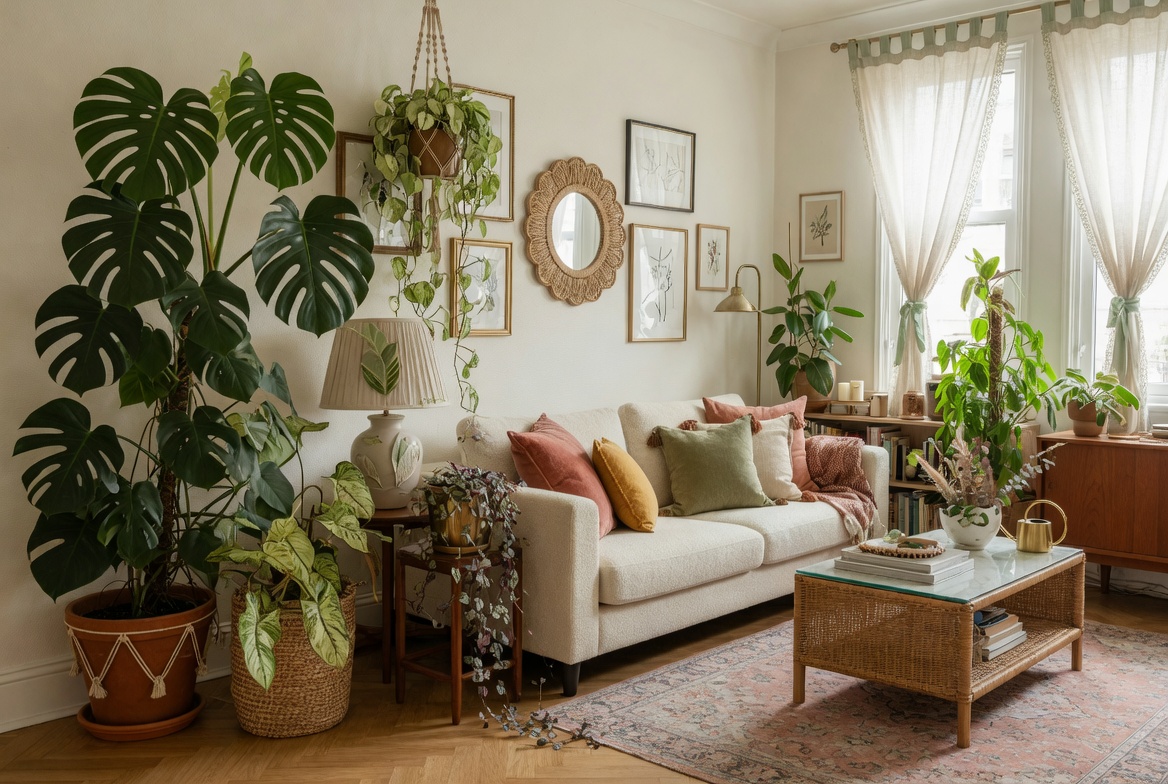
Plants do something for a room that no piece of furniture, no coat of paint, and no artwork can replicate: they bring it to life. A room with plants has movement, has oxygen, has a connection to the natural world that changes the way it feels to be in it. This isn’t interior design theory — it’s a measurable effect on mood, stress levels, and how long people want to stay in a space. Decorating with plants brings life and color into any living space.
The challenge isn’t finding a plant that looks good — it’s understanding how to use plants as a design element rather than an afterthought. A single plant placed randomly in a corner doesn’t do what a considered plant display achieves. These 20 ideas cover every room, every style, and every level of plant experience — from a first statement plant to a full living wall.
1. Use a Statement Floor Plant — Decorating with Plants
Decorating with plants is one of the easiest ways to refresh a room without a full renovation.
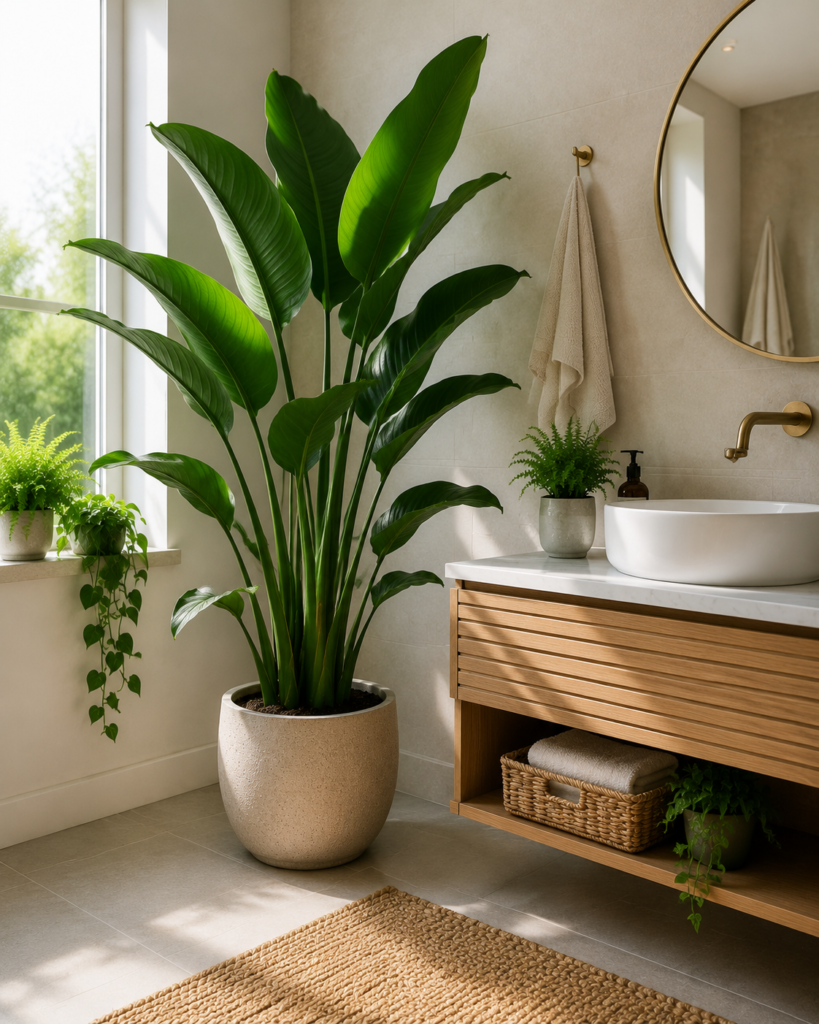
Best for: Living rooms, bedrooms, and any room needing a focal point — a large floor plant creates more visual impact than any other single plant investment
A single large floor plant — a fiddle leaf fig, bird of paradise, monstera, or large rubber plant — does what no collection of small plants can match: it creates a genuine focal point. The scale commands attention from across the room, the form provides architectural interest, and the placement defines a zone within the space.
The best statement floor plants for 2025: fiddle leaf fig (Ficus lyrata) for dramatic architectural leaves; bird of paradise (Strelitzia reginae) for tropical scale and movement; monstera deliciosa for iconic leaf form; and rubber plant (Ficus elastica) in dark burgundy or standard green for sculptural simplicity.
Smart tip: Position the statement plant where it’s visible from the room’s main seating position — where you sit most often is where the plant will be most appreciated. A statement plant tucked into a corner that’s only visible when you actively look for it wastes its impact. Place it where it’s part of the room’s natural view from everyday positions.
Mistake to avoid: Choosing a statement plant that’s too small for the scale of the room. A 2-foot monstera in a large living room looks like a small plant rather than a statement piece. Choose a plant whose scale is genuinely proportional to the space — a statement plant should be at least 4 to 5 feet tall for a standard-height room to read as intentional rather than incidental.
2. Create a Hanging Plant Display — Decorating with Plants
When decorating with plants, choose varieties that match your light conditions for the best results.
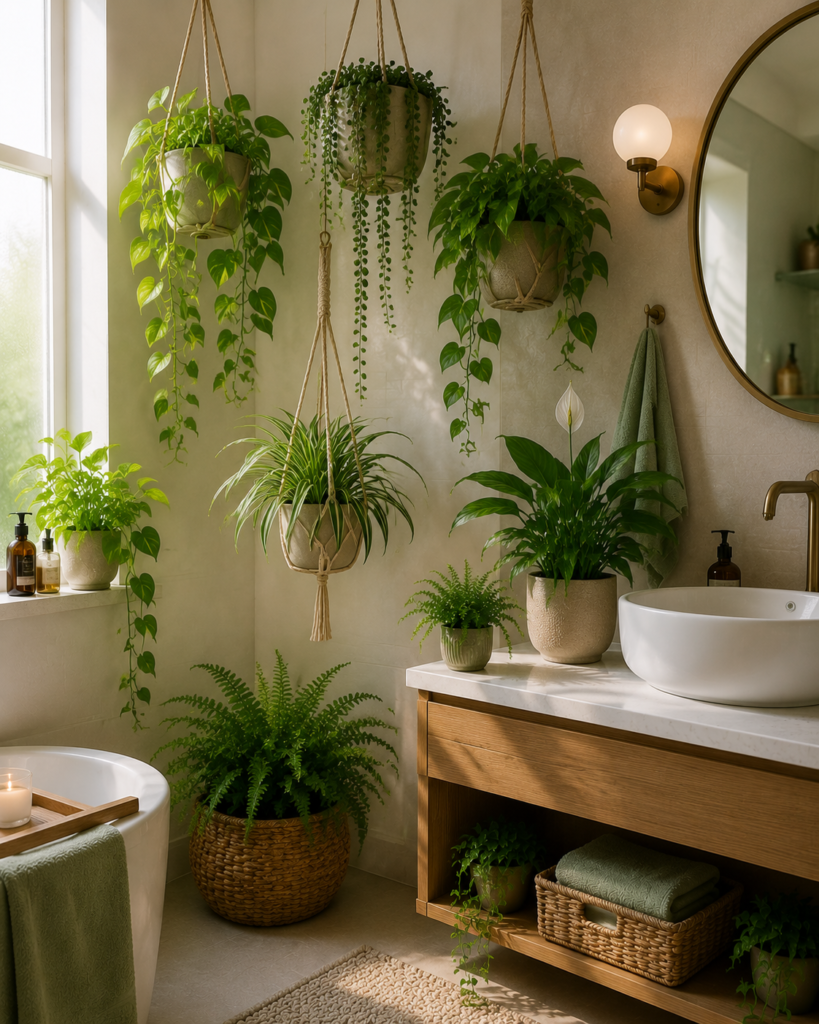
Best for: Rooms with limited floor space — hanging plants use vertical space and draw the eye upward, making rooms feel taller
Hanging plants — suspended from ceiling hooks, mounted on wall brackets, or hanging from curtain rods — use space that’s almost universally underused in interior decoration. The vertical dimension of a room is available without consuming any floor area, and plants at different hanging heights create a layered, abundant quality that floor plants alone can’t achieve.
The best trailing plants for hanging displays: pothos (the most forgiving — tolerates low light, irregular watering, and produces long, dramatic trails); string of pearls (Senecio rowleyanus) for a distinctive bead-like trailing effect; heartleaf philodendron for soft, dense trailing growth; and spider plant for its characteristic cascading babies.
Smart tip: Hang plants at three different heights in the same area — high near the ceiling, mid-level at shelf height, and lower near eye level — to create depth and visual richness. Plants all hung at the same height create a uniform band rather than the layered, abundant quality that different heights produce.
Mistake to avoid: Hanging plants in positions where watering requires a ladder and a bowl every time. Hanging plants that are difficult to water get watered inconsistently — and plants watered inconsistently decline rapidly. Choose positions where watering is genuinely practical, or use hanging planters with integrated drip trays that catch excess water without requiring removal.
3. Style a Plant Shelf Display — Decorating with Plants
Decorating with plants adds texture and a calming natural element to any style of home.
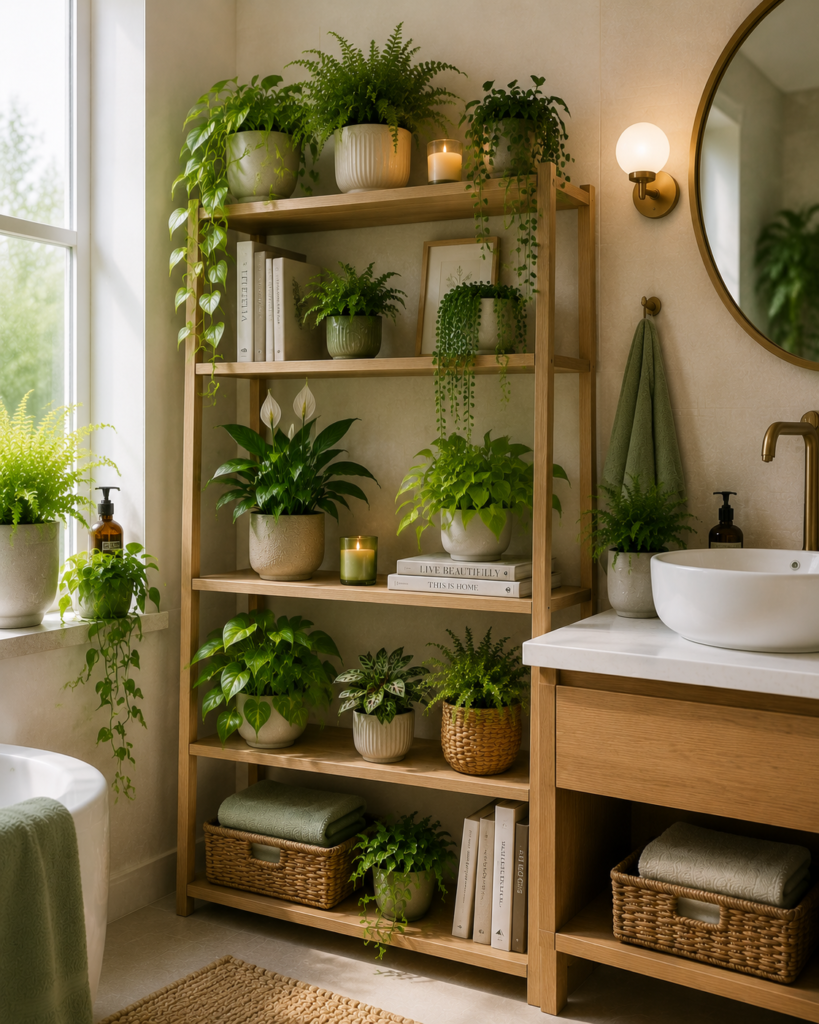
Best for: Any room with shelving — a styled plant shelf combines books, objects, and plants into a cohesive display
A shelf styled with plants — a mix of small potted plants, trailing plants that cascade over the shelf edge, and climbing plants trained up the shelf sides — converts functional storage into a genuine room feature. The plants provide living, changing elements among the static books and objects, creating a display that’s never quite the same from week to week.
The most effective shelf plant styling: vary the plant heights (some upright, some low-growing, some trailing); use consistent planter styles for visual coherence; and allow trailing plants to cascade naturally over the shelf edge rather than containing them.
Smart tip: Use odd numbers of plants on any given shelf — three or five plants of varying sizes look more composed than two or four. The asymmetry of odd numbers creates the natural, collected quality that makes a shelf display look styled rather than symmetrically arranged.
Mistake to avoid: Filling every available shelf space with plants without leaving negative space. A shelf completely packed with plants looks cluttered rather than lush. The empty spaces — the negative space between plants — give each plant visual breathing room and allow the overall display to read as considered rather than overcrowded.
Loving These Ideas? Get the Step-by-Step Guide
Grab the full 5-day eBook and turn these ideas into a finished room.



4. Use Plants as Room Dividers — Decorating with Plants
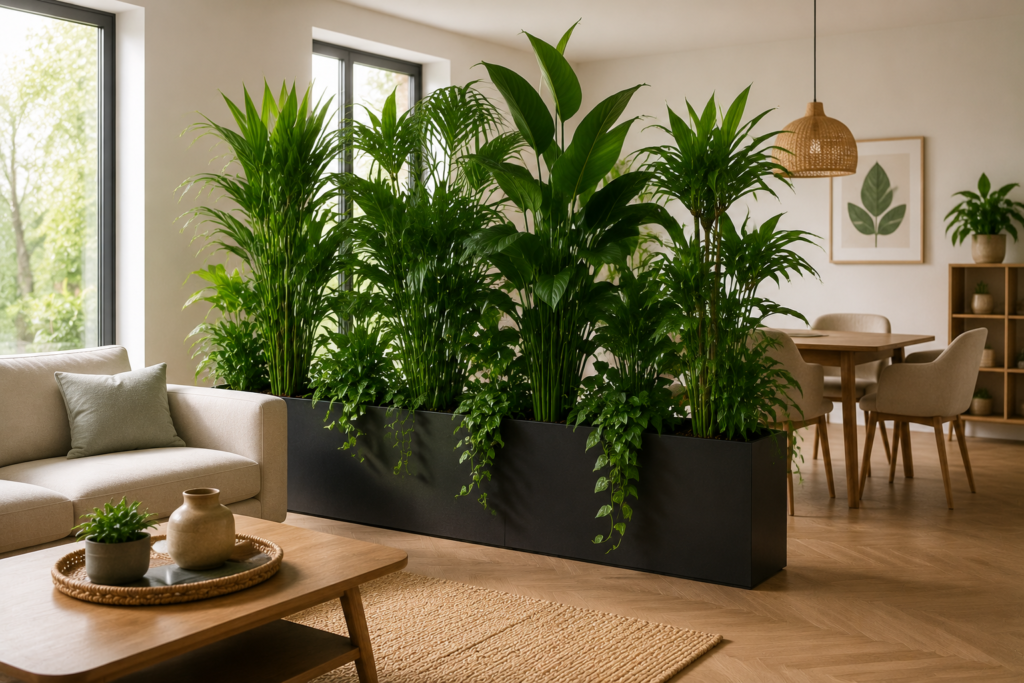
Best for: Open-plan spaces — tall plants define zones without creating physical barriers
Tall plants positioned strategically in an open-plan space — a row of majesty palms separating the dining area from the living zone, or large dracaenas marking the boundary between workspace and relaxation area — create visual zone definition without walls, screens, or heavy furniture. The plants maintain openness and airflow while providing the visual cues that define separate functional areas.
This application is particularly effective in studio apartments and open-plan living spaces where some zone definition improves how the space functions without requiring structural changes.
Smart tip: Use three to five plants of the same species in a loose row rather than a single large plant as a divider. The repetition of the same plant creates a visual sequence that reads as a defined boundary rather than a single plant that happens to be in a particular position. The gaps between plants maintain airflow and light while the visual rhythm of the repeated plant creates the zone boundary effect.
Mistake to avoid: Using plants that grow too large for the position as room dividers. A bird of paradise positioned as a room divider will reach 6 to 8 feet at maturity in a well-lit room — potentially overwhelming the space it was meant to organize. Choose plants whose mature size suits the ceiling height and the available floor area.
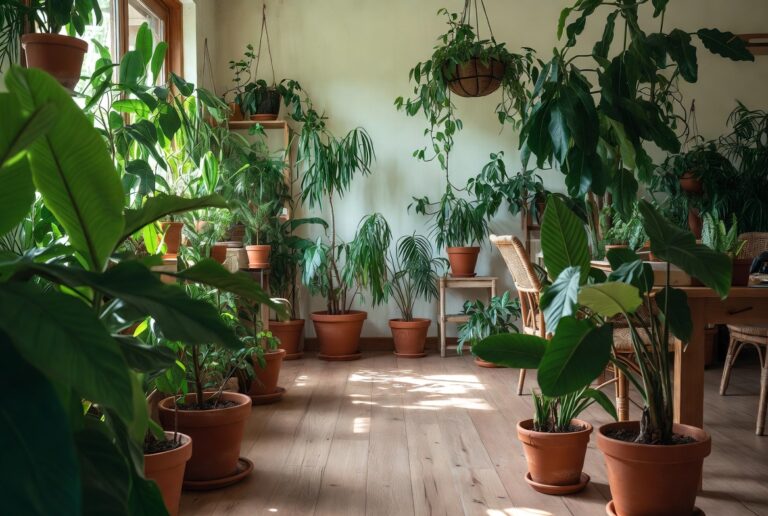
5. Build a Plant Corner or Jungle Nook — Decorating with Plants
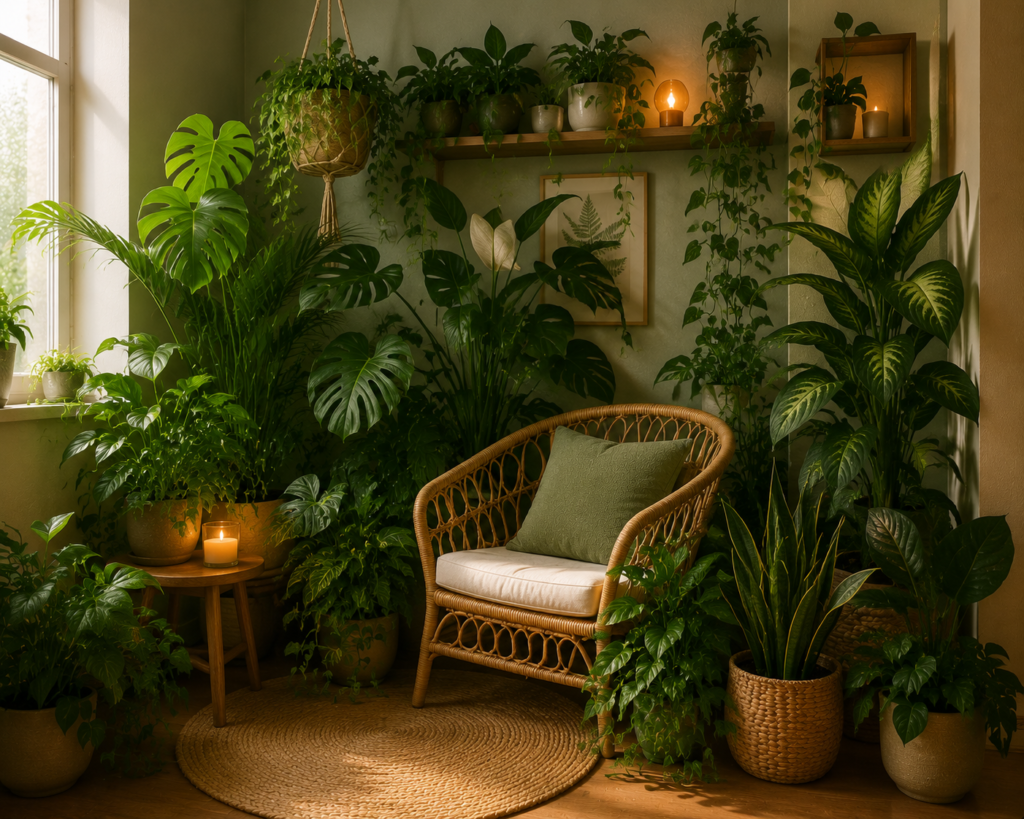
Best for: Any unused corner — a plant corner converts dead space into the most visually rich area in the room
A plant corner — a collection of plants in varying heights, sizes, and species grouped together in a single corner — creates an indoor garden effect that transforms the corner from dead space into the room’s most interesting feature. The grouping produces its own microclimate of slightly elevated humidity through collective transpiration, which benefits all the plants within it.
The most effective plant corner composition: one large floor plant anchoring the back; two to three mid-size plants at varying heights in front; and one or two trailing plants at the edge that flow outward from the grouping.
Smart tip: Place a large mirror on the wall behind a plant corner to double its apparent visual depth and reflect light back into the plants from an additional angle. The mirrored reflection of a plant corner is one of the most effective interior plant styling tricks — it makes a modest plant grouping look like a genuinely lush indoor garden.
Mistake to avoid: Creating a plant corner without considering the light requirements of every plant included. A corner may receive very different light from a window than appears obvious from the room’s center. Assess the actual light levels in the corner before choosing plants — a dark corner that looks spacious from across the room may receive insufficient light for most plants beyond the most shade-tolerant species.
6. Match Planters to Your Decor Style — Decorating with Plants
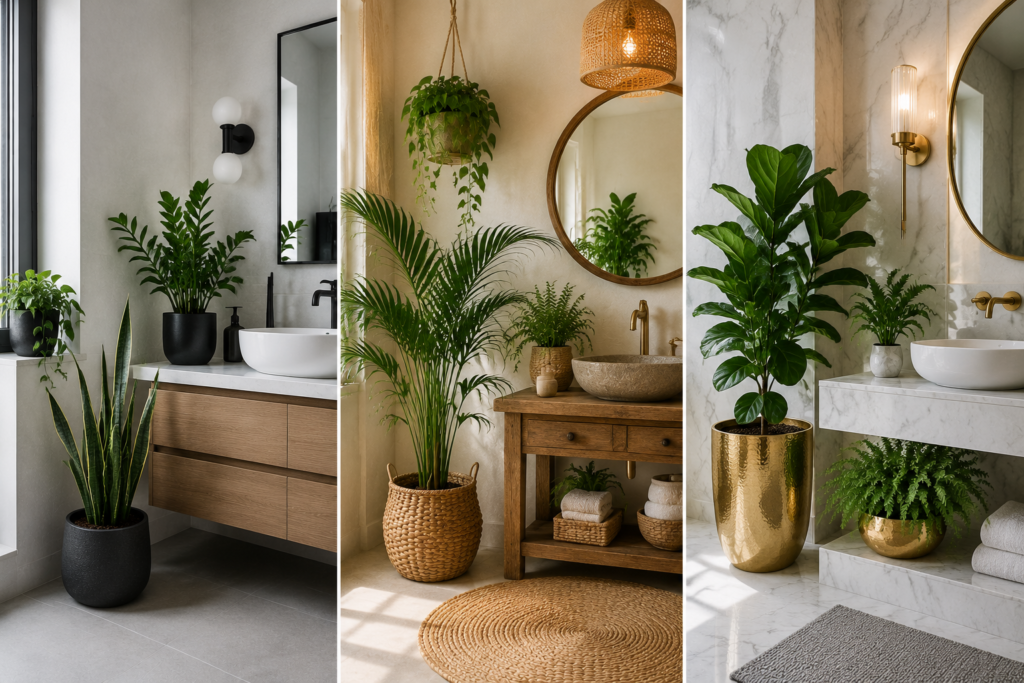
Best for: Any plant display — planter choice determines whether plants look designed into a room or added to it
The planter is as important to the final appearance as the plant itself. A beautiful plant in an inappropriate or low-quality planter looks less considered than a simple plant in a perfectly chosen container. Matching planter style to room aesthetic — textured terracotta in a natural or Mediterranean room, matte ceramic in a contemporary minimal space, woven baskets in a bohemian setting, architectural concrete in an industrial interior — integrates the plant into the room’s design rather than adding it to it.
Planter consistency is also significant: a collection of plants in matching planters (same material, same color family, or same style) reads as a curated display; plants in completely different planters look like an unrelated collection.
Smart tip: Use pot covers (decorative outer pots that conceal the functional plastic grow pots plants come in from the nursery) rather than repotting plants unnecessarily. Pot covers allow easy plant rotation and replacement, allow drainage into the plastic pot without risk of damaging a decorative ceramic, and are significantly less expensive than purchasing decorative pots in every size needed.
Mistake to avoid: Using a planter with no drainage hole as the primary growing container. Plants in non-draining containers accumulate water at the base, causing root rot — the most common cause of indoor plant death. Use planters with drainage holes for actual growing, or use the decorative non-draining planter as a pot cover over a plastic growing pot with drainage.
7. Decorate the Bedroom with Plants
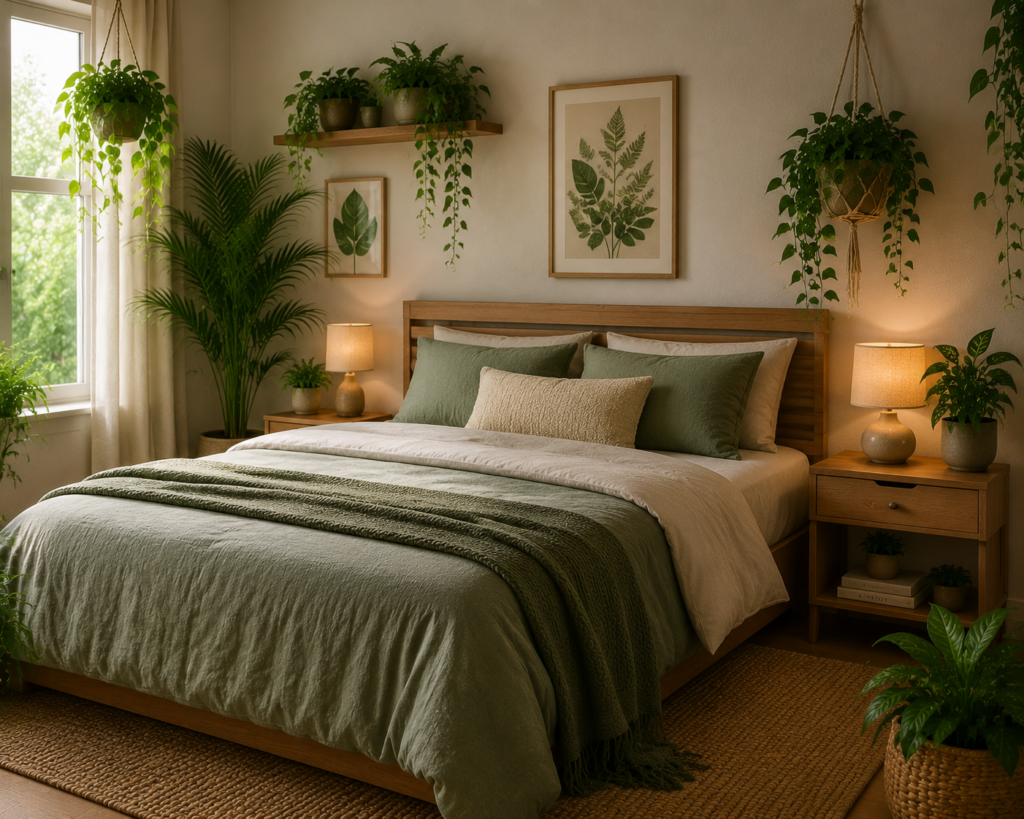
Best for: Creating a calming, nature-connected bedroom atmosphere — the right plants enhance sleep quality and room aesthetics
Bedroom plants create the most intimate indoor garden experience — you wake to them and see them last before sleep. The bedroom’s typically lower light levels and consistent temperature suit many houseplants well, and the calm, restful atmosphere of a well-planted bedroom is supported by research on plants’ effects on stress and air quality.
The best bedroom plants: snake plant (produces oxygen at night and tolerates low light — the ideal bedroom plant); lavender in a sunny bedroom window (fragrance with documented sleep-promoting effects); pothos (tolerant of varying light, requires minimal care); peace lily (air purifying, tolerates low light, elegant appearance).
Smart tip: Position one plant at each side of the bed at bedside table height — mirroring the symmetry of lamps and bedside tables. Two matching plants flanking the bed create the balanced, composed quality of intentional styling. A single plant on one side looks asymmetric; a matched pair looks considered.
Mistake to avoid: Placing large numbers of plants in a bedroom and then worrying about their effect on overnight air quality. The concern that plants consume oxygen at night and harm sleep quality is largely unfounded — the quantity of CO₂ that houseplants produce during nighttime respiration is negligible compared to other sources in a bedroom. The air quality benefits of bedroom plants significantly outweigh any minor overnight CO₂ production.
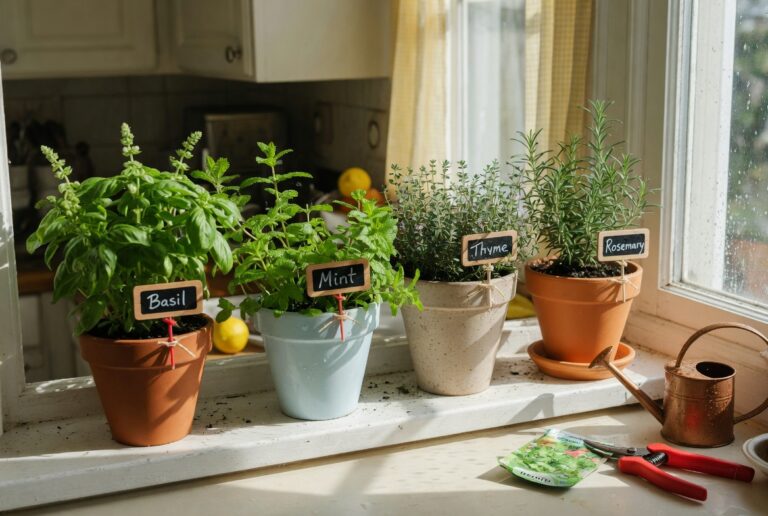
8. Style a Kitchen Window Garden
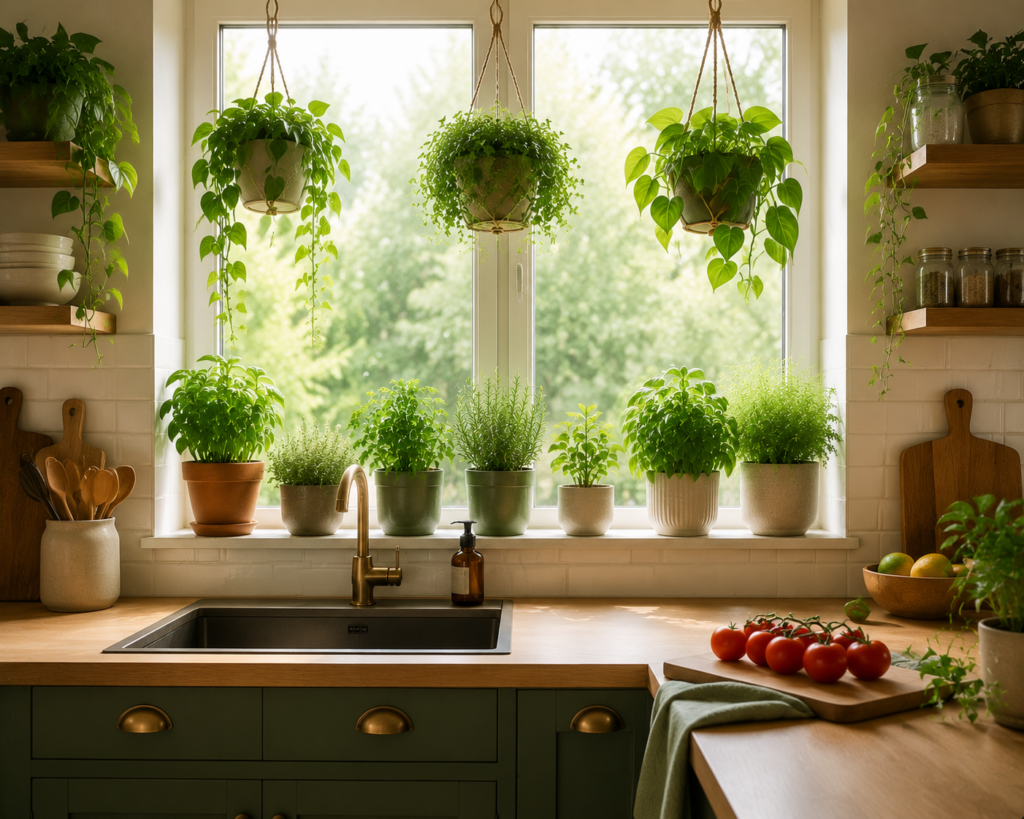
Best for: Kitchen windows — herbs and small plants in a kitchen window are both practical and beautiful
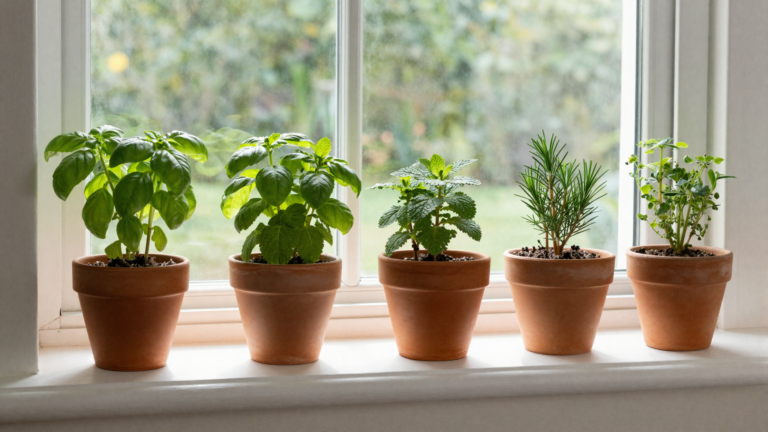
A kitchen window garden — herbs and small plants in uniform pots lined along the windowsill — is the most practical plant display in the home. Fresh herbs at arm’s reach improve the experience of cooking in a way that no decorative plant can, and the living green of herbs and small plants in a kitchen window creates an immediate connection between the cooking space and the natural world.
The most effective kitchen window plants: basil, chives, thyme, and rosemary for culinary use; pothos or small trailing plants for purely decorative value; and aloe vera for both aesthetic and practical use (immediate first aid for minor burns).
Smart tip: Use matching ceramic or terracotta pots in a single size for the kitchen window display. Uniform pots create the visual order that makes a kitchen window garden look styled rather than improvised — the same herbs in mismatched plastic nursery pots look significantly less appealing than the same plants in coordinated containers.
Mistake to avoid: Overwatering kitchen herbs because the kitchen environment feels like it should be watered frequently. Kitchen herbs — particularly Mediterranean varieties like rosemary, thyme, and sage — are among the most commonly killed plants in the home through overwatering. Water only when the top inch of soil is dry, not on a schedule or because the kitchen is warm.
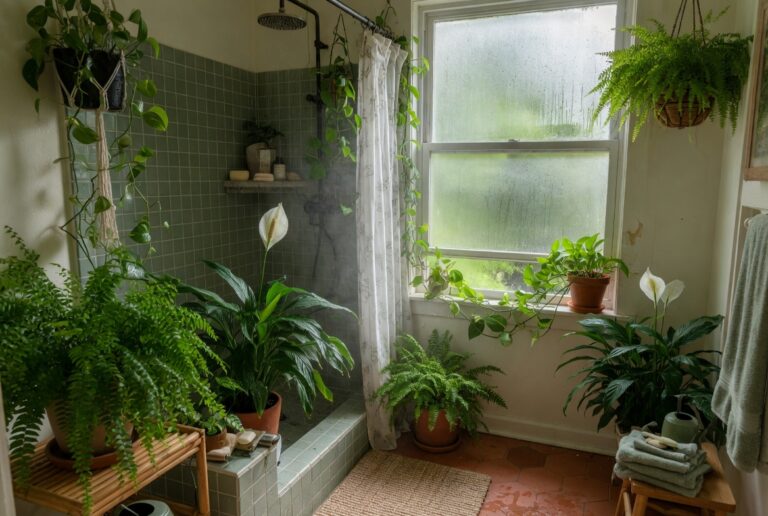
9. Add Plants to Your Bathroom
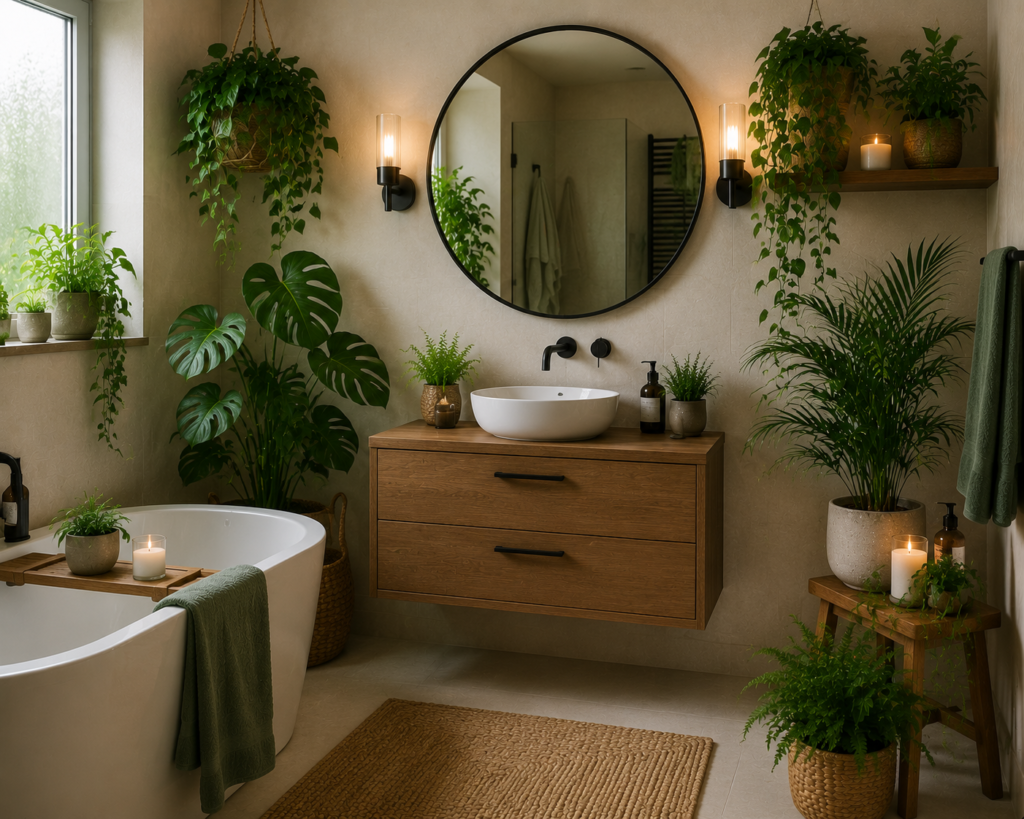
Best for: Any bathroom — the high humidity and typically indirect light of bathrooms suits many houseplants perfectly
Bathrooms are underused as plant locations despite being genuinely ideal environments for many houseplant species. The humidity from bathing and showering creates the tropical conditions that many common houseplants thrive in, and the indirect, diffused light of a frosted glass bathroom window provides adequate light for shade-tolerant species without the direct sun that can scorch delicate leaves.
The best bathroom plants: bird’s nest fern (loves humidity, tolerates low light); peace lily (thrives in humidity, elegant white flowers); spider plant (tolerates varying conditions, produces cascading babies); and pothos (virtually indestructible in any bathroom condition).
Smart tip: Position a trailing plant on top of the bathroom cabinet or on a high shelf where its trails can cascade downward over the cabinet face. A pothos or heartleaf philodendron trailing from a high bathroom shelf creates the lush, spa-like atmosphere that makes a functional bathroom feel genuinely indulgent — a quality that’s difficult to achieve through any other decorative element.
Mistake to avoid: Placing plants in a windowless bathroom without supplemental lighting and expecting them to survive. Even the most shade-tolerant houseplants require some light — typically the equivalent of indirect natural light from a north-facing window at minimum. A truly windowless bathroom requires a grow light for any plant to survive beyond a few weeks.
10. Use Trailing Plants for Visual Drama
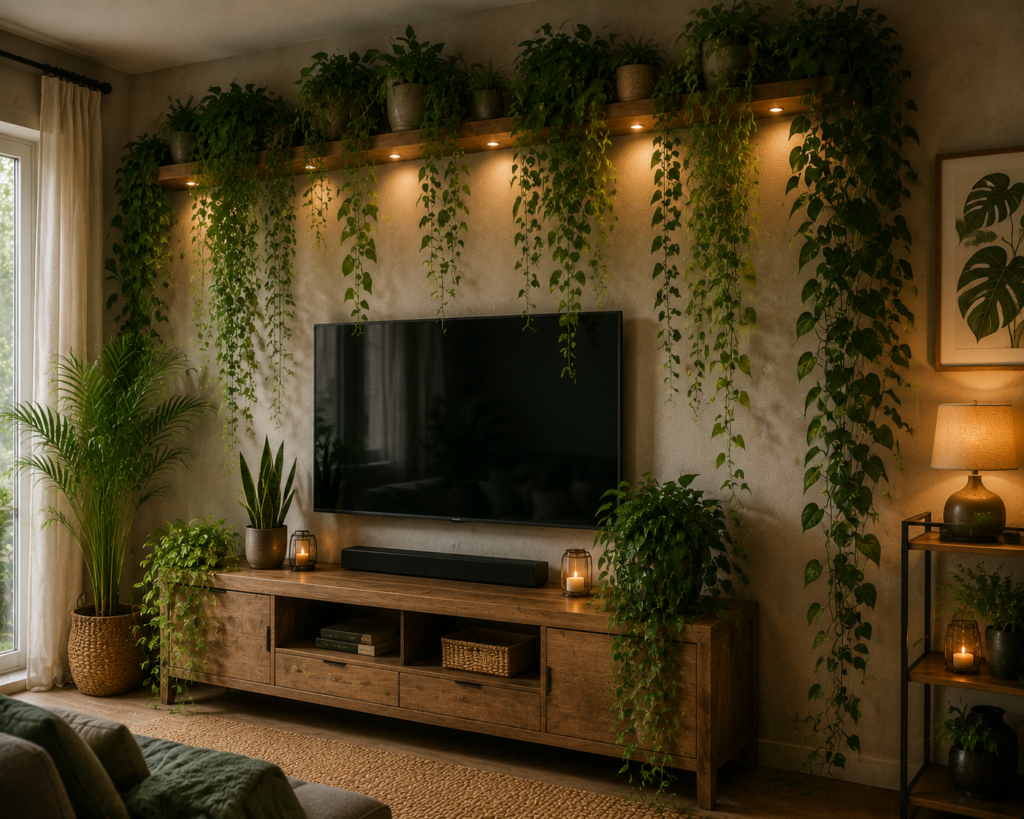
Best for: Shelves, high surfaces, and hanging positions — trailing plants create a visual waterfall effect that no other plant form achieves
Trailing plants — species whose stems grow long and cascade naturally downward — create the most dramatic visual effect of any plant type when positioned at height. A pothos or string of hearts with 3 to 4 feet of trail creates a curtain of living green that transforms the surface it hangs from and fills the vertical space between shelf and floor.
The best trailing plants for dramatic display: pothos (the fastest-growing trailing plant — achieves impressive length quickly); string of hearts (Ceropegia woodii — delicate heart-shaped leaves on thin red stems, grows slowly but beautifully); heartleaf philodendron (velvety leaves, fast growth); and devil’s ivy (essentially a pothos variety — exceptionally tolerant of neglect).
Smart tip: Train trailing plants along a shelf edge rather than allowing them to simply fall — pinning or tucking stems along the shelf to spread the coverage horizontally before allowing the remaining length to trail downward. This technique distributes the plant across a wider area and creates a fuller, more abundant appearance than a single hanging stem.
Mistake to avoid: Cutting trailing plants back frequently to keep them compact. The entire appeal of a trailing plant is its length — cutting it back defeats the purpose. Allow trailing plants to develop their full length, and only remove damaged or dead stems rather than pruning for size control.
11. Group Plants by Height and Texture
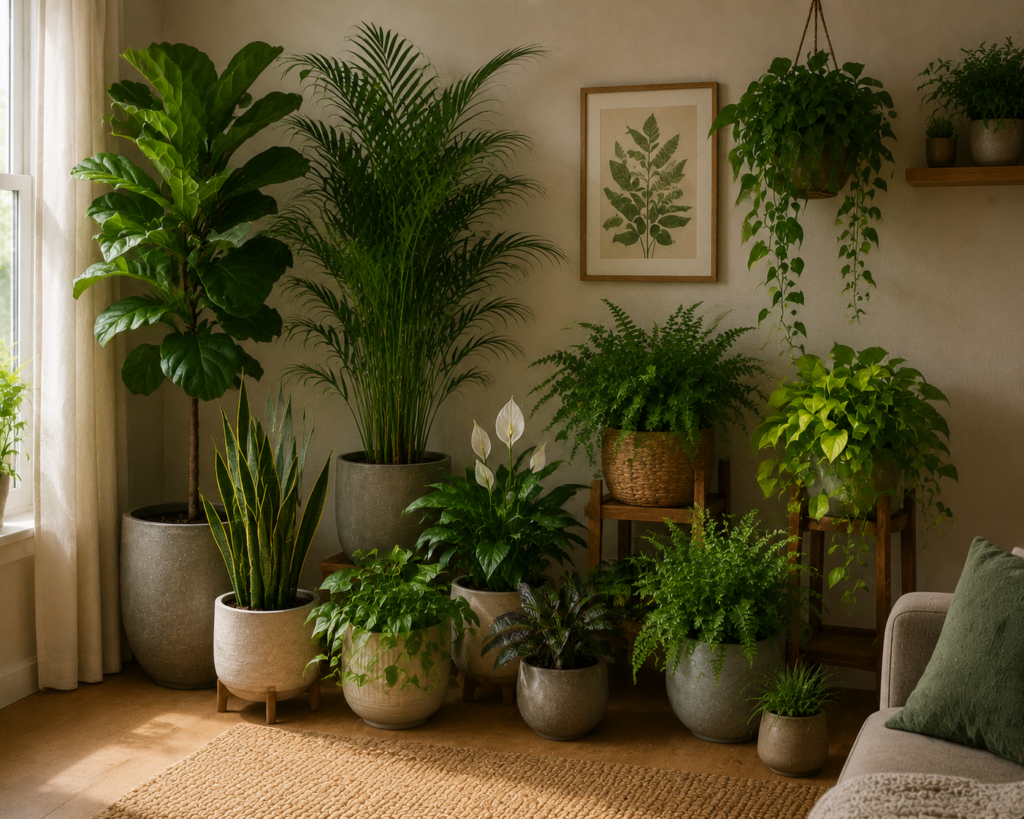
Best for: Creating cohesive plant displays that look professionally styled rather than randomly assembled
A group of plants with dramatically different heights — tall upright plant at the back, medium-height bushy plant in the middle, and low-growing trailing plant at the front — creates a tiered composition with genuine visual depth. The height variation reads as considered and creates the layered quality that makes a plant grouping look like a designed feature rather than a collection of individual plants.
Texture variation is equally important: combining glossy large-leaved plants (monstera, rubber plant) with fine-textured plants (fern, asparagus fern) and strappy plants (snake plant, dracaena) creates visual richness that single-texture groupings lack.
Smart tip: Apply the thriller-filler-spiller principle to indoor plant groupings — the same composition framework that makes window boxes and outdoor containers look designed. One tall thriller at the center or back, bushy filler plants around it, and trailing spillers at the front edge create the composed, layered quality of a professional plant styling.
Mistake to avoid: Grouping plants with completely incompatible care requirements. A drought-tolerant succulent grouped with a moisture-loving fern requires constant compromise — either the succulent is overwatered or the fern is under-watered. Group plants with similar light and water requirements for both practical and aesthetic success.
12. Decorate with Air Plants
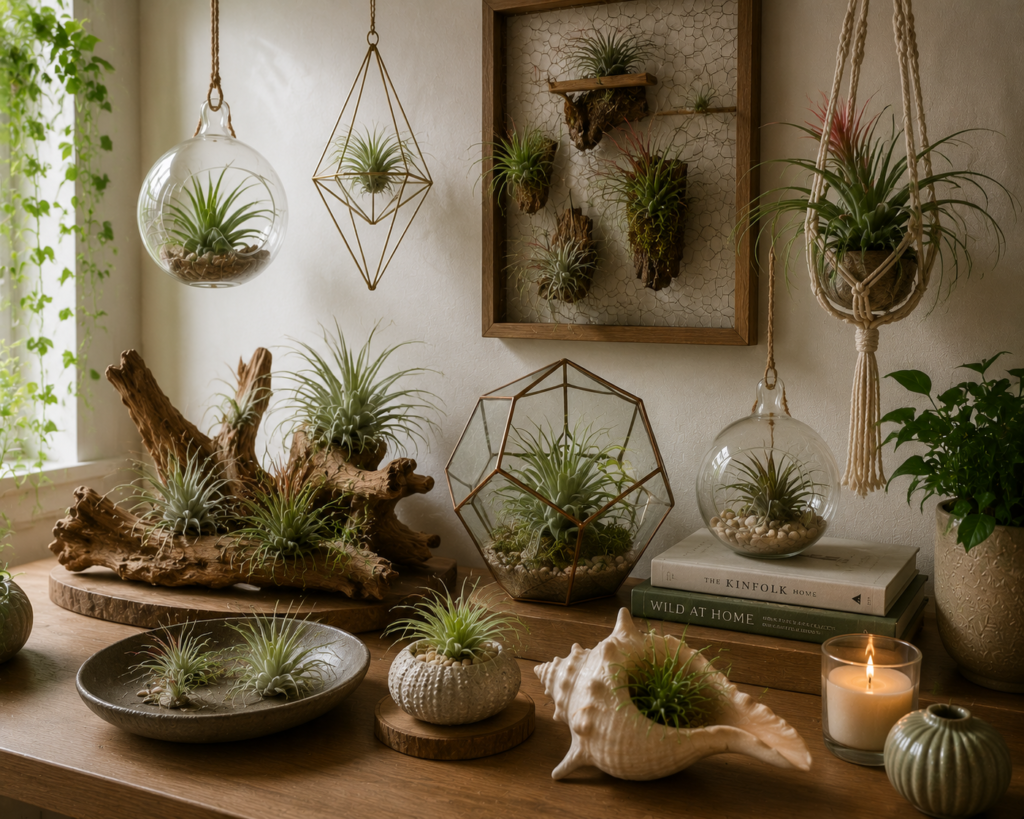
Best for: Unique, soil-free displays — air plants work in locations and containers where conventional plants can’t
Air plants (Tillandsia) are the most versatile decorative plant available — they require no soil, no pot, and attach to almost any surface or can be displayed in any vessel. Mounted on driftwood, displayed in geometric glass terrariums, arranged on a piece of bark, or simply placed in a decorative bowl, air plants create plant displays in spaces and styles that conventional houseplants can’t accommodate.
Their care is equally simple: a thorough soak in water for 20 to 30 minutes every one to two weeks, then allowed to dry completely before returning to their display position.
Smart tip: Group three to five air plants of different species together in a single display — a bowl, a piece of driftwood, or a tray of pebbles — rather than displaying individual specimens in isolation. A collection creates an impact that a single specimen doesn’t achieve, and the variety of forms and sizes within the Tillandsia genus creates genuine visual interest within a single-genus display.
Mistake to avoid: Displaying air plants in enclosed glass globes or terrariums without adequate air circulation. Air plants need to dry completely after watering — an enclosed display that traps moisture causes rot at the plant’s base within weeks. Display air plants in open containers or mount them on surfaces where air can circulate freely around the entire plant.
13. Create a Wellness Plant Corner
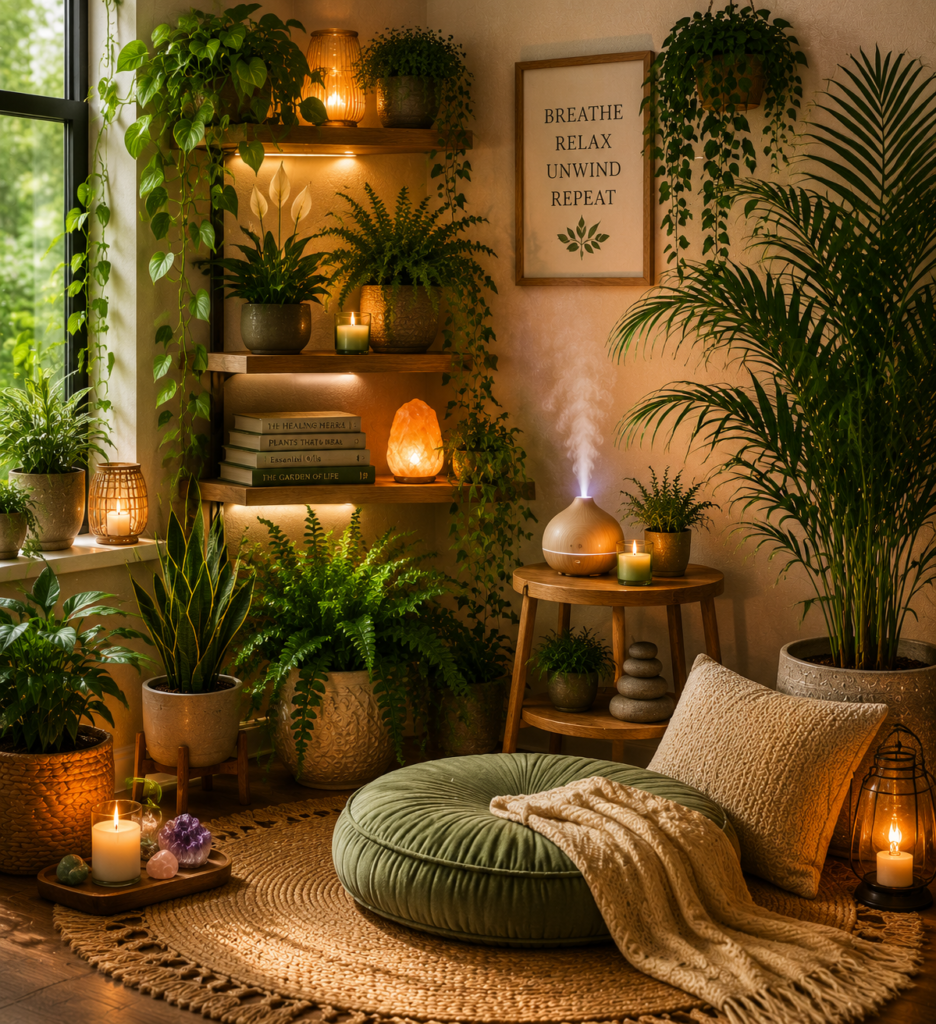
Best for: Meditation spaces, yoga rooms, and any area designated for relaxation — plants enhance the atmosphere of wellness spaces significantly
A wellness corner — plants grouped together with specific selection for air-purifying qualities, fragrance, and calming visual presence — creates a space that actively supports relaxation and mental wellbeing. The combination of living green, gentle fragrance, and the soft movement of plants in air circulation creates an environment measurably different from a plant-free space.
The best wellness plants: snake plant (air purifying, produces oxygen at night); peace lily (air purifying, elegant); lavender (fragrant, documented stress-reducing effects); aloe vera (calming green, air purifying); and calathea (moving leaves, vibrant patterns, humidity-loving).
Smart tip: Cluster five to seven air-purifying plants together in a wellness corner rather than distributing them around the room. A concentrated grouping of air-purifying plants creates a measurably better air quality zone in its immediate vicinity than the same plants spread across a larger space — the local effect of the concentrated grouping is more significant than the dispersed effect of the same plants distributed room-wide.
Mistake to avoid: Expecting dramatic, immediate air quality improvements from houseplants based on frequently cited studies. The original NASA studies on air-purifying plants were conducted in sealed chamber conditions — real rooms with ventilation, air movement, and significantly larger volume require many more plants than most homes contain to achieve similar air quality improvements. Plants improve air quality at the margins, but they’re not a substitute for ventilation.
14. Style a Minimalist Plant Display
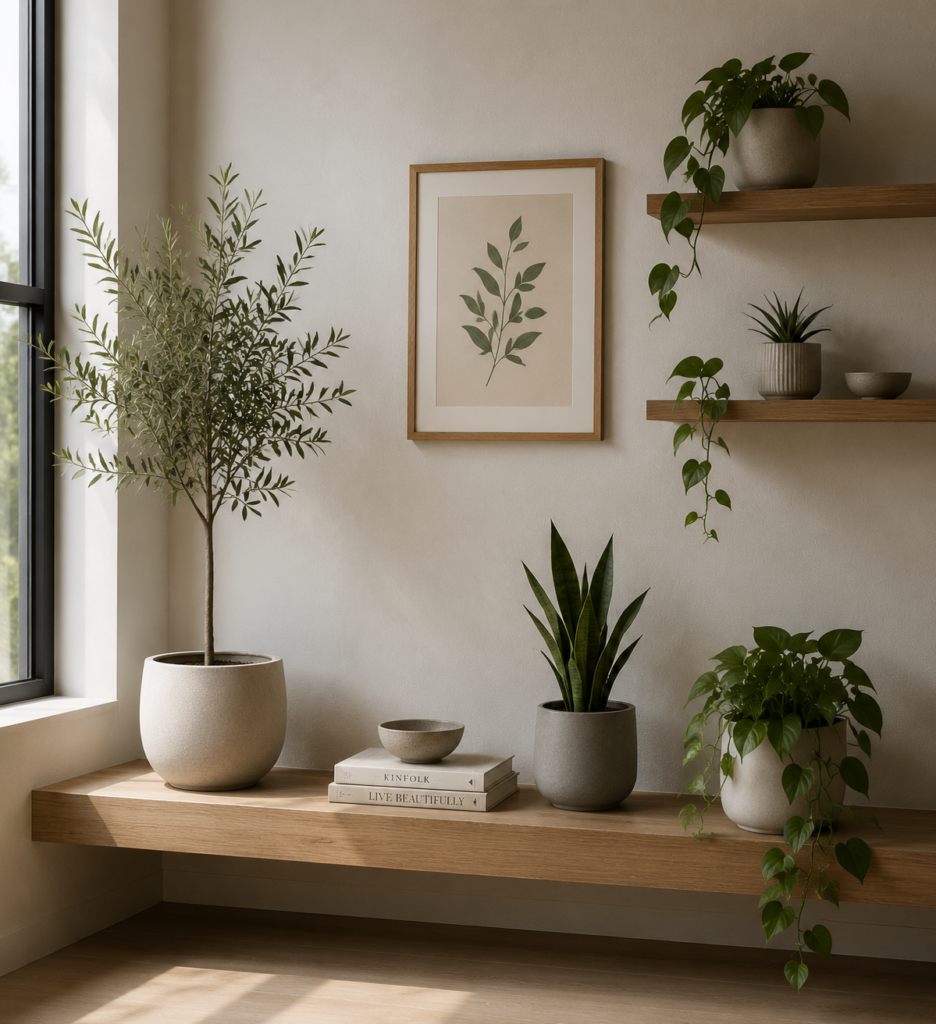
Best for: Contemporary, Japandi, and minimalist interiors — one or two carefully chosen plants suit minimal aesthetics better than abundant plant collections
In a minimalist interior, less is genuinely more — a single beautifully shaped plant in a perfectly chosen planter, placed with deliberate intention, contributes more to the room than a dozen plants scattered without consideration. The minimalist plant display treats each plant as a sculptural object rather than as decoration.
The best plants for minimalist styling: snake plant (upright, architectural, clean form); ZZ plant (glossy, symmetrical, dramatic without fussiness); rubber plant (large glossy leaves, simple form); and peace lily (elegant, white flowers, restrained aesthetic).
Smart tip: Choose a planter that’s as sculptural as the plant itself in a minimalist display. A matte white ceramic, a geometric concrete pot, or a simple textured terracotta — each contributes to the overall composition as much as the plant. The plant-planter combination should read as a single designed object rather than a plant placed in a container.
Mistake to avoid: Introducing colorful, patterned, or busy plants into a minimalist interior. A calathea with bold patterned leaves or a croton with multi-colored foliage creates visual conflict with a minimalist interior’s intentional restraint. Choose plants with simple, uniform foliage — green, glossy, architecturally formed — that suits the palette and aesthetic of minimal spaces.
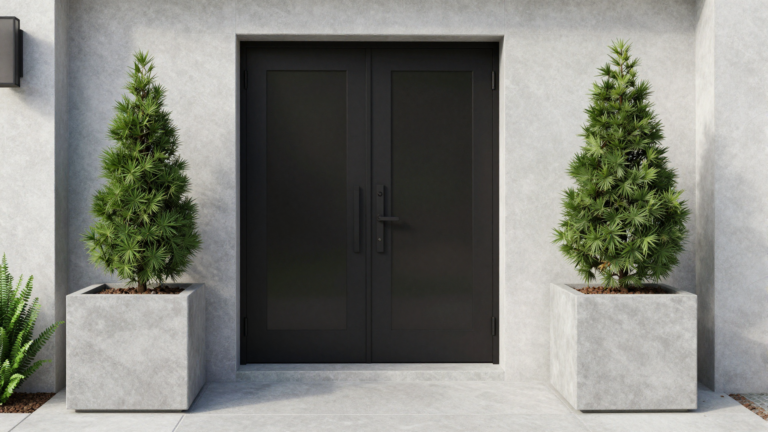
15. Decorate Entryways with Plants
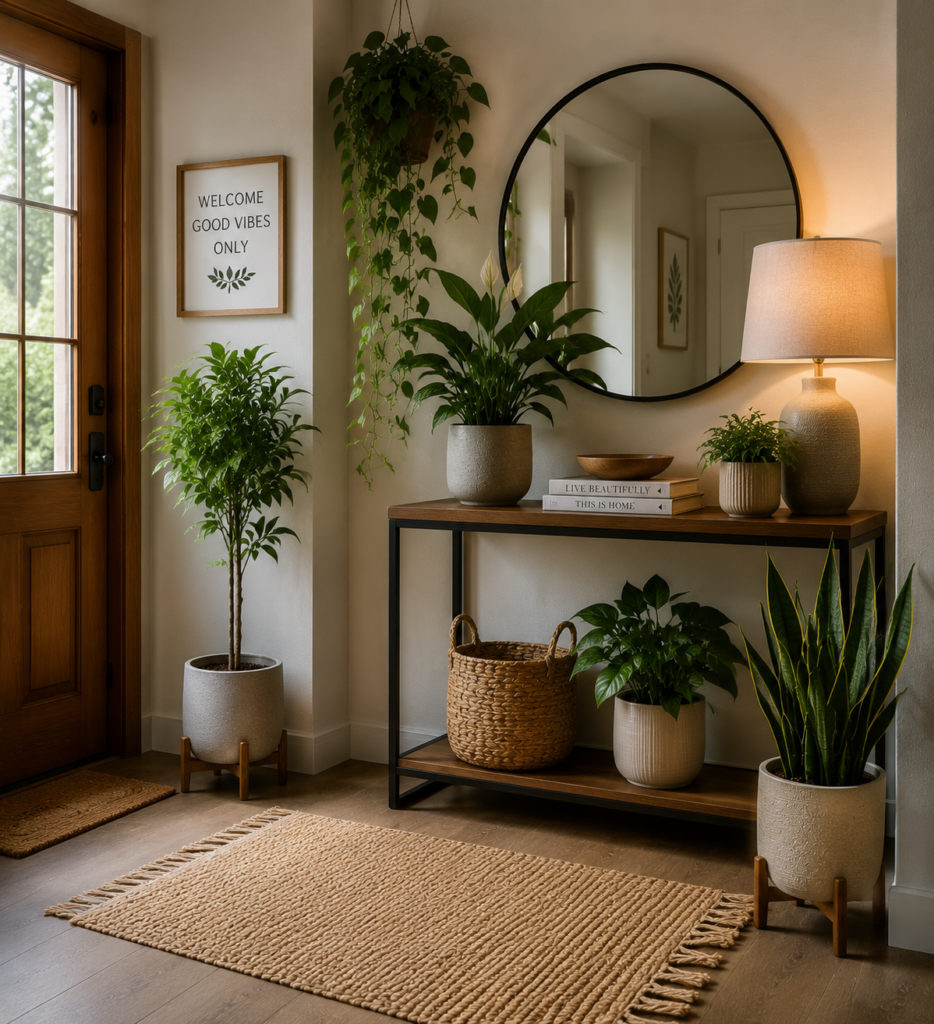
Best for: Creating an immediate impression — the entryway plant sets the tone for the entire home
The entryway is the first space a visitor experiences — a well-planted entryway creates an immediate impression of care, warmth, and life before any other room is seen. It’s also a space that transitions between interior and exterior, making a plant an appropriate visual bridge between the two environments.
Entryway plant options by space: a large statement plant in a tall planter for a spacious entryway (dracaena, bird of paradise); a pair of smaller plants flanking the door on either side for a symmetrical formal entrance; a hanging plant for a narrow entryway where floor space is limited.
Smart tip: Choose a plant with good tolerance for the specific conditions of your entryway — which typically include lower light than main living areas, temperature drafts from the front door, and occasionally neglected watering. Snake plants, ZZ plants, and cast iron plants are the most appropriate entryway plants for these challenging conditions.
Mistake to avoid: Placing a light-demanding plant in an entryway without adequate natural light because it looks good there. A fiddle leaf fig or bird of paradise in a dark entryway will decline visibly within weeks — the entryway becomes a display of a struggling plant rather than a welcoming first impression. Match the plant to the actual light available, not to the aesthetic vision.
16. Use Planters as Decorative Objects
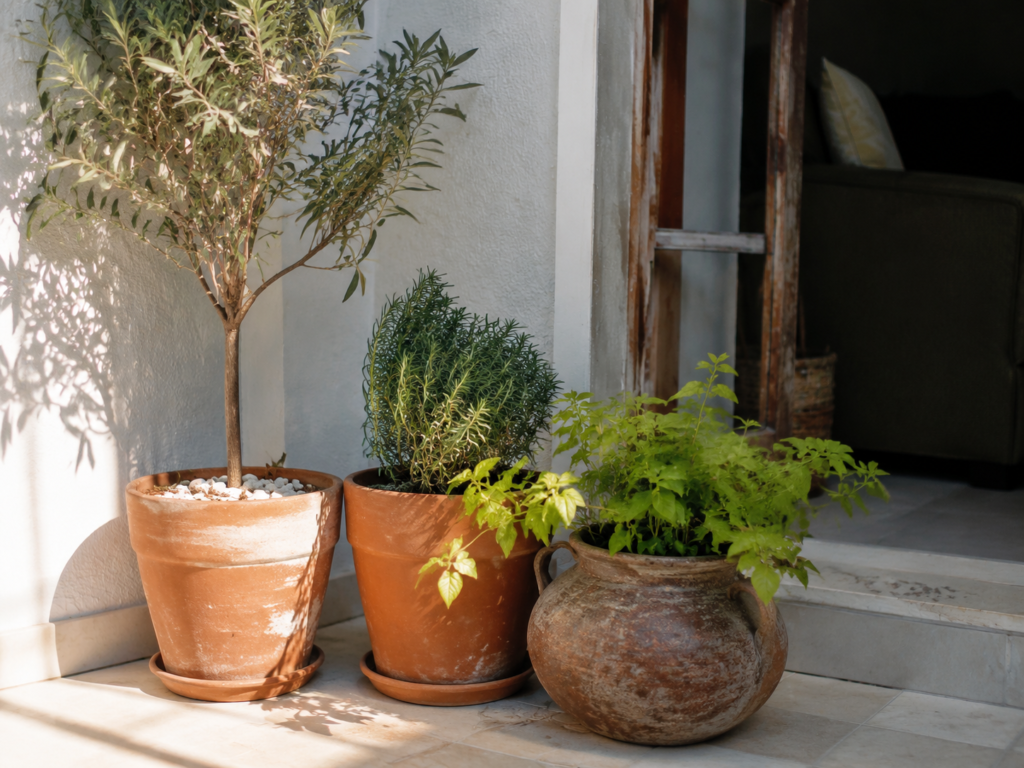
Best for: Homes where the plant container is as important to the aesthetic as the plant itself
A beautifully designed planter — architectural concrete, hand-thrown ceramic, carved stone, woven rattan, hammered copper — functions as a decorative object in its own right regardless of what’s planted in it. In rooms where decorative object styling is important to the overall aesthetic, the planter choice becomes a furniture and accessory decision as much as a gardening one.
The planter-as-object approach suits contemporary interiors where design objects are consciously collected and displayed — the plant collection becomes a curated display of objects that happen to contain living plants rather than plants that happen to be in containers.
Smart tip: Invest the majority of the plant display budget in a few exceptional planters rather than buying many inexpensive ones. Three extraordinary planters with appropriate plants make more visual impact than ten ordinary plastic pots with the same plants. The planter quality elevates the entire display.
Mistake to avoid: Prioritizing the planter over the plant’s requirements. The most beautiful planter without drainage holes will kill most plants. The most architecturally perfect planter in a location without adequate light produces a declining plant. The plant’s needs must be met — the planter should be chosen within those constraints, not instead of them.
17. Create a Living Wall or Moss Panel
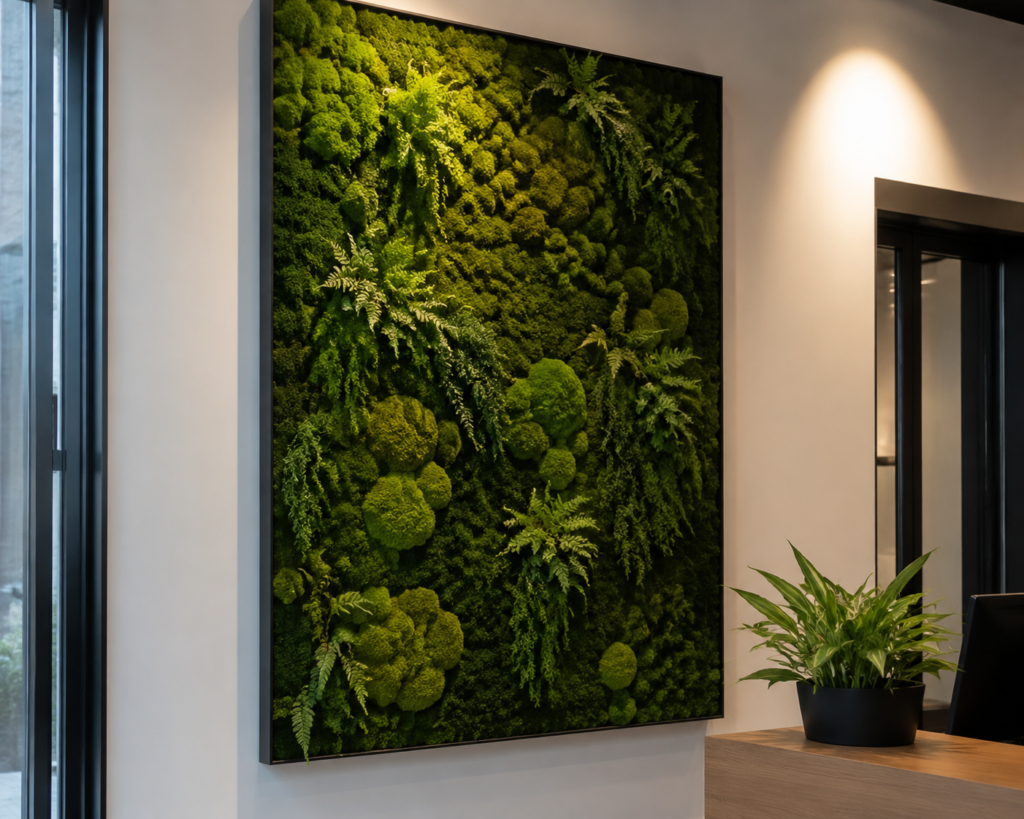
Best for: Feature walls that need a living element — a living wall or moss panel converts a flat surface into an organic, textural feature
A living wall — plants mounted in a vertical panel system on a wall surface — creates the most dramatic plant display available in a residential interior. Even a modest living wall covering 4 to 6 square feet of wall surface creates significant visual impact and establishes the room as genuinely designed around plants rather than simply decorated with them.
Preserved moss panels — a simpler and lower-maintenance alternative to living plant walls — use naturally preserved moss in various species and colors to create textural, organic wall art that requires no water, no light, and essentially no maintenance.
Smart tip: Start with a preserved moss panel rather than a living plant wall if low maintenance is a priority. Preserved moss panels look genuinely organic and beautiful, require absolutely no care, and cost a fraction of a properly installed living plant wall system. Living plant walls are high-impact but genuinely demanding — they need irrigation, fertilizing, pruning, and pest management that preserved panels eliminate entirely.
Mistake to avoid: Installing a living plant wall without planning the irrigation system before mounting. Retrofitting irrigation into an already-installed living plant wall is extremely difficult and often requires dismantling sections. Design the irrigation from the beginning — a drip system or reservoir system integrated into the structure during installation is the only practical approach.
18. Style a Home Office with Plants
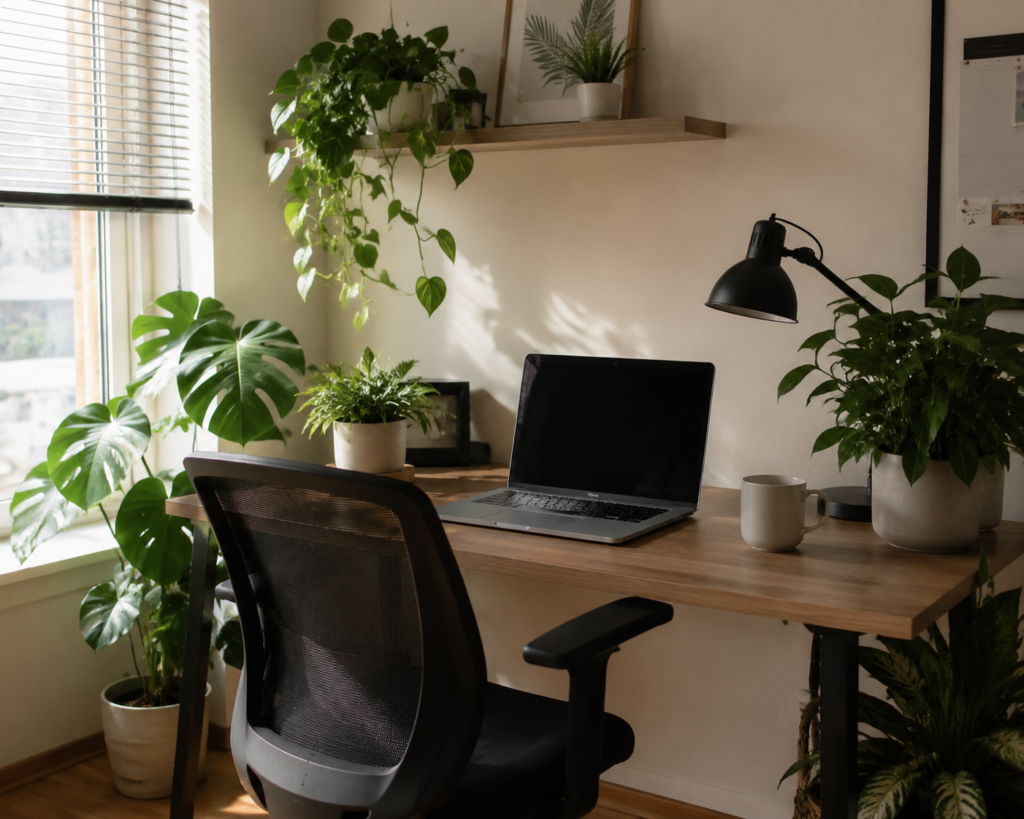
Best for: Home offices — plants improve focus, reduce stress, and make a home office more pleasant to work in
A home office with plants performs better as a workspace than one without them — this is supported by multiple workplace studies showing that plants in work environments improve productivity, reduce stress, and increase reported satisfaction with the work environment. The practical and aesthetic case for home office plants is stronger than for almost any other room.
Home office plant styling: one statement floor plant in a corner visible from the desk; two to three smaller plants on the desk surface or on adjacent shelving at eye level; and a trailing plant above the desk or on a high shelf that provides visual interest without consuming desk surface.
Smart tip: Choose plants for the video call background as deliberately as for the overall office aesthetics. A well-placed plant behind the desk in the video call frame creates a professional, considered background that signals personality and care. A plant that appears in every video call becomes part of professional identity as much as physical appearance.
Mistake to avoid: Placing plants directly on the desk where they interfere with working. A plant positioned between the keyboard and the monitor disrupts the working surface. Plants should be adjacent to the desk — beside it, above it, or behind it — rather than on the primary working surface.
19. Decorate with Succulents and Cacti
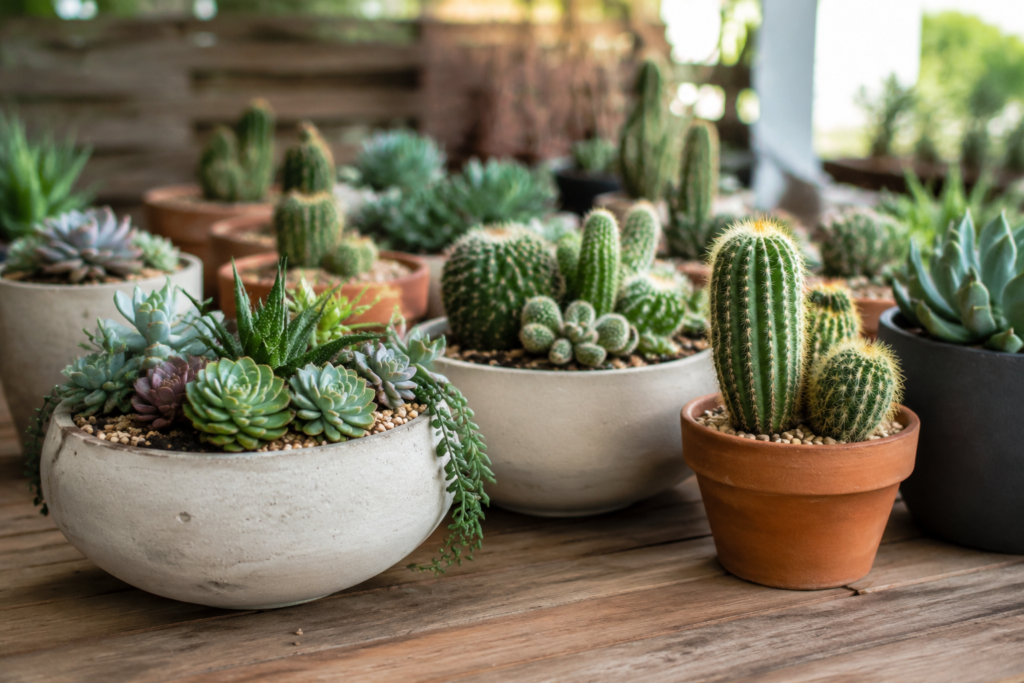
Best for: Sunny windowsills, contemporary interiors, and anyone who wants low-maintenance decorative plants
A styled collection of succulents and cacti — varied forms, textures, and sizes arranged in matching or coordinated planters — creates one of the most visually interesting and least demanding plant displays available. The variety of form within succulents alone is extraordinary: rosette echeveria, columnar cacti, paddle-shaped prickly pear, spherical barrel cacti, and sprawling stonecrop sedum all occupy the same category while looking completely unlike each other.
Succulent arrangements have a quality of designed composition that conventional plant displays rarely achieve — the architectural forms of cacti and the geometric precision of echeveria rosettes create displays that look as much like sculpture as like gardening.
Smart tip: Create a succulent arrangement in a single large shallow dish rather than individual pots. Multiple succulents planted together in a wide, shallow trough create a miniature landscape composition — with the taller, spiky forms as thrillers, the rosette forms as fillers, and the trailing sedums as spillers — that reads as a single designed composition rather than a collection of individual plants.
Mistake to avoid: Watering succulents on the same schedule as other houseplants. Succulents store water in their leaves and are adapted to survive extended drought — watering them as frequently as moisture-loving plants causes root rot rapidly. The correct approach: water thoroughly when the soil is completely dry (not just the top inch), then don’t water again until the soil is completely dry again — which may be two to six weeks depending on conditions.
20. How to Decorate with Plants Successfully
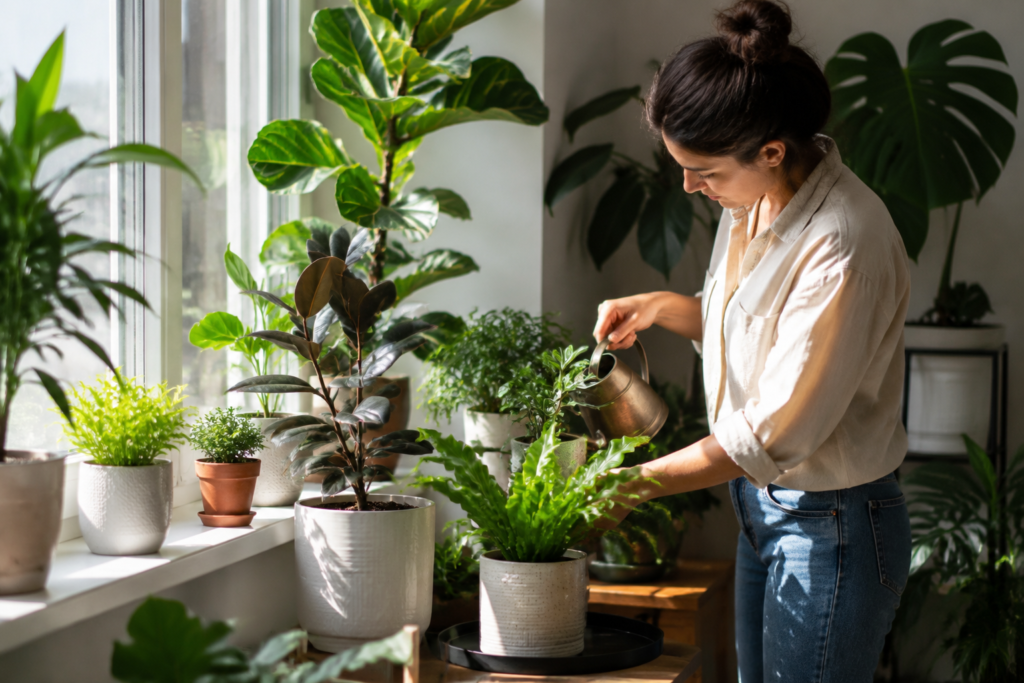
Best for: Anyone building a plant display — these principles prevent the most common plant styling mistakes
Decorating with plants successfully requires understanding a small number of principles that determine whether a plant display looks designed or accidental, thriving or struggling.
Light is the foundation of everything. A plant display that looks beautiful but isn’t positioned in adequate light will look poor within weeks as the plants decline. Assess the actual light in every position before placing any plant. Natural light near a window is dramatically different from natural light 10 feet from a window — the difference in light intensity at these two positions is often 10 to 20 times. Match each plant’s light requirements to the actual available light, not to the position that looks most attractive in the room.
Plant health is the prerequisite for good plant styling. A healthy, well-cared-for plant in a simple pot looks better than a beautiful plant in a perfect planter that’s struggling from incorrect care. Learn the correct care requirements for each plant — particularly watering frequency — and apply them consistently. A plant that’s correctly watered, adequately lit, and in appropriate growing medium will look good in almost any context.
Scale matters as much as species choice. A plant that’s too small for the room disappears visually; a plant that’s too large overwhelms the space. Assess the scale of the room and choose plants proportionally — large rooms need large plants, small rooms need plants that suit the available space without crowding it.
Smart tip: Start with three to five plants that you understand and care for well rather than collecting dozens of different species that each have different requirements. A small collection of healthy, thriving plants creates a better room than a large collection of plants in varying states of health. Expand the collection only when you understand the needs of what you already have.
Mistake to avoid: Treating all plants as interchangeable in terms of care requirements. The difference in watering frequency between a succulent (once every 2 to 6 weeks) and a fern (twice a week or more) is dramatic — watering them on the same schedule kills one or the other. Research the specific requirements of each plant in the collection and water individually based on each plant’s actual soil moisture, not on a uniform schedule.
Before You Start
- Assess your light conditions honestly. Walk through the room at different times of day and identify where the strongest natural light falls and where it doesn’t reach. This dictates which plants can genuinely thrive in each position.
- Start with low-maintenance plants. Snake plants, pothos, ZZ plants, and peace lilies tolerate the variable care of a beginner. Success with these builds the knowledge and confidence to care for more demanding species.
- Invest in quality potting mix. The right growing medium for each plant type — succulent mix for succulents, moisture-retentive mix for ferns and tropical plants — determines success far more than any other care factor.
- Consider pets and children. Many popular houseplants are toxic to cats, dogs, and young children. Research the toxicity of any plant before placing it in a home with pets or young children, and position toxic plants where they’re genuinely inaccessible.
Conclusion
Plants make rooms feel more alive because they are more alive — they grow, they change, they respond to their environment, and they’re genuinely different from week to week in a way that no other interior element is. A room decorated with well-chosen, well-cared-for plants has a quality of vitality that furniture, art, and accessories alone can’t achieve. Start with the right plants for the actual conditions, care for them correctly, and choose containers that suit the room’s aesthetic — and the plants will reward the attention with the kind of living, breathing room that makes people want to stay.
Continue Your Home Transformation
Explore the full collection of step-by-step eBooks and get the guide that fits the room you're working on.

2 Comments