Home office wall storage ideas work best when they give a specific retained item a useful home. Start with the supplies and papers that actually belong in the workspace, then choose an arrangement that makes them easy to find and return. A fully decorated wall is not necessarily a useful working wall.
Separate incoming material, active work and retained reference before buying containers. Each group needs a different review routine. Keep frequently used items within easy reach of the real working position, while preserving the space needed for the monitor, chair and ordinary movement.
These 22 original concepts show modest arrangements rather than tested installation systems. Choose products intended for the wall, contents and use. Follow their complete mounting and load instructions, obtain suitable fixings for the actual wall and seek qualified help when the wall or installation is uncertain.
The images are original AI-generated decor concepts, not installation diagrams or photographs of completed client projects.
Browse These 22 Home Office Wall Storage Ideas
Jump to an idea
- Begin home office wall storage ideas with the retained inventory
- Use one bracketed shelf for a modest everyday group
- Compare two short shelves with one long run
- Use a narrow vertical column beside the work surface
- Keep small supplies visible in shallow cubbies
- Home office wall storage ideas with a closed cabinet
- Combine open and closed storage for distinct roles
- Use a pegboard with compatible containers and hooks
- Compare a rail with its matching small containers
- Give incoming paper one defined wall pocket
- Separate the current project from incoming material
- Create a small outgoing-paper stage
- Keep a modest reference-book group on suitable support
- Give notebooks a simple upright return point
- Use a small stationery cup for everyday tools
- Keep small spare supplies in modest lidded boxes
- Choose a suitable hook for the ordinary headphones
- Store disconnected spare cables as a retained supply group
- Keep a current-task board separate from storage
- Give a shared workspace separate modest zones
- Check full cabinet-door movement around the workstation
- Reset home office wall storage ideas after one ordinary week
Plan home office wall storage ideas from the retained inventory
List each retained group, how often it is used, its approximate quantity and the point where it returns after the task. Mark the desk, monitor, chair and any cabinet-door movement on a simple wall elevation. Compare the complete storage system with its exact mounting guidance and the actual wall. Avoid ordering accessories until the retained objects, suitable support and access are understood.
| The retained group | A useful arrangement to compare | Check before choosing |
|---|---|---|
| A few everyday supplies | One modest bracketed shelf | Useful reach, depth and exact load guidance |
| Different small categories | Shallow cubbies or compatible containers | Each item can be removed without emptying another group |
| Incoming paper | One defined wall pocket | A regular decision point and limited retained volume |
| Work in progress | A separate active-project pocket | Current material remains distinct from incoming paper |
| Occasional supplies | A suitable closed cabinet | Complete door movement and straightforward access |
| Frequently changing tools | A compatible pegboard or rail system | Exact accessories, mounting and permitted contents |
| A shared workspace | Clearly separated modest zones | Each user can retrieve and return their own material |
Treat the wall and the complete storage system as one decision
IKEA identifies the need for secure anchoring and wall-appropriate screws and plugs in its SKÅDIS guidance. Its EKET example also makes wall-hung capacity dependent on the wall material. These are product-specific reminders to read the complete system instructions; they are not a universal capacity or a fixing recipe for every home. Confirm the actual wall, rail, cabinet, accessories and intended contents before installation.
Keep useful reach separate from decorative composition
OSHA’s workstation checklist distinguishes frequently used items within easy reach from less frequently used material placed farther away. Apply that planning principle to the ordinary task: the pen used every hour should not require reaching across a monitor. Compare the arrangement from the actual seated position, and revise an awkward location rather than treating visual symmetry as the final test.
Make a storage inventory and return card
Give each retained group one line: purpose, quantity, frequency, suitable container, intended location and return routine. Add the exact product, instruction link, wall assessment and permitted load information for the chosen installation. After one normal workweek, record what accumulated outside its place and why. Reduce an unnecessary category or improve its access before adding another shelf.
1. Begin home office wall storage ideas with the retained inventory
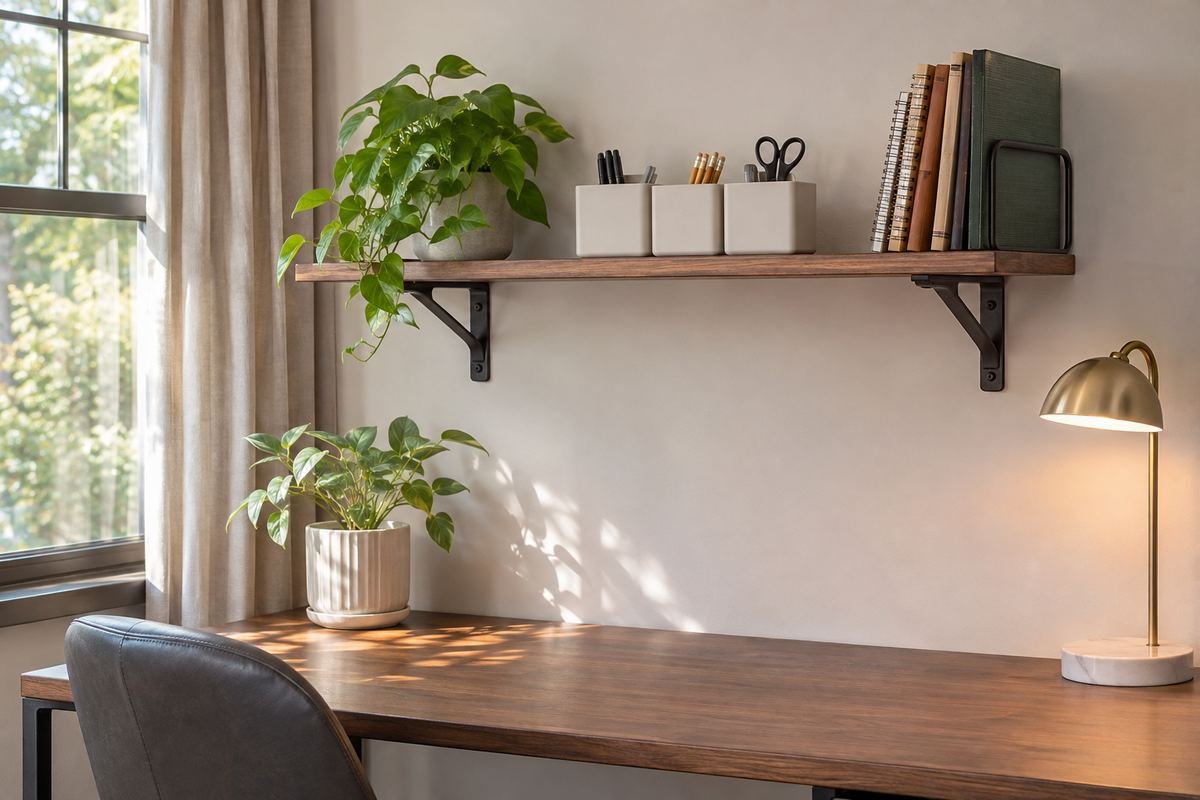
Sort the material that already belongs in the office before choosing a system. Separate everyday supplies, active projects and occasional reference, and remove items that have another proper home. A wall container cannot decide which papers or duplicates should remain in the working inventory.
Compare the retained groups with the tasks performed at the desk. Choose a modest place for each one and leave the rest of the wall available until the routine has been tested. A clear purpose gives the storage an appropriate size and keeps a decorative arrangement from expanding without need.
Practical tip: Count the retained groups before counting shelves.
2. Use one bracketed shelf for a modest everyday group
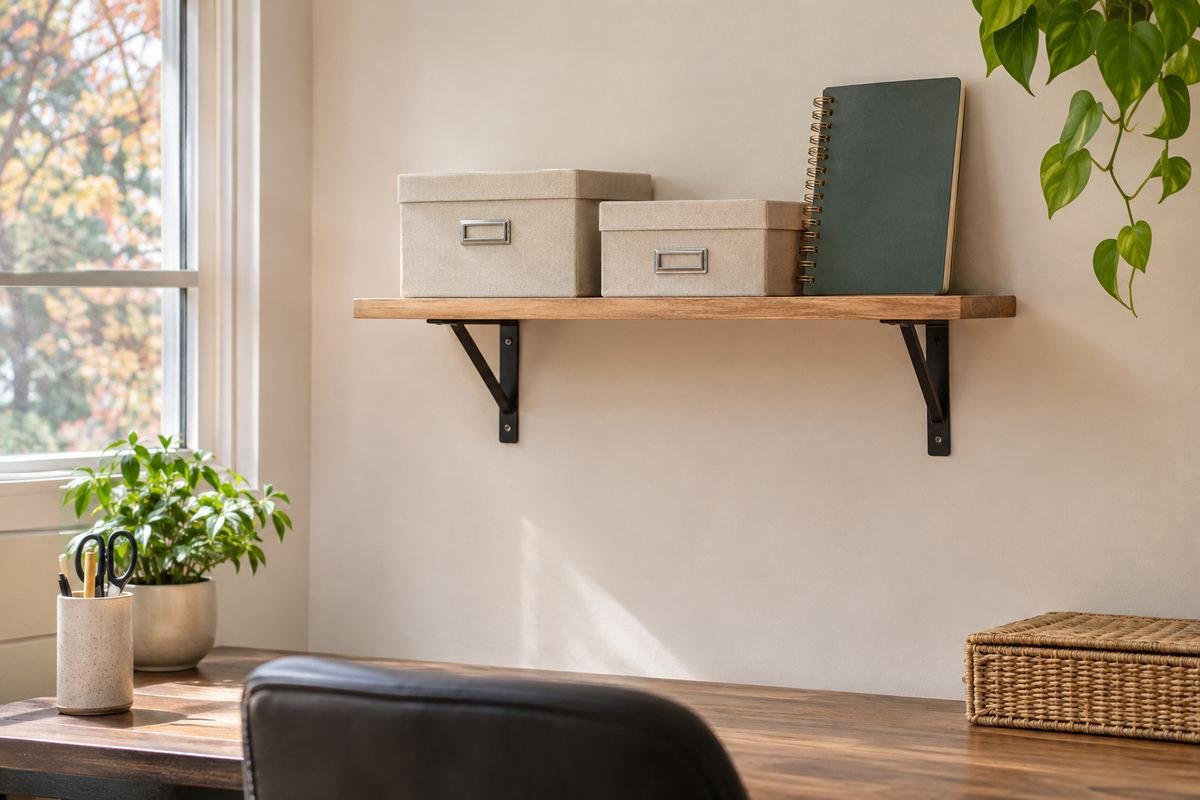
A single suitable shelf can serve a small collection without turning the whole desk wall into storage. Compare its usable depth with the actual containers and the position of the seated worker. Keep the monitor and ordinary working surface clear while considering access to the shelf.
Select the complete shelf and brackets from their intended use and mounting requirements. Do not infer a load rating from the slim appearance of a support. Begin with the retained essentials and review the arrangement in use before adding another level above it.
Practical tip: Choose depth from the container and access together.
3. Compare two short shelves with one long run
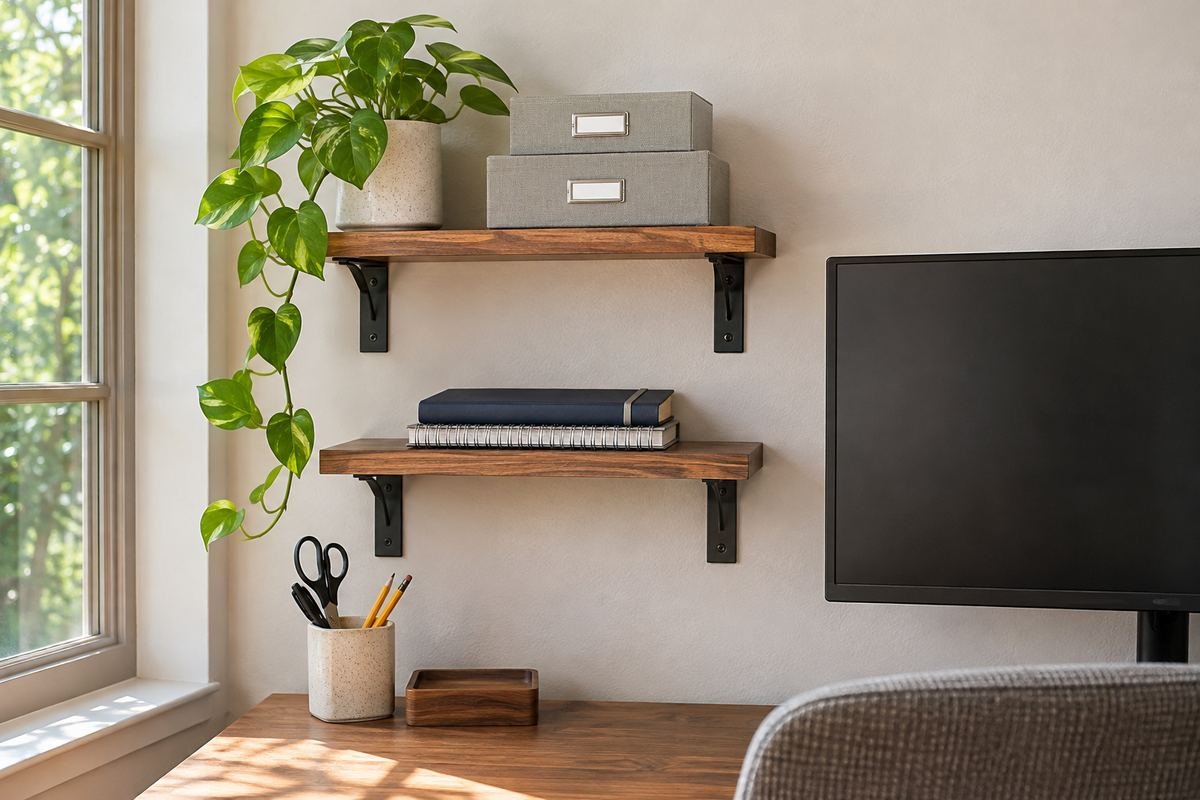
Two shorter suitable shelves can divide distinct categories while leaving a clear area around a monitor or window. Give each shelf a defined job and compare the positions from the actual working place. The break between them should improve the use of the wall rather than simply create symmetry.
Check each complete installation independently, including brackets, permitted load and wall suitability. Avoid treating separate shelves as one continuous support system. A small gap can make the composition calmer when the retained contents and access genuinely benefit from that arrangement.
Practical tip: Give each short shelf one retained category.
4. Use a narrow vertical column beside the work surface
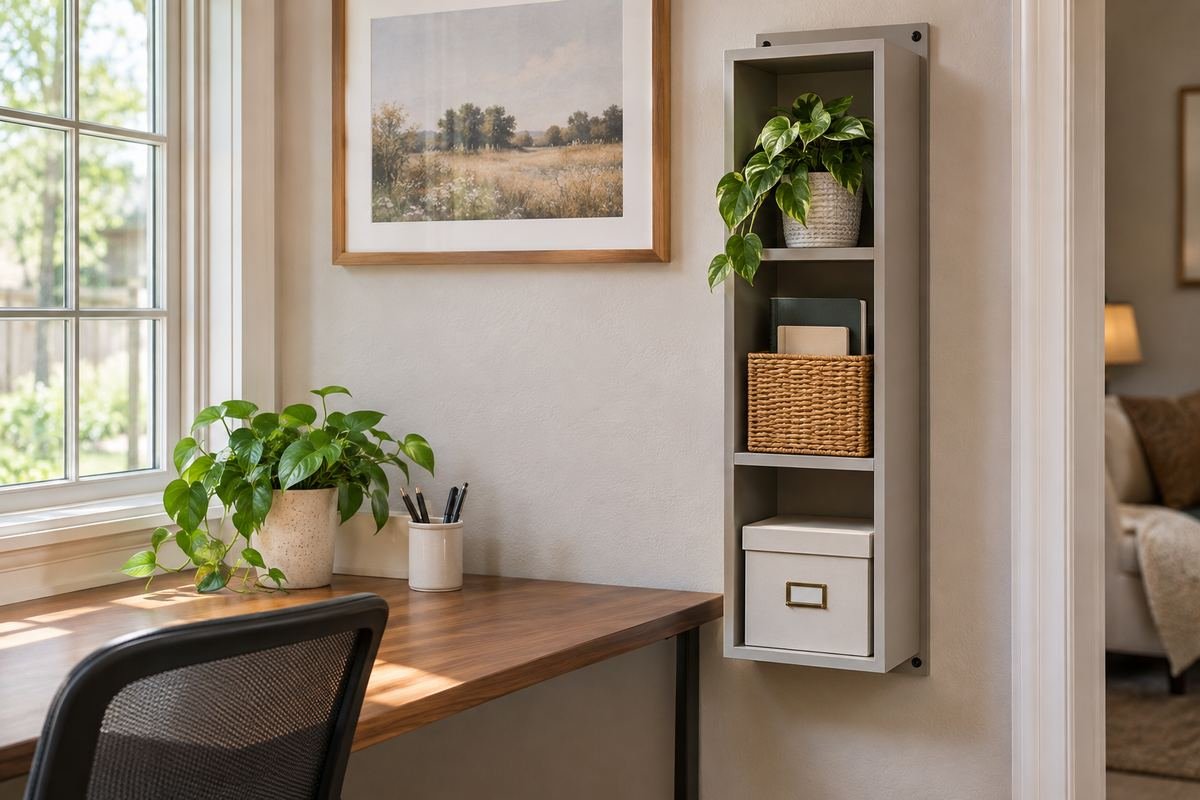
A modest vertical storage unit can collect supplies beside the desk without spanning the entire wall. Compare each compartment with the objects that will occupy it and the frequency with which they are retrieved. Keep the most regularly used group in the location that works from the real task.
Follow the exact unit’s mounting and load guidance and check the complete projection into the room. A narrow front view does not establish a shallow footprint. If the upper compartments would become inconvenient overflow, choose a smaller arrangement or keep occasional material in another suitable place.
Practical tip: Check the full depth as well as the narrow front.
5. Keep small supplies visible in shallow cubbies

Shallow cubbies can give a small retained category its own visible place. Compare the interior dimensions and opening with the actual item rather than buying a collection of tiny boxes first. Keep the groups simple enough that removing one object does not displace the contents of neighboring compartments.
Use the product only for its intended contents and follow the mounting requirements for the complete unit. Leave some empty space around a small category so that it can be returned without careful rearranging. The cubby should simplify the task instead of becoming a display that is difficult to maintain.
Practical tip: Test taking out and returning one ordinary item.
6. Home office wall storage ideas with a closed cabinet
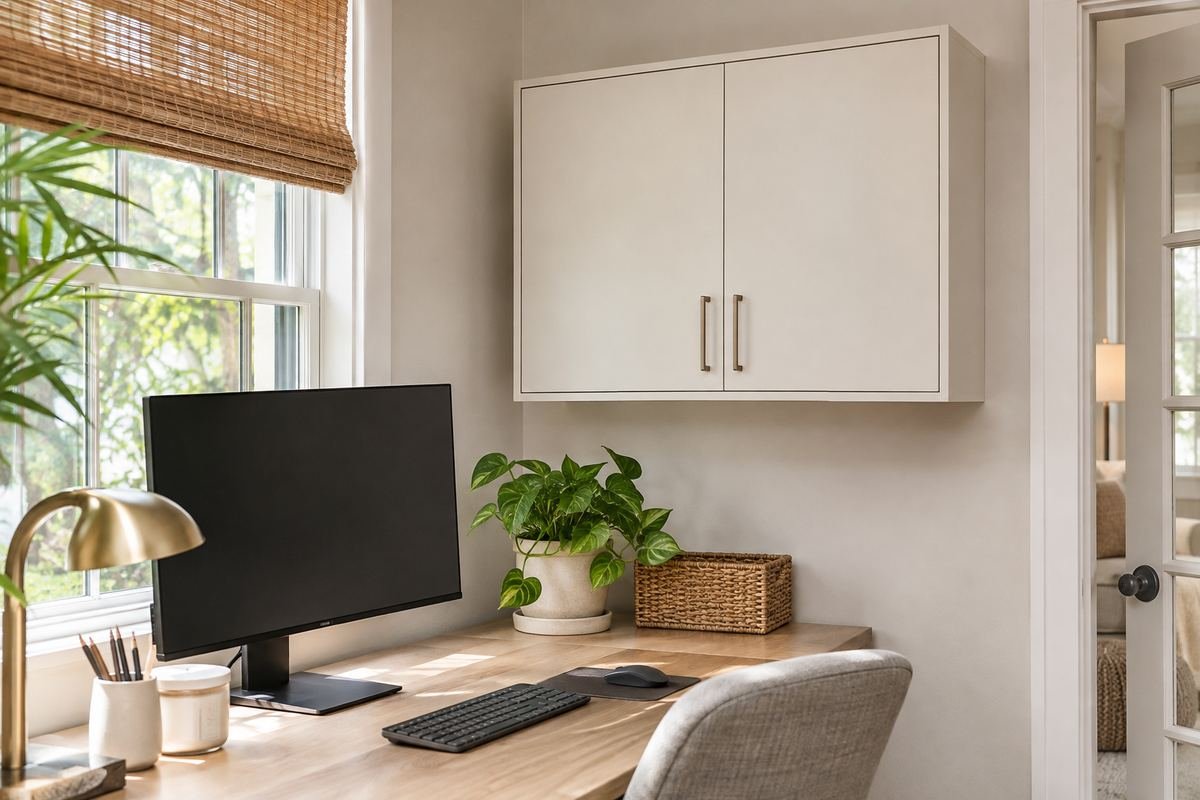
A suitable wall cabinet can keep occasional supplies together while giving the room a quieter appearance. Compare the internal space with the retained contents and the door movement with the desk and monitor. Closed fronts do not remove the need for a limited inventory and useful access.
Confirm the exact cabinet, suspension system, permitted contents and actual wall requirements before installation. Keep retrieval straightforward rather than hiding a mixed collection behind the door. If the routine involves standing and moving a chair every few minutes, reconsider which group belongs inside.
Practical tip: Plan the opening and the retrieval task together.
7. Combine open and closed storage for distinct roles
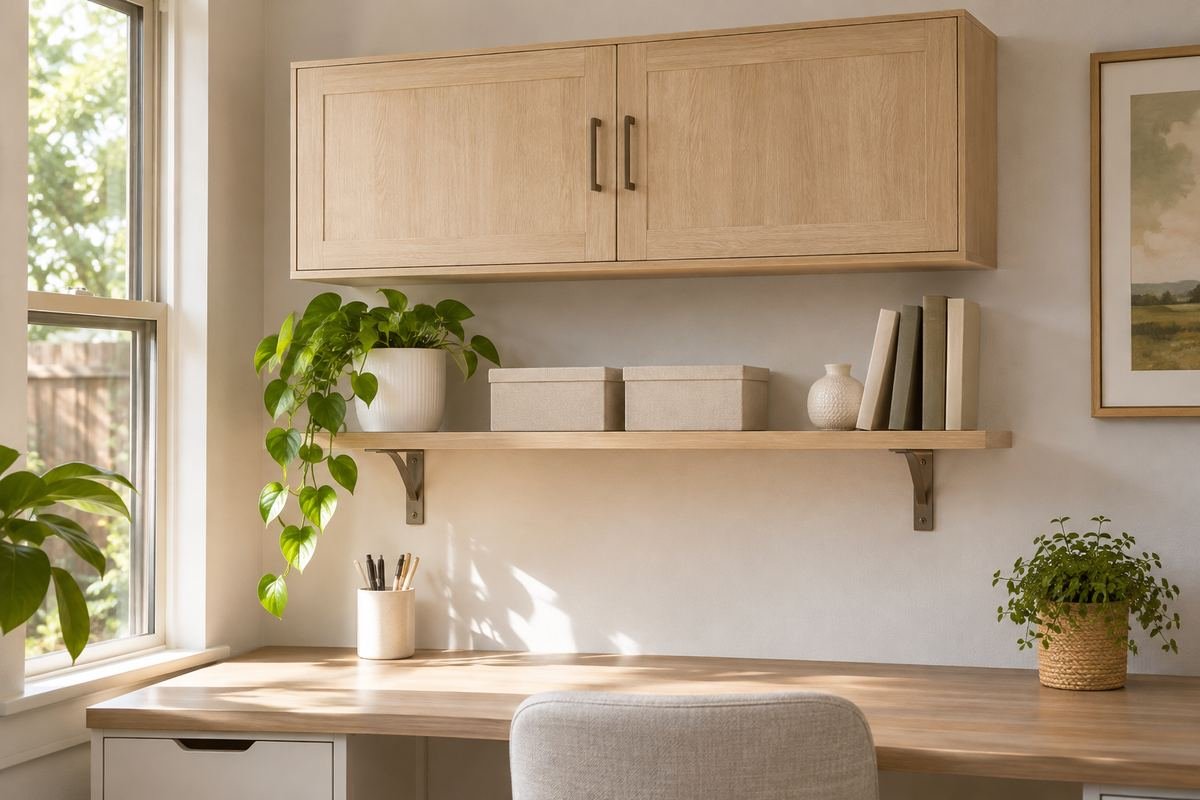
A modest open shelf and a suitable closed cabinet can serve different retained groups on the same wall. Let the exposed portion hold appropriate items that benefit from direct access. Give the cabinet a separate purpose rather than using it as an unassigned place for everything left over.
Compare both complete systems and the actual wall, including the cabinet opening and shelf projection. Keep the composition restrained so the work surface remains visually clear. The combination works when the daily task explains which material is visible and which material belongs behind a door.
Practical tip: Name the two roles before matching their finishes.
8. Use a pegboard with compatible containers and hooks
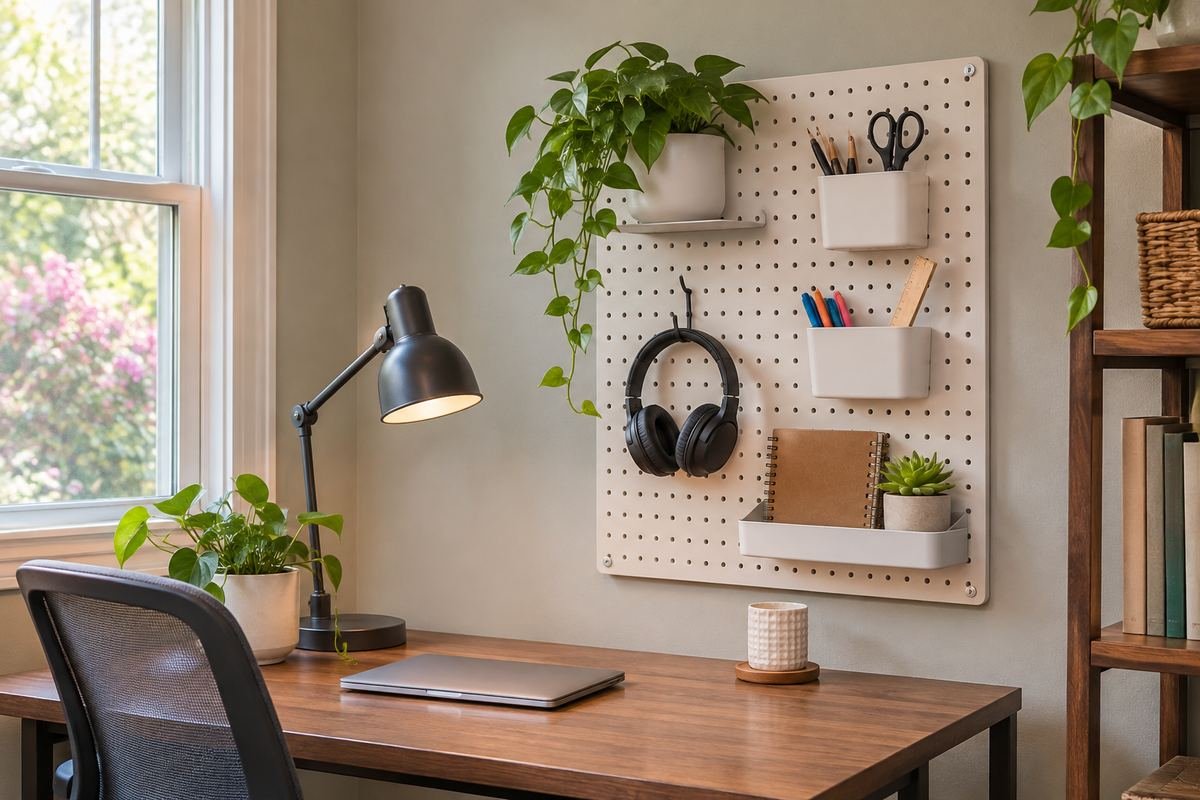
A pegboard can offer a defined arrangement for small suitable supplies when its accessories belong to the actual system. Compare containers, hooks and the items they are intended to hold. A familiar hole pattern does not establish compatibility with an accessory from another product range.
Follow the board’s complete mounting and use guidance, including any required rail and suitable fixings. Begin with a few useful accessories and leave unused holes available. Review what gets taken down and returned during the working week before adding more attachments for visual completeness.
Practical tip: Confirm the board and accessories as one system.
9. Compare a rail with its matching small containers
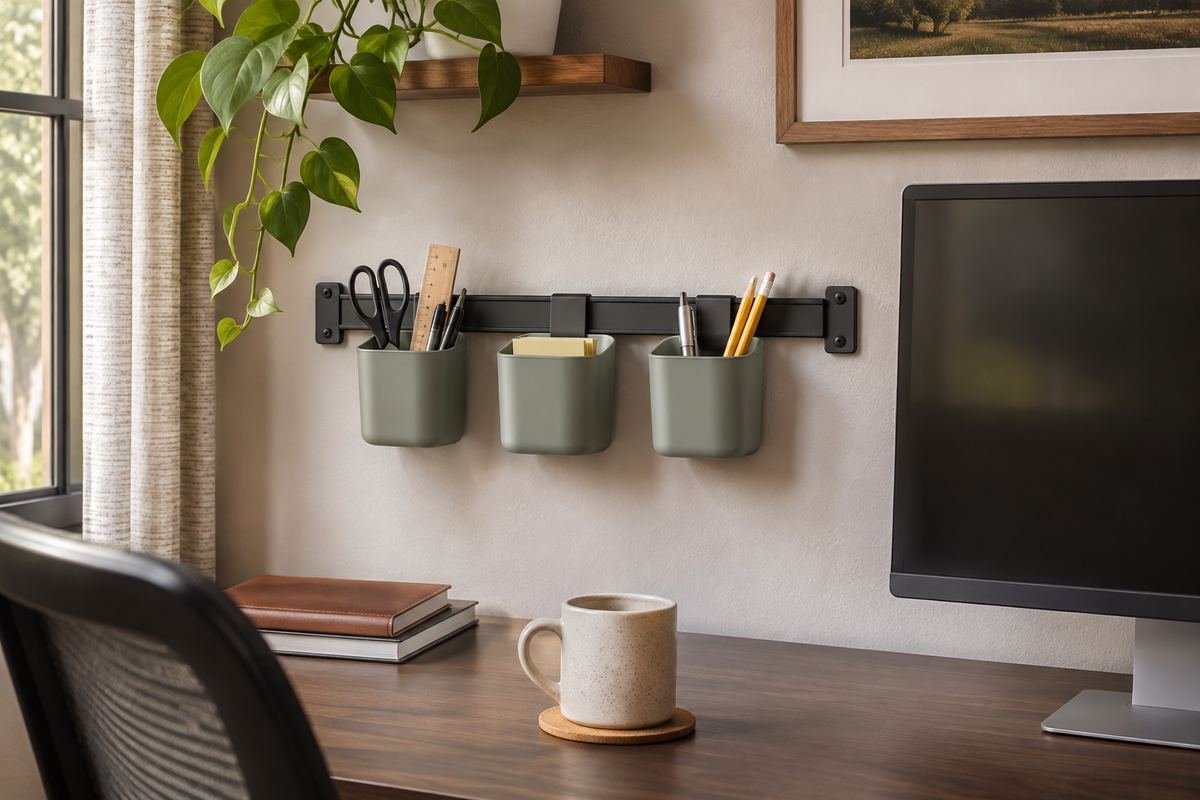
A compatible rail system can group a few supplies in a compact horizontal arrangement. Compare the real container opening, attachment method and the retained contents. Keep the position useful from the task without placing a projecting cup where it conflicts with the monitor or normal movement.
Read the complete rail and accessory requirements and use the system for its permitted role. Do not treat a kitchen-style appearance as proof that every matching-looking container fits. A short clearly assigned run can be easier to maintain than a long rail filled with miscellaneous accessories.
Practical tip: Check the attachment and the usable opening.
10. Give incoming paper one defined wall pocket

An incoming pocket can establish where paper waits for a decision. Keep it separate from current work and retained reference so the household can see what still needs attention. Choose a suitable pocket whose size and access fit the paper that actually enters the office.
Decide when its contents will be reviewed and what happens afterward. Protect private information appropriately and avoid leaving readable personal material exposed in a shared room. The useful limit is the decision routine; adding another pocket when the first fills does not resolve the accumulated work.
Practical tip: Pair the pocket with a regular review point.
11. Separate the current project from incoming material

A dedicated active-project pocket can keep the material for one current task together. Choose a manageable group that is actually in progress and compare the pocket with the paper size. Keep its purpose clear so newly arrived material does not bury the work that needs attention next.
Return completed or inactive material to its appropriate destination during the normal review. Avoid calling several mixed pockets active simply to postpone sorting. A wall position is useful when the current folder is straightforward to retrieve, work with and replace without disturbing the rest of the desk.
Practical tip: Use a clear current-project limit.
12. Create a small outgoing-paper stage
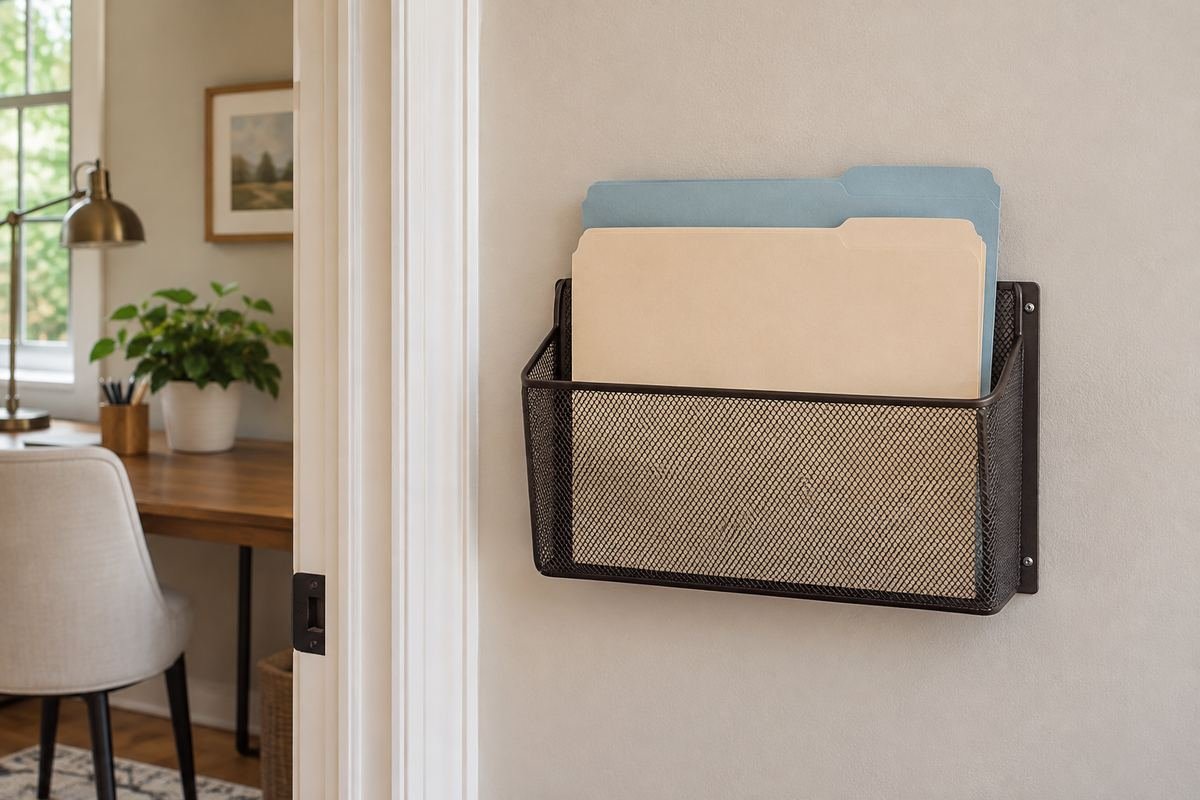
Material ready to leave the workspace benefits from its own defined stage. A suitable wall pocket can hold a modest outgoing group when it fits the actual route and contents. Keep it separate from papers awaiting a decision so the next action remains clear.
Choose a review and removal routine that suits the household. Do not place sensitive information in an exposed location, and do not let the pocket become indefinite archive storage. If the normal exit route is elsewhere, choose a more useful destination rather than forcing the process onto the office wall.
Practical tip: Put outgoing material near its real next step.
13. Keep a modest reference-book group on suitable support

A short retained reference group can work on a properly specified shelf when it is useful beside the task. Compare the actual books, supports and access rather than filling the shelf to match a decorative photograph. Books vary in size and weight, and a small visual group still needs suitable support.
Follow the exact shelf system and wall requirements for the intended contents. Keep frequently consulted material easy to identify and return, and move unnecessary duplicates elsewhere. The result can remain calm when reference storage serves the work instead of acting as a backdrop for an expanding collection.
Practical tip: Assess the actual books with the chosen shelf guidance.
14. Give notebooks a simple upright return point

A small upright notebook group can be easier to choose from than a mixed stack of current and unused books. Compare the retained sizes with the suitable shelf or cubby and keep the current notebook distinct in the ordinary routine. Avoid adding decorative holders that complicate removal.
Check that the complete storage and support are appropriate for the contents. Review completed notebooks according to the household’s retention needs, including privacy. A useful wall arrangement gives each retained item a straightforward return point without suggesting that every old notebook must remain beside the desk.
Practical tip: Keep current and retained notebooks easy to distinguish.
15. Use a small stationery cup for everyday tools
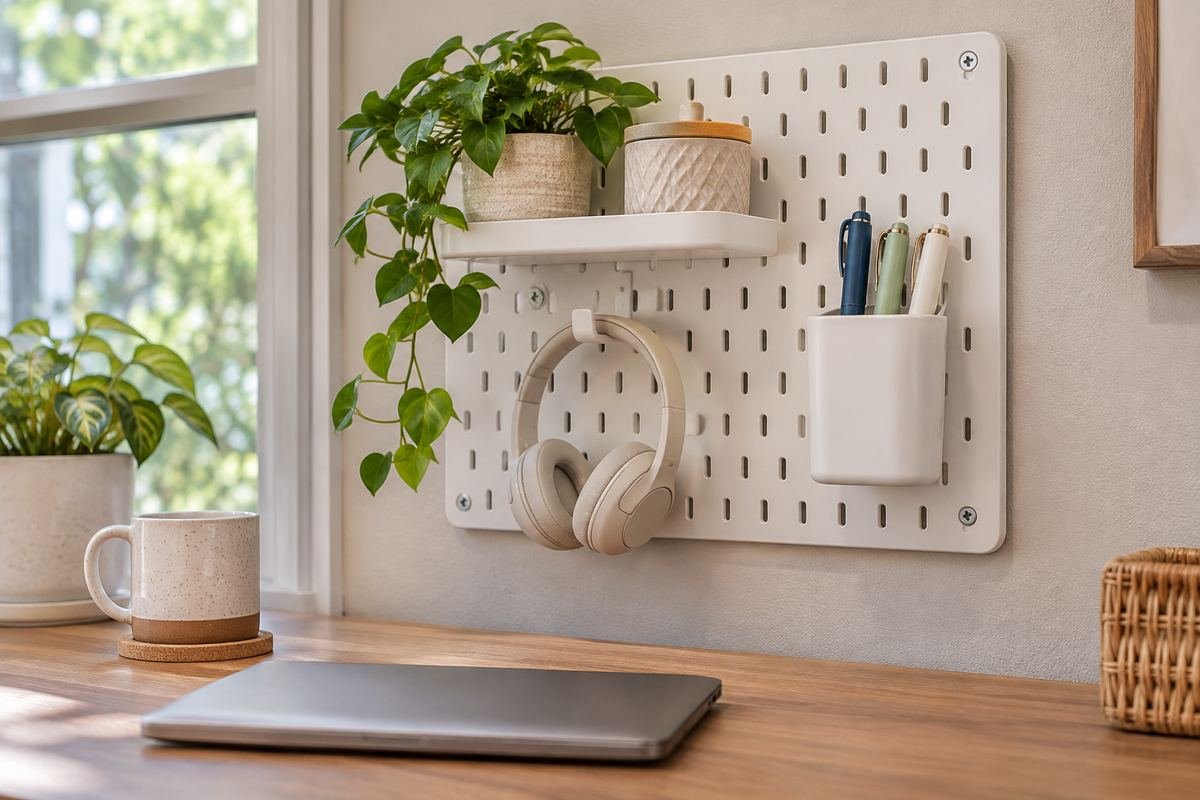
A compatible wall-mounted cup can collect a limited group of ordinary writing tools. Compare its depth, opening and attachment with the actual pens and the system’s intended use. Keep the cup within useful reach of the task without projecting into the monitor or chair movement.
Retain the tools that are actually used and give spares a separate suitable place. An overflowing cup can make the needed item harder to find even when the wall looks organized. Test choosing a pen and returning it during the normal working routine before adding another cup.
Practical tip: Separate everyday tools from spare supplies.
16. Keep small spare supplies in modest lidded boxes
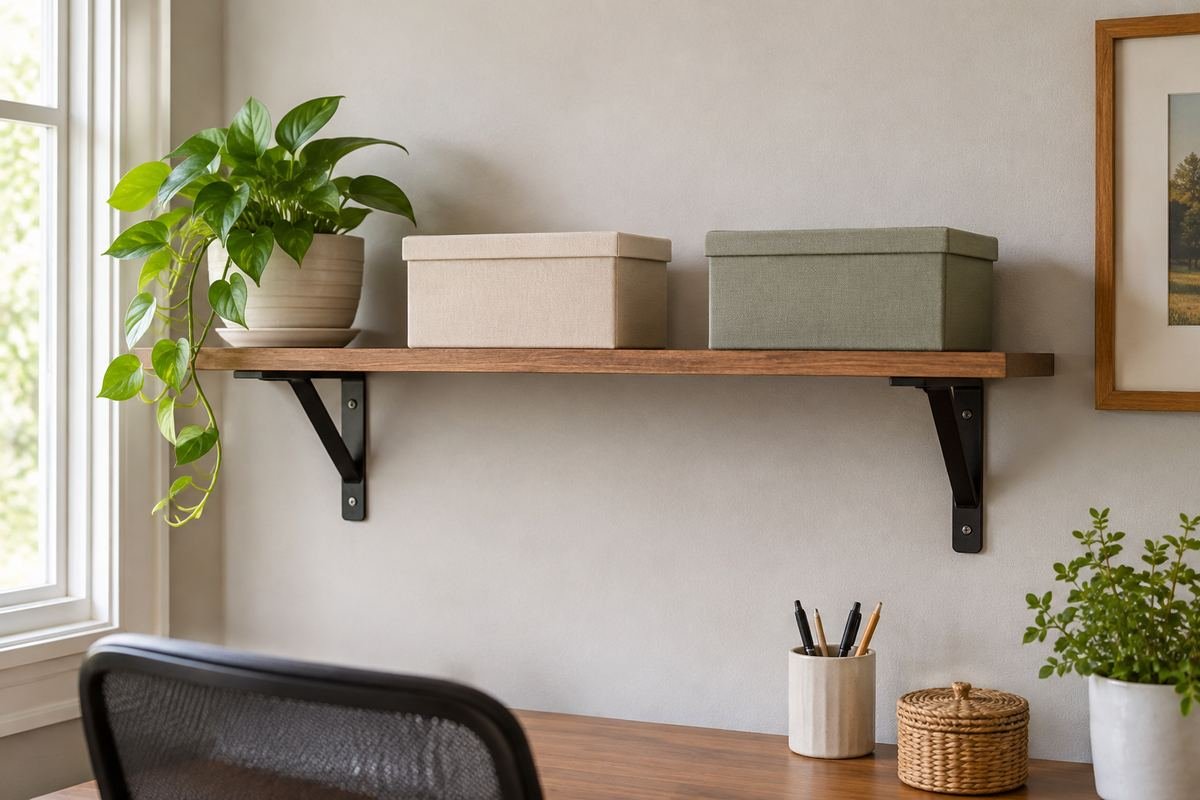
A few suitable lidded boxes can gather small spare categories on an appropriate shelf. Choose the container from the retained objects and compare how it is removed and opened. Keep the group small enough that reaching one box does not require unloading the entire shelf.
Read the shelf and container guidance for the actual contents and place occasional material according to its use. Avoid stacking beyond the intended arrangement or creating several indistinguishable layers. The box earns its place when the contents can be identified, retrieved and returned without a separate sorting task.
Practical tip: Choose a box that can be removed independently.
17. Choose a suitable hook for the ordinary headphones
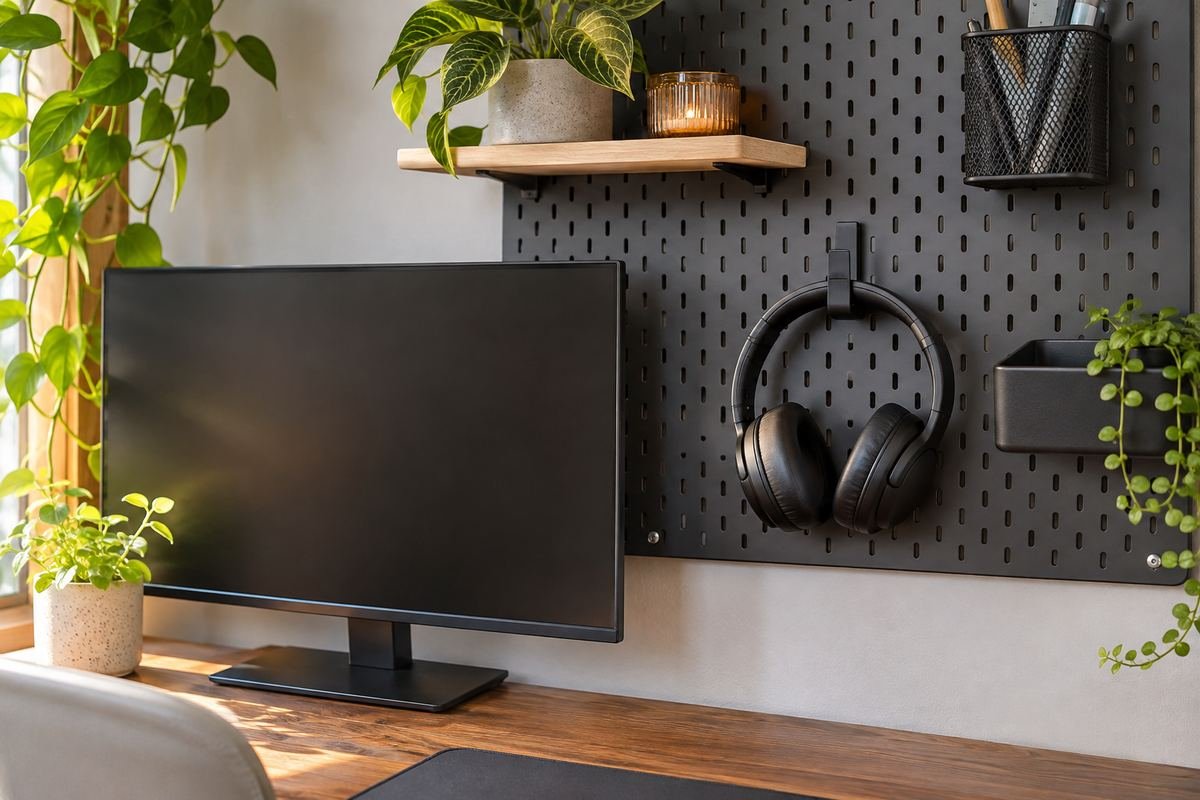
An appropriate hook can give disconnected headphones a clear return point beside the desk. Check the actual headphone shape and the accessory’s intended use rather than treating any small peg as a universal hanger. Keep the position clear of the monitor and normal movement around the work surface.
Follow the complete hook and support system requirements and review how the headphones are removed. Keep any connected cable arranged according to the equipment guidance and the actual desk layout. The purpose is a simple storage destination, not an improvised support for unrelated equipment.
Practical tip: Compare the hook with the actual headband and system.
18. Store disconnected spare cables as a retained supply group

A small suitable box can keep a limited group of identified disconnected spare cables together. Separate this inventory from the connected equipment currently serving the desk. Review what is still relevant to the actual devices rather than collecting every old lead in a wall container.
Choose a container and supporting system appropriate for the contents, and follow the equipment guidance for storage. Keep retrieval easy enough to find the correct spare without emptying several boxes. The wall arrangement should support a modest retained group rather than become another mixed cable archive.
Practical tip: Keep spare storage distinct from connected cable routing.
19. Keep a current-task board separate from storage
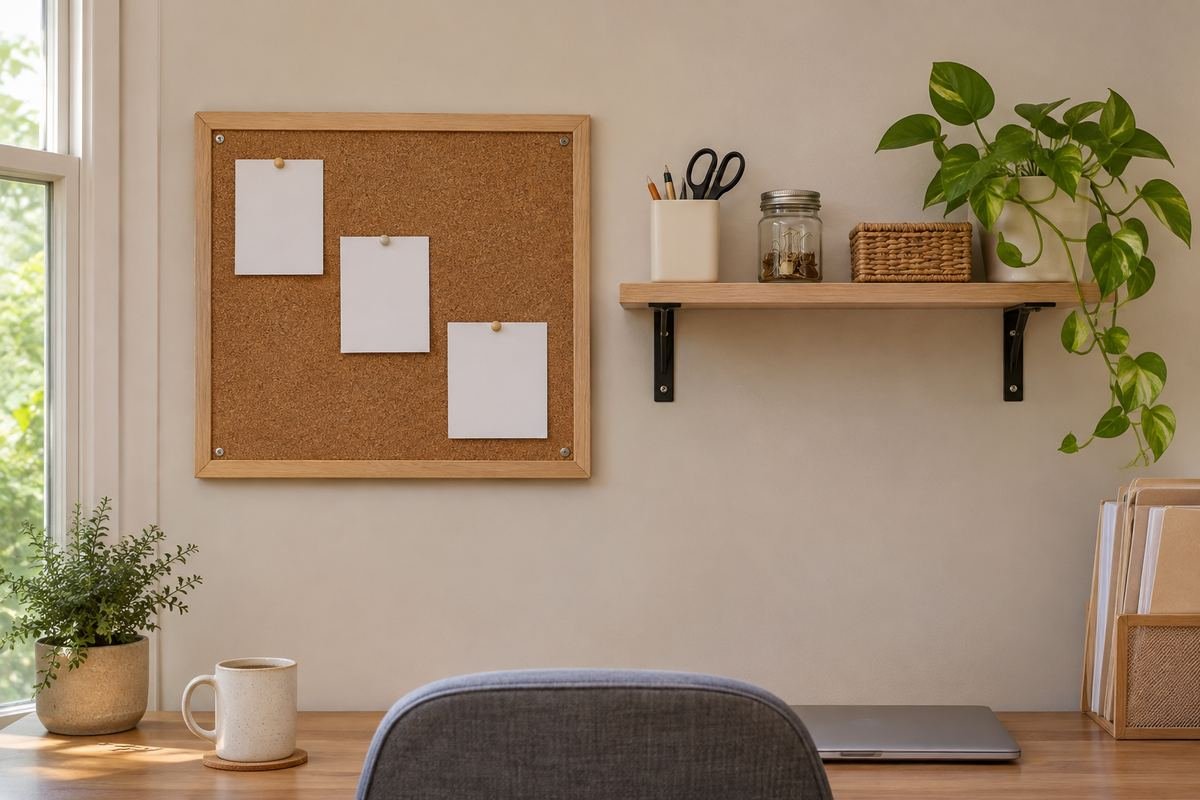
A small board can show a limited current task while adjacent containers hold the actual supplies or papers. Give the board a clear role instead of attaching every reminder and document to the same surface. Keep private details protected and use an appropriate board and accessories.
Review the displayed material when the task changes and move retained records to their proper destination. A board is useful when it helps identify the next action, but it does not replace an organized paper process. Leave enough clear wall that the active area can be read without visual competition.
Practical tip: Remove finished reminders during the project reset.
20. Give a shared workspace separate modest zones
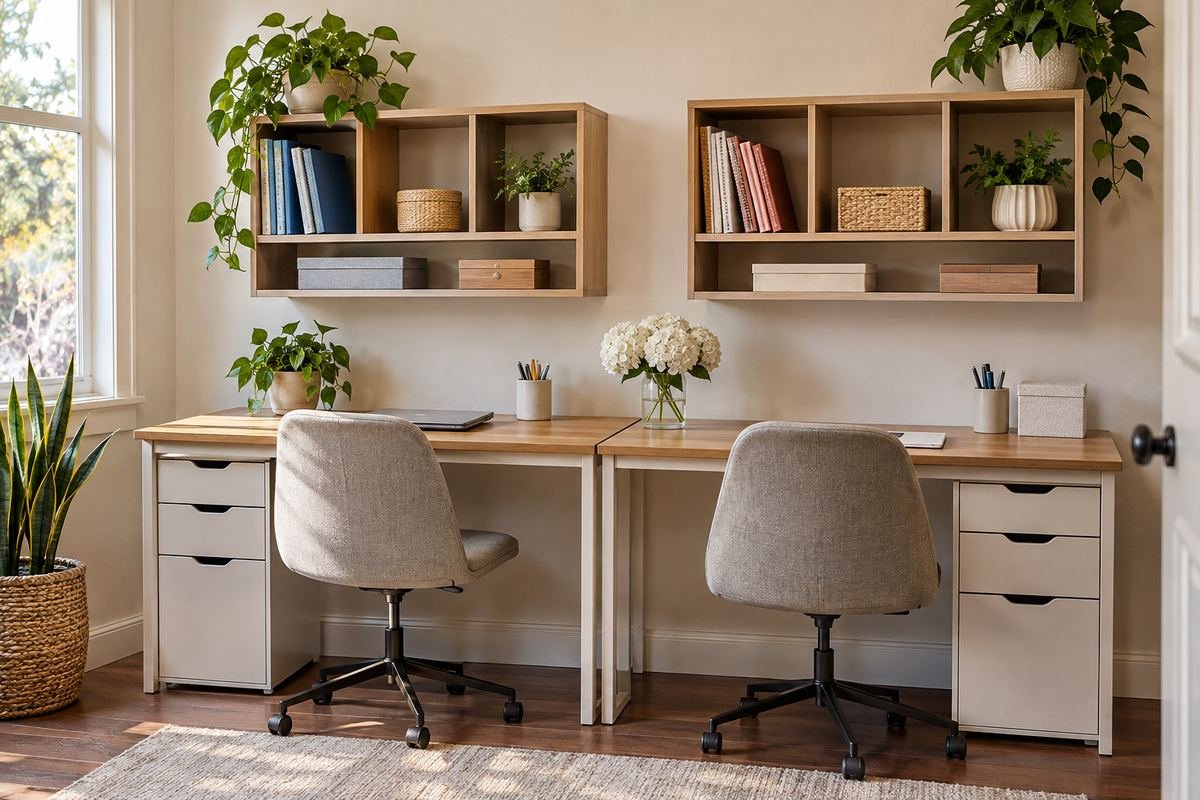
A shared office wall can work when each person has a defined place for the retained material they use. Compare the different tasks and access rather than dividing every container into equal sizes. Keep shared supplies in a clearly understood common location and individual work in its own appropriate place.
Confirm the complete storage system, wall support and actual contents for the whole arrangement. Review how one person retrieves material while the other works. The useful division reduces searching and accidental mixing without requiring a wall filled with matching containers for categories that do not exist.
Practical tip: Plan around the two routines before dividing the wall.
21. Check full cabinet-door movement around the workstation
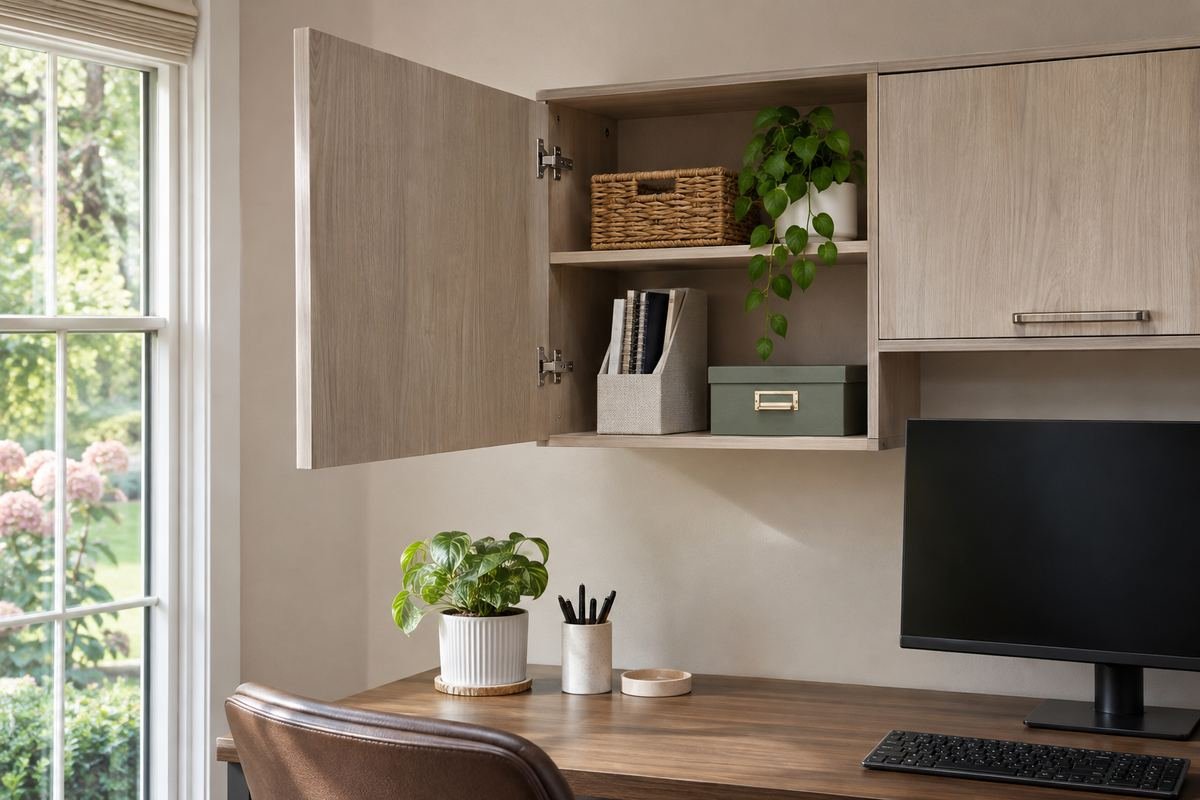
A cabinet can appear to fit when closed and still conflict with the monitor or another storage unit when opened. Compare the complete door movement and the way the contents are retrieved. Include the real desk equipment and chair position rather than judging the wall elevation alone.
Follow the exact cabinet’s positioning, assembly and mounting requirements. Choose another suitable location or product if normal access requires repeatedly moving essential equipment. The final arrangement should support an ordinary working day with its doors open as intended, not only a tidy photograph with every front closed.
Practical tip: Test access with the complete workstation present.
22. Reset home office wall storage ideas after one ordinary week
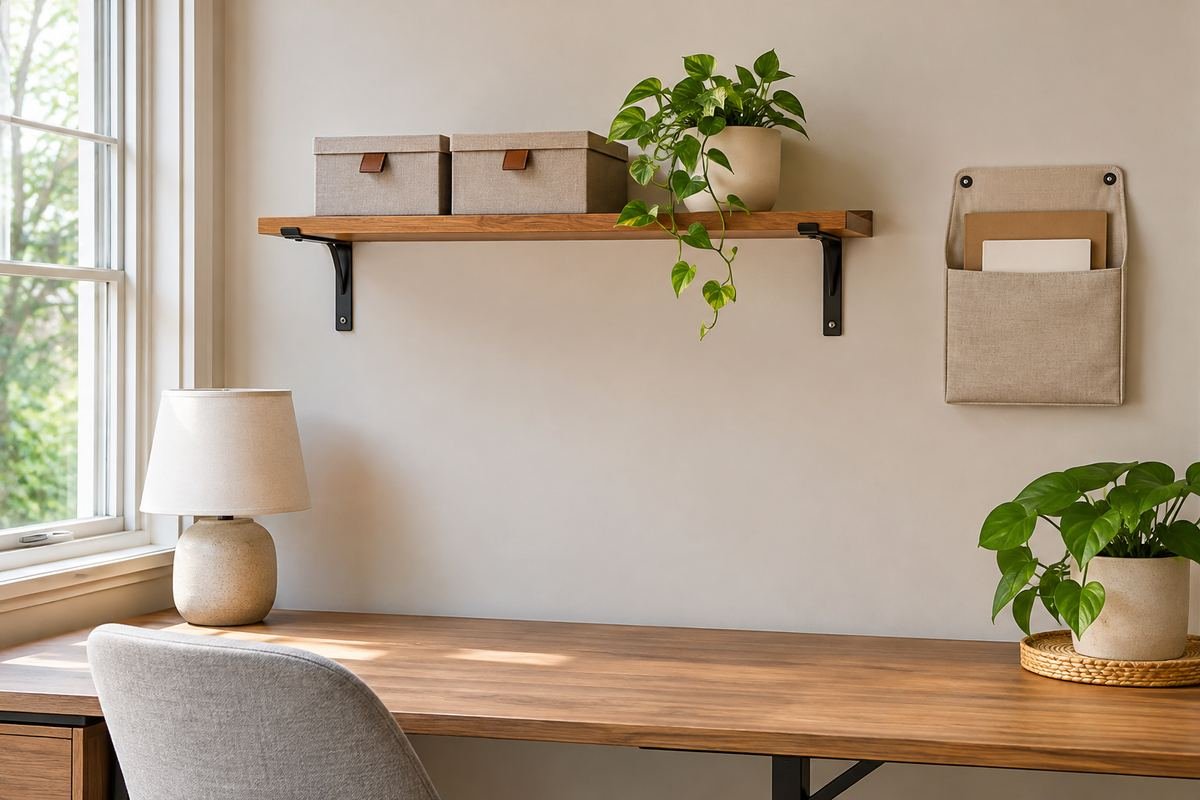
Use the arrangement through a normal week before adding more components. Note which supplies repeatedly stay on the desk, which pockets accumulate unrelated paper and which compartments are awkward to reach. These observations show where the arrangement or retained inventory needs a practical adjustment.
Reduce an unnecessary group or improve its suitable return point before expanding the system. Keep the exact mounting and load guidance available for future changes, and reassess the complete installation when the intended contents change. A short recurring review can preserve a useful working wall without rebuilding the office.
Practical tip: Change the repeated obstacle before buying more storage.
Frequently Asked Questions
What should I store on a home office wall?
Choose retained supplies, active papers or reference material that benefit from a defined nearby home. Start with the task and use frequency, then compare a suitable system, the actual wall and the permitted contents. Do not fill the wall simply because there is room for more containers.
Are shelves above a desk always a good idea?
They can serve a modest appropriate inventory when the complete installation and access work. Compare the monitor, normal reach, chair position and shelf depth. Confirm mounting and load requirements for the exact system and wall, and avoid a position that creates repeated awkward reaching.
How do I choose between a pegboard and shelves?
Compare what needs to be retrieved. Compatible pegboard accessories can suit small separate supplies, while a suitable shelf may work for a modest reference group or containers. Check the exact accessories, permitted contents, mounting requirements and return routine rather than choosing from appearance alone.
How can I keep wall pockets from becoming paper clutter?
Give each pocket a specific stage in the work: incoming, current project or outgoing. Decide when the contents will be reviewed and what moves elsewhere afterward. A pocket should not become permanent storage for every paper that enters the room. Keep private material appropriately protected.
How much weight can wall storage hold?
Use the exact product and installation guidance together with an assessment of the real wall and appropriate fixings. Capacity is not established by shelf length, the number of brackets in a concept image or another product’s rating. Obtain qualified advice when the wall or intended installation is uncertain.
Should home office wall storage be open or closed?
Use open storage for suitable retained items that benefit from direct access and closed storage where an appropriate cabinet serves the contents better. Check the door movement and retrieval task. Either choice still needs a limited inventory, correct support and a regular return routine.
Choose the Details That Work in Your Home
Choose the smallest suitable wall arrangement that gives the retained work a clear return point. Test actual access, keep each paper stage distinct and confirm the complete mounting requirements before installation. A wall that supports the ordinary working week can stay useful with fewer containers and a simpler reset.
For related ideas, explore home office organization ideas, desk cable management ideas, guest bedroom office ideas, ergonomic home office planning.
Planning References
IKEA SKÅDIS 103.216.18: compatible accessories and anchoring guidance; OSHA: computer workstation evaluation checklist and useful reach; IKEA EKET manufacturer example: wall-mounted storage and wall-dependent load. Follow the instructions for the exact products you choose.
Optional digital guide for this topic
If you prefer a structured workbook, explore this related paid guide.