Guitar storage ideas work when the instrument, its case and the room conditions are considered together. Start with the maker’s care guidance, then choose a return position that is easy to use without putting the guitar in the path of doors, furniture or everyday traffic. A display arrangement and storage between long gaps in playing may require different decisions.
These 22 ideas cover home layouts, case parking and the accessories that often crowd a practice corner. They are options to select from, not a reason to buy 22 organizers. The illustrations show design concepts; support compatibility, wall fixings and environmental conditions must be checked for the actual instrument.
Contents
- 1. Start with a case bay in a stable interior room
- 2. Reserve a stand for the guitar played today
- 3. Use a compatible wall hanger for one daily instrument
- 4. Keep a small guitar rack within the collection you use
- 5. Store occupied hard cases upright in separate slots
- 6. Use an on-edge case holder when height is limited
- 7. Give a closet a full-height case compartment
- 8. Separate empty cases from instruments in use
- 9. Measure a guitar cabinet with its door open
- 10. Keep a readable humidity monitor near the storage zone
- 11. Keep case-care accessories in their own small pouch
- 12. Leave the case-opening surface ready
- 13. Pair a strap with its guitar without loading the neck
- 14. Divide a shallow drawer for picks and capos
- 15. Keep spare strings in identifiable original packets
- 16. Coil disconnected leads in a dedicated basket
- 17. Park a pedalboard in a clear low bay
- 18. File music beside the practice position
- 19. Plan the rack around bass and unusual body sizes
- 20. Separate household traffic from the instrument zone
- 21. Set aside a controlled arrival space for a cold case
- 22. Keep a case map for a shared collection
Choose the care conditions before the display
Read the current instructions for the instrument, finish, case and proposed support. Keep the storage zone away from direct sun, heaters and abrupt environmental changes. Where the instrument will not be used for a while, ask its maker about preparation, including strings and removable parts; this layout guide does not prescribe a universal detuning or humidity treatment.
Match the arrangement to the playing routine
- One guitar used during daily practice: A compatible stand or hanger in a clear, suitable room; a matching case remains available.
- An instrument kept between longer gaps: A suitable case and stable indoor location, with the maker’s storage preparation followed.
- Several occupied hard cases: Separate supported case positions, with no flat pile of instruments.
- A small shared room: Check the complete removal route and the furniture or door movement before choosing a display.
- An unusual body, finish or bass: Verify the exact support geometry and contact-material compatibility rather than assuming a universal fit.
1. Start with a case bay in a stable interior room

Choose the room before choosing a rack. A guitar can fit a corner that is unsuitable because it sits beside a heater, a sunny window or a fluctuating exterior wall. Fender recommends an interior room or closet where possible. Begin with a suitable case and one stable, directly accessible return bay; compare the conditions with the instrument maker’s guidance.
Try this: Check the proposed position at different times of day before moving the collection.
2. Reserve a stand for the guitar played today

A stand can make an actively played instrument easier to pick up during a practice session. Match it to the actual guitar’s shape, contact points and finish, and position it beyond the chair’s movement. Fender lists a stand as a daily-access option; that does not establish that every stand suits every guitar or makes an exposed location suitable for long-term storage.
Try this: Stand up, move the chair and return the instrument without crossing another object.
3. Use a compatible wall hanger for one daily instrument

A properly specified wall hanger can free floor space while keeping one instrument visible. Check the guitar’s headstock geometry, finish compatibility and any required retaining parts. Confirm the wall assembly, mounting instructions and permitted load for the complete system. A decorative photograph cannot verify a fixing or prove that a hanger’s padding is safe for a particular finish.
Try this: Measure the full lift needed to take the guitar clear of the hanger.
4. Keep a small guitar rack within the collection you use

A multi-guitar rack makes sense when several instruments are used regularly in the same room. Compare the usable spacing with the thickest body and the easiest gripping position. Leave room to remove the middle instrument without touching its neighbors. Do not turn an open rack into long-term overflow simply because another slot appears to fit.
Try this: Choose the number of spaces from the retained collection, with each instrument directly removable.
5. Store occupied hard cases upright in separate slots

Fender’s storage guide recommends occupied cases standing separately rather than piled flat on one another. A suitable case holder can keep that arrangement orderly without relying on a free-standing lean. Check case orientation with its maker, support each case properly and leave an uncomplicated handhold. The outer case dimensions, including handles and feet, determine the space required.
Try this: Remove the center case without shifting either neighbor.
6. Use an on-edge case holder when height is limited

If upright storage is not possible, Fender describes placing occupied cases on their sides with the upper side pointing up. Use that as a reason to check an appropriate on-edge arrangement for the exact case, rather than to stack occupied cases into a low pile. Confirm support, latch clearance and retrieval with the case manufacturer.
Try this: Mark the intended orientation on the storage plan, not on the instrument.
7. Give a closet a full-height case compartment

A full-height closet compartment can conceal a case while keeping the room visually quiet. Measure the clear door opening as well as the interior height and depth. Include the angle used to lift the case out, and prevent clothing or stored boxes from settling onto it. Choose a suitable indoor closet rather than assuming any closed cupboard has stable conditions.
Try this: Use the actual case to rehearse the door-to-floor movement before adding dividers.
8. Separate empty cases from instruments in use

An empty case still needs an identifiable home while its guitar is in use. Separate empty-case parking from occupied storage so the case is easy to find and return. Keep a simple pairing record for similar cases, especially where several people share a room. Avoid filling an empty case with unrelated items that later delay putting the guitar away.
Try this: Keep the case paired with the instrument even when the two are temporarily apart.
9. Measure a guitar cabinet with its door open
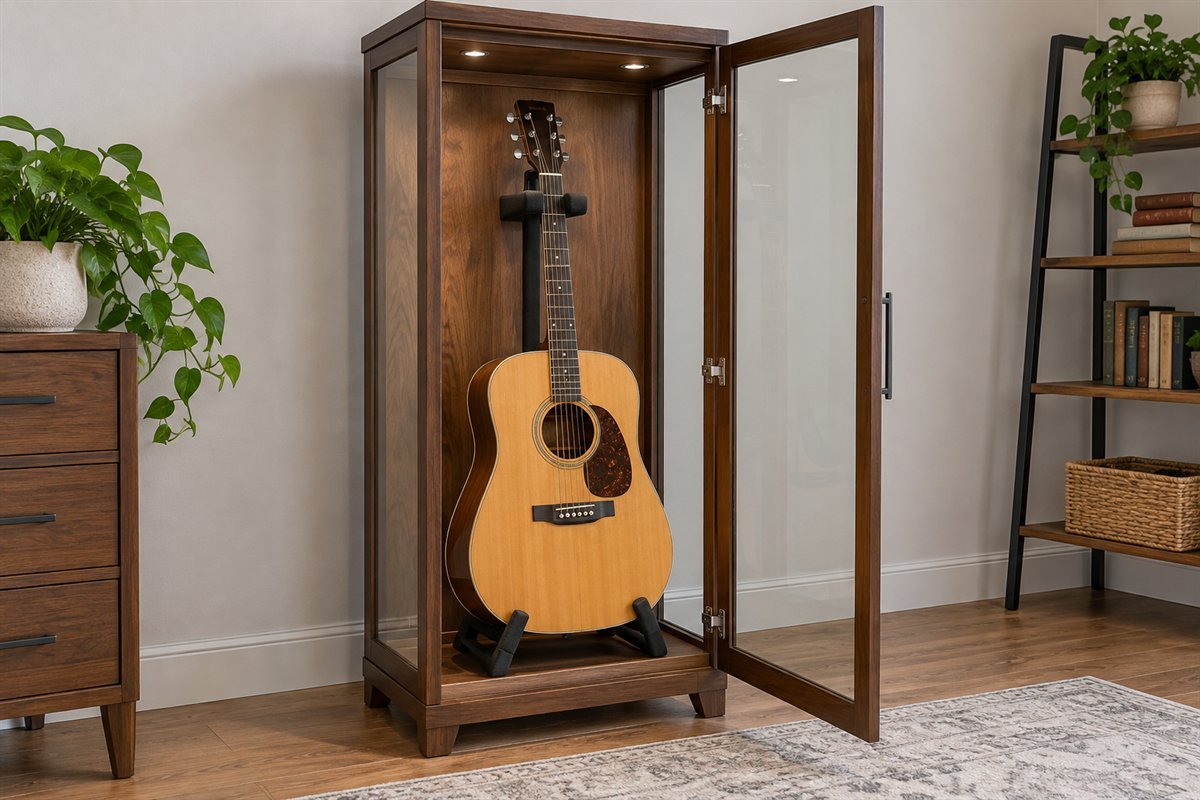
A cabinet can reduce visual clutter, but its appearance does not prove humidity control, ventilation or suitable instrument supports. Compare the complete guitar dimensions, support contact points, door opening and removal route. Follow cabinet and instrument guidance together, including furniture restraint where required. Check actual conditions inside the proposed cabinet before relying on it for storage.
Try this: Treat environmental control as a documented feature to verify, not a benefit implied by glass doors.
10. Keep a readable humidity monitor near the storage zone

A humidity monitor can help you notice changes near the instruments. Use it according to its instructions and compare its readings with the maker’s guidance for each guitar. Yamaha and Taylor specify a 45–55% relative-humidity range in the cited care guidance for their instruments. That range is not a diagnosis or a universal specification for every collection.
Try this: Record a short series of readings and ask the instrument maker about persistent out-of-range conditions.
11. Keep case-care accessories in their own small pouch

Where a maker recommends a particular in-case humidity system, keep its instructions and compatible supplies together. Placement, refilling and monitoring depend on the exact product; do not improvise from a storage photograph. Close the accessory compartment and make sure no loose item can enter the guitar cavity or press against the instrument when the case closes.
Try this: Keep liquids and refilling work away from the open instrument case.
12. Leave the case-opening surface ready

A stored case also needs a place where it can be opened in a supported position. Check the table or floor area against the whole case and its open lid. Keep the surface free of drinks, grit and heavy objects. A direct storage bay is less useful if every practice session begins by clearing an unrelated pile.
Try this: Rehearse taking out, opening, closing and returning the case as one sequence.
13. Pair a strap with its guitar without loading the neck

A strap can have a separate shallow home beside its instrument. Use the guitar and case instructions to decide what must be removed before closing the case. Keep buckles and other hard parts from pressing against the finish. Do not hang accessories from the headstock or use the guitar as a general storage hook.
Try this: Put the strap where it can be collected after the case is safely opened.
14. Divide a shallow drawer for picks and capos

A shallow divided drawer makes small accessories visible without scattering them around a guitar stand. Group picks, a compatible capo and the tuner by the way they are used. Keep loose batteries and cleaning products out of a mixed pocket, and follow their own storage instructions. Limit the drawer to useful items so the next practice begins with an easy choice.
Try this: Check that the capo and tuner can be removed without emptying a compartment.
15. Keep spare strings in identifiable original packets

Original packets can preserve the identity of spare string sets. Group them by the instrument they actually fit, keeping any printed model or gauge information intact. Avoid loose mixed coils that make a future change uncertain. Storage and replacement requirements belong to the string and instrument makers; an attractive box is simply a way to keep the correct set easy to find.
Try this: Review spare sets before buying more, and separate any unidentified package.
16. Coil disconnected leads in a dedicated basket

A separate cable basket can keep disconnected instrument leads out of the guitar-removal route. Coil each lead using its maker’s guidance, secure it gently and leave the ends recognizable. Keep power supplies distinct from signal leads so a similar-looking plug is not mistaken for the correct supply. Do not loop a cable around a guitar or hang it from a tuning machine.
Try this: Collect one complete lead without pulling neighboring cables from the basket.
17. Park a pedalboard in a clear low bay

A low bay for a pedalboard keeps it from being piled against stored instruments. Measure its complete footprint, cable projections and carrying handle. Separate any disconnected power supply that requires its own storage conditions, and follow the equipment instructions before use. Keep the guitar case return place clear even when the pedalboard is being carried out.
Try this: Remove the board with the same grip you will use for practice or a rehearsal.
18. File music beside the practice position

Sheet music and practice notes can live near the playing position without resting on a case or covering an instrument. Use an upright file or a limited folder group that fits the material. Put the current pieces at the front and archive older notes separately. This keeps paper from becoming the reason a case lid remains half open.
Try this: Keep one current-practice folder instead of several loose piles.
19. Plan the rack around bass and unusual body sizes

A bass, an offset body or an unusually shaped guitar can change the storage plan. Compare total length, support contact, center of balance and the maker’s compatibility guidance for each stand or hanger. Do not assume a rack suits every instrument because the neck appears to fit. Use a dedicated position when one instrument requires a different support.
Try this: Test the largest instrument in the plan before fixing the spacing of the others.
20. Separate household traffic from the instrument zone

Keep guitar storage outside the natural route used by people, pets and cleaning equipment. Check the room when a door is fully open and seating is occupied. A quiet alcove can work better than a photogenic gap beside a busy entrance. For a household where exposed instruments remain vulnerable, a suitable closed case may be the more workable everyday return place.
Try this: Walk the normal cleaning route and note anything that could strike a body or stand.
21. Set aside a controlled arrival space for a cold case

A guitar arriving from substantially different conditions needs the maker’s acclimation guidance, not an immediate unpacking rule inferred from room temperature. Taylor distinguishes finish-dependent precautions in its shipping and case advice. Give the closed case a suitable indoor arrival place, keep the instructions available and consult the maker where the instrument or finish is uncertain.
Try this: Decide where the case will wait before bringing home an instrument after travel.
22. Keep a case map for a shared collection

For several instruments, a short case map can prevent repeated opening and reshuffling. Record the instrument, matching case, permitted support, normal location and relevant care instructions. Keep identifying tags on case handles where appropriate rather than attaching adhesive labels to an instrument. Review the map when a guitar is lent out, serviced or returned from travel.
Try this: Confirm that someone else in the household can identify the correct return bay without guessing.
A guitar-storage fit and care worksheet
Make one record per instrument: maker and model; finish if known; complete length, width and body depth; case dimensions including handles; approved support and contact materials; normal storage location; removal movement; and the care instructions used for environmental monitoring. Record what remains uncertain so it can be checked with the maker before buying a rack.
Measure the smallest opening on the removal route, then demonstrate the movement with the actual closed case. For a hanger, include the upward lift needed to release the headstock. For a cabinet, include door movement and a supported case-opening surface nearby. These are fit checks, not load calculations or installation approval.
Review the arrangement after a normal week of playing. Note whether the case is easy to return, cables stay outside the walking route and accessories remain identifiable. Adjust the first recurring obstruction instead of filling every empty surface with another organizer.
Is a wall hanger better than a floor stand?
It depends on the instrument, compatible support, mounting conditions and room routine. A hanger can release floor space; a stand can avoid wall installation. Neither solves an unsuitable environment or guarantees finish compatibility. Check the complete system and use the instrument’s case where its guidance calls for one.
Can guitar cases be stacked flat?
Fender’s cited storage guidance favors occupied cases upright in a row, or on their sides when upright storage is not possible, rather than a flat pile. Check your case maker’s instructions and use suitable supports so a case does not depend on a precarious lean.
Should an acoustic guitar stay on display all the time?
The cited Yamaha acoustic-guitar guidance favors placing the instrument in its case when it is not being played. Follow the instructions for your exact guitar and evaluate the room conditions and impact risks before choosing an exposed everyday position.
A practical next step
Choose one arrangement that suits the guitar you actually play, keep its case identifiable and leave a clear route for returning it. Expand the layout only where another instrument or accessory needs a distinct, useful home.
Wall storage ideas for evaluating shelves, hooks and cabinets. Closet organization ideas for everyday clothing.
Images are original AI-generated organization concepts. They do not show tested instruments, certified supports or verified installations.
Sources and care references
- Fender: daily access and occupied-case storage orientation
- Yamaha: acoustic guitar environment and case care
- String Swing: wall attachment and finish-compatibility limitations
- Taylor Guitars: instrument and finish-dependent acclimation guidance
Optional digital guide for this topic
If you prefer a structured workbook, explore this related paid guide.