Luggage storage ideas at home work best when they start with the suitcase you own and the route used to take it out. A case that fits an empty cupboard is not necessarily easy to retrieve once shoes, clothing and ordinary furniture are back in place. Choose a suitable storage environment first, then compare the available bays.
These ideas concern luggage kept at home between trips, rather than airport storage services. Use a few arrangements that suit your cases and how often you travel. The aim is a clear return place, readable accessories and a manageable next departure, without filling every suitcase with unrelated household overflow.
Contents
- 1. Give one suitcase a clear low closet bay
- 2. Use the space below a genuinely short clothing group
- 3. Try a low suitcase beneath an existing bed
- 4. Check a bed drawer with the actual case inside
- 5. Reserve an accessible under-stair compartment
- 6. Let a guest-room cupboard hold the occasional travel set
- 7. Nest only cases that fit without pressure
- 8. Keep a frequently used carry-on outside the nested set
- 9. Give an occasional large case its own secondary position
- 10. Store a soft duffel in the shape its maker permits
- 11. Give an empty backpack a supported return place
- 12. Keep packing cubes as one removable set
- 13. Make one small home for ordinary travel accessories
- 14. Store an empty toiletry pouch separately from loose products
- 15. Choose a cover suited to the case and conditions
- 16. Give each traveler a recognizable bay
- 17. Check the shelf against the complete stored load
- 18. Turn the usable handle toward the retrieval route
- 19. Keep heavy household objects off empty luggage
- 20. Provide a temporary post-trip care position
- 21. Test the whole removal route before filling the bay
- 22. Keep a location record and a realistic inspection routine
Measure the complete case in its stored position
Record the case’s full length, width and depth, including fixed handles, wheels and any expansion section in the position you intend to store. Then measure the furniture’s usable opening, interior and the route into the room. Check the luggage maker’s care and storage instructions. Bag orientation, nesting and folding are product-specific; choose the method for the exact case rather than from a generic capacity label.
Choose an arrangement from the travel routine
- A carry-on used frequently: Its own direct, easy-to-return bay
- A compatible set used together: Nesting after a complete fit test
- Limited bedroom floor space: A low case with an unobstructed under-bed removal route
- Several travelers in one household: Recognizable individual return positions
- A bag just brought home: A temporary care position before permanent storage
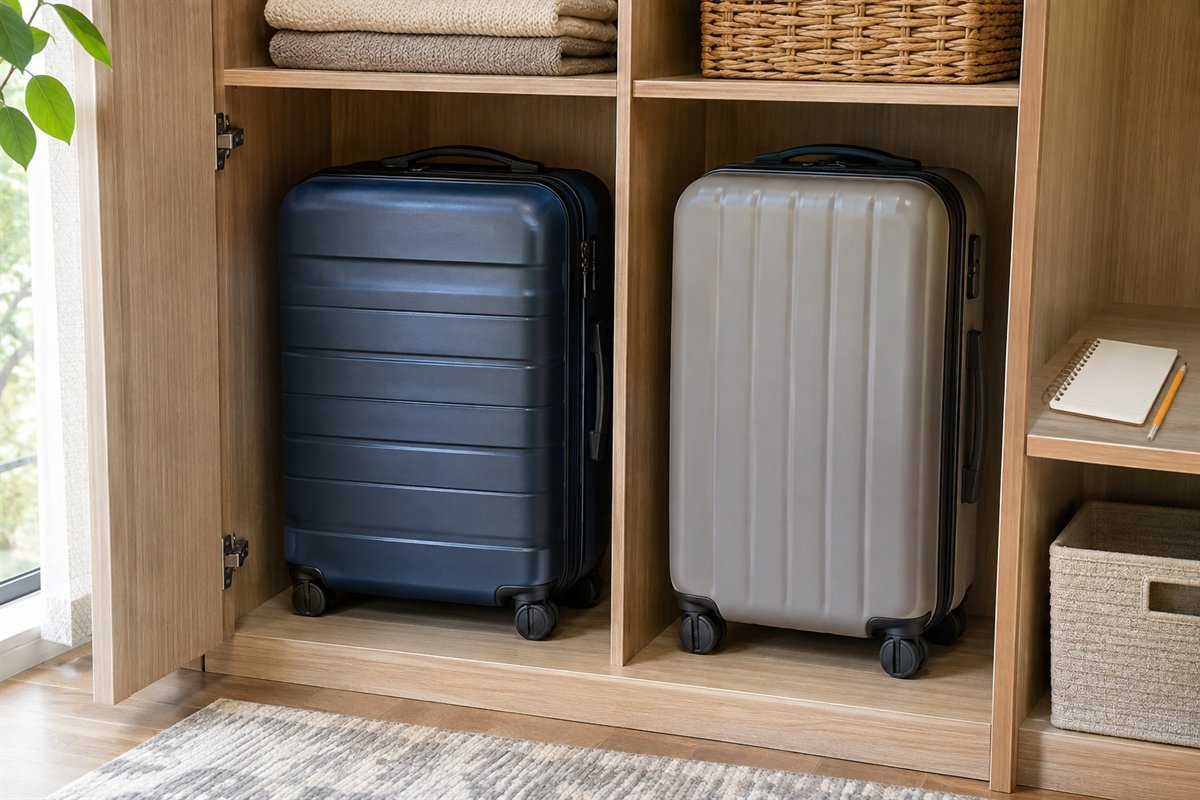
1. Give one suitcase a clear low closet bay
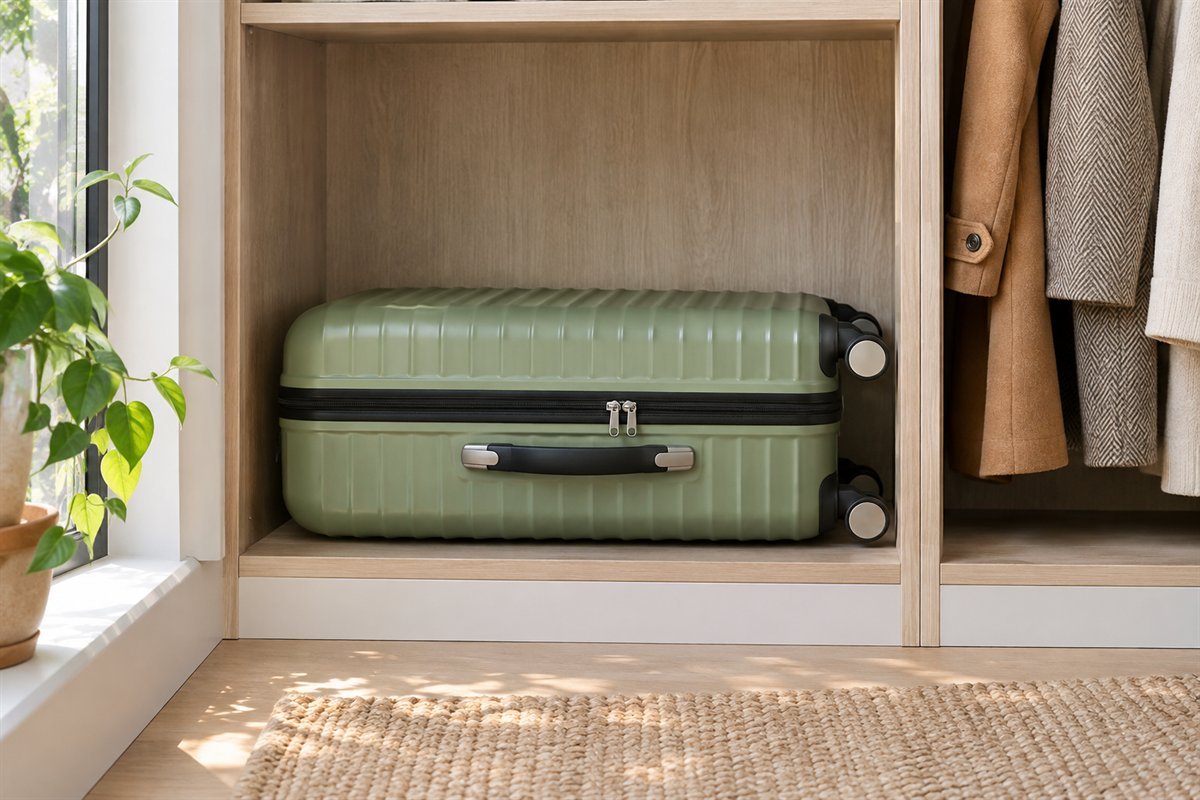
A low closet bay can be a useful starting point when the bag comes out regularly. Place the complete case in its intended stored position, then check the door and the route into the room. Keep a direct place for its return rather than letting shoes fill the gap between trips. Include the wheels, fixed handles and any projecting corners in the fit check.
2. Use the space below a genuinely short clothing group

The gap under short clothing may accommodate a case without taking away a useful long-hanging section. Check the actual lowest garment, not an empty rail. Keep the case from pushing sleeves or hems aside, and include the wardrobe’s hinges and door opening. If retrieving the suitcase requires moving most of the clothing, use another bay rather than treating the nominal empty height as usable storage.
3. Try a low suitcase beneath an existing bed

A low case may fit under an existing bed, provided the complete route remains open. Measure the lowest rail and any center support, then pull the case into the room far enough to open it normally. A nightstand can interrupt that movement even when the bag fits underneath. Keep access for cleaning and choose another location instead of altering the bed to accommodate luggage.
4. Check a bed drawer with the actual case inside
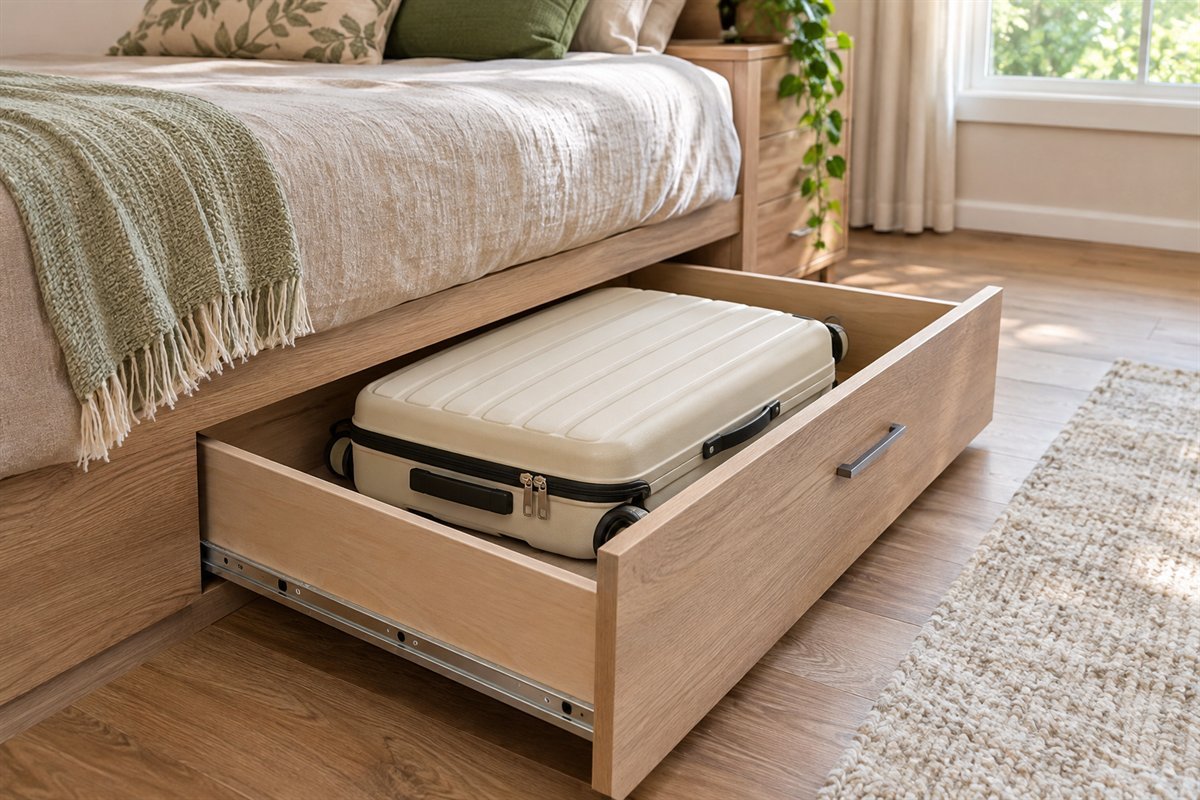
A bed-frame drawer can contain a small case neatly when the exact furniture permits the load. Test the case within the drawer’s usable interior, including its corners and handle. The drawer should close without pressing on the bag and open through the available room space. Match the drawer to its intended frame and instructions rather than assuming every under-bed unit is interchangeable.
5. Reserve an accessible under-stair compartment
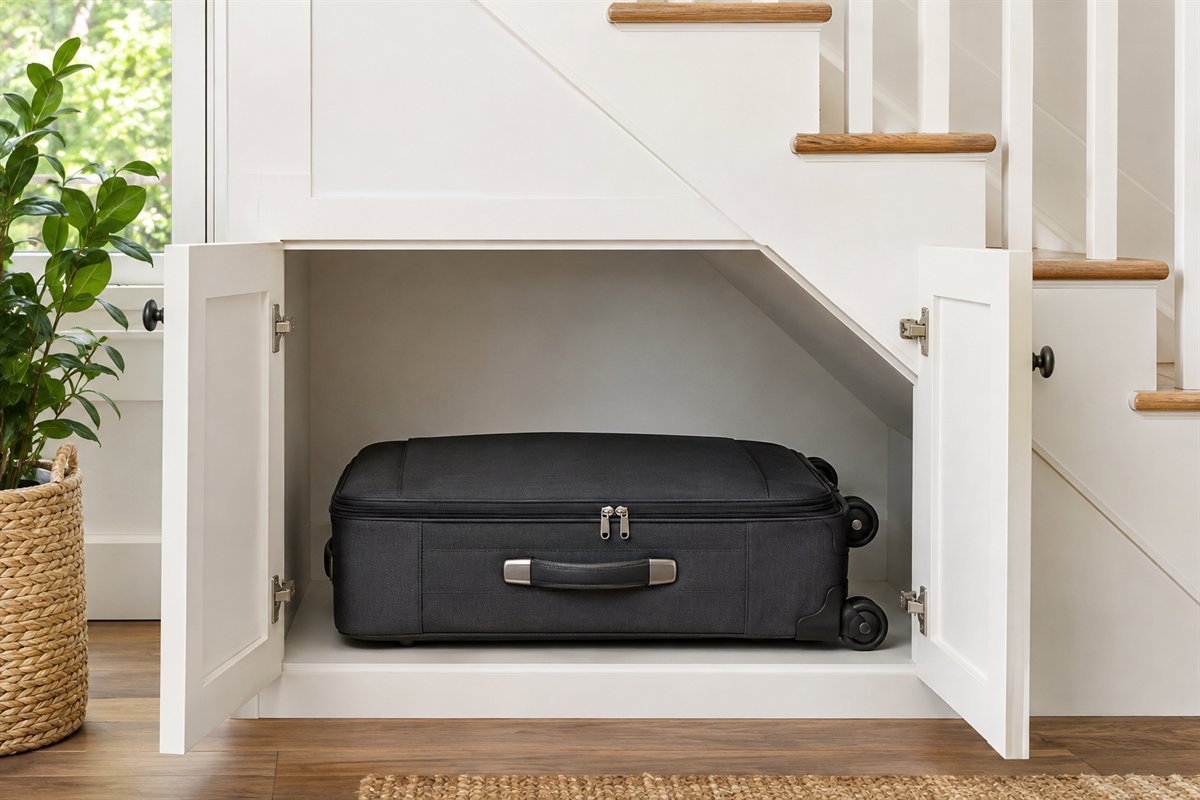
An under-stair cupboard can offer a defined return place without taking over a bedroom. Check the sloping height at the back as well as the front opening, and keep the suitcase in an accessible part of the compartment. Avoid creating a deep mixed store where household items must be unloaded first. Any fitted work must suit the building, services and appropriate furniture design.
6. Let a guest-room cupboard hold the occasional travel set
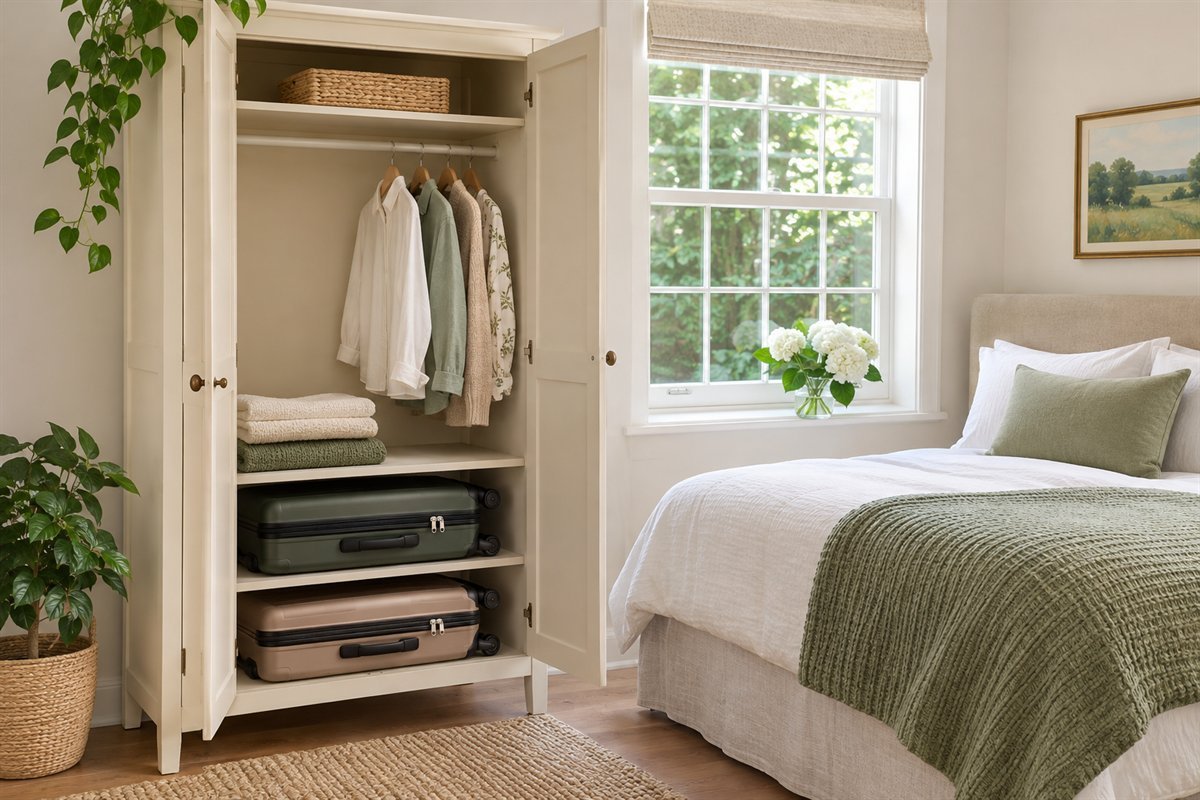
Occasional luggage can live in a spare-room cupboard if that position still works when the room has guests. Use a dedicated bay and keep the luggage retrieval separate from their clothing space. Check the entire room with the bed and cupboard doors in ordinary use. A suitable secondary location is more helpful than keeping a large case permanently beside the main bedroom door.
7. Nest only cases that fit without pressure

Nesting can reduce the space occupied by a compatible set. Samsonite notes that some collections are designed for this arrangement. Check the actual pair: the smaller case, wheels and handles must fit without forcing the larger shell or zipper. Keep the outer case’s closing movement clear. If the set resists closing, separate the bags instead of treating nesting as a requirement for every suitcase.
8. Keep a frequently used carry-on outside the nested set
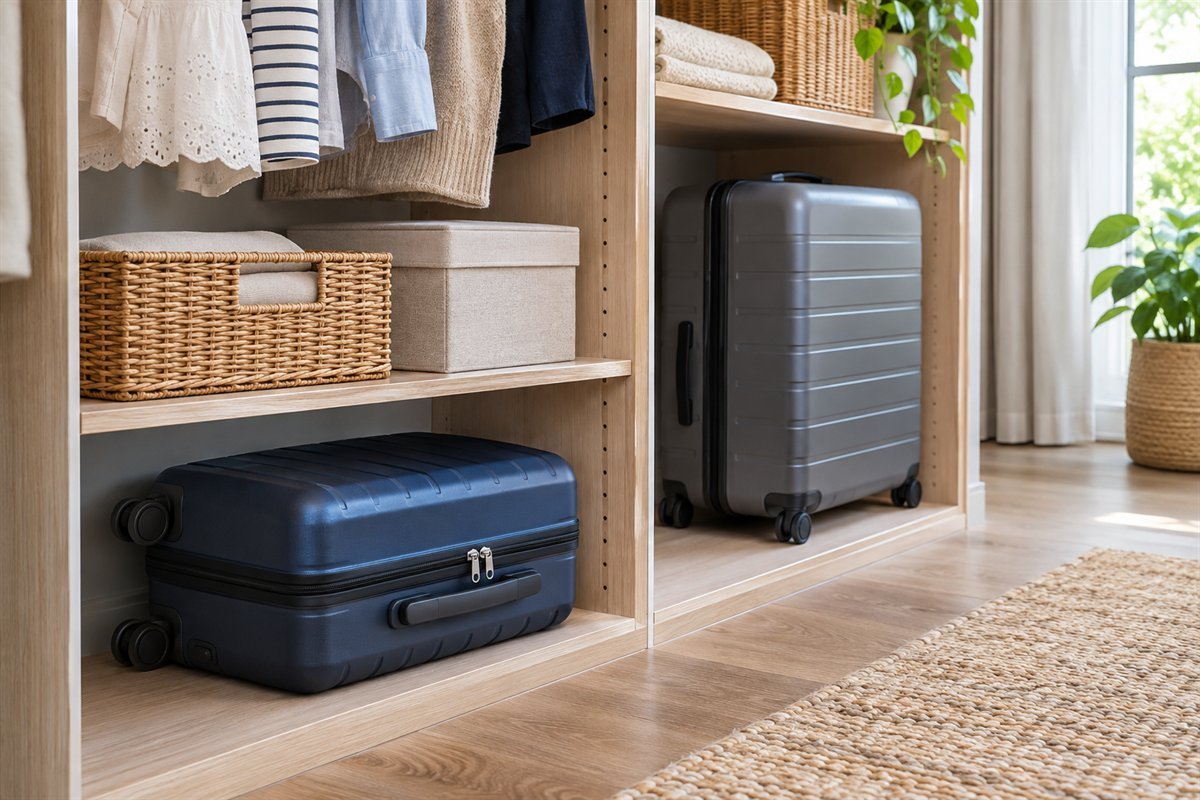
A nested arrangement can be inconvenient when the smallest bag is the one you use most. Give a frequent carry-on its own direct position and nest only the less frequently needed compatible bags. Test the choice against a real short trip: you should be able to take the carry-on without clearing the room or opening the largest case on the floor.
9. Give an occasional large case its own secondary position
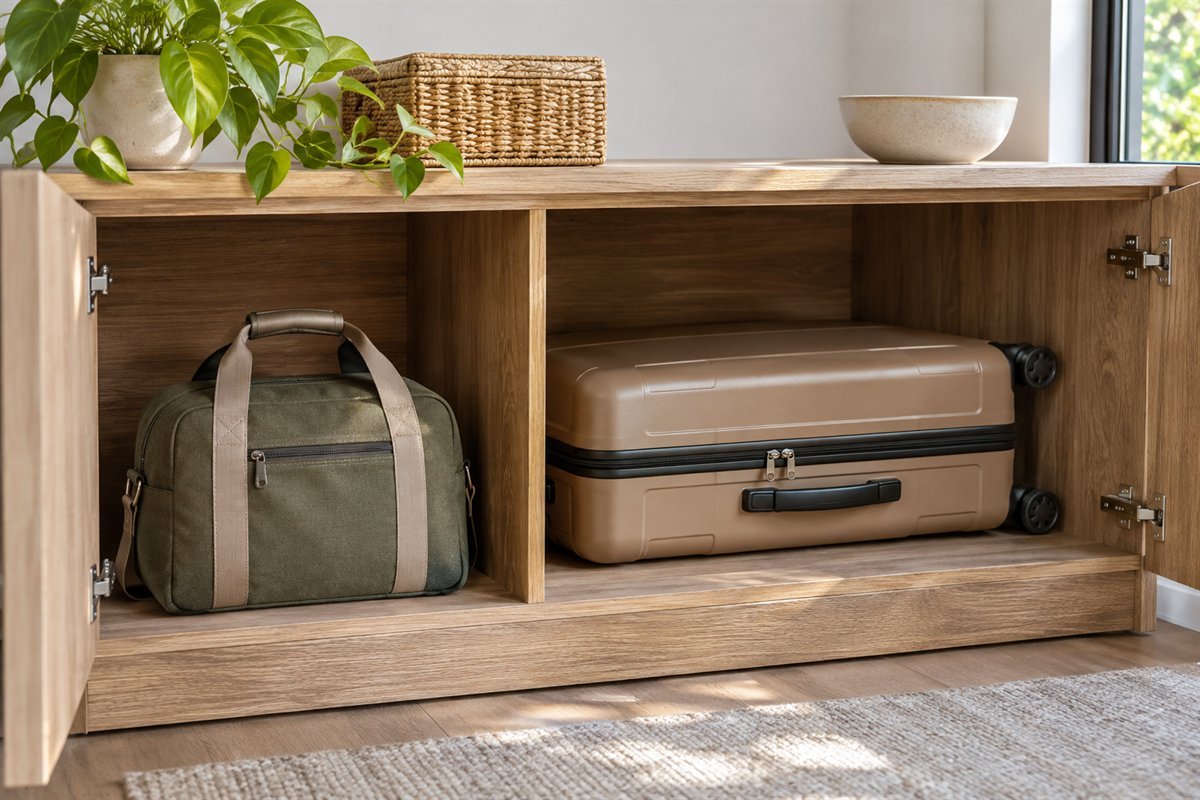
A rarely used checked bag does not need the easiest everyday position. Assign it a secondary bay that remains reachable when the room is occupied. Keep the approach deliberate rather than adding unrelated bins in front. If a move requires several heavy objects to be lifted first, reconsider the storage order even when the suitcase is only needed a few times a year.
10. Store a soft duffel in the shape its maker permits

Soft-sided travel bags vary in construction. Keep a duffel in the shape and conditions permitted for its exact material, without assuming every bag can be tightly folded or compressed. A roomy shelf can let the empty bag rest without another pile pressing on its handles. Keep shoulder straps and removable parts together using their intended attachment or a separately identified pouch.
11. Give an empty backpack a supported return place

Backpacks should not disappear inside a deep bundle of travel accessories. Empty the bag, retain its intended shape and choose a supported position suited to the model. Keep loose straps contained so the bag comes out cleanly. Review its care instructions before folding a structured back panel or using a hanging arrangement; the method should suit the actual bag rather than merely exploit an unused hook.
12. Keep packing cubes as one removable set

Empty packing cubes can stay together in one removable set, making them easier to find before a trip. Separate clean cubes from items still awaiting care. Decide whether the set belongs with a specific suitcase or in a nearby accessories compartment. Keep the packet small enough to remove independently, instead of letting unused cubes spread through several otherwise empty cases.
13. Make one small home for ordinary travel accessories

A modest accessories organizer can keep the ordinary reusable items from becoming a collection of duplicates. Group what you actually take together, such as an eye-mask pouch and compatible charging cable. Preserve product identity and follow care requirements. Keep medicines, liquids, batteries and important documents in their own appropriate storage; a general travel kit is not a universal place for everything used away from home.
14. Store an empty toiletry pouch separately from loose products

An empty toiletry pouch is easier to inspect and clean than one left indefinitely filled with assorted products. Follow its material-care instructions, let it finish drying and give it a defined return place. Keep the actual products in suitable storage with their labels and relevant dates. The next packing session can then begin with a readable pouch rather than an unexplained collection left from the last holiday.
15. Choose a cover suited to the case and conditions

A suitable cover can help keep a stored case from rubbing against neighboring items. Compare it with the complete bag dimensions, including wheels, handles and the closing position. Follow the case and cover instructions, and keep the storage environment suitable. A cover cannot correct a damp room or make a wet case ready to put away; choose it after those more fundamental conditions are resolved.
16. Give each traveler a recognizable bay

In a shared household, a recognizable bay can reduce the need to open every case before finding the correct one. Use a simple location record or a suitable removable identifier without putting private contact information on an exposed household label. Keep the arrangement understandable when one bag is away. Its return space should remain available instead of becoming overflow for another traveler’s equipment.
17. Check the shelf against the complete stored load

If luggage is stored on furniture, review the exact shelf and furniture requirements with the intended load. Include anything stored inside the case and any neighboring contents. A broad shelf that looks substantial in a photograph does not establish its capacity. Choose a manageable retrieval position and follow required anchoring, assembly and loading instructions for the actual furniture.
18. Turn the usable handle toward the retrieval route

A small change of orientation can make a suitable bay much easier to use. Test which ordinary handle is accessible when the case is stored, keeping projecting parts clear of hinges and neighboring furniture. Do not use an extended telescoping handle as a substitute for a proper lifting method. Try the full movement with the case in its intended stored state and use the maker’s handling guidance.
19. Keep heavy household objects off empty luggage

Leave the suitcase’s storage outline clear rather than using the shell as an extra household shelf. Travelpro warns against storing empty luggage underneath heavy objects for long periods because of pressure on its construction. Move unrelated boxes to their own suitable positions. If the luggage contains other items, include them in the handling plan and check that they suit both the bag and its storage conditions.
20. Provide a temporary post-trip care position

The permanent cupboard should receive a case that has completed its post-trip care. Travelpro recommends letting luggage air and dry fully before storing it. Use a temporary position suited to opening the bag, checking its pockets and following its own cleaning instructions. Keep this separate from the return bay so an unfinished unpacking job does not quietly become long-term storage.
21. Test the whole removal route before filling the bay

Draw or mark the proposed footprint with a suitable temporary method, then test the real case through the route. Include the door arc, the place where you turn and the space needed to open the lid. A case that fits the cupboard can still fail this access test. Remove temporary markings after checking and keep the ordinary route usable when neighboring furniture is in place.
22. Keep a location record and a realistic inspection routine
A simple record can identify which case is where, which pair nests and where the accessories belong. Review stored bags periodically according to their actual conditions and manufacturer guidance. Samsonite highlights the effect of temperature and humidity extremes and recommends regularly airing luggage kept in attics or basements. Prefer a suitable indoor location; a reminder to inspect cannot turn an unsuitable environment into good storage.
Make a suitcase-fit and retrieval checklist
Create one line for each case with these entries: bag identity, complete stored dimensions, whether another case fits inside it, return location, ordinary retrieval handle and the space where it will be opened. Add the relevant care instructions and any permitted furniture load. Keep the record with the accessories rather than inside the least accessible nested case.
For a hypothetical fit check, a case 24 inches long may fit a compartment 26 inches deep, yet still be impossible to turn through a narrow cupboard door. Those example dimensions are not a product recommendation or a required allowance. Test the full three-dimensional case, the actual opening and the movement into the room before committing the bay to luggage.
Finish by rehearsing a short-trip departure. Remove the case you use most, collect the intended accessories and return everything afterward. Note the first obstruction or missing item. Adjust that location or grouping before buying another storage product. Keep the plan simple enough that the returning empty case has an obvious home after its care routine is complete.
A practical next step
Choose luggage storage ideas that keep the actual bag identifiable, suitably cared for and straightforward to remove. A clear low bay, a properly checked nesting pair or one direct carry-on position may solve the problem. Preserve the return space between trips so the arrangement continues to work when the house is busy.
Under-bed storage ideas for the complete pull-out route. Bedroom wardrobe ideas for the furniture and opening plan.
The images are original AI-generated organization concepts, not photographs of tested luggage or verified furniture installations.
Sources and care references
- Samsonite: storage conditions, airing and compatible nesting collections
- Travelpro: pre-storage care, dry luggage and avoiding pressure from heavy objects
Optional digital guide for this topic
If you prefer a structured workbook, explore this related paid guide.