The most useful bay window curtain ideas begin with the shape of the opening. A curtain that follows the angled glass creates a different room from a pair that closes across the front of the recess. Decide which area you want to enclose before choosing a fabric or decorative rod.
A bay also needs a place for the curtains when they are open. Stacks at the outer edges, small stacks between windows and fabric behind a seat each affect the available daylight and the way the recess is used. Consider the open arrangement as carefully as the closed one.
These 27 concepts explore those choices in living rooms, dining areas and quiet corners. Match the design to measured window angles and the actual hardware rather than copying an unmeasured photograph. Fabric color, lining, heading and support all contribute to the finished result.
The images are original AI-generated decor concepts, not installation diagrams or photographs of completed client projects.
Browse These 27 Bay Window Curtain Ideas
Jump to an idea
- Follow all three faces with one considered curtain route
- Frame the entire bay with a straight outer pair
- Give each window face its own short curtain run
- Use a discreet ceiling track in a contemporary bay
- Choose an adjustable pole system for a traditional finish
- Keep the curtain stack at the outer edges
- Use narrow decorative panels with independent shades
- Layer a soft sheer with a separate privacy curtain
- Pair outer curtains with tailored Roman shades
- Combine woven shades with a quieter fabric frame
- Let curtains finish neatly above a built-in seat
- Put the closing curtain across the front of a seat nook
- Leave room for a dining chair to move
- Frame a reading chair without trapping the fabric
- Use wall-colored curtains to quiet a complex bay
- Choose warm white when the trim needs breathing room
- Use blue panels to connect the bay with the seating
- Try olive with warm wood and pale walls
- Bring rust fabric into a pale dining bay
- Use a narrow stripe to emphasize the vertical folds
- Choose a small-scale print for a traditional room
- Add a leading-edge border to plain panels
- Use a regular wave heading for a quiet modern line
- Use tailored pleats to echo substantial window trim
- Match the hem to a practical everyday floor line
- Give a compact bay fewer competing layers
- Repeat the room’s curtain language on a neighboring window
Plan bay window curtain ideas around the whole opening
Make a sketch showing each window, the angled returns, the opening into the room and anything below the sill. Mark the intended curtain route and the places where the open fabric will gather. Then compare the route with window handles, the seat, furniture and the required operation of the actual windows.
| Arrangement | What it can offer | What to check |
|---|---|---|
| Following the bay angles | Keeps the recess connected to the room when curtains close | Compatible corners, gliders and stack positions |
| Across the front opening | A simpler straight line that frames the whole recess | The bay is enclosed behind the closed fabric |
| Separate short runs | Independent treatment at each window face | Fabric and end fittings at the narrow corners |
| Shades plus side panels | Independent window coverage and a soft outer frame | Layer depth and access to every control |
| Seat-length curtains | A tailored relationship with a built-in bench | Seat cushion, drawer and window operation |
| Full-length curtains within the bay | A continuous vertical finish | A free hanging path clear of nearby furniture |
Specify the angle, not just the overall width
Record each face and the angles between them for the supplier. A product sold as a corner system may offer a particular corner shape rather than an adjustable solution for every bay. IKEA’s VIDGA page illustrates a track family with corner components; it does not establish that the pictured kit fits your opening.
Make a place for the open curtain stack
Gather a sample of the proposed cloth and heading to understand how substantial it becomes when open. The final stack depends on the fabric, lining and construction. Ask the curtain maker to show its intended position on the plan before allocating every narrow pier to glass or decorative trim.
Give the curtain a clear travel path
A track needs to let the cloth move past the actual sill and handles. IKEA’s guidance calls attention to these obstructions and to using fasteners suitable for the mounting material. Confirm the complete support and weight requirements for your chosen system with the supplier; an attractive rail profile alone does not settle them.
Decide how privacy will work after dark
A translucent panel can soften the daytime view without providing the nighttime coverage you need. Assess a real sample with the room illuminated and consider a separate privacy layer where appropriate. Hunter Douglas’s bay-window guide also discusses shade families; the choice should fit the particular window geometry and intended use.
1. Follow all three faces with one considered curtain route

A curtain route that follows the bay can retain the shape of the recess when the fabric closes. It suits a room where the bay is part of the main living area. Keep the folds consistent across the angled faces so the treatment reads as one composition.
Plan the bends and the intended opening positions as a complete system. Ask the supplier how the gliders move through the specified corners and supports. A continuous-looking line in a photograph does not prove the curtains can travel that way with your chosen hardware.
Practical tip: Show the intended open and closed positions on the same sketch.
2. Frame the entire bay with a straight outer pair

A straight pair across the front of the bay gives the room a clear rectangular frame. When open, the fabric can sit outside the recess and leave the windows relatively uncomplicated. This arrangement is particularly useful when the architecture already has strong angled trim.
Remember that closing the pair separates the bay from the room. A chair, plants or seat behind the fabric will sit within that enclosed recess. Compare the full closed position with the way the household wants to use the space in the evening.
Practical tip: Include the furniture behind the closed curtain in the plan.
3. Give each window face its own short curtain run

Separate curtain runs can emphasize the individual faces of a bay. They can suit a traditional opening with substantial trim between the windows. Repeat the heading and fabric so the separate pieces feel intentional rather than like three unrelated window treatments.
Allow for the gathered fabric and end fittings near the angles. Narrow corner areas can become crowded when two adjacent panels meet. Ask the maker to resolve those junctions on the measured drawing before deciding that every window should have a full pair.
Practical tip: Check the two corner junctions with the curtains fully open.
4. Use a discreet ceiling track in a contemporary bay

A quiet ceiling track can let the cloth become the main visual feature. It works well where a decorative pole would compete with clean window frames. Keep the ceiling line and curtain heading consistent so the treatment feels connected to the architecture.
The track still needs appropriate support and a suitable mounting surface. Coordinate that detail before ordering the finished curtain length. Check the actual distance required for the cloth to pass the handles and sill without catching.
Practical tip: Confirm the hanging position before measuring the final drop.
5. Choose an adjustable pole system for a traditional finish

A visible pole can give an angled bay a more traditional outline. A restrained metal finish allows the joints and supports to sit comfortably with the window trim. Treat the pole as part of the design rather than an accessory added after the fabric is chosen.
Ask for hardware intended for the actual bay angles and the required curtain movement. Not every ring can pass every support or joint. Compare the proposed pole, heading and opening arrangement together before approving the order.
Practical tip: Confirm how the rings or carriers pass the required supports.
6. Keep the curtain stack at the outer edges
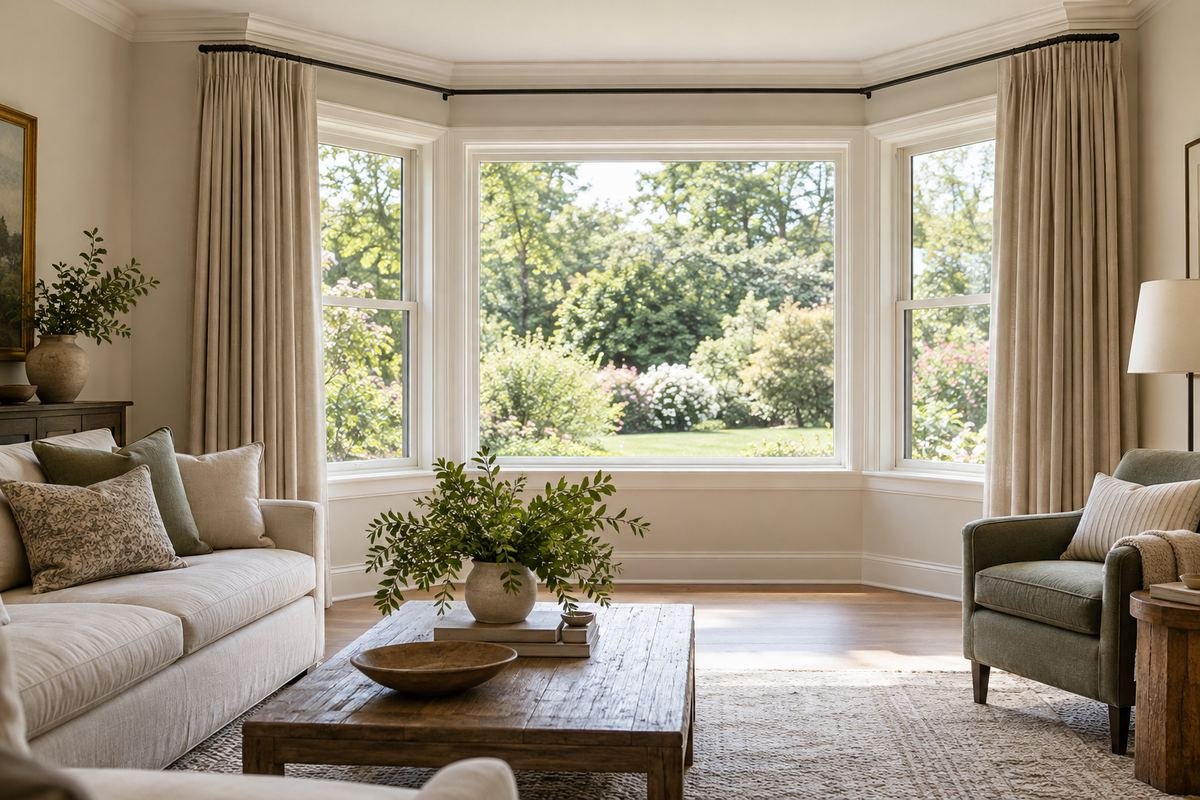
Placing the main curtain stacks at the outer sides can leave the central glass visually open. It creates a clear view through the bay and gives the fabric an obvious resting place. This is worth comparing when the outlook is the room’s main attraction.
The system must be designed for the full travel and the available side space. Check the proposed stack with the actual fabric rather than a flat swatch. A lined curtain can take more room when gathered than its appearance on the sample board suggests.
Practical tip: Ask for the proposed stack positions on the measured elevation.
7. Use narrow decorative panels with independent shades
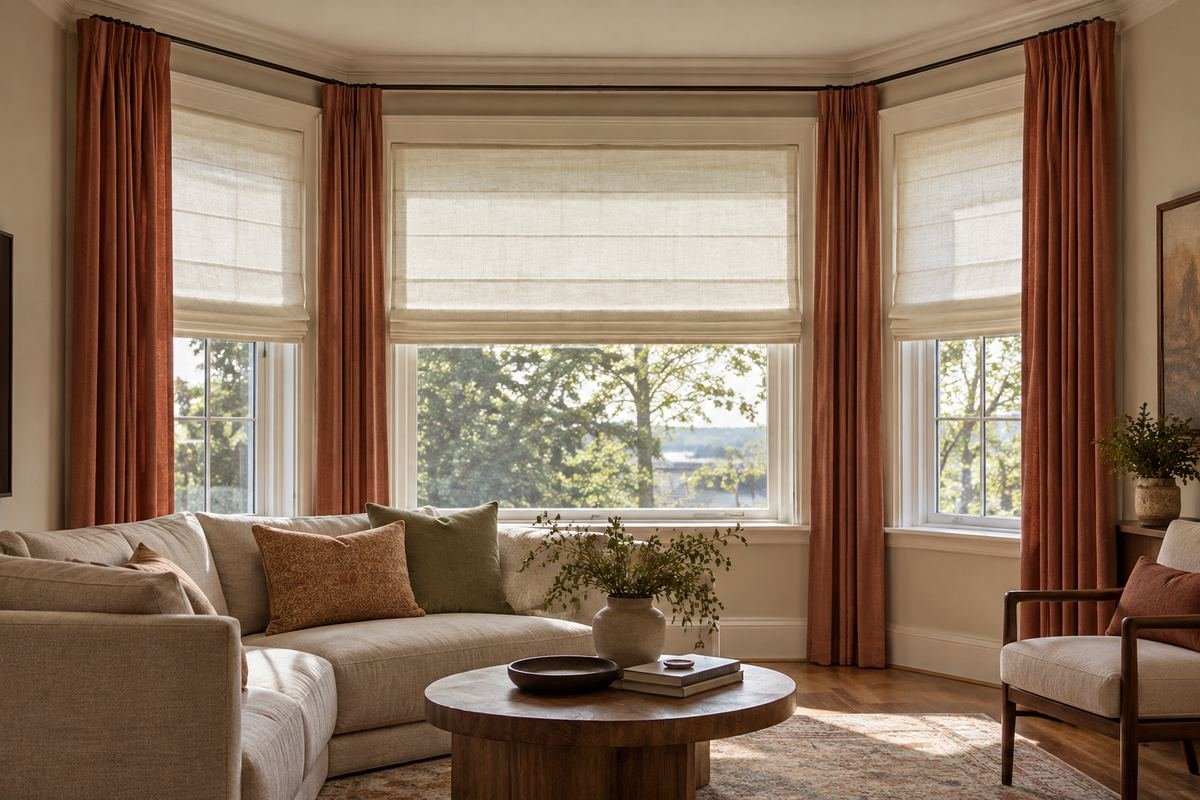
Stationary side panels can add softness while separate shades provide the window coverage. This can keep heavy curtain stacks out of narrow bay corners. Choose a fabric with enough presence to frame the opening without pretending the decorative panels close across all the glass.
Plan each layer’s role explicitly. The shades need to fit and operate within the individual window faces, while the panels need a secure hanging position. Avoid adding decorative rods that obstruct the shade or window controls.
Practical tip: Write down which layer provides privacy and which is decorative.
8. Layer a soft sheer with a separate privacy curtain

Two fabric layers can give a bay different daytime and evening settings. A light inner cloth softens the view while the outer layer supplies the coverage chosen for the room. Keep their colors related so the combined folds do not overwhelm the recess.
Specify both tracks and their stack positions together. The layers need room to move independently without tangling or pushing each other into the glass. Assess the proposed privacy cloth under the lighting conditions that matter instead of judging its name alone.
Practical tip: Check that both layers can open independently.
9. Pair outer curtains with tailored Roman shades
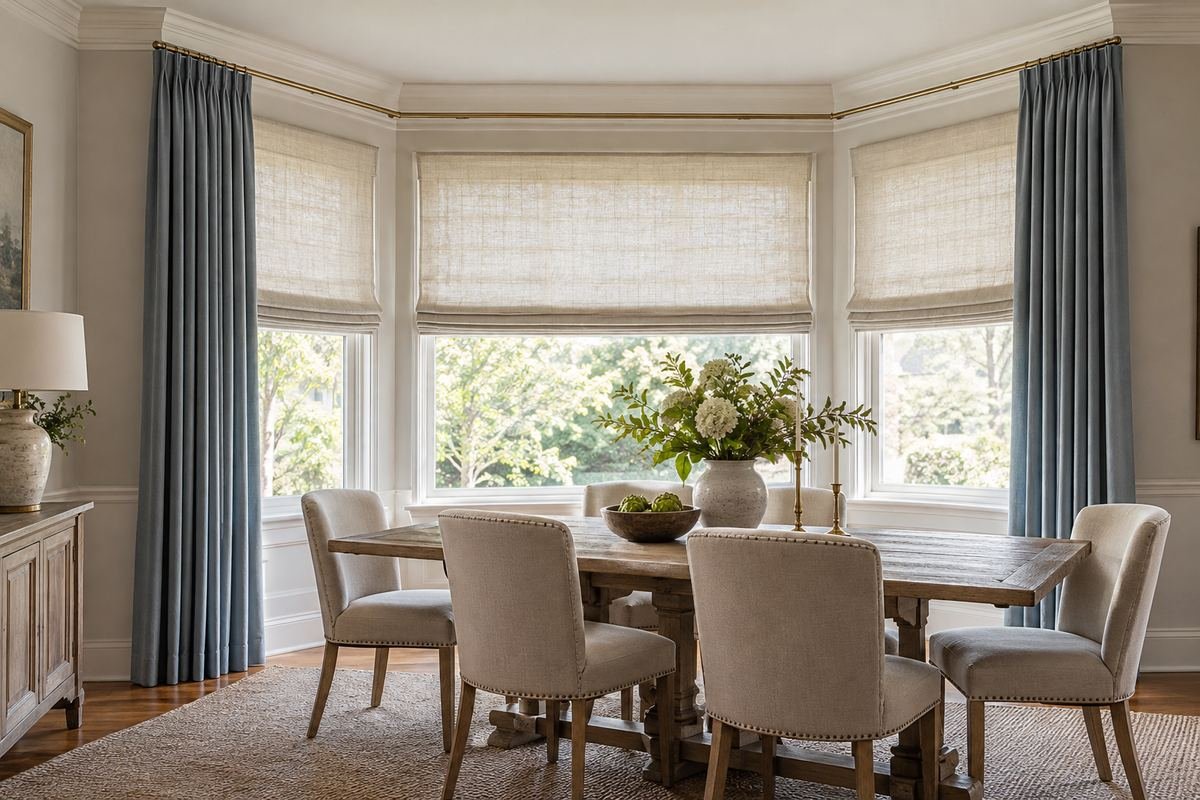
Roman shades can give each window face a compact treatment while outer curtains frame the whole bay. A plain shade and a gently textured curtain make a useful combination when the room already contains pattern. The contrast comes from the different forms rather than several competing prints.
Compare the shade stack, mounting position and curtain route at each angle. Keep access to the window handles and controls visible in the plan. The same nominal shade width may not suit every face of an uneven existing bay.
Practical tip: Measure each window face individually.
10. Combine woven shades with a quieter fabric frame

A woven shade can introduce a natural texture close to the glass. Quiet cotton or linen-look panels then soften the larger opening. This arrangement can work well with wood furniture because the woven surface connects to the room without requiring another patterned textile.
Inspect the weave and any available lining according to the coverage you need. Natural-looking texture does not establish privacy or light blocking. Check the actual sample and the way the shade fits each angled face before choosing the decorative outer cloth.
Practical tip: Assess the shade’s coverage separately from its texture.
11. Let curtains finish neatly above a built-in seat

A shorter curtain behind a built-in bench can keep the cloth away from the cushion and storage fronts. The treatment feels tailored when its hem relates clearly to the seat’s architecture. Use a restrained heading so the small space does not become crowded with folds.
Test the closed curtain with the cushion, window handles and normal seated position. The fabric should not be continually trapped or pulled by someone leaning back. If the bench leaves too little hanging space, compare independent shades instead.
Practical tip: Review the hem with the actual cushion in place.
12. Put the closing curtain across the front of a seat nook

A full-length curtain across the front can make a built-in seat feel like a distinct nook. When open, the side panels frame the cushion and windows. When closed, they conceal the entire recess, which creates a different evening relationship with the main room.
Check how the curtain affects access to the bench and any storage beneath it. Keep the open stacks clear of the seat ends and drawers. This arrangement is best chosen because the household wants that enclosure, rather than as a shortcut around difficult bay hardware.
Practical tip: Compare access to the bench with the panels open and closed.
13. Leave room for a dining chair to move

A dining table in a bay needs its curtains to work with occupied chairs. Keep the fabric outside the places where chair backs move during normal meals. A soft treatment can frame the dining area without becoming something people push aside every time they sit down.
Review the open curtain stacks with the chairs pulled out, not only tucked neatly beneath the table. If the bay is compact, compare shades at the glass with narrower outer decorative panels. The attractive full curtain arrangement may need more space than the dining routine allows.
Practical tip: Test the chair positions used during an ordinary meal.
14. Frame a reading chair without trapping the fabric

A reading chair can make a bay useful without a built-in seat. Let the curtains frame the chair while leaving their hanging path clear. A small table and a focused lamp can complete the corner without requiring the chair to press against the window treatment.
Compare the chair’s occupied position and any swivel or reclining movement with the curtain route. Keep the control and window access usable. If the fabric repeatedly catches behind the chair, adjust the furniture or use a more compact window layer.
Practical tip: Check the chair’s normal movement beside the open curtains.
15. Use wall-colored curtains to quiet a complex bay

Curtains close to the wall color can soften an opening with many trim lines. The folds supply texture while the room keeps a calm overall field. This can suit a small living room where a strong outline around every window would make the architecture feel busier.
Compare the fabric and paint together in the bay’s changing light. Similar names do not guarantee matching undertones. A slight difference can look intentional, but test a generous sample before ordering a large amount of cloth.
Practical tip: View the cloth beside the actual painted trim and wall.
16. Choose warm white when the trim needs breathing room

Warm white curtains can provide a soft interval between dark furniture and detailed window trim. Keep the cloth substantial enough to show a clear fold. A quiet white can still have character through its weave, heading and relationship with the room’s existing finishes.
Compare several whites next to the actual trim. A cool sample may look stark beside creamy paint, while a very yellow cloth can change the room’s balance. Assess the sample at the window as well as under the evening lamps.
Practical tip: Choose the white against the existing finishes, not a screen.
17. Use blue panels to connect the bay with the seating

A muted blue curtain can link a bright bay to a blue accent elsewhere in the living room. Repeat the color in a small textile or artwork rather than matching every upholstered piece. The bay then feels connected to the group instead of becoming a separate decorated corner.
Choose the depth of blue according to the light and the amount of gathered cloth. A large stack can appear darker than a single flat sample. Keep the rest of the window layers restrained so the color has a clear role.
Practical tip: Compare the gathered sample with the seating fabrics.
18. Try olive with warm wood and pale walls

Olive curtains can bring a grounded color into a bright bay without relying on a bold print. They work particularly well as a bridge between pale walls, wood furniture and a garden view. Keep the fabric texture and nearby finishes varied so the room does not feel uniformly green.
Assess the olive beside the actual wood and flooring. Yellow and gray undertones can change how the combination reads. A restrained neutral shade layer can give the color room to breathe while handling the window’s everyday coverage.
Practical tip: Test the green beside the largest wood surface.
19. Bring rust fabric into a pale dining bay
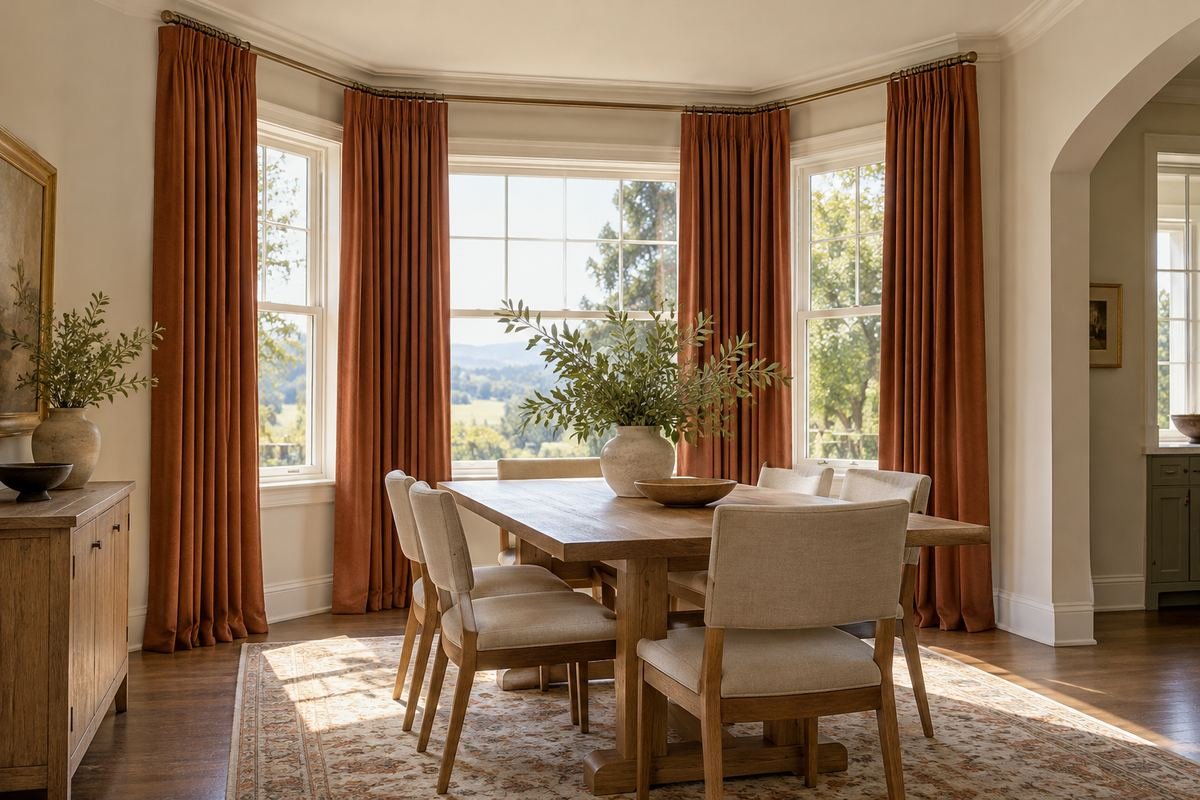
Rust or clay curtains can give a pale dining area a warm focal point. Use a plain cloth so the angled opening remains easy to read. A small related detail on the table can connect the color without making the entire room revolve around a single accent.
Compare the shade with brick, wood and flooring already present. Orange-red undertones become more prominent across a full curtain surface. Check the cloth in the window light before deciding how saturated the final pair should be.
Practical tip: Review the fabric as a large folded sample.
20. Use a narrow stripe to emphasize the vertical folds

A restrained vertical stripe can add pattern while keeping the bay organized. It works best when the scale remains legible through the folds rather than breaking into a busy surface. Repeat the same fabric construction across the faces for a composed result.
Look at the stripe gathered in the proposed heading. A flat swatch will not show how the pattern compresses when open. Keep nearby patterned upholstery quieter so the window treatment has a useful visual hierarchy.
Practical tip: Judge the stripe in folds, not only laid flat.
21. Choose a small-scale print for a traditional room

A small botanical or geometric print can sit comfortably with a traditional bay. Give it a clear background color that connects to the wall or upholstery. The repeat then supplies interest without making each angled face appear to have a different treatment.
Ask the maker how the pattern will align across joined widths and paired panels. Check a folded sample next to the other textiles. A restrained print can still become busy when multiplied across several gathered curtain stacks.
Practical tip: Review the repeat across the intended panel arrangement.
22. Add a leading-edge border to plain panels

A narrow contrasting border can give plain bay curtains a defined edge. It is useful where the room needs a little structure without a full patterned fabric. Let the border connect to one existing dark or colored detail so it feels part of the wider palette.
Keep the border’s direction consistent across the paired panels. Ask how it will look both open and closed before the curtains are made. A very broad trim may dominate a narrow bay, so compare its scale on a full-length sample drawing.
Practical tip: Confirm which edges receive the border before ordering.
23. Use a regular wave heading for a quiet modern line

A regular wave heading can give a contemporary bay an orderly rhythm. The repeated folds work well with a discreet track and plain cloth. Keep the surrounding trim simple enough that the heading reads as a considered detail rather than another competing horizontal line.
Wave headings require a compatible system and an appropriate curtain specification. Ask the maker to confirm the depth of the folds and the stack. The neat appearance in a concept image does not establish the space required by the actual cloth.
Practical tip: Confirm the heading and carrier system as one specification.
24. Use tailored pleats to echo substantial window trim

Tailored pleats can give a traditional bay a composed finish. The structured top relates well to substantial casing and a visible pole. Use a plain or softly textured fabric so the heading remains legible without needing elaborate swags or several decorative layers.
Compare the pleat style with the proposed hardware and lining. The same fabric can gather differently with another heading. Have the maker include the open stack in the design rather than choosing pleats from a close-up photograph alone.
Practical tip: Review a sample heading with the intended lining.
25. Match the hem to a practical everyday floor line

A clean floor-length finish can give a bay a calm vertical outline. It keeps the attention on the fabric and opening instead of a large pool of cloth. This can be useful in a frequently used living or dining area where people move close to the windows.
Measure at the actual hanging position and account for an uneven floor. Follow the curtain maker’s method for the desired finish rather than transferring a generic drop from another room. Check the cloth’s care and construction before treating the first measurement as final.
Practical tip: Measure the drop at more than one point across the bay.
26. Give a compact bay fewer competing layers

A small bay can look more resolved with one useful shade layer and a restrained outer frame. This leaves the individual windows easy to understand. Choose the treatment according to light and privacy first, then add only the fabric needed to soften the room.
Compare the space taken by controls, headings and open stacks. Several individually attractive layers may crowd the narrow angled faces. A simpler arrangement can give more visual room to the seat, table or chair that makes the bay useful.
Practical tip: Remove one redundant layer before adding another decorative detail.
27. Repeat the room’s curtain language on a neighboring window

A bay and a nearby flat window can use the same fabric and heading to feel related. Let the hardware route respond to each opening rather than forcing identical rods onto different shapes. The repeated cloth can connect the room while allowing the bay its own architecture.
Compare the finished heights and visible fabric proportions from the main seating position. A neighboring pair may need a different width or mounting detail to look balanced. Aim for a coherent relationship, not identical dimensions across unlike windows.
Practical tip: Review both windows together from the main room entrance.
Frequently Asked Questions
Should bay window curtains follow the angles?
They can, but they do not have to. Following the bay keeps its shape within the room when the curtains close. A straight curtain across the front frames the entire opening and encloses the recess behind it. Compare both arrangements with the way you use the bay.
Can I use one ordinary straight rod on a bay window?
A straight rod can span the front of a suitable opening. It will not follow the angled window faces. Check its span, support, mounting surface and curtain weight with the supplier rather than assuming an ordinary rod can be adapted around corners.
Where should the curtains gather when open?
Possible positions include the outer sides of the bay or designated places between window faces. The better choice depends on available wall area and hardware operation. Have the curtain maker account for the actual cloth, lining and heading before choosing a stack position.
What works around a bay window seat?
Compare a short treatment behind the bench, independent shades, outer decorative panels or a full-length curtain across the front. Check access to seat storage and the windows. Avoid letting a long curtain become trapped behind a cushion or pulled across the bench.
Are sheer curtains enough for privacy?
Do not assume so. The result changes with the cloth and the lighting on each side. Check a sample in the conditions that matter, including after dark, and add an appropriate separate privacy layer if needed.
Do all corner curtain tracks work on angled bays?
No. Confirm the actual angles, compatible components, supports, curtain heading and operating route for the system. Some corner pieces have a specific shape. A bay, a square corner and a curved bow window can require different solutions.
Choose the Details That Work in Your Home
Choose bay window curtain ideas that work both open and closed. Resolve the route, stacks and furniture first, then use fabric, color and headings to give that practical arrangement its character. The finished bay should remain easy to use while making the whole room feel considered.
For related ideas, explore living room curtain ideas, window seat ideas, living room accent chair ideas.
Planning References
IKEA: corner track components and mounting considerations; Hunter Douglas: treatment choices for bay windows. Follow the instructions for the exact products you choose.
Optional digital guide for this topic
If you prefer a structured workbook, explore this related paid guide.