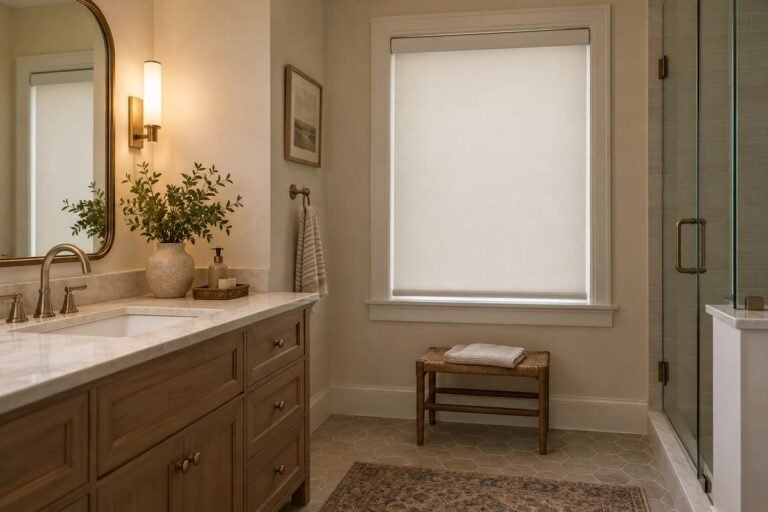
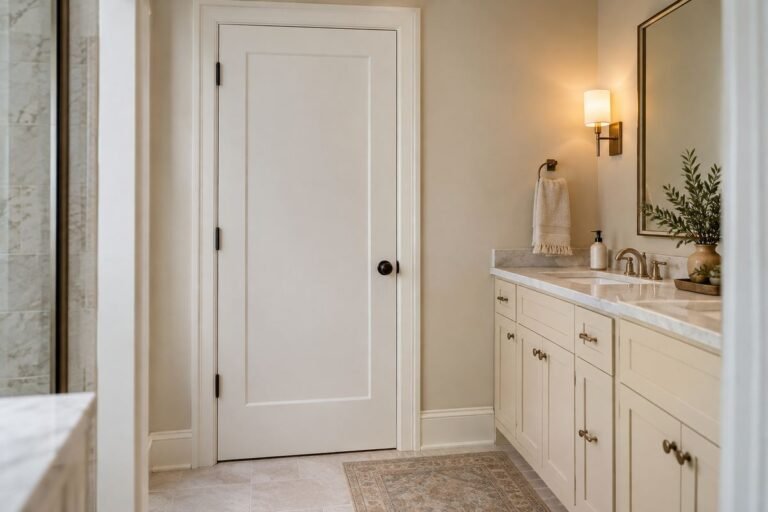
Shower curtain ideas can change a bathroom without replacing the tile or vanity. Because the curtain occupies a large visible surface, its color, texture and proportions can make the room feel more deliberate.
Start with the opening and the actual shower arrangement. Measure the rod, hanging hardware and required drop, then follow the curtain, liner and rod instructions. A common package size is a starting point to compare, not a promise that it fits every tub.
The ideas below focus on useful design choices. Images illustrate styling concepts rather than installation details. Keep the shower functional, give wet materials the ventilation and care their manufacturers specify, and avoid fabric pooling on the bathroom floor.
The images are original AI-generated decor concepts, not installation diagrams or photographs of completed client projects.
Test Shower Curtain Ideas With the Full Working Assembly
Record the opening, rod path, hooks and required lower position before selecting a decorative panel. Next, draw the curtain and liner through the full shower arrangement and check nearby shelves or handles. For example, a curved rod can change the coverage needed even when the advertised panel width stays the same. Keep decorative fabric and the required water barrier as separate decisions, and retain the exact care guidance for both.
Jump to an idea
- Start with a white waffle texture
- Choose a soft ivory instead of a stark white
- Try pale gray with cooler finishes
- Add a muted sage panel
- Use dusty blue for a calm accent
- Warm the room with terracotta
- Use navy as a deliberate dark surface
- Echo warm wood with a sandy neutral
- Choose narrow vertical stripes
- Use broad stripes as the main pattern
- Try a restrained windowpane check
- Use a small gingham in a simple room
- Add a quiet botanical print
- Choose a small floral repeat
- Use one large abstract motif
- Match the curtain background to the tile
- Let patterned tile stay in charge
- Repeat one color from the floor
- Pair charcoal with warm wood
- Use a subtle textured stripe
- Keep a suitable translucent layer visually light
- Separate the decorative outer layer from the liner
- Choose a length from the actual hanging setup
- Check coverage on a curved rod
- Use simple rings that suit the curtain
- Coordinate towels without matching every detail
- Give a small bathroom one clear statement
- Choose an upkeep routine you can actually follow
- Finish with fewer competing accessories
Plan shower curtain ideas with a fit worksheet
Record four measurements before choosing a design: the opening the curtain must cover, the usable rod length, the drop from the hanging hardware and the actual curtain dimensions. For a simple comparison, a hypothetical 72-inch-wide panel across a 60-inch opening has 12 inches of extra fabric width. That arithmetic does not establish sufficient fullness, side coverage or splash containment for your shower. Hooks, rod shape and the product construction all affect the result. Check the bottom position against the manufacturer instructions for the tub or shower arrangement, including the liner where required. A straight rod and a curved rod can need different coverage. Keep the outer curtain and inner liner requirements separate so a decorative fabric choice does not accidentally replace a necessary water barrier.
| Design priority | Possible direction | Check first |
|---|---|---|
| Quiet texture | Solid waffle or subtle woven effect | The material, liner requirement and exact care label |
| More visible light | A suitable translucent curtain or liner | Privacy and actual coverage |
| A strong tile pattern | A quiet solid or restrained stripe | Both patterns together in the room |
| Color in a neutral bathroom | One deliberate colored panel | A sample beside tile and vanity finishes |
| Simple upkeep | A product with a suitable care routine | Whether washing and drying are permitted |
1. Begin Textured Shower Curtain Ideas With a White Waffle Panel
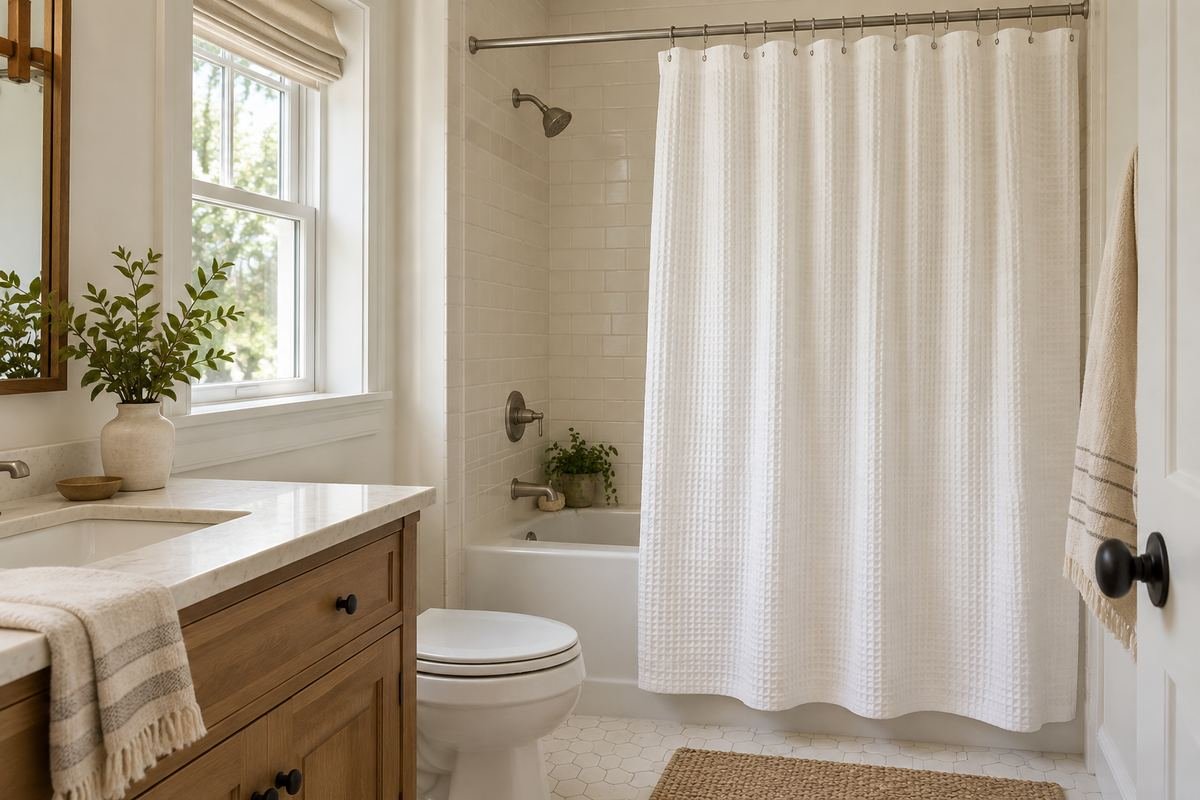
A white waffle curtain gives a simple bathroom more surface detail. It can feel considered without adding another strong pattern.
Compare the fabric beside the actual tile white. Check whether the exact curtain needs a liner and follow its care label rather than assuming the texture makes it waterproof.
Practical tip: Use texture when the room already has enough color.
2. Choose a soft ivory instead of a stark white

Ivory can relate gently to cream tile or a warm stone-look floor. It gives the shower a defined surface without introducing a cold white rectangle.
View the fabric in the room during daylight and with the bathroom lights on. A warm white on a screen can appear much yellower beside the actual finishes.
Practical tip: Compare warm neutrals in the bathroom itself.
3. Try pale gray with cooler finishes

A light gray curtain can connect a white tub with cool gray tile. Keep the rest of the palette simple so the gray reads as an intentional choice.
Check the undertone beside the floor and vanity. Some grays appear blue or violet in different light, especially when surrounded by warm finishes.
Practical tip: Use the tile undertone as the reference.
4. Add a muted sage panel

A soft green curtain can add color to an otherwise neutral room. It works especially well when the other large surfaces remain quiet.
Repeat the green lightly in one small accessory if useful. Avoid buying several nearly matching greens that compete instead of forming a clear palette.
Practical tip: Let one large textile carry the color.
5. Use dusty blue for a calm accent

A dusty blue curtain can give white tile a softer backdrop. The restrained color can remain useful when towels or smaller accessories change.
Compare the blue with both warm and cool light in the room. Choose the fabric from the complete bathroom rather than matching a single towel online.
Practical tip: Judge the whole palette before matching accessories.
6. Warm Shower Curtain Ideas With a Muted Clay Color

A muted clay tone adds warmth to pale tile and white fixtures. It can make a simple bathroom feel less anonymous without a complex print.
Keep the color away from an overly orange match if the floor is already warm. A fabric sample helps show whether the tones support each other.
Practical tip: Balance a warm curtain with quieter surrounding surfaces.
7. Use navy as a deliberate dark surface

A navy curtain creates a strong boundary around the tub area. It can make a white bathroom feel more graphic with relatively little decoration.
Check how the darker panel affects the room when closed. Keep the existing bathroom lighting useful and avoid relying on a dark curtain to solve an unrelated lighting issue.
Practical tip: Test the closed-curtain view as well as the open one.
8. Echo warm wood with a sandy neutral
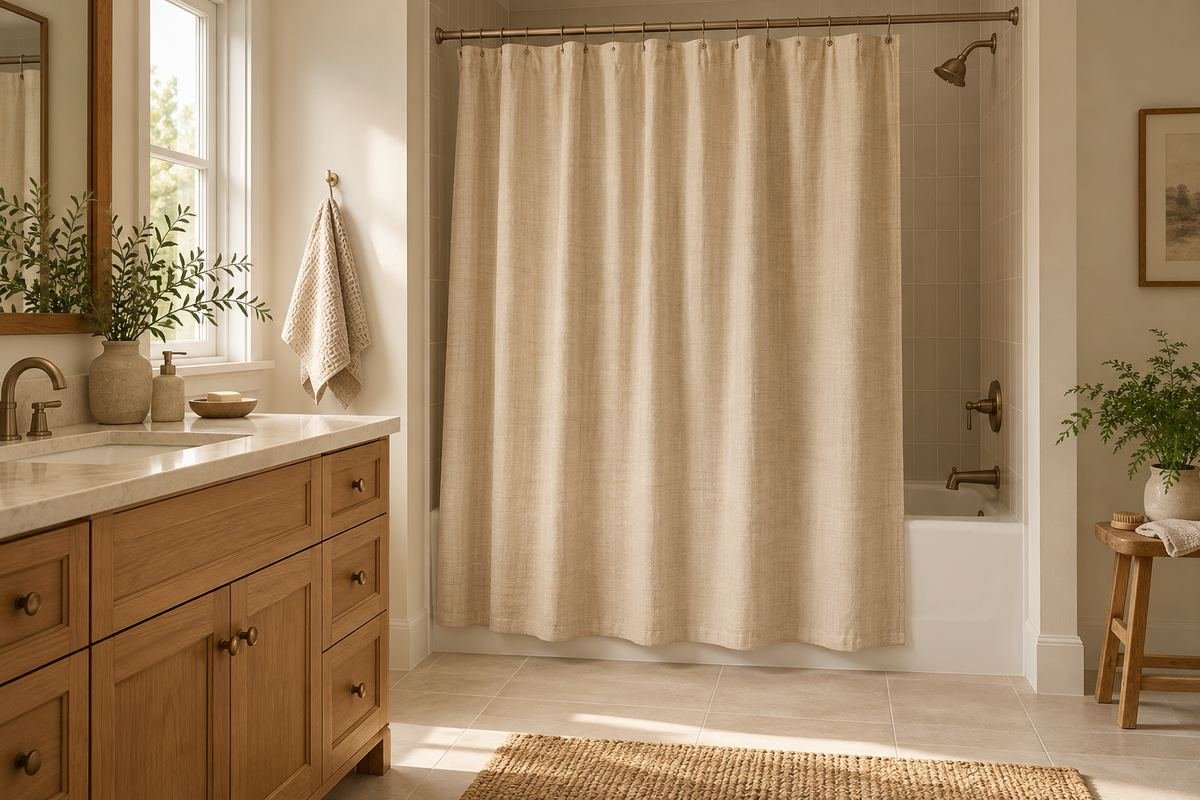
A sand-colored curtain can relate to oak or maple without matching the wood exactly. The softer contrast makes the vanity and shower feel connected.
Compare the curtain beside the wood finish and the floor. If everything blends too closely, add definition through a small contrast in texture rather than more decor.
Practical tip: Repeat the warmth without copying the wood color.
9. Choose narrow vertical stripes

Fine vertical stripes can make the curtain feel tailored. Their repeated lines add structure to a small room without a large motif.
Look at the stripe spacing from the doorway. Very tight high-contrast lines may look busier at room scale than they do in a close product photograph.
Practical tip: Evaluate the full panel from a normal viewing distance.
10. Use broad stripes as the main pattern

Broad stripes can give a plain bathroom an immediate visual direction. Keep the colors restrained if the room has several other finishes.
Check where the stripe pattern lands when the curtain is gathered. A design that depends on perfect flatness may look different in daily use.
Practical tip: Choose a pattern that still works in soft folds.
11. Try a restrained windowpane check

A fine grid can relate to rectangular wall tile without copying every grout line. It gives the curtain a little rhythm while remaining fairly quiet.
Compare the scale of the check with the tile pattern. Two equally strong grids can become distracting when they sit directly beside each other.
Practical tip: Let one grid carry more visual weight.
12. Keep Gingham Shower Curtain Ideas Clear at Full Scale
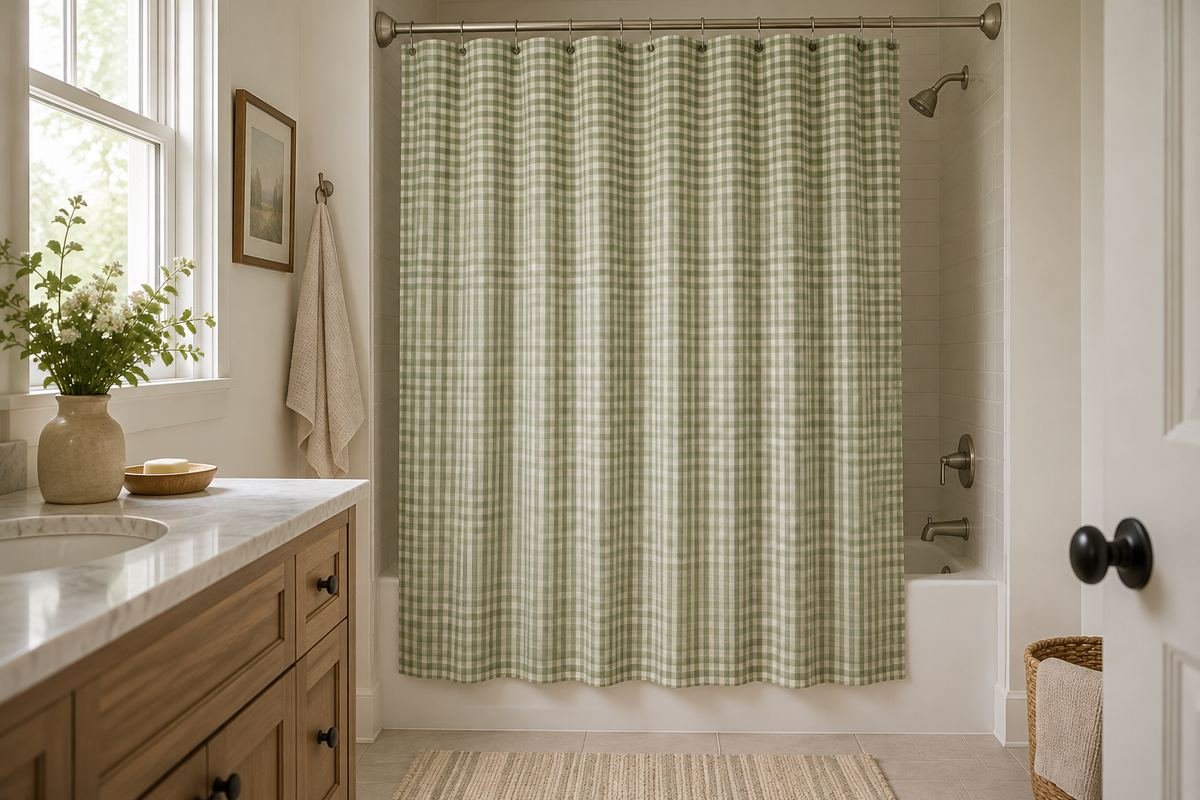
A small check can make a basic bathroom feel welcoming. A muted color keeps the pattern easy to combine with plain towels.
Use the curtain as the main print and simplify the smaller textiles. Check that the full repeat remains clear when the panel is gathered.
Practical tip: Give a small repeating pattern some quiet surroundings.
13. Add a quiet botanical print

A botanical curtain can provide the main decorative gesture in a neutral bathroom. An open background often keeps the print from feeling crowded.
Compare the motif size with the room. Leave other accessories simple so the curtain does not compete with several unrelated leafy patterns.
Practical tip: Use one botanical statement rather than many separate prints.
14. Choose a small floral repeat

A small floral print can add detail without turning the shower into a large mural. Limited colors make the pattern easier to connect with existing finishes.
Look at the entire curtain before choosing a towel color. Pick one quiet color from the print rather than trying to repeat every shade.
Practical tip: Edit the supporting colors around the print.
15. Use one large abstract motif

A large abstract pattern can give a plain room a focal point. Broad shapes may be easier to read than many tiny details from the doorway.
Keep the surrounding wall art and floor textiles restrained. Check the gathered appearance so the pattern still looks intentional while the shower is open.
Practical tip: Let the curtain be the main artwork.
16. Match the curtain background to the tile

A similar background color can make a patterned curtain sit more comfortably beside the shower wall. The motif then becomes the visible change.
Compare undertones rather than relying on both products being called white. The fabric and glazed tile will reflect light differently.
Practical tip: Choose harmony from real samples.
17. Let patterned tile stay in charge

A plain curtain can give a patterned floor room to be appreciated. Its large quiet surface helps the room feel edited.
Choose the curtain from one of the calmer colors in the tile. Avoid adding another equally prominent pattern simply because the shower feels undecorated.
Practical tip: Use a solid panel to support an existing focal point.
18. Connect Shower Curtain Ideas With One Floor Color

A curtain can connect the upper room to a multicolored floor. One repeated color is often enough to make the choice feel deliberate.
Compare the full curtain area with the small amount of that color in the tile. A strong shade repeated at a larger scale can change the balance considerably.
Practical tip: Test the amount of color as well as the match.
19. Pair charcoal with warm wood

Charcoal fabric can give a wood vanity more definition. It creates a strong contrast while staying less colorful than a saturated dark panel.
Check the room with the curtain fully closed. If the bathroom feels too heavy, try a lighter charcoal or a smaller scale pattern on a pale background.
Practical tip: Balance dark textile area against the available light.
20. Use a subtle textured stripe

A tone-on-tone stripe can bring detail to a simple palette. The effect stays softer than a printed high-contrast line.
Confirm that the product is made for shower use and read the care instructions. An attractive ordinary window curtain is not automatically suitable for this location.
Practical tip: Choose a shower product before choosing its texture.
21. Keep a suitable translucent layer visually light

A translucent shower product can make the tub area feel less visually closed. It offers a different balance of openness and privacy from an opaque panel.
Check the intended use, privacy and water-containment requirements of the exact product. Translucency alone says nothing about material quality or cleaning method.
Practical tip: Choose transparency from function and household preference.
22. Separate the decorative outer layer from the liner

A simple fabric outer curtain can carry the room design while a suitable inner liner serves its intended role. This keeps two different decisions clear.
Use compatible hardware and follow the installation guidance for both products. The outer fabric and liner may have different dimensions and care instructions.
Practical tip: Record the care routine for each layer separately.
23. Choose a length from the actual hanging setup

A panel that fits the rod and hardware can look more finished than a fashionable length chosen first. The useful drop depends on the actual shower arrangement.
Measure from the hanging point and check the required lower position. Avoid fabric pooling on the bathroom floor or a liner arrangement that fails to contain water.
Practical tip: Fit the curtain to the shower rather than a generic photo.
24. Check Curved-Rod Shower Curtain Ideas Through Actual Coverage

A curved rod changes the path the curtain follows. A size that worked on a straight rod may not provide the same coverage after the change.
Compare the actual rod arc and curtain guidance before ordering. Check end coverage and the shower route without treating the illustration as an installation diagram.
Practical tip: Measure along the working curtain path.
25. Use simple rings that suit the curtain

Restrained hardware lets the textile remain the main visual choice. A repeated metal finish can connect the shower with existing fixtures.
Check the rod, curtain openings and any separate liner for compatibility. Appearance alone does not establish that the hardware supports the complete assembly.
Practical tip: Choose compatible hardware before choosing its finish.
26. Coordinate towels without matching every detail

Plain towels in one related color can help the curtain feel integrated. They give the eye a quieter surface beside a patterned panel.
Use the curtain as the main reference and edit extra accents. A full matching set is optional, and several similar patterns can make a small room feel busy.
Practical tip: Repeat one color and vary the texture.
27. Give a small bathroom one clear statement

One distinct curtain can make a compact bathroom feel purposeful. It may be enough decoration when the mirror, tile and fixtures already fill the room.
Choose the view from the entrance and keep counters usable. Avoid adding display objects simply to repeat every element of the curtain design.
Practical tip: Let one useful textile do most of the decorating.
28. Choose an upkeep routine you can actually follow

A curtain is easier to live with when its care instructions suit the household. Material and construction can matter more than a washable claim in a listing.
Read the current product label before purchase. For example, the linked IKEA fabric and PEVA products have different care directions, so do not apply one cleaning routine to both.
Practical tip: Save the exact care information with the product details.
29. Finish with fewer competing accessories

A curtain often looks more intentional after the surrounding room is edited. A clear counter and simple towel arrangement can reveal the design already present.
Remove objects that interfere with daily use and keep only a few useful accents. Judge the curtain with the bathroom in its ordinary state, not a temporary display.
Practical tip: Make the finished room easy to reset.
Frequently Asked Questions
Do all shower curtains need a liner?
Follow the instructions for the exact curtain and shower arrangement. A decorative or water-repellent fabric is not automatically a complete water barrier. Check the intended use before deciding whether a separate liner is needed.
Is a 72-inch shower curtain always the right size?
No. Measure your opening and the required drop from the actual hanging hardware. Compare those measurements with the product dimensions, coverage and installation guidance. Curved rods and unusual openings can change the requirements.
Can every shower curtain go in the washing machine?
No. The linked IKEA BORSTALOE fabric curtain allows warm machine washing and line drying, while the linked PEVA NÄCKTEN care instructions say not to wash. Read the current label for the exact product rather than using one routine for every material.
What shower curtain works with patterned tile?
A quieter solid or small restrained pattern can make the tile easier to appreciate. Compare the curtain and tile at the distance from which the bathroom is usually seen. A sample is more useful than choosing from separate screen images.
Should a shower curtain touch the bathroom floor?
Avoid decorative pooling on the bathroom floor. Determine the required curtain and liner position from the shower arrangement and product instructions, with clear access and appropriate containment. A generic styling rule cannot replace those details.
Choose the Details That Work in Your Home
Choose the fit and care routine first, then give the bathroom one clear visual direction. A well-chosen curtain can add texture or color while keeping the shower straightforward to use.
For related ideas, explore Bathroom lighting ideas, Bathroom counter organization, Small bathroom wall ideas.
Planning References
IKEA BORSTALOE: waffle texture, dimensions and fabric care; IKEA NÄCKTEN: PEVA curtain dimensions and care. Follow the instructions for the exact products you choose.
Optional digital guide for this topic
If you prefer a structured workbook, explore this related paid guide.