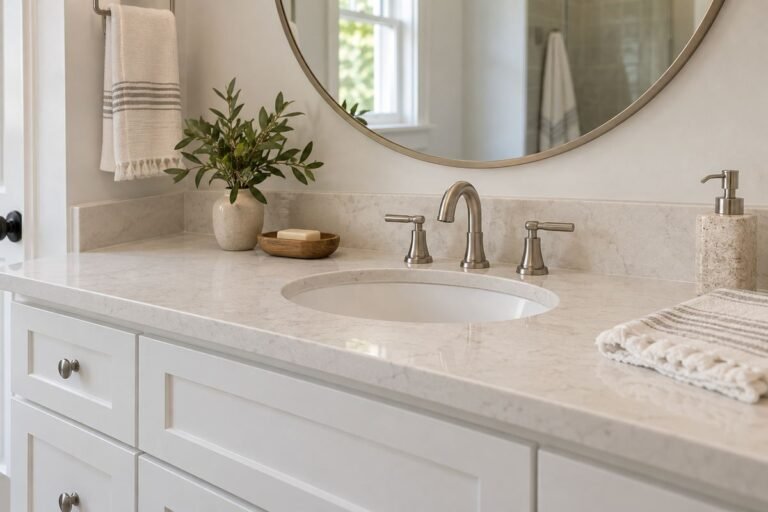
Hallway runner ideas work best when they follow the route people actually take. An internal passage may connect bedrooms, turn toward a bathroom and pass a cupboard before reaching the living room. Its rug has to work with all those movements, not simply fill the longest rectangle in a photograph.
Start by recording the usable floor between skirting boards, open doors and furniture. Then compare runner dimensions, the combined rug-and-pad thickness and the care requirements of the exact product. A good-looking runner becomes much easier to live with when its edges, ends and cleaning routine have been considered together.
These 24 ideas focus on interior hallways rather than stair installation or the wet-weather landing inside a front door. Use the concepts to make a short list, test the real footprint, and choose the material and finish after the route works.
The images are original AI-generated decor concepts, not installation diagrams or photographs of completed client projects.
Browse These 24 Hallway Runner Ideas
Jump to an idea
- Give a straight hallway one continuous runner
- Leave the door swing free of the rug
- Stop the runner before a branching doorway
- Treat an L-shaped route as two measured stretches
- Keep a console on bare floor beside the runner
- Frame a long corridor with a restrained border
- Use a tonal weave when the walls already carry pattern
- Give a plain passage one small repeating motif
- Bring blue into a warm timber hallway
- Repeat green from the adjoining room
- Use a crosswise stripe to interrupt a long view
- Let a fine lengthwise stripe follow the route
- Choose a heathered surface for gentle variation
- Pair a pale runner with darker architectural details
- Warm a cool floor with a muted clay runner
- Align the rug to an offset usable passage
- Keep a bench and its seated position outside the runner edge
- Break a very long hall at a genuine architectural pause
- Choose a lower profile through the complete assembly
- Make the pad part of the original purchase decision
- Plan a realistic washing and drying route
- Leave a practical route for cupboard access and cleaning
- Keep floor transitions visible and deliberate
- Finish with a runner that can survive the ordinary weekly reset
Measure hallway runner ideas through every doorway
Draw the passage as connected usable stretches. Include the narrowest point, all doors in their ordinary open positions, cupboard fronts, floor transitions and furniture feet. Record the proposed runner and its compatible pad as a complete assembly. A nominal rug size does not tell you whether a door clears it; compare the actual thickness and test movement before committing.
| What you observe | Direction to compare | What to check at home |
|---|---|---|
| One straight interior passage | One continuous runner | Both ends, side margins and every door |
| A right-angle turn | Two separate measured stretches | An uncovered turn without overlapping edges |
| An offset walking route | A runner aligned to the usable passage | Furniture and door clearances |
| Several strong wall finishes | A quieter tonal rug | The view from both adjoining rooms |
| Frequent laundry needs | A product with verified care instructions | Washer capacity, pad care and full drying |
| A delicate floor finish | A compatible rug-and-pad combination | Written guidance from the flooring and pad makers |
Use a worked fit record instead of a universal size rule
For an illustrative straight passage 42 inches wide, a proposed 30-inch runner leaves 12 inches of exposed floor in total, or 6 inches on each side when centered. That arithmetic describes this example, not a recommended clearance or accessibility standard. Subtract the real furniture projection and door conflicts before comparing products. Record length separately: the longest available runner may extend into a turn or room opening that should remain clear.
Treat washable as a product specification
Care instructions can differ even within one brand. Ruggable distinguishes removable two-piece covers, washable all-in-one rugs and wool rugs that are not machine washable; it also treats separate pad care differently. Read the label and current guide for your exact runner, and check the appliance capacity. Do not transfer one product’s wash settings, drying method or vacuum advice to a different material.
1. Give a straight hallway one continuous runner
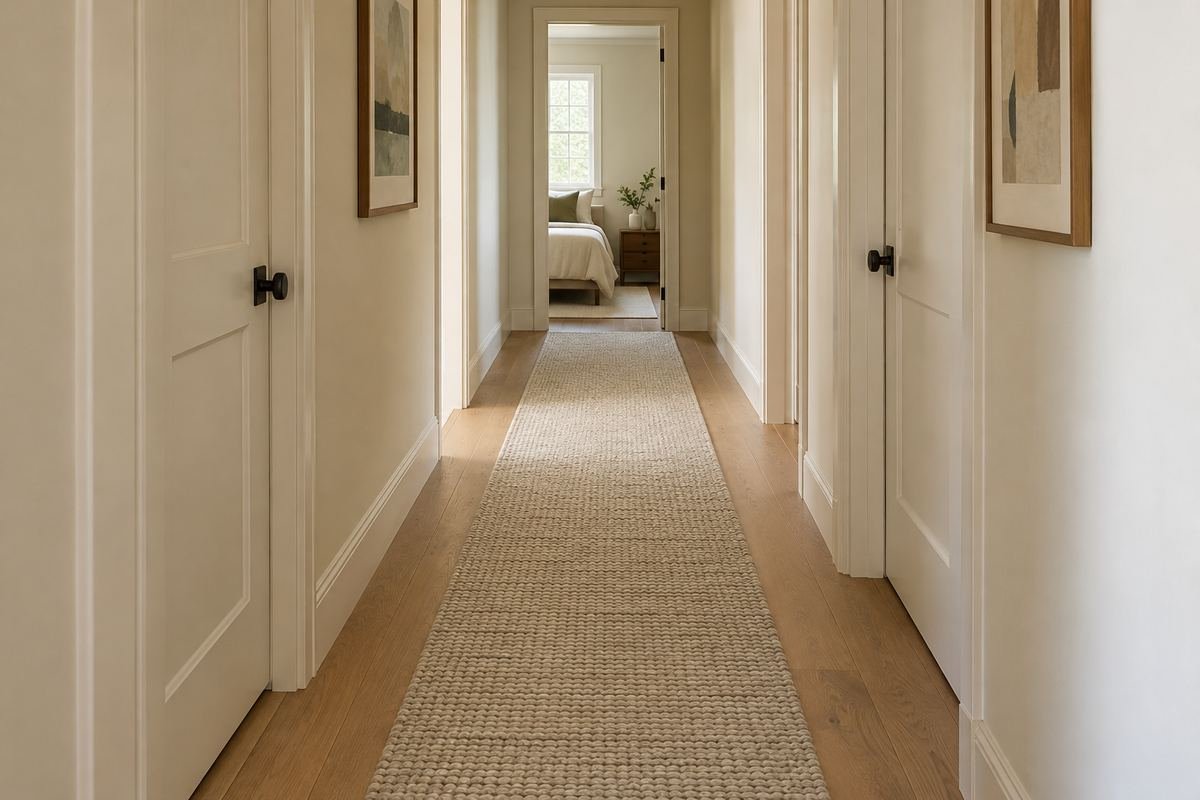
A single runner can make a sequence of internal doors feel connected. Begin with the uninterrupted length of usable floor, rather than measuring from wall to wall through every threshold. The rug should read as one settled element within that passage.
Compare both ends from the adjoining rooms. A runner that looks centered from the entrance may finish awkwardly beneath an opening at the far end. Mark the proposed outline with a removable method suitable for the floor and walk the ordinary route before ordering.
Practical tip: Check the far end from the room you enter most often.
2. Leave the door swing free of the rug

An internal door can interrupt an otherwise simple runner layout. Test it through the complete arc, including the point where the lower edge passes closest to the floor. Consider the runner and pad together rather than checking the rug alone.
If the assembly does not clear reliably, compare a different product profile or stop the runner beyond that movement. Do not force a thick rug beneath a door or assume it will flatten with use. Also inspect cupboards that open into the same passage.
Practical tip: Record the combined rug-and-pad thickness.
3. Stop the runner before a branching doorway

A T-shaped passage has more than one direction of travel. Let the main runner end before the junction when that creates a clearer transition. Bare floor can be a deliberate part of the composition rather than a gap that must be filled.
Look along both branches before deciding on the endpoint. Avoid a short protruding corner that gets repeatedly crossed at an angle. If the second route needs its own rug, measure it as a separate stretch and keep the junction physically coherent.
Practical tip: Test the junction from every connected room.
4. Treat an L-shaped route as two measured stretches
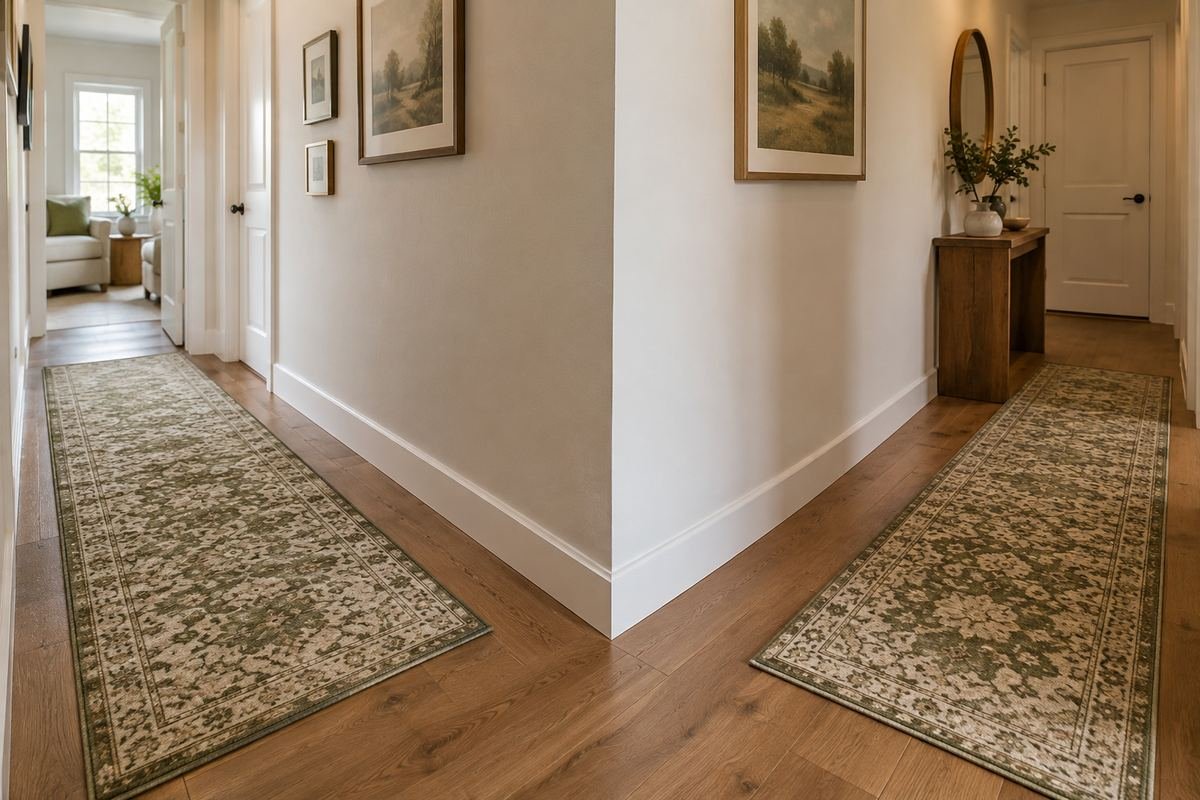
A right-angle corridor often works more naturally with two runners than with one rug forced around a corner. Give each leg a usable footprint and decide how much floor should remain visible at the turn. The two rugs can coordinate without being identical.
Keep their ends separate rather than overlapping them. Compare the turn with doors open, and avoid creating a cramped patchwork of tiny mats. A shared color family can connect the stretches while their individual lengths respond to the actual architecture.
Practical tip: Resolve the uncovered corner before buying either runner.
5. Keep a console on bare floor beside the runner
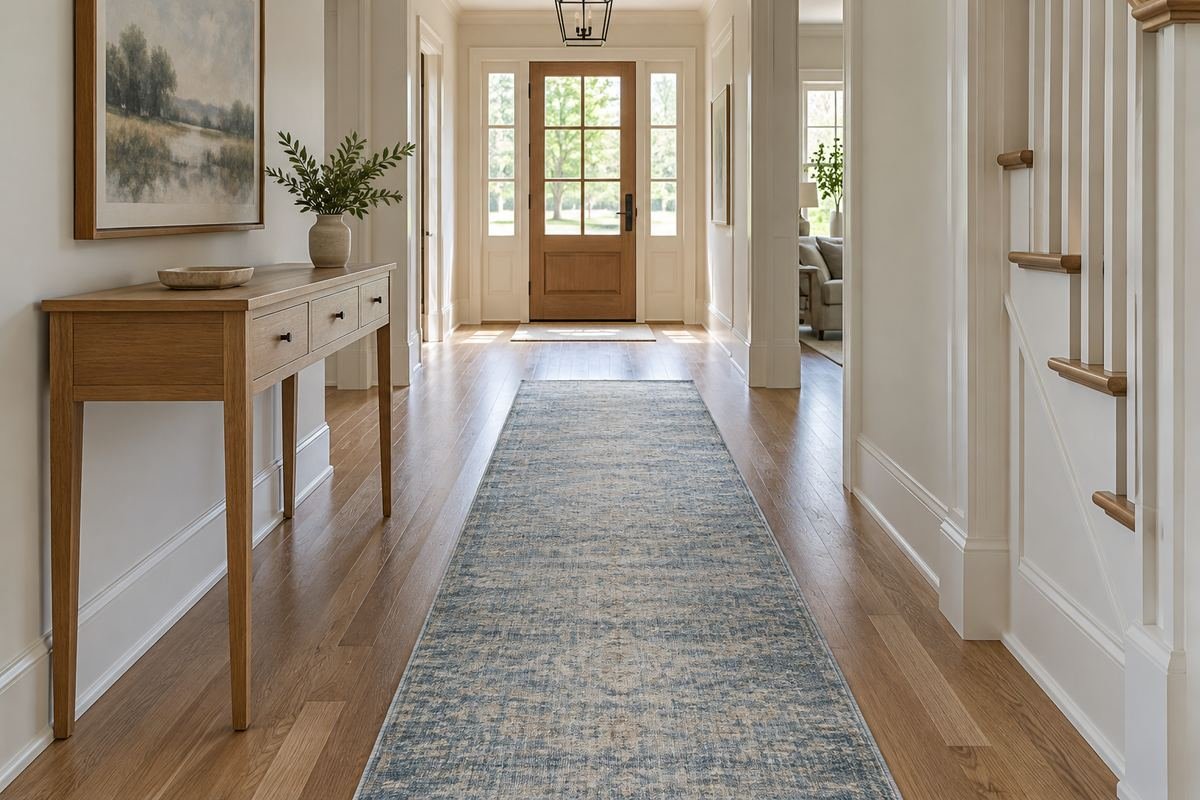
A narrow console can make the hallway useful, but its legs should not create an accidental uneven relationship with the rug. Placing the furniture fully beside the runner gives both objects a clear footprint and makes the edge easier to see.
Measure the passage after accounting for the console depth and handles. Align the rug to the remaining usable route, which may differ from the center of the entire room. Keep baskets beneath the console contained within its footprint rather than extending onto the rug.
Practical tip: Center the runner on the walking route after furniture is placed.
6. Frame a long corridor with a restrained border
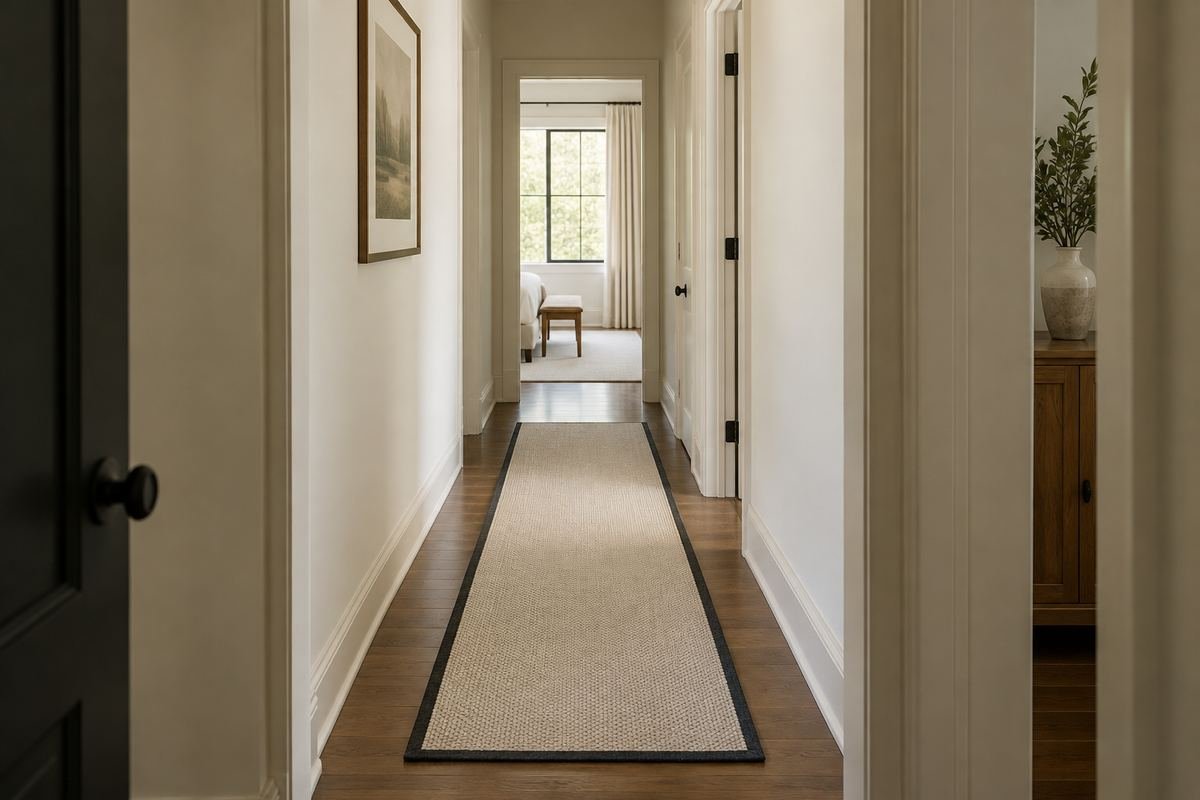
A thin border can give a runner a finished outline without adding a large motif. It works particularly well in a passage where several doors and wall frames already create a rhythm. Choose the border through its contrast with both the rug center and the floor.
Compare the full runner image, not only a small cropped swatch. A border that looks subtle close up can become a strong pair of lines over a long distance. Keep the surrounding wall decoration quiet if the outline already provides enough structure.
Practical tip: Judge the border at the full proposed length.
7. Use a tonal weave when the walls already carry pattern
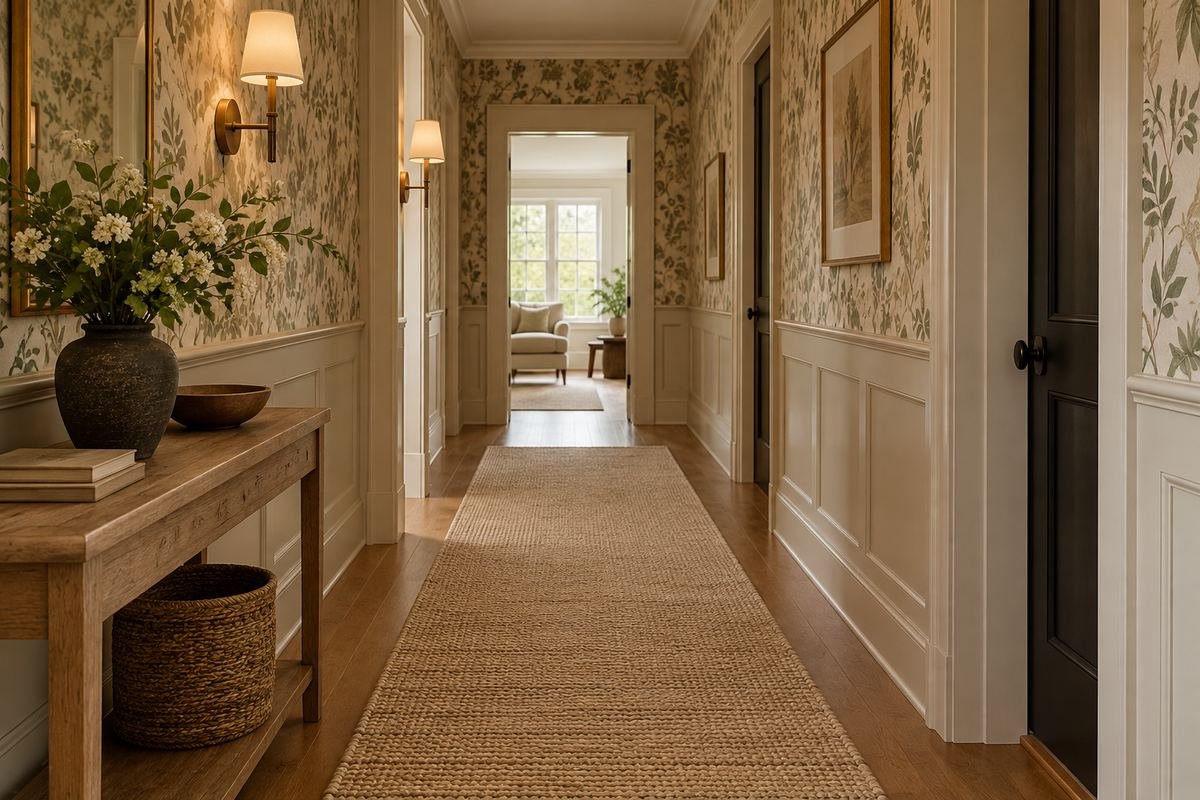
Wallpaper can supply most of the hallway’s visual movement. A tonal runner gives the eye a calmer surface below it, especially when the passage also contains paneling, door trim and wall lights. Texture can provide interest without another competing repeat.
Compare the rug against the wallpaper in the light the passage actually receives. A beige that looks neutral online may appear pink or green beside the wall finish. Keep samples near the floor so the relationship is assessed at its real height.
Practical tip: Test undertones beside the finished wall and flooring.
8. Give a plain passage one small repeating motif
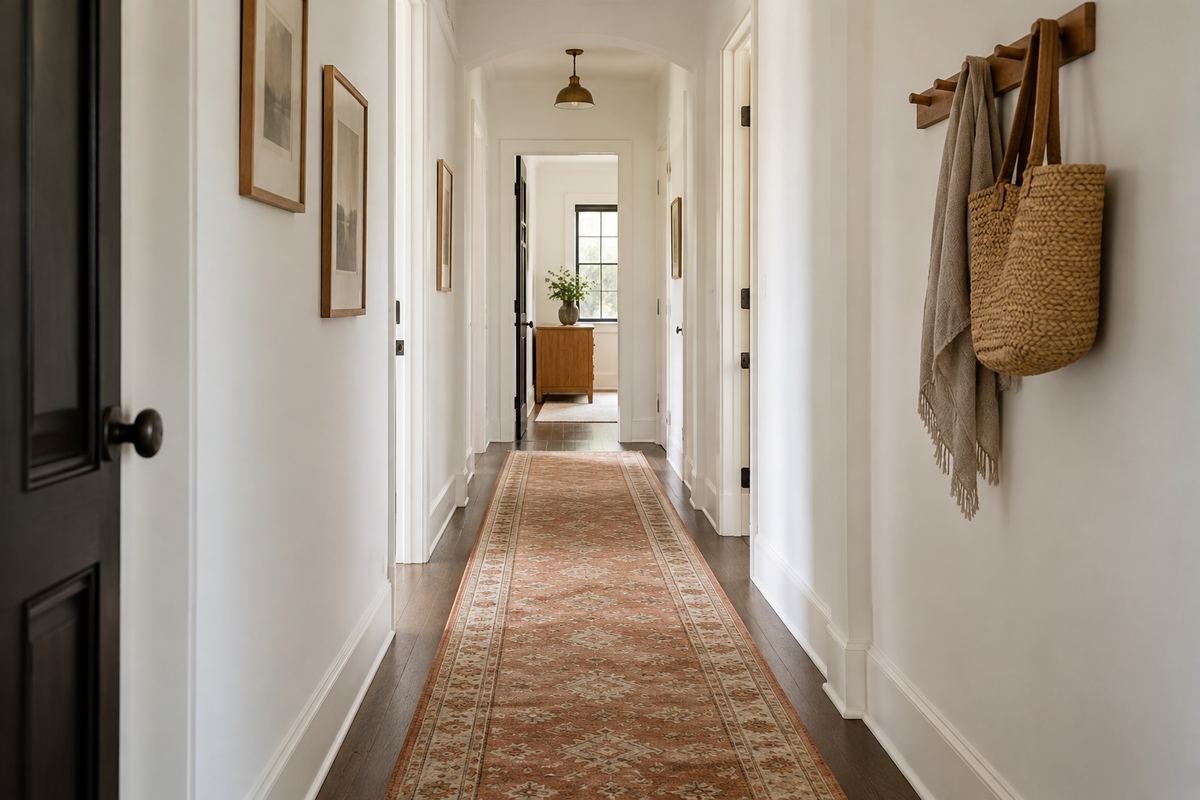
A small repeat can make an undecorated corridor feel complete without requiring a gallery wall. Repetition also allows the rug to remain interesting when only a short section is visible through an open door. Choose a pattern whose scale still reads at the end of the hall.
Study where the repeat stops at the runner ends. Very large motifs can look abruptly cropped in a narrow format. A smaller geometric or faded traditional pattern may be easier to connect with simple trim and plain walls.
Practical tip: Look at a full-format runner photograph before ordering.
9. Bring blue into a warm timber hallway
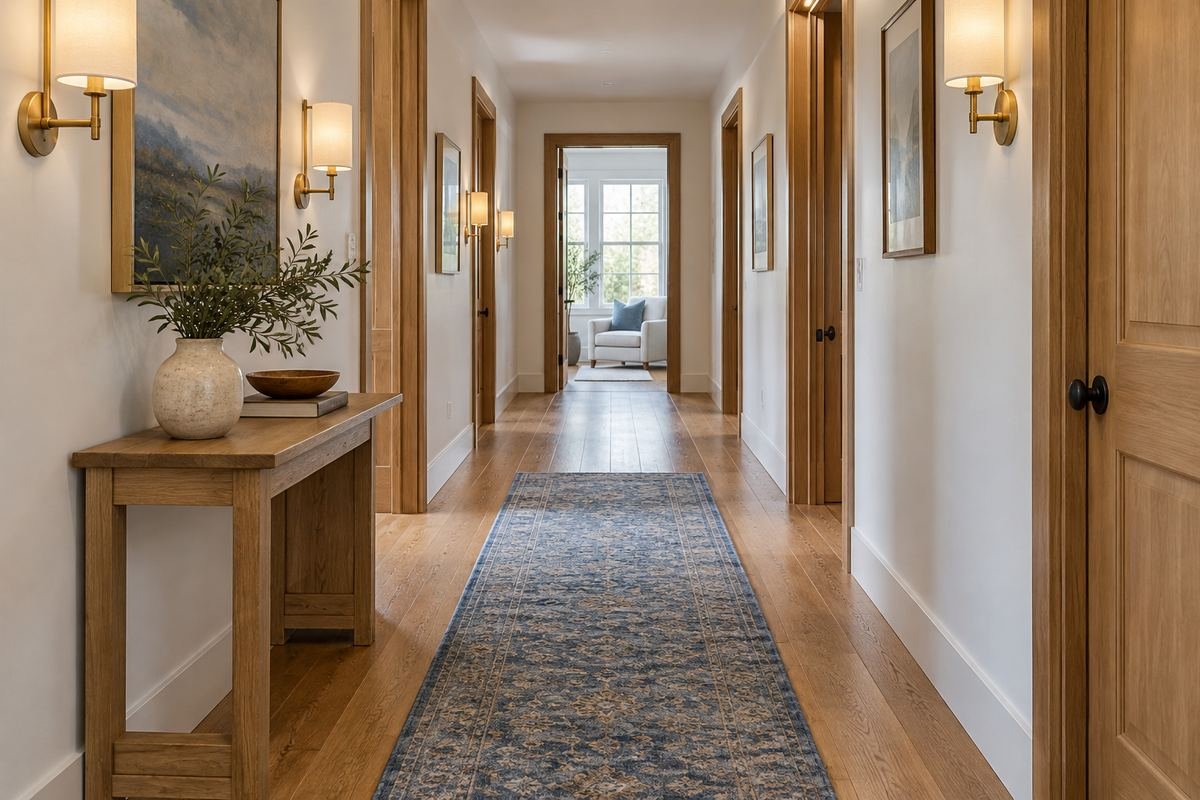
Muted blue can balance golden timber without cooling every surface in the passage. Let the flooring remain visible at the sides so the relationship between wood and textile becomes part of the design. Brass or aged metal details can sit comfortably between the two.
Compare a gray-blue, an ink blue and a softened denim sample before choosing. Their undertones behave differently beside orange or honey-colored wood. Repeat the selected blue once in an adjoining room if the hallway should feel connected to it.
Practical tip: Compare blue samples directly against the timber.
10. Repeat green from the adjoining room

A runner can borrow a color from the room at the end of the passage. An olive thread in the rug and a green chair beyond the doorway create continuity without painting every wall the same shade. The connection is strongest when both are visible in one ordinary view.
Keep the surrounding colors restrained enough for that relationship to remain readable. The rug does not need to match the upholstery exactly; a related muted tone can feel less forced. Check the view with the connecting door in its usual position.
Practical tip: Choose a color relationship visible in everyday use.
11. Use a crosswise stripe to interrupt a long view

Stripes running across the width of a runner create a different rhythm from long parallel bands. In a plain corridor, they can break the floor into smaller visual intervals. Treat this as a pattern choice, not a promise that the room will appear a particular size.
Compare stripe contrast with the number of door frames already crossing the view. Strong black-and-white bands can make the floor busy, while a softer oatmeal and tan version stays quieter. Check that the pattern remains legible in the narrow runner format.
Practical tip: Reduce stripe contrast when the architecture is already busy.
12. Let a fine lengthwise stripe follow the route
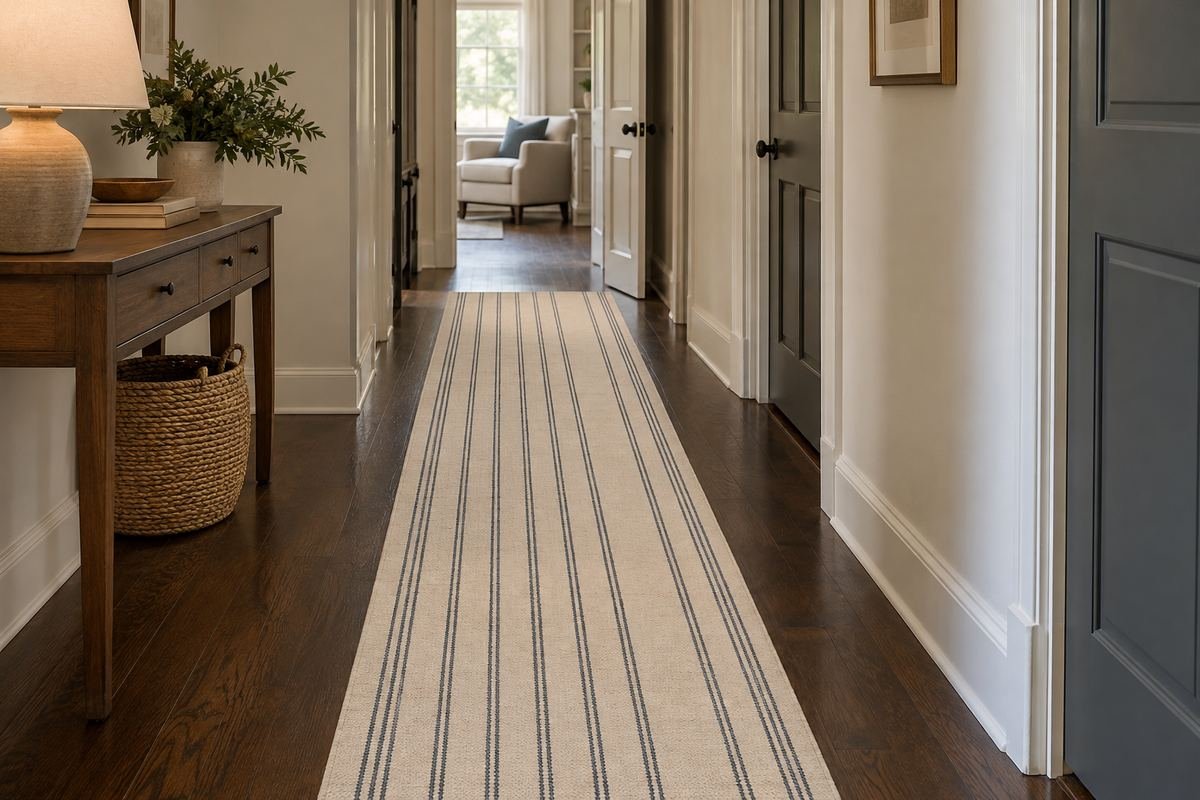
A restrained lengthwise stripe can emphasize the direction between two rooms. It suits a hallway where the destination is clear and there are few side interruptions. Keep the runner aligned to the actual passage rather than to an isolated ceiling light.
Inspect how the stripe meets the runner binding and ends. A slight misalignment can be more noticeable with a linear pattern than with a small irregular motif. Compare the delivered rug laid flat before removing packaging or deciding that it fits the room.
Practical tip: Use the actual walking route as the alignment reference.
13. Choose a heathered surface for gentle variation

A heathered runner mixes related fibers or tones to create a quieter variation than an obvious printed motif. It can suit a passage shared by rooms with different palettes. Choose it because you like the close-up texture as well as the distant view.
Mixed color does not establish stain resistance or easy care. Read the material and cleaning specification separately, and compare a sample under the hallway lights. Keep the edges and binding deliberate so the subtle center still looks finished.
Practical tip: Separate visual variation from performance claims.
14. Pair a pale runner with darker architectural details

Dark door handles, painted doors or a stair rail can frame a pale runner without filling the entire floor with strong color. The rug becomes a lighter continuous element between those details. Use a material and care routine suited to the real household.
Compare the pale surface with the lightest flooring and wall tones so it does not appear accidentally mismatched. A warm ivory can work better than a bright white beside older timber. Plan cleaning access before choosing an especially light textile for a busy route.
Practical tip: Pick the pale tone after comparing the permanent finishes.
15. Warm a cool floor with a muted clay runner

Stone-look or gray tiled hallways can benefit from a warmer textile color. A softened clay or cinnamon tone adds warmth while leaving the floor visible around it. Check the backing and pad against the exact floor finish before using the combination.
Keep other warm accents small: a timber frame or woven shade may be enough. If the tile has a strong mottled pattern, choose a quieter rug so both surfaces remain readable. Judge the relationship under the hallway’s evening lighting as well as daylight.
Practical tip: Check floor compatibility independently of the color choice.
16. Align the rug to an offset usable passage
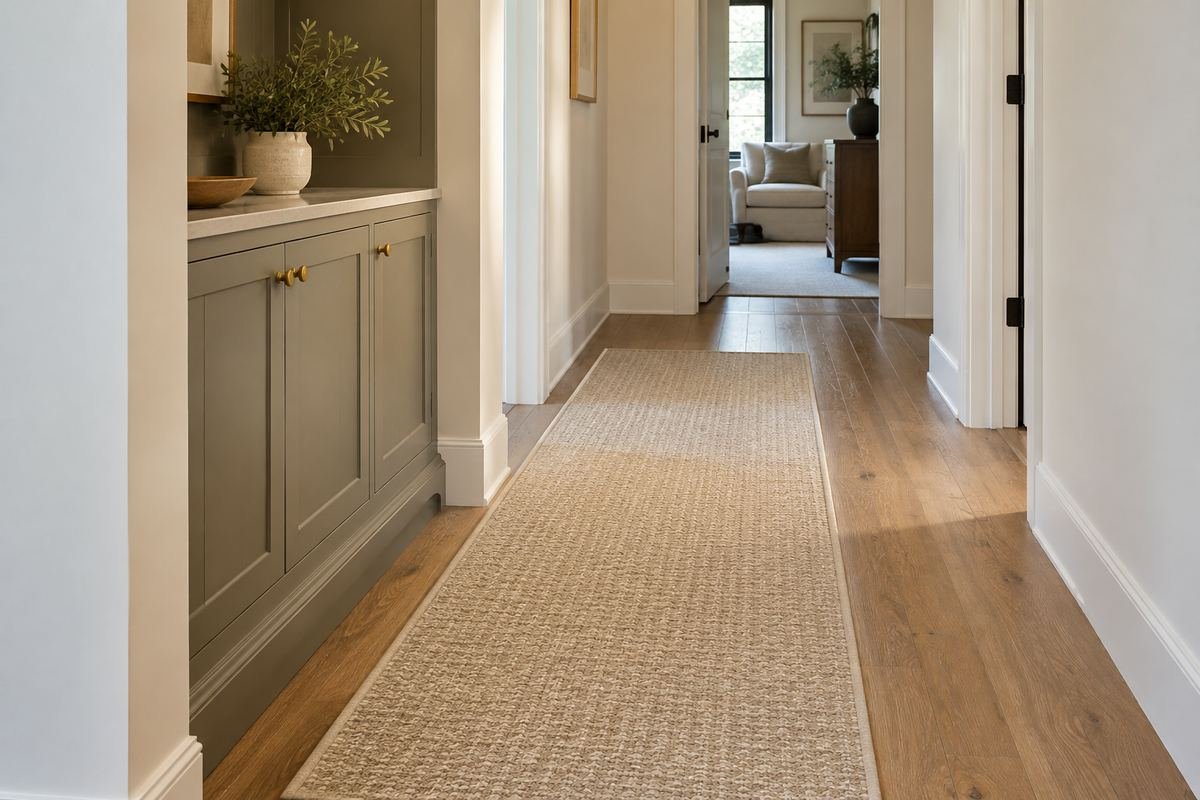
Some hallways widen on one side for furniture or an alcove. Centering the runner between the outer walls can place it partly beneath a cabinet and partly outside the actual route. Aligning it to the clear passage usually makes the arrangement easier to understand.
Mark the cabinet projection and the route past it before comparing widths. Look from both ends rather than trying to produce equal margins everywhere. An intentional asymmetry can be more convincing than a centered rug that conflicts with how the space is used.
Practical tip: Measure the clear route after subtracting fixed projections.
17. Keep a bench and its seated position outside the runner edge

A hallway bench needs room for the person using it, not only room for its legs. Place the runner with that occupied position in mind. A clear relationship between the bench area and the through route helps the passage remain useful.
Try sitting, standing and moving past the bench before deciding on the rug width. Keep stored shoes contained beneath the bench or in a suitable separate location. If the hallway cannot support both uses comfortably, reconsider the furniture rather than shrinking every margin around it.
Practical tip: Test the bench with a person seated before finalizing the rug.
18. Break a very long hall at a genuine architectural pause
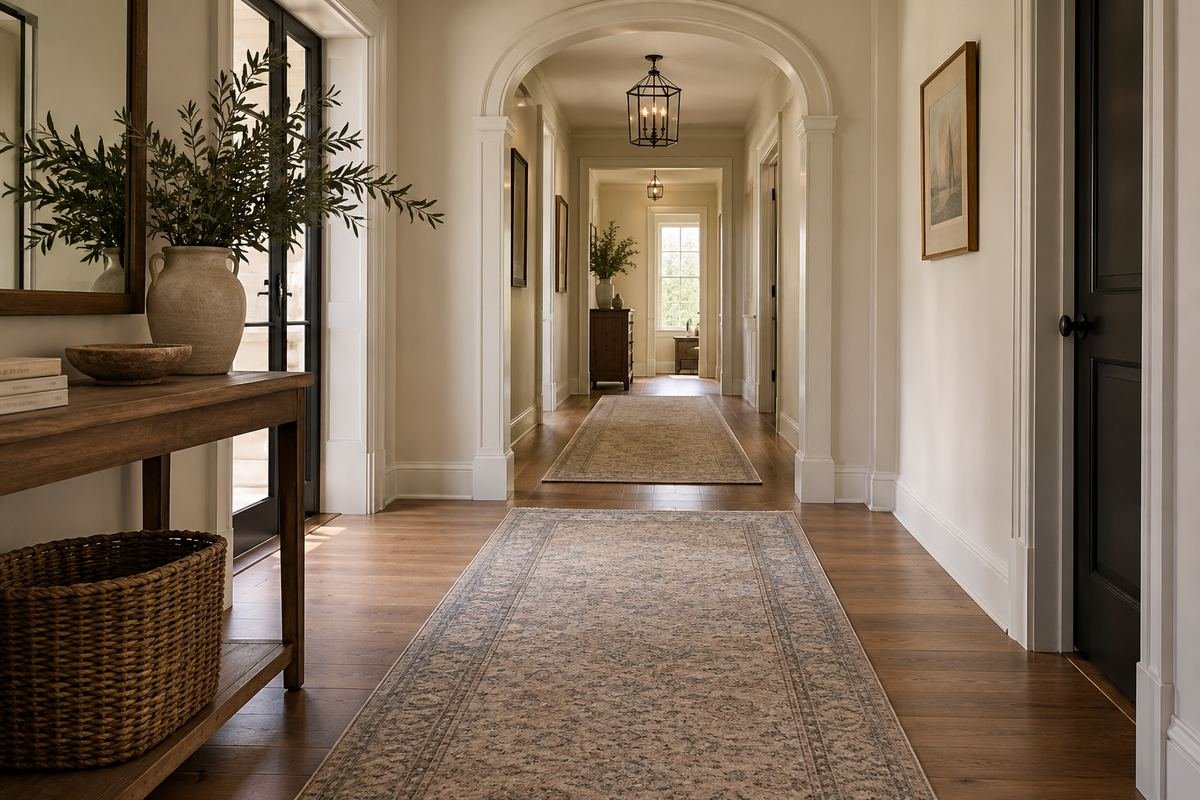
A long corridor may have an arch, a widened landing or a clear change in direction. That existing pause can be a sensible place to separate two runner zones. Let the architecture explain the break instead of dividing the floor into arbitrary equal pieces.
Compare the exposed section between the rugs with the doorways around it. Keep lengths proportional to their individual stretches. Matching rugs can work, but coordinated colors with slightly different patterns can also feel deliberate when the two areas serve different rooms.
Practical tip: Use an existing arch or widening to locate the break.
19. Choose a lower profile through the complete assembly

Where internal doors leave little room, a lower-profile runner may be useful. The decision includes its backing and any pad, so compare the finished assembly rather than a pile-height number in isolation. Test every door and cupboard along the route.
A low profile does not establish that edges will stay flat or that the backing suits the floor. Read the product guidance and inspect the delivered rug laid out as intended. If a door catches or an edge repeatedly lifts, change the arrangement.
Practical tip: Test the rug and pad together beneath each moving door.
20. Make the pad part of the original purchase decision

A runner and its pad should be selected as a compatible combination for the actual floor and intended use. Different constructions and backings have different requirements. Confirm the written guidance instead of assuming a generic pad suits every surface.
Include the pad in your dimensions, door-clearance check and cleaning routine. Keep it properly contained beneath the rug according to its instructions. Avoid improvised overlapping pieces or an exposed pad edge that changes the shape of the walking surface.
Practical tip: Ask about the exact floor finish when checking pad suitability.
21. Plan a realistic washing and drying route
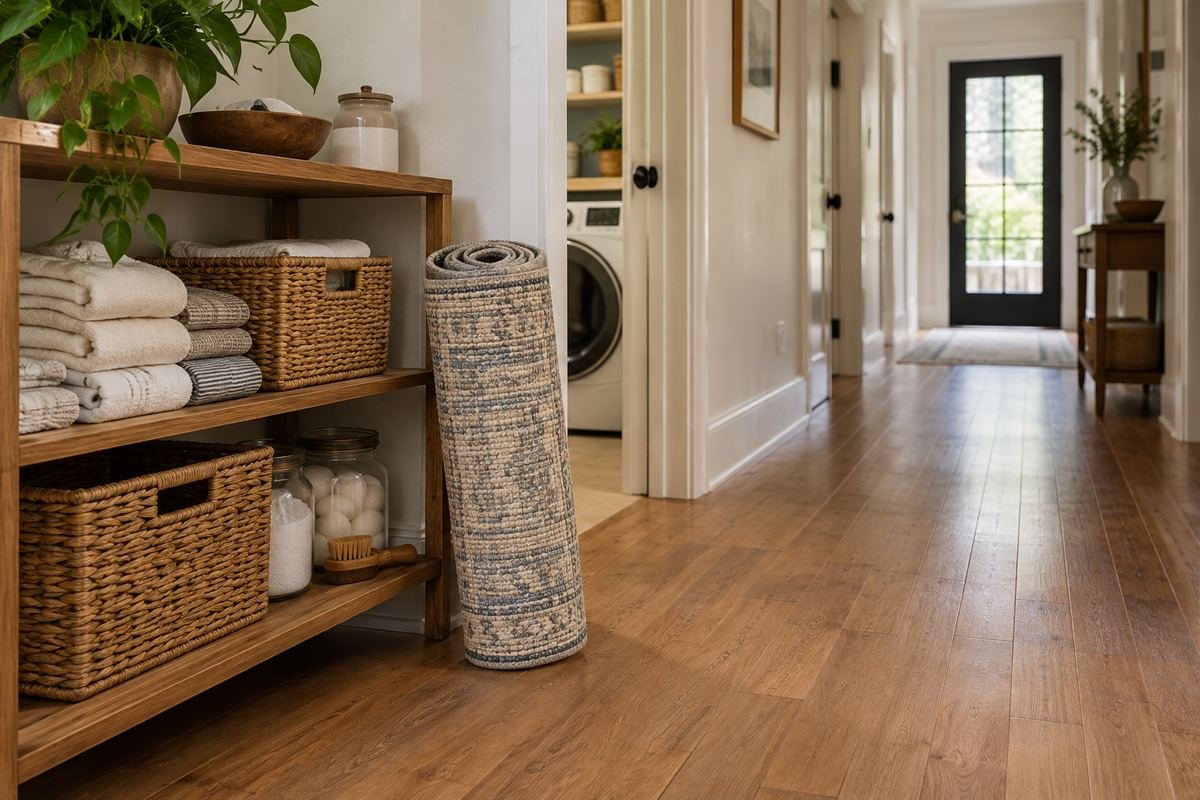
A washable runner is only convenient when the household can manage its specified care process. Check whether the entire rug or only a removable cover is washed, whether the home appliance has suitable capacity and where the piece will dry completely.
Do this before selecting the largest runner that fits the floor. A separate pad may have a different cleaning method. Keep the hallway usable while the rug is being cleaned, and replace the assembly only when the relevant components and floor are ready according to the instructions.
Practical tip: Read the care guide before deciding on runner size.
22. Leave a practical route for cupboard access and cleaning
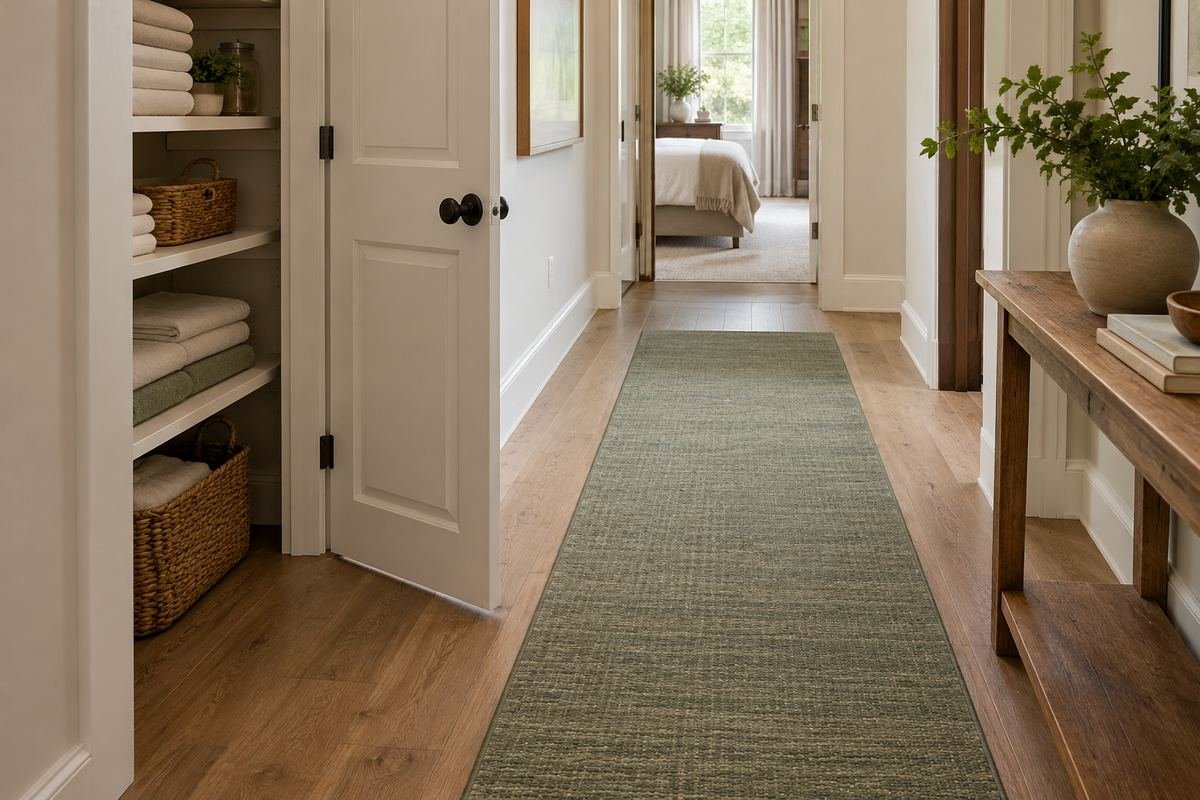
A runner should not make routine access to a linen cupboard or vacuum storage awkward. Check how doors open and where you stand while removing bulky items. Keep the rug positioned so it can be lifted or moved for appropriate floor care.
Avoid trapping its edges beneath several unrelated pieces of furniture. A simple arrangement is easier to restore after cleaning. Review whether a vacuum can move along the route using the settings permitted for the rug, without repeatedly catching fringe or corners.
Practical tip: Include cupboard use in the footprint test.
23. Keep floor transitions visible and deliberate
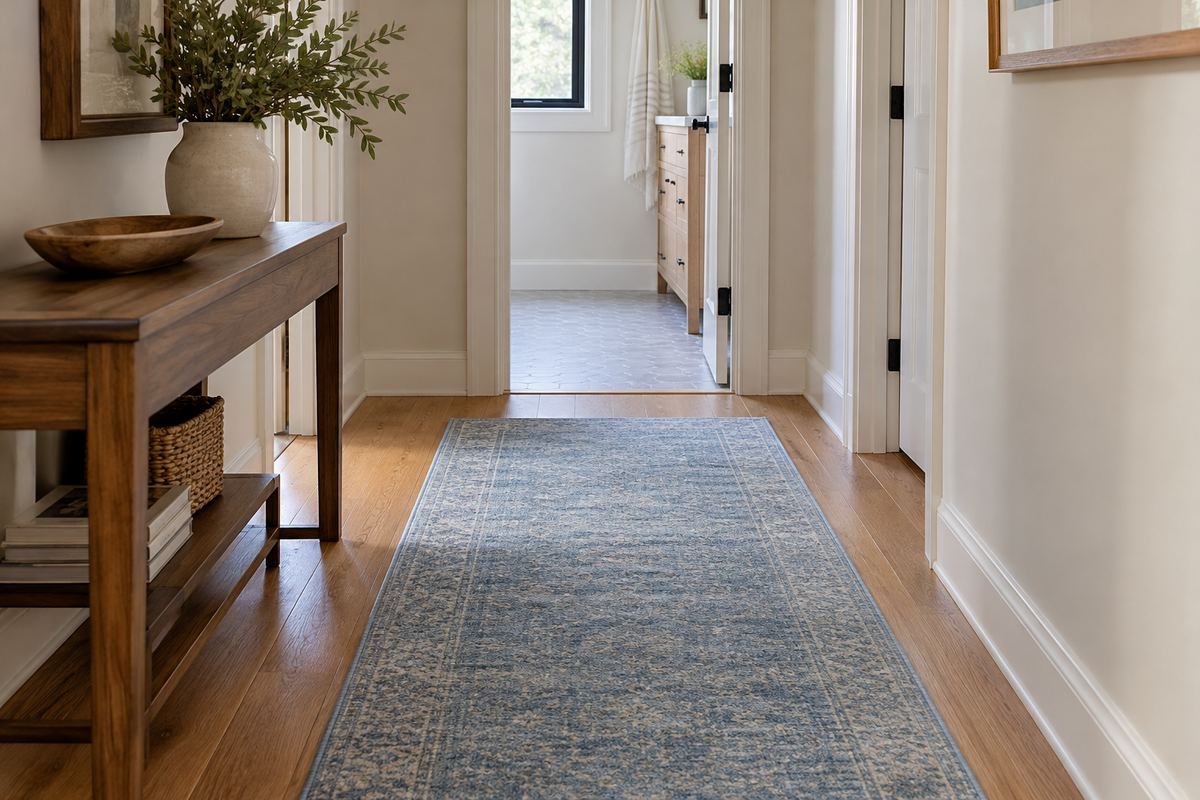
The point where timber meets tile or another room surface can be a useful place to finish a runner. A clear endpoint helps each material read as its own area. Inspect the real transition detail rather than covering an unresolved edge with a rug.
Check the proposed placement from both rooms and with the connecting door open. Avoid letting a loose runner end bunch against a threshold. If the floor transition itself needs repair, have that addressed as a separate issue before using a textile to complete the room.
Practical tip: Resolve the floor transition before styling over it.
24. Finish with a runner that can survive the ordinary weekly reset

A hallway is successful when its arrangement is easy to put back after daily life. Keep the runner’s position simple enough to check during ordinary cleaning, and leave nearby baskets, bags and footwear within their own storage footprints. The floor should remain readable.
After living with the arrangement, note whether the rug migrates, catches a door or becomes difficult to clean. Those observations are more useful than adding another decorative object. Adjust the footprint or product if necessary, then keep the walls and accessories focused on the same calm route.
Practical tip: Review movement and edge condition during the weekly reset.
Frequently Asked Questions
How wide should a hallway runner be?
Measure the actual usable width, including furniture projections and the route through doorways. Compare the proposed runner with the exposed floor on both sides. There is no single width that fits every hallway, and a decorative side margin is not a substitute for required usable passage space.
Should a runner cover the entire hallway?
It can define a long straight stretch without covering every inch. Keep its ends deliberate around room openings, turns and floor transitions. Two well-positioned rugs can be easier to resolve than one runner that crosses an awkward junction.
Can I put two runners in an L-shaped hall?
Compare each leg separately and resolve the corner as a shared transition. Keep the edges from overlapping or bunching, use a compatible pad where appropriate, and test how the route works from both directions.
Is a flatwoven runner always the best option?
A lower profile can be useful where door clearance is limited, but construction, backing, pad, floor compatibility and care still matter. Compare the exact assembly instead of assuming every flatwoven rug behaves alike.
Can a hallway runner go over carpet?
Check the guidance for the runner, pad and underlying carpet together. A combination intended for hard flooring may behave differently over carpet. If the edges move or the arrangement cannot stay properly settled, reassess the product and layout.
How do I keep the runner looking considered?
Start with a correct footprint, keep nearby objects from crowding the route and choose one clear color or pattern relationship. Maintain the rug according to its own care instructions and review its position after ordinary household use.
Choose the Details That Work in Your Home
Choose the route first, then decide what the runner should contribute visually. A useful footprint, a suitable complete rug-and-pad assembly and a realistic care plan will outlast a color choice made in isolation. The most successful hallway runner ideas connect rooms while leaving doors, furniture and everyday movement easy to use.
For related ideas, explore hallway paint colors, hallway lighting ideas, entryway rug ideas.
Planning References
Ruggable: product-specific rug wash and care guide. Follow the instructions for the exact products you choose.
Optional digital guide for this topic
If you prefer a structured workbook, explore this related paid guide.