Useful closet lighting ideas help you see what you are choosing, not simply the outline of the cabinetry. Start with the hanging clothes, shelves, shoes and mirror used during the ordinary dressing routine. Those separate tasks may need different light positions.
A ceiling fixture can illuminate the room while leaving a deep shelf in shadow. Equally, a decorative strip around every cabinet edge can look dramatic without helping you identify a dark sweater. Compare where the light reaches with the storage filled and the doors in their normal positions.
These 23 concepts explore restrained arrangements for wardrobes, reach-in closets and walk-in dressing spaces. They are design starting points rather than wiring or installation plans. Choose luminaires intended for the location and follow the exact product instructions and applicable requirements, with qualified installation help where appropriate.
The images are original AI-generated decor concepts, not installation diagrams or photographs of completed client projects.
Browse These 23 Closet Lighting Ideas
Jump to an idea
- Light the hanging section with a restrained top bar
- Give deep shelves their own useful illumination
- Compare vertical lighting beside a tall compartment
- Keep a compact reach-in light visually quiet
- Plan the light with hinged doors open
- Check the exposed section of a sliding wardrobe
- Use general lighting to establish a walk-in route
- Balance a two-sided dressing space
- Give an L-shaped closet attention at the return
- Illuminate a shoe section without spotlight clutter
- Give accessory shelves a calm light rhythm
- Compare drawer lighting as a complete furniture feature
- Keep mirror light focused on the person
- Use a modest enclosed ceiling fixture in a small walk-in
- Choose a consistent light character across adjoining bays
- Test a darker cabinet with the clothing in place
- Let pale cabinetry support a quieter scheme
- Keep a smaller automatic light easy to maintain
- Use a manual control where it suits the routine
- Test automatic activation during ordinary use
- Keep required power components reachable
- Keep cables clear of moving storage parts
- Finish by checking the closet with its normal contents
Plan closet lighting ideas around the storage in use
Sketch the hanging rails, shelves, drawers, door movement and usual standing positions. Mark what is difficult to see now. Compare useful light at those locations before deciding how many fixtures to add. Review the complete system, including compatible power components, controls, clearances and access for maintenance; those details should be resolved before cabinetry or finishes conceal them.
| What needs light | Arrangement to compare | Check before choosing |
|---|---|---|
| A hanging section | A suitable linear wardrobe light | Clothing shadows and the exact system requirements |
| Deep shelves | Individual shelf illumination | Whether the front objects block the rear view |
| A small reach-in | Compact enclosed fixtures suited to the space | Door movement and the normal standing position |
| A walk-in route | Useful general room lighting | The view with the storage filled |
| A dressing mirror | Light that reaches the person using it | Glare in the reflection |
| An occasional cabinet | An appropriate self-contained light | Battery or charging access and intended use |
Buy a complete compatible system
A lighting strip is not necessarily a complete kit. For example, IKEA’s current ÖVERSIDAN product page lists separate power components and compatible controls. Check the actual fixture, driver, connectors and power arrangement as one system. Do not mix components or assume an old product guide still describes the current version.
Distinguish automatic controls from the light itself
A door-responsive sensor, a room motion detector and a manual switch do different jobs. Check the exact control’s intended use and test the proposed position. The word sensor on a product listing does not establish that it will detect someone standing in an open walk-in closet.
Keep decorative glow subordinate to useful visibility
Philips Hue’s strip-light guide includes shelves and dark storage as possible applications. Use that idea to compare the visibility of the actual contents. A photograph of glowing cabinet edges does not establish that the shelf, hanger or mirror receives the light needed for daily use.
Resolve installation and service access early
Follow the exact luminaire’s listing, mounting instructions, clearances and system limits. Do not improvise wiring or conceal power components where the instructions do not permit them. A qualified professional can resolve fixed electrical work and applicable local requirements. Keep maintenance access part of the design, not an afterthought.
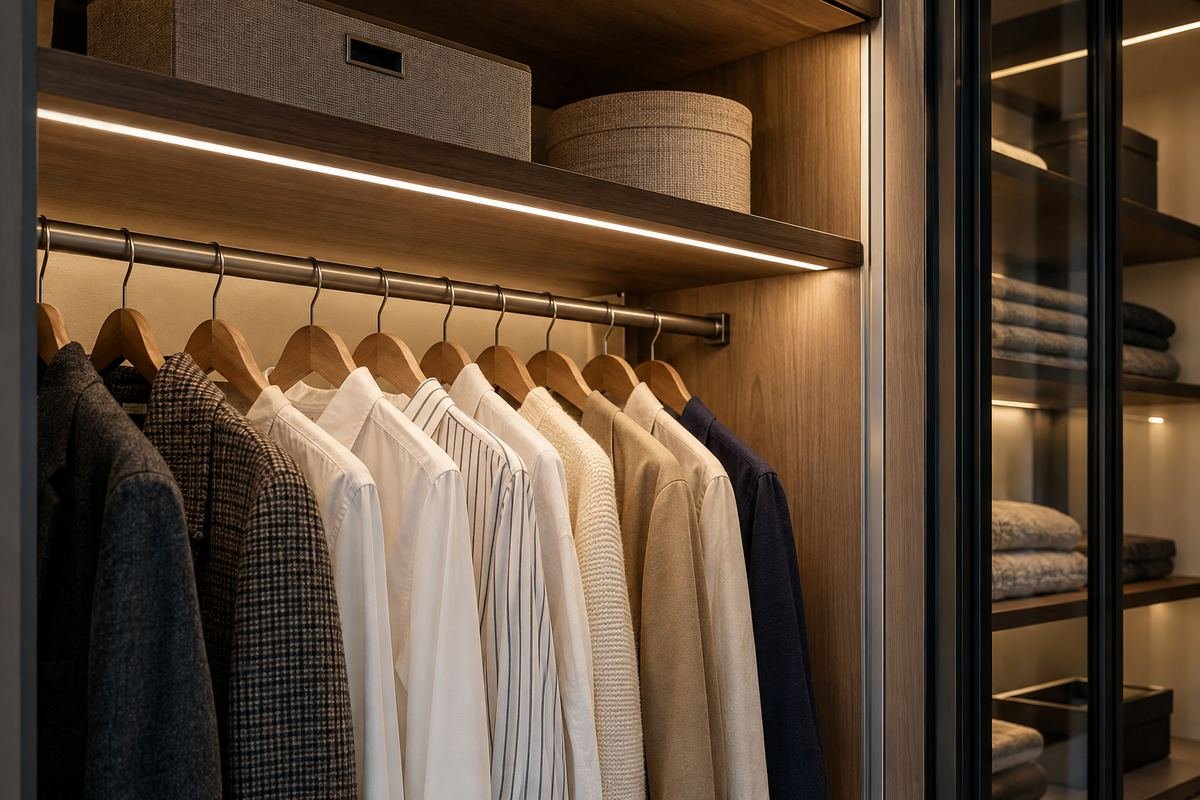
1. Light the hanging section with a restrained top bar

A suitable linear wardrobe light can give a hanging section a clear source of illumination. Keep the fixture visually restrained so the clothing remains easy to read. Compare the view of the fronts and shoulders of the garments rather than judging the brightness of the empty cabinet.
Confirm the exact mounting arrangement and clearances with the manufacturer. Stored items must remain clear of the fixture as required. Plan the compatible power components and controls before choosing cabinetry details that make them difficult to reach.
Practical tip: Judge the hanging section with its normal clothing load.
2. Give deep shelves their own useful illumination

A shelf can remain dark when the light comes only from the top of the wardrobe. Suitable localized illumination can help distinguish folded items at the front and rear. Keep the storage simple enough that the effect on the contents remains clear.
Compare the exact product’s permitted mounting and storage distances. Each shelf arrangement needs its own assessment; a light on one shelf may not illuminate the one below. Avoid treating a continuous decorative outline as proof that every stored item is visible.
Practical tip: Check the rear of the shelf from the normal standing position.
3. Compare vertical lighting beside a tall compartment
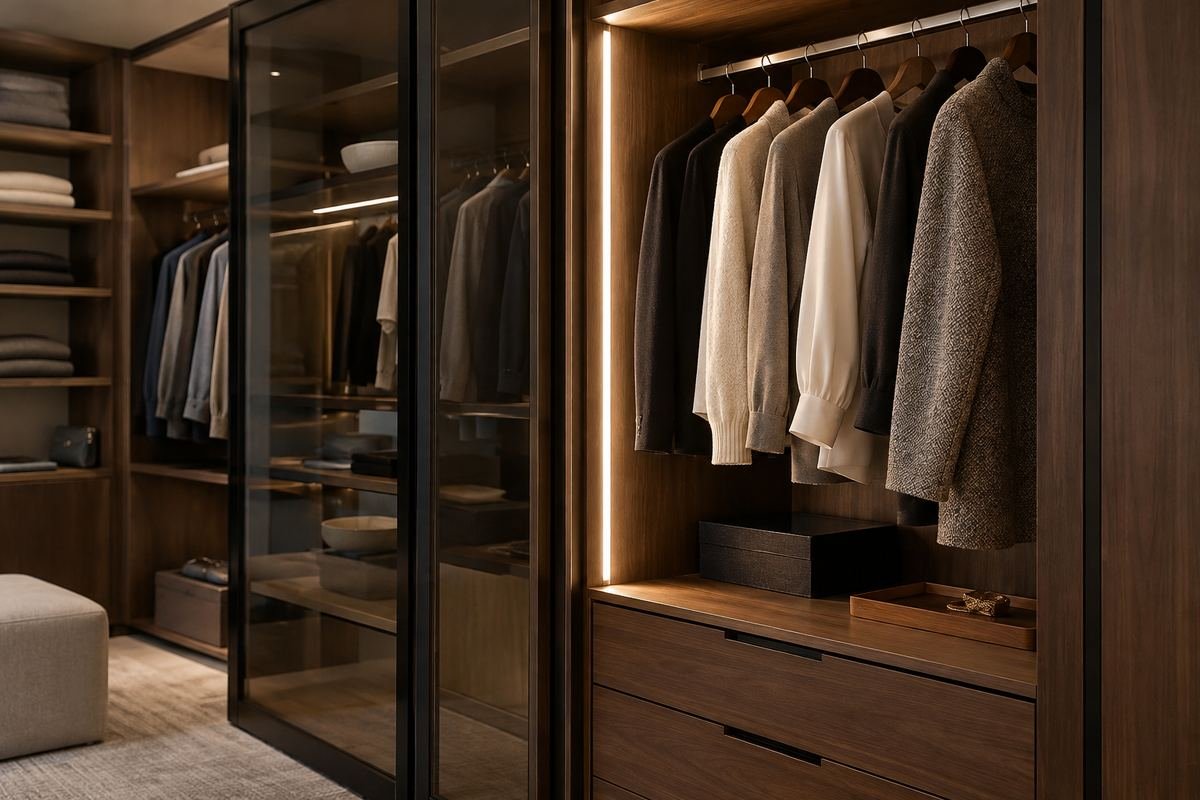
A suitable vertical light at the side of a tall storage bay can create a different distribution from a top-only source. It can also emphasize the cabinet’s height without adding a large decorative fixture. Keep the composition focused on one useful compartment.
Review the complete proposed arrangement with the supplier or installer. The product must suit its mounting orientation and location, with required separation from clothing. Check the view for glare rather than assuming a longer glowing line automatically gives better task light.
Practical tip: Compare the side-lit view with the top-lit alternative.
4. Keep a compact reach-in light visually quiet

A small reach-in closet benefits from a clear view more than a prominent fixture. A compact enclosed light suited to the space can keep the focus on the clothing. Compare the closet from the place where a person normally stands to choose an item.
Check door travel, shelf shadows and the exact fixture’s requirements. A central bright spot can leave the outer sections difficult to see. Choose the product and installation for the actual closet rather than copying the appearance of a larger walk-in room.
Practical tip: Check both ends of the reach-in from outside the opening.
5. Plan the light with hinged doors open

Hinged wardrobe doors change the view and can affect how light reaches the contents. Compare the open-door composition before finalizing fixtures. A quiet light within each useful section can look deliberate without turning the whole wardrobe into a display case.
Confirm that the fixture, sensor and mounting arrangement are designed for the actual door configuration. Test the opening and closing behavior according to the product guidance. The door position should not create a recurring blind area or block required access.
Practical tip: Review the fixture and control with the actual door design.
6. Check the exposed section of a sliding wardrobe
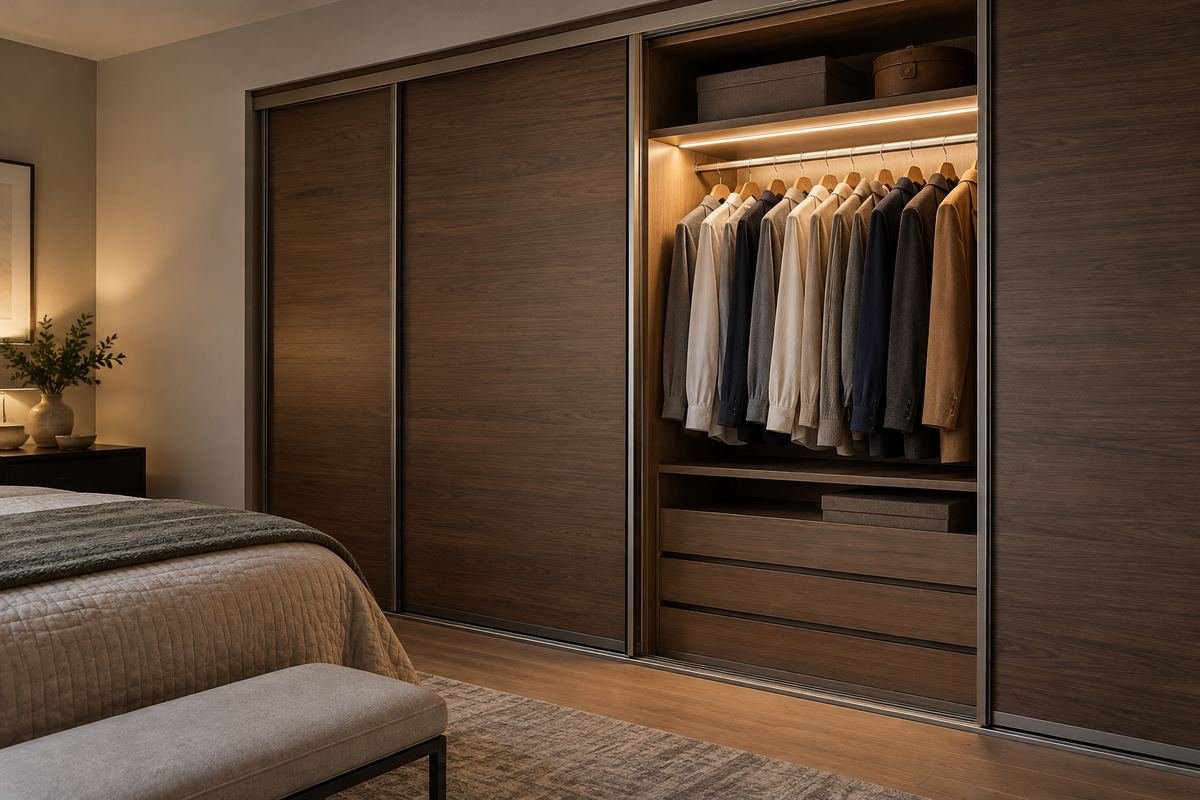
A sliding wardrobe reveals only part of its interior at one time. Compare illumination in each accessible position rather than designing the light solely for the fully exposed cabinet in a showroom. Keep the fixture arrangement compatible with the door system.
Review the manufacturer’s mounting options and control behavior for sliding doors. Do not assume a fitting intended for another configuration will work. Check the useful view of both the hanging and shelf sections as the door moves between them.
Practical tip: Compare each normal opening position.
7. Use general lighting to establish a walk-in route
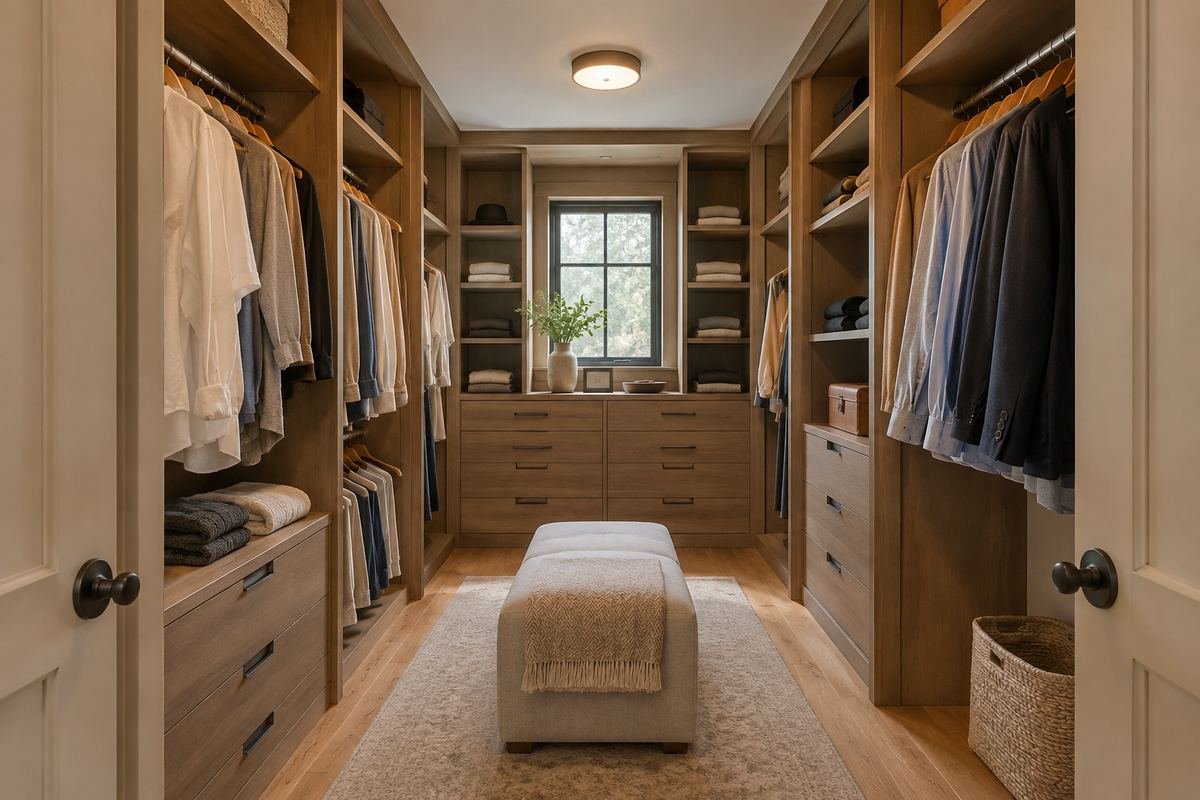
A walk-in closet needs useful room light as well as illumination inside cabinetry. A restrained enclosed ceiling fixture can make the route and standing area easy to understand. Let the storage lighting serve particular sections instead of asking it to illuminate the entire room.
Compare the arrangement with doors, drawers and clothing in normal use. Resolve the exact fixture placement, requirements and installation with an appropriate professional. An attractive center fixture does not establish that every cabinet or dressing position is adequately lit.
Practical tip: Review the route and storage tasks separately.
8. Balance a two-sided dressing space

Storage on both sides of a walk-in can create a balanced composition when the light reaches each side usefully. Repeat a restrained fixture family or light character so the room feels considered. Keep the central route clearly readable.
Check the clothing from both standing positions. Light on one wall can leave the opposite cabinet in shadow once someone stands between them. Compare general and localized illumination together, using a plan suited to the actual room rather than symmetry alone.
Practical tip: Inspect each side from its normal approach.
9. Give an L-shaped closet attention at the return

The return of an L-shaped storage arrangement can become difficult to see when fixtures follow only the main wall. Treat the second run as a useful storage area with its own view. A repeated light character can connect the two sides quietly.
Compare the inner corner with the storage filled. Cabinet sides and hanging garments can interrupt the light path. Review the proposed fixture positions and installation requirements before choosing the final shelf or hanging arrangement.
Practical tip: Check the return from both sides of the corner.
10. Illuminate a shoe section without spotlight clutter

A restrained light can make a shoe shelf easier to read without turning every pair into a separate display. Keep the illumination related to the shelf arrangement. A simple repeated rhythm can give the section a finished appearance.
Check the back of the shelf and the shadow from the pairs in front. Follow product requirements and avoid fitting a fixture where stored items will cover it. Compare the useful result with a simpler arrangement before adding more points of light.
Practical tip: Assess the shelf when the normal pairs are in place.
11. Give accessory shelves a calm light rhythm

A few illuminated accessory shelves can provide a clear home for bags or folded small items. Keep the light repeated and restrained so the storage remains easy to use. Choose the shelf contents first, then decide which sections benefit from additional illumination.
Review the actual sizes of the stored items. A large bag can block the light for objects behind it or cover a fixture that needs clearance. Keep the setup appropriate to ordinary use rather than arranging every object solely for the photograph.
Practical tip: Check the largest item in each illuminated section.
12. Compare drawer lighting as a complete furniture feature
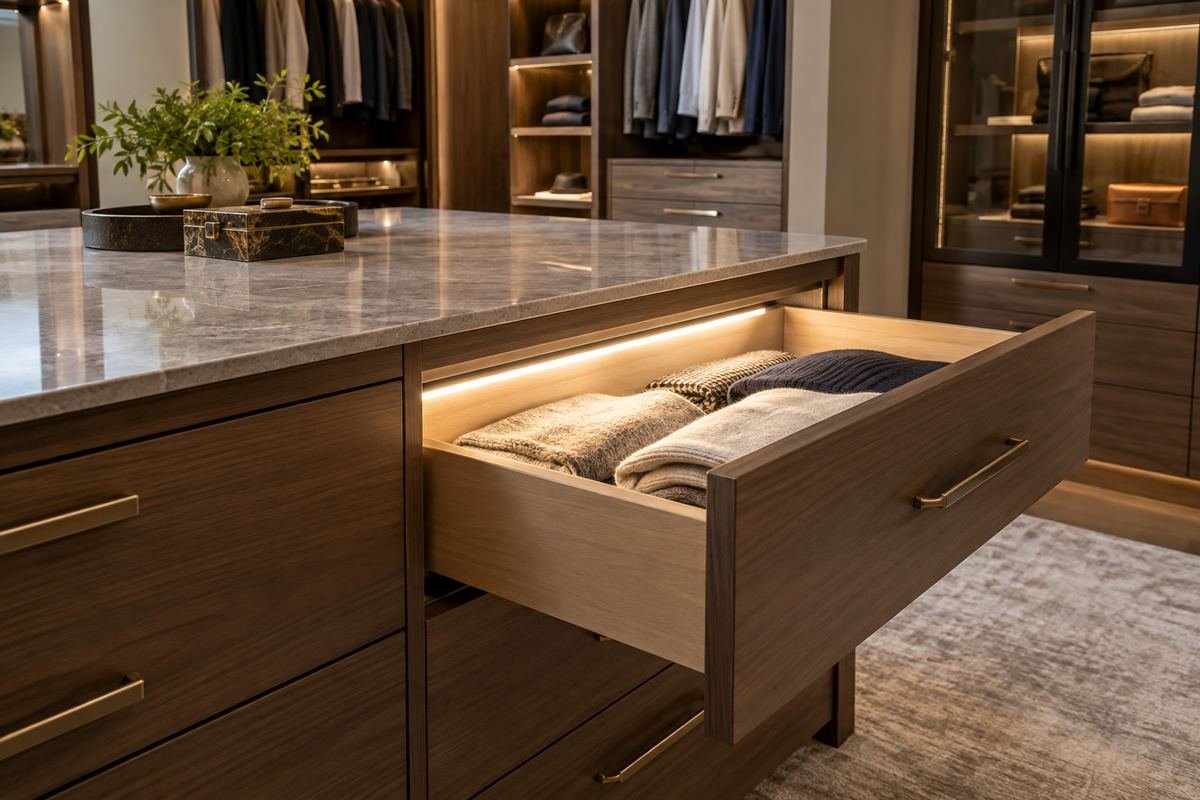
Integrated drawer lighting can make a deep storage compartment easier to inspect when the furniture system supports it. Keep the drawer contents simple enough that the useful effect is visible. This can be a considered detail in a larger dressing area.
Choose a purpose-designed arrangement with compatible controls and moving components. Do not improvise cables across drawer runners or hinges. Check maintenance access and the product’s intended operation with the supplier before treating it as a small decorative addition.
Practical tip: Review the drawer light as part of the complete furniture system.
13. Keep mirror light focused on the person

A mirror in a dressing area needs a useful view of the person, not only a glow around its frame. Compare the lighting from the normal standing position. A restrained source near the mirror can connect visually with the surrounding cabinetry.
Check reflected glare and the light on clothing. A backlit outline can be decorative without providing the desired front illumination. Resolve the actual fixture and mounting requirements for the location, especially when the mirror and storage share a confined wall.
Practical tip: Test the reflection from the usual dressing position.
14. Use a modest enclosed ceiling fixture in a small walk-in

An enclosed ceiling fixture can provide a quiet central element in a modest dressing room. Its restrained form can leave the cabinetry and clothing as the main features. Choose its appearance in relation to the ceiling height and room proportions.
The fixture must be appropriate for the closet and installed according to its requirements. Compare useful distribution and service access before judging the shade finish. A small decorative appearance does not establish suitability beside stored materials.
Practical tip: Review product suitability before choosing the finish.
15. Choose a consistent light character across adjoining bays

Adjoining wardrobe bays can look calmer when their light has a related character. Consistency makes it easier to compare clothing across the storage wall. Keep the repetition restrained rather than drawing a bright line around every surface.
Compare actual lighting samples instead of relying only on color names. Different products can look noticeably different together. Use components that are intended to work as a compatible system, with appropriate installation and controls for each section.
Practical tip: Compare neighboring bays with their actual clothing.
16. Test a darker cabinet with the clothing in place

A dark cabinet finish can create a strong furniture character, but its useful illumination needs careful comparison. Keep the light focused on the stored objects so the finish remains a backdrop. A restrained arrangement can feel more considered than excessive glowing trim.
Review the actual finish and fabric colors under a sample light. Increasing brightness alone may not address awkward distribution or glare. Check the filled cabinet from the normal standing position before committing to the final lighting specification.
Practical tip: Evaluate the dark finish with the actual stored colors.
17. Let pale cabinetry support a quieter scheme

Pale cabinetry can work with a restrained lighting scheme that keeps the storage easy to read. Use the cabinet’s simple lines as the visual structure. The light should help distinguish the clothing without making the white surfaces uncomfortably bright.
Compare glare and contrast from the normal viewing positions. A pale finish does not eliminate shelf shadows or establish that fewer fixtures will always suffice. Review the useful tasks and product requirements just as carefully as in a dark cabinet.
Practical tip: Check the clothing and bright cabinet surfaces together.
18. Keep a smaller automatic light easy to maintain

A suitable self-contained automatic light can serve an occasional compact storage area. Its small form can be visually quiet when a larger system is unnecessary. Choose the location around the actual item that is difficult to see.
Compare battery replacement or charging access as well as output and activation. Follow the product’s mounting and use instructions. A light that is awkward to maintain may become unused even if its first demonstration looks convenient.
Practical tip: Check how the power source will be serviced.
19. Use a manual control where it suits the routine

A straightforward manual control can be a useful choice when the user wants predictable operation. Keep the control easy to find at the normal approach. It can work well with a restrained lighting scheme that does not require several separate daily actions.
Choose the control as part of the compatible system and follow installation requirements. Compare its location with both the opening and closing routine. An automatically activated alternative is not inherently better if the manual arrangement is simpler for the household.
Practical tip: Plan the control from the entry sequence.
20. Test automatic activation during ordinary use

An automatic control can make storage lighting convenient when its behavior matches the room. Compare the approach, standing position and exit. Keep the visible fixtures restrained so the automatic function supports the routine without dominating the design.
Verify the exact sensor type and intended coverage. Door-responsive behavior and motion detection are different. Review shutoff and continued use according to the product guidance, including a person remaining relatively still while choosing clothing.
Practical tip: Test the whole routine rather than the first activation only.
21. Keep required power components reachable

Compatible power components and connections need a deliberate home within the design. Plan suitable access before the cabinetry is completed. A considered service arrangement can keep the finished storage visually quiet without making essential components inaccessible.
Follow the actual product’s location, ventilation and access instructions. Do not conceal components inside an unsuitable sealed void or improvise a power route. Coordinate the plan with the supplier or qualified installer before choosing fixed trim that limits future access.
Practical tip: Resolve service access before final cabinetry details.
22. Keep cables clear of moving storage parts
The cable route should be planned with doors, drawers and hanging storage in use. A compatible system can include appropriate management fittings that help keep the finished interior restrained. Consider the moving parts before deciding the light positions.
Follow the manufacturer’s instructions and have suitable installation work completed appropriately. Do not route loose cords across runners, hinges or a walking path. The clean appearance should come from a resolved plan, not from pushing an unsuitable connection behind clothing.
Practical tip: Check the complete movement of nearby doors and drawers.
23. Finish by checking the closet with its normal contents

The final lighting review should happen with ordinary clothing and accessories in place. Look at the hanging section, shelf rear, shoe storage and mirror from their normal positions. A restrained arrangement succeeds when those views remain useful.
Review glare, controls and maintenance access as well as appearance. If one section remains difficult to see, address that specific task before adding more decorative illumination elsewhere. Keep the final scheme tied to the household’s routine rather than an empty-cabinet photograph.
Practical tip: Use the filled closet as the final acceptance view.
Frequently Asked Questions
What is the best light for a closet?
Choose by the storage task, closet dimensions and product suitability. Hanging sections, deep shelves and a dressing mirror may need different arrangements. Compare the actual filled storage and follow the exact fixture instructions rather than choosing one type for every closet.
Can LED strips go inside a wardrobe?
A suitable wardrobe-lighting product can work when installed according to its instructions and required clearances. Check the complete compatible system, mounting position and power components. Do not assume every decorative LED strip is appropriate beside stored clothing.
Are battery lights useful in a closet?
They can suit some occasional or compact storage locations when the product is intended for the use. Compare output, mounting, controls and access for battery replacement or charging. A convenient power source does not establish that the light reaches the needed area.
Why are shelves still dark after adding a ceiling light?
The shelf structure and front objects can block light from above. Compare the contents from the normal standing position, then consider suitable localized lighting. Adding a brighter ceiling source alone may not address the shadowed area.
Does every closet need motion detection?
No. A manual control, door-responsive light or room sensor can suit different routines. Compare activation and shutoff with normal use, including standing relatively still. Choose the control for its intended behavior rather than treating automatic operation as universally better.
Should closet lights be warm or cool?
Compare an actual lighting sample with the clothing and adjoining room. Brightness, color appearance, distribution and glare all influence usefulness. There is no single color-temperature number that establishes the right result for every closet and every person.
Choose the Details That Work in Your Home
Choose closet lighting ideas that make the clothing and storage easier to use. Once useful visibility, suitable products, controls and maintenance access work together, refine the fixture finish and visual rhythm. A restrained arrangement that serves the daily routine can be more satisfying than lighting every edge.
For related ideas, explore closet door ideas, closet organization ideas, bedroom lighting ideas.
Planning References
IKEA: current wardrobe-light system details and compatibility; Philips Hue: lighting shelves and storage with LED strips. Follow the instructions for the exact products you choose.
Optional digital guide for this topic
If you prefer a structured workbook, explore this related paid guide.