The most useful outdoor dining area ideas make an ordinary meal easy to carry out, sit down to and clear away. A beautiful table can still be frustrating if a pulled-out chair blocks the kitchen door or every serving dish has to share the same crowded surface.
Begin with the people who usually eat outside and the route from the house. Draw the complete table, occupied chairs and any serving furniture on the actual usable surface. Check the arrangement at the time of day you expect to use it, including the sun, exposure and movement through the garden.
These 25 furnishing concepts focus on arranging an existing suitable outdoor space. They are not paving, structural, electrical or shade-installation plans. Follow the exact furniture, equipment, surface and site requirements, and make major changes through an appropriate project plan. The illustrations show possibilities rather than verified completed installations.
The images are original AI-generated decor concepts, not installation diagrams or photographs of completed client projects.
Browse These 25 Outdoor Dining Area Ideas
Jump to an idea
- Keep the kitchen-to-table route direct
- Use a small round table for two regular diners
- Run a rectangular table along a narrow patio
- Try a square table in a compact defined corner
- Compare an oval table with the end routes
- Give a bench one deliberate side of the group
- Keep the principal seat facing the garden view
- Offset the group beside a glazed door
- Separate dining from an existing lounging group
- Put a suitable serving console beside the dining zone
- Use a serving cart with a planned resting position
- Reserve a useful place for a tray landing
- Compare an extendable table in both complete modes
- Choose folding pieces with a real storage destination
- Use stackable chairs only with suitable storage space
- Choose armchairs from the table clearance
- Try armless chairs where their actual footprint helps
- Keep the tabletop center useful during a meal
- Repeat one color across separate dining pieces
- Relate the dining furniture to the existing house finish
- Use planting as a backdrop beyond chair movement
- Define a dining zone through the furniture footprint
- Review the table position at the actual mealtime
- Keep the dining setup clear of the garden through-route
- Finish with a simple reset and storage routine
Plan outdoor dining area ideas around a complete meal
List the regular diners, the food-carrying route and the items that need a temporary place beside the table. Test the actual furniture with chairs occupied and pulled out, doors open and serving storage in use. Check suitable support on the existing surface and all relevant furniture and site requirements before committing to a layout.
| Everyday condition | Arrangement to compare | Test in the real space |
|---|---|---|
| Two regular diners | A modest complete table group | Both chairs occupied and a useful serving surface |
| A long narrow patio | A lengthwise table arrangement | The through-route with chairs in use |
| A door beside the table | An offset dining position | The full door movement and carrying route |
| Occasional extra guests | An appropriate extendable table | Both modes, stored parts and extra chairs |
| Separate garden seating | A distinct dining zone | Movement between the groups without passing through seats |
| Seasonal storage | Suitable folding or stackable pieces | Actual storage size, handling and permitted use |
Distinguish a table size from an occupied dining footprint
The tabletop outline is only the beginning of the layout. Draw the actual chair depth, the movement needed to sit down and the routes that remain useful while people are seated. Use the real furniture and the needs of the household rather than treating one clearance number as a complete design rule.
Compare the usual meal with the occasional larger gathering
IKEA’s outdoor table guidance recommends considering regular seating and other table uses. Start there, then test any larger mode independently. Keep the everyday layout useful even if a larger gathering requires a different appropriate arrangement, extra chairs or a separate serving position.
Keep serving and dining as related, separate tasks
Pottery Barn discusses distinct outdoor activity zones and choosing furniture placement before arranging large pieces. Apply that to carrying, setting down and clearing a meal. A nearby suitable serving surface can help, but it still needs its own occupied footprint and straightforward access.
Choose furniture for the actual exposure and storage routine
Read the exact products’ location, care, securing and storage instructions. An outdoor label does not establish suitability for every exposure or permission to leave items out in all conditions. Keep drainage and required routes useful, and avoid adding a rug, screen or shade structure solely because it completes a photograph.
1. Keep the kitchen-to-table route direct
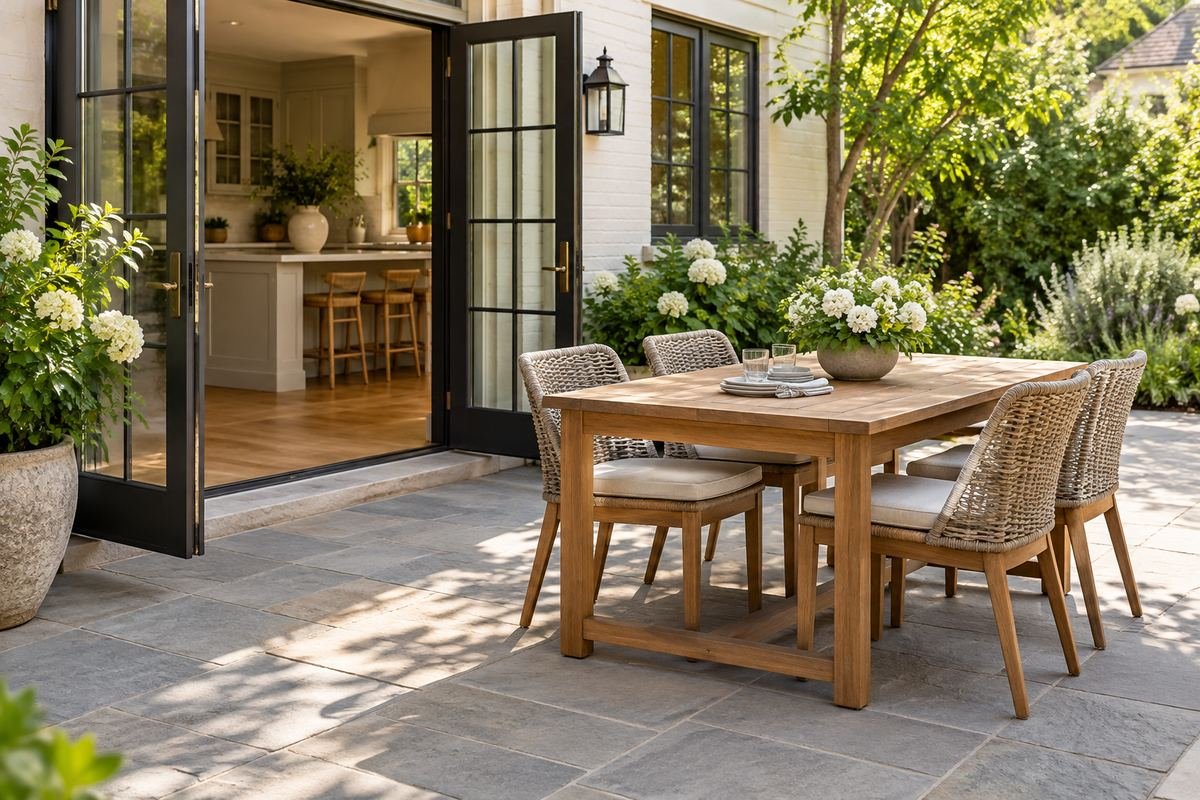
A dining position near the kitchen can make everyday meals easier to carry outside. Set the table where the route reaches a useful serving side without passing through occupied chairs. The group can feel connected to the house while still leaving the doorway its own clear working area.
Test the actual door movement and the carrying route with the full group in use. Near does not mean directly in front of the threshold. If a chair or table corner interrupts the approach, offset the group or compare a smaller suitable table before adding decorative pieces around it.
Practical tip: Carry a tray through the proposed route before fixing the layout.
2. Use a small round table for two regular diners
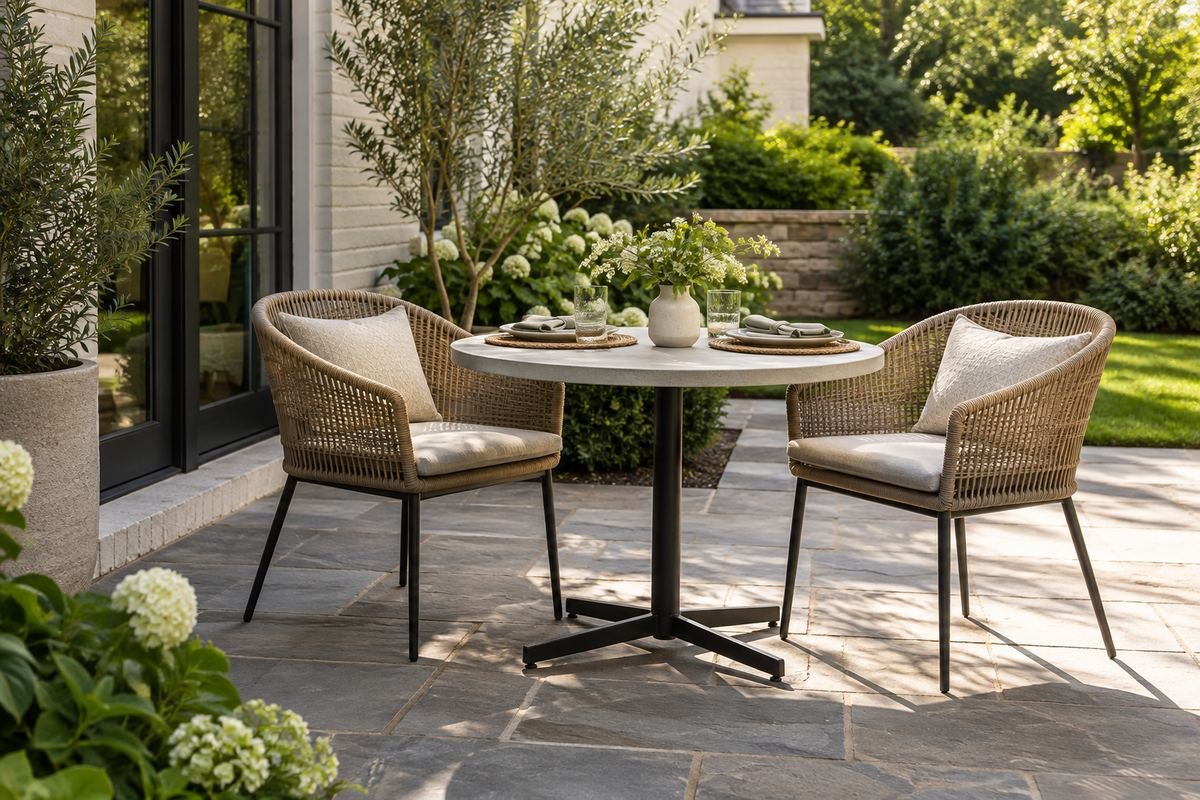
A modest round table can create a distinct place for two without turning the whole patio into a dining zone. Give both seats a deliberate orientation and a useful approach. A small group can look complete with a restrained tabletop and a clear edge around the actual chairs.
Compare the complete occupied circle with the existing surface and routes. The table’s diameter alone does not establish the required area. Test reaching the center and moving a chair back, and choose another shape if the round group pushes a seat into the doorway or planting edge.
Practical tip: Compare the complete chair group rather than just the tabletop.
3. Run a rectangular table along a narrow patio

A lengthwise table can relate to a long patio and give the dining group a clear direction. Keep the principal route beside the occupied group rather than through its center. The arrangement can make a narrow space readable when the table length and chair positions are chosen together.
Mark the chairs in their working positions before deciding the table fits. Review both ends and any doors along the wall. If circulation only works when the chairs are pushed in, shorten or narrow the group appropriately instead of treating the empty-patio photograph as evidence of a useful layout.
Practical tip: Test the through-route while the side chairs are occupied.
4. Try a square table in a compact defined corner
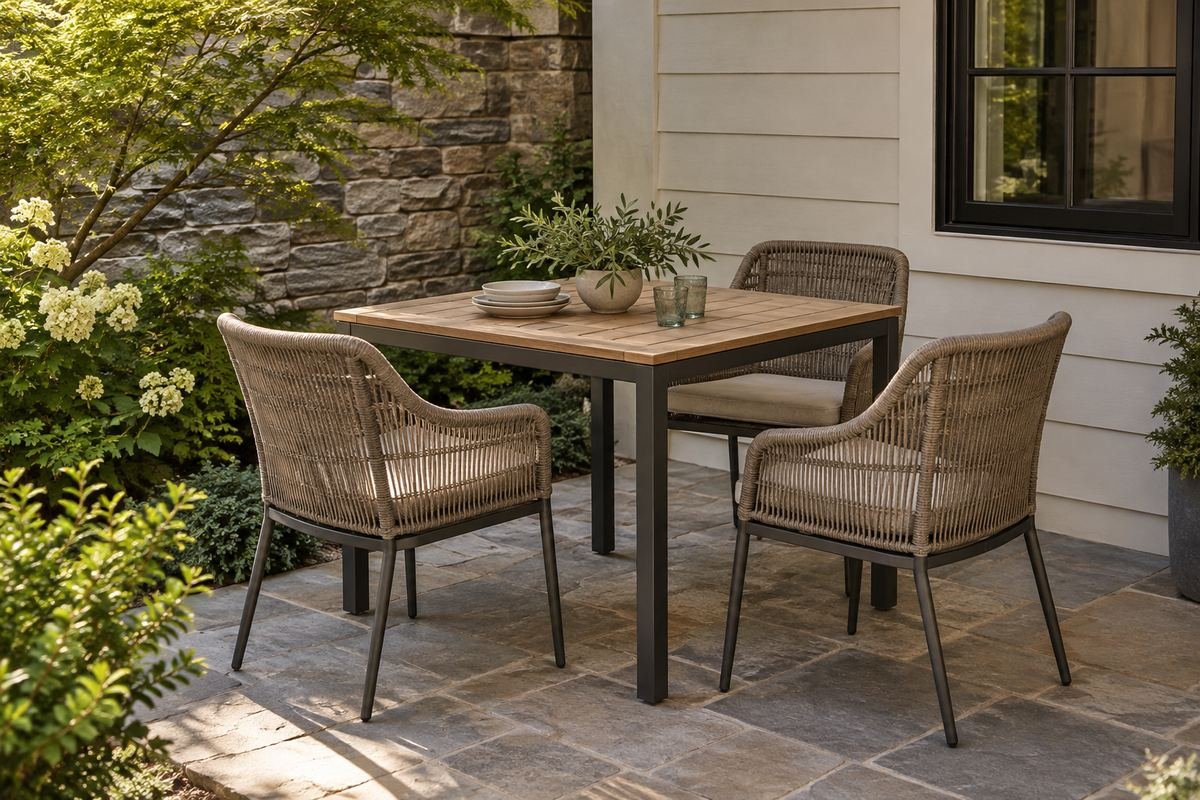
A square table can give a compact dining corner a balanced outline. Arrange the actual seats according to how the corner is approached rather than filling every side automatically. The repeated right angles can relate to paving and the house while a simple setting keeps the group light.
Test the chairs nearest walls and planting edges as well as the open sides. A corner can reduce approach choices even when the table itself fits. Keep each usable place straightforward to reach, and compare fewer regular seats if four positions make the everyday group awkward.
Practical tip: Check the approach to the least accessible seat first.
5. Compare an oval table with the end routes

An oval table can soften the outline of a longer dining group where people move around its ends. Keep the actual base and seat positions in the comparison. The rounded shape can relate comfortably to planting without requiring a completely circular dining footprint.
Test the table’s broadest part, the end chairs and the route around them. A curved edge does not automatically create enough circulation. Compare the actual oval with a rectangular option at the same useful seating level, and choose according to the occupied arrangement rather than the tabletop silhouette alone.
Practical tip: Walk around the ends with the intended chairs in place.
6. Give a bench one deliberate side of the group

An appropriate outdoor dining bench can give one side of a table a continuous visual line. Pair it with suitable individual chairs where that combination serves the household. The bench can relate to a wall-side edge without forcing every diner to use the same kind of seat.
Check the actual bench depth, table base and the movement needed to sit down or leave. Keep access to each place realistic, including passing another diner when relevant. Do not count on sliding the bench beneath the table unless the real furniture is designed and sized to do so.
Practical tip: Test entering and leaving the bench before counting its places.
7. Keep the principal seat facing the garden view

A dining group can use a worthwhile garden view as its orientation cue. Position the table so the regularly used seats appreciate that view without twisting away from the meal. Let the planting form a background while the table remains a useful place to eat.
Sit at the proposed height and check the actual sightline rather than choosing the view from a standing photograph. Keep routes and chair access working first. A table placed too close to a planted edge may trade the view for difficult seating, so compare a slightly offset position if needed.
Practical tip: Assess the view from a real dining-chair position.
8. Offset the group beside a glazed door

A table beside a glazed opening can connect indoor and outdoor meals visually while leaving the door area useful. Move the group to one side so the doorway reads as an approach rather than a missing dining place. The offset can give a simple patio a clear organization.
Review the full door movement, threshold approach and any screen operation with chairs in use. Keep the furniture distinct from the opening’s required space. Do not infer a suitable route from the closed-door position alone, especially where the tabletop or a pulled-out chair is close to the frame.
Practical tip: Draw the open door and occupied seats on the same plan.
9. Separate dining from an existing lounging group

A distinct table group can make a larger patio easier to use when it also holds lounge seating. Give the two activities their own occupied footprints and a clear connecting route. They can share a restrained material palette without merging into one crowded furniture arrangement.
Test moving between the groups while people are seated in both. Avoid counting the same open patch as dining chair space and lounge access. If the patio cannot support two complete activities, choose the main use or compare a more modest appropriate group before adding another table.
Practical tip: Test both furniture groups in use at the same time.
10. Put a suitable serving console beside the dining zone

A modest outdoor-suitable console can give serving dishes a temporary home outside the main table. Position it where food can be set down and returned without walking through occupied seats. The dining surface can then remain available for the meal rather than becoming the only landing place.
Check the console’s full depth, permitted location and any fastening requirements. Test standing at it while someone passes behind, and include drawers or doors if present. Choose a smaller surface or another suitable position if the serving task interrupts the route from the house.
Practical tip: Test serving and passing as two separate movements.
11. Use a serving cart with a planned resting position

An appropriate outdoor serving cart can move a small collection of dining items between useful positions. Give it a deliberate parked location beside the group instead of leaving it in the chair route. The arrangement can suit a meal that needs a temporary extra surface.
Follow the cart’s exact loading, movement and securing instructions, including its suitability for the actual surface. Plan both the travel path and its stationary footprint. Do not assume any wheeled indoor piece can be used outside or that a compact cart is easy to move when fully loaded.
Practical tip: Mark the cart’s parked position before bringing it into the layout.
12. Reserve a useful place for a tray landing

A small appropriate side surface near the dining group can provide a landing place for a tray before the meal is arranged. Keep it connected to the carrying route and distinct from the diners’ elbow space. It can be a modest furnishing choice rather than a large outdoor buffet.
Compare the actual tray dimensions with the usable top and the surface’s permitted load. Test approaching and setting it down without reaching over a chair. A narrow decorative table is useful only if the complete serving item fits securely and its position does not block the next movement.
Practical tip: Test the full tray on the proposed surface before choosing its size.
13. Compare an extendable table in both complete modes

A suitable extending table can make occasional larger meals possible without defining the everyday patio around the largest group. Keep the usual mode useful for regular diners. The additional length should have its own planned occupied footprint rather than borrowing space from an essential route.
Follow the exact furniture instructions and test the extended table with every intended chair. Include the mechanism, any separate components and the storage position for extra seating. If the larger mode blocks a doorway or another necessary activity, compare a different arrangement before treating the extension as extra usable capacity.
Practical tip: Draw both occupied modes and the extra-chair storage.
14. Choose folding pieces with a real storage destination

Suitable folding outdoor furniture can help a patio change between a small dining setup and a more open surface. Plan where each folded piece belongs before choosing it. The useful flexibility comes from a manageable storage routine, not simply from a hinge shown in a product picture.
Follow the exact furniture’s opening, locking, handling and storage requirements. Measure its folded dimensions and the route to the storage location. Keep the dining arrangement useful when open, and avoid selecting pieces that require awkward repeated carrying or have nowhere suitable to go when the patio is cleared.
Practical tip: Measure the folded furniture as well as the dining setup.
15. Use stackable chairs only with suitable storage space
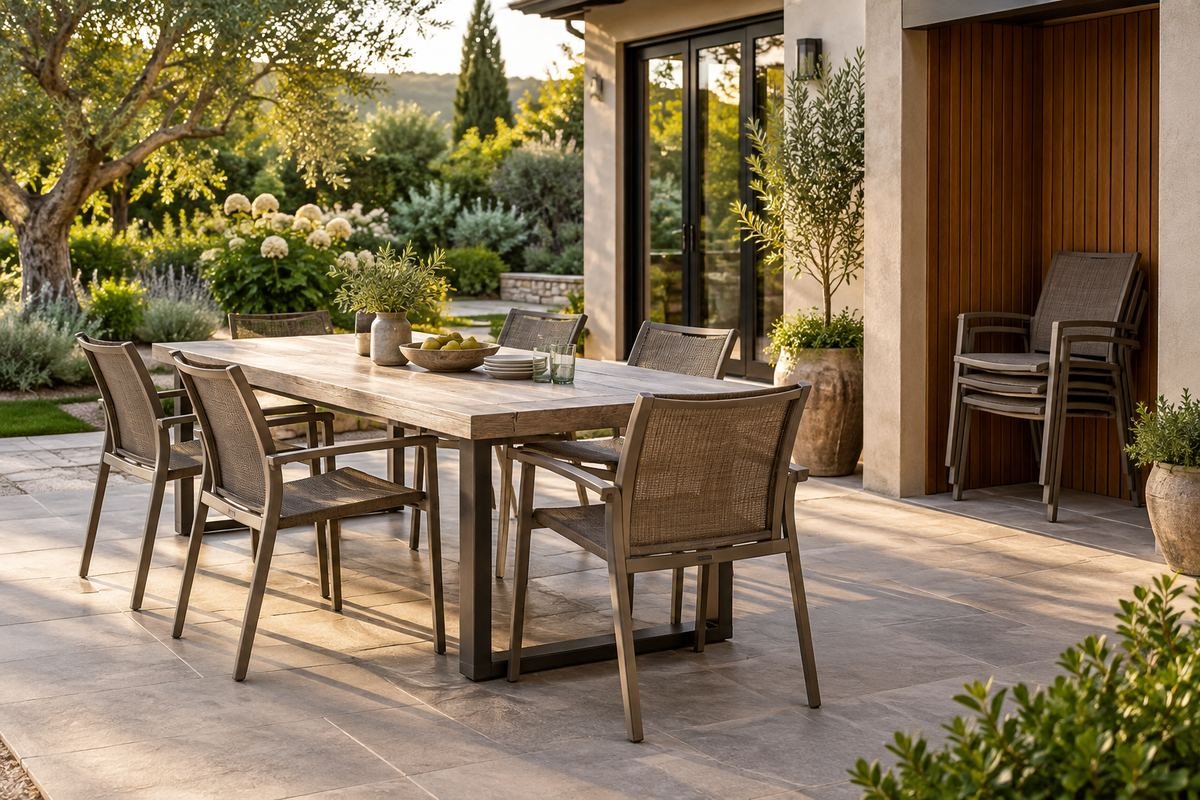
Appropriate stackable chairs can give occasional seats a distinct home when the everyday dining group is smaller. Keep that storage position out of the meal and garden routes. A restrained stack can look orderly beside the dining zone when the exact furniture is designed for that use.
Check the manufacturer’s stacking limits, handling instructions and exposure requirements. Include the actual stack footprint and height in the storage plan. Do not infer that similar-looking chairs are stackable, and keep the stored group suitable for the household rather than maximizing the number in a narrow corner.
Practical tip: Plan the permitted stack as a complete stored object.
16. Choose armchairs from the table clearance
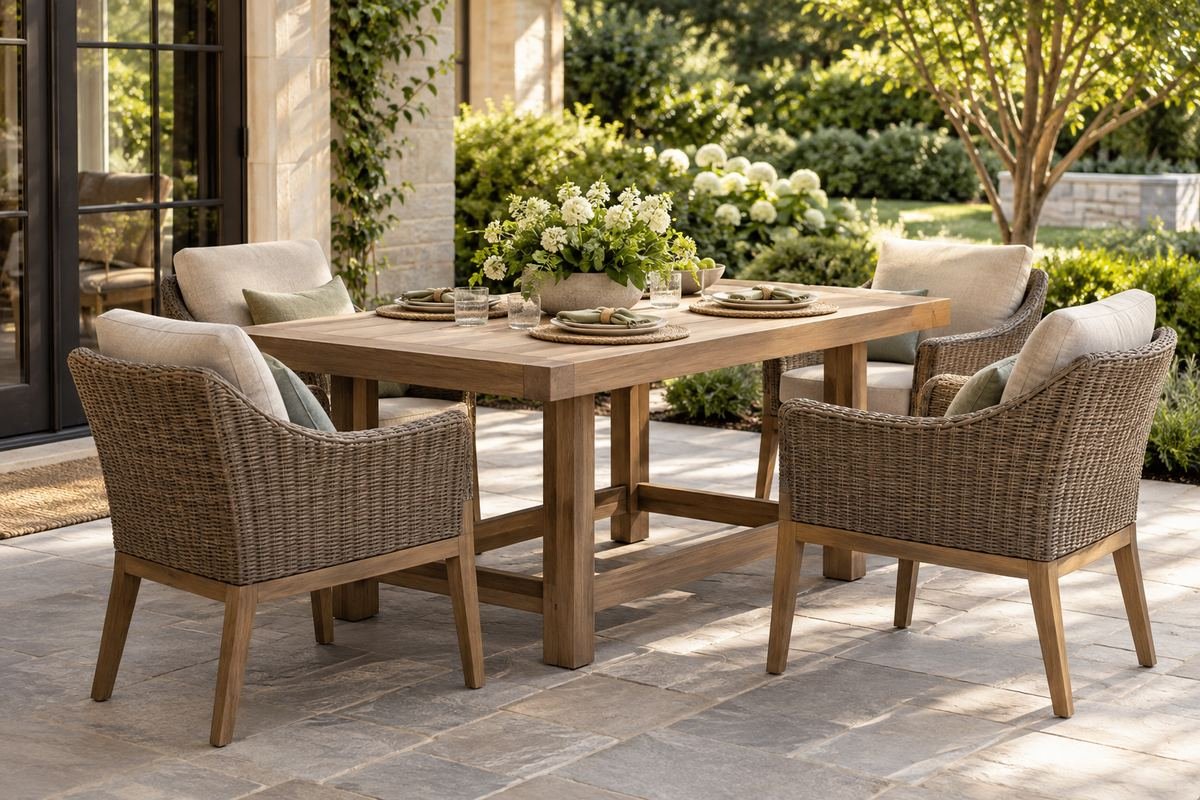
Outdoor dining armchairs can make a simple table group feel more substantial and give each place a defined outline. Compare the actual chair arms with the table apron and base. The combination should work as furniture before cushions or a coordinated finish are chosen.
Test pulling in, sitting and leaving with the real pieces. An armchair may use more width or remain farther from the tabletop than expected. Avoid counting on the arms sliding under the table unless that clearance is verified, and check the complete occupied group against the patio routes.
Practical tip: Compare arm height, table underside and the seated position together.
17. Try armless chairs where their actual footprint helps

A suitable armless chair can give an outdoor table group a simpler visual outline and different approach options. Compare the actual pieces rather than assuming the missing arms make every chair compact. A restrained frame can relate well to a modest patio when the seat remains comfortable for the household.
Check full depth, back shape and the movement needed to sit down and leave. Review the table base and all occupied places. Choose the combination through use rather than relying on a narrow-looking front photograph, and keep the resulting route useful when the chairs are pulled away from the tabletop.
Practical tip: Measure the chair’s full depth before choosing it for a narrow area.
18. Keep the tabletop center useful during a meal

A restrained center arrangement can give an outdoor table character while leaving its main purpose clear. Use one modest decorative group where it can be moved easily when dishes arrive. The dining area can feel considered without requiring food to compete with a permanent centerpiece.
Set out a typical meal with the usual plates and shared dishes. Check sightlines across the table from the actual seating height. If the decorative pieces make serving awkward, reduce the group or move it to a suitable nearby surface rather than adding more small objects between the place settings.
Practical tip: Lay out the normal meal before choosing the center decoration.
19. Repeat one color across separate dining pieces

A repeated quiet color can connect a table and chairs chosen as separate pieces. Let it appear in a restrained frame finish, cushion or small tabletop detail. The group can feel coherent while the actual furniture is selected for fit, use and exposure rather than an exact matching set.
Compare real finish samples in the outdoor light and follow every product’s care requirements. A similar color does not establish the same material or durability. Keep the palette limited enough that the whole group remains readable against the house and planting, and test the occupied layout before adding accessories.
Practical tip: Choose the working furniture combination before repeating the accent.
20. Relate the dining furniture to the existing house finish

An outdoor table group can borrow one material tone from the house so the patio feels connected to its setting. Compare warm furniture with masonry or a quiet frame color with the trim. A small deliberate relationship can be enough without copying every exterior finish.
View the furniture and house together during the expected mealtime. Read the actual furniture material and care requirements independently of the color choice. If the repeated tone makes the group visually heavy, balance it with a simpler tabletop setting rather than extending the same finish across every surface.
Practical tip: Compare the whole exterior view before buying a coordinated set.
21. Use planting as a backdrop beyond chair movement
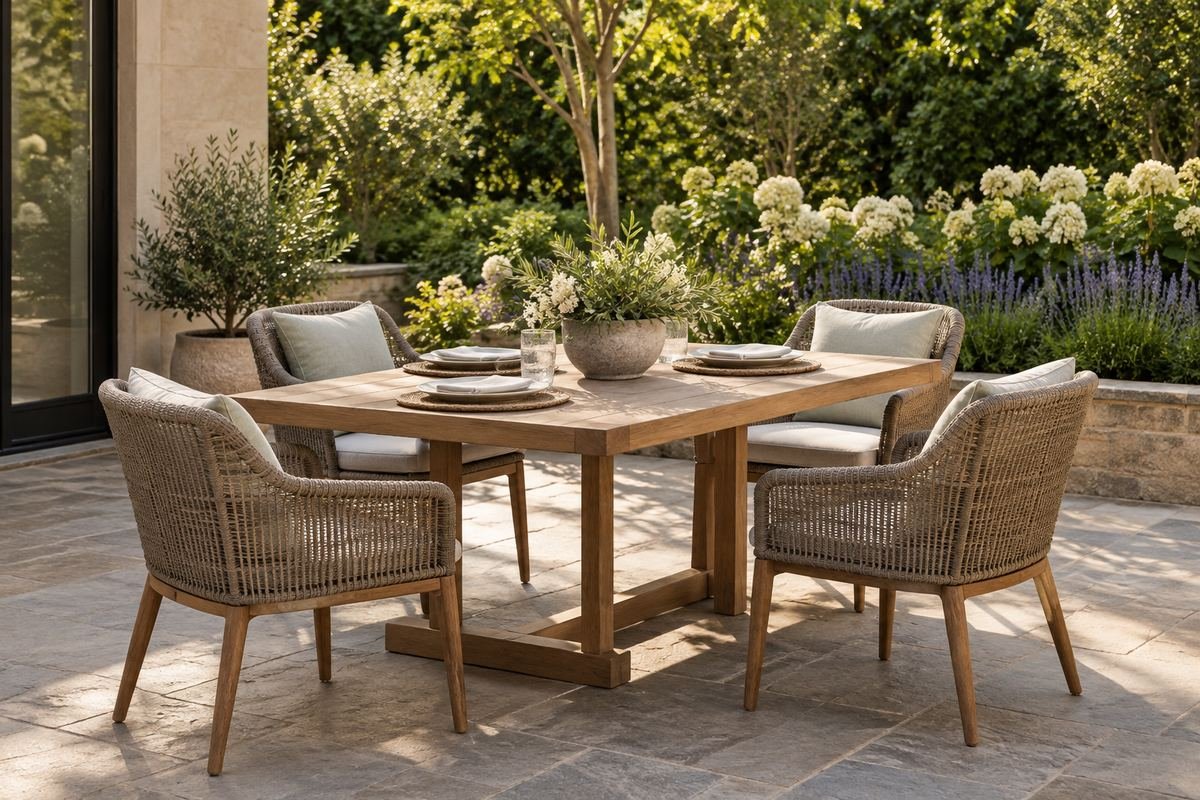
A planting edge can give an outdoor meal a garden setting without filling the dining surface with pots. Keep the main growth beyond the space used by chairs and routes. The background can feel lush while the actual dining footprint remains readable and straightforward to use.
Select plants for the real growing conditions and household, and account for their mature spread and care access. A decorative container does not establish a suitable growing position. Keep the table far enough from the edge for the actual seat movement, and review the arrangement as the planting changes.
Practical tip: Draw the mature plant outline beside the occupied chairs.
22. Define a dining zone through the furniture footprint

The dining group itself can define a useful outdoor zone without an added rug or raised platform. Keep the table and chairs visually related and let the surrounding surface remain clear. This can suit an existing patio where extra layers would complicate maintenance or everyday movement.
Test the complete occupied group against the surface and drainage requirements. Do not assume a visual boundary needs to become a physical edge. If the dining area feels indistinct, refine the furniture placement or palette before introducing another item that uses the same necessary walking or chair space.
Practical tip: Try the complete dining group on the existing surface first.
23. Review the table position at the actual mealtime

A patio can feel quite different at breakfast and in late afternoon. Check the proposed dining position during the time it will normally be used. The useful arrangement may be a modest offset from the most symmetrical location, depending on the sun and the existing site.
Treat any new shade product or structure as a separate complete planning task with its own requirements. A photograph cannot establish suitable support, exposure or wind use. Start by observing the conditions and testing the furniture position rather than assuming that a decorative canopy will solve every comfort issue.
Practical tip: Observe the planned seat positions during a real expected meal period.
24. Keep the dining setup clear of the garden through-route

A patio may also be the way to a gate, lawn or storage area. Arrange the table group so that ordinary through-movement stays distinct from occupied places. The dining zone can remain part of the garden without turning every trip through it into a request for someone to move.
Walk the complete route with the chairs occupied and any nearby doors in use. Include the objects normally carried along it. If the dining group takes over that movement, compare a smaller table or another suitable orientation rather than assuming the route can disappear whenever a meal is served.
Practical tip: Walk the necessary garden route with the full table group in use.
25. Finish with a simple reset and storage routine

A good outdoor dining layout is easy to return to its everyday state after the meal. Give removable dining items and any stored cushions a suitable destination according to their actual requirements. Keep the table group modest enough that ordinary clearing does not require rearranging the entire patio.
Follow the exact furniture and accessory instructions for care, securing and storage in changing conditions. Test carrying items back to the house and putting each piece away. If that routine feels awkward, simplify the group or adjust the serving position before adding more decorative layers around the table.
Practical tip: Complete one meal-and-reset rehearsal before adding accessories.
Frequently Asked Questions
Where should an outdoor dining table go?
Start with a suitable usable surface, the route from the house and the conditions during the expected mealtime. Compare the complete occupied furniture group with doors and garden routes in use. A central position in the patio is useful only when those tasks still work.
Is a round table better for a small patio?
A round table can suit some layouts, but its complete chair group may need more room than the tabletop suggests. Compare it with an actual rectangular or square option using occupied chairs and the real route. Shape alone does not establish a better fit.
Can a bench save space outdoors?
A bench changes how people approach and leave the table. Test its depth, leg positions and the access to each place, including movement past other diners. Do not assume that every bench stores beneath the table or that an end position works for every household.
How should I plan an extendable outdoor table?
Draw and test every permitted mode with the matching chairs and required routes. Include the extension mechanism, stored components and the place for extra chairs. Follow the exact furniture instructions, and keep the everyday setup useful in its own right.
Do outdoor dining area ideas need a rug?
No. A suitable existing surface can define the group without an added layer. If you choose a rug, review its outdoor suitability, the full chair footprint, drying and surface requirements. Keep drainage and routes clear rather than using a rug simply to complete the color palette.
Can shade be added after arranging the table?
Assess the sun during the actual mealtime before settling the layout. Any shade product or structure needs its own suitable complete installation and use plan, including supports and site conditions. A decorative image cannot establish anchoring, wind suitability or a safe equipment relationship.
Choose the Details That Work in Your Home
Choose outdoor dining area ideas through the ordinary meal: carry food out, take a seat, serve and clear away. Keep the complete furniture group suited to the existing surface and leave the useful routes available. A modest table with straightforward serving can offer a better everyday experience than an oversized arrangement that only works when the patio is empty.
For related ideas, explore patio rug ideas, backyard shade planning, dining table sizing checks.
Planning References
IKEA: outdoor table shapes, regular seating and folding storage; Pottery Barn: planning patio furniture around outdoor activities. Follow the instructions for the exact products you choose.
Optional digital guide for this topic
If you prefer a structured workbook, explore this related paid guide.