The most useful pot lid storage ideas let you choose one lid without lifting a pile or trying several sizes against the same pan. Start with the lids used in ordinary cooking, including the handles that project from them. Their complete stored shape matters more than a neat row of round rims.
These 23 arrangements cover supported racks, divided drawers, suitable mounted holders and reserve storage. Choose the few that solve your kitchen's actual problem. A holder's empty footprint, advertised capacity and supported lid range describe different things; compare all of them with the collection you own.
Contents
- 1. Use an expandable rack for a changing lid collection
- 2. Set movable dividers around the actual lid thickness
- 3. Run a short lid row from front to back
- 4. Arrange lids side by side across a shallow shelf
- 5. Pair one lid bay with the matching pan group
- 6. Lay a small collection flat in a shallow drawer
- 7. Use a suitable peg system to define separate positions
- 8. Bring the rack forward on a compatible pull-out shelf
- 9. Compare purpose-made cupboard-door holders
- 10. Consider an approved holder on a deep drawer's inner wall
- 11. Give a pantry shelf a defined occasional-lid group
- 12. Reserve a broad position for an oversized stockpot lid
- 13. Allow extra depth for a strongly domed lid
- 14. Turn broad bridge handles toward a clear grasping route
- 15. Keep fragile-looking glass lids independently supported
- 16. Choose a manageable low position for heavy lids
- 17. Give a stepped universal lid its own identifiable home
- 18. Separate rectangular casserole lids from round pan lids
- 19. Keep appliance lids with their own storage instructions
- 20. Separate seasonal lids from the daily cooking route
- 21. Leave an obvious return position for the lid in use
- 22. Use a small size map when similar lids cause confusion
- 23. Check the complete door-closing path before committing
Measure the lid in its intended storage position
Record the complete diameter or outline, the handle projection and the space needed to grasp each lid. Measure the cabinet opening as well as the interior, including hinges and the shelf above. Follow the actual cookware, cabinet and organizer instructions for care, mounting and loads. Start with cooled, appropriately cleaned and dry lids. A glass lid's appearance does not establish that a particular slot, hanging hook or adhesive system is suitable for it.
Choose an arrangement that fits your situation
- A mixed collection with different knobs: Compare movable dividers with the actual loaded profiles
- A few flat lids and a usable shallow drawer: Try individual flat positions with closed-height clearance
- A compatible door and ordinary-sized lids: Check a purpose-made holder's exact mounting and diameter limits
- One very broad or heavy lid: Give it an appropriately supported separate bay
- Several occasional sets: Keep reserve lids identifiable near their matching cookware
1. Use an expandable rack for a changing lid collection

An expandable organizer can let the storage length follow the current group rather than a fixed number of compartments. IKEA's VARIERA is one example intended for drawers or shelves. Check the loaded outline and stability at the chosen setting. Expansion does not create extra cabinet height, so include the tallest lid and its lifting route before filling the rack.
2. Set movable dividers around the actual lid thickness

A rack with movable dividers can accommodate a thin lid beside a deeper one. YouCopia's StoreMore instructions recommend positioning its dividers closely enough to keep lids upright and removable. Use the approved attachment positions and test the middle lid as well as the end pieces. More gaps on the base do not mean every gap should contain another lid.
3. Run a short lid row from front to back

A front-to-back arrangement can suit a narrow cupboard section when the lids remain easy to identify from the opening. Keep the most-used pieces toward the front and the row short enough that the rear lid comes out without removing the rack. Compare the lifting movement with the shelf above. Deep storage is less useful when the back positions become permanent hiding places.
4. Arrange lids side by side across a shallow shelf

A sideways row can show several lid profiles at once when the cabinet is wide but not especially deep. Choose a suitable organizer that keeps the pieces individually supported. Leave space to grasp each handle without pressing against its neighbor. Compare this orientation with a front-to-back row using the same collection; the better choice is the one that makes the awkward lid easier to remove.
5. Pair one lid bay with the matching pan group

Neighboring compartments can keep the cookware together without putting the lids on top of nested pans. Arrange the lid group in an order that is easy to recognize, such as matching the pan positions from left to right. Keep the groups independently removable. This works best when pairing reduces searching rather than adding a complicated numbering system to a small collection.
6. Lay a small collection flat in a shallow drawer

A shallow drawer may be enough for a few lids when every knob clears the cabinet opening. Give each piece its own supported position so one does not conceal another. Check the tallest handle with the drawer in its closed position. Do not force the drawer or turn the lids into an overlapping pile simply because the round outlines fit the drawer floor.
7. Use a suitable peg system to define separate positions

An approved adjustable pegboard can let the dividers follow several lid shapes. Set the pegs around the complete pieces without pressing on a glass edge or obstructing the handle. Confirm that the system is intended for the contents and drawer. The pegs should define a useful position, while the drawer and organizer remain responsible for supporting the actual load.
8. Bring the rack forward on a compatible pull-out shelf

When reaching the rear is the main difficulty, a suitable pull-out shelf can bring a lid organizer closer. Check its mounting instructions, rated load and complete travel path with the loaded rack installed. Keep the rack seated as its maker directs. The shelf must clear the door and frame before the tallest lid can be lifted; an empty sliding shelf does not prove the finished arrangement will work.
9. Compare purpose-made cupboard-door holders

Individual door holders can use an otherwise empty area when the door and product are compatible. Check the exact supported lid range and mounting requirements before choosing positions. Joseph Joseph's cited gray four-piece model is intended for lids from 16 to 24 cm in diameter. A larger lid needs another appropriate solution even if its rim appears to rest on the same holder.
10. Consider an approved holder on a deep drawer's inner wall

Some individual lid holders are also intended for the inside of a deep drawer. This can leave a broad central area for cookware, but the lid, knob and holder still occupy usable space. Follow the exact product instructions and check closure with the neighboring pans installed. Avoid treating a mounting option advertised for one model as permission to use any wall hook in the same position.
11. Give a pantry shelf a defined occasional-lid group

A pantry can hold reserve lids when the everyday cookware already has a useful kitchen position. Use a suitable rack and keep the group distinct from food packages and small appliances. Choose a shelf you can reach comfortably with the loaded items. A reserve home should remain identifiable rather than becoming a mixed shelf that requires unloading several unrelated objects before cooking.
12. Reserve a broad position for an oversized stockpot lid

A wide stockpot lid can dominate a rack intended for smaller saucepans. Give it a supported bay sized for the full rim and handle instead of squeezing it across two narrow positions. Check the cabinet opening at its normal door angle. Keep this occasional large piece away from the daily lids when moving it repeatedly makes the whole collection inconvenient.
13. Allow extra depth for a strongly domed lid
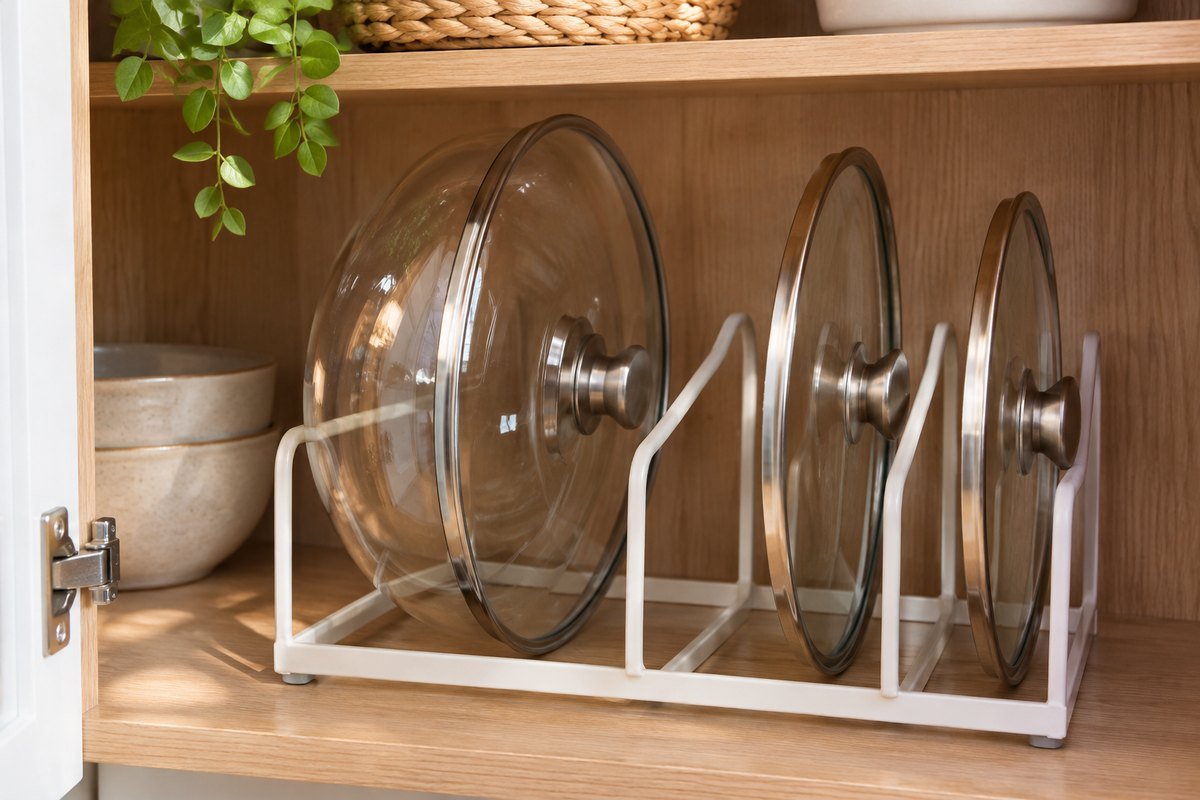
A domed lid can need considerably more spacing than a flat-looking rim suggests. Measure the deepest part in its proposed orientation and compare it with adjacent dividers. Choose a wider intended position when necessary. A row of equal gaps may look orderly while forcing one curved lid against the next, so let the shape determine the spacing.
14. Turn broad bridge handles toward a clear grasping route

A lid with a long bridge handle may fit the rack differently from one with a small central knob. Compare how you grasp it and whether the handle catches a divider during removal. Keep the lid in a position the organizer supports, with clearance for the entire handle. Do not rotate it into an unsupported angle merely to make a crowded row appear narrower.
15. Keep fragile-looking glass lids independently supported

A transparent lid can disappear visually when several pieces overlap. Separate the pieces so each rim and handle remains easy to identify. Follow the cookware maker's care requirements and use an organizer suitable for the actual lid. Avoid claiming that any wire coating or decorative separator prevents scratches; the contact points and product compatibility need their own check.
16. Choose a manageable low position for heavy lids

A heavy lid needs a location where its handle can be grasped and its weight controlled comfortably. Compare a supported low shelf or suitable drawer rather than assigning it an overhead gap. Check the storage hardware's load limits separately. Keep enough room around the piece to retrieve it without lifting another lid or dragging it past a fragile neighboring item.
17. Give a stepped universal lid its own identifiable home

A universal lid may serve several pan sizes, so assigning it to only one pan can make it difficult to find. Keep it in a clearly recognizable shared position and confirm which cookware the maker says it fits. Compare its full stepped profile with the organizer. A broad silicone-looking edge in a photograph does not establish heat limits or compatibility with every pan.
18. Separate rectangular casserole lids from round pan lids

A rectangular cover has corners and a different lifting outline from a round lid. Store it in a fitting supported section beside the related dish or in a separate wide divider. Measure the diagonal movement through the opening too. Avoid forcing corners into a rack selected only by round-lid diameter or balancing the cover on top of a row of saucepans.
19. Keep appliance lids with their own storage instructions

A pressure-cooker or specialty appliance lid may include seals, vents or other projecting components. Follow the appliance manual for its storage orientation and component care. Give it a defined fitting position rather than assuming it belongs in the ordinary saucepan rack. Keep any required parts identifiable, and avoid resting the lid in a way that presses on a valve or forces a seal out of shape.
20. Separate seasonal lids from the daily cooking route

A lid used with occasional entertaining cookware does not need the first position in the everyday rack. Keep the reserve in an appropriate dry location near its matching cookware, with an easy way to identify the set. Avoid building a tall heavy reserve stack. This frees the working group without pretending that another organizer will make every rarely used piece equally convenient.
21. Leave an obvious return position for the lid in use

Plan with the entire collection, including the lid currently on the stove or draining after washing. Its empty position should remain available when cleanup begins. Keep spare utensils and extra lids out of that gap. If the rack only works while several pieces are elsewhere, reduce the group or move reserve items instead of calling the temporary arrangement finished.
22. Use a small size map when similar lids cause confusion

When several lids look alike, a simple note beside the rack can record the matching cookware and its location. Check the real fit rather than trusting visual diameter alone. Keep the note on the storage area instead of attaching unverified labels to cooking surfaces. Skip the extra system if the household already recognizes each lid; the cue should remove uncertainty, not add administration.
23. Check the complete door-closing path before committing

A shelf rack or door holder can fit the open cabinet while still colliding with a shelf, hinge or pan when the door closes. Include the loaded handle projection in the trial. Joseph Joseph's cited installation guidance specifically requires checking closure. Choose a different supported position when the pieces meet; do not rely on pushing the door harder or letting a lid tilt out of its holder.
Build a lid-to-holder fit record
For each lid, note its complete outline, handle projection, weight where relevant and matching cookware. For each proposed holder, note the supported lid range, contact points, complete footprint and required clearance. Joseph Joseph's cited gray four-holder set, SKU 85149, specifies 16–24 cm lids and excludes porous, unsealed or heavily textured mounting surfaces. Follow its preparation and waiting instructions. A hypothetical 28 cm lid is outside that model's stated diameter range, even if it fits the cupboard. Do not transfer the limits from a differently sized set with a similar name. YouCopia describes approximately six lids for its cited StoreMore holder depending on their sizes; that capacity is not a promise for six large domed lids. Compare your whole group before choosing the final arrangement.
A practical next step
Start with the lid that is hardest to find or return. Give it a supported position, check the complete handle movement and then arrange the neighboring pieces around that access. A useful system stays clear after an ordinary cooking and cleanup cycle, including when the whole collection is back in storage.
For the surrounding room, plan storage for the matching pots and pans. organize the surrounding kitchen drawers.
The images are original AI-generated design concepts, not photographs of tested products or verified installations.
Sources and care references
- YouCopia: movable lid dividers, capacity and care
- IKEA: expandable VARIERA pot-lid organizer
- Joseph Joseph: gray pan-lid holders, fit and mounting instructions
Optional digital guide for this topic
If you prefer a structured workbook, explore this related paid guide.