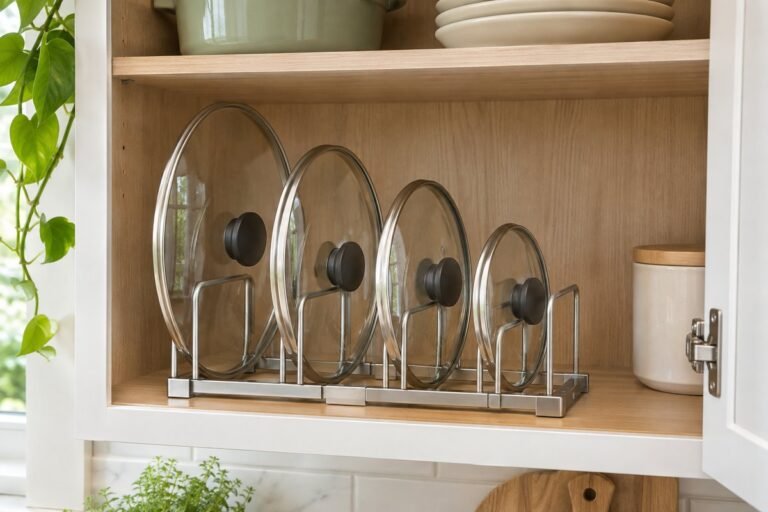
Useful plate storage ideas make one plate easy to lift without moving half the cupboard. Start with the plates used during an ordinary meal, then give larger platters and occasional sets their own positions. A short, reachable stack can be more useful than a tall arrangement that fits neatly only when nobody is using it.
These 22 options cover flat stacks, upright organizers, drawers and protected reserve storage. Choose the few that solve your kitchen's actual problem. The right arrangement depends on plate shape, weight, care instructions and the usable cabinet opening, rather than the number of compartments in a photograph.
Contents
- 1. Keep one modest everyday stack at the front
- 2. Separate dinner plates from smaller side plates
- 3. Use an adjustable plate holder inside a drawer
- 4. Arrange plate groups between drawer pegs
- 5. Stand individual plates in a fitted slot rack
- 6. Use a shelf insert to separate two small groups
- 7. Set an adjustable shelf to the real stack height
- 8. Give an open shelf a restrained daily collection
- 9. Use a glass-front cabinet for a working display
- 10. Store table-setting plates beside the dining area
- 11. Place heavier plate groups in a comfortable low drawer
- 12. Give oval serving platters their own upright bay
- 13. Reserve a wider compartment for charger plates
- 14. Check square plates against the actual corner clearance
- 15. Use a purpose-made padded case for occasional sets
- 16. Follow the dinnerware's guidance on protective separators
- 17. Keep the drying position separate from finished storage
- 18. Keep serving bowls out of the plate stacks
- 19. Leave a clear gripping gap around each stack
- 20. Keep plates clear of door hinges and hardware
- 21. Leave a return space for dishes currently in use
- 22. Identify reserve groups without covering the dinnerware
Measure a complete plate movement, not just an empty shelf
Gather the clean, dry collection and separate everyday dinner plates, smaller plates, serving pieces and occasional dinnerware. Measure the largest diameter or corner-to-corner width in each family, the stack height and the room needed to grasp it. Then check the storage location with doors and drawers in their normal open positions. Follow the actual dinnerware, cabinet and organizer instructions, including load limits and any specified furniture restraint. An attractive arrangement does not establish that a shelf or rack can support your collection.
Choose an arrangement that fits your situation
- Everyday round dinner plates: Compare a short accessible stack with a fitted drawer holder
- Several shapes in a deep drawer: Consider an approved adjustable pegboard arrangement
- A small plate group with suitable rims: Check a purpose-made upright slot rack
- Broad platters or square plates: Measure the entire outline and reserve a separate fitting bay
- Occasional decorated dinnerware: Follow its care guidance and consider divided protected reserve storage
1. Keep one modest everyday stack at the front

Give the plates used most often a position you can reach and return to comfortably. Keep the stack short enough to lift the top plate without nudging the shelf above it. Put spare place settings elsewhere rather than extending the daily stack upward. Test the position after clearing a meal, when the full group is back in the cupboard.
2. Separate dinner plates from smaller side plates

Two neighboring stacks make the size choice visible before anyone reaches into the cabinet. Avoid placing a smaller plate beneath a wider dinner plate simply to create a tidy pyramid. Allow room between the groups for fingers. If the two sizes nest differently, keep each family together instead of treating their shared color as proof that they belong in one stack.
3. Use an adjustable plate holder inside a drawer

A purpose-made holder can keep a plate group defined within a deep drawer. Compare its plate-size range with the actual dinnerware, then check the holder's complete exterior footprint. IKEA's cited UPPDATERA model is one example of an adjustable holder. Its handles and frame need room too; a plate fitting the holder does not establish that the assembled organizer fits the drawer.
4. Arrange plate groups between drawer pegs

A suitable pegboard system lets the dividers follow several plate shapes instead of forcing them into identical channels. Set the pegs using the approved positions and keep enough space to lift the plates. Check the opening beneath the cabinet frame before loading. The tallest peg or plate stack must pass through the usable opening without being pushed down.
5. Stand individual plates in a fitted slot rack

Upright slots can suit a small plate group when each piece is supported by the rack and can come out freely. Compare the slot spacing with the plate's rim and profile, not only its diameter. IKEA's OSTBIT illustrates this type of plate holder. Use a rack appropriate to the intended storage location rather than leaning loose plates against a cabinet wall.
6. Use a shelf insert to separate two small groups

A suitable freestanding insert can create an extra level for a small side-plate stack above another category. Check the complete insert's load limit, stable footing and height before placing dishes on it. Leave enough room to reach both levels independently. A shallow lower opening that traps the dinner plates defeats the reason for adding the extra shelf.
7. Set an adjustable shelf to the real stack height

Where the cabinet is designed for adjustment, a different shelf setting may serve the plates better than another organizer. Keep a comfortable grasping gap above the stack while preserving useful space on the next level. Use the correct supports in their intended positions. Do not add improvised supports or assume that lowering a shelf increases its permitted load.
8. Give an open shelf a restrained daily collection

A small group of ordinary plates can work on an accessible open shelf if you are comfortable with the cleaning it requires. Leave the front edge useful instead of lining it with ornaments. Keep the plate count tied to actual use. When the collection needs several rows or a tall stack to fit, a closed cabinet or drawer may be the more convenient home.
9. Use a glass-front cabinet for a working display

Glazed doors can make an attractive dinnerware family visible while keeping it in ordinary storage. Arrange the pieces so their daily retrieval remains straightforward. A plate should not require moving a display vase first. Check the complete door swing and the room to lift a stack; the attractive view through the glass is only one part of the arrangement.
10. Store table-setting plates beside the dining area

A suitable sideboard can serve a table that is some distance from the main kitchen cupboards. Give its accessible compartments a clear table-setting job instead of splitting one plate family across several rooms. Include the occupied dining chairs when checking the approach. Follow the furniture's assembly and restraint directions, and keep the top available for setting a plate down if that is an intended use.
11. Place heavier plate groups in a comfortable low drawer

For a heavy collection, choose a level where you can support the plates while retrieving them. A suitable drawer can bring the whole group forward instead of requiring a reach into a deep cupboard. Check the drawer and organizer limits for the actual load. Keep stacks modest and leave room for both hands; a low position alone does not make a heavy stack easy to handle.
12. Give oval serving platters their own upright bay

A large oval platter often interrupts a shelf intended for round dinner plates. A suitable vertical divider can give it a separate supported position without trapping the smaller daily collection. Compare the whole platter outline with the cabinet opening and removal route. Keep it inside the compartment rather than allowing an edge to project into the door's closing path.
13. Reserve a wider compartment for charger plates

Decorative chargers may be broader than the dinnerware they sit beneath. Measure their full rim and store the group in a compartment sized for that outline. Keep them separate from everyday plates so the wide pieces do not have to move at each meal. Follow their own care instructions; a decorative charger should not automatically be treated like a food-service dinner plate.
14. Check square plates against the actual corner clearance

A rack advertised by round-plate diameter may not accommodate a square plate in the same way. Compare the usable opening with the plate's full shape and the movement needed to lift it out. Give cornered dinnerware its own well-fitting section. Avoid pushing corners into a narrow rack simply because the central width looks similar to a round plate that fits.
15. Use a purpose-made padded case for occasional sets
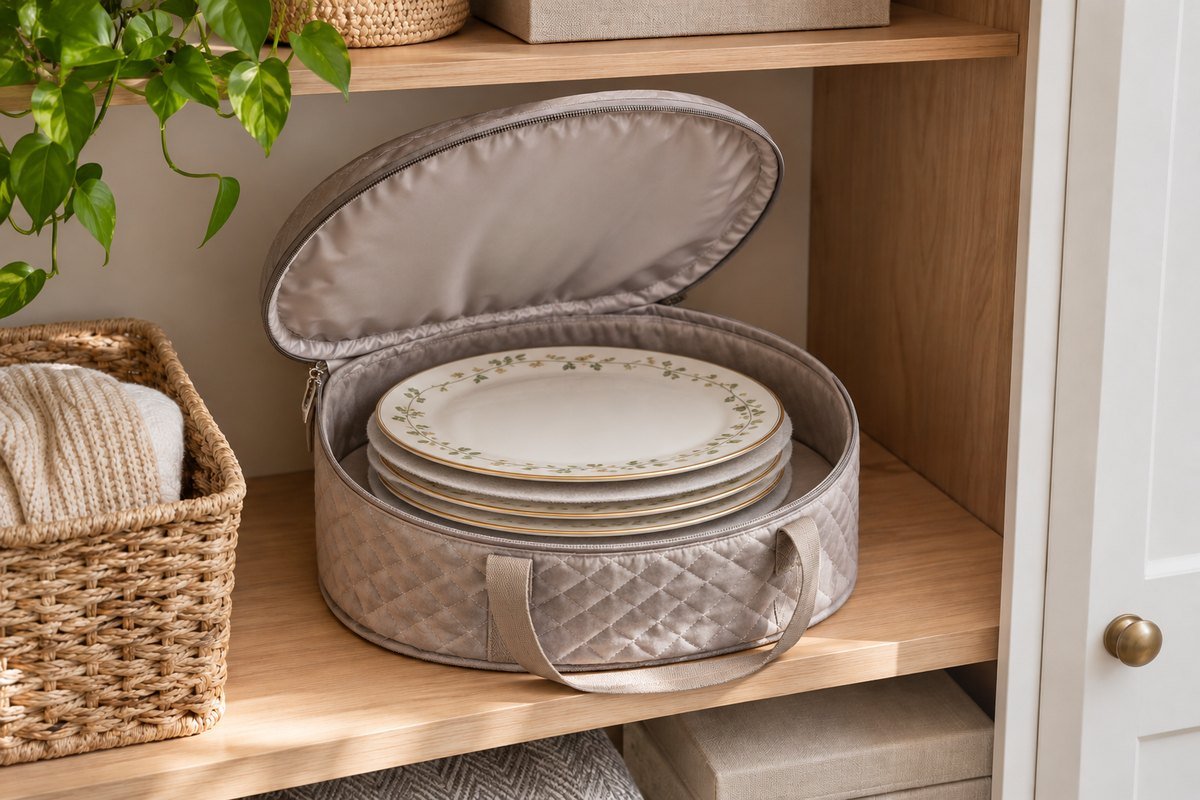
An occasional set can have a defined reserve home in a container designed for the dishes and their separators. Lenox's cited china-storage guide discusses quilted containers and divided storage. Check the case capacity and shelf support before filling it. Keep the complete set identifiable and store it where the loaded case can be handled comfortably, following the product directions.
16. Follow the dinnerware's guidance on protective separators

Some finishes need separation even within a short stack. Wedgwood's cited care guide recommends napkins or protective liners between stacked pieces. Use the care instructions for your exact dinnerware and choose separators that fit without bunching under the plates. Leave a top plate easy to lift. Protection should support normal handling rather than turn the daily group into a tightly compressed bundle.
17. Keep the drying position separate from finished storage

Let washed plates complete the drying required by their care instructions before returning them to a closed cabinet or storage case. Lenox's guide specifically calls for complete drying before packing china. Keep the rack's draining role distinct from the cabinet's storage role. A plate that is still drying needs an obvious temporary position rather than being slid into a finished stack.
18. Keep serving bowls out of the plate stacks

Deep bowls can prevent a plate group from lifting cleanly when the two are mixed together. Give bowls a neighboring section or another suitable level instead of using the plate stack as a base. The arrangement should reveal the shape you need immediately. Set the ordinary meal's dishes back into place to check that one category can return without displacing the other.
19. Leave a clear gripping gap around each stack

A cabinet can appear to hold several stacks while leaving no useful space to grasp them. Move the groups slightly apart and compare retrieval with the neighboring shelves occupied. Avoid pulling a plate from beneath a loaded stack just because the edge is visible. If the full collection cannot be handled comfortably, split it between two supported locations rather than eliminating every gap.
20. Keep plates clear of door hinges and hardware

Measure the usable cabinet space with the door open, including hinge projections and any central frame. A stack may need to sit inward from the side even when the shelf itself is wide. Check both the lifting path and the closed door position. This is especially useful for broad plates or organizers with handles that extend beyond the dish outline.
21. Leave a return space for dishes currently in use

Plan with the whole collection, including plates on the table or in the dishwasher. An empty section should show where those pieces return rather than invite unrelated supplies into the gap. If the cabinet only works while dishes are elsewhere, reduce the daily quantity or assign reserve storage. A system needs to work after clearing the table as well as before setting it.
22. Identify reserve groups without covering the dinnerware

A small card on the storage container or shelf can record a set name, plate sizes and the number stored. This is useful for seasonal or inherited pieces that are not retrieved every day. Keep the card with the storage group rather than attaching an unverified adhesive label to a decorated surface. Update the record when a piece is moved so it remains useful.
Use this plate-to-organizer fit checklist
Record five things for each plate family: complete outline, stack height, weight of the planned group, care requirements and comfortable lifting position. Then compare the organizer's external dimensions, usable slots, permitted load and removal movement with the cabinet. IKEA lists its cited UPPDATERA plate holder for plates from 7 3/8 to 12 1/4 inches, while the complete holder's width adjusts from 10 3/8 to 14 1/2 inches and its height is 5 3/4 inches. These are model-specific specifications: the supported plate range and the drawer footprint are different measurements. Its OSTBIT plate holder is a different layout, listed as 11 inches long, 5 inches wide and 3 inches high. Before choosing either style, compare your plate's shape and rim with the exact product instructions. For a hypothetical drawer, a plate may fit its organizer while the handle-inclusive frame fails to pass the cabinet opening. Resolve that complete movement before loading the collection.
A practical next step
Start with the plates used most often, keep their return path obvious and choose the remaining storage around the awkward pieces. A useful arrangement combines a supported position, a comfortable grip and enough space for the full collection. Buy an organizer only after the plate and the complete organizer both fit the intended location.
For the surrounding room, plan a kitchen hutch around the dishes you use. organize the neighboring kitchen drawers.
The images are original AI-generated design concepts, not photographs of tested products or verified installations.
Sources and care references
- IKEA: UPPDATERA plate-holder dimensions and intended fit
- IKEA: OSTBIT plate-holder layout and dimensions
- Lenox: divided china storage, drying and careful handling
- Wedgwood: product-specific care and protective separators
Optional digital guide for this topic
If you prefer a structured workbook, explore this related paid guide.