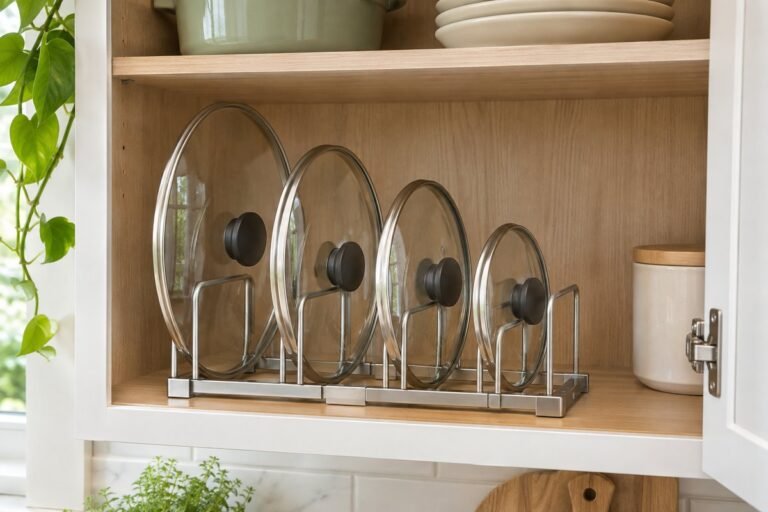
Useful bread storage ideas begin with the bread you actually buy or bake. A round loaf, a long baguette and a bag of sliced sandwich bread need different space. Start with the package directions and how quickly your household uses each loaf, then choose a place that is easy to open, check and clean.
These 22 arrangements cover storage furniture, short-term access and a clearly organized freezer reserve. They focus on ordinary unfilled bread; breads with perishable fillings or toppings need their own recipe or package instructions. A bread box can tidy the room, but it cannot guarantee a fixed number of fresh days or make moldy bread usable.
Contents
- 1. Give the everyday loaf one defined bread box
- 2. Choose a roll-top lid for a low overhead space
- 3. Use a hinged lid where the full swing stays clear
- 4. Keep a front-opening box's approach free
- 5. Use a removable lid when there is a clear landing place
- 6. Put a fitting bread bin on a reachable pantry shelf
- 7. Define a drawer section for packaged sandwich bread
- 8. Use a shallow caddy to gather wrapped bread varieties
- 9. Give a round loaf enough width without a crowded rim
- 10. Plan a long container around the baguette you buy
- 11. Keep soft rolls together without compressing them
- 12. Retain useful package information with the loaf
- 13. Match wrapping to the texture you want
- 14. Keep the cooling stage separate from closed storage
- 15. Leave room to lift and wipe beneath the box
- 16. Make the current loaf easier to reach than the reserve
- 17. Separate freezer bread into portions used together
- 18. Use a defined freezer bin for the wrapped reserve
- 19. Record freezing dates and identify different loaves
- 20. Give an intact wrapped freezer loaf a supported position
- 21. Move only the planned quantity into a clear thawing area
- 22. Reset the storage area when a loaf is discarded
Plan around the complete loaf and its opening movement
Measure the loaf with its normal wrapping and compare it with the container's usable interior and opening. External dimensions do not tell you whether a tall crown will pass through a low front. Include room for a bag closure and your hand. Choose a position away from direct sunlight, heat and persistent dampness. Do not use an oven or another appliance cavity as a storage cupboard.
Choose an arrangement that fits your situation
- You have little room above the counter: Compare a suitable roll-top or front-opening box and its full opening route
- The loaf is broad or unusually tall: Check usable interior and opening against its wrapped outline
- You use only a few slices at a time: Keep an identifiable wrapped freezer reserve in useful portions
- A drawer closes against the bread: Choose a different section or storage position without compressing the loaf
- The current loaf gets lost among supplies: Reduce the working group and make the opened package easiest to reach
1. Give the everyday loaf one defined bread box

A bread box works best when it holds the small quantity currently in use. Put it on a surface where opening the lid does not require moving a vase or pulling the box toward the edge. Check the wrapping and storage directions for your bread first. Choose the box for its useful access rather than relying on a decorative finish to preserve every kind of loaf.
2. Choose a roll-top lid for a low overhead space

A lid that retracts into the box can avoid the upward sweep of a hinged top. Check the exact mechanism and usable opening, because the moving cover also occupies part of the enclosure. Brabantia's cited roll-top model is one example of an internally retracting lid. Compare your loaf with the actual opening instead of assuming every roll-top has the same capacity.
3. Use a hinged lid where the full swing stays clear

A hinged bread box can provide a broad view of its contents when the top has room to open. Test the complete swing beneath cabinets, lights and projecting shelves. Leave the handle accessible without reaching around another object. If the lid repeatedly rests against a wall or has to be held partway open, choose another position or a different opening style.
4. Keep a front-opening box's approach free

A front-opening design can suit a shelf that has little space above it. Allow for the door's outward movement and the room needed to lift bread through the opening. Do not turn a lowered door into a cutting or serving surface unless that exact product is designed for the task. Keep the box fully supported at the back of the counter.
5. Use a removable lid when there is a clear landing place

A simple lift-off cover can make the entire interior accessible. Plan a nearby clean place for the lid while the bread is taken out, especially if the cover is heavy or awkward to grip. Compare its care directions with your routine. A substantial-looking ceramic box may be attractive, but appearance cannot establish its actual weight, grip or food-contact suitability.
6. Put a fitting bread bin on a reachable pantry shelf

A pantry shelf can keep the counter available without hiding the loaf behind unrelated food. Compare the shelf opening with the full box and its lid movement. Leave enough space to remove the bread directly. Use a position you can check easily, rather than an upper corner where a partly used loaf disappears from view.
7. Define a drawer section for packaged sandwich bread

A drawer can hold a loaf in its existing packaging when the opening and internal height suit the bread. Keep the loaf from being pressed by the cabinet frame as the drawer closes. Give it a dedicated section away from sharp tools and heavy supplies. This is a location choice, not a substitute for the package's storage requirements.
8. Use a shallow caddy to gather wrapped bread varieties

A shallow handled container can bring a small selection forward from a deeper shelf. Keep each bread in its appropriate wrapping and avoid piling a soft loaf beneath heavier items. Check the caddy's intended use and make its handle accessible. Its purpose is to move and identify the group, rather than to create a second container that is difficult to clean.
9. Give a round loaf enough width without a crowded rim

A round boule may need a wider enclosure than a narrow sandwich loaf of a similar weight. Check the widest point, crown height and access route before buying a box. Leave enough room to take it out without dragging the crust across the rim. If the wrapped loaf only fits when squeezed, compare another container instead of forcing a decorative size.
10. Plan a long container around the baguette you buy

Long bread can project from an otherwise roomy box. Compare its complete wrapped length with a suitable enclosure and the available shelf depth. Do not balance an unsupported end over the counter. If a full baguette is routinely too long, make a deliberate portioning and wrapping plan rather than leaving the opening partly closed around it.
11. Keep soft rolls together without compressing them

A short, broad container can keep a bag of rolls visible without a deep stack. Choose the amount that matches the next planned meals and keep its closure usable. Avoid pushing other pantry items onto the soft bread. A separate small group is easier to check than a tightly packed assortment where the oldest rolls remain buried underneath.
12. Retain useful package information with the loaf

When bought bread has storage directions, ingredients or a date on its packaging, keep that information available. A plain basket does not need to replace the original bag. If you decant into a suitable container, preserve the relevant details separately and clearly. Do not assume that bread which looks similar has identical storage or ingredient requirements.
13. Match wrapping to the texture you want

Crust and crumb do not respond identically to wrapping. King Arthur's bread guide describes the tradeoff: closer wrapping helps retain moisture while softening a crisp crust. Use the relevant baking or package advice for your bread, and compare what suits the next meal. No single cloth bag or airtight box is the best answer for every loaf and every kitchen.
14. Keep the cooling stage separate from closed storage

For home baking, allow bread to cool fully before wrapping it for the freezer, as King Arthur advises. Give the cooling rack a temporary clear place so the hot loaf is not immediately enclosed in the bread box. Store the rack after the cooling task. Keep this step separate from the permanent display instead of treating a lidded container as a cooling chamber.
15. Leave room to lift and wipe beneath the box
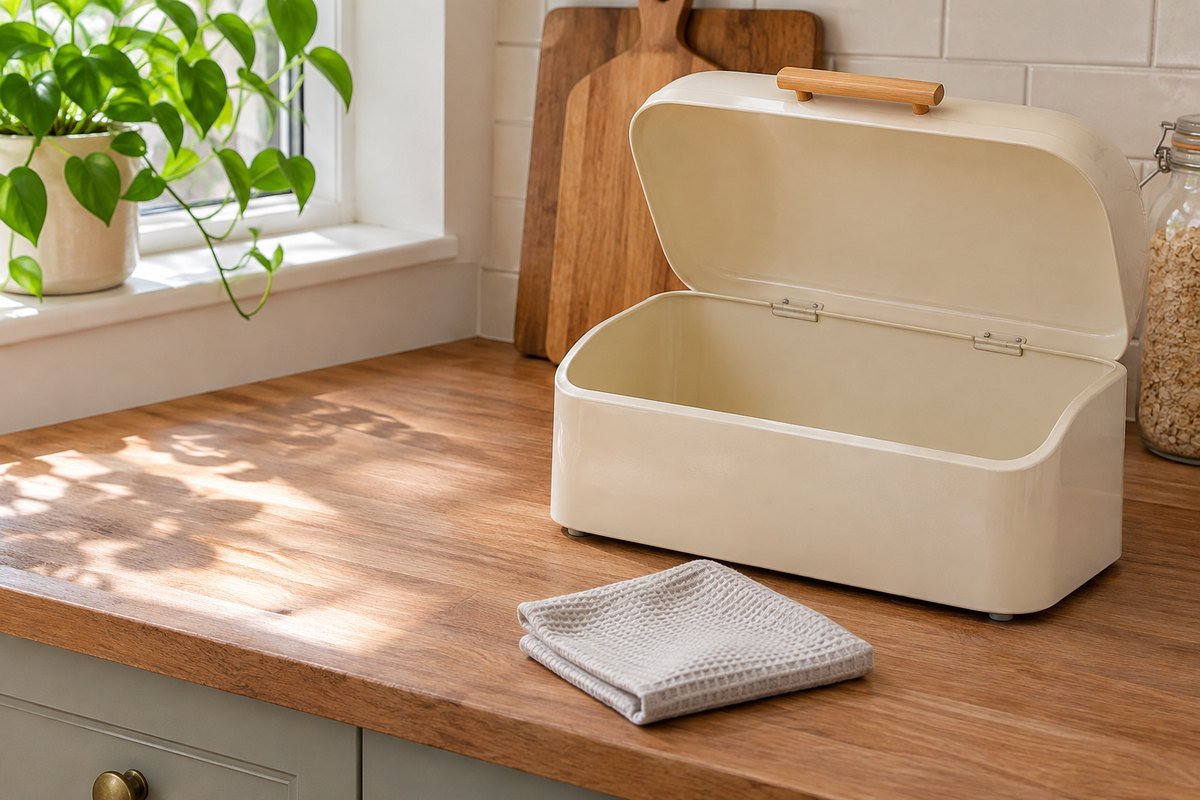
Make cleaning part of the location decision. A box wedged between several tall accessories can be awkward to move when crumbs collect around it. Follow the actual container's care directions and dry it as required before returning food. Keep decorative textiles from wrapping around the base or making the storage area harder to inspect.
16. Make the current loaf easier to reach than the reserve

Give the opened package the front position and keep an unopened suitable reserve separately identifiable. Check both when deciding what to buy next. This simple arrangement helps avoid opening another loaf just because the first is hidden. Use the bread's own condition and directions, rather than treating shelf position as a freshness test.
17. Separate freezer bread into portions used together

Package the amount normally taken out for one meal rather than making the entire loaf one frozen block. King Arthur suggests grouping slices for the intended use or separating them with parchment. Choose freezer-suitable wrapping and keep the packages recognizable. Portioning is most useful when it matches your household, rather than creating many tiny bundles that are difficult to find.
18. Use a defined freezer bin for the wrapped reserve

A modest freezer bin can distinguish bread from unrelated packages. Check the usable drawer opening and leave access to the surrounding frozen food. Keep the bread properly wrapped inside it; the bin is an organizer, not the protective wrapping itself. Avoid forcing a tall loaf into a drawer that will catch it on closure.
19. Record freezing dates and identify different loaves

A clear record can stop similar packages becoming a guessing exercise. Add the bread type and freezing date to an appropriate label, retaining any relevant ingredient information. Rotate the reserve as you use it. Dates help manage the group, but do not create a universal storage life; follow the bread's directions and relevant freezing guidance.
20. Give an intact wrapped freezer loaf a supported position

If the whole loaf is intended for one occasion, keep its wrapped shape protected from being crushed by other packages. Compare it with the space before choosing a container. King Arthur recommends airtight protective wrapping for frozen bread. Use a freezer-compatible material and avoid relying on a loosely folded decorative fabric bag as the only freezer protection.
21. Move only the planned quantity into a clear thawing area
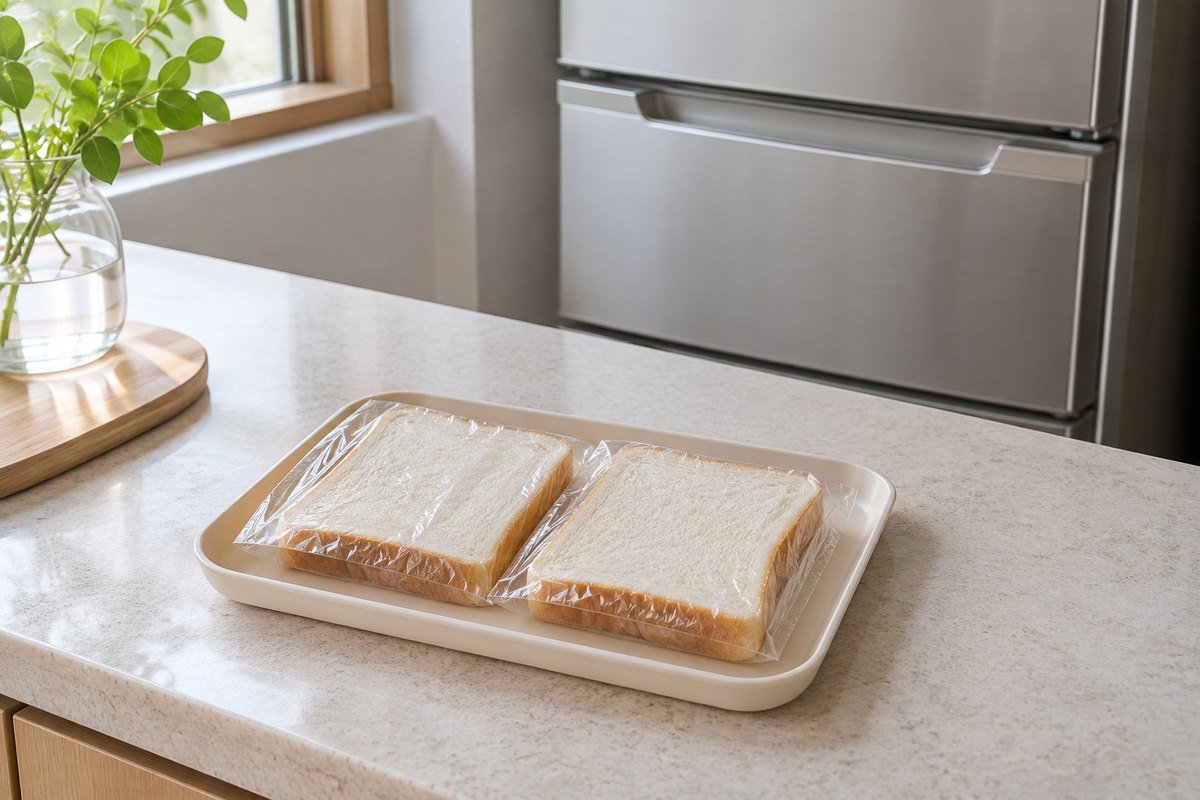
Keep the counter arrangement small by bringing forward the portion needed rather than emptying the entire freezer group. Follow the bread's thawing or preparation directions and any relevant recipe requirements. Leave a clean landing position without storing packages on appliance controls or work surfaces needed for cooking. Put the remaining frozen reserve back in its defined place.
22. Reset the storage area when a loaf is discarded

Check the bread as you use it. N.C. Cooperative Extension advises discarding moldy bread because contamination can extend below the visible surface; cutting off a spot is not a storage solution. Remove the affected bread and clean the container according to its care directions before reusing it. A clear, modest setup makes inspection easier than a box filled with forgotten mixed packages.
Make a loaf-fit and use record before buying a box
Record the wrapped loaf's length, width and height, the storage position's clear width and depth, and the space needed for the chosen lid. For example, a hypothetical 16-inch-wide shelf cannot hold a 17.5-inch-wide box fully within that space. Brabantia lists the cited white roll-top model at 17.5 inches wide, 10.3 inches long and 6.8 inches high; these are external product measurements, not its usable loaf capacity.
Next write down which bread stays in current use, which reserve is frozen, the normal meal-sized portion and where the package instructions are kept. Check the arrangement after an ordinary shopping cycle. Reduce the reserve or change the position if the box becomes difficult to inspect, the drawer compresses the loaf or freezer portions remain unidentified.
A practical next step
Choose bread storage around the loaf, its instructions and the next meals. A fitting box or drawer can keep the kitchen orderly, while a clearly wrapped freezer reserve prevents the counter from becoming an overflow shelf. Keep access and cleaning straightforward, and adjust the amount stored before adding more containers.
For the surrounding room, keep the surrounding kitchen counter practical. organize the neighboring pantry shelves.
The images are original AI-generated design concepts, not photographs of tested products or verified installations.
Sources and care references
- Brabantia: white roll-top bread bin features and external dimensions
- King Arthur Baking: wrapping and storing ordinary yeast bread
- King Arthur Baking: cooling, wrapping and portioning bread for freezing
- N.C. Cooperative Extension: handling moldy bread and other foods
Optional digital guide for this topic
If you prefer a structured workbook, explore this related paid guide.