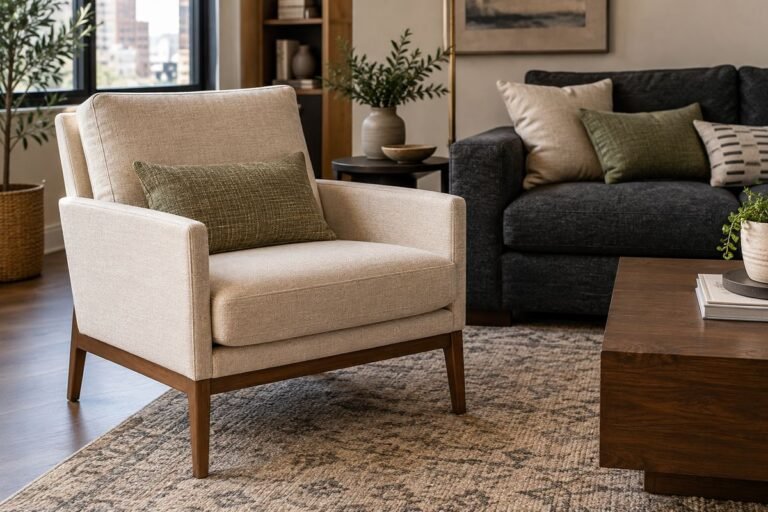
Good throw pillow combinations start with the sofa you already own. Its color, seat depth, back height and everyday use matter more than a fixed rule about how many cushions a room should contain. Choose one color direction, then make sure the pillows leave comfortable seating.
The combinations below are original styling suggestions rather than product reviews or claims about tested fabrics. They show how solids, patterns and textures can work together on different sofa colors. Use them as a starting point and compare real swatches in your room.
Begin with the pillows you have. Set aside worn inserts and covers that no longer suit the room, then identify the missing role: a quiet background, a connecting pattern or one deliberate accent. You may only need to change one cover.
The images are original AI-generated decor concepts, not installation diagrams or photographs of completed client projects.
Test Throw Pillow Combinations With the Usual Seats Occupied
Place the retained pillows on the sofa and sit in the normal lounging position before adding another cover. Next, view the same arrangement from the doorway under the evening lamps. For example, a tonal palette may look clear in daylight while its two darkest covers merge after dark. Adjust one color or texture at a time and retain the number and depth that leave the actual seats comfortable.
Jump to an idea
- Beige sofa with cream and rust
- Beige sofa with olive and oatmeal
- Gray sofa with dusty blue and white
- Gray sofa with charcoal and plum
- Navy sofa with ivory and denim
- Navy sofa with ochre and a fine stripe
- Cognac leather with cream and black
- Cognac leather with deep green
- Cream sofa with blue floral and a solid
- Cream sofa with taupe texture
- Green sofa with blush and warm white
- Green sofa with ochre and cream checks
- A brown sofa with denim and ecru
- A black sofa with warm neutrals
- A patterned sofa with quiet solids
- One large stripe with one small check
- A botanical print with a simple lumbar
- A tonal blue arrangement
- Warm neutrals with a single dark edge
- A matched pair on a small loveseat
- A balanced trio on a wide sofa
- A sectional with repeated color zones
- An asymmetric group with one quiet end
- A seasonal cover change with the same inserts
Build throw pillow combinations in three useful steps
First choose an anchor color already present in the sofa, rug or artwork. Next choose one visible pattern and a quieter companion that shares a color with it. Finally sit on the sofa with the pillows in place. If guests must move a pile before sitting, reduce the number or depth. A two-cushion arrangement can be complete; odd numbers are a styling option, not a requirement.
| Sofa | Quiet starting colors | Possible accent |
|---|---|---|
| Warm beige | Cream and oatmeal | Rust, olive or muted blue |
| Cool gray | Soft white and charcoal | Dusty blue or plum |
| Navy | Ivory and denim | Ochre or a small rust detail |
| Cognac leather | Cream and warm gray | Deep green or black pattern |
| Patterned upholstery | One background color from the sofa | A restrained solid from its pattern |
A simple scale worksheet
For an illustrative arrangement, try two 20-inch square pillows at the ends of a 78-inch sofa, then add one 12×20-inch lumbar only if the seat remains comfortable. Those sizes are trial inputs, not a universal formula. Pillow overlap, fill depth and how you sit make a width-only calculation unreliable. Photograph the arrangement from the doorway, then check it again while seated.
Choose covers for the care routine you can maintain
Read the exact cover and insert care labels separately. Removable does not automatically mean machine washable, and a photograph cannot establish a fiber’s composition or durability. If the sofa is used for snacks, pets or frequent naps, compare closures, cleaning instructions and replacement-cover availability before selecting a delicate texture.
1. Warm Beige-Sofa Throw Pillow Combinations With Cream and Rust

A warm beige sofa gives cream and muted rust a gentle background. Use cream for the larger pillow and rust as the smaller accent so the warm color remains deliberate rather than taking over.
A lightly textured solid is enough if the rug already has a pattern. Let the sofa upholstery show between the pillows.
Practical tip: Compare rust against the sofa in daylight; some shades lean noticeably orange.
2. Beige sofa with olive and oatmeal

Olive gives a neutral sofa a grounded accent without a sharp contrast. An oatmeal companion connects the green pillow to the sofa and nearby wood furniture.
Keep the green slightly different from any green wall so the pillow remains visible. A narrow stripe can introduce movement without another strong color.
Practical tip: Repeat olive once elsewhere in the room if it needs a visual connection.
3. Gray sofa with dusty blue and white
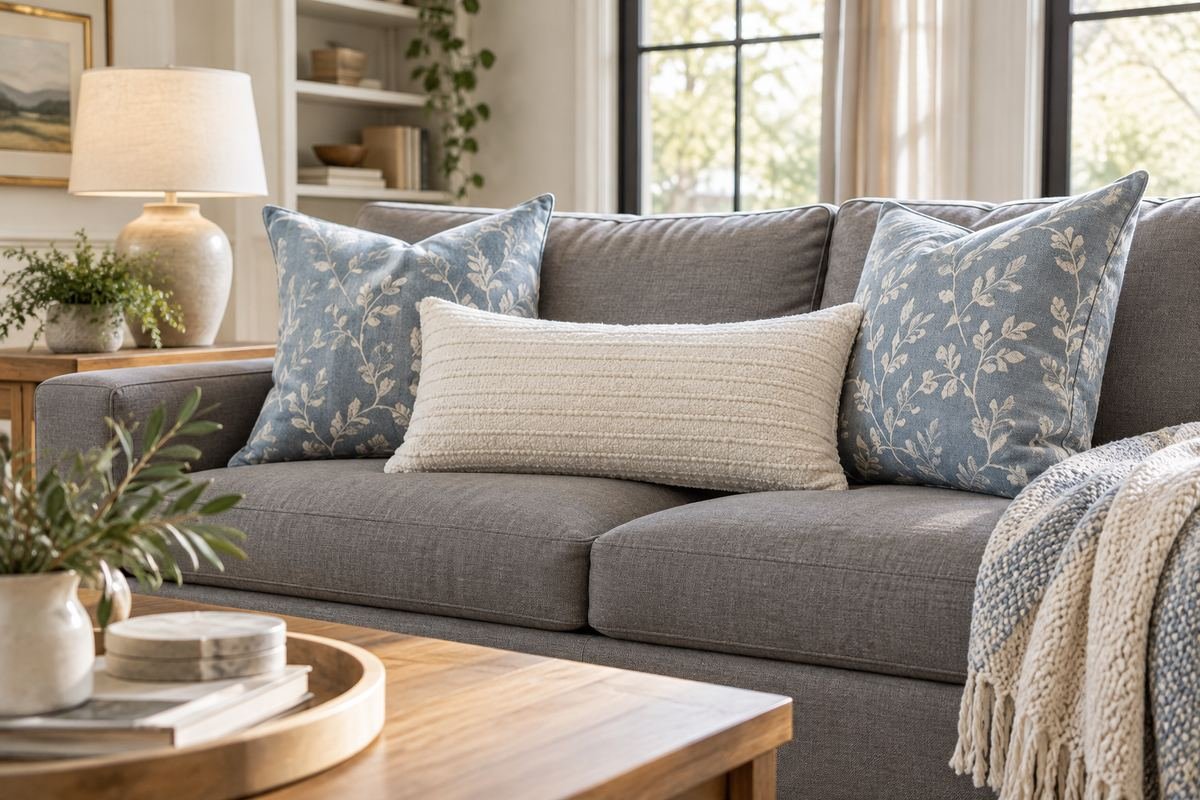
Dusty blue can soften a cool gray sofa while white provides a clear light note. Choose a blue with enough depth to remain visible against the gray upholstery.
If the room feels chilly, bring warmth through wood or a cream throw instead of adding several unrelated pillow colors.
Practical tip: Check the white cover beside the wall color before buying a full set.
4. Gray sofa with charcoal and plum

A restrained plum accent gives gray upholstery a richer mood. Charcoal provides a bridge between the sofa and the deeper color, especially in a room with dark frames or furniture.
Keep one of the dark covers plain so the combination does not become a dense block of pattern. A lighter cushion can preserve separation.
Practical tip: View the darkest colors under evening lamps as well as daylight.
5. Navy sofa with ivory and denim
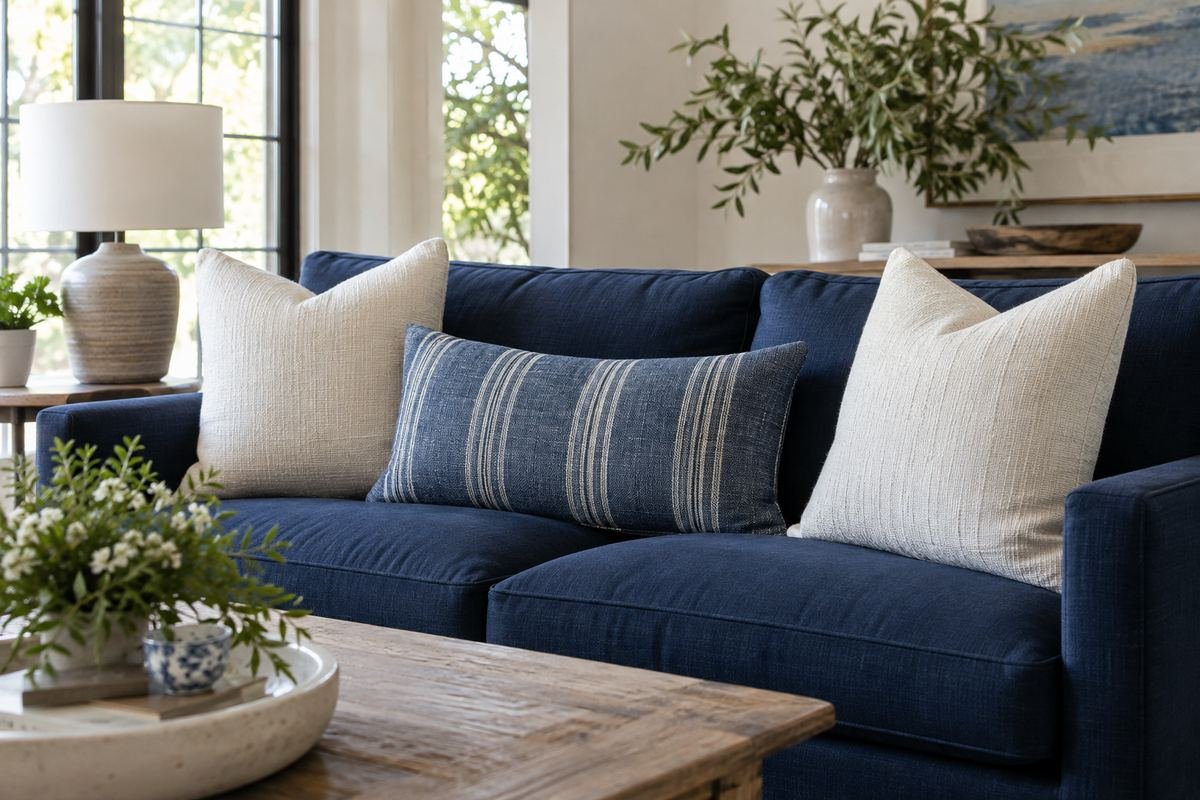
Ivory makes a navy sofa’s outline feel lighter, while a softer denim blue repeats the color family at a different depth. This is an easy place to mix a solid with a fine stripe.
Let the ivory be visibly warmer or lighter than the wall if you want the pillows to stand out. Avoid adding so many blue shades that the palette loses a clear anchor.
Practical tip: Choose one blue pattern and keep the remaining covers quieter.
6. Compare Navy-Sofa Throw Pillow Combinations With Ochre
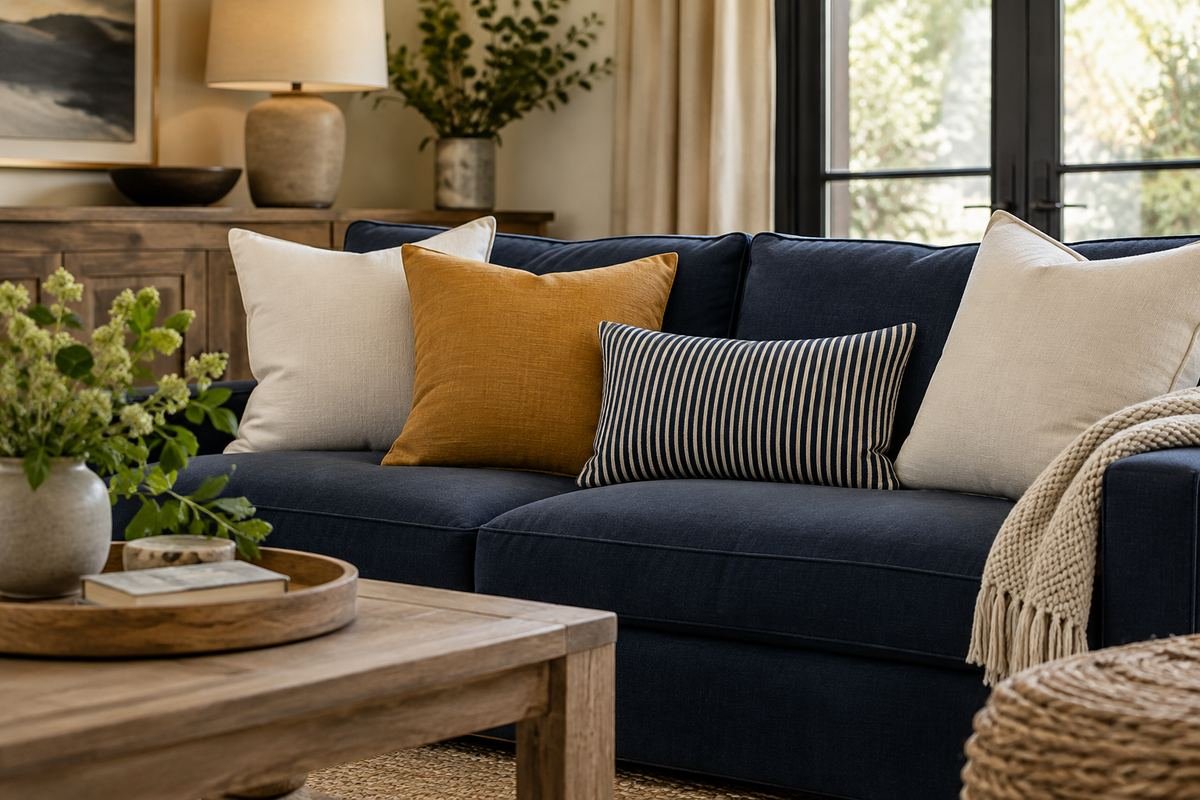
Ochre creates a warm focal point against deep blue. A small navy-and-ivory stripe ties the accent back to the upholstery without needing a second saturated color.
Use the warm color in a limited area if the room already has strong artwork. The sofa can carry the darker part of the palette.
Practical tip: Test a muted mustard rather than assuming the brightest yellow will work.
7. Cognac leather with cream and black

Cream softens the contrast with warm leather while a small black pattern connects to dark furniture legs or window frames. A graphic lumbar can provide enough detail for the whole sofa.
Choose textures that feel comfortable against the actual seat and do not slip excessively. Leather color varies, so compare the covers with your sofa rather than a generic brown sample.
Practical tip: Keep the boldest graphic to one clearly visible pillow.
8. Cognac leather with deep green
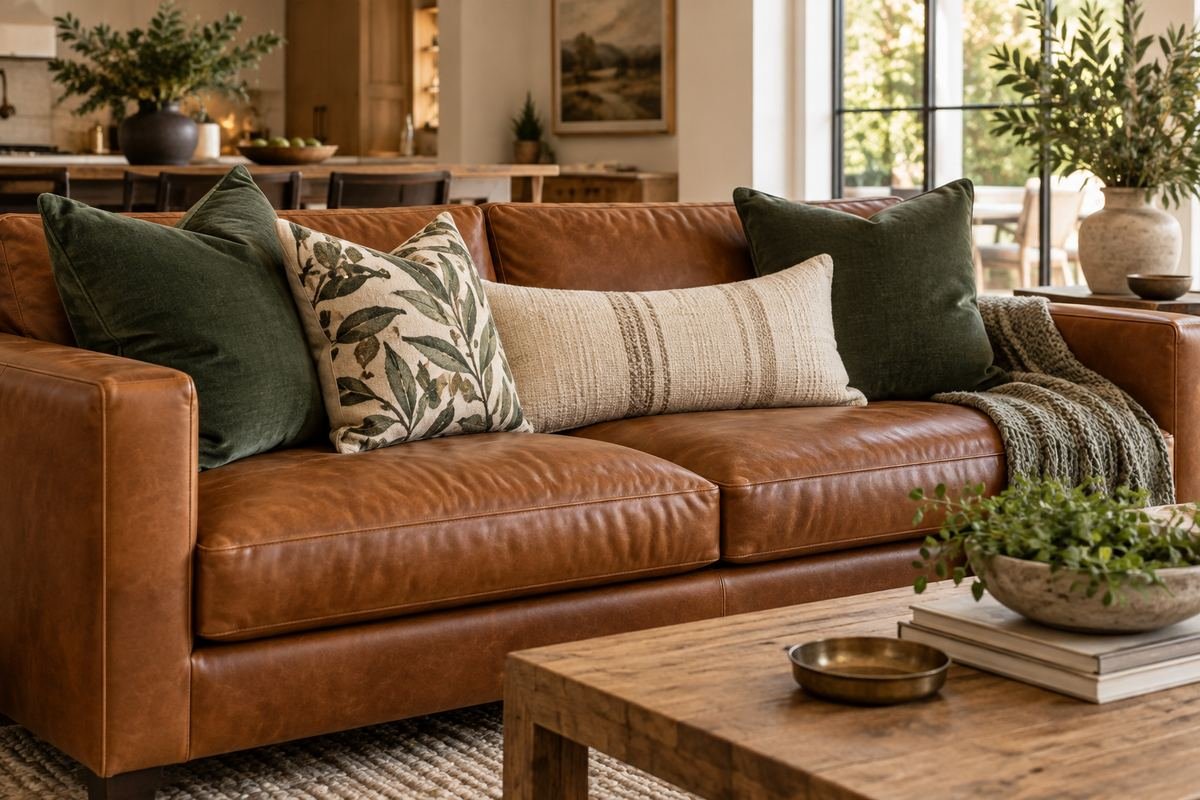
A dark green cushion creates a quiet connection to wood and plant colors around a leather sofa. Add a lighter neutral companion so the green does not disappear into evening shadows.
A woven-looking texture can contrast with the smooth upholstery. The image is a styling concept; choose the real cover by its stated material and care needs.
Practical tip: Check the green next to the leather before adding another brown accent.
9. Cream sofa with blue floral and a solid

A floral pillow can introduce several colors while a plain blue companion keeps the composition readable. Choose the solid from one visible color in the print.
Let the floral be the main motif rather than competing with equally detailed stripes and checks. A cream cushion can separate the printed pieces.
Practical tip: Look at the print from across the room; tiny details may disappear.
10. Cream sofa with taupe texture
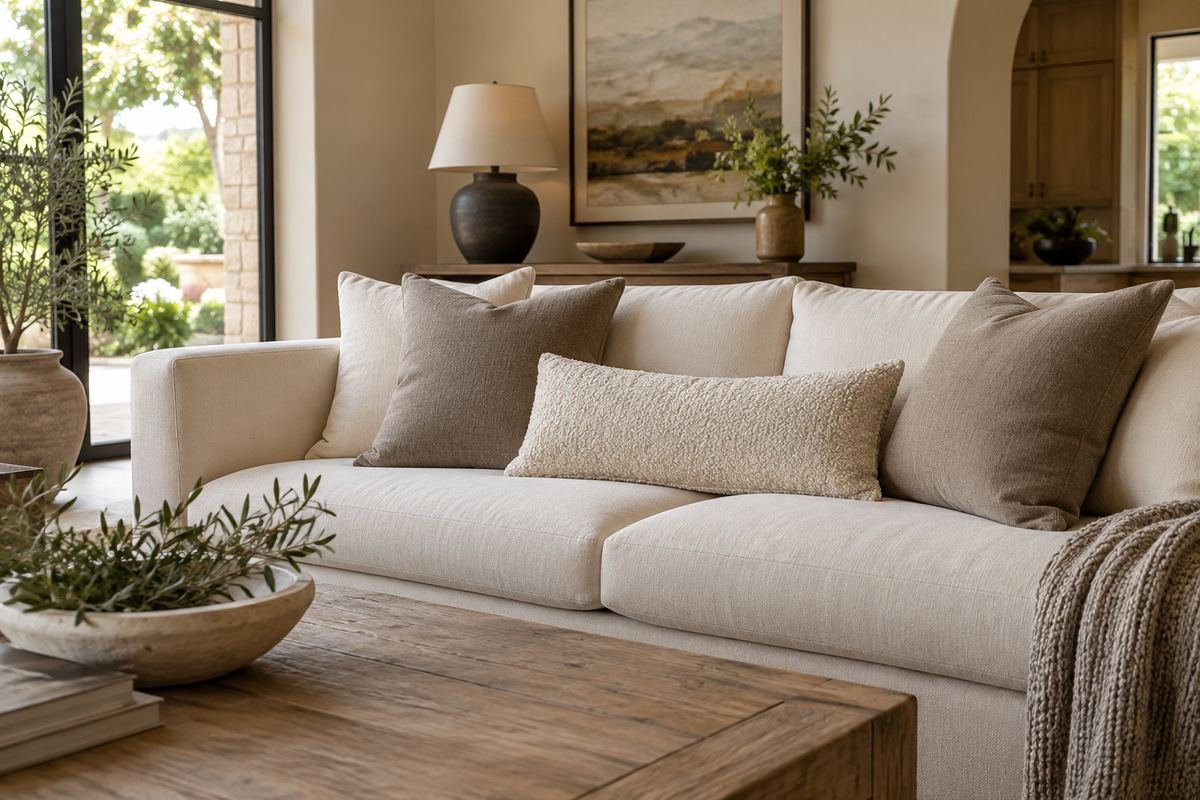
A tone-on-tone arrangement can feel complete through texture instead of color contrast. Combine a smooth taupe cover with a more raised cream surface.
Make sure the shades are distinct enough to avoid looking like an accidental near match. Keep the outline simple if the fabrics provide most of the interest.
Practical tip: Compare samples together rather than ordering each neutral separately.
11. Green sofa with blush and warm white

Soft blush creates a gentle contrast with green upholstery. Warm white gives the combination a lighter area and prevents both colored surfaces from merging into one muted mass.
Choose a blush that relates to the room’s wood and wall tones. Keep the shapes straightforward so the color relationship remains the focus.
Practical tip: Start with one blush cushion before committing to a matching pair.
12. Connect Green-Sofa Throw Pillow Combinations With Checks

Ochre brings a warmer accent to deeper green upholstery. A cream check can repeat small touches of both colors while leaving a quieter background.
Keep the check scale broad enough to read clearly. If the rug is already geometric, use a solid cream cover instead.
Practical tip: Repeat the ochre in a small area rather than across every cushion.
13. A brown sofa with denim and ecru
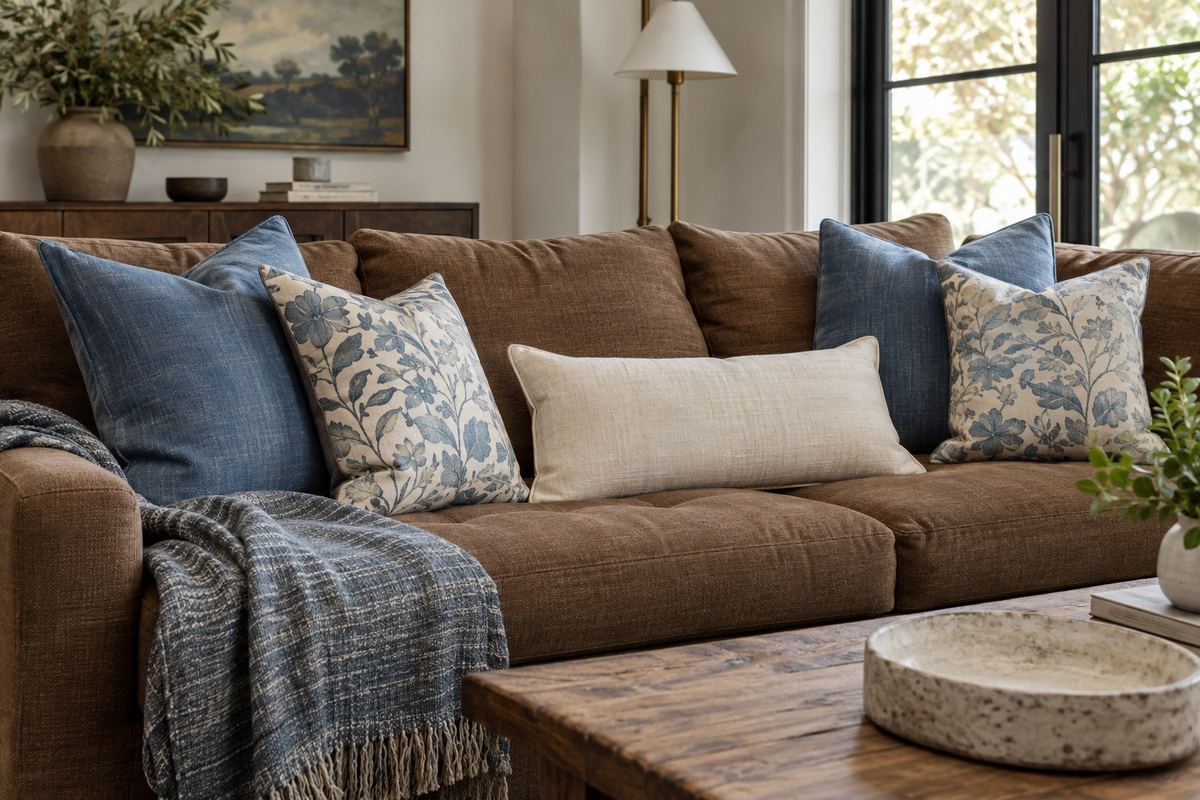
Denim blue can give a brown fabric sofa a relaxed lighter companion. Ecru connects the cooler accent to warm upholstery without the starkness of a very bright white.
Use a faded-looking pattern if the room is informal. Avoid combining several equally mottled surfaces when the sofa fabric already has visible variation.
Practical tip: Check whether the brown sofa reads red, yellow or gray before choosing blue.
14. A black sofa with warm neutrals

Oatmeal and soft beige make a strong contrast with black without a sharp monochrome effect. A small black line in one patterned cover can connect the light pillows to the sofa.
Keep the light fabrics distinct from each other. Too many slightly different creams may look less intentional than two clear tones.
Practical tip: Use the room’s wood tone to guide warm-neutral choices.
15. A patterned sofa with quiet solids
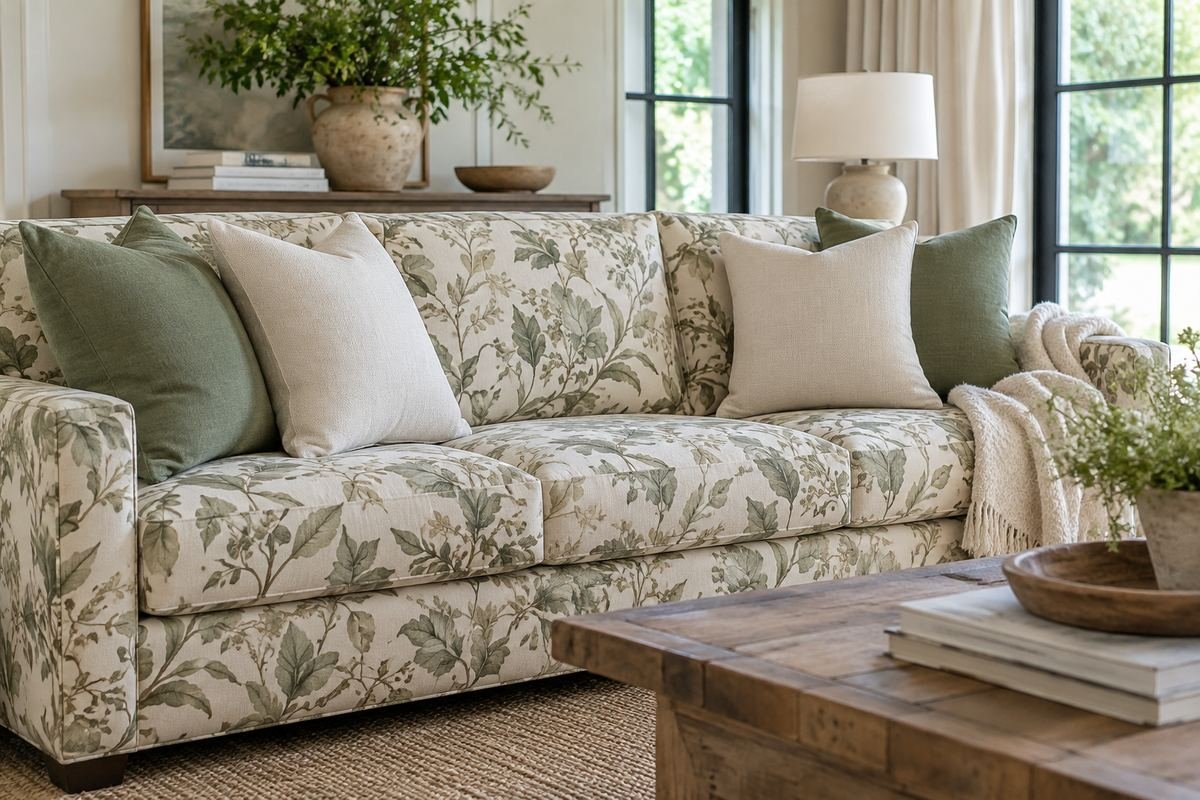
When upholstery already has a visible print, choose pillows from its existing background and accent colors. Plain covers let the sofa pattern remain the main element.
You do not need to introduce another pattern to make the arrangement feel styled. Compare the pillows at normal viewing distance rather than only beside a small fabric sample.
Practical tip: Pull one quiet color from the upholstery and try it first.
16. One large stripe with one small check

Varying pattern scale helps two geometric covers remain distinct. A broad stripe and a smaller check can share cream and blue while performing different visual roles.
Give one pattern more space or a larger pillow so the arrangement has a clear lead. Add a solid only if the two prints need a quieter connection.
Practical tip: Avoid choosing patterns with identical spacing and contrast.
17. A botanical print with a simple lumbar
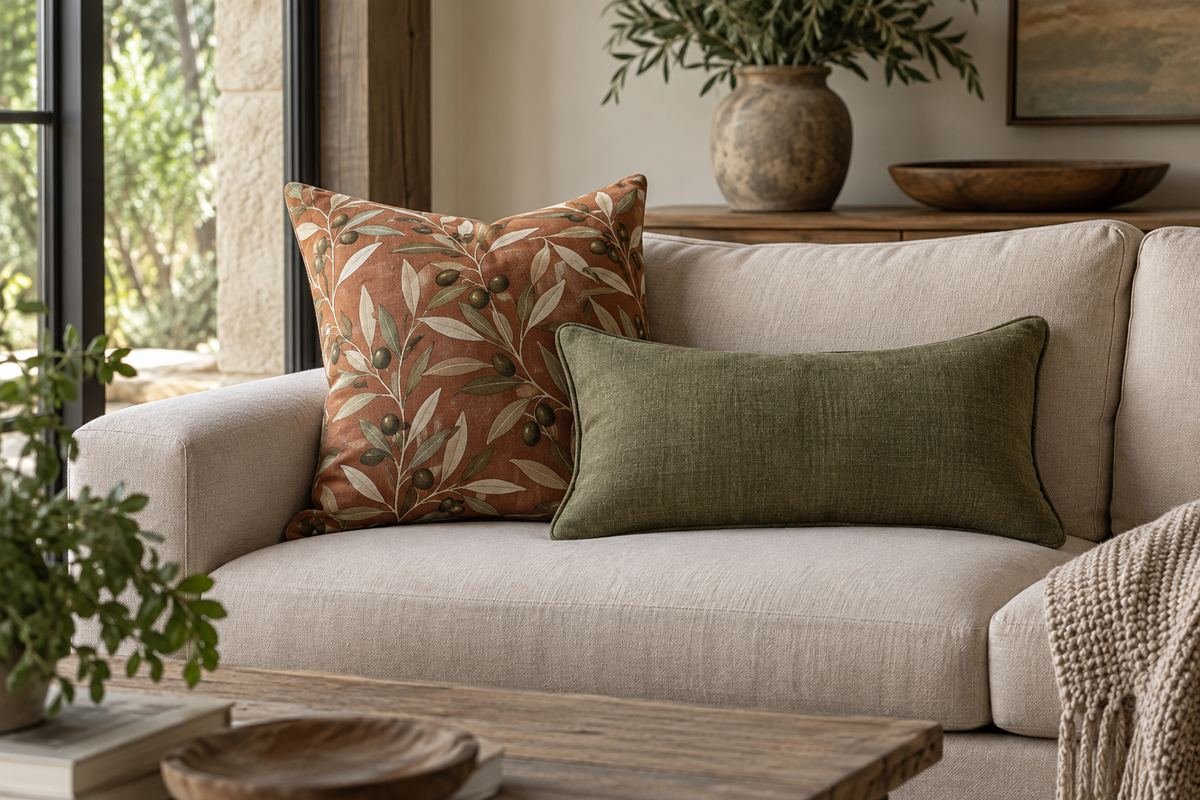
A botanical print can act as a compact palette for the whole sofa. Choose a solid lumbar from one of its quieter colors rather than its most vivid detail.
Keep the background of the print connected to the sofa or wall. This helps the patterned cushion feel integrated instead of like an unrelated artwork.
Practical tip: Limit other small motifs close to the sofa.
18. Build Tonal Blue Throw Pillow Combinations Through Contrast

Use navy, dusty blue and a pale blue-white to create depth within one color family. Different values matter more than finding several nearly identical blues.
Mix one smooth surface with a visible weave so the arrangement has interest even when the colors sit close together. Keep a clear light-to-dark sequence.
Practical tip: Check all covers together under the same light.
19. Warm neutrals with a single dark edge

A cream and sand arrangement can benefit from one dark piping detail. The narrow edge provides definition without adding a large patterned area.
Repeat the dark line in a nearby frame or table leg if it feels disconnected. The piping is enough detail; elaborate trim on every cushion may make the sofa busy.
Practical tip: Choose a comfortable edge if you rest against the pillow.
20. A matched pair on a small loveseat

Two coordinated pillows can finish a compact loveseat without consuming the middle seat. Matching color or fabric creates order even when the shapes are slightly different.
Choose depth as carefully as width. A very plump pillow can make a shallow loveseat uncomfortable despite looking proportional from the front.
Practical tip: Sit with both pillows in place before adding a third.
21. A balanced trio on a wide sofa

A wider sofa may comfortably hold a pair of background pillows and one smaller accent. Keep the accent connected by color while varying its shape.
The group should fit the way people use the sofa. If the middle seat is occupied regularly, the third pillow may belong at an end rather than centered.
Practical tip: Check the arrangement with all usual seats in use.
22. A sectional with repeated color zones
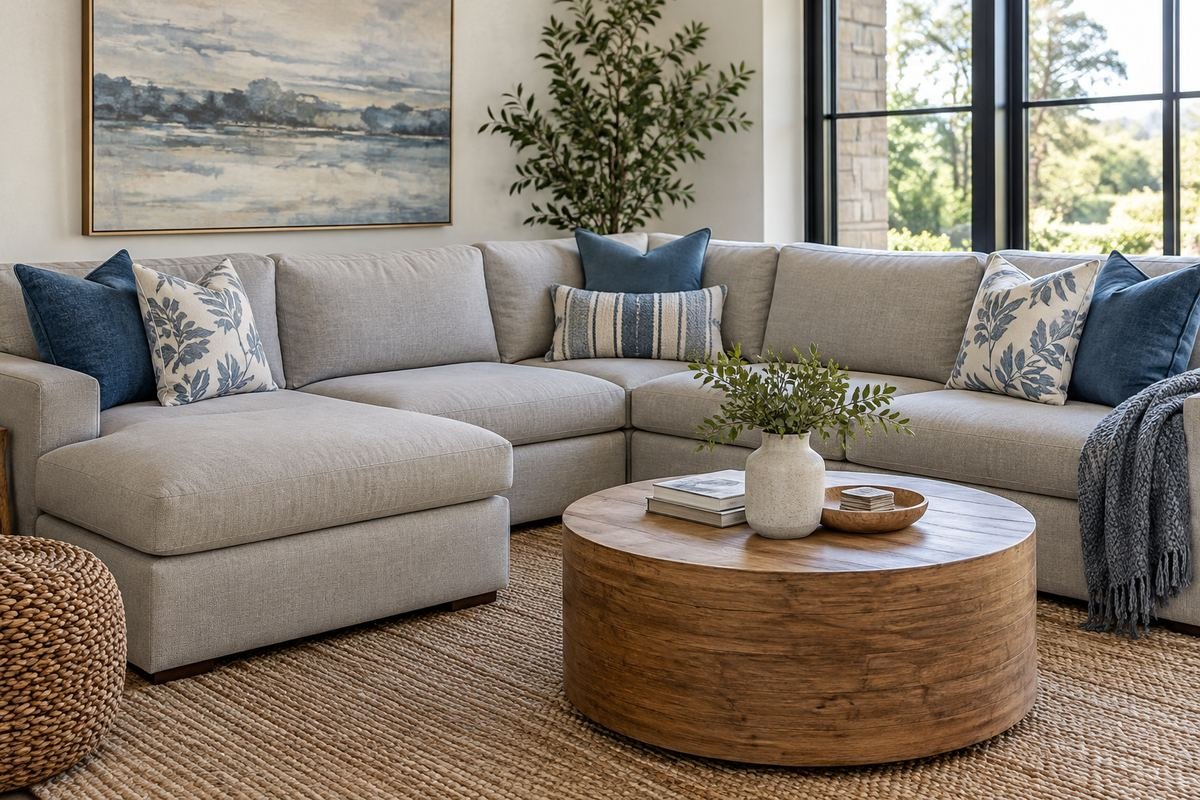
Repeat one color at the outer ends and the inside corner of a sectional. This can connect a large seating shape without creating a continuous wall of pillows.
Leave the chaise or favorite lounging spot clear enough for normal use. A sectional corner may hold a group that would overwhelm a straight sofa.
Practical tip: Choose the main lounging position before arranging the cushions.
23. An asymmetric group with one quiet end

A cluster at one end can suit a sofa beside a large window or a busy side table. The quieter end gives the arrangement breathing room.
Repeat a color across the sofa through a small throw or a single companion pillow if balance is needed. Asymmetry works best when it responds to the room layout.
Practical tip: View the whole wall, not just a close-up of the cushions.
24. Refresh Seasonal Throw Pillow Combinations With Existing Inserts

A limited alternate cover set lets the sofa shift mood without storing several complete pillows. Keep the new palette connected to permanent pieces such as the rug.
Compare cover size, insert fit and care instructions before changing the set. A different season does not require replacing every cushion or adding seasonal lettering.
Practical tip: Store clean spare covers flat and keep matching pairs together.
Frequently Asked Questions
How many throw pillows should I put on a sofa?
Use the number that leaves comfortable seating and suits the sofa’s depth. Start with one at each end, sit down and add another only if it serves the arrangement. A compact sofa and a deep sectional need different decisions; neither requires a prescribed odd number.
Do all throw pillows have to match?
No. Repeating one color can connect different patterns and textures. Matching pairs create a more ordered look, while an asymmetric group can suit a casual sofa. Compare the entire composition rather than trying to make every cover identical.
How do I mix pillow patterns without making the sofa busy?
Choose one pattern to lead and vary the scale of any companion pattern. A broad stripe, a smaller motif and a solid can be easier to distinguish than three equally dense prints. Leave enough quiet upholstery visible around them.
Choose the Details That Work in Your Home
Choose a palette that connects to the room, give each pattern a clear role and stop adding pillows when the sofa feels finished and comfortable. The right combination should make the room easier to enjoy, not create a daily pile on the floor.
For related ideas, explore Living room curtain ideas, Sofa table ideas, Living room ideas.
Planning References
Crate & Barrel: throw pillow styling ideas. Follow the instructions for the exact products you choose.
Optional digital guide for this topic
If you prefer a structured workbook, explore this related paid guide.