Kitchen corner cabinet ideas should solve the way the corner is reached, not simply fill a deep space. The usable opening, door direction and surrounding cabinets can matter more than the total interior volume. Begin with what you can comfortably retrieve and return.
Identify whether the cabinet has a diagonal opening, a blind corner or another layout before comparing organizers. Record the cabinet construction and any obstructions. A product designed for a particular corner system is not automatically a retrofit for another cupboard with similar outside dimensions.
These 24 original concepts compare accessible shelves, rotating arrangements and useful supply groups. They are planning illustrations rather than installation diagrams or photographs of specific branded mechanisms. Follow the exact cabinet and organizer instructions, including fitting, mounting and load requirements.
The images are original AI-generated decor concepts, not installation diagrams or photographs of completed client projects.
Browse These 24 Kitchen Corner Cabinet Ideas
Jump to an idea
- Keep a small front group on the existing shelf
- Use a small removable group for an awkward opening
- Kitchen corner cabinet ideas with a compatible round carousel
- Compare a pie-cut tray with the cabinet door position
- Give different storage levels useful item heights
- Compare a half-moon fitting with its complete swing
- Kitchen corner cabinet ideas with a specified swing-out tray
- Review a multi-stage pullout as a complete sequence
- Keep shallow cookware in a low visible group
- Give pot lids a separate suitable position
- Kitchen corner cabinet ideas for baking tins
- Nest a modest mixing-bowl group
- Keep the colander reachable as its own item
- Check cookware handles through the tray movement
- Use a suitable position for an unplugged appliance
- Keep the serving pieces that fit the actual opening
- Separate empty food containers from their lids
- Make a retained rear group visible
- Keep an upper corner group within useful reach
- Review the nearby appliance door
- Account for adjacent handles and doors
- Preserve access to nearby services
- Let an unusable pocket remain empty
- Reset the corner after a week of ordinary use
Compare kitchen corner cabinet ideas through the whole movement
Record the usable opening, interior dimensions, door direction, hinge movement and adjacent handles or appliances. Test the stored item’s route through the opening and the space an organizer occupies when extended. Include cleaning and access to nearby services. Decide what belongs in the corner only after comparing a complete retrieval and return.
| Corner condition | Arrangement to compare | What must work |
|---|---|---|
| A narrow opening into a deep space | Small removable groups or a correctly specified fitting | The full retrieval route through the opening |
| A diagonal or wide corner opening | Suitable fixed shelves or a compatible carousel | Door movement and the tray’s full rotation |
| Different cookware heights | Appropriate separation between storage levels | The complete item and its handles fit |
| A blind left or blind right cabinet | A product specified for that configuration | Correct handedness and cabinet construction |
| A nearby dishwasher or projecting handle | A group reviewed with the neighboring feature | No interference during ordinary use |
| An upper corner cabinet | A modest reachable group | No need to climb on a chair or counter |
| A corner with no practical retrieval route | Less storage or another location | Every retained item can be returned normally |
Check the exact system instead of relying on a family name
IKEA’s UTRUSTA corner base carousel, article 606.018.00, is described for a SEKTION corner base cabinet measuring 38 by 24 inches. The product has two rotating trays and a height-adjustable upper tray. Those are details of that version; they do not establish fit for every older IKEA cabinet or another manufacturer’s corner. Use the current exact product documents and actual cabinet measurements.
Separate cabinet construction from organizer movement
Rev-A-Shelf’s Cloud instructions distinguish single-tier, double-single-tier and two-tier configurations, as well as the cabinet’s left or right orientation. The referenced instructions also distinguish face-frame and frameless applications. That is why a photograph and a nominal cabinet width are insufficient for choosing the fitting. Have the relevant instructions assessed for your actual cabinet rather than copying a generic mounting arrangement.
Prepare a corner-cabinet comparison card
Photograph the empty opening and interior, note the cabinet type, and list the actual items you want to store with their complete dimensions and weights where required. For each proposed arrangement, record how the item comes out, where the moving tray goes and what remains accessible. Keep one failed-fit reason beside each rejected option. This gives a cabinet specialist or supplier a clear brief and prevents the same unsuitable organizer from returning to the shortlist.
1. Keep a small front group on the existing shelf
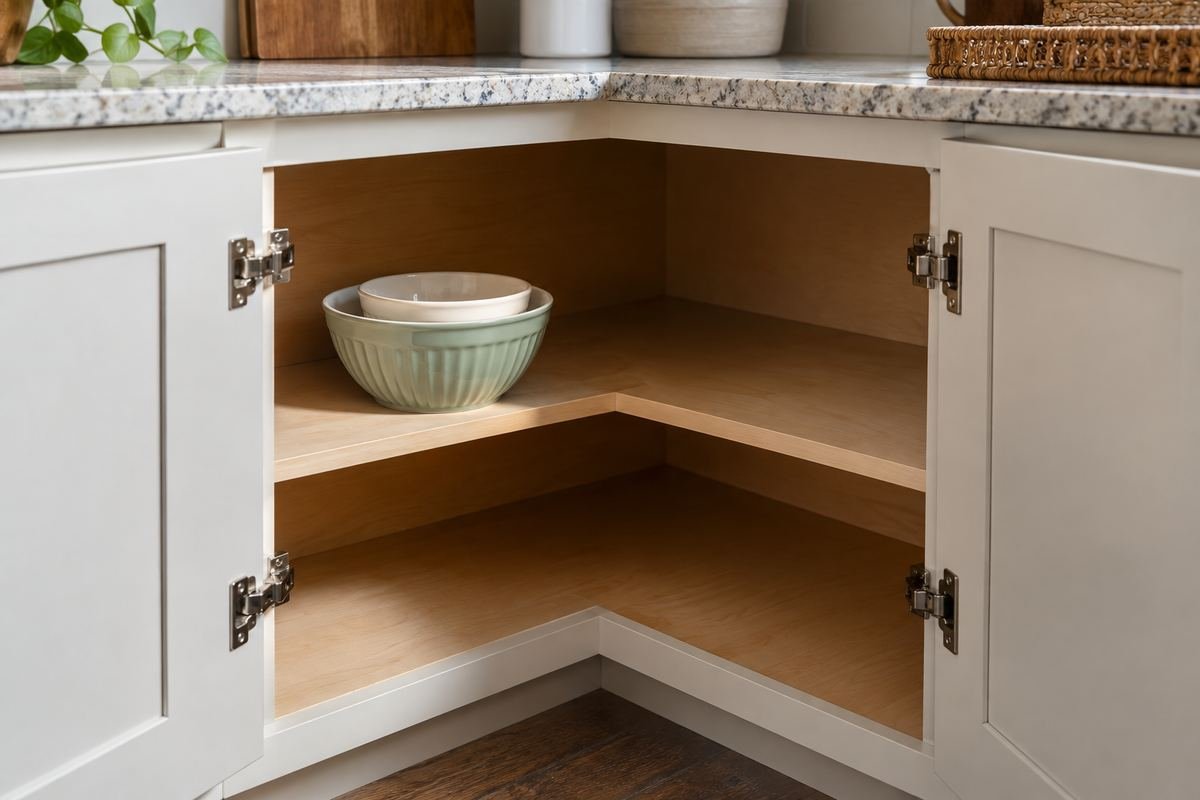
A modest reachable group can make a corner cabinet useful without adding hardware. Choose the items that can be removed through the actual opening and keep the shelf within its stated use and load. Do not start by filling the deepest part of the corner.
Test taking out one item and returning it with the neighboring items in place. If the group needs to be unloaded for every task, reduce it or compare another arrangement. An existing shelf can be a finished solution when its access works.
Practical tip: Test one ordinary retrieval before buying a fitting.
2. Use a small removable group for an awkward opening
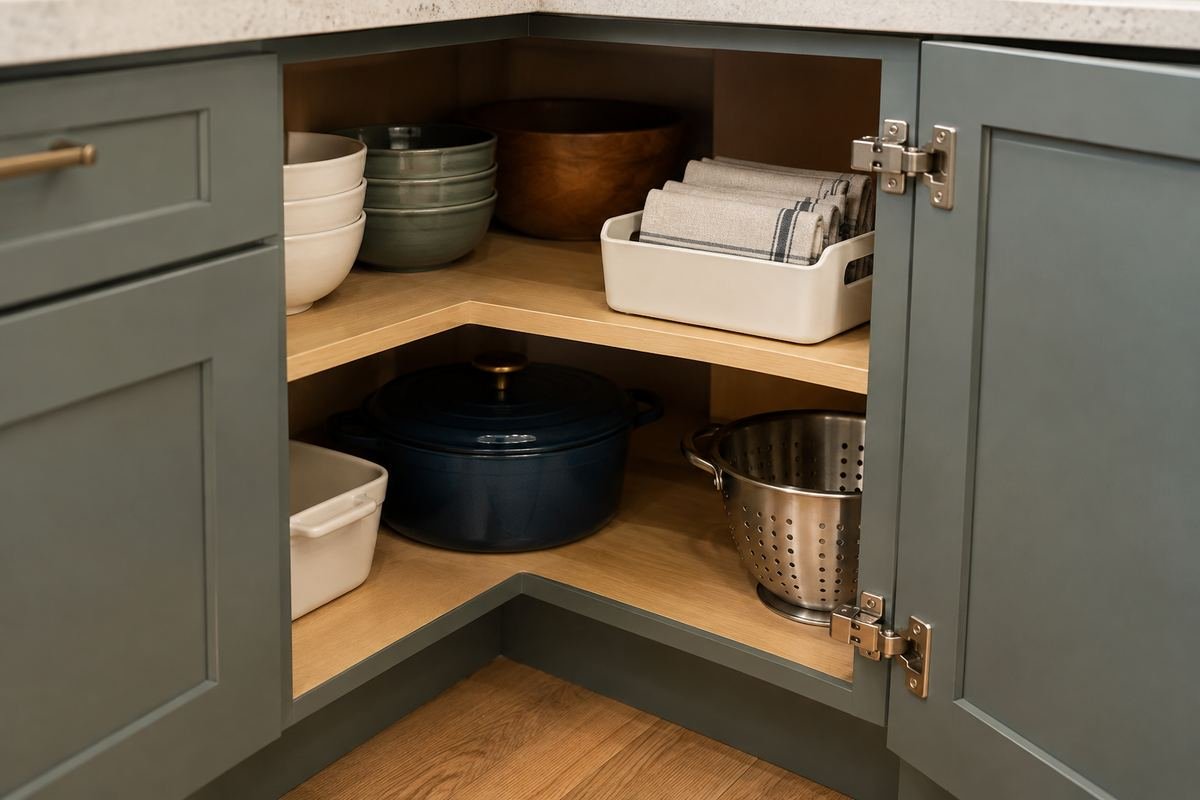
A manageable container can bring a few suitable items out of the cupboard together. Compare the complete loaded group with the opening, including any turn around a hinge. Choose a stable container appropriate to the contents and cabinet.
Avoid using a large deep bin merely because it fits once inside. The useful measurement includes the route out and the space to grip it. If the loaded group must be tilted sharply to pass through the door, compare a smaller container or another storage position.
Practical tip: Measure the removal route as well as the stored position.
3. Kitchen corner cabinet ideas with a compatible round carousel
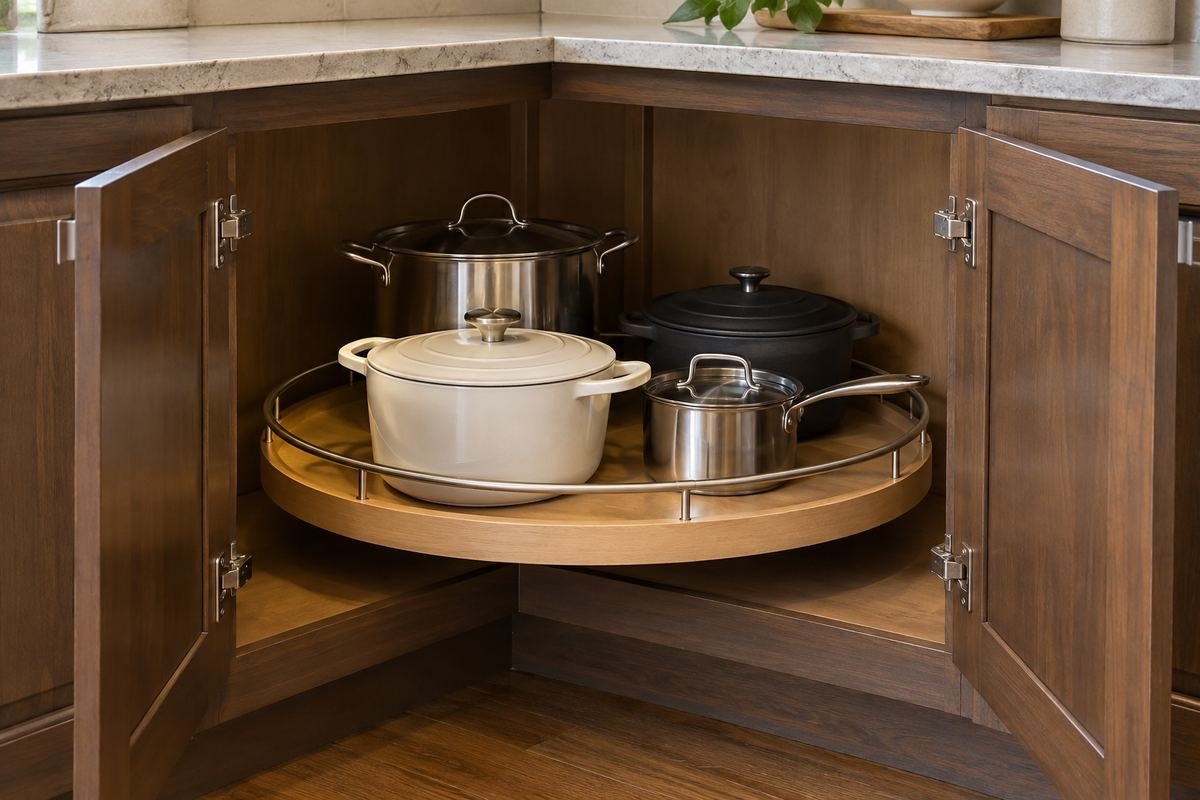
A suitable carousel can bring a modest group toward the opening when its exact design matches the cabinet. Compare the whole rotating tray and the items on it. Handles, projecting lids and tall containers need room through the full movement.
Choose the product from its current instructions and the actual cabinet system. Keep items within the tray as directed and do not treat a round organizer as a universal solution for every corner. A restrained group can be easier to review than an overloaded rotating shelf.
Practical tip: Test the full rotation with the actual contents.
4. Compare a pie-cut tray with the cabinet door position
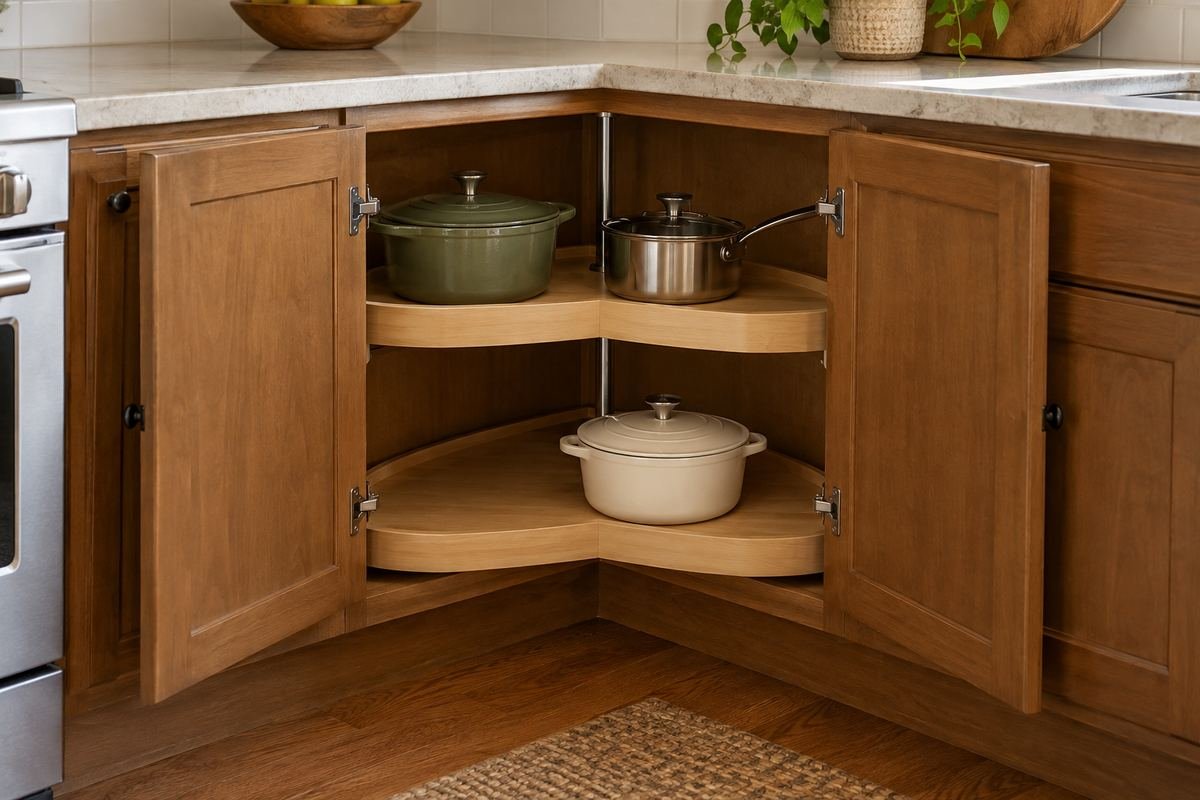
A pie-cut rotating arrangement may suit a compatible corner system with the appropriate opening and doors. Review how the tray and doors work together instead of judging the empty interior alone. Use the exact product’s instructions for its fitted position.
Keep the stored group within the usable tray and test its return to the resting position. A pot handle extending into the cutout can change the movement. If the arrangement only works after shifting the contents by hand, reduce or reorganize the group.
Practical tip: Check the resting position as carefully as the rotation.
5. Give different storage levels useful item heights
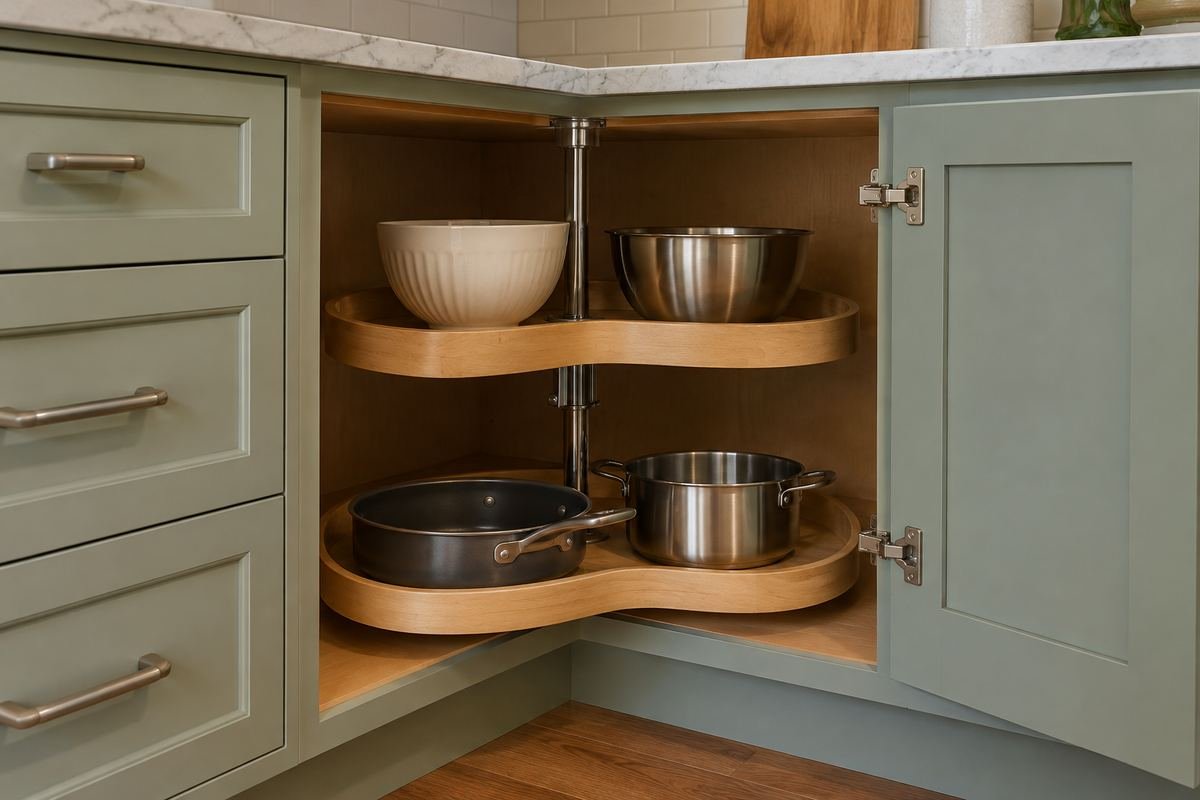
Two storage levels can separate low cookware from taller items when the cabinet and organizer allow the arrangement. Compare the complete item height with the usable space between levels. Follow the product’s adjustment and load instructions rather than assuming shelves can move anywhere.
Leave room to grasp the item and bring it through the opening. A taller gap is useful only when the item has a practical route out. Keep the upper group modest enough that the lower level remains easy to see and use.
Practical tip: Measure the item with its lid and handles.
6. Compare a half-moon fitting with its complete swing
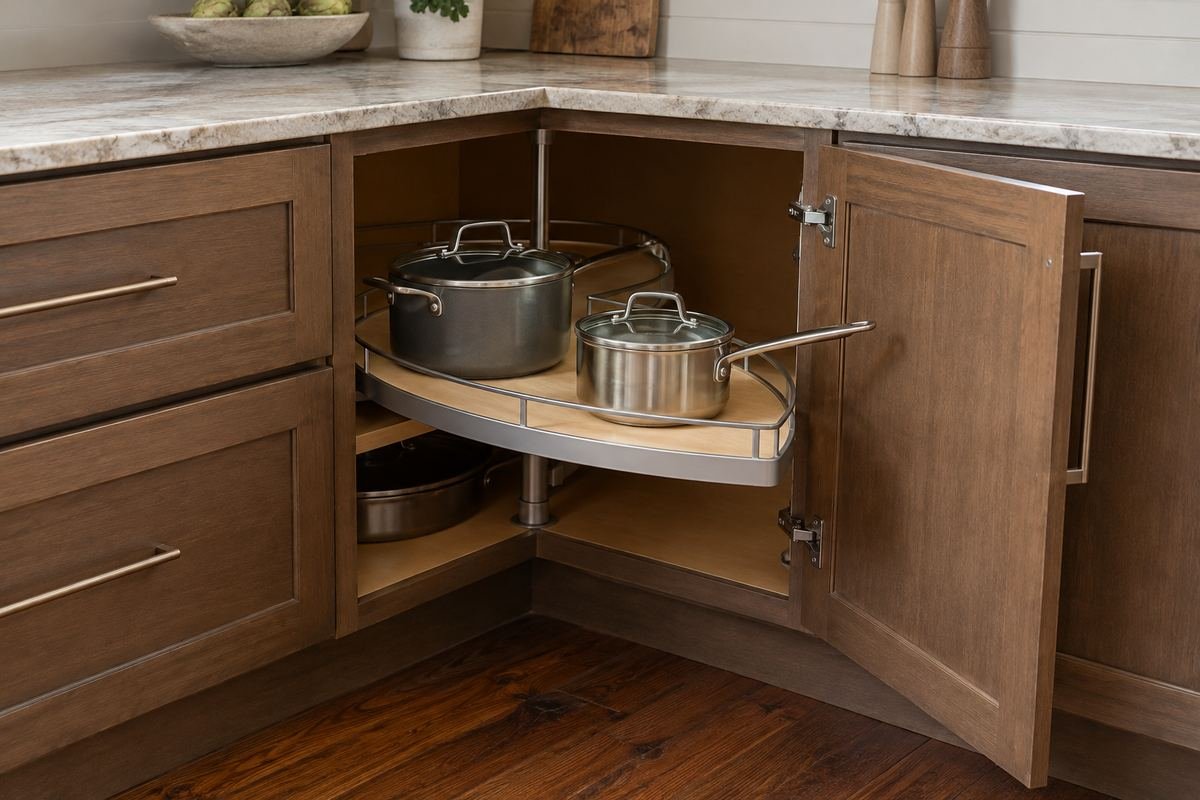
A correctly specified half-moon fitting can bring part of a blind corner toward the opening. Check its handedness, mounting requirements and the space it needs outside the cabinet. The visible shape alone does not establish whether it will work in the cupboard.
Review the loaded fitting through the entire movement and keep the surrounding room usable. Avoid treating a partial-open photograph as proof of access. Appropriate product selection and installation matter more than recreating the exact appearance of a concept image.
Practical tip: Check the fully moved position, not only the first swing.
7. Kitchen corner cabinet ideas with a specified swing-out tray
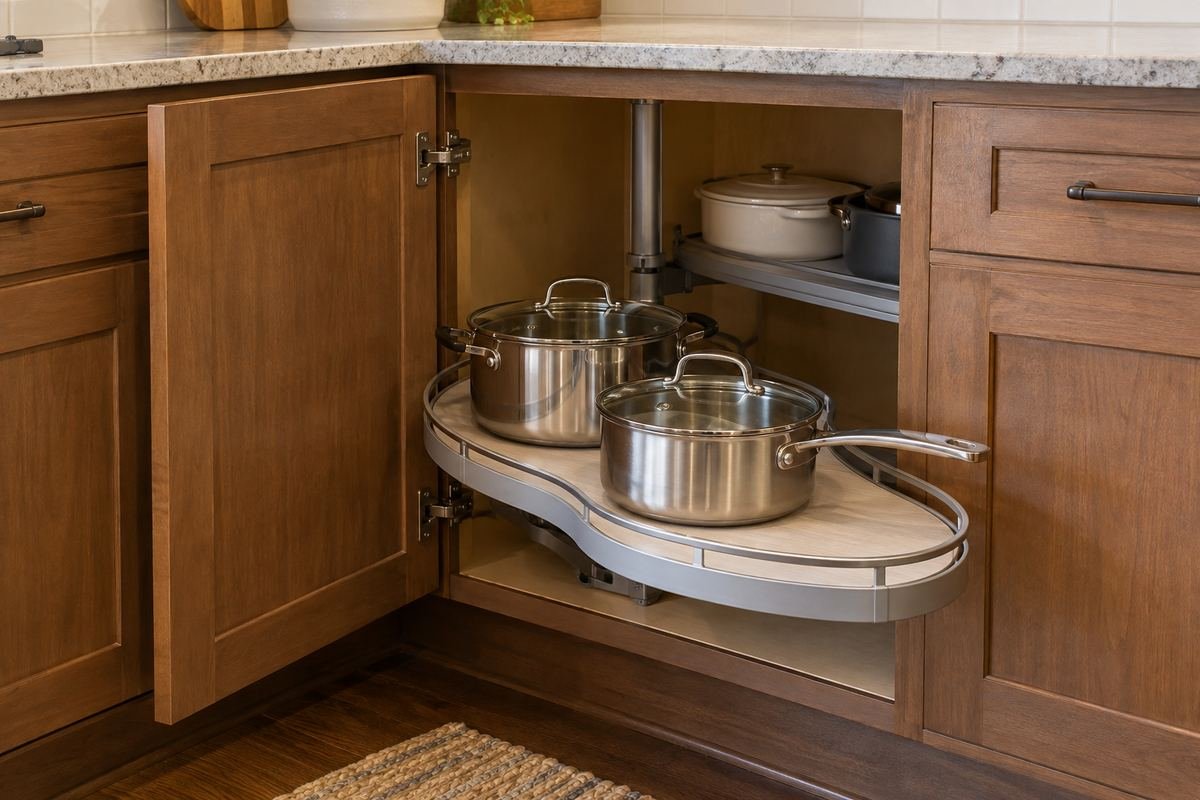
A compatible swing-out tray may give a blind corner a more useful access path. Compare the support and movement described for the exact product with the cabinet’s construction and direction. Keep the proposed contents within its stated use.
The tray needs a useful destination when open as well as a place when stored. Check nearby handles and the person’s standing position during retrieval. If the movement blocks another feature needed for the task, compare a simpler arrangement.
Practical tip: Include the space outside the cabinet in the decision.
8. Review a multi-stage pullout as a complete sequence
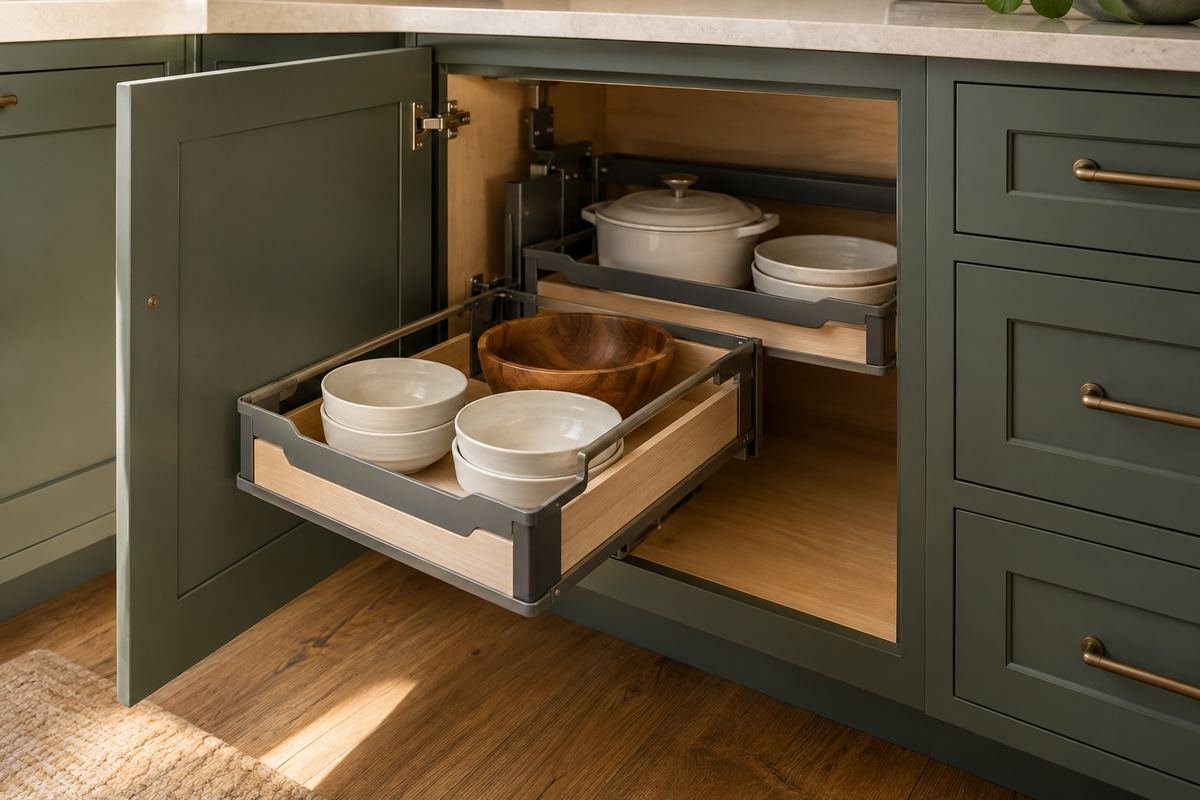
Some corner fittings move in several stages to bring rear storage forward. Compare the full sequence in the actual kitchen and follow the manufacturer’s instructions for the product. Each stage needs suitable clearance and a manageable loaded group.
Do not judge the fitting only by the number of baskets it provides. Consider cleaning, visibility and how easily an item returns to its original place. A system that adds capacity but complicates the regular task may not be the most useful choice for the household.
Practical tip: Ask to see the whole product movement before choosing.
9. Keep shallow cookware in a low visible group
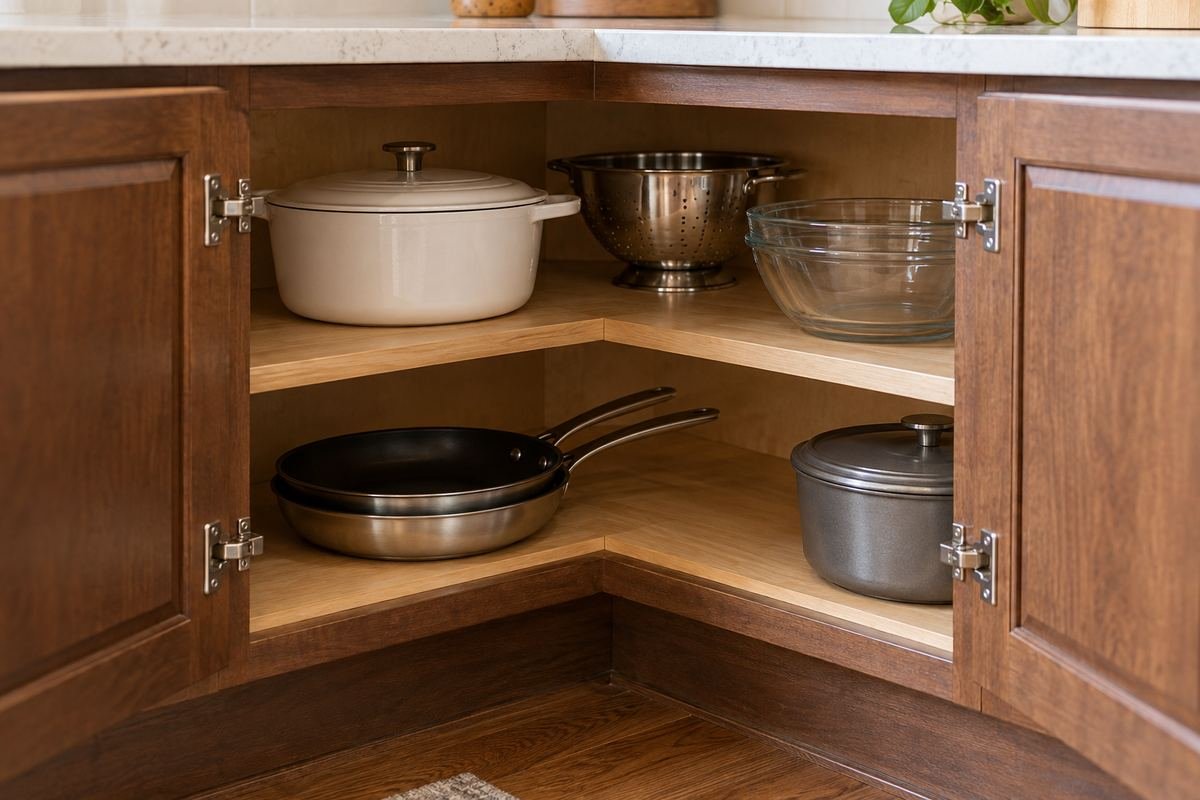
Shallow pans can form a useful group when the actual shelf or tray supports them and their handles remain clear. Compare a restrained stack with a vertical product designed for the purpose. Choose the arrangement from how the pans are removed during ordinary cooking.
Avoid making the stack so deep that the regular pan sits under several rarely used pieces. Keep the complete group within the product’s load and movement requirements. A smaller group near the useful opening may serve the task better than a fully filled corner.
Practical tip: Put the regular pan where it can come out normally.
10. Give pot lids a separate suitable position

Loose lids can make cookware storage awkward when they slide beneath a pot or project beyond a moving tray. Compare a purpose-made suitable lid organizer or a small manageable group within the usable shelf area. Check the actual lid diameter and handle shape.
Keep lids stable during the full movement of any fitting. Do not improvise support against hinges or use the cabinet door without an appropriate product. The useful arrangement lets a lid return without disturbing the whole cookware group.
Practical tip: Test the largest lid as well as the smallest.
11. Kitchen corner cabinet ideas for baking tins
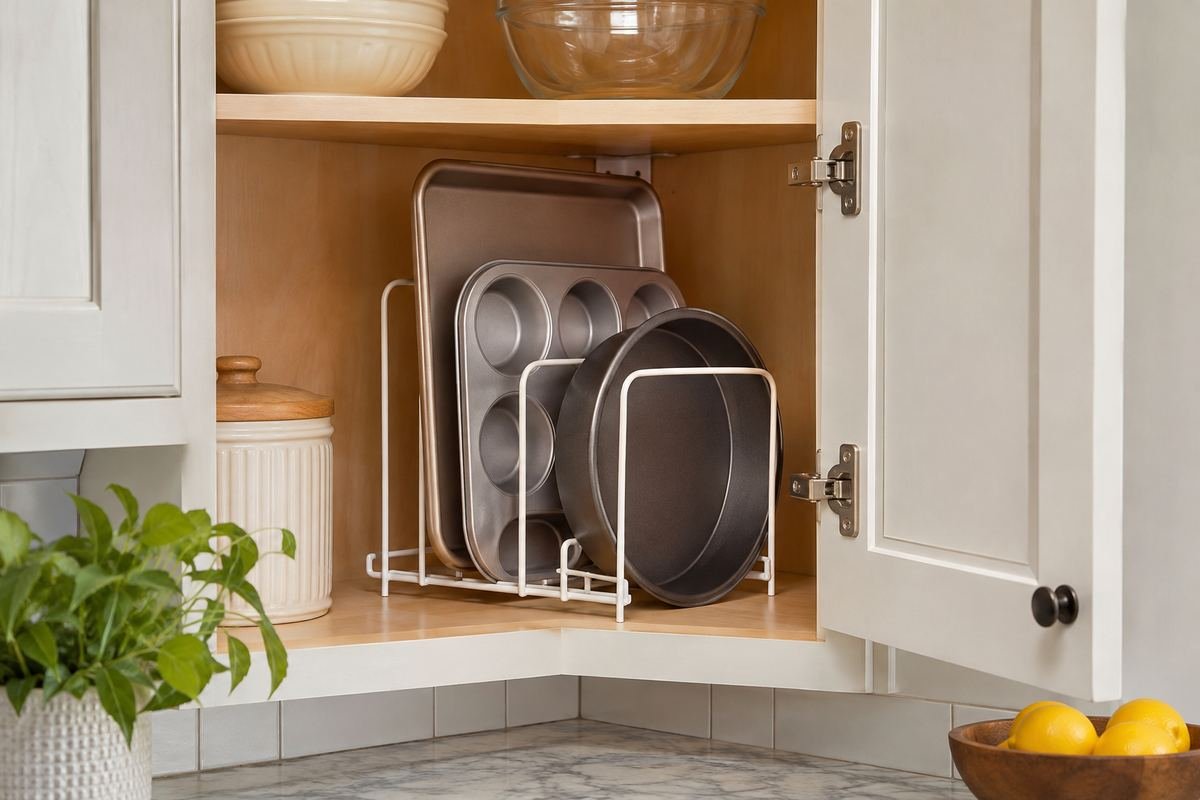
A suitable vertical organizer can separate modest baking tins where the shelf height and opening allow them to come out easily. Compare each tin’s complete shape and the gripping space above or beside it. Follow the organizer and cabinet instructions for support and load.
Keep the group small enough that a tin does not need to be forced between several neighbors. If the larger pieces do not have a practical route, store them elsewhere and use the corner for the items that fit its real access.
Practical tip: Test removal with the neighboring tins in place.
12. Nest a modest mixing-bowl group
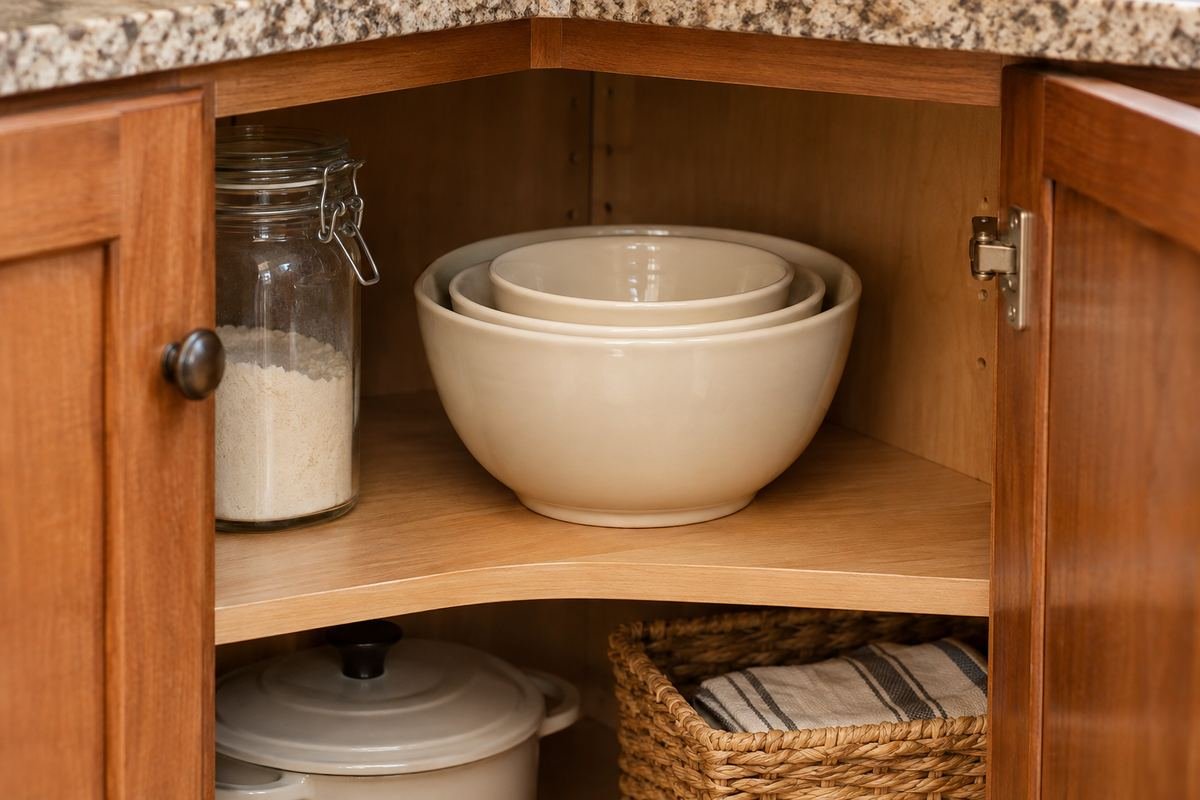
Nested mixing bowls can use a suitable shelf efficiently when the stack is manageable and easy to grasp. Compare the group’s full height and weight with the cabinet and the person using it. Keep any required surface protection appropriate to the bowls.
Avoid storing the regular bowl beneath a tall mixed stack of unrelated serving pieces. A small consistent group can be easier to lift and return. If the whole stack is awkward, divide the items between suitable locations rather than adding another layer.
Practical tip: Choose the group you can handle comfortably.
13. Keep the colander reachable as its own item

An awkwardly shaped colander can fit inside a larger bowl while making both items harder to retrieve. Compare keeping it as a separate suitable group in the corner. Check projecting handles and the way it passes through the actual opening.
Choose a position that lets the item return without catching neighboring cookware. The corner does not have to store matching shapes in matching bins. One deliberately separate object can make a repeated kitchen task easier.
Practical tip: Test the complete handle width through the opening.
14. Check cookware handles through the tray movement

The body of a pan may fit a rotating or moving tray while its handle projects into the door or another shelf. Compare the full object through the organizer’s intended movement. Keep every part positioned as the product instructions require.
Do not rely on turning the handle slightly each time the door closes. Choose a stable repeatable resting position or another suitable item for that tray. A storage group should work after an ordinary return without careful restyling.
Practical tip: Include handles in every fit measurement.
15. Use a suitable position for an unplugged appliance
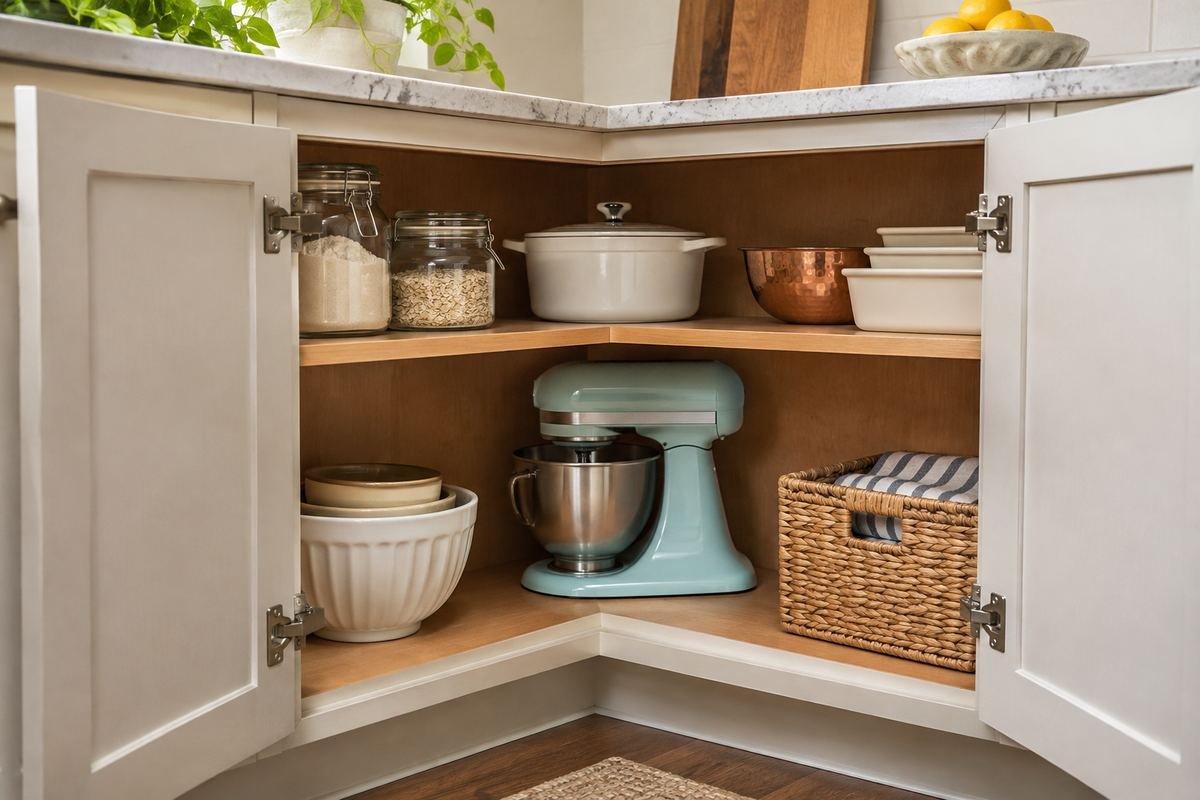
A small appliance may have a useful storage position in a corner cabinet when its instructions allow it and the cabinet can support the group. Compare the complete size, accessories and handling route. Let the appliance cool and follow its storage guidance before putting it away.
This is storage rather than an operating position. Move the appliance to an appropriate location for use according to its instructions; do not run it inside a closed cupboard or trap its cord in moving fittings. Choose another location if retrieving it is awkward.
Practical tip: Check storage and operating instructions separately.
16. Keep the serving pieces that fit the actual opening
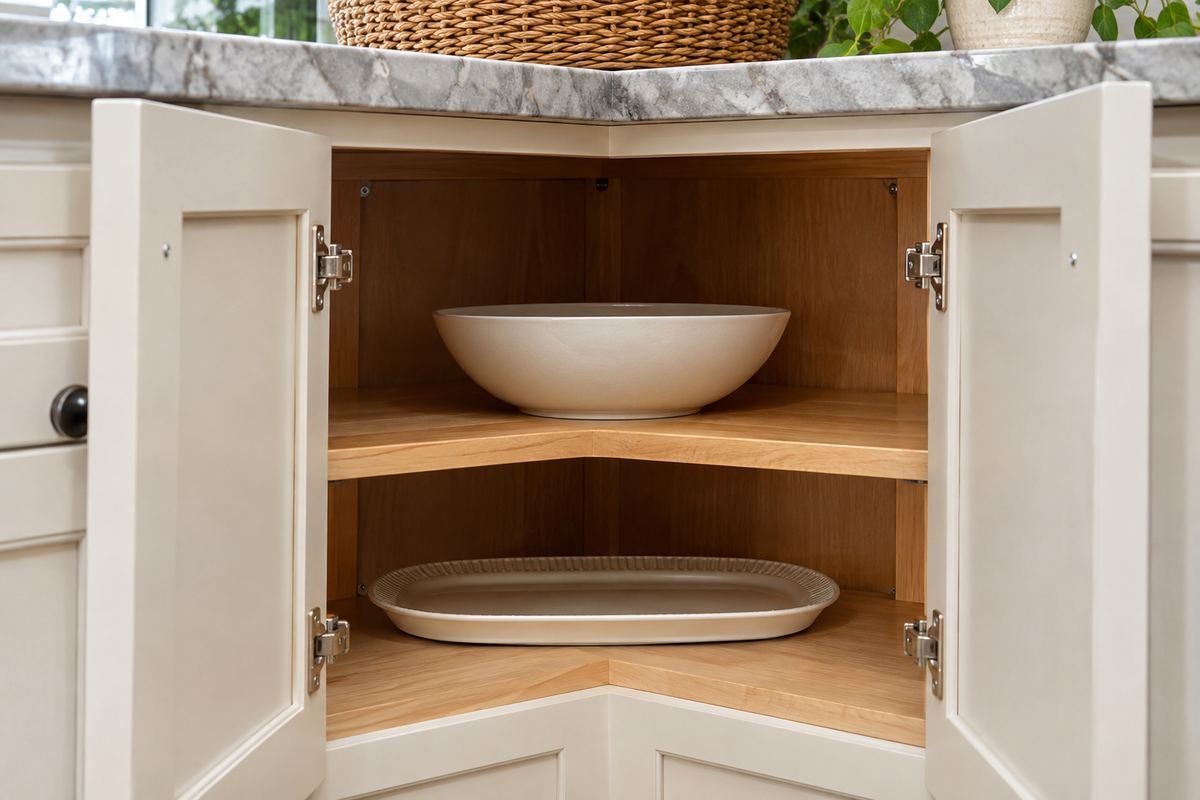
An infrequently used serving bowl may suit a corner only when it can be removed and returned normally. Compare the actual piece with the opening and the other retained items. Keep its support and any surface protection appropriate to the material.
Do not assign every large occasional item to the deep corner by default. A piece that is difficult to handle may need a more accessible suitable location even when it is used rarely. Choose a modest group that can be reviewed without emptying the whole cupboard.
Practical tip: Rare use does not make an awkward fit useful.
17. Separate empty food containers from their lids
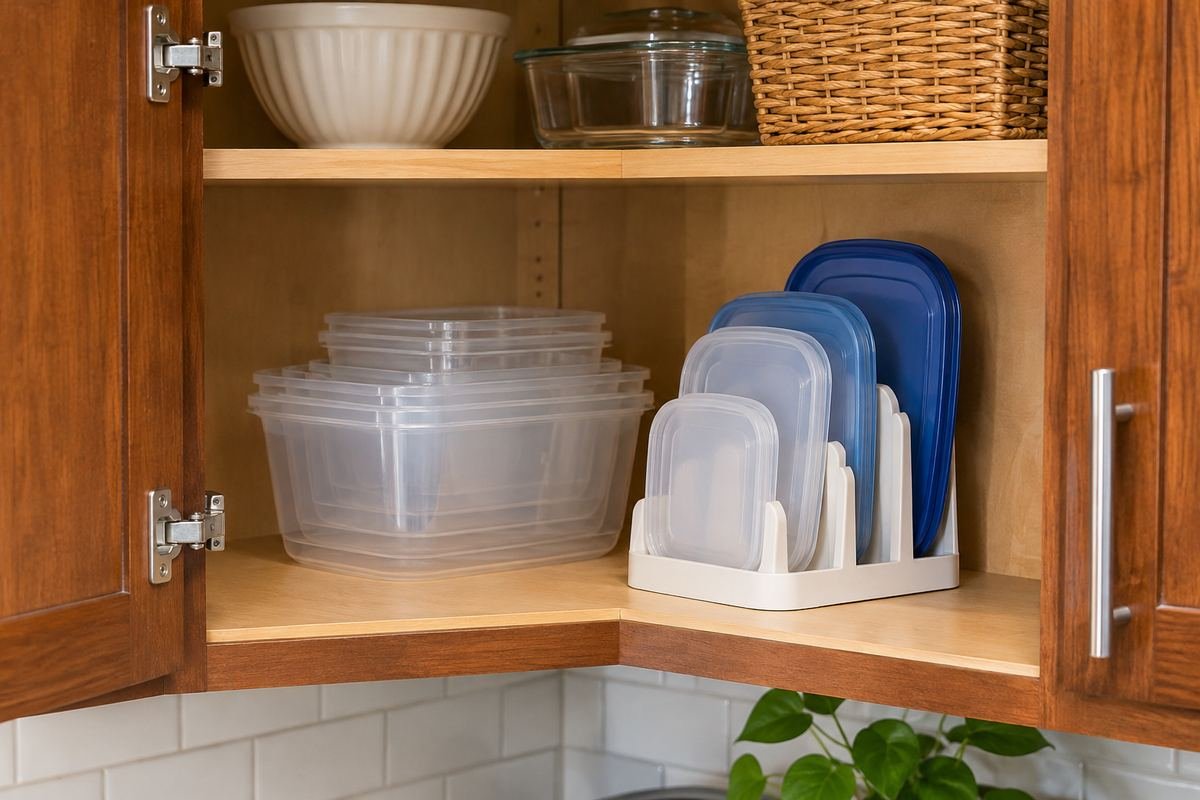
A small suitable group of empty food-storage containers can use an accessible corner shelf. Compare a modest nested stack with the matching lids held in their own stable organizer. Keep the parts clean and dry according to their care instructions before storing them.
Test assembling one complete container without removing the entire group. Retain the sizes used in the kitchen and relocate excess pieces rather than filling the hidden rear corner. The arrangement should make the matching lid easy to identify.
Practical tip: Return matching parts to the same small group.
18. Make a retained rear group visible
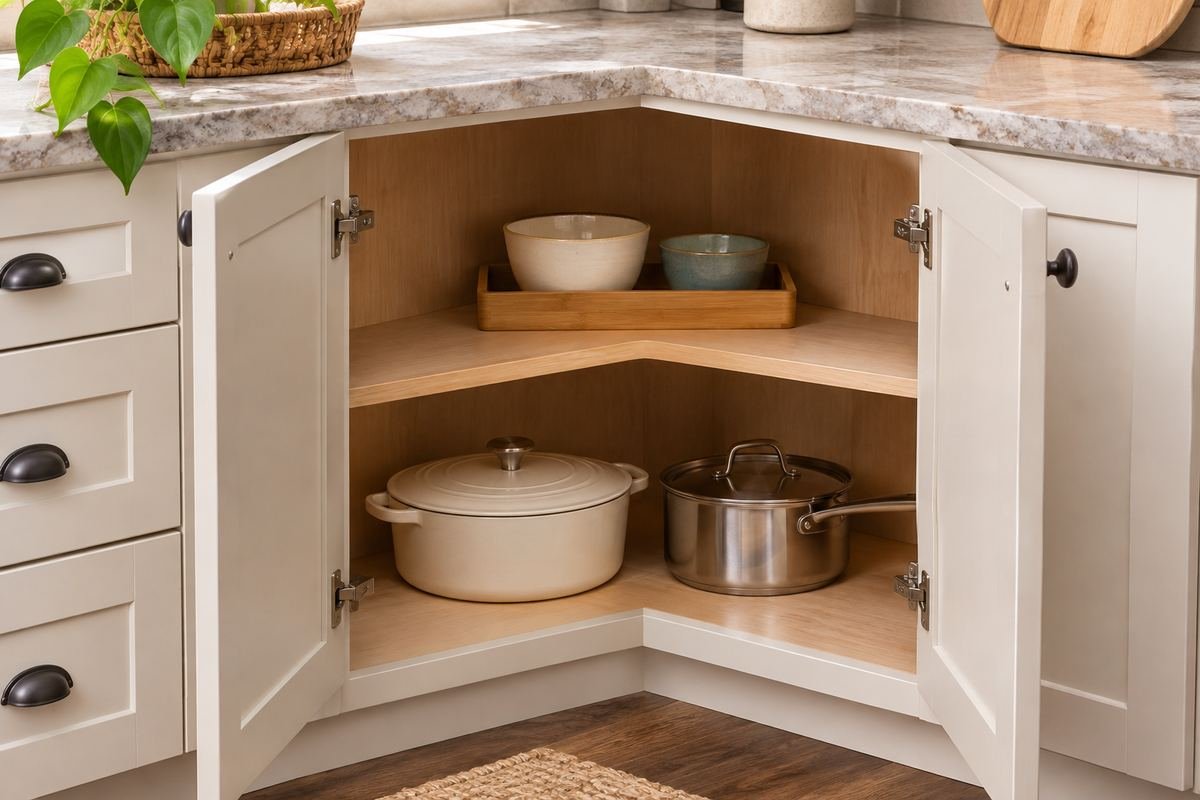
A rear shelf position can be useful when the actual items remain identifiable and can be retrieved normally. Compare a shallow open group with the view through the cabinet opening. Do not assign essential items to a dark pocket simply because there is space behind the front row.
Test the route with the front group in its normal position. If several unrelated objects must be unloaded to reach the back, choose fewer items or a different arrangement. Visibility helps only when the item can also come out.
Practical tip: Inspect the rear group with the cabinet normally loaded.
19. Keep an upper corner group within useful reach

An upper corner cupboard needs a different arrangement from a base cabinet. Choose a modest regular group that can be reached and returned appropriately, and follow the cabinet’s load and use instructions. The entire height of the cupboard does not need to become daily storage.
Compare the route for the complete item, including space to grasp it and clear the shelf edge. Do not build a routine that requires climbing on a counter or chair. Move the regular group to another suitable position if the corner cannot serve it comfortably.
Practical tip: Choose the usable reach before filling upper shelves.
20. Review the nearby appliance door
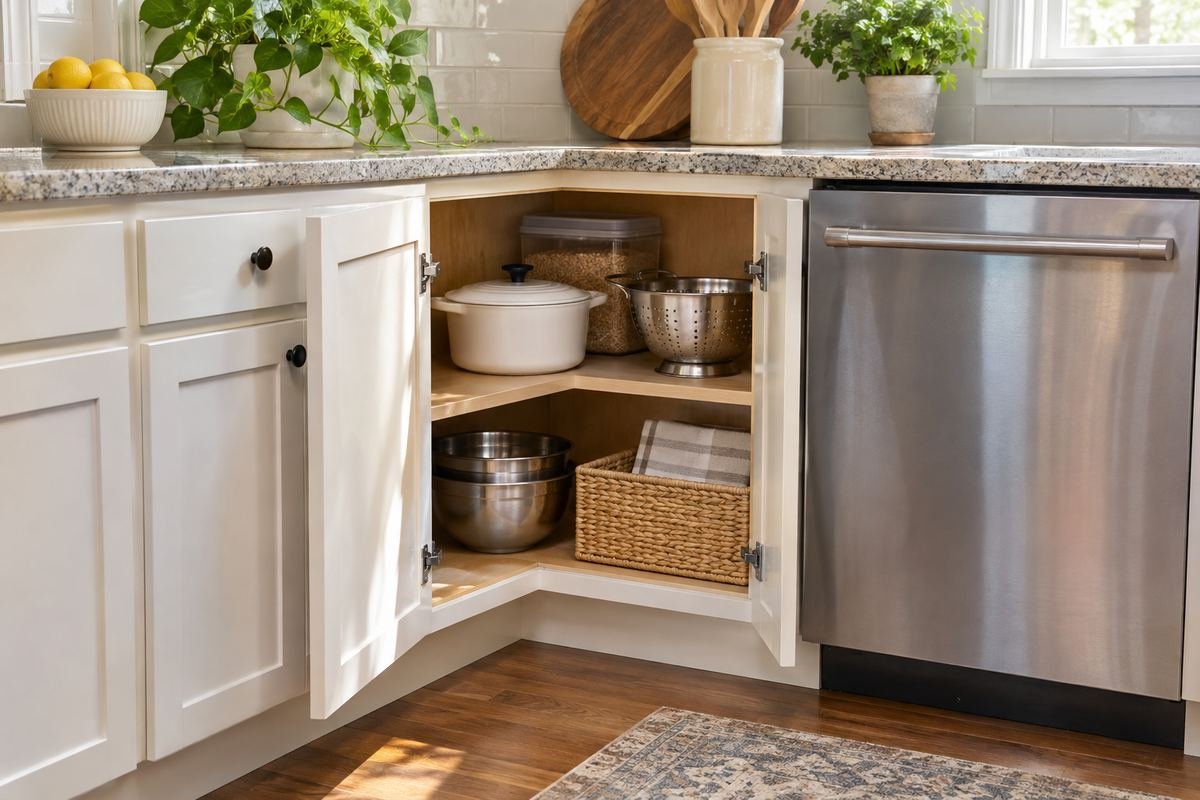
A corner fitting can work in isolation and still interfere with the dishwasher or another nearby appliance. Compare the corner’s full intended movement with the neighboring door positions used during the task. Follow the requirements for both products.
Consider unloading and putting items away as a sequence, not as separate photographs. If one feature must remain open while another is used, the arrangement needs to accommodate that routine. A smaller fixed group may be more useful than an extended tray in a constrained layout.
Practical tip: Test the ordinary task with the neighboring appliance.
21. Account for adjacent handles and doors

Projecting cabinet handles and neighboring doors can change an organizer’s usable route. Compare the actual hardware throughout opening, retrieval and return. Include the shape of the stored items rather than testing an empty tray alone.
Avoid depending on a careful angled maneuver that other household members will not repeat. A useful corner setup has a clear normal motion within the product’s instructions. Ask a suitable cabinet professional to assess a fitting that conflicts with the surrounding cabinetry.
Practical tip: Check the neighboring hardware before ordering.
22. Preserve access to nearby services
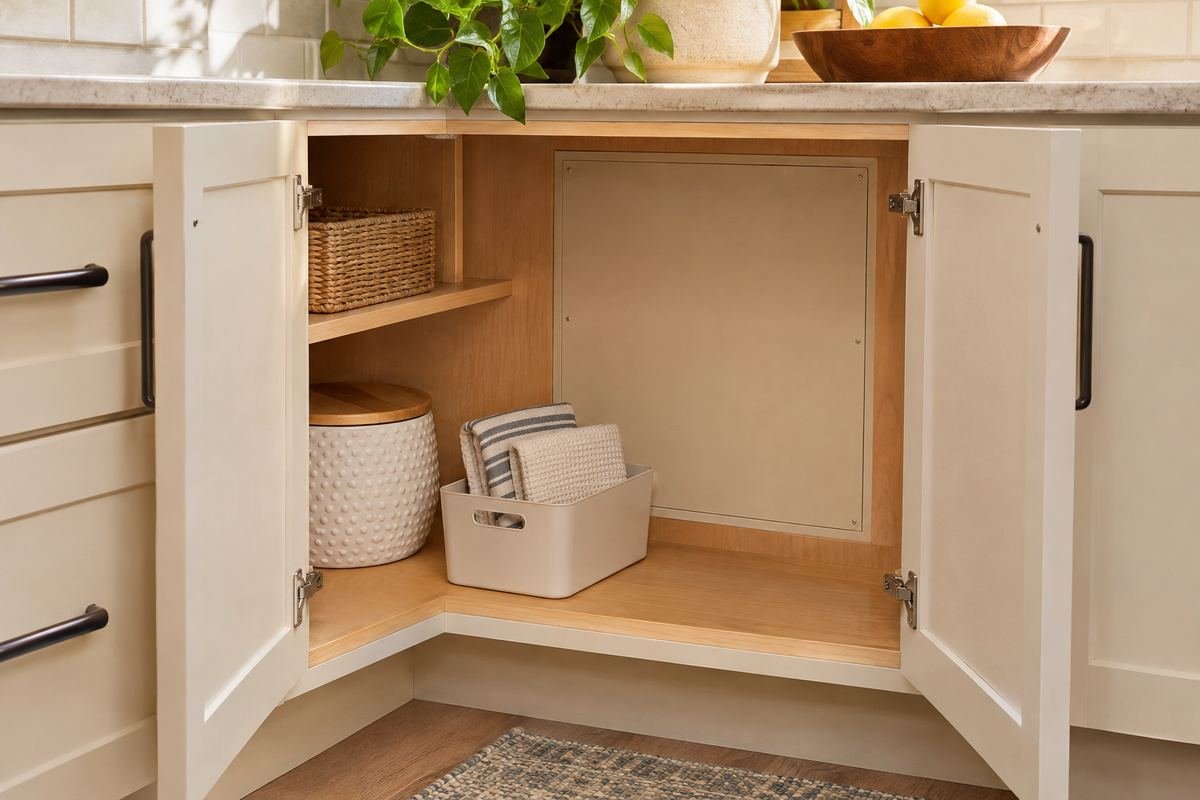
Some kitchen corners include an access panel or services that must remain reachable. Identify those features before assigning storage or fitting new hardware. Follow the relevant product and service requirements, and leave their access arrangements intact.
Choose modest removable groups only where they are suitable and do not obstruct the required access. Do not conceal a service panel behind permanent improvised storage. A deliberately clear area can be part of a successful cabinet plan.
Practical tip: Record any required access before choosing the organizer.
23. Let an unusable pocket remain empty

The deepest part of a corner is not always practical storage. If an item cannot be retrieved and returned normally, keeping that pocket clear can make the useful front area easier to manage. Choose the arrangement from usable access rather than total occupied volume.
An empty area also makes the limits of the setup easy to see during a review. Resist adding an occasional purchase simply to fill the gap. Keep the corner’s retained group focused on items with a real purpose and an appropriate retrieval route.
Practical tip: Count useful items rather than filled shelf area.
24. Reset the corner after a week of ordinary use

Review the corner after it has served normal meals and cleaning rather than judging it immediately after styling. Note which items stayed easy to retrieve, which groups spread across the shelf and what required an awkward maneuver. Use the comparison card to record actual problems.
Change one arrangement at a time and repeat the ordinary retrieval test. Remove an unused piece before adding another organizer. The finished corner should be understandable to the people using the kitchen and simple enough to return to its regular state.
Practical tip: Keep one useful observation beside each proposed change.
Frequently Asked Questions
What is the best organizer for a blind corner cabinet?
Choose from the exact opening, interior, handedness and cabinet construction, together with the items you need to store. A correctly specified moving fitting may help, but modest removable groups or a partly empty corner can work better in some cabinets. Test the complete retrieval route.
Will a carousel fit any corner cabinet?
No. Check the exact carousel and cabinet system. IKEA’s referenced 606.018.00 product names a particular SEKTION cabinet size, and other products have their own requirements. Similar outside dimensions or a shared brand name do not prove compatibility.
How do I choose between fixed shelves and a pullout?
Compare ordinary retrieval, the movement outside the cabinet, installation requirements and cleaning. A fixed shelf with small reachable groups may be simpler. A pullout is useful only when its complete operation and fit work in the actual kitchen.
Can I put a small appliance in a corner cabinet?
Use a suitable storage position only when the appliance and cabinet instructions allow it and it can be handled appropriately. This guide illustrates unplugged storage, not operation inside a closed cupboard. Follow the appliance’s instructions for where and how it is used.
Should I fill the very back of the corner?
Keep only items that have a practical retrieval and return route. An inaccessible pocket can remain empty. Filling every part of the interior is not an improvement if it makes ordinary use or access to services difficult.
How should an upper corner cabinet be organized?
Keep the regular group within a suitable comfortable reach and follow the cabinet’s load and use instructions. Choose modest groups that can be removed normally. Do not plan an arrangement that requires climbing on chairs or counters to reach daily items.
Choose the Details That Work in Your Home
Choose kitchen corner cabinet ideas from the opening, movement and belongings rather than a promise to use every inch. Compare the exact fitting, test the item’s route and keep the arrangement modest enough to clean and reset. A corner that stores fewer useful things well can be more valuable than a fully packed cupboard.
For related ideas, explore kitchen drawer organization ideas, kitchen shelf ideas, kitchen island storage ideas, kitchen under-sink organization ideas.
Planning References
IKEA UTRUSTA 606.018.00: exact cabinet compatibility and tray details; Rev-A-Shelf Cloud: configuration-specific manufacturer instructions. Follow the instructions for the exact products you choose.
Optional digital guide for this topic
If you prefer a structured workbook, explore this related paid guide.