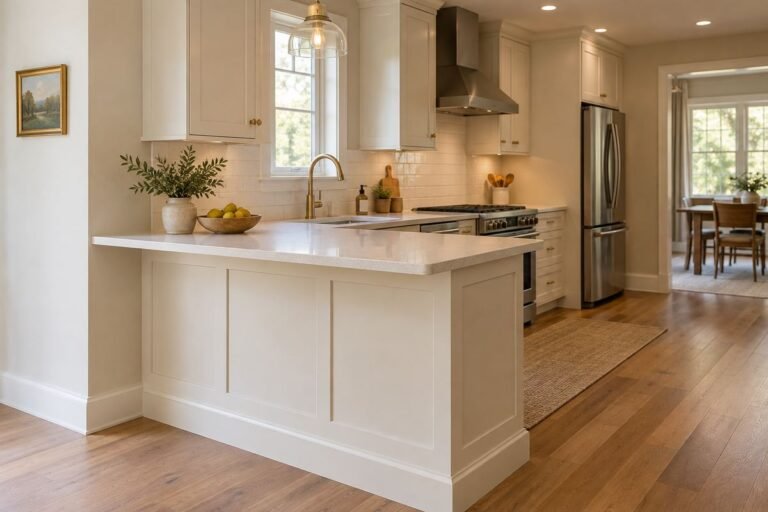
The best kitchen hutch ideas start with the dishes you want to reach and the place where you use them. A hutch can combine a lower storage cabinet with upper shelves or glazed cupboards, giving everyday tableware a home without turning the whole kitchen into a display.
Think of it as a piece of working furniture. Its doors need room to open, its drawers need a clear approach and its shelves need to accommodate your actual plates and pitchers. The space it occupies includes the person retrieving a stack of bowls, not just the cabinet footprint against the wall.
These 22 concepts focus on the complete hutch: useful proportions, storage arrangements and a finish that belongs in the room. The images illustrate original decor concepts rather than tested furniture products. Choose a complete assembly suitable for the intended use, follow its load limits and secure it according to the manufacturer’s instructions and the wall conditions.
The images are original AI-generated decor concepts, not installation diagrams or photographs of completed client projects.
Browse These 22 Kitchen Hutch Ideas
Jump to an idea
- Start with a glass-front top and a closed base
- Use open upper shelves for the dishes used every day
- Choose a mostly closed hutch for mixed household storage
- Try a narrow hutch on a short kitchen wall
- Choose shallow furniture where the room route is tight
- Use a corner-shaped hutch only after checking the diagonal view
- Leave an open middle surface for setting down dishes
- Add drawers for table linens and small serving supplies
- Use adjustable shelves for a collection that changes
- Separate everyday dinnerware from occasional serving pieces
- Reserve a lower cupboard for bulky serving bowls
- Give mugs and breakfast bowls one complete section
- Use a glazed side section to lighten a broad piece
- Keep a freestanding hutch distinct from built-in cabinets
- Relate a painted hutch to the wall for a quieter view
- Use natural wood as the room’s warm furniture note
- Choose a dark hutch with a restrained visible collection
- Repeat a muted color already used in the room
- Let traditional details relate to the house
- Use simple flat fronts beside a visually busy kitchen
- Place the hutch at the kitchen–dining handoff
- Leave one shelf deliberately spare for a calmer collection
Plan kitchen hutch ideas around one ordinary meal
Choose a normal meal and gather the plates, bowls, glasses, serving pieces and linens you would retrieve. Group them on a table before deciding how much open display and closed storage you need. Measure the largest item as well as the cabinet location, then draw the furniture with doors and drawers open. Include chairs in their occupied positions and the route between the hutch, kitchen counter and dining table.
| Main need | Useful arrangement | Check before choosing |
|---|---|---|
| Everyday dishes | Accessible shelves above a closed base | Plate depth, stack height and comfortable reach |
| Mixed packages and attractive tableware | A small display area with more closed storage | Enough hidden capacity for the untidy categories |
| Serving a nearby table | An open middle surface kept mostly clear | Manufacturer-approved surface use and the occupied chair route |
| A compact kitchen wall | A narrower, appropriately shallow complete unit | Real internal depth and the door or drawer approach |
| A varied collection | Adjustable shelves with a restrained display | Approved shelf positions, loads and furniture restraint |
Compare usable storage with the outside dimensions
An attractive overall width does not tell you whether a dinner plate fits. Look for the internal shelf depth, door intrusion, shelf supports and any division between compartments. For a simple planning example, two stacks measuring 11 inches across each occupy 22 inches before space between them and side clearances are considered. That arithmetic is an item inventory, not a recommendation for a particular cabinet width or shelf load. Use the furniture’s actual dimensions and rated capacity.
Give the hutch a specific role in the room
Pottery Barn’s current buffet collection distinguishes open shelving, closed cupboards and drawers. Those are useful categories to compare, rather than reasons to buy the largest piece. Decide what you want visible and what should disappear behind a front. A hutch storing breakfast bowls beside the kitchen has a different job from one holding occasional serving pieces beside a dining table. If it is expected to do both, reserve the easiest shelves for the routine you repeat most.
Treat furniture stability as part of the finished design
The U.S. Consumer Product Safety Commission’s Anchor It! campaign recommends anchoring furniture with drawers, doors and shelves to help prevent tip-overs. Follow the exact assembly and restraint instructions for the chosen unit, including any connection between an upper hutch and its base. A wall placement, a heavy collection on the bottom shelf or a low-looking design is not a substitute for the specified restraint. An older piece without reliable instructions needs an appropriate assessment before use.
1. Start with a glass-front top and a closed base

A glazed upper cupboard can make everyday plates easy to identify while the base keeps varied supplies out of view. It is a useful starting point when you want the hutch to provide both display and practical storage without exposing every item you own.
Give the two areas different jobs. Put a restrained set of dishes behind the glass and reserve the lower cabinet for the less coordinated categories. Check that the glass doors open far enough to lift a plate stack comfortably without colliding with the adjacent wall or furniture.
Practical tip: Assign the visible shelves before buying extra display pieces.
2. Use open upper shelves for the dishes used every day

An open upper section can suit a household that retrieves the same bowls and mugs frequently. The furniture feels approachable because the useful collection is visible and there is no upper door to open during a quick meal.
Keep the shelves edited to the routine. A deep display of small ornaments makes the front edge harder to use and adds things to move during cleaning. Compare the actual shelf depth with the largest dinner plate and leave enough room to lift it, rather than arranging stacks tightly for a photograph.
Practical tip: Use the front row for a complete, reachable everyday group.
3. Choose a mostly closed hutch for mixed household storage

A mostly solid-front hutch can be useful when the stored contents are less visually coordinated. It may hold table linens, spare food containers and serving supplies while letting the kitchen remain calm when the doors are closed.
Do an honest inventory instead of buying the cabinet for its exterior alone. The internal compartments need to suit the awkward containers as well as the neat plate stack. One small open or glazed section can provide visual relief without forcing the practical categories into decorative baskets that reduce usable capacity.
Practical tip: Choose hidden capacity around real contents, not empty-cabinet photographs.
4. Try a narrow hutch on a short kitchen wall
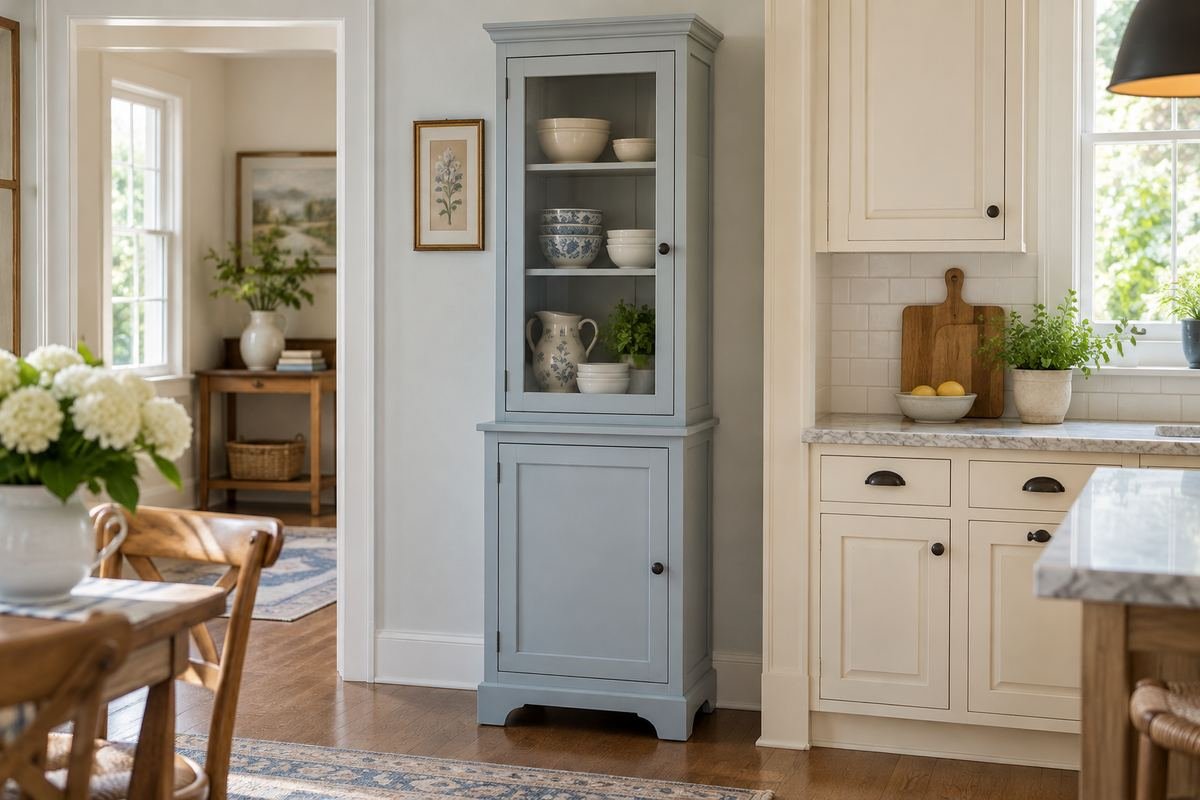
A narrow complete unit can give a short wall a useful purpose without spreading storage across several corners. It works best when its contents are limited to one job, such as everyday breakfast dishes or a small collection of serving pieces.
Check the inside dimensions carefully. A slim outside width may be divided into compartments too narrow for your plates, and an oversized cornice can project farther than the base. Draw the largest parts of the complete furniture, including handles and door movement, when testing the location.
Practical tip: Measure the widest detail, not only the base footprint.
5. Choose shallow furniture where the room route is tight

A shallower hutch can preserve a useful route through the kitchen or dining edge while still storing items suited to its depth. Mugs, small bowls and linens may fit where a deep collection of large serving platters does not.
Use the intended objects to decide whether the compromise is worthwhile. A shallow cabinet that forces dinner plates to stand awkwardly or leaves doors unable to close is not a practical saving. Include the person standing in front of the open furniture when comparing the route, particularly beside occupied chairs.
Practical tip: Match the storage category to the available internal depth.
6. Use a corner-shaped hutch only after checking the diagonal view

A properly designed corner hutch can use a position that is difficult for rectangular furniture. Its angled front may give a compact room a softer visual edge and hold a small collection without occupying a long straight wall.
The apparent corner saving can disappear once the diagonal projection and open doors are included. Measure the complete front and check access to the deepest shelf sections. Use a purpose-made complete unit rather than trying to balance a straight upper cabinet across unrelated corner bases.
Practical tip: Draw the diagonal front and open doors in the room plan.
7. Leave an open middle surface for setting down dishes
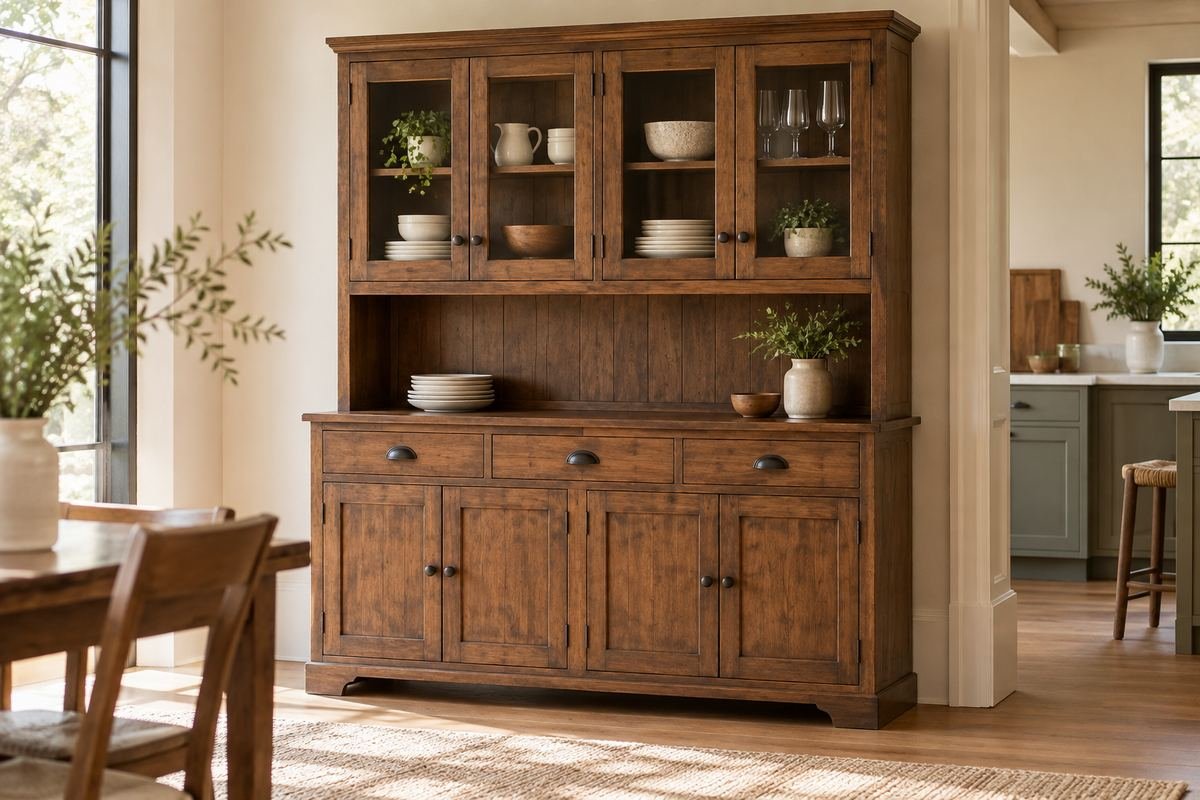
An open middle section gives the hutch a useful pause between upper display and lower storage. It can provide a place to set down a stack of plates while opening a cupboard or arranging tableware for a nearby meal.
Keep the surface largely available. A line of permanent vases or a large appliance can erase the purpose of the open bay. Verify what the furniture surface is intended to support and protect it appropriately; a decorative hutch top should not automatically be treated as a kitchen worktop for heat, moisture or food preparation.
Practical tip: Leave a clear landing place sized to the items you handle.
8. Add drawers for table linens and small serving supplies

Drawers can give folded napkins, placemats and smaller serving tools a defined home beneath the dish shelves. This arrangement is especially useful when those items otherwise migrate between the kitchen and several dining-room cupboards.
Check the usable drawer size and its open position. A deep-looking front may hide a shallow box, while a wide drawer can need a clear stance in front of it. Sort contents by the way you set the table so a normal meal does not require opening every drawer.
Practical tip: Measure a folded placemat against the actual drawer interior.
9. Use adjustable shelves for a collection that changes
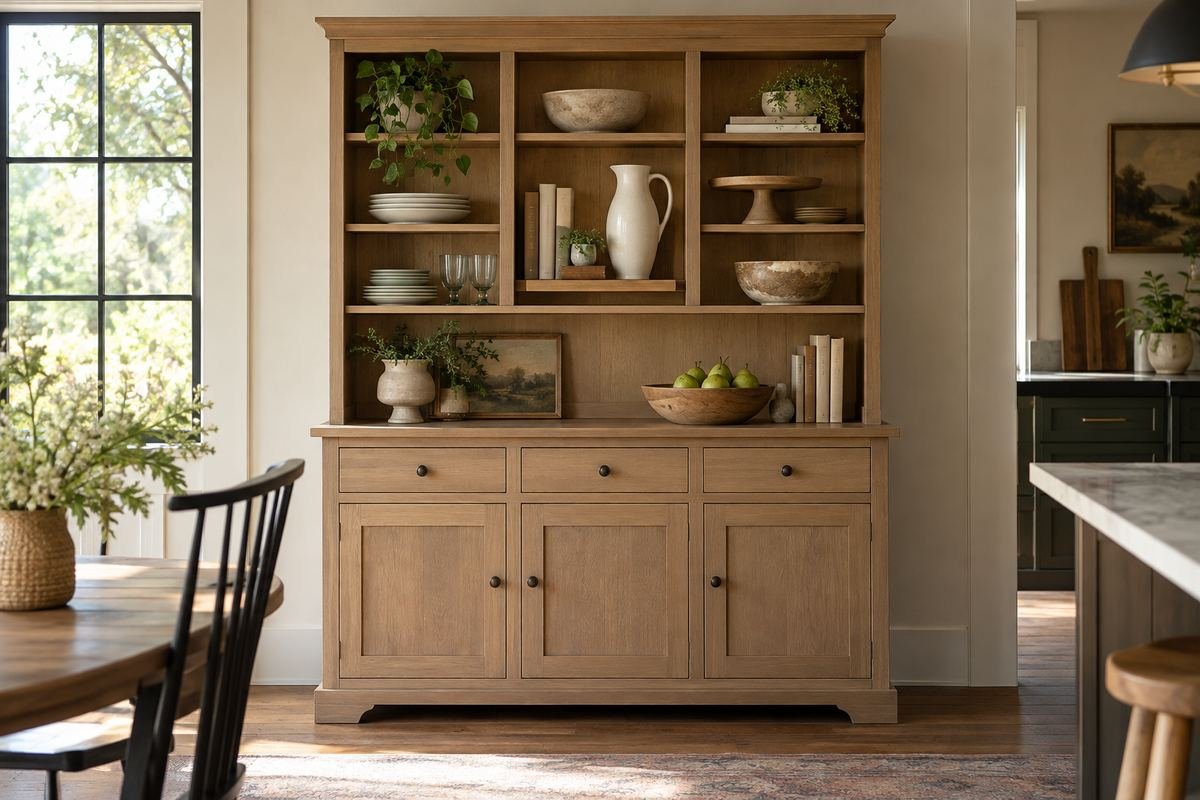
Adjustable shelves can make a hutch more useful when the collection includes both low bowl stacks and taller pitchers. They allow the interior to reflect the items you actually keep instead of forcing every shelf into an identical display.
Use only the approved shelf positions, supports and loading for the complete unit. More empty height is not always better if it puts the next useful shelf beyond comfortable reach. Arrange the everyday group first and use the remaining space for occasional items that suit the rated shelf capacity.
Practical tip: Compare the shelf setting with the tallest item before loading the cabinet.
10. Separate everyday dinnerware from occasional serving pieces

A hutch can hold two related routines without mixing them on every shelf. Keep ordinary dinnerware together in the easiest area and give less frequently used serving bowls or special platters a separate compartment.
The distinction should make retrieval simpler. Avoid placing an everyday bowl behind a large platter that must be moved each morning. If a serving piece is heavy or awkward, its position should suit safe handling and the manufacturer’s loading limits rather than being chosen solely to balance the display.
Practical tip: Set the everyday shelves before arranging the occasional collection.
11. Reserve a lower cupboard for bulky serving bowls

Large serving bowls can consume the most useful upper shelf space while being awkward to lift from above. A suitable lower cupboard can give them a defined place and keep the upper section focused on smaller items.
Check the opening and how you would retrieve the largest bowl without removing an unstable stack. A lower location alone does not establish safe storage or furniture stability. Keep within the cabinet ratings and retain the specified restraint, then choose a grouping you can handle comfortably.
Practical tip: Avoid nesting so many large bowls that retrieval becomes a lifting task.
12. Give mugs and breakfast bowls one complete section
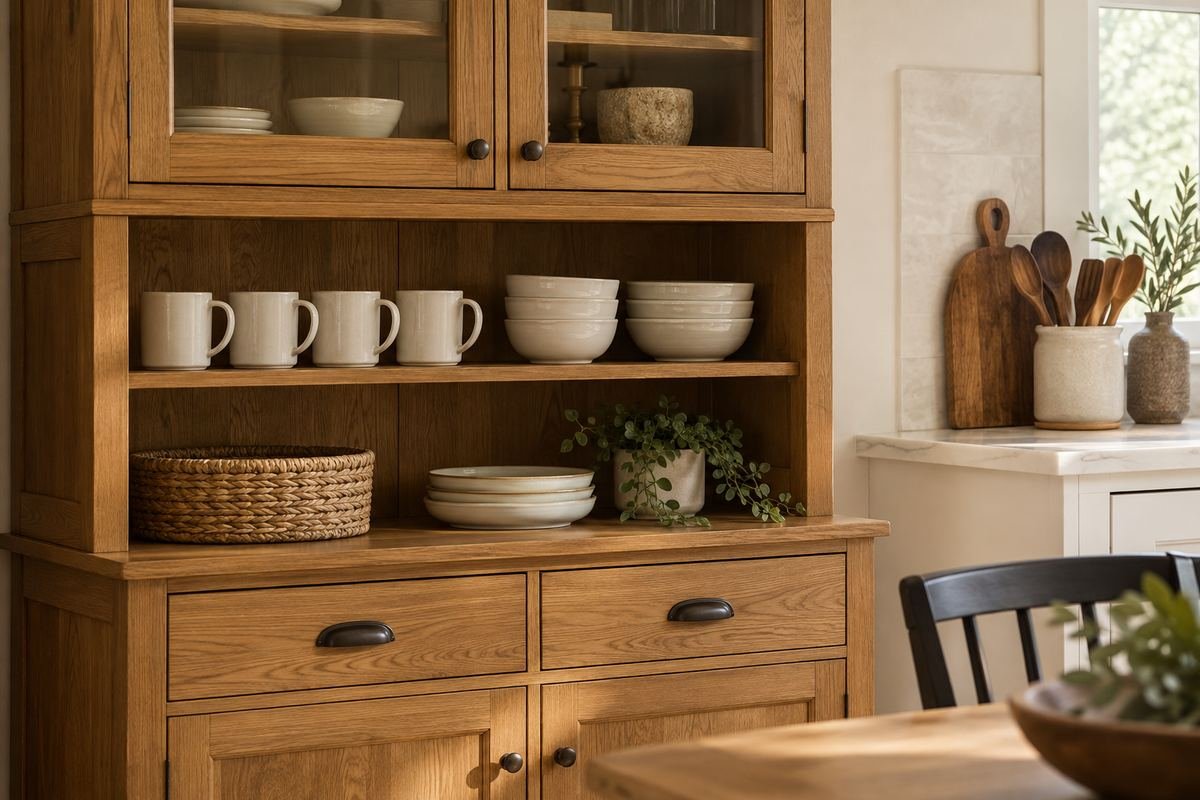
A breakfast section can reduce the back-and-forth between storage spots during an ordinary morning. Group the mugs and bowls you actually use instead of filling the shelf with a full collection that belongs elsewhere.
Keep any coffee preparation on an appropriate nearby kitchen surface rather than assuming the hutch is an appliance station. The furniture’s role can be storage and retrieval. A compact section near the normal breakfast route may be more useful than turning the entire piece into a themed display.
Practical tip: Group a realistic daily quantity, with spare pieces stored separately.
13. Use a glazed side section to lighten a broad piece

A broader hutch can feel less visually dense when one part of the upper cabinet is glazed. This can work along a wall where the base needs to hold more supplies but a fully solid tall elevation would dominate the room.
Make the glazed area purposeful rather than symmetrical by default. A smaller display section may be enough for a collection you enjoy, leaving the rest of the furniture useful for mixed contents. Compare the sightline from the kitchen entrance as well as the view directly in front of the cabinet.
Practical tip: Let the display proportion follow the collection you want visible.
14. Keep a freestanding hutch distinct from built-in cabinets
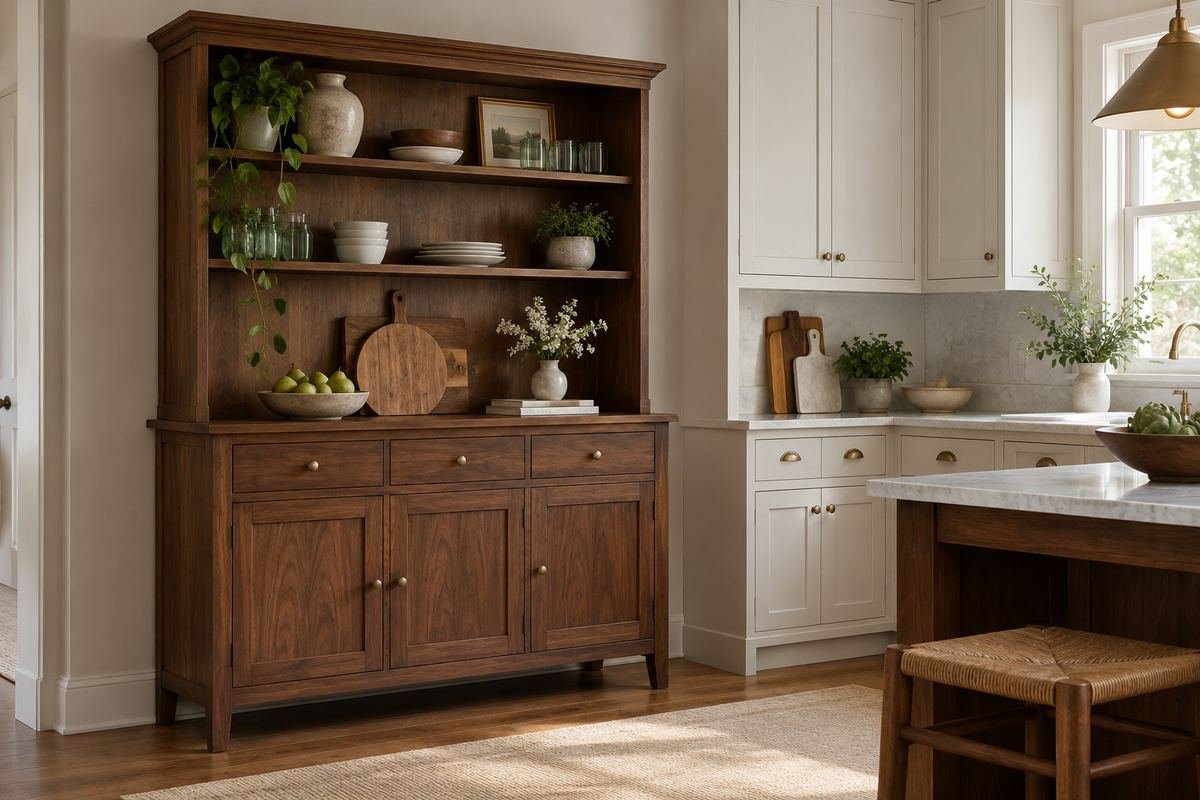
A freestanding piece can make a kitchen feel collected when its outline and finish have a clear identity. Visible legs, a defined top or a slightly different wood tone can help it read as furniture alongside simpler fixed cabinets.
The distinction should be deliberate. A piece that nearly matches the built-ins but stops at an awkward height can look accidental. Compare its full silhouette with nearby cabinet lines while keeping the practical requirements of a complete freestanding assembly, including suitable restraints and clear movement around it.
Practical tip: Choose one clear furniture detail instead of copying every cabinet feature.
15. Relate a painted hutch to the wall for a quieter view
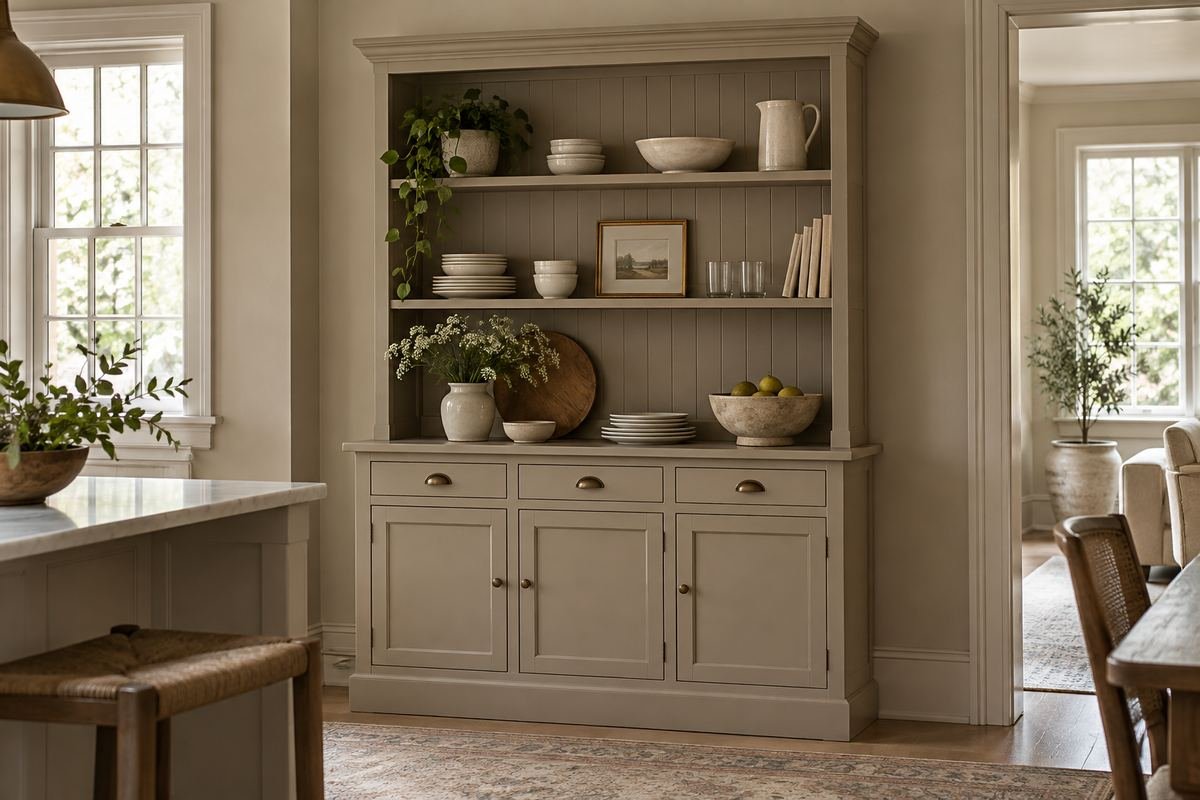
Painting the furniture in a tone related to the wall can make a tall piece feel calmer in a busy kitchen. The dishes, handles and shelf shadows provide enough detail without adding another strong block of color.
Coordinate the appearance while using coatings suitable for each surface. The wall paint and furniture finish may need different specifications even when the colors are related. Judge samples beside the fixed floor and cabinets, then check the effect with the hutch doors open and its ordinary contents visible.
Practical tip: Test a furniture-finish sample vertically beside the wall color.
16. Use natural wood as the room’s warm furniture note
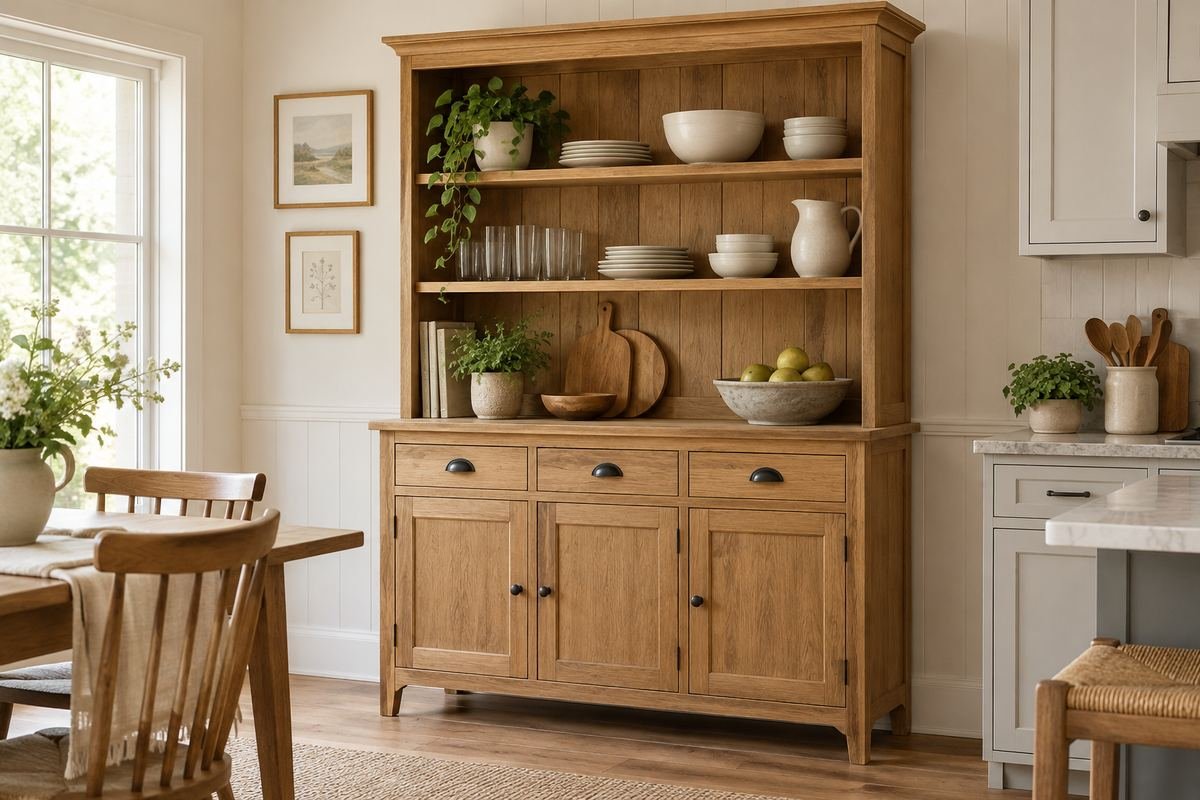
A natural wood hutch can bring warmth to a kitchen dominated by painted cabinets and stone. It can also connect with a dining table or timber floor without requiring every wood surface to match exactly.
Compare undertones and the scale of the grain. A richly figured front may become the room’s focal point, while a quieter timber can sit more gently beside a patterned floor. Use the actual finish sample where the furniture will stand; a small online image cannot show how it relates to the kitchen light.
Practical tip: Aim for a deliberate companion wood tone rather than an almost-match.
17. Choose a dark hutch with a restrained visible collection

A dark-painted hutch can give a light kitchen a clear furniture anchor. The contrast works especially well when the piece has an uncomplicated shape and the upper display remains simple enough to read against the darker interior.
Do not fill every shelf to compensate for the strong color. A few related dishes can make the storage legible, while assorted tiny objects tend to dissolve into visual noise. Compare the furniture in the evening too, since a dark cabinet can feel much heavier under the room’s ordinary lighting.
Practical tip: Check the closed silhouette and open shelves after dark.
18. Repeat a muted color already used in the room

A colored hutch can belong naturally in the kitchen when it repeats an existing tone from an island, textile or adjoining dining space. The repetition gives the furniture a relationship instead of making it an isolated accent.
Choose which element should lead. If the hutch is the stronger color feature, keep its display and hardware quieter. Sample the color beside the actual counter and flooring, because a green or blue that works in another room may shift noticeably in this kitchen’s light.
Practical tip: Repeat one established color before introducing a new palette.
19. Let traditional details relate to the house

A traditionally detailed hutch can make sense in a kitchen with familiar paneling, older door trim or a classic dining table. The furniture does not need to reproduce every architectural detail to look at home.
Compare the weight of the cornice, door frames and base with what is already in the room. An elaborate cabinet can crowd a small wall even when its basic width fits. Keep the contents simpler when the furniture itself provides the decorative interest, and avoid treating ornate old components as safe to stack without assessment.
Practical tip: Match the scale of the detailing before matching the style label.
20. Use simple flat fronts beside a visually busy kitchen
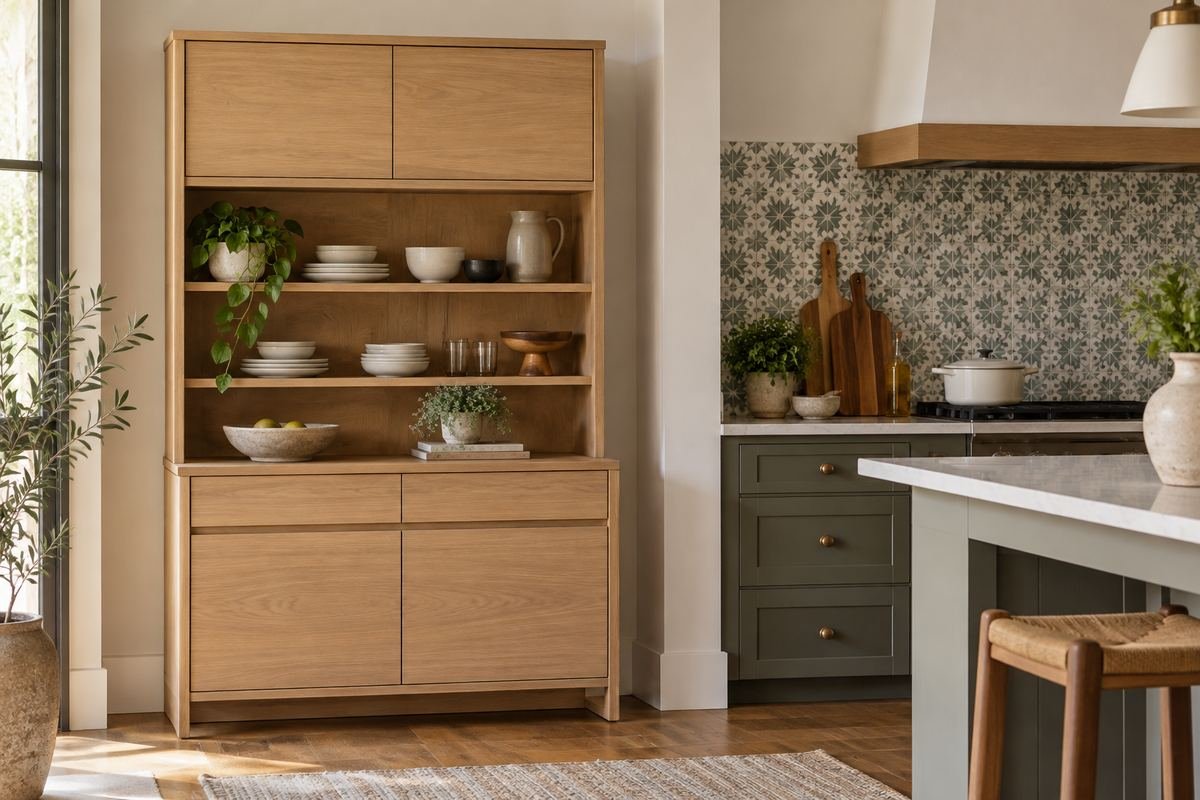
A hutch with plain fronts can provide storage without adding another pattern beside a strongly veined counter or detailed backsplash. Its quiet shape allows the fixed finishes to remain the main visual feature.
Choose the internal layout with the same care as the exterior. Minimal fronts do not make an inconvenient shelf or oversized door more useful. A small open section can reveal a familiar dish group while the rest of the plain furniture holds the practical categories out of sight.
Practical tip: Keep the silhouette quiet and make the compartments do the work.
21. Place the hutch at the kitchen–dining handoff
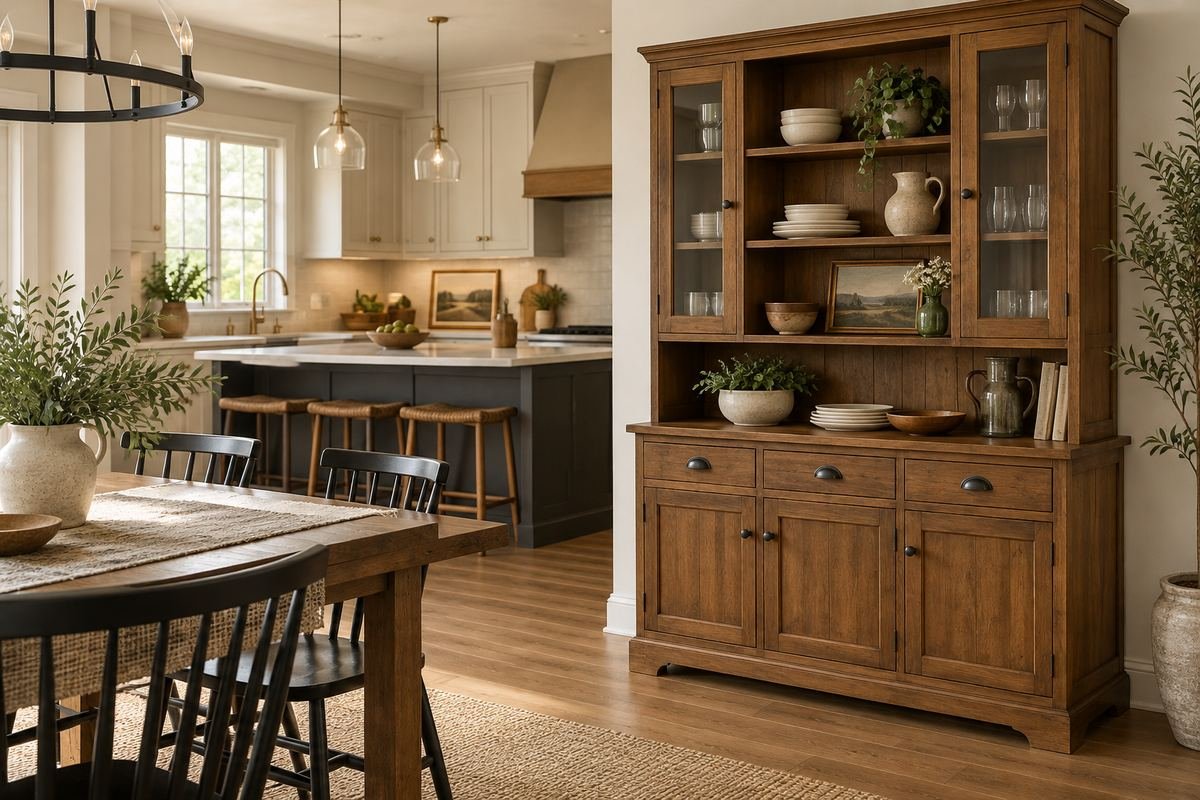
A hutch near the connection between kitchen and dining room can serve both spaces when the route remains clear. Tableware can move from storage to setting without crossing the whole kitchen, and serving pieces have a place near the meal.
Test the position with chairs occupied and the hutch open. A cabinet that works when the table is empty may block the route during dinner. Coordinate one finish with each room rather than piling more display on the furniture to explain the connection.
Practical tip: Walk through a normal serving sequence before committing to the location.
22. Leave one shelf deliberately spare for a calmer collection

An intentionally spare shelf can make the useful contents easier to see and leave room for the collection to change. It is especially helpful when a hutch has become a crowded mixture of everyday dishes, gifts and objects stored by default.
Remove the items with no clear role and regroup what remains by use. Empty space should improve retrieval rather than become a rule that pushes needed dishes elsewhere. Revisit the arrangement after a normal week and keep the shelves that make setting and clearing the table straightforward.
Practical tip: Edit around a real week of meals, then keep the useful gaps.
Frequently Asked Questions
What is the difference between a hutch and a sideboard?
A sideboard is generally a lower storage and serving piece. A hutch adds upper storage or display above a base, either as a complete tall cabinet or an upper-and-lower assembly. Product names vary, so compare the actual construction, storage layout and intended use rather than the name alone.
How do I choose the right kitchen hutch size?
Measure the wall, ceiling, delivery route and the space needed to open the furniture. Then check the internal dimensions against actual dishes. Include people, occupied dining chairs and nearby kitchen fronts in the layout. A narrower piece with suitable compartments may be more useful than a large cabinet that interrupts the room.
Should a kitchen hutch match the cabinets?
It can match when you want a quiet, coordinated wall. A related wood tone or a deliberately different paint color can also make it feel like collected furniture. Compare samples beside the fixed floor, counter and cabinets; an accidental near-match is harder to coordinate than a clear relationship.
What should I display in a hutch?
Start with the tableware you use or a small collection you enjoy. Keep retrieval straightforward and leave room to lift items without rearranging the entire shelf. Put less attractive supplies in appropriate closed storage instead of trying to make every category part of the display.
Can any old cabinet become a kitchen hutch?
Condition, stability, shelf strength, finish suitability and the connection between components all matter. Do not simply stack separate pieces to create the silhouette. Assess the specific furniture and use a complete suitable assembly with the required restraints before loading it with dishes.
Choose the Details That Work in Your Home
Choose the role first, fit the storage to real dishes and keep the everyday approach clear. The most convincing kitchen hutch ideas make a room feel collected because the furniture holds useful things well. Add the finish and display details after the proportions, internal layout and stability have been resolved.
For related ideas, explore kitchen storage ideas, sideboard decor ideas, small dining room ideas.
Planning References
Pottery Barn: buffet, sideboard and cabinet storage arrangements; CPSC Anchor It!: furniture restraint guidance. Follow the instructions for the exact products you choose.
Optional digital guide for this topic
If you prefer a structured workbook, explore this related paid guide.