Home library ideas should connect the books you keep with the way you find, read and return them. Begin with a collection you value, a suitable room location and an understandable arrangement. A home library can share a living room, study or guest room; buying enough books to reach an arbitrary number is not the purpose of this planning guide.
These 26 concepts cover room layouts, book support and ordinary reading routines. They are design options, not measured construction plans. Check the furniture’s actual capacity and restraint instructions, and get suitable help for building work or special collections. The images cannot establish a floor’s capacity, hidden fixings or conservation performance.
Contents
- 1. Begin with one book wall and a clear route
- 2. Use an L-shaped library in a suitable corner
- 3. Compare parallel shelves only when browsing still works
- 4. Give an existing alcove a manageable collection
- 5. Let a living room hold the library without losing its seats
- 6. Make a dining room library easy to change between tasks
- 7. Separate reference books from a home office desktop
- 8. Keep a guest-room library clear of the bed routine
- 9. Build a shared family library around reachable categories
- 10. Preserve useful window access beside the collection
- 11. Compare a low bookcase for a modest library wall
- 12. Choose adjustable openings from the real book sizes
- 13. Give oversized volumes suitable flat support
- 14. Use bookends that support an incomplete row
- 15. Keep fragile or valuable books in an appropriate protected group
- 16. Limit the current-reading group beside the seat
- 17. Give borrowed books a distinct return position
- 18. Make frequently consulted references easy to reach
- 19. Choose an understandable collection order
- 20. Test the reading chair with the library layout
- 21. Provide a stable place for the open reading task
- 22. Place task light for the page and seated view
- 23. Use window treatments to manage changing brightness
- 24. Choose a restrained palette around the books you own
- 25. Let one display position serve a real purpose
- 26. Finish with a return routine and a growth limit
Plan home library ideas from the collection and the room together
The Library of Congress identifies suitable storage, a stable environment and careful handling as key preventive measures for books. Begin by assessing the actual room rather than assigning the collection to an attic or damp storage area simply because it has space. The CPSC Anchor It! guidance also emphasizes following manufacturers’ instructions when securing furniture. Use those principles alongside a room plan and your actual book sizes.
Choose the library arrangement from its everyday job
- A modest retained collection: Start with one reachable book wall and a reading position.
- Shared living or dining room: Test the other activity with books and furniture in place.
- Large or unusual book formats: Reserve appropriate support instead of forcing identical shelf spacing.
- Reference-heavy use: Compare a useful desk and a clear subject sequence.
- Special or fragile books: Seek item-specific housing and handling advice.
1. Begin with one book wall and a clear route
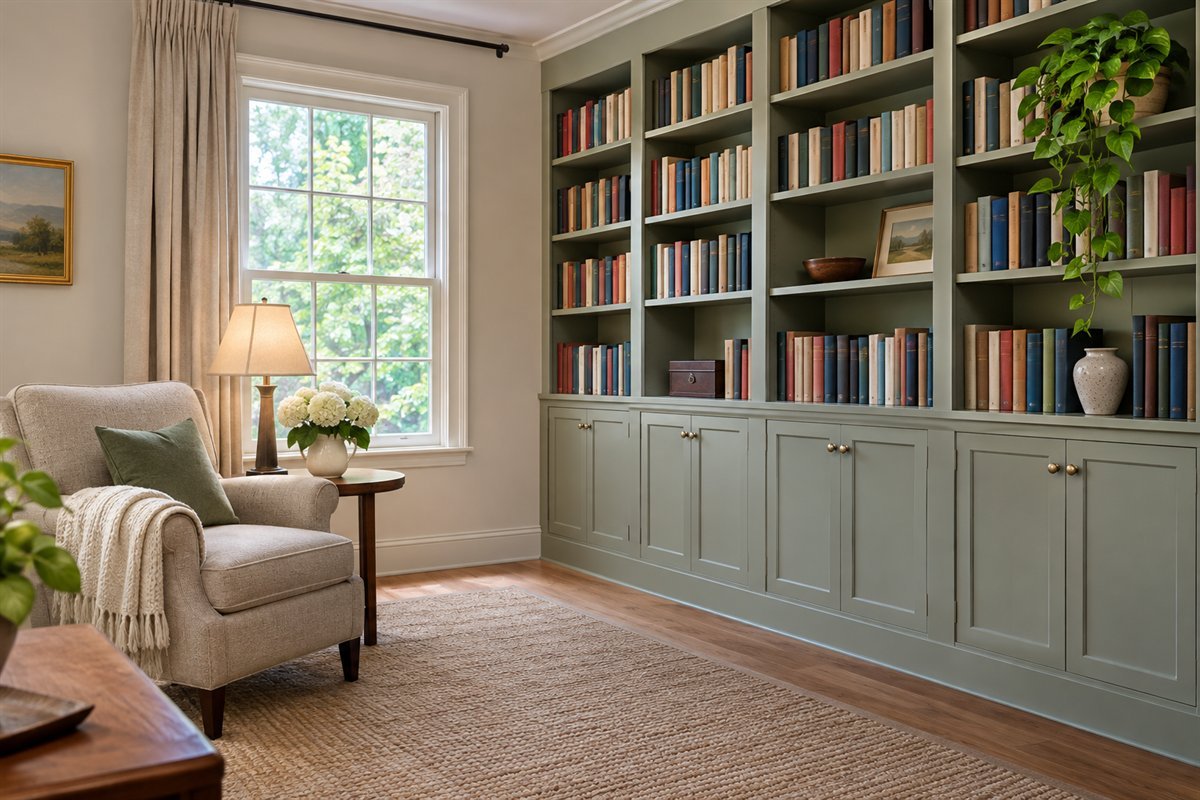
One well-planned wall can hold the main collection while leaving the room useful for reading. Start with the retained books, door movement and seat rather than extending shelving around every surface. Compare the bookcase depth with the route when someone is browsing. A wall that can be reached and maintained is more useful than a larger collection trapped behind furniture.
Try this: Mark the usable route with the chair occupied before choosing another unit.
2. Use an L-shaped library in a suitable corner

Two adjoining bookcase runs can make a corner feel like a deliberate library area. Check how the units meet, whether the corner remains accessible and how doors or drawers open. A matching finish can connect separate pieces without assuming they function as a built-in system. Follow the actual furniture support and restraint guidance.
Try this: Test the inner corner with real book sizes before ordering both runs.
3. Compare parallel shelves only when browsing still works

Parallel shelves can suit a longer room, but the aisle needs to work with a person browsing and a book being carried. Include open cabinet doors and any movable chair in the comparison. Use the actual floor plan rather than judging the gap from a wide-angle photograph. If the room becomes a tight storage aisle, keep one side simpler.
Try this: Walk the route while another household member pauses at a shelf.
4. Give an existing alcove a manageable collection

An existing alcove can give a small library a clear boundary. Measure the usable opening and the depth of the intended units, including skirting and nearby doors. Keep access to services and ventilation available. New fitted work requires a suitable design for the building; an inspiration image cannot establish hidden wall strength or a cabinet specification.
Try this: Measure at several positions instead of assuming the opening is perfectly square.
5. Let a living room hold the library without losing its seats

A living room library should support both reading and the room’s ordinary social use. Keep the main collection on suitable shelving, then place the seating so someone can choose a book without crossing another person’s feet. Use a limited reading group beside the favorite chair. The room does not need a second complete seating arrangement just to signal that books belong there.
Try this: Test the library while the rest of the seating is occupied.
6. Make a dining room library easy to change between tasks

A dining room can share its space with a book collection when the two activities have clear boundaries. Keep books in appropriate shelving rather than using the dining table as permanent overflow. Check chair pullback against the cabinet depth and allow a convenient return route. Put food, drinks and table-clearing supplies away from the collection.
Try this: Set the table for its normal use before judging how much shelving fits.
7. Separate reference books from a home office desktop

In a study, keep frequently used references within practical reach without turning the desk into another shelf. Group the books by the work they support, leaving the keyboard and writing area available. Check the task chair and open drawers with the bookcase occupied. The library should shorten an ordinary search, not add furniture that makes sitting down difficult.
Try this: Try one real work task and record which books actually need the closest position.
8. Keep a guest-room library clear of the bed routine

A guest room can house part of the collection without making the visitor navigate a storage room. Keep the bed, luggage position, curtains and usable drawers straightforward. Place books where the household can retrieve them respectfully when the room is occupied. If access would disturb a sleeping guest, keep frequently used references elsewhere.
Try this: Open the suitcase and bedside drawer during the layout test.
9. Build a shared family library around reachable categories

A shared collection benefits from categories that the people using the room can understand and return. Keep suitable everyday books in appropriate reachable positions and store fragile or special volumes separately. Follow the furniture’s restraint instructions and household safety requirements. Avoid placing an enticing display high up merely to balance the color of the wall.
Try this: Choose category names from how the household asks for books, not a complicated catalog no one will use.
10. Preserve useful window access beside the collection

A window can make the room inviting while stored books still need protection from intense light. Keep the collection on a suitable wall and use an appropriate shade to manage the actual conditions. Check access to the window and its controls with the furniture in use. A bright photograph does not show how exposure changes over a full day.
Try this: Visit the planned shelf location at the times when direct light reaches the room.
11. Compare a low bookcase for a modest library wall

A lower bookcase can give a small collection a defined home without filling the entire wall. Choose it from the usable shelf dimensions and the actual books. Keep its top simple enough to maintain and follow the furniture instructions even when the unit appears low. A lower visual profile does not establish load capacity or remove the need for appropriate restraint.
Try this: Check the full footprint, including doors or handles, before adding a side table.
12. Choose adjustable openings from the real book sizes

A mixed collection can include paperbacks, tall reference books and wide art volumes. Adjustable openings may use the furniture more effectively than a set of identical decorative squares. Compare the actual book dimensions with the usable space and the product’s permitted shelf positions. Keep adequate room to grasp a volume without bending its cover into the shelf above.
Try this: Measure a representative group of the largest retained books before selecting the unit.
13. Give oversized volumes suitable flat support

Oversized or unusually heavy books may need a different supported arrangement from an ordinary upright row. Compare the volume’s size, condition and weight with suitable shelving and conservation guidance. Keep any flat group manageable to lift, and do not place a decorative object on a book that is frequently removed. The shelf capacity must come from the actual product.
Try this: Make a separate list of books that do not fit the main shelf pattern.
14. Use bookends that support an incomplete row

An unfinished shelf row should still support the books appropriately. The Canadian Conservation Institute recommends supporting upright groups rather than letting them lean. Choose bookends that suit the books and surface, and check that their edges do not intrude between pages. Leave room for careful removal instead of squeezing an extra volume into a tight row.
Try this: Remove a middle book once, then adjust the support to the changed row.
15. Keep fragile or valuable books in an appropriate protected group

Special books may need more than the arrangement used for everyday paperbacks. Keep their condition and care needs identifiable and seek a qualified conservator’s advice when necessary. A cabinet door can be part of an appropriate setting, but glass alone does not prove environmental control or archival suitability. Choose housing and contact materials for the specific item.
Try this: Record which books need special handling before assigning their display position.
16. Limit the current-reading group beside the seat

Keep the current selection beside the reading seat while the main collection remains on its proper shelves. A small defined group can keep the chair and floor available between sessions. Return finished books before another stack develops. Avoid using a soft basket for a fragile volume that needs a more supported arrangement.
Try this: Decide the current-reading limit from the actual landing surface.
17. Give borrowed books a distinct return position

A borrowed book needs to leave the collection again, so give it a clearly separate position. Keep its return information in a record you will check, without covering the book in adhesive notes. A defined return group can prevent it from disappearing into the permanent shelving. Use the same idea for books waiting to be lent or transferred.
Try this: Review the return position before making the next library visit.
18. Make frequently consulted references easy to reach

A library can contain books used in different ways. Keep the references you repeatedly consult in a convenient group, with related material close enough to compare. A decorative color arrangement should not make the useful sequence harder to follow. Place rarely used material elsewhere if it crowds the books that support ordinary work.
Try this: Keep a short list of what you reach for during one typical week.
19. Choose an understandable collection order

Choose an order that helps you find the book you want: author, broad subject, series or another clear household system. Color can be a visual preference, but it should not erase information you rely on. Keep the system simple enough to restore after use. Avoid reorganizing the whole library repeatedly when a small category adjustment would solve the actual search problem.
Try this: Ask someone who uses the room to find one book using the proposed categories.
20. Test the reading chair with the library layout

Choose the seat from how you like to read and the usable room around it. Check the chair’s width, sitting position and any swivel or reclining movement together with the shelves. A footstool needs both an in-use position and a place to park. Keep book retrieval possible while someone is settled into the chair.
Try this: Try the seat with an ordinary book instead of judging comfort from upholstery alone.
21. Provide a stable place for the open reading task

A desk or broad table can suit readers who compare books, make notes or work with larger pages. Give the task enough usable support without forcing a binding open beyond its natural movement. Keep the surface clear of permanent stacks and use suitable support for delicate material. A reading table and a side table have different jobs.
Try this: Test the table with the largest book you normally use there.
22. Place task light for the page and seated view

A reading light should work from the actual seat and at the time you use the room. Compare its direction, glare and the shadow cast by your ordinary position. Follow the light’s installation and operating instructions, with a suitable cable route. Decorative shelf lighting may reveal a display without providing the light needed for the reading task.
Try this: Test the arrangement after dark before deciding that the general ceiling light is enough.
23. Use window treatments to manage changing brightness
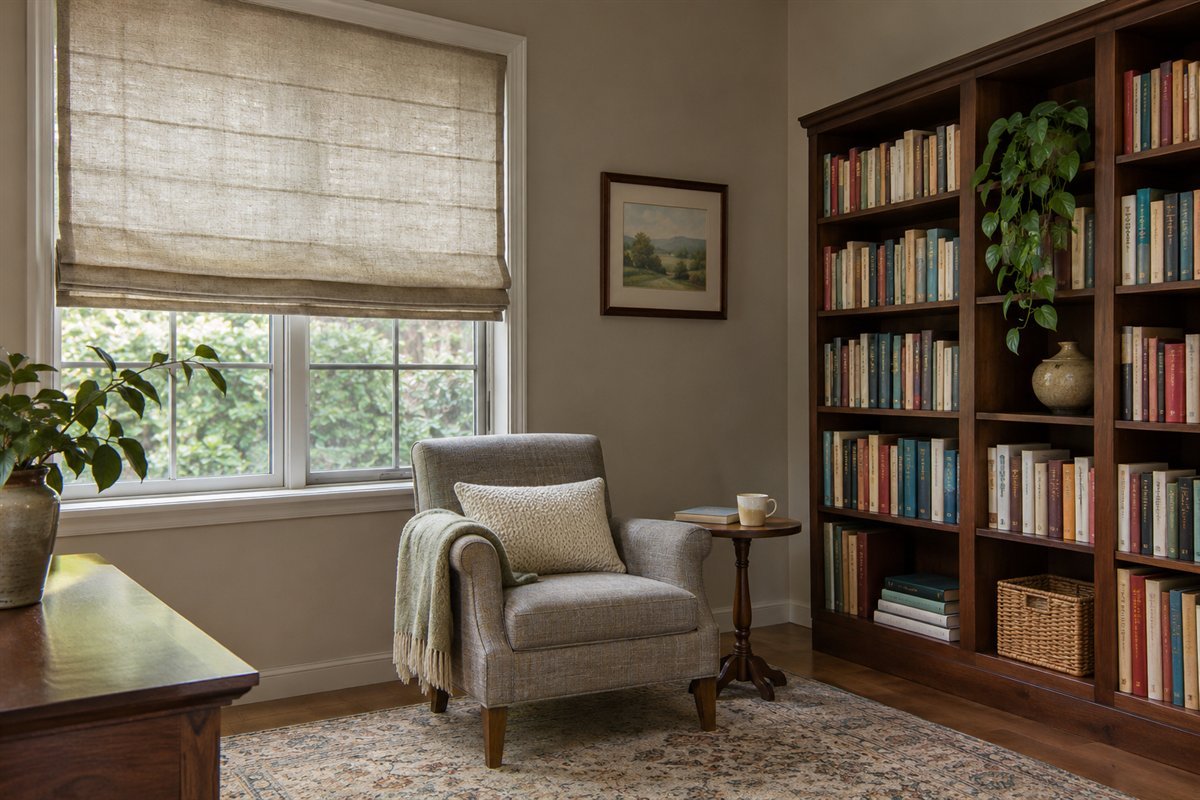
The Library of Congress advises minimizing light exposure to stored books and avoiding direct or intense light. Choose window treatment from the actual exposure and the room’s practical use, then test it through its full movement. Keep a pleasant view where possible without using the book wall as an unprotected display in strong sun.
Try this: Check light on the spines as well as glare at the reading seat.
24. Choose a restrained palette around the books you own

A cohesive library does not require replacing or wrapping every book to match the room. Use the wall, shelving or seating to create a limited color relationship while keeping the collection recognizable. Compare finish samples under the room’s real light. New coatings or shelf liners must be suitable for contact with the actual books; appearance alone does not establish that.
Try this: Choose the room palette around a representative group from the retained collection.
25. Let one display position serve a real purpose

A favorite print or personal object can make the library feel connected to the household. Give it a suitable supported position that does not trap books behind it or sit on a volume you need often. Keep food, drinks and plant watering away from the collection. One deliberate display can be enough in a room where the books already provide varied color and texture.
Try this: Remove the display temporarily if it interrupts ordinary browsing.
26. Finish with a return routine and a growth limit

Keep the library useful by returning books to the same understandable system. Review borrowed, current and reserved groups before buying more furniture. Leave a practical amount of usable capacity based on your collection plans rather than filling every opening immediately. A growing room of unidentified piles is harder to browse even when each new bookcase matches.
Try this: Change one recurring retrieval problem before adding another shelving run.
A collection-to-room worksheet before buying shelves
First, group your retained books by the way they need to be used and supported. List ordinary upright volumes, oversized items, frequently consulted references and special pieces. Keep borrowed books and the current-reading selection distinct from the permanent collection. Record any item whose condition needs advice rather than assigning it a convenient gap.
Next, measure representative book heights, depths and the space occupied by each retained group. Compare these with the usable shelf dimensions and the furniture manufacturer’s stated load limits. Linear shelf length helps plan arrangement; it does not measure the load a floor or shelf can safely carry. Heavy or extensive collections and new fitted work may need a qualified assessment of the actual building and furniture.
Draw the bookcase footprints, door swings, open drawers and reading furniture on the same room plan. Walk from the entrance to a representative shelf, choose a book, sit down, use the light and return the book. Include a second person where the room is normally shared. Record the movement that becomes awkward and adjust that part before buying additional units.
For a hypothetical planning example, suppose one retained group occupies 48 inches of usable shelf length and the selected unit provides two suitable openings of 30 inches each. That leaves 12 inches of linear space in this simplified example. It does not prove that the book heights, shelf depth, weight limits, fixings or floor are suitable; check each separately. This is an illustration of planning arithmetic, not a tested room or capacity specification.
Finish with a short care and return plan: who uses each group, where current and borrowed books wait, how the room’s light is managed and which items need specialist advice. Revisit the arrangement after ordinary use. A modest system that stays understandable is more valuable than an elaborate library display that makes books difficult to retrieve.
How many books do I need for these home library ideas?
Use the collection you intend to keep and read. This home-planning guide does not set a qualifying book count; measure and arrange the actual collection instead of buying books just to meet a number.
Can a home library share another room?
Yes, a suitable living room, study, dining room or guest room can share its space with books. Test both activities, including chair movement, book retrieval and the room’s ordinary access.
Do books need to match the room color?
No. Keep the collection recognizable and use the shelving, walls or seating for a color connection when you want one. A decorative color system should still let you find and return the book.
A practical next step
Choose home library ideas that make the retained collection easy to browse and the room comfortable to use. Plan suitable shelving, a useful reading position and a simple return routine together, then refine color and display after those practical decisions work.
Choose a comfortable small reading nook within the room. Style selected living-room bookshelf display areas.
Images are original AI-generated home library concepts, not verified installations, measured rooms or certified book-preservation arrangements.
Sources and care references
- Library of Congress: preventive storage and handling principles for books
- Canadian Conservation Institute: book handling and supported storage
- CPSC Anchor It!: following furniture restraint instructions
Optional digital guide for this topic
If you prefer a structured workbook, explore this related paid guide.