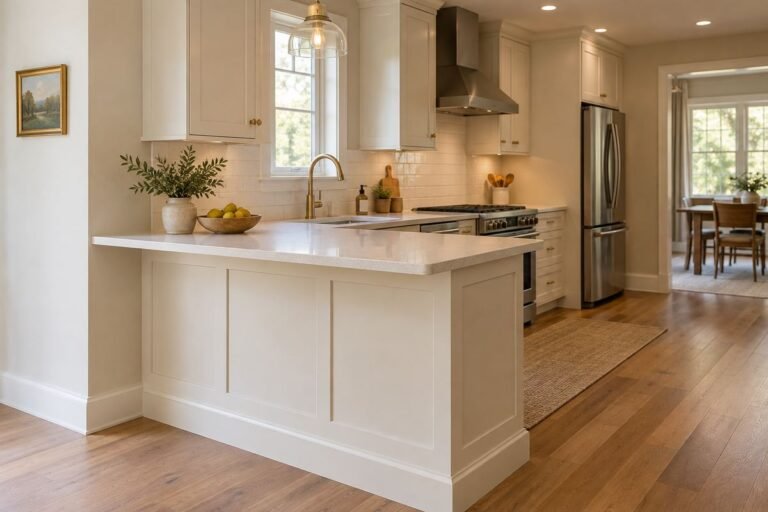
Kitchen window treatments have a practical job before they have a decorative one. They should let you use the window, control the view and cope with the conditions around it. A quiet breakfast-corner window and a window behind a splashing sink may need completely different solutions.
These ideas cover individual coverings and ways to arrange them on wide, paired and awkward windows. Choose for the exact location first, then coordinate the texture and color with your cabinets. A treatment that looks beautiful from the doorway still needs to work when the faucet, window handle and neighboring cabinet doors are in use.
Before ordering, measure the frame and check how the window opens. Hold a sample near the cabinets in daylight, then check privacy after dark with the room lights on. Review cleaning instructions and the product’s suitability for moisture, heat and the proposed mounting location rather than assuming every blind or fabric is kitchen-ready.
The images are original AI-generated decor concepts, not installation diagrams or photographs of completed client projects.
Test Kitchen Window Treatments With the Window and Faucet in Use
Operate the window and nearby cabinets while marking the proposed covering in its open and closed positions. Next, compare a sample at night with the kitchen illuminated. For example, a folded shade can clear the sill yet still catch the handle or cover more glass than expected when raised. Choose for the actual dry or splash-prone location and retain the equipment separation required by the complete installation.
Plan kitchen window treatments around the work zone
Keep fabrics and other combustible materials away from cooking and heating equipment, following appliance and covering instructions for the actual installation. Do not use a general decor photograph to establish a safe distance. The CPSC recommends cordless window coverings, especially around young children. Keep operating cords out of the arrangement and check that the covering does not obstruct the window or create a problem at the sink.
1. Begin Kitchen Window Treatments With a Contained Roller Shade

A plain roller shade gives a busy kitchen a calm line. When raised, it leaves much of the frame visible; when lowered, it provides a broad surface that can repeat a quiet cabinet or wall color.
Check the material’s cleaning instructions and light-control description. A fabric that looks opaque in a product photo may still show silhouettes or let more light through than you expect.
Practical tip: Test privacy with the kitchen illuminated after dark.
2. A softly textured cellular shade

Cellular construction gives the window a restrained folded texture. It can suit a kitchen where the cabinets are flat-fronted and you want the covering to add softness without a strong print.
Choose the material for the location and review care instructions. Avoid assuming the folded construction automatically makes every version suitable for repeated sink splashes or heavy cooking residue.
Practical tip: Compare the shade’s stack height when fully raised.
3. A flat Roman shade in a dry area

A flat Roman shade creates a tailored fabric panel with orderly folds when raised. Use it where the window is away from splashes and cooking, such as a breakfast corner or a dry end of the kitchen.
A simple fabric can connect the window to seat cushions without making a matched set. Check how the folds gather and whether the upper section covers more glass than you want.
Practical tip: Hold a folded sample near the top of the frame.
4. A relaxed Roman profile
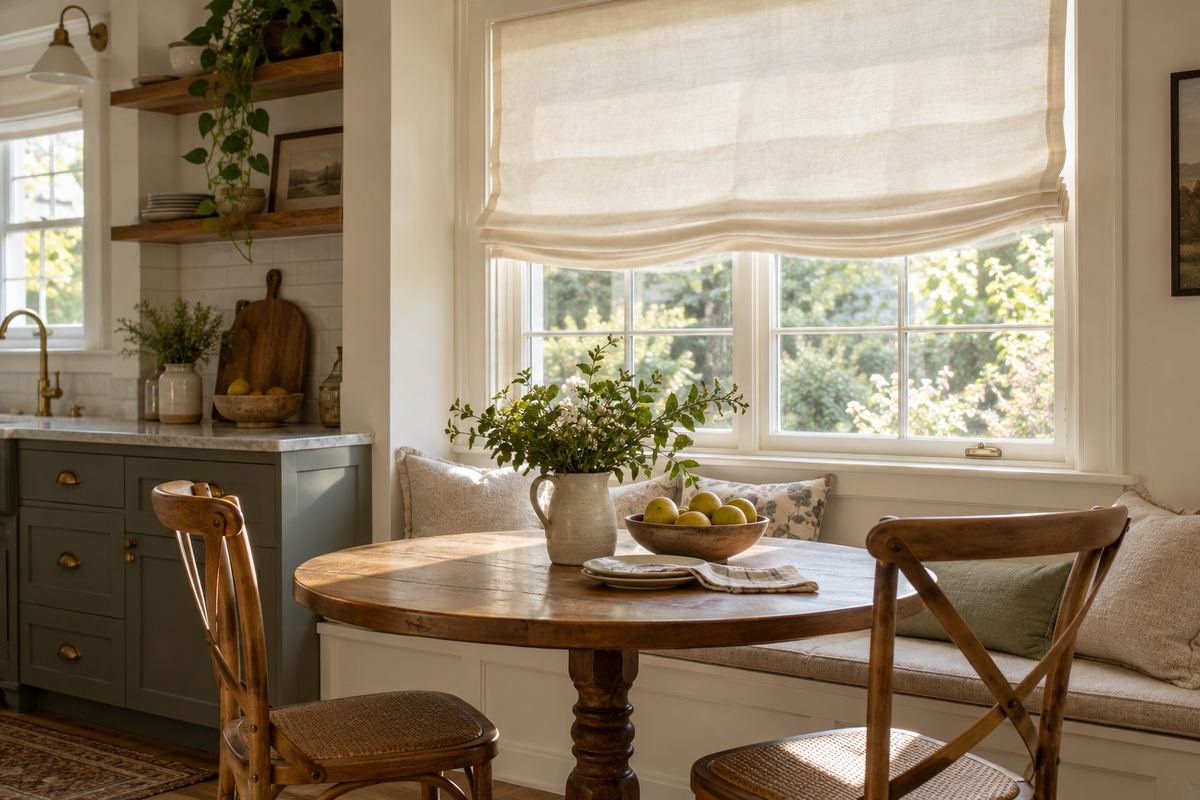
A gently relaxed lower edge feels less formal than a sharply tailored shade. It works well with quieter cabinetry and a room that already has natural wood or softly textured textiles.
Keep the fabric pattern restrained so the lower curve remains readable. Use a product designed for that shape rather than creating loose hanging fabric near a working counter.
Practical tip: Choose this treatment for a dry window zone.
5. A woven shade for a dry window

A woven shade can introduce a natural texture when the cabinetry and counters are very smooth. It is particularly useful in a kitchen dining area where the window is not exposed to sink splashes.
Check the weave, lining and cleaning requirements. Open woven material can behave quite differently at night from the way it looks in a sunlit photograph.
Practical tip: Assess a large sample instead of a tiny material swatch.
6. Check Shutter Kitchen Window Treatments Through Full Movement

Shutters add an architectural edge that can work with both traditional and simpler cabinets. For a window exposed to kitchen moisture, compare products expressly suitable for the conditions rather than relying on appearance.
Check that the panels and louvers can move without hitting the faucet or neighboring walls. The complete opening arrangement matters as much as the finish color.
Practical tip: Draw the panel swing on your window plan.
7. Faux-wood horizontal blinds
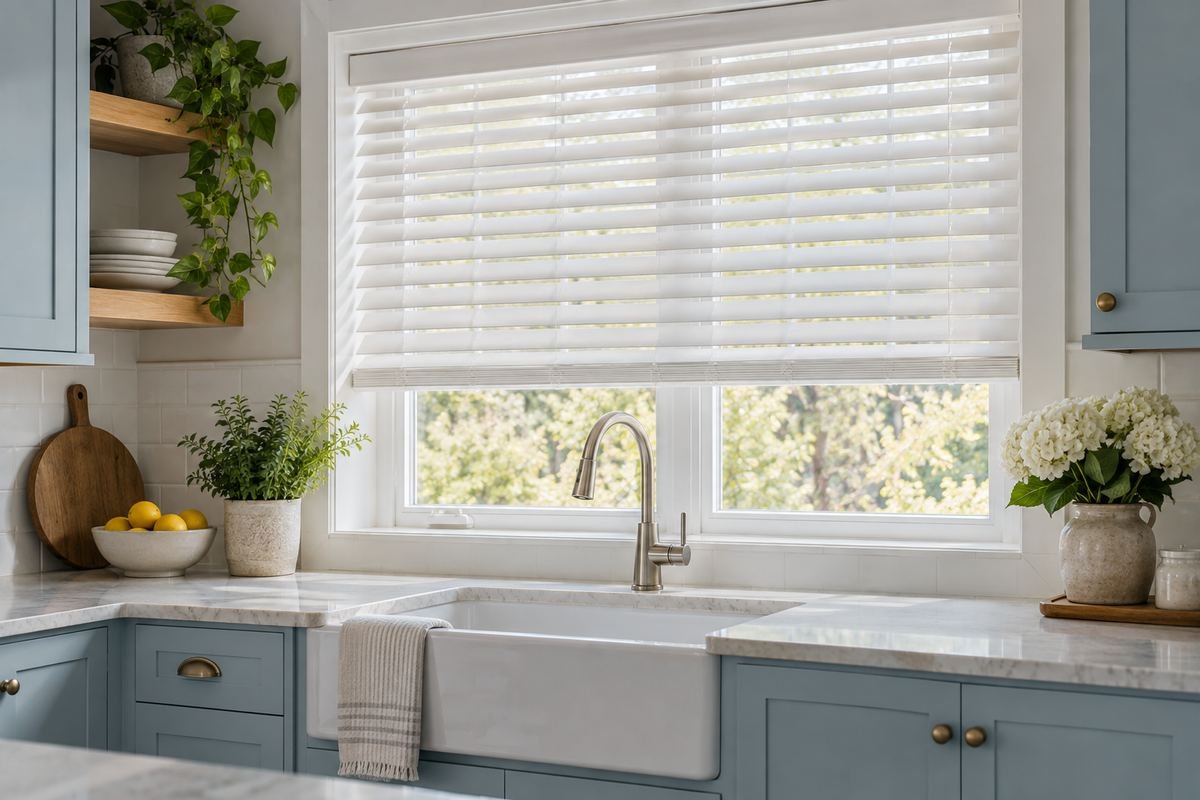
Horizontal blinds offer an adjustable balance between daylight and privacy. A restrained slat profile can echo cabinet rails or the horizontal lines of a backsplash without requiring a patterned fabric.
Review the exact product’s moisture and cleaning guidance. Check the fully raised stack and keep the operating system cordless so the window arrangement stays contained.
Practical tip: Make sure the slats can tilt without touching the handle.
8. A top-down privacy arrangement

A top-down, bottom-up shade lets you cover a lower sightline while leaving light near the top. It can suit a window facing a close neighbor when you still want an open strip of sky.
Check the actual controls and mounting requirements. Choose a current cordless product and test whether the covered section meets your privacy needs after dark.
Practical tip: Decide which sightline you need to block before measuring.
9. A frosted lower window film

A suitable frosted film can soften the view through part of the glass while leaving the frame free of fabric. It is useful when there is little room for a moving covering around a faucet or narrow reveal.
Check compatibility with the glazing and follow the film manufacturer’s instructions. A removable label does not establish that a film suits every coated, insulated or specialty window.
Practical tip: Try a small sample before covering the whole pane.
10. Textured glass as a lasting feature

A textured-glass panel can provide a distinctive window surface without an additional fabric layer. It is a more permanent design decision, suitable when you are already planning window work.
Choose the glazing with the window professional and review the privacy effect in the proposed setting. Texture can blur a view without guaranteeing complete privacy under every lighting condition.
Practical tip: Inspect a full-size sample with light behind it.
11. Cafe curtains at the breakfast window
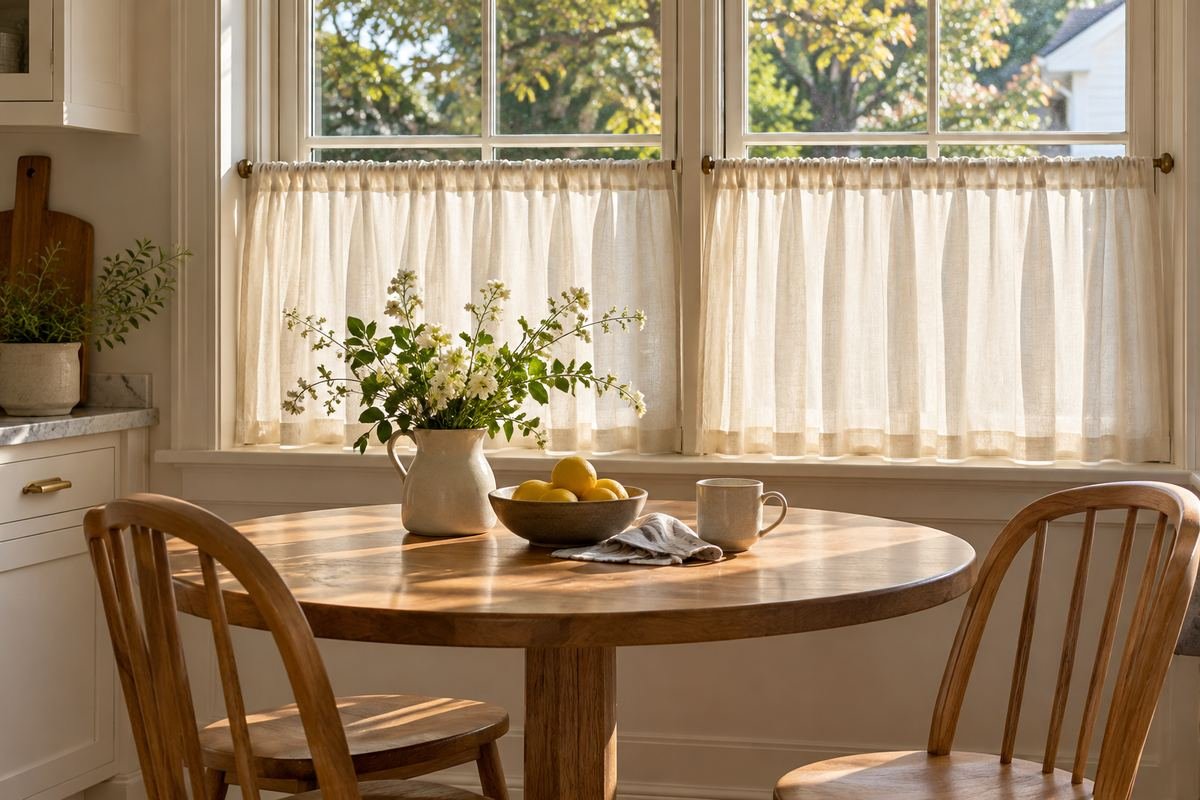
Cafe curtains cover the lower part of the window while leaving a clear area above. They can make a breakfast spot feel more intimate without adding long panels around the chairs.
Use them away from cooking equipment and repeated splashes. Choose an appropriate fabric and a stable mounting arrangement, then check what the upper uncovered glass reveals from outside.
Practical tip: Place the rod for the sightline rather than an arbitrary midpoint.
12. Keep Short-Curtain Kitchen Window Treatments in Dry Areas
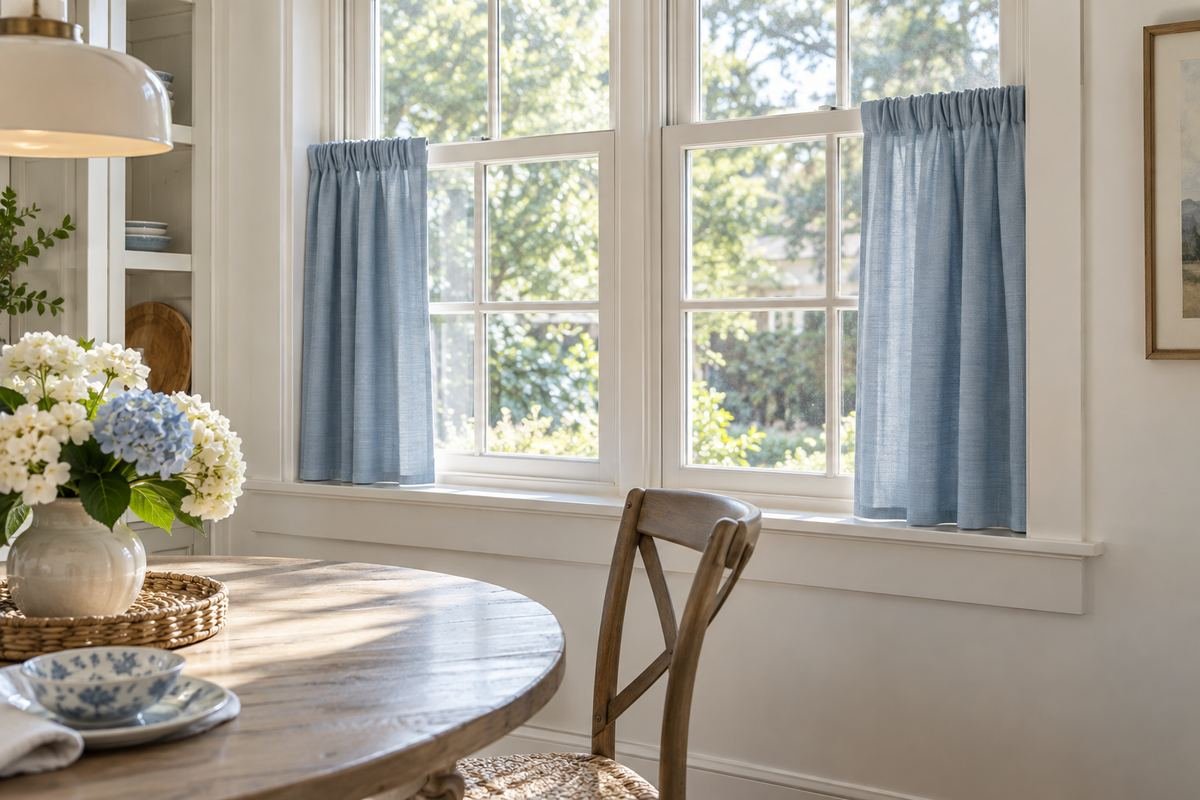
Short curtains can soften a kitchen dining area while keeping fabric clear of the floor. They work best when the fabric stays away from food preparation and the lower edge does not catch nearby furniture.
Plan where open panels stack so they do not hide the whole window. A small pair of restrained panels can be enough; you do not need the fullness of a formal living room treatment.
Practical tip: Open nearby chairs and doors during your layout test.
13. A simple valance with a working shade

A small valance can introduce a fabric detail while a separate shade handles privacy. Keep the valance shape simple if the kitchen already has decorative cabinet doors or a patterned backsplash.
Check how much light the combined layers remove at the top of the window. This arrangement belongs in a dry area where the fabric can be maintained according to its care instructions.
Practical tip: Avoid adding a valance simply to conceal poor measurements.
14. Full-length panels beside the breakfast area

Full-length curtains can connect a kitchen dining corner to an adjoining living space. Use them where there is enough dry clear space for the panels to move and where they stay away from cooking or heating equipment.
Choose a neat hem rather than excess fabric on the floor. Pull the chairs out and check the entire path before deciding the panels belong in that position.
Practical tip: Include the open-panel stack in the floor plan.
15. Separate shades on paired windows

Two coordinated shades let paired windows keep their individual frames. They also let you control light differently when one window faces glare and the other looks toward a shaded part of the garden.
Use the same material and align the visible top edges for a tidy result. Measure each opening separately instead of assuming the two windows are identical.
Practical tip: Record each window’s measurements with a clear label.
16. Several shades across a wide opening

A wide window can be easier to manage with several coordinated coverings. Align the divisions with the window’s own structure so the treatment feels connected to the frame.
Check where the gaps fall and whether they affect privacy. Confirm the manufacturer’s size and mounting options for the complete opening instead of simply dividing its width into equal numbers.
Practical tip: Plan the divisions before ordering separate units.
17. Individual treatments on a bay window

A bay window often looks more considered when each face has its own treatment. Keep the material consistent so the angles remain the interesting feature.
Check brackets and neighboring coverings at the corners. When raised or tilted, each unit should still operate without rubbing the next one or blocking the window handles.
Practical tip: Use the supplier’s bay-window measuring instructions.
18. Fit Corner Kitchen Window Treatments as One Arrangement
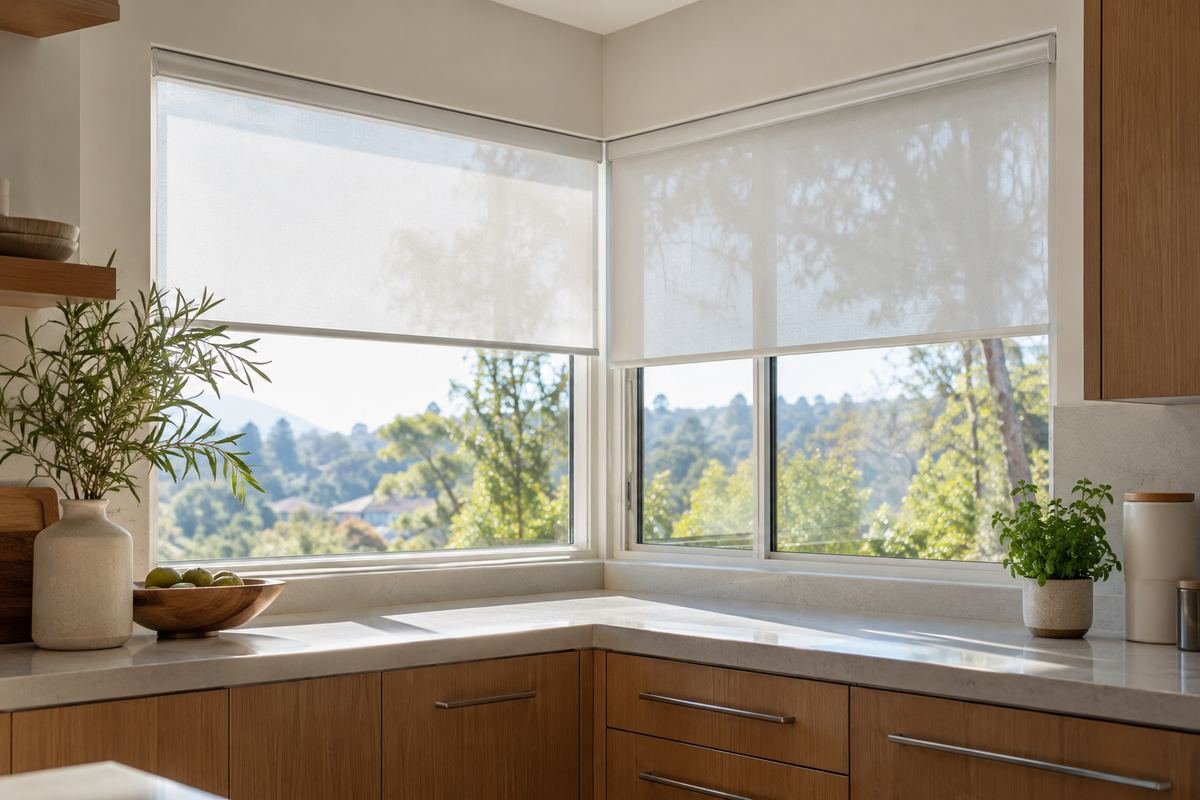
A corner window needs a plan for where the two treatments meet. A coordinated pair can preserve the clean glass corner while giving each side independent light control.
Compare the roll or fold depth at the junction. An attractive material is not enough if one unit prevents the other window from opening.
Practical tip: Test the meeting point with a temporary paper model.
19. A contained sliding-door treatment

A kitchen sliding door needs a covering that leaves the usable doorway clear. A purpose-designed vertical arrangement or another compatible door treatment can serve the glass without requiring long loose fabric in the route.
Check the stacking side against the handle and the direction people enter. The covering should be easy to move fully aside before using the doorway.
Practical tip: Stand in the actual walking route when checking the stack.
20. Fitted shades on glazed doors

A fitted covering can give a glazed door privacy while moving with the door itself. It suits a kitchen dining area where a separate curtain would interfere with the handle or swing.
Use a product designed for the door type. Check the handle, hinges and complete opening movement, and confirm any drilling or no-drill arrangement with the product instructions.
Practical tip: Measure the handle projection as well as the glass.
21. An inside mount that reveals the trim

An inside-mounted treatment lets decorative window trim remain visible. It can look especially tidy when the surrounding cabinets already provide strong edges and you want the covering to recede.
Check the usable reveal depth and allow for handles or other obstructions as instructed. A shallow frame may need a different mounting approach even if the front view looks ideal.
Practical tip: Use the product’s depth requirement rather than guessing.
22. An outside mount for a shallow frame

An outside-mounted shade can solve a frame that is too shallow for the chosen product. It can also make a modest window read as a slightly broader feature against a plain wall.
Plan the overlap and the bracket location with the exact product instructions. Check nearby cabinet doors so the covering does not turn a small measuring problem into a daily obstruction.
Practical tip: Mark the full outside dimensions before ordering.
23. Compare Uncovered Kitchen Window Treatments With Evening Privacy

Sometimes the most useful kitchen window treatment is no additional covering. A clear window can work when the view, glare and privacy conditions already suit the way you use the room.
Keep the sill practical and avoid treating the open look as a reason to ignore evening sightlines. If the conditions change, you can add a contained covering later.
Practical tip: Check the view from outside after dark before leaving it bare.
Frequently Asked Questions
What works best over a kitchen sink?
Start with splash exposure, access to the faucet and the way the window opens. Compare coverings specifically suitable for those conditions and easy to clean according to their instructions. A short, contained treatment is often more practical there than fabric hanging into the work area.
Do kitchen curtains provide privacy at night?
That depends on the fabric and light on each side of the glass. Check a sample after dark with the kitchen lights on. Sheer curtains and solar fabrics may preserve a daytime view without providing the evening privacy you need.
Should the window treatment match the cabinets?
It can coordinate without being an exact match. Repeat a cabinet undertone, hardware finish or textile color, then compare a sample in the room. If the cabinets and backsplash are already detailed, a simpler window treatment usually gives the eye somewhere to rest.
Choose the Details That Work in Your Home
Choose kitchen window treatments by location, operation and cleaning first. Once those decisions are settled, narrow the look to a shape and texture that work with your cabinets. One well-tested sample will prevent more disappointment than choosing from a long list of attractive product photographs.
For related ideas, explore Kitchen counter decor ideas, Kitchen backsplash ideas, Breakfast nook ideas.
Planning References
Hunter Douglas guide to kitchen window treatments; CPSC cordless window covering guidance. Follow the instructions for the exact products you choose.
Optional digital guide for this topic
If you prefer a structured workbook, explore this related paid guide.