Garden trellis ideas work best when the plant and the support are chosen together. A lattice that looks right against a wall may be too thick for a leaf stalk to grasp, while a delicate frame may be unsuitable for the mature growth you hope to cover it. Begin with the vine’s attachment method, expected size and local growing conditions.
These 25 concepts compare useful forms and locations, from one container to a garden passage. They are layout options rather than structural installation plans or a list of plants suitable everywhere. Check species and cultivar suitability, including local invasive-plant guidance, before planting. Match the complete support and installation to the actual site and exposure.
Contents
- 1. Give a narrow border one simple grid panel
- 2. Use diamond lattice where the pattern will stay visible
- 3. Choose a fan shape for a modest spreading plant
- 4. Put an obelisk inside a mixed border
- 5. Use two restrained towers to mark a path destination
- 6. Keep a compact pot trellis proportional to the container
- 7. Use an integrated planter-and-trellis system
- 8. Use an A-frame for an appropriate vining crop
- 9. Give climbing peas a dedicated net row
- 10. Use a purpose-sized pole-bean tripod
- 11. Frame a garden entrance with one arch
- 12. Repeat arches only where the route earns a tunnel
- 13. Turn a corner with two separate panels
- 14. Screen one seated view with a managed climber
- 15. Keep a wall trellis separate from the wall surface
- 16. Give clematis contacts it can actually grasp
- 17. Train climbing roses on a suitable open support
- 18. Use a restrained cable grid for a light suitable vine
- 19. Put a raised-bed trellis where the bed remains reachable
- 20. Keep a gate opening clear between planted supports
- 21. Keep a narrow side-yard route readable
- 22. Use a low panel below a window without covering access
- 23. Choose a removable annual support with a return plan
- 24. Use the frame finish to clarify the planting
- 25. Leave room to tend the plant from the useful side
Choose garden trellis ideas from the plant’s attachment method
Illinois Extension distinguishes twining stems, tendrils, aerial roots and adhesive pads, and notes that clematis uses its leaf stalks. Decide what the plant can actually grasp before choosing grid thickness or a blank wall. Check its mature growth, intended care, local suitability and the support instructions. Put an appropriate support in place before the plant needs it.
Compare the support with the task it must perform
- A suitable twining or tendril-bearing vine: Support contacts and spacing the selected plant can use.
- Clematis on a decorative framework: Thin appropriate contact elements rather than broad beams alone.
- A climbing rose: A sturdy training system with access for tying and care.
- A vegetable crop: Variety, mature crop size, support, harvest access and seasonal cleanup.
- A garden screen or arch: Mature growth, exposure, complete installation and a clear occupied route.
1. Give a narrow border one simple grid panel

A single flat panel can give a narrow border a clear vertical focus without filling the whole boundary. Choose the plant and the usable mature growing space together, then compare the grid with the way the vine attaches. Leave a route for tending it. The frame, posts and installation must suit the actual plant and site, not merely the empty trellis.
Try this: Mark the mature plant outline as well as the panel footprint on the plan.
2. Use diamond lattice where the pattern will stay visible

Diamond lattice changes the visual rhythm of a boundary when the vine is still young or seasonally bare. Compare the real slat thickness and opening size with the plant’s attachment method. A decorative diagonal pattern is not automatically a useful climbing surface. Keep the planting restrained enough that the intended pattern has a reason to remain visible.
Try this: View a panel sample with the plant’s leaves beside it before repeating the pattern along a fence.
3. Choose a fan shape for a modest spreading plant
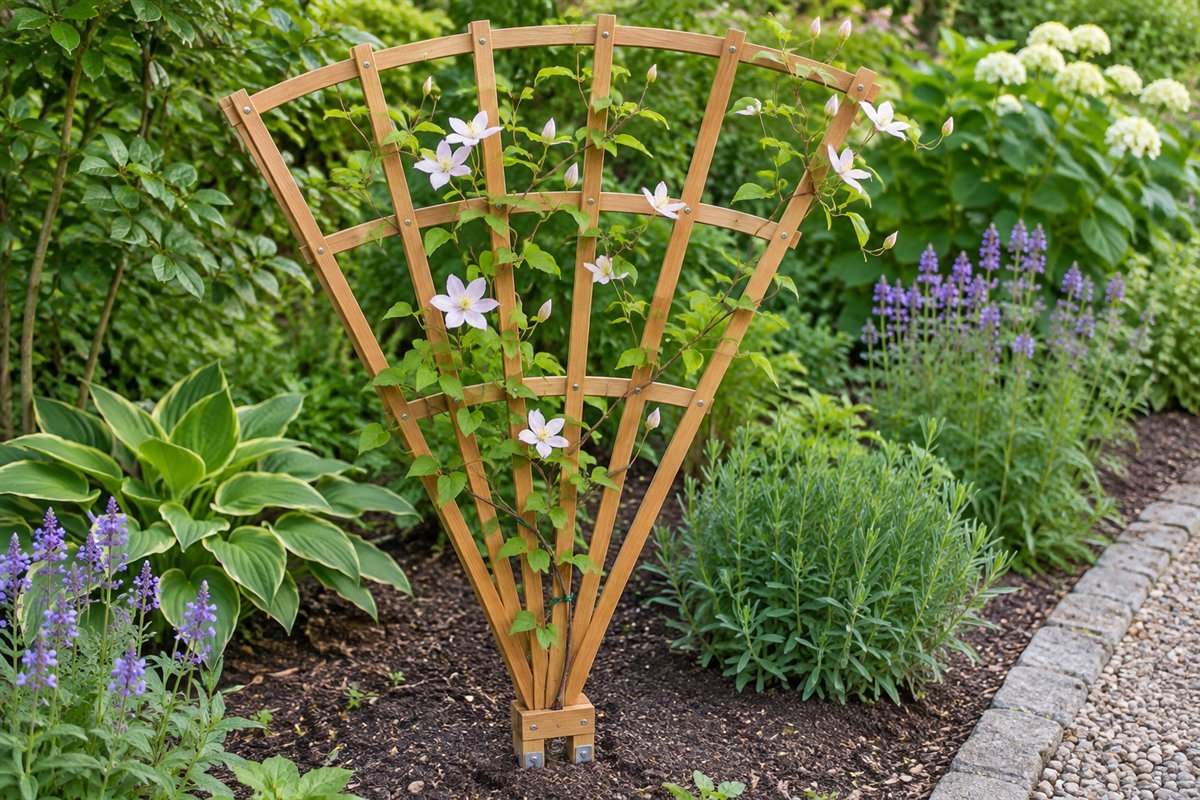
A fan can suit a plant you intend to train outward from a small starting area. Leave room for the wider top rather than choosing from the narrow base alone. Check the mature spread and the support contacts. For plants needing ties, use the method suited to that plant instead of assuming the stems will attach themselves to broad timber slats.
Try this: Measure the fan’s widest point against neighboring planting and maintenance space.
4. Put an obelisk inside a mixed border

An obelisk gives a mixed border a vertical center without requiring a wall. Position it where the plant can be reached and where its growth will not engulf neighboring specimens. Compare the full base footprint, mature plant and exposure. A slender-looking frame can become a very different object once dense foliage catches the weather.
Try this: Walk around the proposed position before planting close to the frame.
5. Use two restrained towers to mark a path destination

A pair of towers can mark a destination at the end of a path while leaving the center open. Check their separation with the expected mature foliage, not only the bare frames. Keep the pair proportionate to the border so it does not crowd the destination. Choose the supports independently of any assumption that the two plants will grow at identical rates.
Try this: Judge the pair from the ordinary approach and from the seat or doorway beyond it.
6. Keep a compact pot trellis proportional to the container

A compact trellis can organize the growth of a suitable container plant. Assess the pot, support, plant and exposure as one arrangement. The trellis must be compatible with the planting depth and root space, while the complete setup needs appropriate stability. Avoid adding a tall sail of foliage to a small pot simply because it fits in a photograph.
Try this: Check the container and support guidance together before choosing the frame height.
7. Use an integrated planter-and-trellis system

An integrated planter-and-trellis product can define a patio edge while keeping the support coordinated with the container. Read the complete product’s installation and use instructions, including restraint or exposure limits. An attached planter is not proof that the system is stable in every wind. Retain space to water, inspect and maintain the plant without leaning over occupied furniture.
Try this: Include the planter depth and every supporting foot in the patio layout.
8. Use an A-frame for an appropriate vining crop
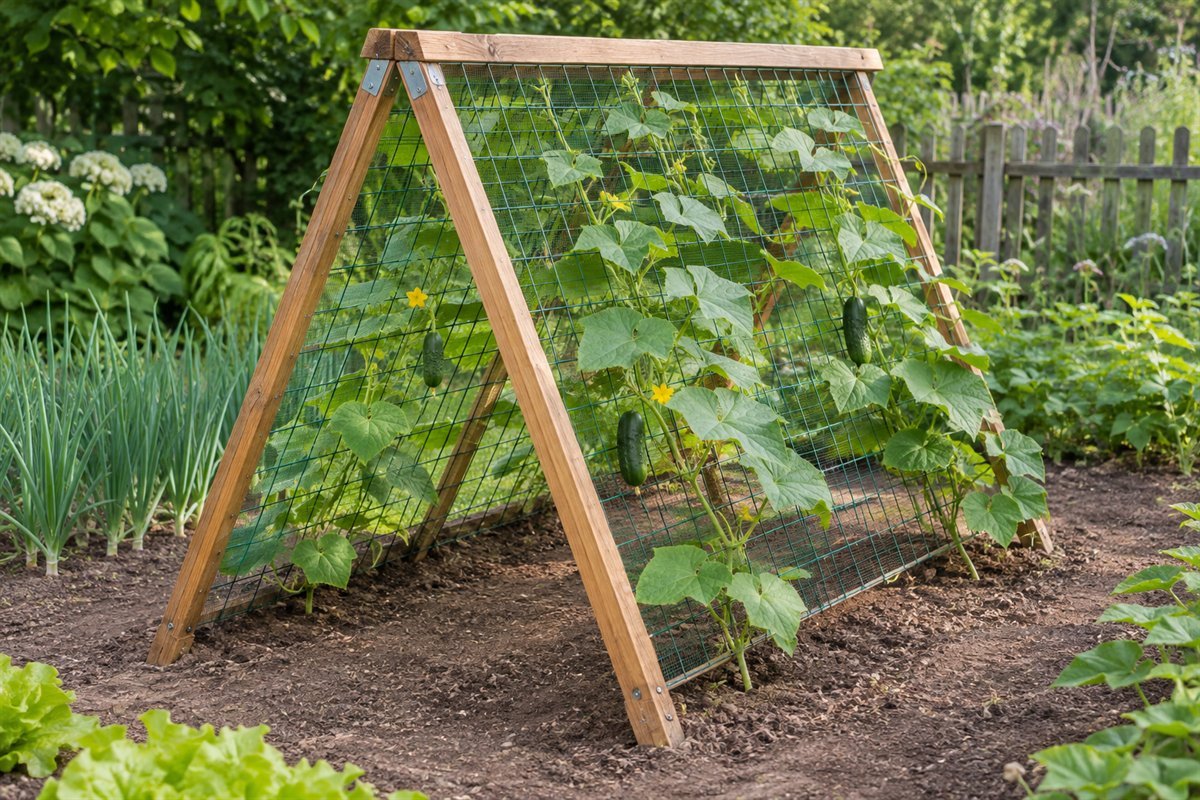
An A-frame offers two growing faces and a defined footprint in a vegetable plot. Match the crop and variety to the support; a vining cucumber and a compact bush variety do not create the same task. University of Minnesota Extension discusses crop size, mesh and support requirements for trellising. Do not extend a small-crop example to heavy pumpkins or an inadequately supported frame.
Try this: Check that both faces can be tended and harvested from the surrounding route.
9. Give climbing peas a dedicated net row
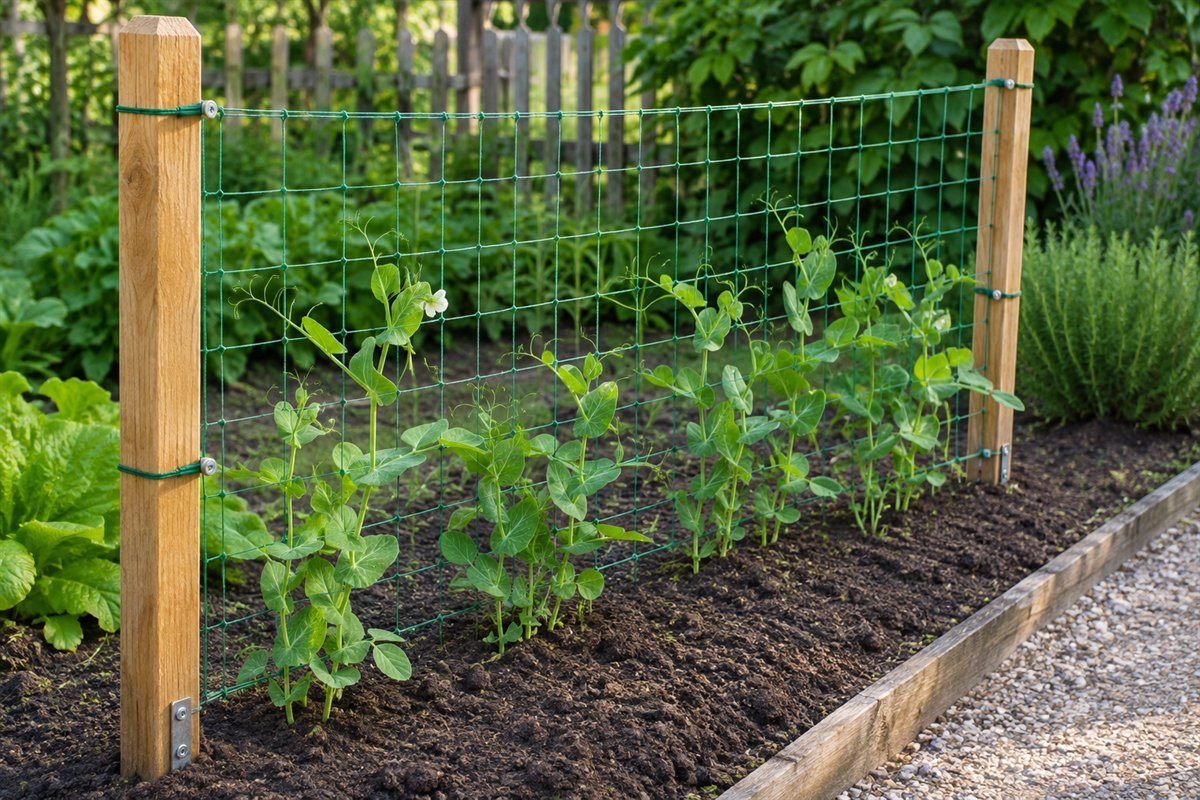
A dedicated net row can keep suitable climbing peas within a clear growing line. Confirm the variety’s expected height and whether it needs support; some peas remain short. Choose a complete netting and post arrangement suited to the site and keep it maintained. A loose or failed net should not be left entangled across the garden after the crop is finished.
Try this: Keep the harvesting side easy to reach before adding another planted row.
10. Use a purpose-sized pole-bean tripod

A tripod can gather a suitable climbing bean crop into one defined position. Distinguish pole beans from bush types before choosing the structure. Check the support height, base width and how the upper crop will be reached. The illustration is a layout concept, not a prescription for pole dimensions, joint strength or installation in a particular soil.
Try this: Choose a height that works with a safe, practical harvesting routine.
11. Frame a garden entrance with one arch

A single arch can announce the move between garden areas. Keep the opening wide and high enough for ordinary use after the plant fills out. Include side growth, gates and objects carried along the path in the check. The actual arch needs an appropriate installation for its site, exposure and mature plant rather than a generic pair of shallow feet.
Try this: Walk the intended route with the widest garden item you normally carry.
12. Repeat arches only where the route earns a tunnel

A short run of arches can make a path feel like a deliberate garden passage. First confirm that the route is used and can remain accessible for pruning and maintenance. Allow for mature growth and changing light underneath. Repetition multiplies the structure to inspect; it does not make each arch suitable for an arbitrary vine or a heavier connected canopy.
Try this: Check the view through the entire run from both ends before choosing the spacing.
13. Turn a corner with two separate panels

Two panels can turn a planting idea around a corner without asking one vine to spread indefinitely along a boundary. Plan the corner’s usable growing space and access to both supports. Avoid creating a blind tangle that can only be reached from a neighbor’s side. A clear division between panels can also make seasonal inspection easier.
Try this: Confirm how the back and corner joints will be reached after the foliage develops.
14. Screen one seated view with a managed climber

A trellis can interrupt one seated sightline while retaining a lighter garden edge. Check the view from the actual chair and decide how much seasonal openness is acceptable. A young or deciduous vine will not deliver a year-round solid screen. Keep the support and mature growth clear of the seat’s movement, and assess the installation for its exposure.
Try this: Use a temporary visual mock-up at the intended height before buying the panel.
15. Keep a wall trellis separate from the wall surface

A wall-side trellis needs room for the plant and for building maintenance. RHS guidance describes supports set away from the wall, while Missouri Extension discusses access and circulation behind trellised vines. Determine the actual gap and fixings for the system, building and plant. Do not treat a decorative grid as permission to cover damaged siding or an unassessed wall.
Try this: Include the future inspection and maintenance route before choosing the planting position.
16. Give clematis contacts it can actually grasp

Clematis is a useful reminder that attachment matters. Illinois Extension explains that its leaf stalks wrap around thin support elements. A broad timber beam may look substantial yet offer little that the plant can grasp without an appropriate secondary support. Compare the actual rod or lattice size with the selected plant and its training guidance.
Try this: Examine the climbing contacts as closely as the overall frame outline.
17. Train climbing roses on a suitable open support

Climbing roses need support and training rather than attaching themselves like a self-clinging vine. RHS describes tying shoots to trellis or horizontal wires. Choose a system that can hold the mature plant and leave room for the rose’s care. Follow guidance for the actual rose type and local conditions instead of borrowing a pruning calendar from another climate.
Try this: Keep the main framework and the points that need regular attention easy to reach.
18. Use a restrained cable grid for a light suitable vine

A cable grid can make the support visually quieter where a suitable vine is the focus. Confirm the plant’s attachment method, mature size and the complete cable-and-fixing system first. Keep the layout inspectable rather than assuming a nearly invisible wire is maintenance-free. Dense mature growth may hide the very parts that need to be checked.
Try this: Keep a record of the support system before the plant covers it.
19. Put a raised-bed trellis where the bed remains reachable

A trellis along a raised bed can organize a vining crop while leaving other plants visible. Observe the site’s sun and check the shade the mature vine will cast. Keep the bed reachable from the intended paths. The bed wall is not automatically an adequate structural fixing; choose the support and its installation for the actual system.
Try this: Reach the planted area from the path before committing the full bed edge to a tall frame.
20. Keep a gate opening clear between planted supports

Separate planted supports can frame a gate without using the moving gate as the climbing structure. Preserve the full swing, latch access and the route through it. Allow for stems at mature size and the regular work needed to keep them within bounds. Avoid letting a vigorous plant become the device that holds a gate open or closed.
Try this: Test the gate from both sides with the proposed planting area marked.
21. Keep a narrow side-yard route readable
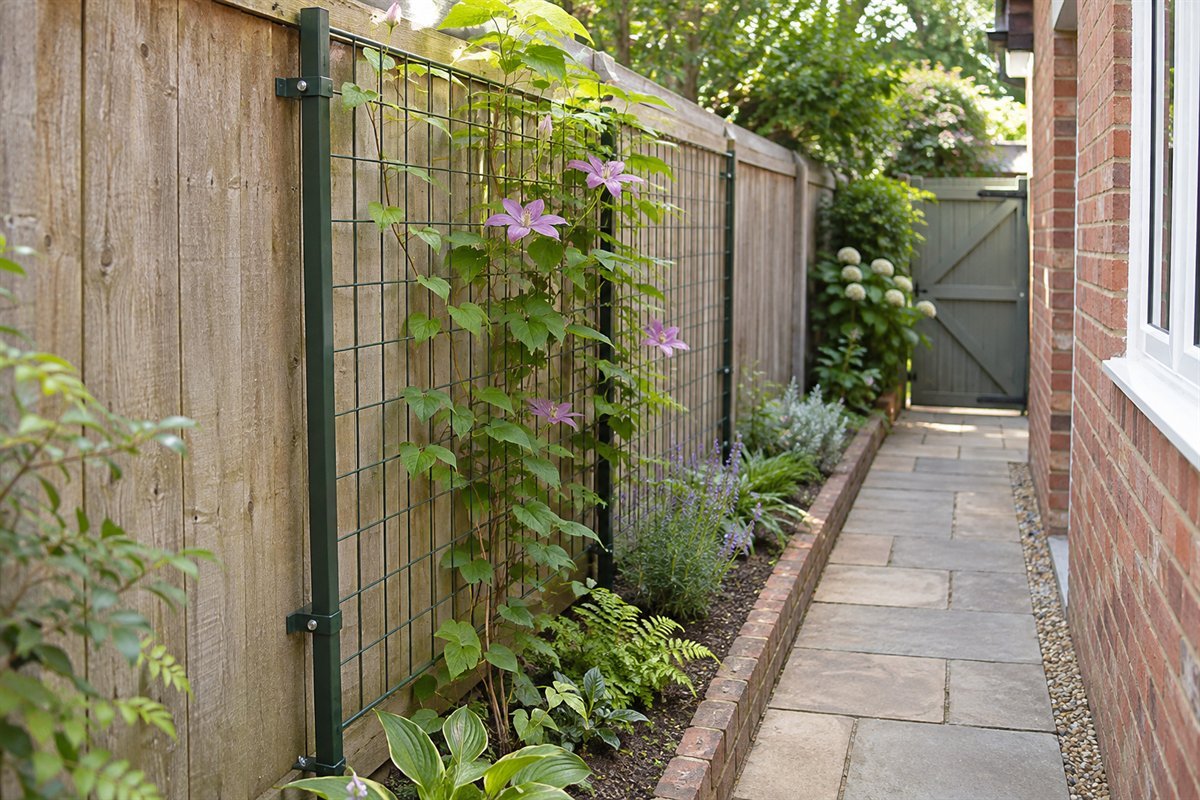
A narrow side yard leaves little room for a vine that spreads beyond its intended support. Select a plant and frame that can be maintained within the actual bed, and preserve the complete walking route. Keep projecting supports outside the path. If routine care would require standing in an inaccessible gap, reconsider the location before planting.
Try this: Check the route with ordinary bins or tools being moved through it.
22. Use a low panel below a window without covering access

A low panel can add a planted pattern below a window while leaving the opening visually clear. Check the window’s movement, required access and any nearby vents or services. Match the plant’s mature extent to the intended low framework. Choosing a low panel alone will not make an unsuitable vigorous climber remain short.
Try this: Open the window fully and mark the area that must remain clear before placing the support.
23. Choose a removable annual support with a return plan

A removable annual support can suit a crop or display that changes each season. Choose a system designed to be assembled, inspected and stored as directed. Plan the storage position for the complete frame and its small parts before buying it. Keep cleanup manageable rather than leaving worn netting or unidentified fixings in the bed after the plants are removed.
Try this: Keep the system’s instructions and compatible components together between seasons.
24. Use the frame finish to clarify the planting

A frame finish can either recede into the planting or make the support part of the composition. Compare a real sample against the leaves, flowers and adjacent boundary in more than one light condition. Choose any coating and maintenance method for the actual support material and plant setting. A color decision is most useful after the functional support and growing space are settled.
Try this: Start with one panel sample before repainting a long boundary.
25. Leave room to tend the plant from the useful side

The best-looking support can become frustrating if the plant can only be tied, inspected or pruned from an awkward position. Plan where the gardener will stand, which parts must be reached and how the support remains accessible as growth develops. Choose the layout from the maintenance routine as well as the first view. Keep needed access out of neighboring property or a blocked service route.
Try this: Rehearse one ordinary care session before adding more plants around the frame.
A plant-and-support planning sheet
Create one record for the proposed trellis: exact plant and cultivar; local suitability and invasive-status check; attachment method; expected mature height and spread; growing conditions; complete support dimensions; system and fixing guidance; exposure; occupied path or gate clearance; and the side used for care. Keep uncertain entries open until they are verified.
Mark the bare frame and the mature plant as separate outlines on a plan. A narrow support does not guarantee narrow foliage, and a frame that fits between two windows can still put growth across an opening. Check the location from the useful seat, path and maintenance position before choosing the finish.
For a container, evaluate the pot, soil, support and mature plant as a complete installation. For a wall, include building condition and access. For a vegetable support, include harvest and end-of-season removal. None of these checks establishes load capacity or replaces the complete product instructions and any site-specific professional assessment.
Begin with one trellis. Observe how the plant uses its support and whether the route and care access remain workable. Expand the arrangement only where another panel gives the garden a clear purpose.
Will every climbing plant use any trellis?
No. Match the support to the plant’s attachment method and mature size. Twining stems, tendrils, leaf stalks and self-clinging growth interact with surfaces differently. A frame chosen only for appearance may need a suitable secondary support or a different plant.
Can a trellis be fixed directly against a wall?
Plan an appropriate separation and complete fixing system for the plant and building. The cited RHS and Missouri guidance discuss space and access behind supports. Check the actual wall and system rather than treating a generic gap or photograph as installation approval.
Can one trellis support any vining vegetable?
No. Variety, mature crop weight and the complete structure matter. University of Minnesota guidance distinguishes smaller suitable vining crops from larger squash and pumpkins that should be grown on the ground. Check the selected crop and support before starting.
A practical next step
Choose one of these garden trellis ideas by the plant, the garden task and the full care routine. Confirm attachment, growing space and support suitability first, then refine the form and finish. A useful frame keeps the plant manageable without making the garden harder to walk through or maintain.
Patio privacy screen ideas for checking the seated view. Pergola ideas for larger outdoor structures and occupied layouts.
Images are original AI-generated garden concepts. They do not document tested structures, verified fixings, certified wind resistance or measured plant performance.
Sources and care references
- Illinois Extension: vine attachment methods and matching supports
- Missouri Extension: vine-support planning, access and wall considerations
- RHS: putting supports in place and initial climber training
- RHS: climbing roses need supports and tying-in
- University of Minnesota Extension: matching vegetable crops with trellises
Optional digital guide for this topic
If you prefer a structured workbook, explore this related paid guide.