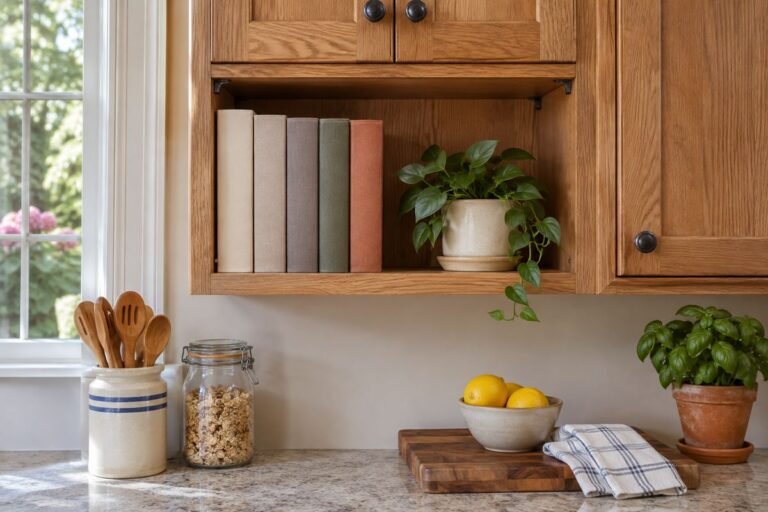
The most useful kitchen towel storage ideas account for two different moments: reaching for a fresh towel and returning the towel currently in use. A beautifully folded drawer cannot solve an awkward drying position, while a convenient hook does little for a crowded backup supply. Give each part of the routine a clear home.
These layouts cover drawers, open shelves, hanging loops and modest display baskets. Start with the towels you already use and the actual space available. The folding example and measuring card turn a decorative choice into a plan you can test, without assuming that a product photo proves capacity or fit.
The images are original AI-generated decor concepts, not installation diagrams or photographs of completed client projects.
Browse These 23 Kitchen Towel Storage Ideas
Jump to an idea
- Give clean spares and the working towel separate homes
- Use one broad rail for a comfortably spread towel
- Choose a looped towel for a small hook position
- Put a rail on an accessible island side
- File folded towels upright in a deep drawer
- Keep short flat stacks in a shallow drawer
- Use soft dividers to separate towel sizes
- Place dry spare towels in a shallow open basket
- Roll a small reserve in a compact basket
- Reserve a shelf compartment for dry backups
- Create a small pantry towel bin
- Keep a coffee-station pair within the working zone
- Display one patterned tea towel on a simple bar
- Build a calm palette with solids and stripes
- Separate dish towels from small wiping cloths
- Use the inside of a cabinet for dry spares only when it fits
- Keep the used-towel return separate from clean storage
- Arrange the daily drawer in a small rotation
- Keep an entertaining set together in a dry reserve
- Make the most-used towel easy to reach
- Check the towel drop against doors and handles
- Use a removable drawer basket for a flexible supply
- Finish with a quick towel-storage reset
Kitchen Towel Storage Ideas Start with Two Return Places
Separate the clean, completely dry supply from the towel in current use before choosing a holder. Then locate each by its task: fresh towels near the preparation area, the working towel near the place where you reach for it. Keep either position clear of heat, moving doors and any obstruction to normal work. Follow the care label on your own towels; a particular cotton towel’s washing instructions are not a universal rule for every fabric or trim.
| Available space | A layout worth testing | Measure first |
|---|---|---|
| Shallow drawer | Flat folded towels in short stacks | Internal height and the folded thickness |
| Deep drawer | Upright folded rows with light dividers | Row support and full drawer travel |
| Clear side panel | A properly fitted towel rail | Usable bar length and nearby movement |
| Small accessible hook position | A towel with an appropriate hanging loop | Drop length and secure loop fit |
| Open shelf away from splashes | A basket of completely dry spares | Basket opening and easy return |
Work Out a Fold Before Buying a Drawer Organizer
As a hypothetical example, take a towel that measures 20 by 30 inches. Fold the width in half to 10 inches, then fold the 30-inch length in half twice to 7½ inches. Its flat footprint is roughly 10 by 7½ inches before fabric bulk. Two footprints side by side occupy about 20 inches of a 24-inch-wide drawer, leaving 4 inches before dividers or irregular edges. That calculation does not establish stack height: measure a real folded towel and close the drawer gently with the intended stack inside.
Copy This Kitchen Towel Storage Measuring Card
Write down the towel’s unfolded size, its folded footprint, its measured folded thickness, the clear drawer or basket dimensions, and the hanging drop in the chosen position. For a rail, add the usable length between its brackets rather than relying on the overall product length. IKEA lists one HULTARP rail at 23½ inches overall, for example; that figure alone does not show how many of your towels can hang without bunching. Check the actual wall and fastening instructions before installing any rail.
1. Give clean spares and the working towel separate homes
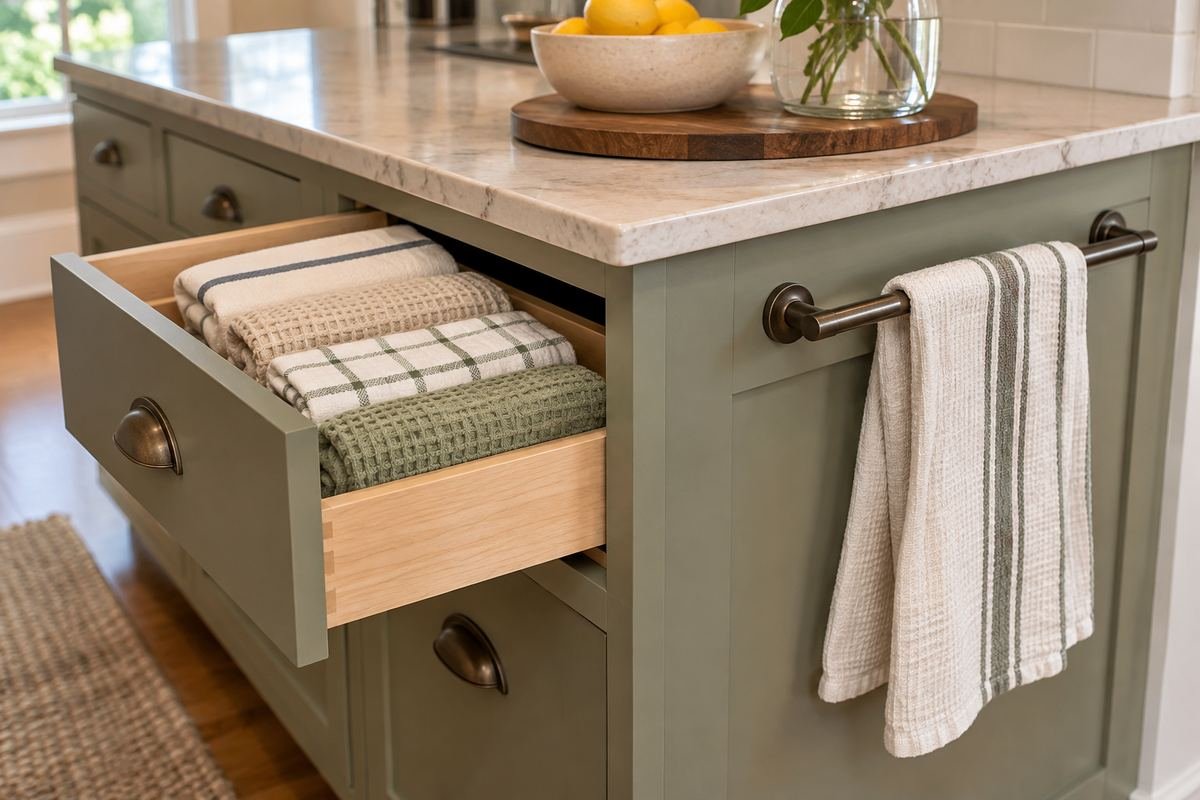
A drawer of clean, completely dry towels and a nearby hanging position solve different jobs. Keeping them separate makes the fresh supply easy to identify. It also prevents the everyday towel from being pushed into a neat stack simply because there is no obvious place to return it.
Begin with one drawer section and one suitable rail or hook. Try the route during an ordinary meal, then shift either position if it requires an awkward reach. The arrangement should feel natural when your attention is on cooking rather than on maintaining a display.
Practical tip: Choose the working towel position before arranging the backup drawer.
2. Use one broad rail for a comfortably spread towel

A broad towel rail can give the daily towel a clear position without crowding the counter. Fold the towel only as much as needed to fit the usable bar. A short bar packed with several thick folds may be less convenient than a slightly wider position carrying a single towel.
Measure between the supports and check the hanging drop. The towel should stay clear of doors, drawers and nearby work. Use a rail and fastening method suitable for the actual surface rather than treating a decorative adhesive hook as interchangeable with a mounted bar.
Practical tip: Measure the usable bar, not only its advertised overall length.
3. Choose a looped towel for a small hook position

A sewn hanging loop can give a towel a dependable return point on an appropriate hook. It is useful where there is room for the towel’s drop but little room for a long bar. Choose a hook that holds the loop without requiring you to force or stretch the fabric.
Check the actual towel rather than assuming every tea towel includes the same loop. Williams Sonoma’s Classic Stripe listing is one example that describes a hanging loop, but the towel you own may have a different construction. Make sure the full hanging length clears the surface below.
Practical tip: Test the longest towel on the hook before adding a second one.
4. Put a rail on an accessible island side
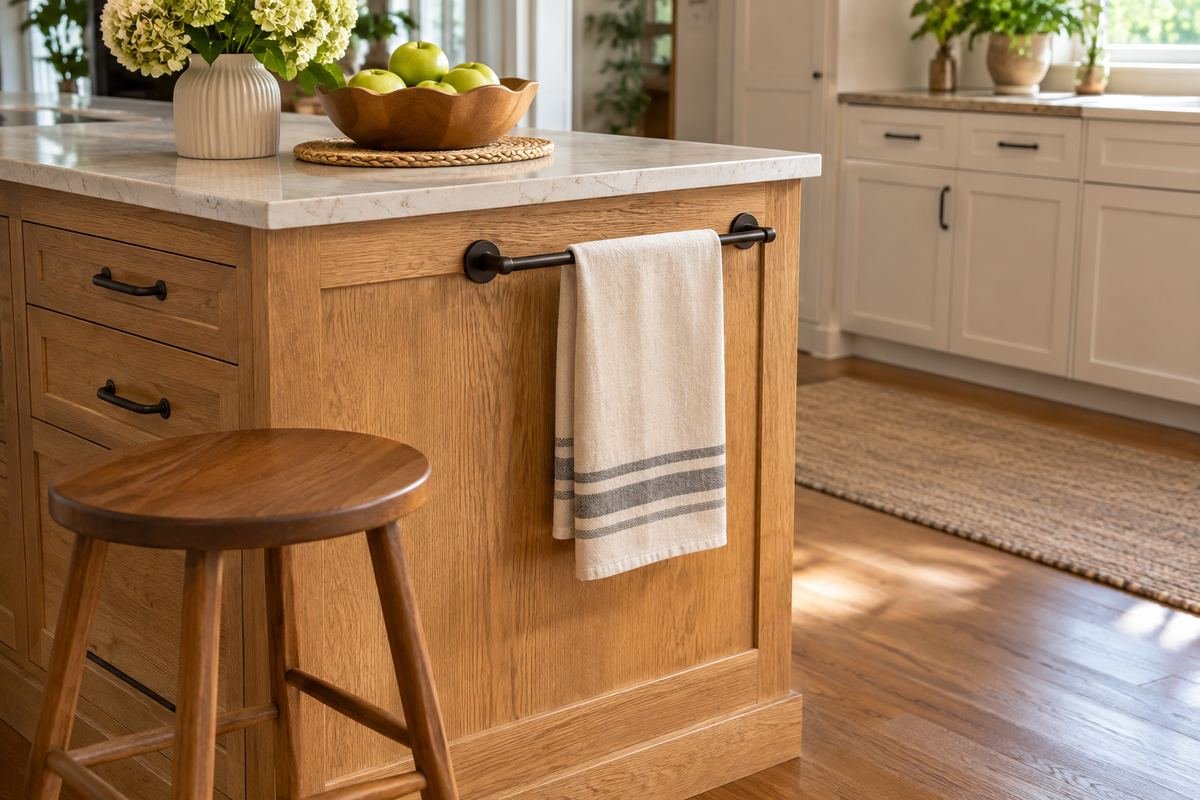
An island side can keep a working towel within reach without using the main preparation surface. Choose the side that serves your normal standing position. The rail should not project into the main walking route or make seating and drawer access uncomfortable.
Hold the towel in the proposed position before arranging any installation. Open neighboring drawers and pull out a stool if one is used there. A side panel that looks empty in a photograph may be valuable clearance during an actual meal or cleanup.
Practical tip: Include stools and open drawers in the position test.
5. File folded towels upright in a deep drawer
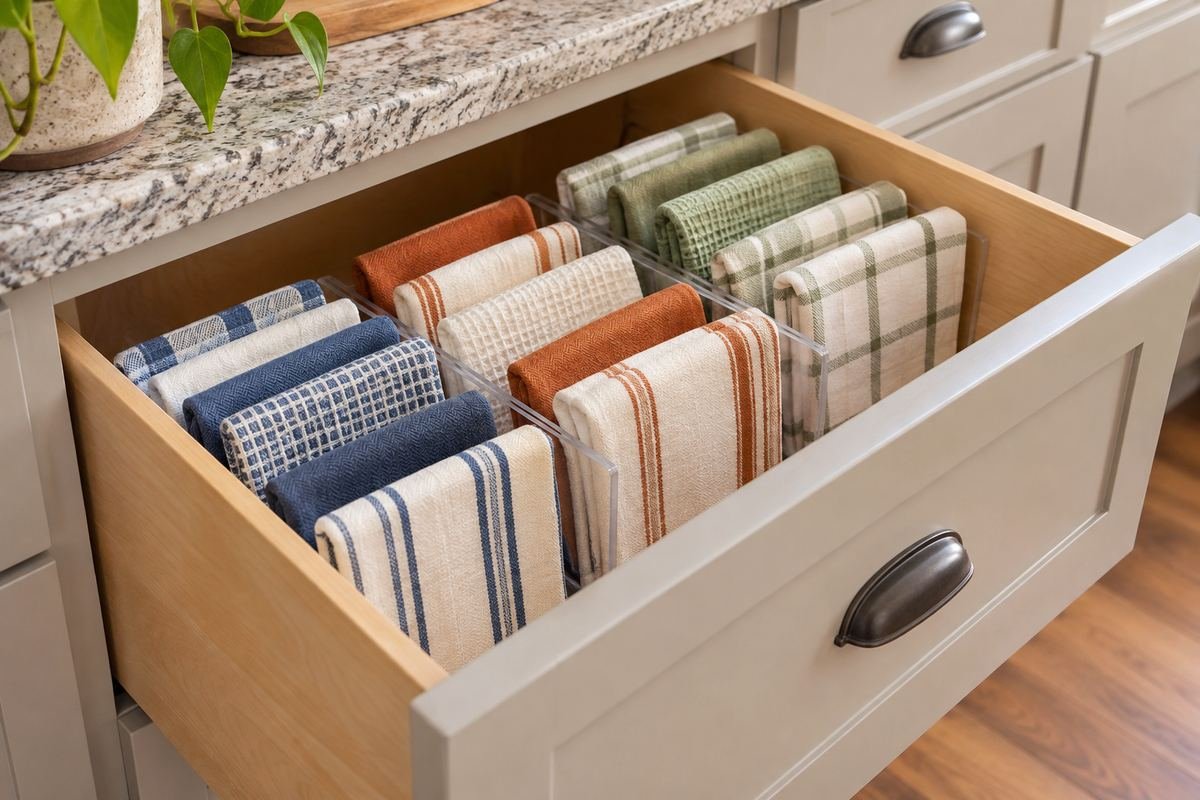
Upright folded rows make colors and patterns visible without lifting a top stack. Use a fold that stands comfortably within the drawer’s clear height. Light dividers can support the rows, especially when one towel is removed and the remaining pieces would otherwise slump.
Do not compress the towels just to create an immaculate grid. You should be able to lift one out and return another without rebuilding the entire drawer. Test the final arrangement through the full drawer movement, including the top edge under the counter.
Practical tip: Leave a little finger space between rows.
6. Keep short flat stacks in a shallow drawer
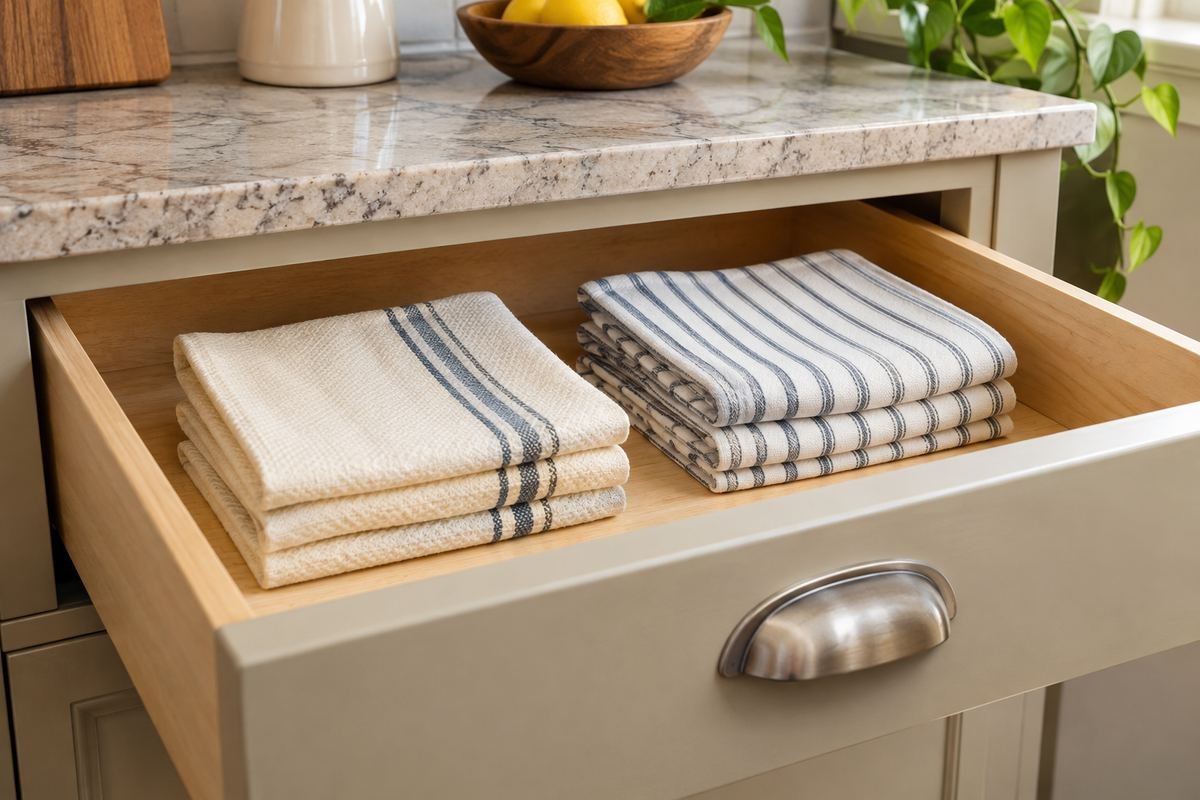
A shallow drawer often works better with low flat stacks than tall upright folds. Keep each stack low enough to slide beneath the cabinet frame without brushing it. A consistent fold makes the available height easier to judge and gives the drawer an orderly appearance.
Take the bottom towel once during the test. If lifting the whole stack feels awkward, shorten it or divide the supply into two groups. The useful capacity is the amount you can handle comfortably, not the number you can force into the drawer when it is open.
Practical tip: Measure the folded stack before buying inserts.
7. Use soft dividers to separate towel sizes
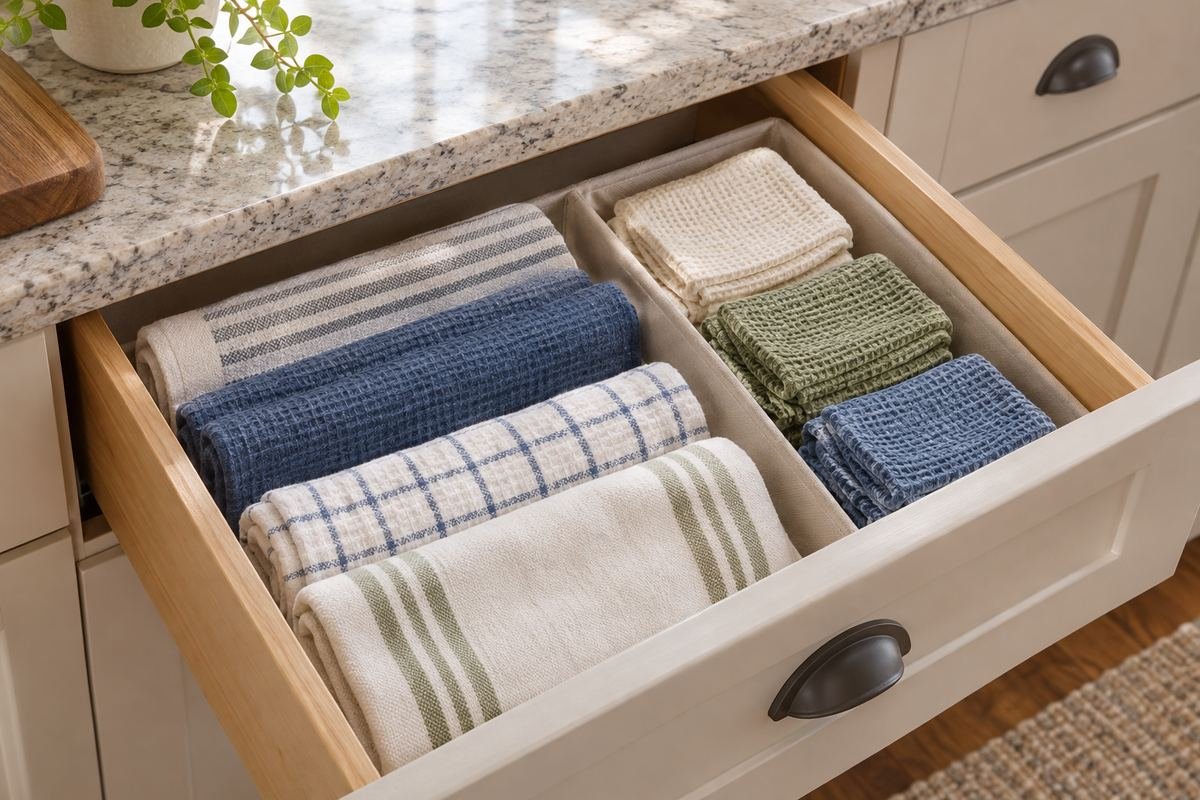
Large kitchen towels and smaller cloths can become a mixed pile when they share an undivided drawer. A pair of light dividers gives each size a clear section. Fold around the actual compartment dimensions instead of expecting every cloth to take the same shape.
Keep the dividers easy to reposition as the supply changes. An overly exact arrangement can become inconvenient when one replacement towel is thicker or larger than the rest. Labeling is optional; a clear size difference and a stable return place may be enough.
Practical tip: Reserve the easiest section for the size used most often.
8. Place dry spare towels in a shallow open basket
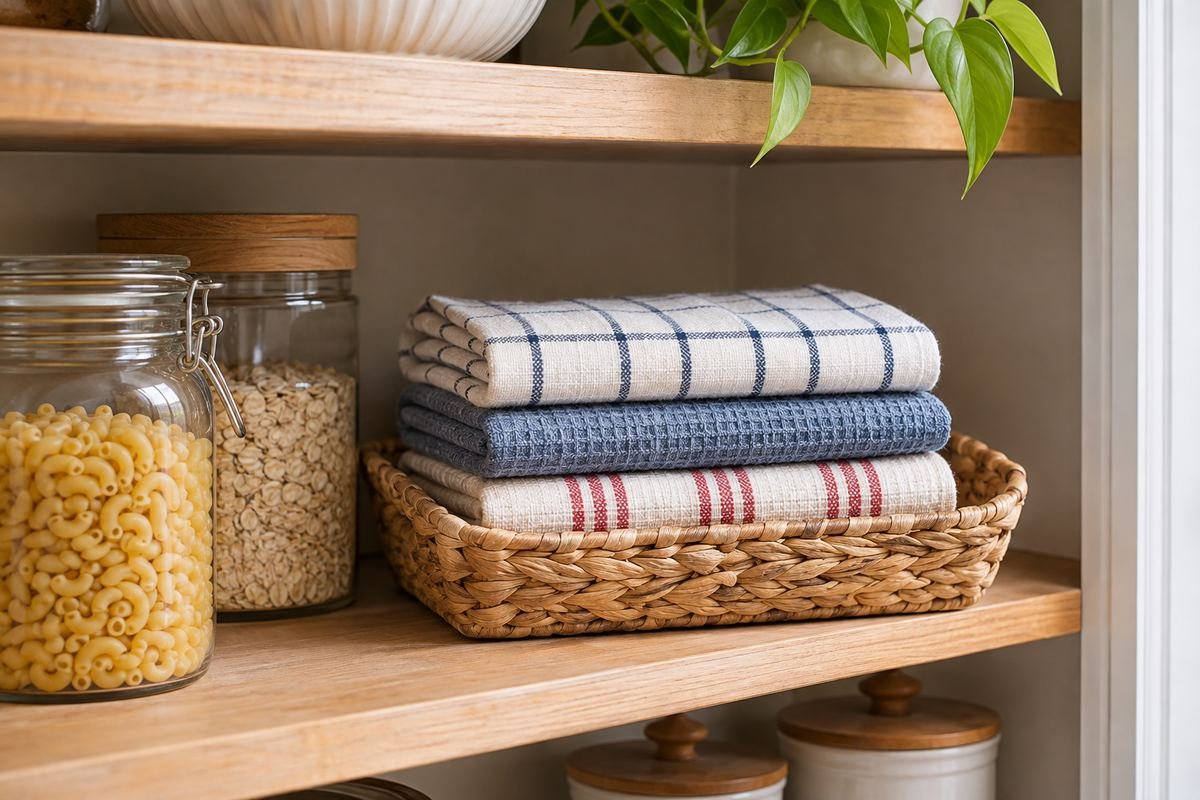
A shallow basket can hold a small reserve on a suitable open shelf away from splashes and heat. Its low sides make the folded towels easy to see and remove. Choose a basket that supports the whole stack instead of leaving fabric draped across a shelf edge.
Treat the basket as storage for completely dry spares. Keep the daily working towel in its own position, and leave enough shelf space to lift the basket out when needed. A deep decorative basket may hide the lower towels and make the reserve harder to use.
Practical tip: Test access to the bottom towel before filling the basket.
9. Roll a small reserve in a compact basket

Rolled towels can make a modest basket easy to browse when the rolls stay visible. Choose a fold-and-roll method that suits the container’s depth, and keep the rolls loose enough to remove individually. This works best with a limited reserve rather than an entire household linen supply.
Try one actual towel first. A thick roll may consume more room than a flat fold, while a narrow basket may make the end rolls difficult to grip. Let the real fabric and your available shelf determine whether the attractive arrangement is also practical.
Practical tip: Compare one rolled towel with one flat fold in the same container.
10. Reserve a shelf compartment for dry backups
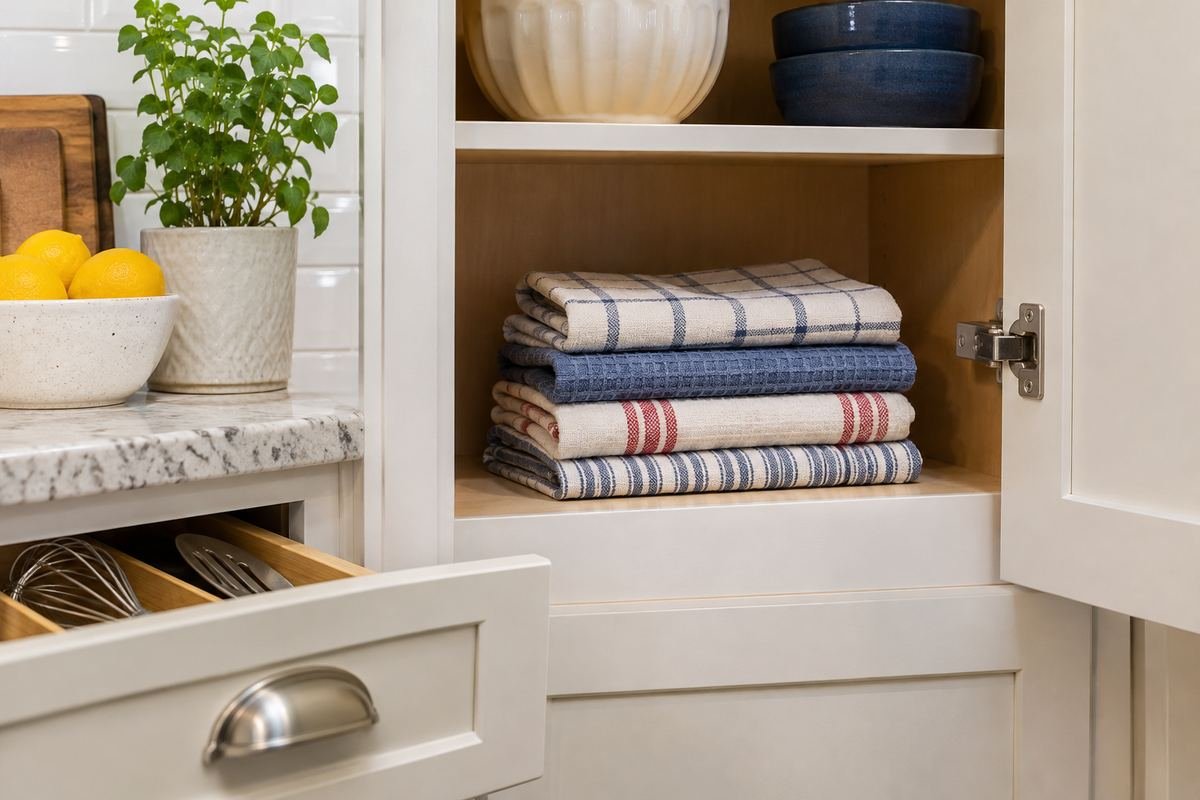
A defined shelf compartment can hold the reserve supply without occupying the busiest drawer. Keep the group modest and visible, with the stack close enough to the front to reach comfortably. Choose a dry storage location suitable for the fabric rather than treating every empty cabinet corner as equivalent.
Use the shelf as a backup position, not as the only place for a towel needed mid-task. Move a small working amount into the accessible drawer. This separation can make a small kitchen easier to manage when the most convenient drawers already have important daily jobs.
Practical tip: Store the reserve where it can be counted without unloading the shelf.
11. Create a small pantry towel bin

A pantry bin can gather the dry reserve when cabinet shelves are shared by several household supplies. Choose a low-front bin with a comfortable lifting grip. Its opening should let you see the towels rather than hiding them behind a tall opaque front.
Avoid buying a large bin merely because it matches other pantry containers. Measure the folded supply and the shelf depth first. Leave enough clearance to lift the bin out without catching the shelf above, especially if the towels are stored upright inside it.
Practical tip: Check the bin’s inner dimensions as well as its outer size.
12. Keep a coffee-station pair within the working zone

A small coffee station may need only a clearly chosen pair of dry towels nearby, with the working towel returned separately after use. Store the clean pair in a drawer section beneath the station or in a suitable small shelf basket. This avoids spreading a full reserve across a compact counter.
Keep fabric away from the machine’s vents, hot surfaces and normal drip area. Follow the appliance’s clearance instructions rather than using a styled image to judge safety. If there is no suitable surface nearby, the regular kitchen towel drawer can serve the station just as well.
Practical tip: Choose the storage location after identifying the appliance’s required clearances.
13. Display one patterned tea towel on a simple bar

One patterned towel can add color to a kitchen while remaining useful. A plain rail lets the textile carry the detail. Keep the pattern related to an existing room color so the display feels connected to the cabinetry, dishes or backsplash.
Choose the bar for practical access and clearance before considering the composition. A beautiful towel hung where it catches a door is still an awkward arrangement. Keep backup patterns folded elsewhere, allowing the one working piece to provide the visual accent.
Practical tip: Start with one patterned towel and keep nearby accessories quiet.
14. Build a calm palette with solids and stripes

A small combination of solid and striped towels can make a visible drawer or basket feel intentional. Use a few compatible colors rather than replacing every towel to produce a perfect set. A repeated neutral can connect different fabrics while leaving the supply easy to recognize.
Keep the best fold for each towel’s thickness. Matching appearance should not require bulky pieces to be squeezed into spaces intended for thin tea towels. Choose the practical arrangement first, then edit which colors remain on open display.
Practical tip: Group by a shared color when exact matching sets are unnecessary.
15. Separate dish towels from small wiping cloths

A clear section for dish towels and another for smaller kitchen cloths makes the supply easier to navigate. Choose the categories around the tasks in your own kitchen and make the return place obvious. The purpose is clarity, not a complicated system that requires explaining after each wash.
Use different compartment sizes if the pieces differ in bulk. A small cloth can disappear beneath a large folded towel in a shared stack. Keep the daily working pieces separate from the clean reserve and follow the actual fabric care instructions for each group.
Practical tip: Give the smallest cloths a section where they remain visible.
16. Use the inside of a cabinet for dry spares only when it fits
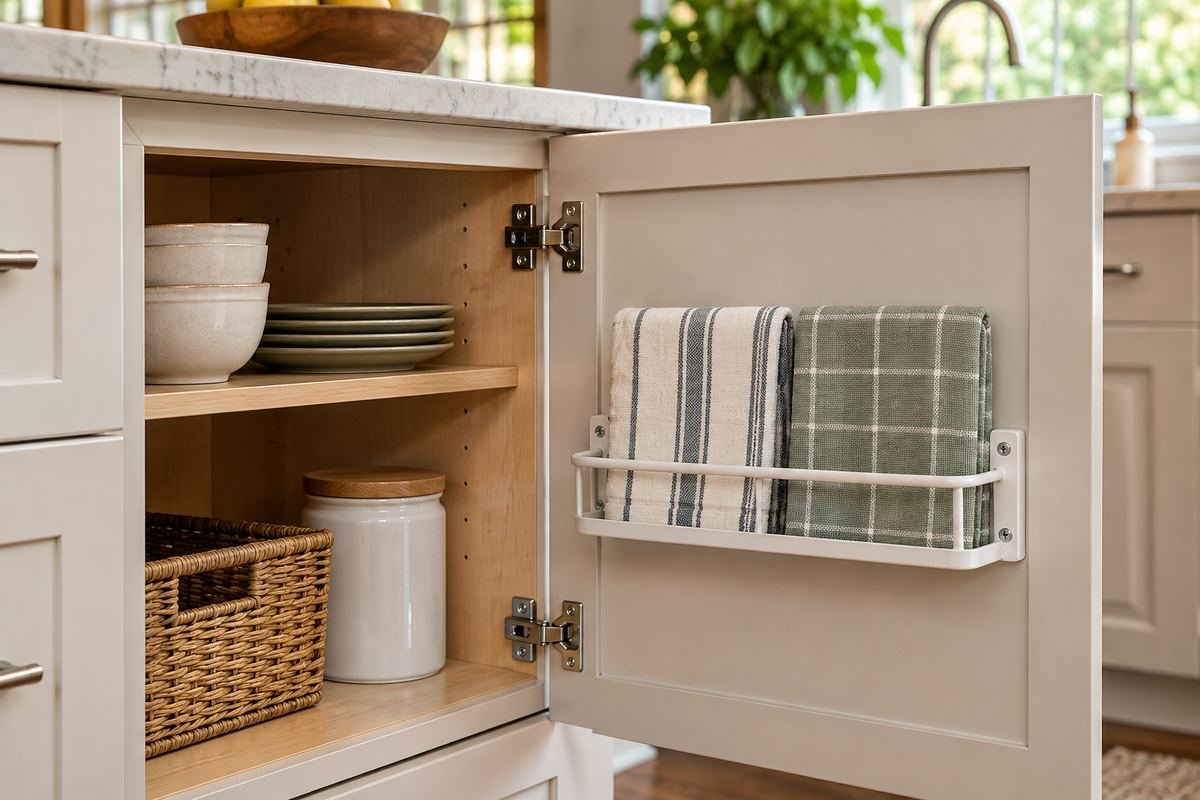
A suitable door-mounted holder can store a small number of completely dry spare towels where other storage is limited. Check the door construction, hinge movement and space behind the closed door. Use a purpose-designed accessory with an appropriate fixing method for that surface.
Test with the cabinet empty around the holder’s intended position before adding towels. The holder and fabric must clear shelves and stored objects throughout the movement. If closing requires compressing the towel against a shelf, choose another location instead of accepting the interference.
Practical tip: Measure the closed-door clearance before choosing an accessory.
17. Keep the used-towel return separate from clean storage

A distinct used-towel collection position helps prevent an absent-minded return to the clean drawer. Choose a container and location suited to your actual laundry routine. Do not pack damp towels into a sealed decorative box or let a hidden pile grow beneath the fresh supply.
Make the return step straightforward without inventing a second elaborate sorting system. Keep the clean drawer and used collection visibly different. Follow appropriate care and laundering guidance for the towels you own, and adjust the amount in circulation to how frequently you can manage that routine.
Practical tip: Give used towels a return place before rearranging the clean supply.
18. Arrange the daily drawer in a small rotation
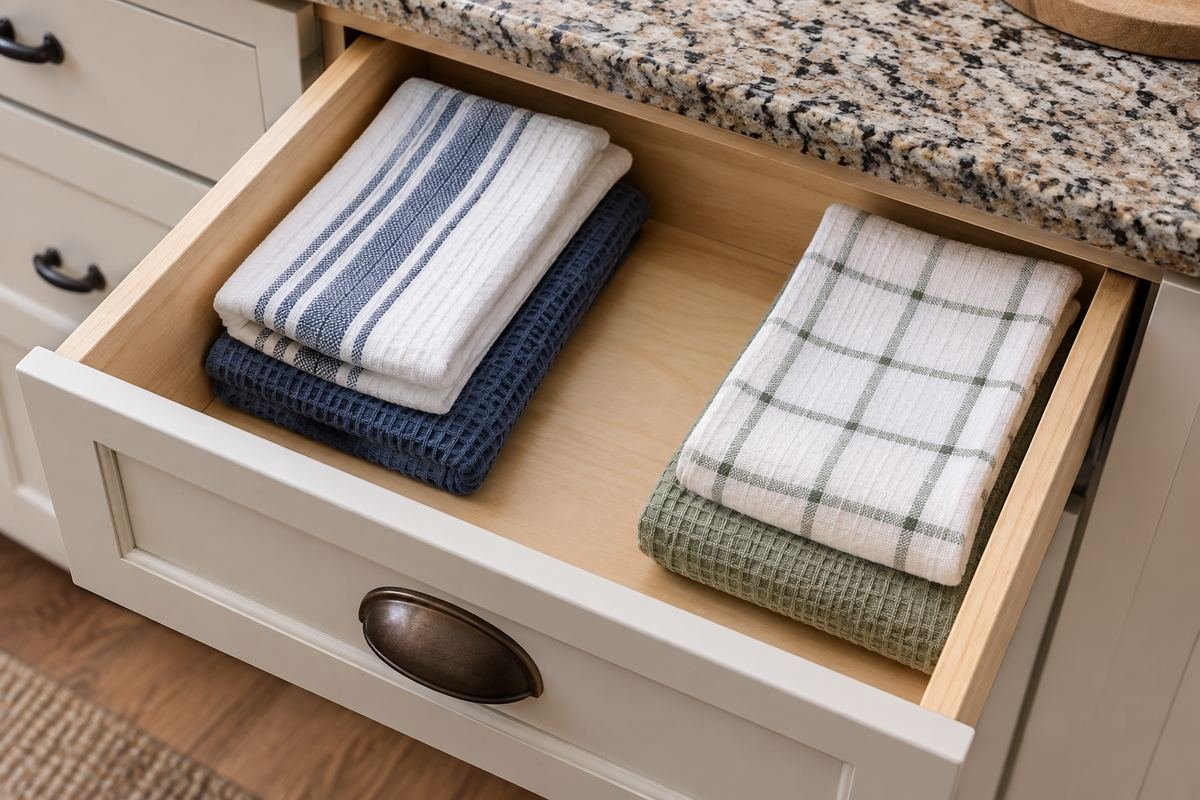
A compact daily rotation keeps the accessible drawer useful without filling every inch. Place freshly laundered, completely dry towels behind or beneath the current clean supply if that fits your routine. The goal is an easy sequence rather than a fixed number of towels for every household.
Watch the drawer over a normal laundry cycle. If the same bottom pieces never move, the daily amount may be larger than needed. Move a clearly defined reserve elsewhere and keep the working drawer easy to open, inspect and refill.
Practical tip: Review the rotation after one ordinary laundry cycle.
19. Keep an entertaining set together in a dry reserve

Occasional tea towels used with serving pieces can live together in a separate dry reserve. This protects the daily drawer from becoming crowded with linens rarely needed during ordinary meals. A small basket or shelf section can keep the group visible and easy to retrieve.
Store the group near related serving supplies only when the location is appropriate for fabric. Avoid stacking heavy dishes directly on top of the towels. Keep the set small enough to lift out without disturbing an entire cabinet arrangement.
Practical tip: Let frequency of use decide whether a towel belongs in the daily drawer.
20. Make the most-used towel easy to reach

Put the towel you use most often in a position that suits your comfortable reach. A low accessible drawer or a sensibly placed rail can be more useful than a high display shelf. Test the actual movement without stretching across a sink or a preparation area.
Households differ in reach and working habits, so use the people in your own kitchen as the reference. Keep the arrangement simple enough that another person can find a fresh towel without moving decorative objects. A clear everyday position also makes returning the towel more predictable.
Practical tip: Test the reach from the place where the task actually happens.
21. Check the towel drop against doors and handles

A towel can fit a rail beautifully yet catch the drawer below when it opens. Test its full drop with all neighboring doors and handles moving normally. Include the longest towel in the supply rather than judging the arrangement with a smaller decorative piece.
If the fabric catches, change the location or use a different suitable holder. Repeatedly shortening an awkward fold can make the return routine frustrating. Do not assume an oven handle is a towel bar; use appliance guidance and choose a separate suitable position when needed.
Practical tip: Open every nearby door with the towel hanging in place.
22. Use a removable drawer basket for a flexible supply

A small removable basket can keep towels together while allowing the drawer to change jobs later. Choose a smooth interior that suits the fabric and a low edge that does not block access. The basket should fit comfortably without scraping the drawer sides.
Try lifting the loaded basket once. If it is too tightly wedged to remove, a simple divider may suit the drawer better. Leave the basket’s handle or edge available, and keep its capacity aligned with a practical working rotation instead of filling it to the rim.
Practical tip: Measure the drawer opening, including any narrower frame at the front.
23. Finish with a quick towel-storage reset
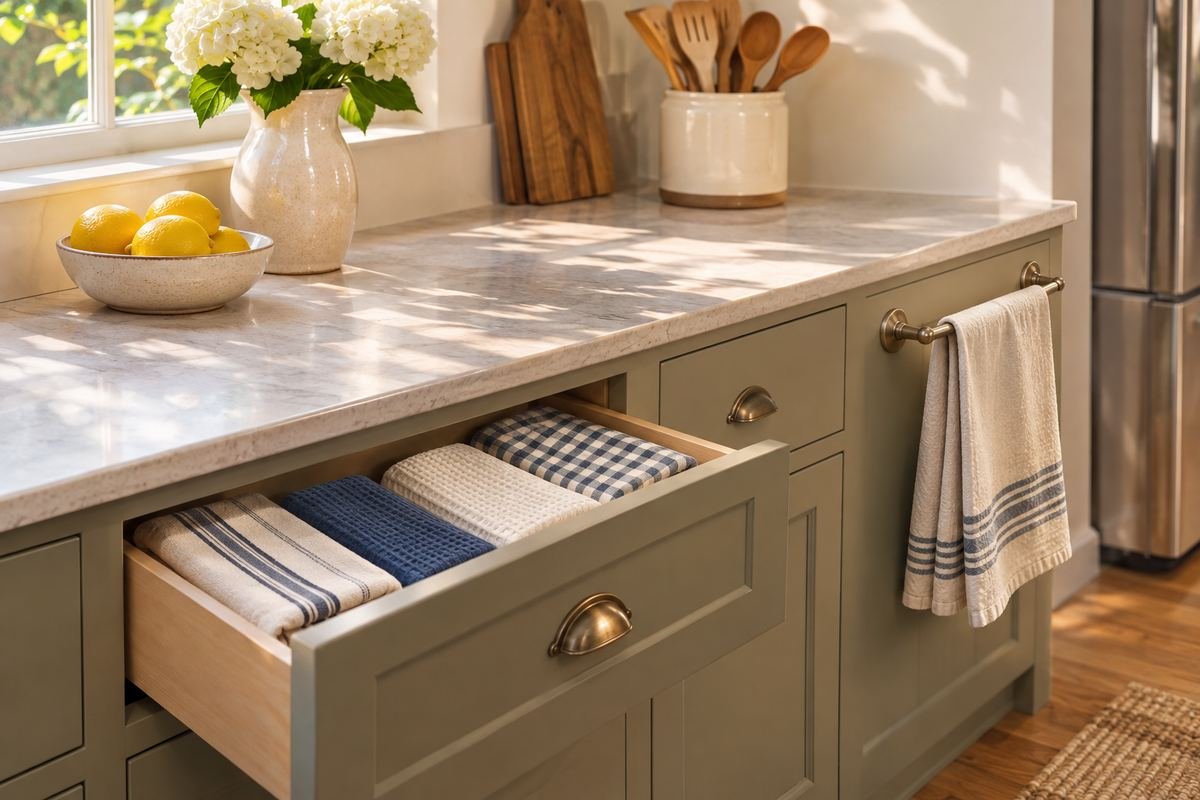
A short reset can keep the system useful after the first tidy day. Return completely dry towels to their chosen fold, remove pieces that belong in the used collection and clear anything that has migrated into the towel section. Use the same simple return positions each time.
If the drawer repeatedly becomes crowded, adjust its daily amount or folding method before buying another organizer. The best arrangement is the one that survives ordinary meals and laundry, while leaving the kitchen comfortable to work in.
Practical tip: Change one awkward step after observing the system in daily use.
Frequently Asked Questions
Is it better to fold or roll kitchen towels?
Use the method that suits the actual container and makes individual towels easy to remove. Flat folds work well in shallow drawers; supported upright folds can show the whole selection in a deeper drawer. Rolled towels can suit a small basket, but test the space with real towels before buying it.
Can I store kitchen towels inside a cabinet door?
A purpose-designed holder may suit a compatible door, but check its fastening method, the towel’s hanging drop and the space behind the closed door. Store only completely dry spare towels in an enclosed backup position. Keep the towel currently in use in a suitable accessible place.
How many kitchen towels should I keep in the daily drawer?
Base the amount on your own cooking and laundry routine. Put a realistic working rotation in the accessible drawer and move a clearly defined reserve elsewhere if needed. There is no universal number that fits every household, fabric or washing schedule.
Choose the Details That Work in Your Home
Choose one accessible home for completely dry spares and one sensible position for the working towel. Test the arrangement with a full drawer, an open cabinet and the longest towel hanging in place. A modest supply that is easy to reach and return usually serves a kitchen better than a decorative arrangement that must be rebuilt after every meal.
For related ideas, explore kitchen drawer organization ideas, small linen closet organization ideas, kitchen counter decor ideas.
Planning References
IKEA: HULTARP rail dimensions, material and mounting notes; Williams Sonoma: Classic Stripe cotton towels, hanging loop and model-specific care. Follow the instructions for the exact products you choose.
Optional digital guide for this topic
If you prefer a structured workbook, explore this related paid guide.