Practical cookbook storage ideas let you choose a recipe without moving a stack of bowls or balancing a heavy book on a narrow ledge. These arrangements also give the book a sensible home once the meal is finished. A beautiful collection becomes more useful when its location suits both the books and your cooking routine.
These cookbook storage ideas cover small working collections, oversized volumes, closed cupboards and storage just outside the kitchen. Start with one shelf or one category. You can make a considered arrangement with the books and furniture you own, then use the measuring worksheet below to judge any new organizer.
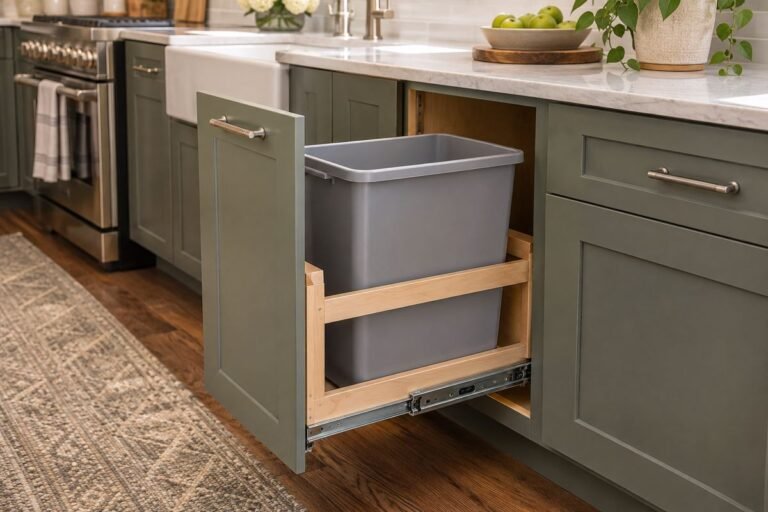
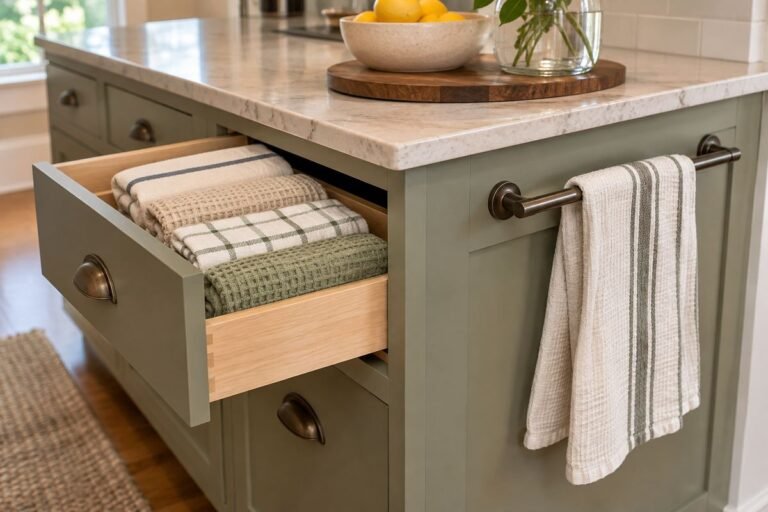
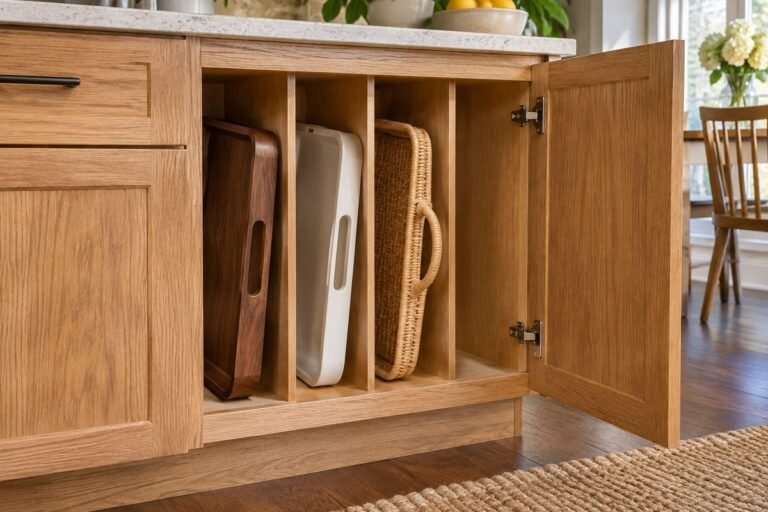
The images are original AI-generated decor concepts, not installation diagrams or photographs of completed client projects.
Browse These 25 Cookbook Storage Ideas
Jump to an idea
- Keep a short everyday row near a dry prep space
- Use a closed cupboard for the whole collection
- Turn an island end into a cookbook bay
- Reserve a dry pantry shelf for recipe books
- Place a cookbook section inside a dining hutch
- Make room for a reference library in an adjoining room
- Give baking books a defined section
- Use broad bookends for a small open collection
- Lay oversized cookbooks in a supported compartment
- Display one current title facing forward
- Separate the reading stand from the storage shelf
- Park a small cookbook cart in a real home position
- Carry a few books in a solid-base handled bin
- Use a deep drawer only when the books fit closed
- Build a book bay into an existing base cabinet layout
- Split a mixed collection across two shelves
- Let mixed spines sit against a quiet backdrop
- Fit a narrow alcove with a measured bookcase
- Give a dining bench a separate book compartment
- Match the shelf finish to the room’s existing wood
- Keep a fragile family volume in its own enclosure
- Store recipe folders beside the books as a separate group
- Use an occasional-reference cabinet for a larger library
- Reserve a clear return space for the book in use
- Rotate the working collection after real meals
Plan the Book Collection Before the Shelf
Sort the books into regular cooking, occasional reference and books you mainly browse. Measure each group with the covers closed, including its tallest height, deepest cover and total spine width. The Library of Congress recommends supportive upright shelving, minimal direct light and a stable environment; keep that in mind when choosing between a dry cupboard and an exposed cooking-area shelf. For wall storage, check the complete shelf system, fixing method and loaded weight. A decorative ledge and a bookshelf may have very different limits.
| What you need to solve | A useful starting point | The deciding measurement |
|---|---|---|
| Five books used every week | Short upright row or small cabinet bay | Total spine width plus removal room |
| Several large hardcovers | Fully supported horizontal compartment | Largest cover width and depth |
| A counter crowded by appliances | Island-end bay or dining-room cupboard | Clear opening and door movement |
| One recipe open during cooking | Separate supported reading stand | Open-book footprint and dry work area |
| A growing reference library | Dry bookcase outside the kitchen | Shelf capacity and space for a new volume |
A Worked Fit Example: Why Shelf Depth Matters
Imagine your largest closed cookbook is 11 inches tall, 9 inches deep and 1.5 inches thick. A shelf that is 8 inches deep leaves an inch of its cover unsupported when stored upright in the usual orientation. IKEA lists one BERGSHULT shelf version at 7 7/8 inches deep, illustrating why a product described as a shelf is not automatically a suitable cookbook shelf. Its published load limit also depends on proper mounting. Compare the actual book footprint with usable support, then check the chosen system’s instructions; this example is not a universal shelf specification.
Cookbook Storage Ideas: A Six-Field Fit Card
Record: largest closed-book height; largest cover depth; total spine width of the working group; clear cabinet opening; supported shelf depth; loaded collection weight. Add a separate note for the place where you will read an open book. For example, a 14-inch row inside an 18-inch bay leaves 4 inches before bookends and dividers, but that arithmetic does not prove easy access. Try removing a middle book and returning it without scraping its cover.
1. Keep a short everyday row near a dry prep space

A small group of the books you use every week can live close to the place where you plan meals. A short upright row is easier to browse than a decorative tower, and you can see when a title has not been returned. Keep the adjacent surface open for the book you take out.
Choose the row from real use rather than from matching covers. If your usual meals come from five books, start with those five and give occasional references another home. Keeping the working collection small leaves the nearby counter available for food preparation instead of turning it into a permanent library.
Practical tip: Try the arrangement with only the books used in your last few meals.
2. Use a closed cupboard for the whole collection

A cupboard door gives a mixed collection a quiet appearance while keeping it together. Adjustable shelves are useful when tall hardcovers and shorter paperbacks need different openings. Arrange the books so a person can identify the title and pull it out without unloading a second row.
Measure behind the hinges and look at the clear opening with the door in its normal position. A shelf that fits a book inside may still make removal awkward at the edge. Give the books their own bay rather than sharing a crowded compartment with heavy bowls that must move every time you choose a recipe.
Practical tip: Test the tallest book at the hinged side of the opening.
3. Turn an island end into a cookbook bay

An island-end compartment can put books within reach without occupying the main worktop. It is most useful on the quiet end of the island, where the person choosing a book does not stand in the cooking route or interfere with a seated diner.
Plan the bay around the biggest book instead of filling a leftover opening with whatever fits. Include a stable end support and enough room above the row to remove a volume. Keep the front flush with the furniture so book corners and shelf edges do not become projections into the walkway.
Practical tip: Stand where you would browse the bay while someone uses the kitchen.
4. Reserve a dry pantry shelf for recipe books

A pantry shelf can hold occasional cookbooks while leaving the kitchen counter clear. Put the books in a defined section where they remain visible when the pantry is stocked. A short divider between books and supplies makes the boundary easier to maintain.
Avoid wedging volumes behind packages or below containers that tend to drip. The aim is a predictable home you can browse before cooking. If shopping additions repeatedly push the books aside, move the collection to a separate cupboard rather than treating every empty patch of pantry shelving as permanent book storage.
Practical tip: Give books a fixed shelf boundary that grocery restocking will not erase.
5. Place a cookbook section inside a dining hutch

A dining hutch can be a convenient library when the kitchen lacks spare cabinetry. Put the books in a reachable compartment near the edge of the serving area, then use a separate table or stand for reading. The short trip may be preferable to a crowded kitchen worktop.
Mixing books with tableware works best when each group has a clear zone. Leave space for the cupboard door and for a hand to grasp the book. If a glass-front hutch is used, choose a modest row that suits the shelf support instead of filling every space for a symmetrical display.
Practical tip: Keep the cookbook bay separate from the stack of dishes used daily.
6. Make room for a reference library in an adjoining room

A larger cookbook collection does not have to live entirely in the kitchen. A dry bookcase in an adjoining room can serve browsing, meal planning and occasional reference. Bring one title into the kitchen for the recipe, then return it when the work area is cleared.
This approach is useful for a collection that has outgrown a single cupboard. Arrange categories around the way you choose a meal, and keep the room’s ordinary reading surface nearby. Avoid creating a second hidden kitchen collection by leaving every borrowed book permanently on a spare counter.
Practical tip: Decide where a book waits before returning to the main library.
7. Give baking books a defined section
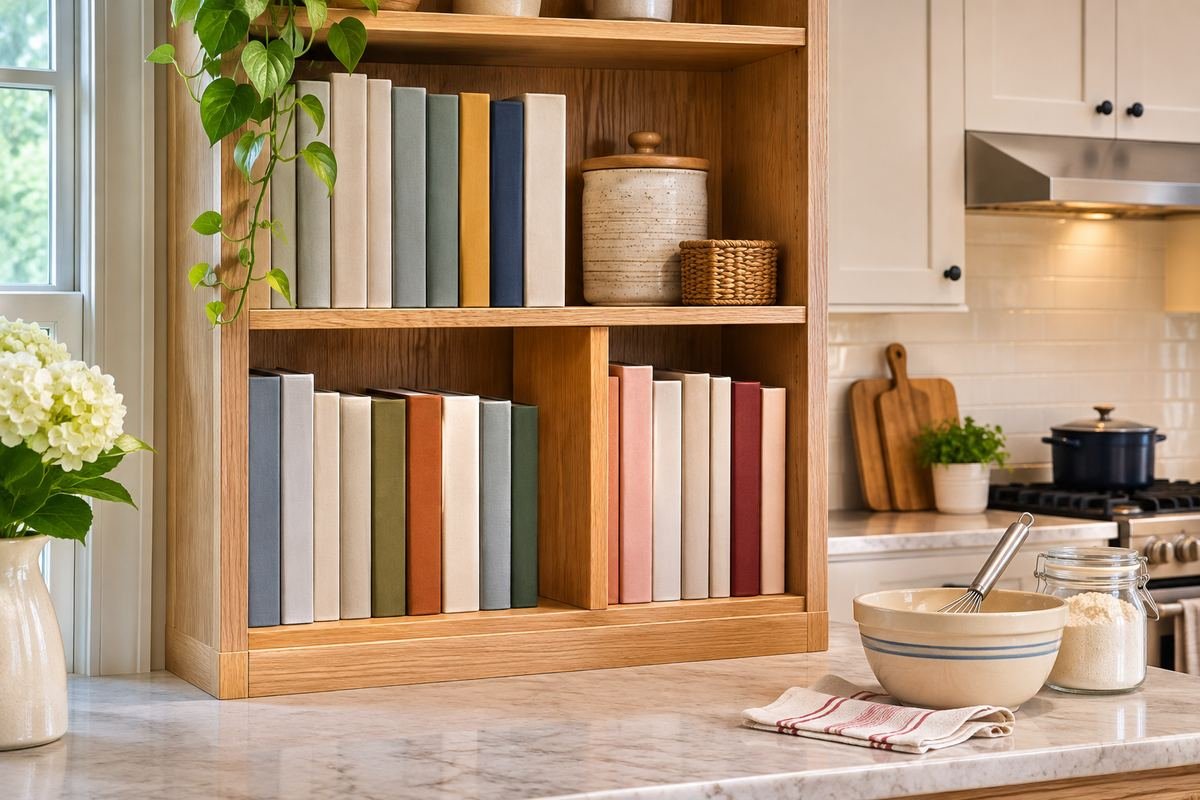
If baking is a regular activity, group the relevant books where you gather recipes and ingredients. A small dedicated section means a baking session begins with a clear choice instead of a search across several shelves. It can sit beside the main collection without needing a separate piece of furniture.
Use a divider or a noticeable gap rather than a tightly packed decorative category. Keep the section limited to books you actually consult for baking. A title used only for an occasional celebration can remain with the reference group, leaving the working section easy to browse and return.
Practical tip: Review the section after a baking project and move rarely used titles back.
8. Use broad bookends for a small open collection
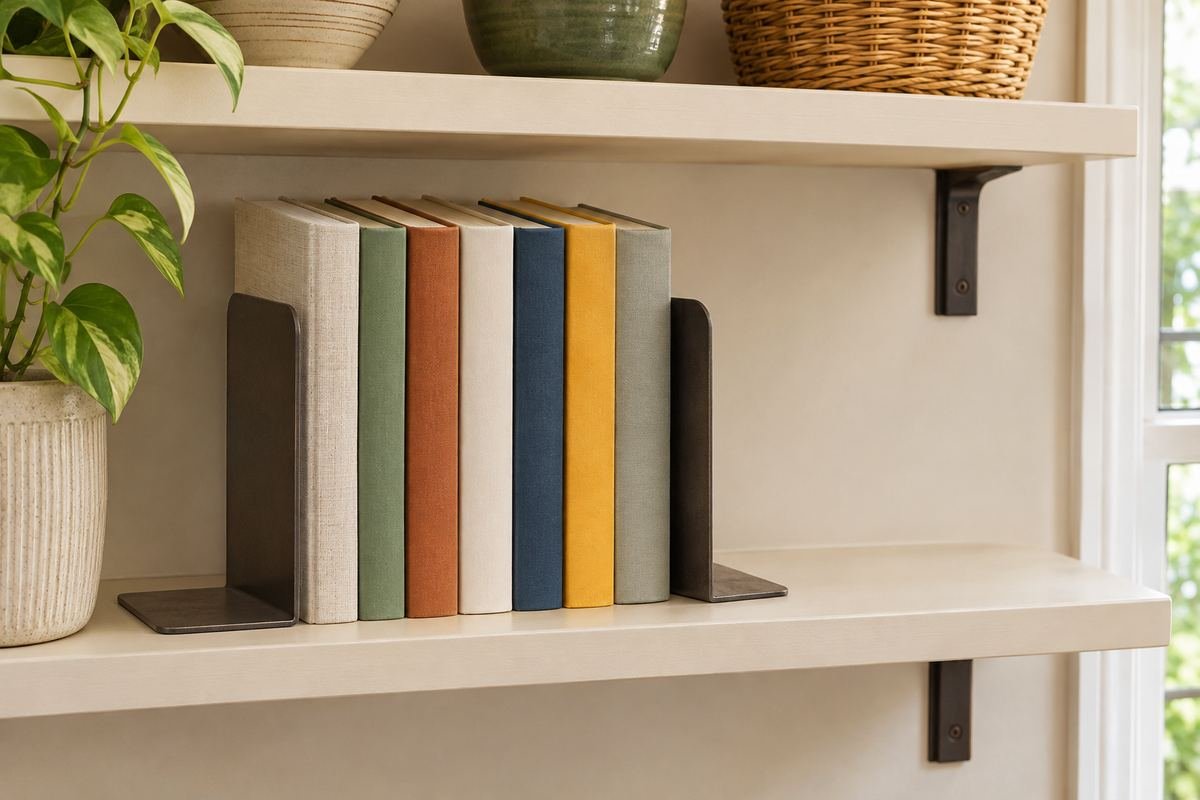
A pair of bookends can give a short row a finished appearance without requiring a custom cabinet. Choose a shape that supports the covers and leaves the spines visible. A broad, simple form often works better beside cookbooks than a delicate ornament that takes up most of the available shelf.
Include the bookends in your width calculation. They need to stay stable when a middle book is removed, and their base should suit the shelf surface. Do not rely on a fragile vase as a substitute for book support simply because it completes the color scheme.
Practical tip: Remove the middle book and see whether the remaining row stays supported.
9. Lay oversized cookbooks in a supported compartment

A very large book may suit a horizontal compartment better than a shelf that forces it into a poor fit. Use a surface that supports the full cover, and keep the group short enough that taking out the bottom volume remains manageable.
Put the largest footprint at the bottom and avoid balancing a small stack across a narrow ledge. If a volume is heavy, find a lower position where it can be lifted directly onto a nearby surface. A separate compartment can make these books look intentional without turning every large hardcover into a display pedestal.
Practical tip: Compare the full cover footprint with the shelf beneath it.
10. Display one current title facing forward

A face-out title can give the collection a focal point while the rest remains in ordinary storage. Use it for the book you are currently cooking from or a title that genuinely interests you. The display becomes useful because it changes with your routine.
Choose a supported stand or a purpose-made display space with adequate depth and capacity. A book cover takes more width facing forward, so do not assume a crowded shelf can accommodate the same number. Leave the display easy to lift out rather than wedging it behind decorative objects.
Practical tip: Rotate the visible title when your cooking interests change.
11. Separate the reading stand from the storage shelf
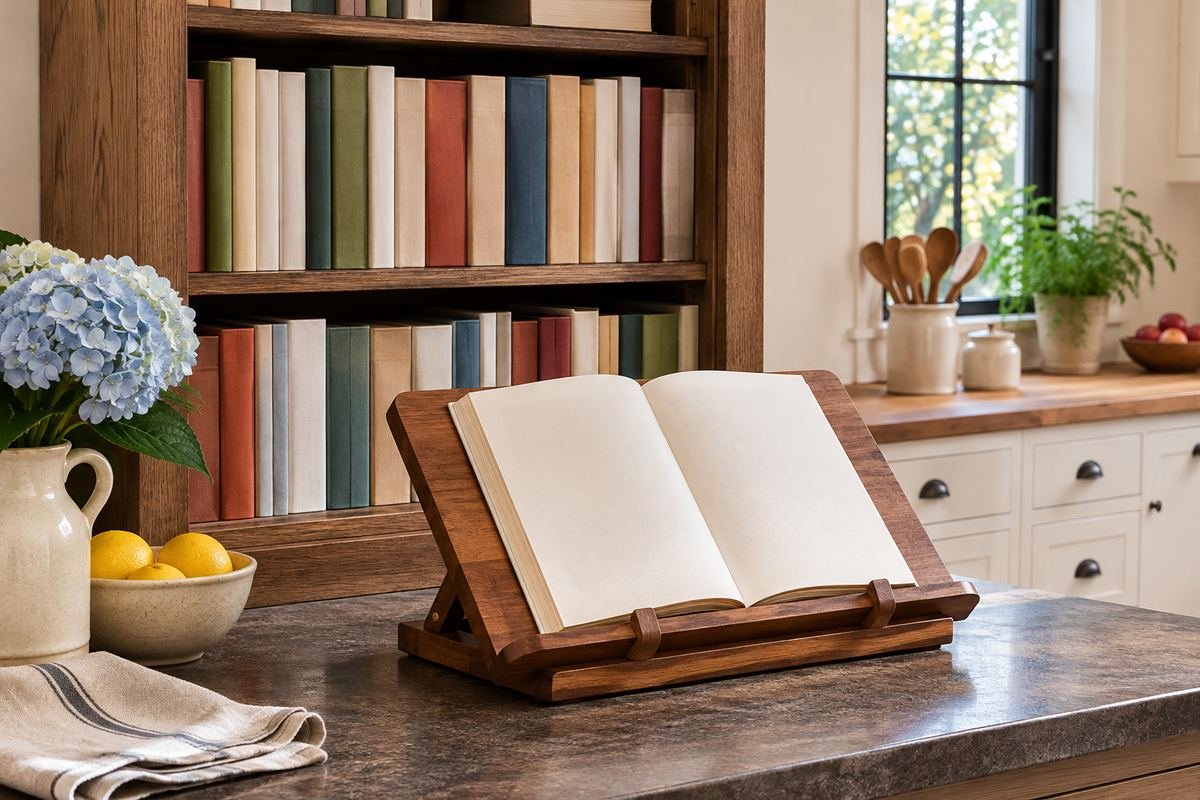
Storing books and reading an open recipe are different jobs. A supported reading stand can hold the selected book in a dry place while the main collection stays compact. The arrangement works especially well when a wide open book would otherwise take over the entire work surface.
Test the stand with the thickest book you expect to use, including the page spread and the way the covers rest. Keep the stand’s base stable and the cooking tools on a separate part of the counter. Fold or return the stand afterward if the kitchen needs the surface for another task.
Practical tip: Measure the open book on its actual stand, not just the folded stand.
12. Park a small cookbook cart in a real home position
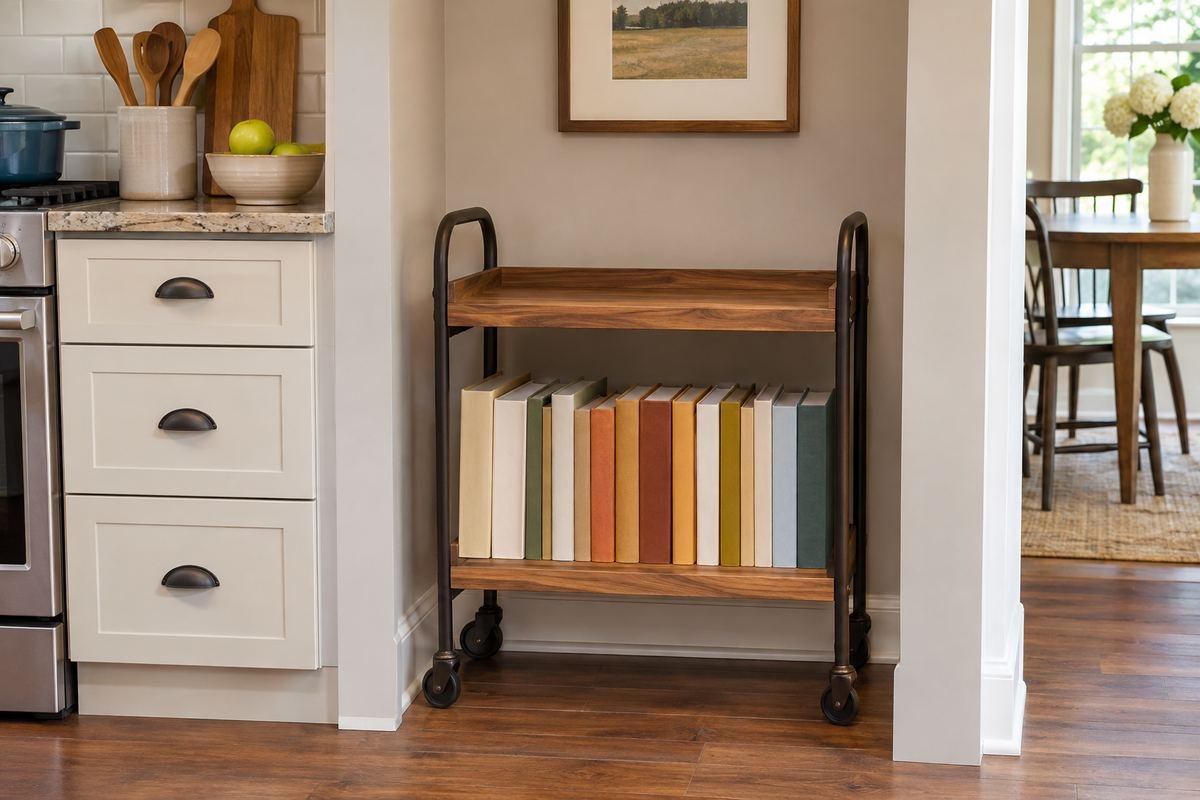
A compact cart can suit a flexible kitchen when it has a parking space outside the main route. Books stay on its lower supported shelf, and the top can serve as a dry place to choose the next recipe. The cart should still fit comfortably when it is not in use.
Consider the loaded cart’s movement and the floor transitions it would cross. A cart that must be shifted to open a cupboard is likely to become an obstacle. Use the manufacturer’s load guidance and keep the collection modest enough that moving it remains a practical part of the routine.
Practical tip: Mark the parking footprint before deciding a cart solves the problem.
13. Carry a few books in a solid-base handled bin

A small handled bin can bring a limited selection to the meal-planning table. A solid base supports the books, while a low front makes them easier to see. Treat it as a movable working group rather than a way to carry an entire heavy library at once.
Use a bin whose handles, dimensions and load instructions suit the contents. Include the space needed to lift it out of its shelf bay. If the filled bin is awkward, reduce the number of books or return to ordinary shelving instead of assuming handles make any load convenient.
Practical tip: Try lifting the filled bin a short distance before assigning it a high shelf.
14. Use a deep drawer only when the books fit closed

A deep drawer can contain a compact cookbook group while leaving the room visually calm. Arrange the books so they can be identified from above and removed without bending covers. The drawer needs enough usable height for the complete stored book.
Include its load rating and runners in the decision. Books are a concentrated load, and a drawer intended for light utensils may be a poor candidate. Place a few actual books inside, close it gently and test the removal motion before adding a divider or committing to a full collection.
Practical tip: Measure closed height and clear opening separately.
15. Build a book bay into an existing base cabinet layout

An existing base-cabinet compartment can become a practical book bay when its shelves suit the collection. Keeping books low makes a heavy volume easier to bring to a nearby table. A plain open bay can also break up a long run of closed doors visually.
Work with the cabinet’s usable dimensions and structure. Do not remove supports or modify cabinetry solely because an inspiration image shows an opening. If the current shelves cannot be adjusted safely within the manufacturer’s system, choose another location that already supports the books properly.
Practical tip: Use the cabinet as designed and plan the books around its actual opening.
16. Split a mixed collection across two shelves

Two carefully arranged shelves can use space better than one oversized opening. A supported upright row can share the display with a short horizontal group of books that fits its own shelf. The arrangement gives different book shapes a clear home without requiring every cover to be the same size.
Allow room to grasp and remove the books at each level, and reserve the easier lower position for heavier volumes. Extra shelf capacity is useful only if both groups remain reachable. Where shelves are wall mounted, assess the complete loaded system rather than treating shelf depth as the only specification that matters.
Practical tip: Mock up both groups with your own books before fixing the shelf heights.
17. Let mixed spines sit against a quiet backdrop
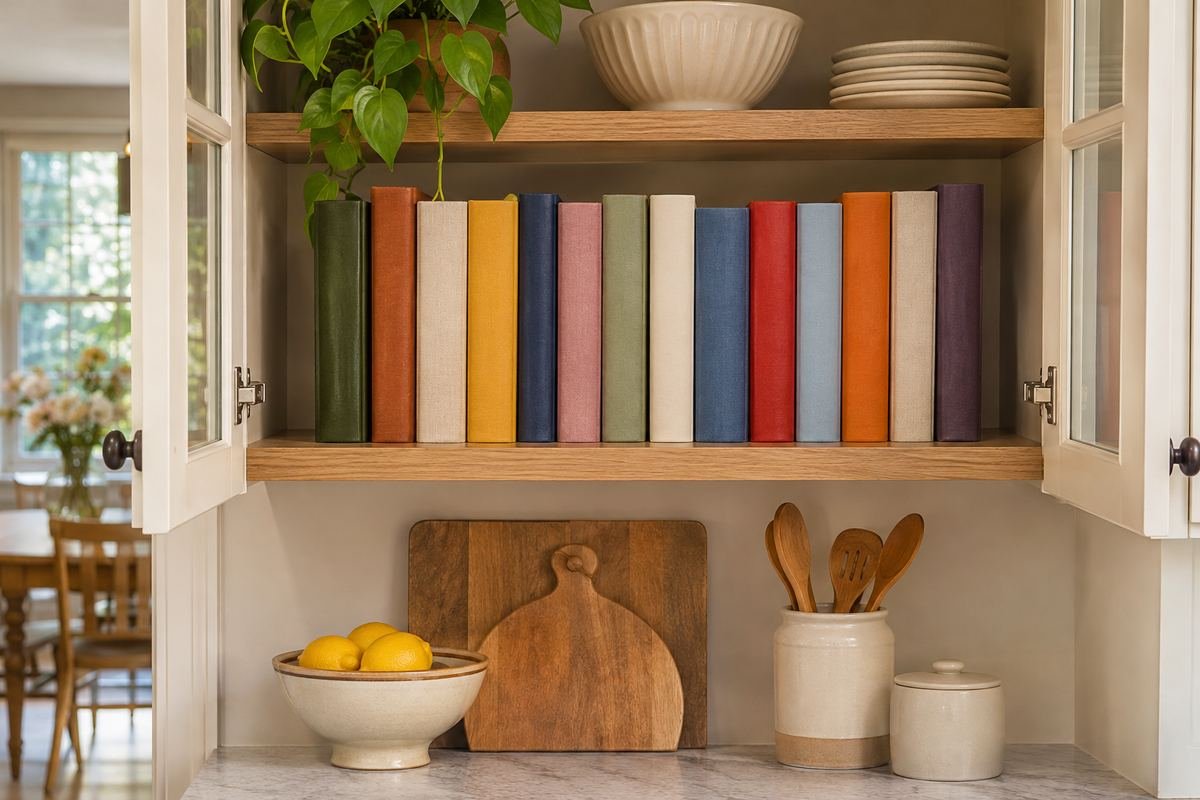
A varied cookbook collection can look orderly when the furniture around it is restrained. A simple shelf finish and a clear boundary give different spine colors somewhere to belong. There is no need to turn the books backward or hide the titles to achieve a calm room.
Organize the row by how you find recipes, then use the wall or cabinet finish to connect it with the kitchen. A consistent shelf line is often enough. Keeping titles easy to identify makes the display more useful than arranging books purely as a gradient that you do not remember.
Practical tip: Choose the finding system first and let the backdrop do the visual work.
18. Fit a narrow alcove with a measured bookcase

A narrow alcove can be a useful home for cookbooks if it has enough depth and a clear approach. Measure at several heights because walls, skirting and trim can reduce the opening. A bookcase that fits the alcove outside still needs usable internal shelves for the collection.
Consider how the largest volume turns as it comes out. The surrounding wall should not force the book into an awkward twist. Follow furniture assembly and anchoring instructions, and leave access to sockets or other features that should remain reachable rather than covering them behind a packed unit.
Practical tip: Use the narrowest alcove measurement when comparing furniture dimensions.
19. Give a dining bench a separate book compartment

A purpose-designed bench or nearby low cabinet can store occasional books in a dining nook. A dedicated side compartment is easier to use than lifting a seat full of cushions every time you want a recipe. Keep the books clear of shoes and the everyday floor-cleaning area.
Use only furniture designed for its seating and storage roles. Book access should not require someone to stand on the bench or move another person’s place setting. If the compartment is deep, a short front row may be more manageable than layers of books that disappear behind one another.
Practical tip: Choose side access when a lifting seat would interrupt the whole nook.
20. Match the shelf finish to the room’s existing wood

A book shelf can feel integrated by repeating one wood tone already present in the kitchen. Choose the overall relationship first: a pale shelf with pale seating, or a darker shelf that echoes a table. The books provide enough visual detail without a second competing furniture statement.
Keep the decision practical as well as visual. The shelf needs a smooth supported surface suited to its role and the care routine specified for its finish. A coordinated color does not make an unsuitable shelf strong enough for books, so establish the fit and load before judging the final appearance.
Practical tip: Compare a finish sample beside existing furniture in ordinary room light.
21. Keep a fragile family volume in its own enclosure
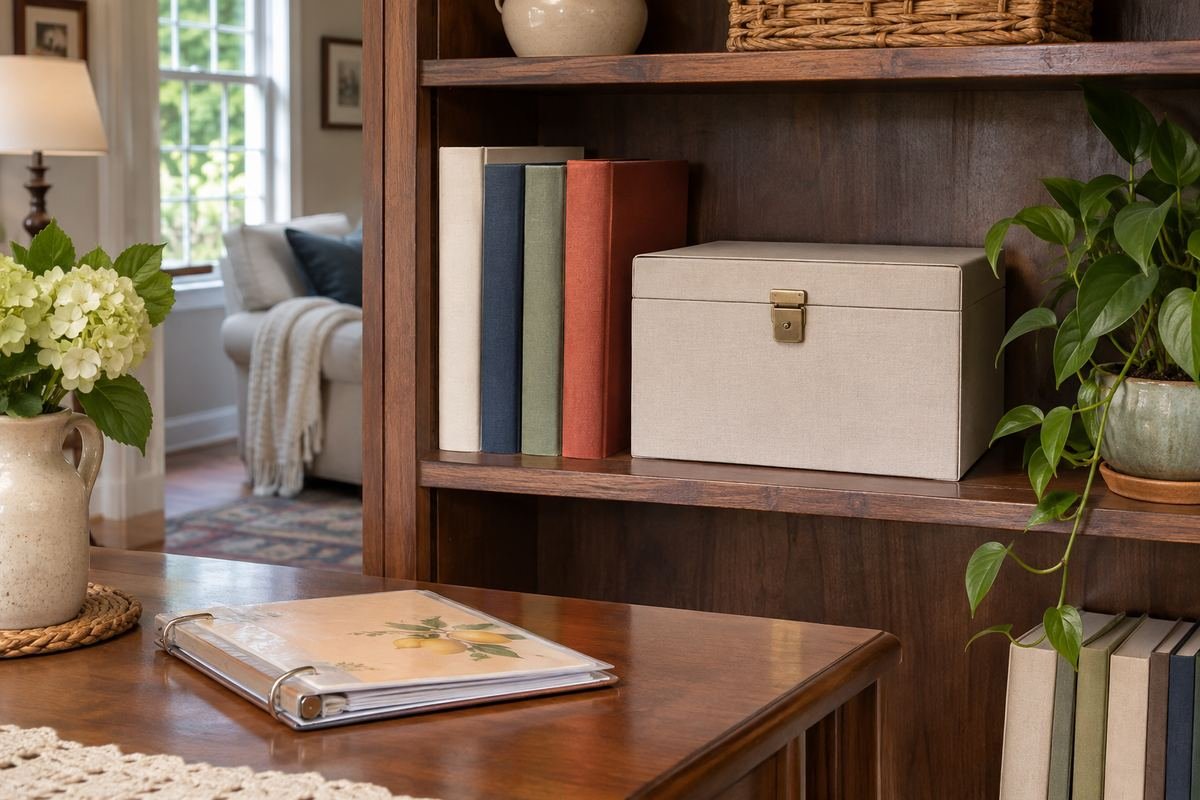
An older family cookbook may deserve a different home from the books used beside dinner preparation. A suitable supportive enclosure can keep loose pieces together, while a copy of the recipe handles the everyday cooking job. This lets the original remain part of the collection without constant handling.
For a valuable or damaged volume, follow preservation guidance or consult an appropriate conservator instead of attempting improvised repairs. Label the outside in a way that identifies the contents without attaching an adhesive label to the original book. Keep the enclosure in a stable, dry part of the home.
Practical tip: Use a separate working copy when a treasured original is too fragile for routine use.
22. Store recipe folders beside the books as a separate group

Loose recipes and booklets have different storage needs from bound hardcovers. A slim upright folder can keep those pieces visible without slipping them randomly between book pages. Give the folder its own position beside the collection so it can be returned as easily as a book.
Group the recipes by a system you actually use, such as regular meals and recipes to try. Avoid expanding the folder into a second archive that hides everything. Review clippings after cooking from them, then keep the ones you expect to use again in a readable order.
Practical tip: Separate untried recipes from the small group you return to often.
23. Use an occasional-reference cabinet for a larger library

Books used for reference can live farther from the working kitchen than the titles you consult every week. A separate cabinet gives them a predictable place while the smaller active group stays within easy reach. This is a collection decision rather than a reason to buy more organizers.
Choose a location that remains comfortable to browse, with enough space to open the door and bring a title out. Keep an occasional book’s return position obvious. If several reference books repeatedly remain in the kitchen after use, reconsider which group they belong to instead of letting an unplanned stack develop.
Practical tip: Move a repeatedly used reference title into the working group.
24. Reserve a clear return space for the book in use

A small empty section makes it obvious where the current cookbook belongs. It can sit at the end of the shelf or on a defined dry landing surface during cleanup. That simple return space can be more useful than another decorative object beside the collection.
Leave it empty on purpose rather than filling every gap after the first photograph. When a meal is finished, the book should move from stand to shelf without requiring other objects to shift. A shared return rule helps when more than one person chooses recipes from the collection.
Practical tip: Clear the reading stand as part of the kitchen reset.
25. Rotate the working collection after real meals
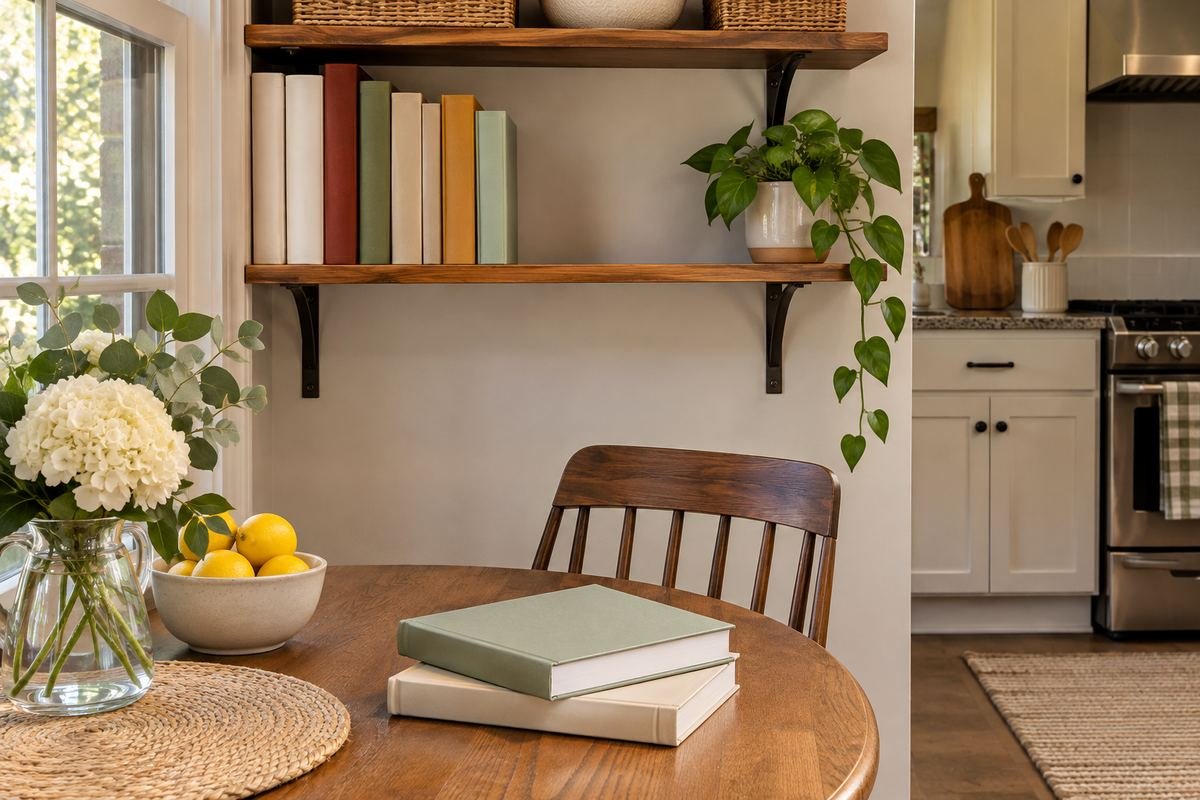
After a few weeks, notice which books were easy to find and which never left the shelf. Move one or two titles at a time rather than rebuilding the whole arrangement. A collection that reflects current cooking interests is more useful than a permanent display chosen only for its first photograph.
Keep a modest amount of room for a book you are borrowing or trying. If every new title forces two others onto the counter, use that moment to review the working group. The best cookbook storage supports an ordinary meal and an easy return, with the reference collection available when you need it.
Practical tip: Review one shelf after your next meal-planning session.
Frequently Asked Questions
Where should cookbooks go in a small kitchen?
Begin with a compact working group in a dry cabinet or a supported shelf bay. Store the larger reference collection in an adjoining room if that protects useful counter space. The best location is one where you can remove and return the books without moving cooking equipment.
Can I use a picture ledge for cookbooks?
Only when the particular ledge, wall fixings and installation are suitable for the actual loaded books. Many display ledges are shallow, so measure the full cover footprint and follow the manufacturer’s load and mounting instructions. Do not infer capacity from a photograph.
Should every cookbook be displayed?
No. You can display one current title and store the rest together. A small rotating selection often works better than a crowded counter. Keep the full collection easy to identify, including the books that do not match the room’s color palette.
Choose the Details That Work in Your Home
Choose the location that makes one ordinary meal easier: find the book, read it in a dry spot and put it away without rearranging the kitchen. Use the storage card to test one arrangement, then adjust the collection after a few weeks of actual cooking. A clear, supported home for the books matters more than a perfect display.
For related ideas, explore kitchen shelf ideas, kitchen hutch ideas, dining room storage ideas.
Planning References
Library of Congress: storing books; IKEA: BERGSHULT shelf dimensions and mounting-dependent load information. Follow the instructions for the exact products you choose.
Optional digital guide for this topic
If you prefer a structured workbook, explore this related paid guide.