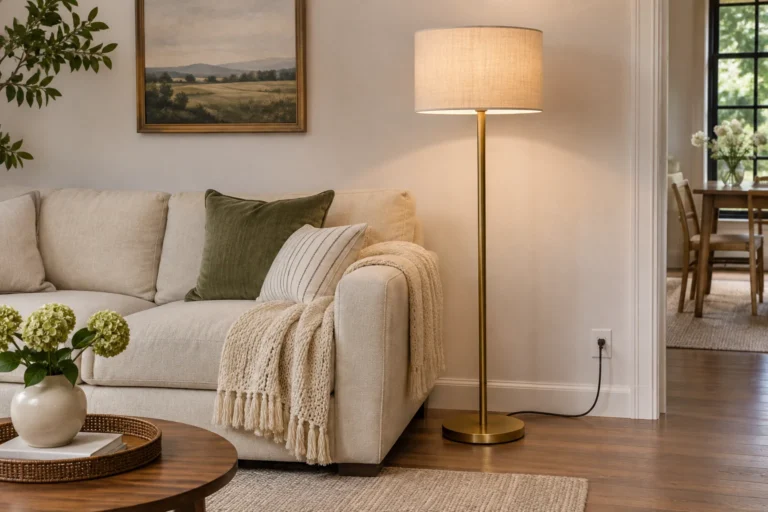
A living room ceiling fan occupies the same view as the furniture, windows and overhead lighting. A well-chosen finish can connect those elements, but appearance is only one part of the decision. The fan also needs suitable support, clearances and controls for the actual room.
These ideas help you compare design directions before selecting a product. They are not installation plans or claims about the performance of an illustrated fan. Start with a measured room and a suitable model, then choose the combination of shape, finish and lighting that belongs with your furniture.
Contents
- 1. Let a white fan recede into a pale ceiling
- 2. Repeat light wood from the main furniture
- 3. Use a black fan as a deliberate graphic accent
- 4. Warm a neutral room with darker wood tones
- 5. Pair a warm metal housing with restrained blades
- 6. Consider brushed metal in a cooler palette
- 7. Compare a simple three-blade silhouette
- 8. Use a traditional five-blade form with familiar furniture
- 9. Choose a compact visual form for a modest room
- 10. Let a larger room carry a broader span
- 11. Use a suitable low-profile model for a lower ceiling
- 12. Use a compatible downrod in a tall room
- 13. Keep a fan on a vaulted ceiling visually simple
- 14. Coordinate with beams without crowding the blade path
- 15. Consider an integrated light as part of the whole shape
- 16. Choose a fan without a light when lamps do the work
- 17. Review the television view before fixing the layout
- 18. Give an open living area its own considered fan position
- 19. Repeat a restrained fan style in a very large space
- 20. Keep coastal styling focused on materials rather than props
- 21. Settle the controls as part of the room plan
- 22. Choose a form you can maintain appropriately
- 23. Let ordinary daily use be the final test
Resolve the placement before choosing the finish
Record the ceiling height, room dimensions, beams, nearby walls and other fixtures. Review the exact fan manual with a qualified installer, including the support and electrical requirements. General guidance differs: ENERGY STAR's basics page describes an 18-inch wall separation, while Hunter's installation guide calls for 30 inches from blade tips to obstructions. Do not treat either as a substitute for your model's requirements and applicable local rules. The illustrations below cannot establish measured clearance.
Choose an arrangement that fits your situation
- Visually busy room: Compare a pale, restrained silhouette against the complete ceiling view.
- Low or sloped ceiling: Confirm an approved mounting arrangement and the complete installed drop before considering finishes.
- Main ceiling light is being replaced: Review the fan light and the remaining task lighting together after dark.
- Quiet conversation or television area: Compare documented specifications and a real demonstration where available; appearance cannot prove quiet operation.
1. Let a white fan recede into a pale ceiling

A white housing and blades can keep the overhead view quiet in a room with pale walls and linen furniture. Compare the finish in person because glossy white and a warm flat ceiling can still read as separate colors. Keep the form restrained if the room already has detailed curtains or a patterned rug. This approach makes the fan visually quieter without disguising its real dimensions.
2. Repeat light wood from the main furniture

Light wood-look blades can relate to an oak coffee table or a simple sideboard. Look for compatible undertones rather than an exact printed grain match. The fan can provide one overhead repeat while the larger surfaces stay calm. Check the actual blade material and care instructions separately; a wood appearance does not establish solid timber construction or suitability for a humid room.
3. Use a black fan as a deliberate graphic accent

A black fan can connect to dark window frames or slim furniture legs in a light room. Keep those repeats selective so the ceiling does not become part of an overly outlined interior. Compare the entire fan silhouette from the sofa, including the housing and any light. A narrow-looking blade finish may still create a substantial visual presence once the full span is overhead.
4. Warm a neutral room with darker wood tones

Walnut-toned blades can give a pale room a richer connection to an existing cabinet or chair frame. Keep the surrounding ceiling plain so the blade shape is easy to read. Compare several real samples if the furniture has strong red or yellow undertones. A related depth of color can feel coherent even when the woods are different, especially when the fan is not the only dark element.
5. Pair a warm metal housing with restrained blades

A small brass-toned housing can repeat a lamp base or cabinet handle without making the whole fan decorative. Keep the blades simpler if the room already contains reflective finishes. View the metal under evening light as well as daylight because its apparent warmth can change. Select the finish for the complete composition, then confirm that the product's controls and light options meet everyday needs.
6. Consider brushed metal in a cooler palette

A brushed silver-toned housing can suit a room with cool gray textiles or existing stainless details. A restrained surface may feel easier to coordinate than a highly mirrored finish. Compare the fan with the largest fixed finishes, including windows and built-in cabinetry. Do not assume that every visible metal needs to match; a controlled repeat can be enough to make the fan feel considered.
7. Compare a simple three-blade silhouette

A three-blade form can look visually direct in a room with clean-lined furniture. Compare the blade shape and overall span rather than assuming that fewer blades mean a smaller or quieter fan. Airflow and sound depend on the actual design and operating conditions. Ask for the product's documented specifications and, where possible, hear it running before deciding it suits a television or conversation area.
8. Use a traditional five-blade form with familiar furniture

A more traditional fan shape can relate comfortably to framed art, turned furniture legs or a classic sofa. Keep the finish controlled so the room does not need additional period accessories to explain it. Compare the complete light kit as well as the blades. A fan that looks simple without its light can become a very different focal point once several glass shades are attached.
9. Choose a compact visual form for a modest room

A smaller living room often benefits from a restrained housing and simple blades. Begin with the model's suitability for the measured room rather than choosing the smallest fan solely for appearance. Compare the proposed span on a ceiling plan and check it from the entrance. If the available position cannot meet the required clearances, another cooling arrangement may be more appropriate than forcing a ceiling fan into place.
10. Let a larger room carry a broader span

A broad fan may look more proportionate in a generous seating area than a very small fixture surrounded by empty ceiling. Use the actual product dimensions and performance information to compare candidates. Do not enlarge the fan merely to fill a photograph. The best choice relates to the occupied area, room layout and clearances while leaving the rest of the ceiling composition understandable.
11. Use a suitable low-profile model for a lower ceiling

A low-profile fan can reduce the amount of housing projecting into the room, where a suitable model and ceiling height allow it. Compare the entire installed drop, including any light, rather than the motor body alone. Have the installer verify the blade-to-floor requirement from the actual manual. A close-to-ceiling appearance is not proof that a fan will work safely in every low room.
12. Use a compatible downrod in a tall room

A tall room may need a different mounting arrangement from a standard-height living room. Compare the fan's approved downrod options with the installer before settling on the visual length. Keep the rod and housing finishes coordinated so the assembly reads as one object. The decorative goal is a composed relationship with the room; the mounting choice still follows the product and installation requirements.
13. Keep a fan on a vaulted ceiling visually simple

A vaulted ceiling already has a strong shape, so a restrained fan can avoid adding another complicated outline. Check that the exact fan and mounting components are approved for the ceiling's slope. Compare the fan's relationship with the ridge and the seating below without assuming the ridge is automatically the correct fixing point. The installer needs to resolve the actual structure and the full blade path.
14. Coordinate with beams without crowding the blade path

Existing beams can help establish a finish direction for the fan, especially when both use related timber tones. Draw the beam positions and the complete fan span together before selecting a model. Keep the moving blade area clear according to the actual requirements. A balanced-looking photograph cannot tell you whether the nearest beam or decorative trim is far enough from the fan.
15. Consider an integrated light as part of the whole shape

A fan with a compact integrated light can keep the ceiling arrangement relatively simple. Compare the light's output, controls and service information as carefully as the finish. It may provide useful general light while reading seats still need their own lamps. Check the real product with the light switched on; the appearance and comfort of an illuminated diffuser can differ from an unlit catalog photograph.
16. Choose a fan without a light when lamps do the work

If the living room already has a considered lighting plan, a fan without a light can keep its silhouette simpler. Review that decision after dark with the lamps normally used for conversation, reading and television. Removing a central light should not leave everyday tasks awkward. Choose the actual fan and electrical arrangement with the installer rather than assuming any model can have its light removed.
17. Review the television view before fixing the layout

Look at the proposed fan from the main television seat as well as from the doorway. Check whether the housing feels distracting above the screen or competes with the room's other focal points. Ask the installer to coordinate the fan with existing lights and obstructions. A visually tidy ceiling plan should also make sense when the room is being used, rather than only when every light and screen is off.
18. Give an open living area its own considered fan position

In a connected living and dining space, one fan does not need to sit at the visual center of the entire combined rectangle. Review the occupied seating area and the actual installation options together. Keep the relationship with dining lights clear so the ceiling does not look accidental. Performance and suitable positioning need product-specific review; a furniture arrangement alone cannot establish where a fan should be installed.
19. Repeat a restrained fan style in a very large space

A large or unusually shaped living area may need more than one fan, subject to a suitable design and installation plan. Matching the forms can provide visual continuity without adding extra ceiling details. Have the spacing and controls planned for the real room. Two attractive fixtures in a rendering do not prove that their coverage, airflow interaction or clearances will work in the completed space.
20. Keep coastal styling focused on materials rather than props

Pale blades and simple natural textures can relate a fan to a relaxed coastal room without adding themed objects overhead. Let linen, a woven rug or light furniture provide most of the character. If considering a woven-look fan detail, check the exact product's construction and cleaning instructions. A decorative surface should remain a product feature rather than an improvised covering attached to moving blades or the housing.
21. Settle the controls as part of the room plan

A well-chosen fan becomes frustrating if its controls are difficult to find or use. Compare the actual wall control, remote or app requirements before buying. Give a remote a predictable storage place near the main seat and confirm any holder is fitted appropriately. Do not assume compatibility with an existing dimmer or smart system; use the controls approved for the fan and have electrical changes handled properly.
22. Choose a form you can maintain appropriately

Compare how the blades, light diffuser and housing are accessed and cleaned according to the product instructions. A very intricate form may ask more of the household than a plain one. Plan suitable access with the installer, especially in a tall room. Avoid choosing a fan on the assumption that an improvised reach from furniture will be an acceptable way to maintain it.
23. Let ordinary daily use be the final test

Make the final comparison with the normal furniture, curtains and lighting included. Consider whether the fan supports conversation, television and the places people actually sit. ENERGY STAR advises switching a fan off when the room is unoccupied because its cooling effect is for people. Choose a useful operating routine along with the decorative finish, rather than leaving the fan running merely because it looks complete overhead.
A fan comparison record to take to the installer
For each candidate, record the full blade span, installed drop, mounting type, stated room suitability, approved controls and light specifications. Add the room's ceiling height, nearby walls, beams and fixtures to one drawing. Ask the installer to mark the required clearances and support arrangement for that exact model. Compare appearance from the entrance, sofa and television seat only after those requirements are resolved. Keep the model number and manual with the final decision so a similar-looking substitute is not treated as equivalent.
A practical next step
Choose living room ceiling fan ideas by putting a suitable product and installation plan first, then connecting the form to the furniture and lighting. A restrained finish, clear controls and an everyday operating routine can make the fan feel like a useful part of the room rather than a separate feature overhead.
For the surrounding room, plan the surrounding living room ceiling. Compare living room floor lamp ideas.
The images are original AI-generated design concepts, not photographs of tested products or verified installations.
Sources and care references
- ENERGY STAR: ceiling fan sizing and mounting considerations
- Hunter: model-specific manuals and installation considerations
- ENERGY STAR: installation and everyday fan use
Optional digital guide for this topic
If you prefer a structured workbook, explore this related paid guide.