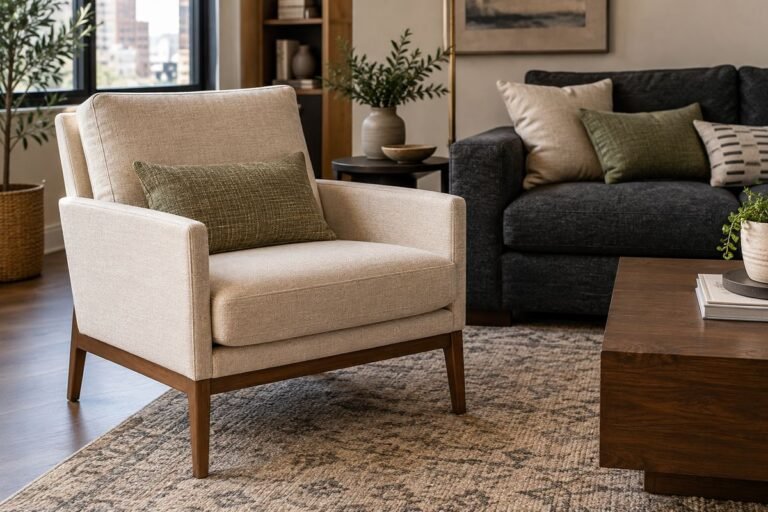
Living room toy storage ideas work best when they connect the place where play happens with a simple place to put things back. A beautiful cabinet can still fail if every game must be unpacked to reach the one at the bottom. Start with the toys currently used in this room and the people who return them.
A shared living room needs space for adults as well as play. Keep the sofa route, doors and ordinary seating usable, then assign a manageable storage home to each active group. The aim is a repeatable reset rather than a room that can only look finished while no one uses it.
These 26 original concepts focus on different toy types, retrieval tasks and cleanup routines. Adapt each arrangement to the children’s ages, the toy instructions and the furniture in your home. Images illustrate decor concepts; they do not demonstrate anchoring hardware or certify a child-safe installation.
The images are original AI-generated decor concepts, not installation diagrams or photographs of completed client projects.
Browse These 26 Living Room Toy Storage Ideas
Jump to an idea
- Start with one open bin beside the play area
- Give removable trays a place in a compatible frame
- Reserve a cabinet for a few contained toy groups
- Living room toy storage ideas for a few visible books
- Support an upright row of everyday books
- Living room toy storage ideas for complete puzzles
- Give large building blocks their own open container
- Separate small construction pieces from the general toy bin
- Keep board games in their actual box sizes
- Park toy vehicles in a shallow tray
- Let a track set travel as one group
- Keep soft toys contained in an open basket
- Separate dress-up textiles from hard toys
- Create an adult-managed drawing caddy
- Use one portable basket for the daily return journey
- Living room toy storage ideas for a shared household
- Keep a small toy rotation group outside the active display
- Reserve one shelf for oversized play pieces
- Separate a finished project from loose construction parts
- Use a deep drawer only for a group it can reveal
- Preserve a clear place for the play mat after use
- Use an existing cabinet compartment for one complete activity
- Make container shapes recognizable at a glance
- Living room toy storage ideas for changing interests
- Keep the storage route clear of the sofa conversation area
- Finish with a reset that can happen on an ordinary day
Plan living room toy storage around a real cleanup
Put the current living room toys into temporary groups: books, large pieces, sets with parts, soft toys and adult-managed activities. Note where each group is used and what makes it difficult to put away. Measure the usable cabinet opening, not just the furniture exterior, and test a proposed container with its actual contents. A bin that fits perfectly but becomes too awkward to carry needs a different arrangement.
| Play group | Storage direction | Return test |
|---|---|---|
| Picture books | A small face-forward selection or supported upright row | Can the chosen book be returned without pulling out the rest? |
| Large blocks | A suitable open bin or removable tray | Can the group be lifted and returned comfortably? |
| Puzzles | One complete set per appropriate container | Can the pieces and reference image stay together? |
| Board games | A shelf sized for the actual boxes | Can one game be removed without a leaning pile? |
| Soft toys | A contained open basket | Can the toys stay below the opening? |
| Adult-managed art materials | A separately managed caddy | Can the whole activity be put away together? |
| Oversized play pieces | A dedicated floor-level parking place | Does the room’s walking route stay clear? |
Check furniture and container safety before styling
CPSC’s Anchor It campaign recommends securing furniture and TVs according to manufacturer instructions and removing tempting objects from high surfaces. Follow the exact furniture instructions, including anchoring requirements, even when the unit looks low or sturdy. CPSC also warns about entrapment and falling-lid hazards in storage chests. Favor appropriate open bins for these concepts; do not assume an old trunk or decorative storage ottoman is suitable toy storage. Check product recalls and age guidance before use.
Treat dimensions as product-specific information
For example, IKEA lists the white TROFAST frame 100.914.53 at 39 inches wide, 17 3/8 inches deep and 37 inches high, with compatible series components and an anchoring warning. Those are details for that frame, not universal dimensions for every toy-storage unit. Compare the complete assembled product, usable openings, wall condition and its installation instructions before choosing a similar system.
Test living room toy storage ideas with one container
Try one representative container with the toys that will live in it. Run a normal play session and return the contents afterward. Observe whether the obstacle is a heavy load, a confusing category, an awkward lid or a location too far from play. Solve that specific issue before buying several identical containers. A useful trial gives better information than filling every shelf on the first day.
1. Start with one open bin beside the play area
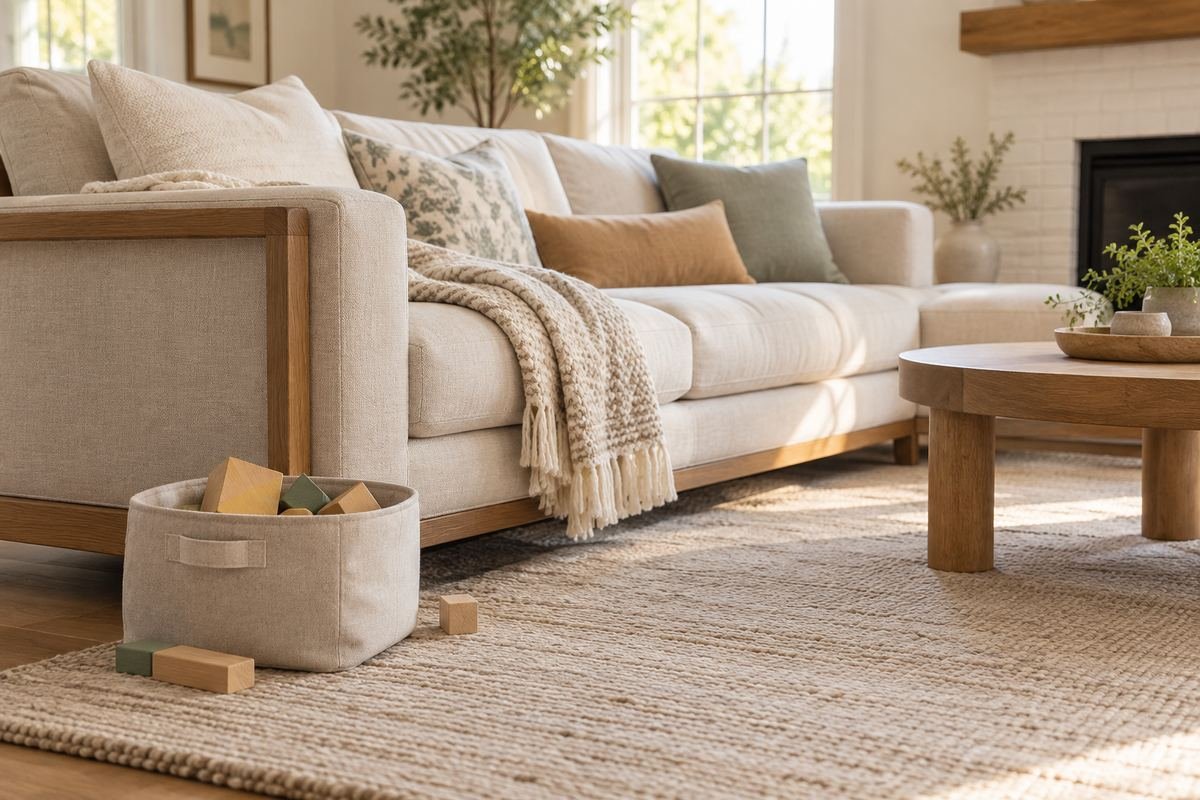
A single open bin can give the toys currently used on the living room floor an obvious return point. Choose a suitable container without an awkward falling lid, and keep its contents to one recognizable group. The purpose is to make the last step of play easier rather than to hide an unlimited mixed collection.
Try the bin in the actual position for a few days. If it blocks the route around the sofa or becomes a place for unrelated household items, change the location or narrow the category. Keep toys contained below the opening so retrieval does not begin with moving a pile.
Practical tip: Test the bin after a normal play session, not only when it is newly arranged.
2. Give removable trays a place in a compatible frame
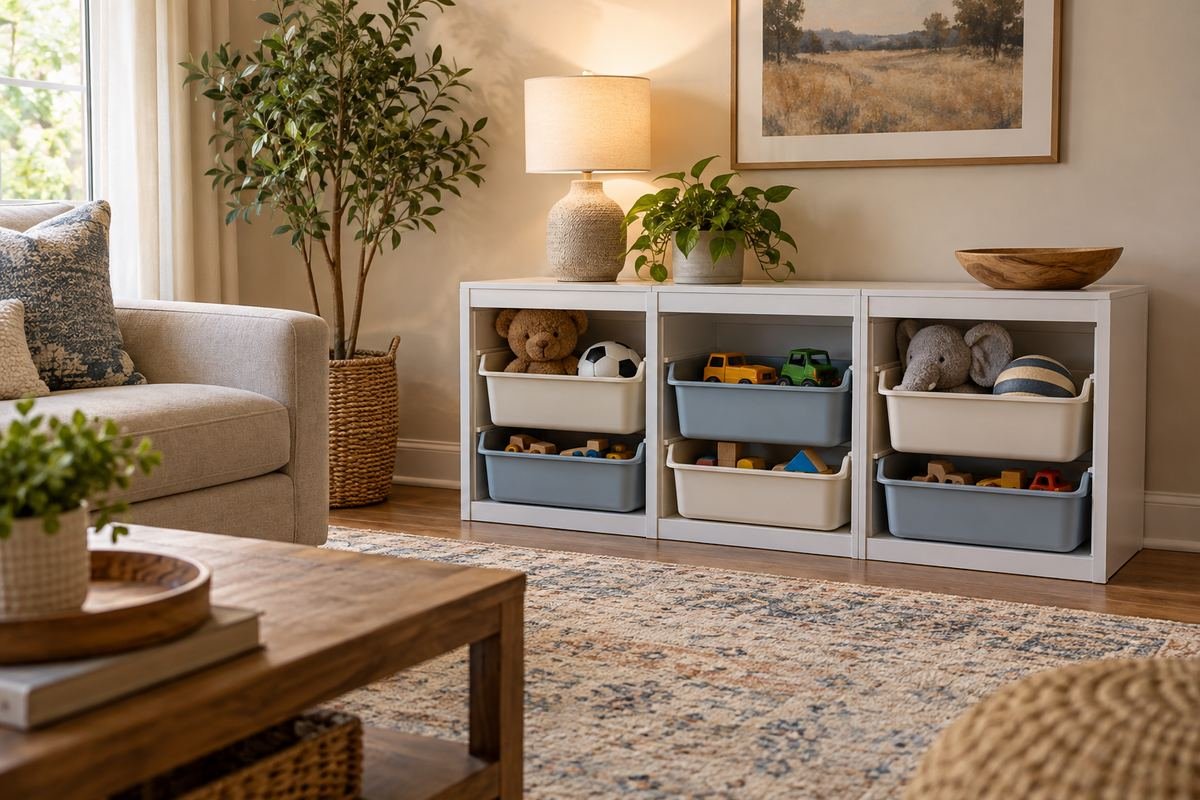
A frame with suitable removable containers can let one play group travel to the rug and return as a complete unit. Check that the trays belong to the exact system and follow its assembly and anchoring instructions. Similar-looking bins are not necessarily interchangeable.
Choose the container depth from the objects rather than filling every slot with the deepest option. A shallow tray may make a small active set easier to see, while a larger toy needs a different compartment. Keep the arrangement manageable for the person who carries it.
Practical tip: Check the complete container-and-frame combination before buying extra trays.
3. Reserve a cabinet for a few contained toy groups
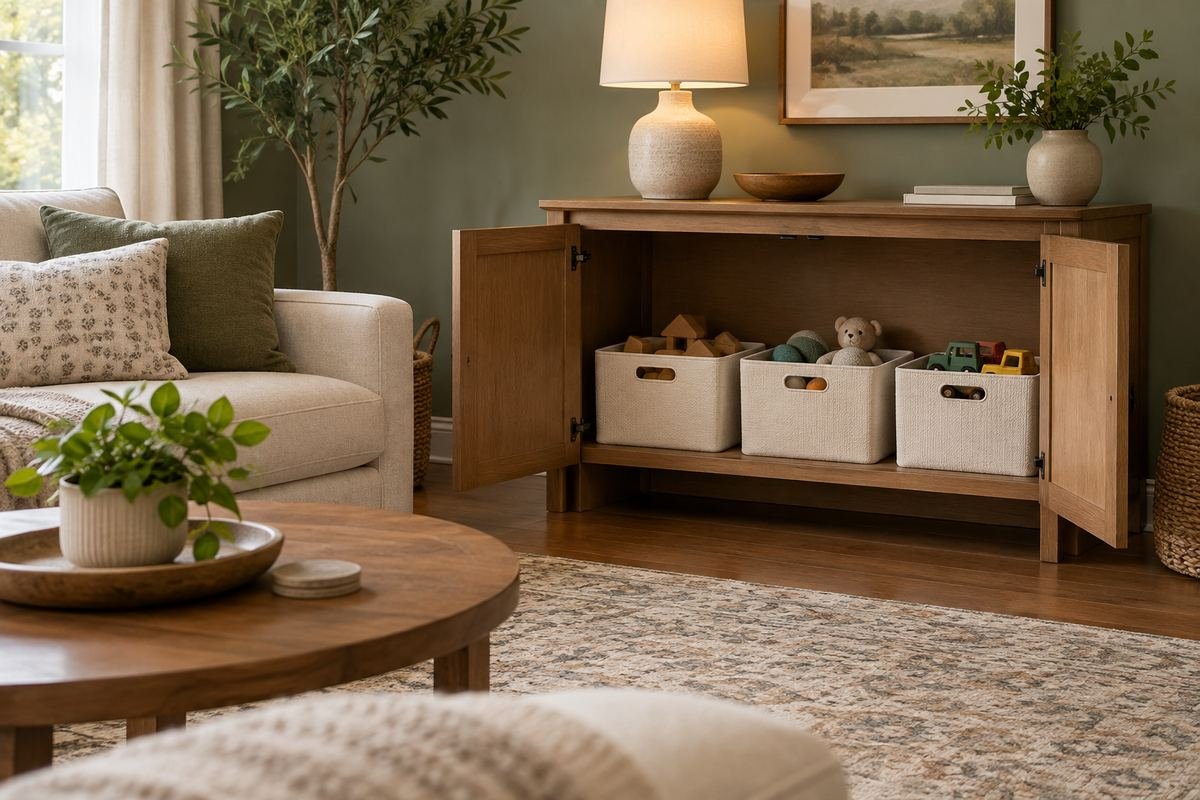
A closed cabinet can help the living room return to a quieter appearance after play. The useful detail is a clear internal system: a few removable groups with room to pull them out. Compare the cabinet’s usable opening with the container, handles and contents together.
Test the doors while the room is furnished and someone is seated nearby. A cabinet that opens only after moving the coffee table will create friction every day. Follow the product instructions for installation and use rather than assuming an existing decorative cabinet is suitable for every household.
Practical tip: Open the cabinet fully during the layout test.
4. Living room toy storage ideas for a few visible books
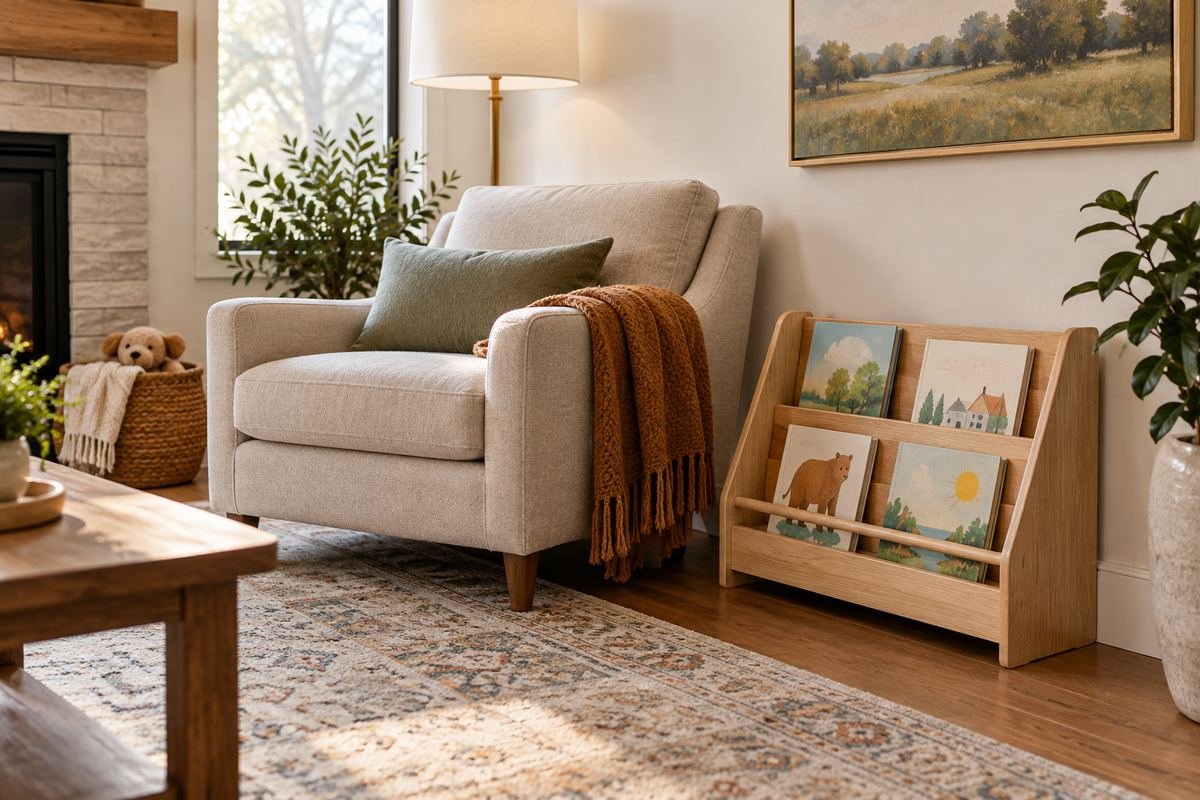
A limited face-forward book display can make the current reading choices visible without occupying an entire wall. Use an appropriate stable storage product and leave room to remove a book without catching neighboring covers. Keep the selection modest enough that returning one remains straightforward.
Place the display near a reading seat but outside the route around it. Rotate the titles if the shelf becomes crowded rather than adding a second leaning row. A few visible books can work alongside the household’s main book storage elsewhere.
Practical tip: Try removing and returning the largest book in the selection.
5. Support an upright row of everyday books
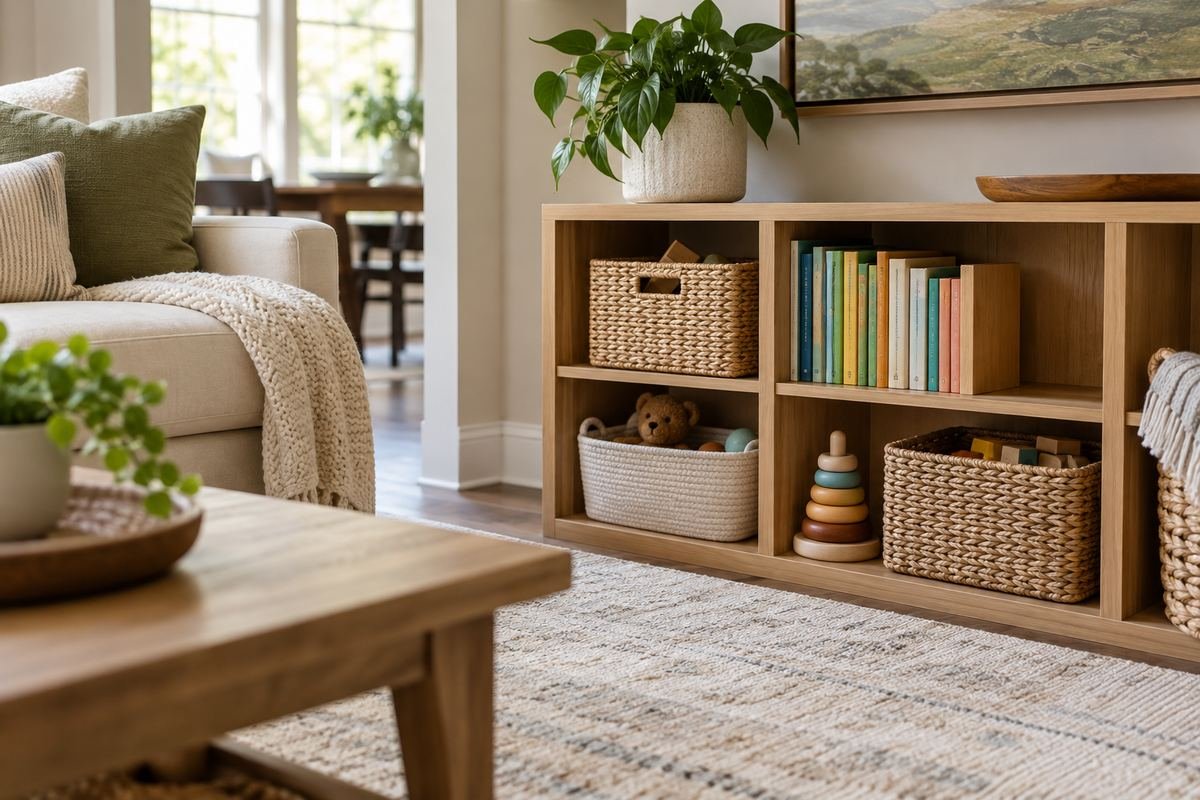
An upright row uses shelf width differently from a face-forward display and may suit a mixed collection of book sizes. Use suitable supports so the row does not fall over each time a book is removed. Compare the shelf depth with the largest cover rather than hiding deep books behind a second row.
Keep everyday books separate from a decorative display that must be restyled after each use. If the shelf is difficult for the intended user to reach, choose another location instead of relying on a stool beside the cabinet. Follow the furniture requirements for secure installation.
Practical tip: Leave enough space to return a book without forcing it into a tight row.
6. Living room toy storage ideas for complete puzzles
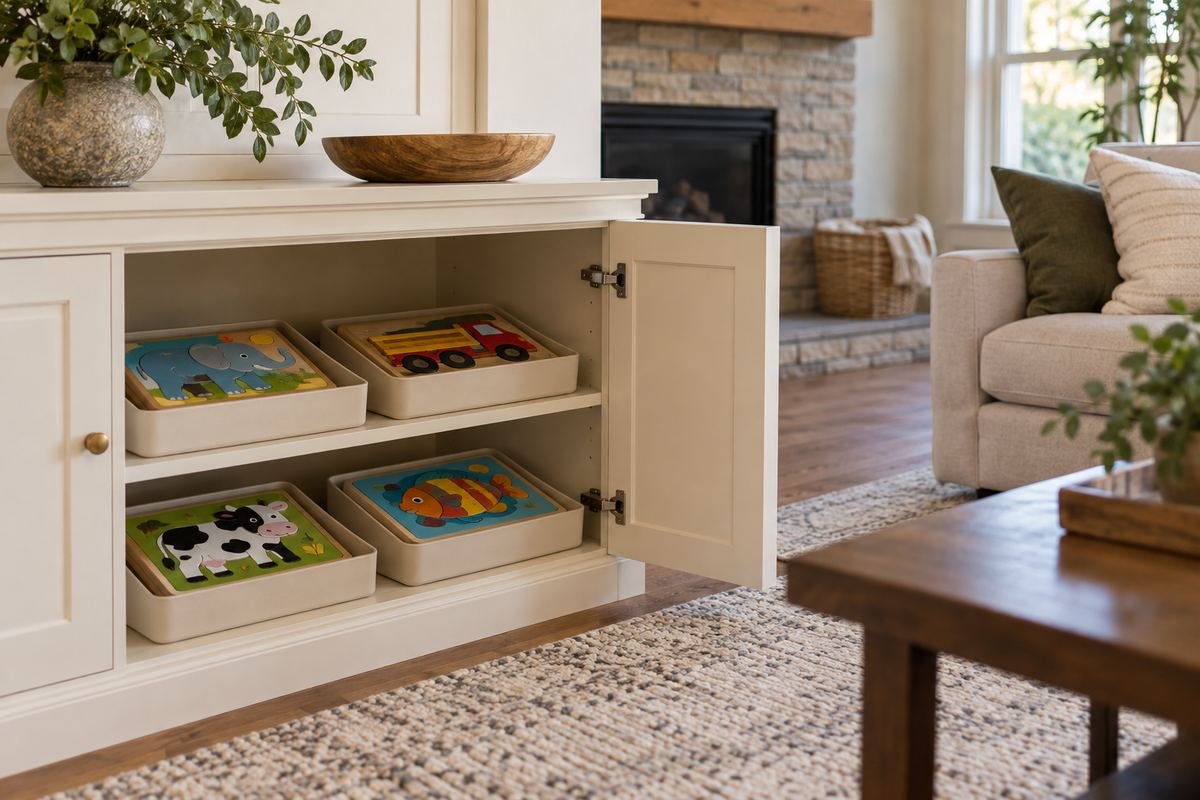
A puzzle is easier to use when its pieces and reference image remain together in a suitable container. Compare the container with the largest piece and the intended user’s ability to open and close it. Avoid a giant mixed tub that makes every new puzzle begin with a sorting task.
Keep the collection sized to its actual shelf or drawer. For younger children, use the toy’s age guidance and appropriate adult management rather than treating every small piece as universally suitable. Return stray pieces to the right set during the regular reset.
Practical tip: Check a puzzle for completeness before assigning its permanent storage home.
7. Give large building blocks their own open container

Large blocks can quickly dominate a mixed toy bin because they spread between smaller objects. A dedicated suitable container makes their volume easier to judge and their return task clearer. Use a shape that can be placed near play without narrowing the normal room route.
Do not choose a container only because its empty shape fits the shelf. Fill it with the real block group and test the loaded weight and retrieval movement. If it becomes awkward, divide the collection into two useful groups rather than making a deep heavy bin the default.
Practical tip: Test the container with the actual block load.
8. Separate small construction pieces from the general toy bin
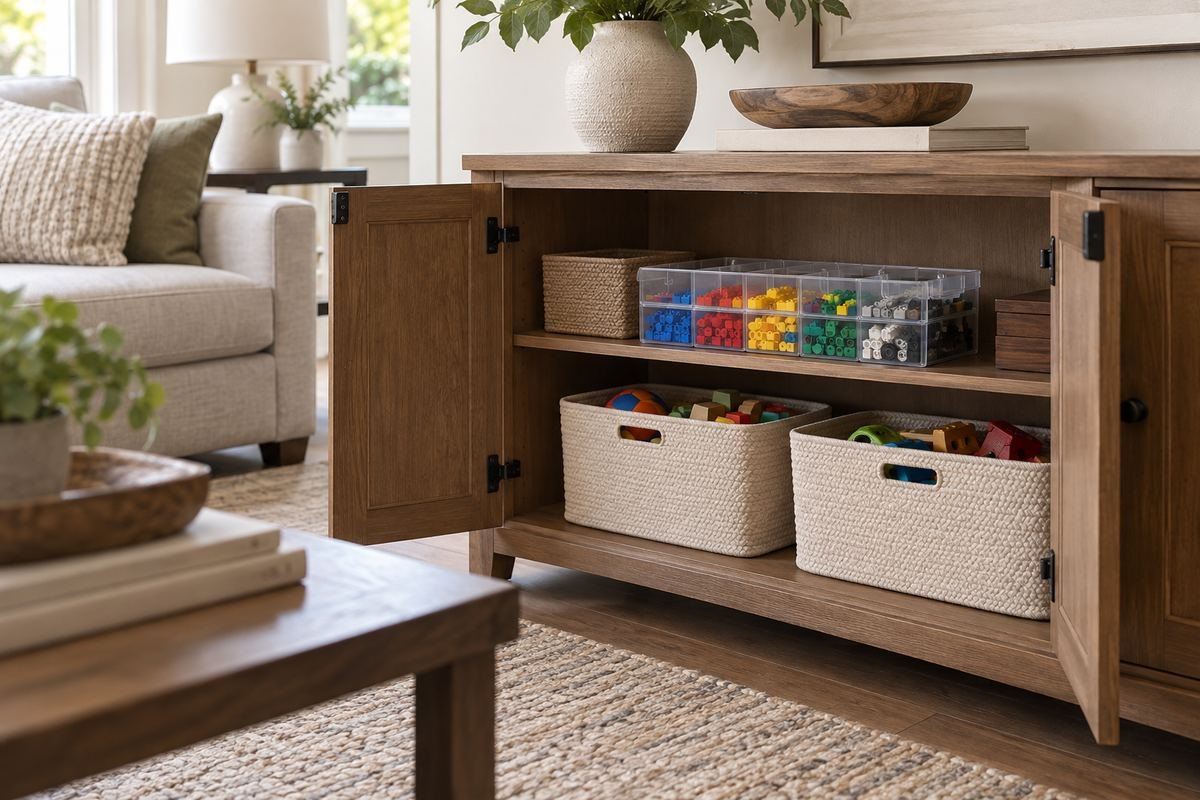
A suitable divided container can keep a small construction set together when the household includes users for whom those pieces are appropriate. Choose broad categories that can actually be maintained. Many tiny divisions can create more work than they save.
Manage age-inappropriate parts separately from younger children and follow the toy instructions. The storage illustration is not a childproofing design. Compare the container closure and storage location with the people in the home, then keep the routine consistent each time the activity ends.
Practical tip: Use only as many divisions as the user can return correctly.
9. Keep board games in their actual box sizes

A shelf of board games works best when each box can be removed without lifting a precarious pile. Measure the longest box, including the space needed for a hand to grip it. Group games by usable size or frequency rather than forcing every box into an identical decorative container.
Inspect whether parts remain contained when a box is stored upright. If that arrangement spills the contents, keep the box in a suitable flat position or use its intended internal organizer. Avoid storing large heavy games where retrieving them becomes an overhead task.
Practical tip: Test one complete game removal before filling the shelf.
10. Park toy vehicles in a shallow tray
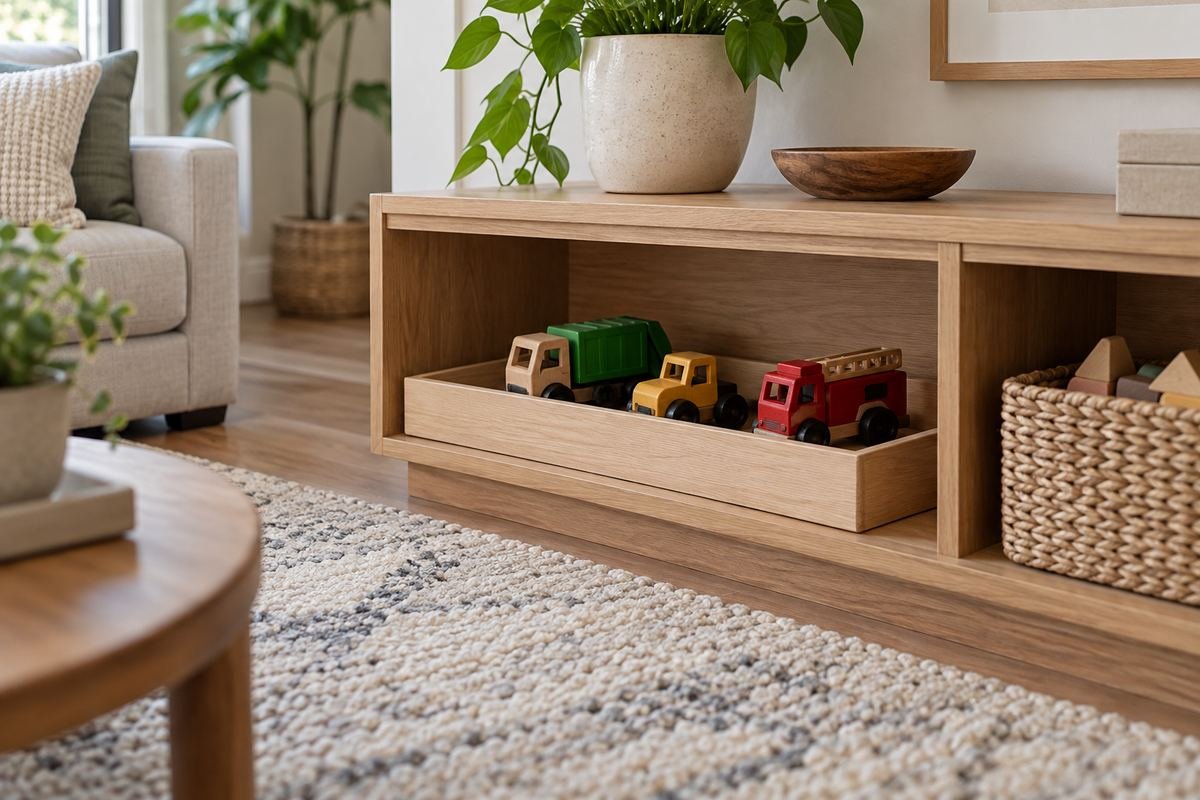
A shallow tray can make a small vehicle collection visible and easier to return without turning the living room into a display shop. Choose enough surface area for the active selection and keep the contents appropriate to the children who use them. The tray should travel easily between storage and play.
Avoid making a single perfect row the only acceptable reset. A broad contained group may be more realistic for daily use. If vehicles spill into several nearby shelves, reduce the active selection or choose a different storage size rather than adding decoration around the overflow.
Practical tip: Aim for a contained return, not a fragile display arrangement.
11. Let a track set travel as one group
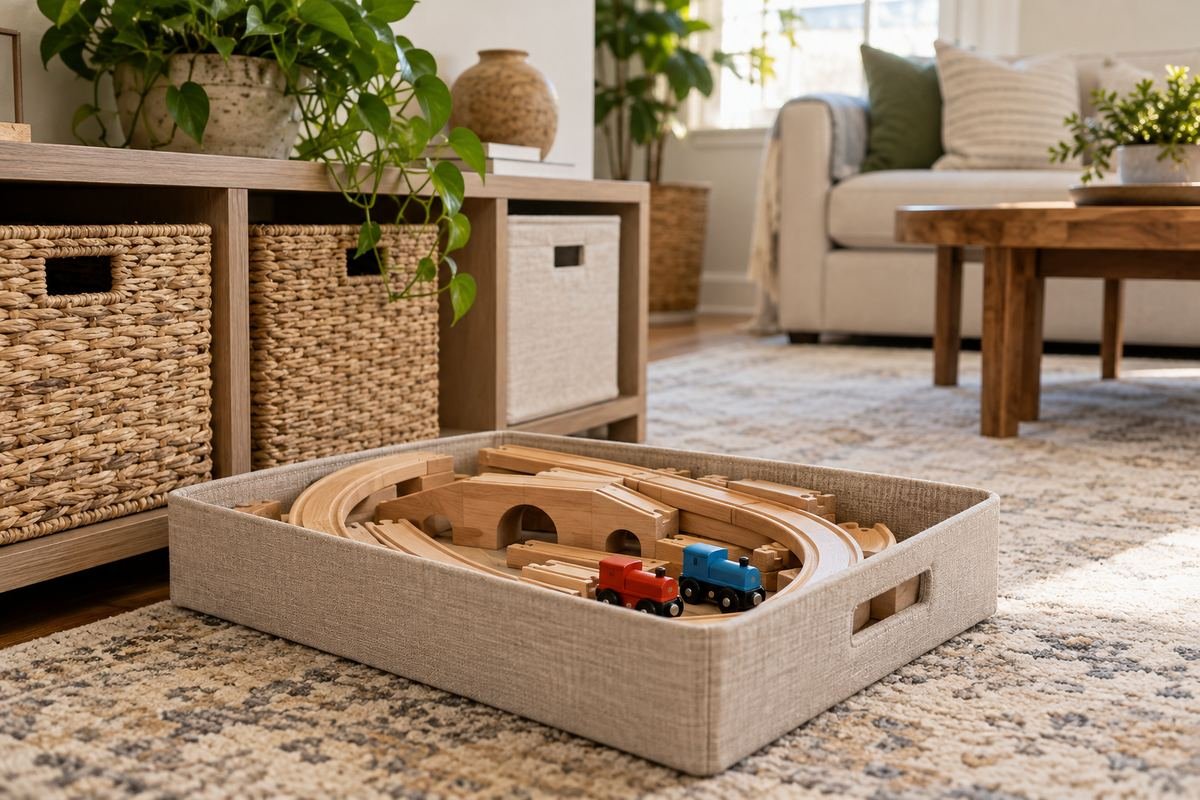
A train or road-track set is easier to begin when the main components share one suitable storage home. Use a removable container sized for the longest pieces and the actual loaded weight. Keep unrelated toys elsewhere so setup does not require emptying the whole living room collection.
A small internal division can separate vehicles from track pieces if it helps the user, but it should not make return complicated. Check that every component stays inside the container when it is carried normally. Place it where the transfer to the play area is straightforward.
Practical tip: Choose the container from the longest component first.
12. Keep soft toys contained in an open basket
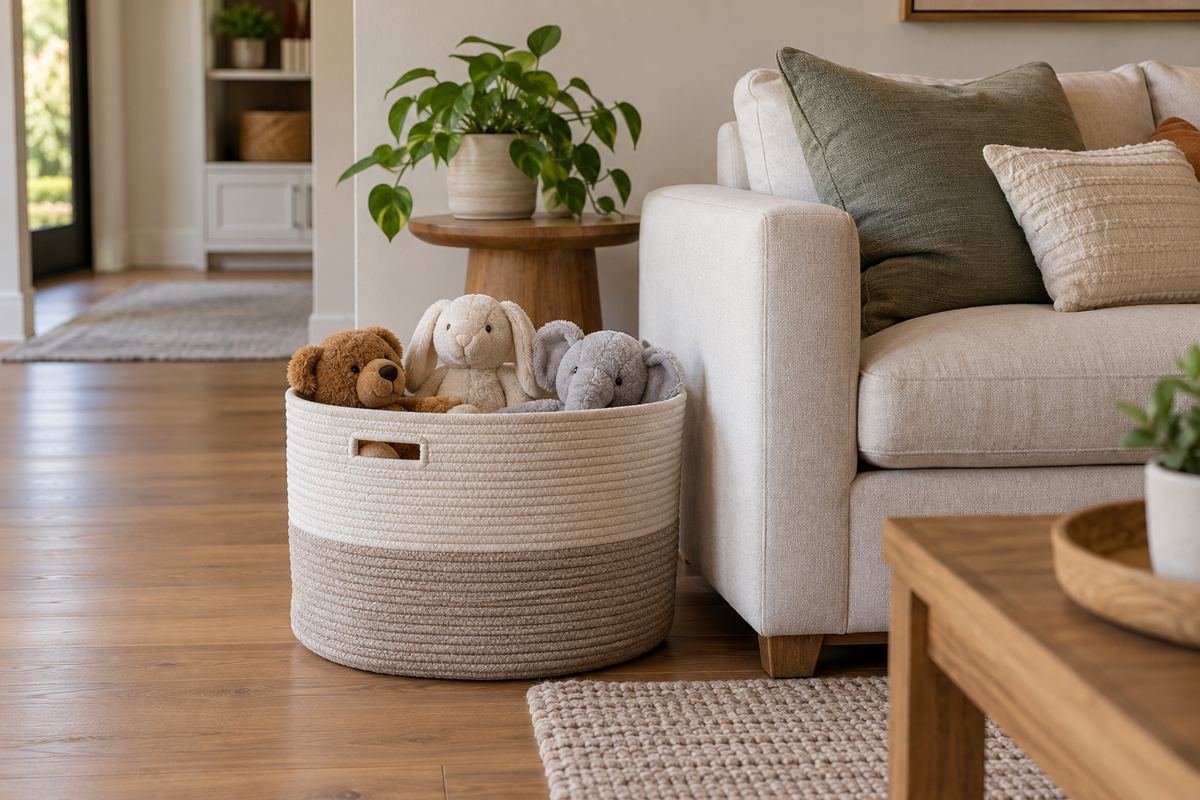
A suitable open basket can keep the active soft-toy group together without a hinged-lid storage chest. Choose a shape that does not become a large unstable mound as the collection grows. Keep the toys settled in the basket rather than balanced in an unstable mound.
Keep the basket in a dry appropriate location away from heat sources and the ordinary walking route. Inspect it as part of the normal cleanup for damage or unsuitable loose details. If the group no longer fits, review the selection instead of compressing the contents into an inconvenient load.
Practical tip: Let the basket’s usable volume set the active selection.
13. Separate dress-up textiles from hard toys

A dedicated suitable bin can stop small dress-up textiles from tangling through blocks and game pieces. Keep a manageable current selection and return the pieces dry and clean according to their care guidance. The storage home should make it easy to see what is available without unpacking unrelated toys.
Avoid hooks or furniture arrangements that invite climbing to reach appealing items. Choose a suitable accessible location and manage accessories according to their age guidance. If the textiles need frequent sorting, simplify the group before adding more internal divisions.
Practical tip: Keep this category focused on the textiles actually used in the living room.
14. Create an adult-managed drawing caddy
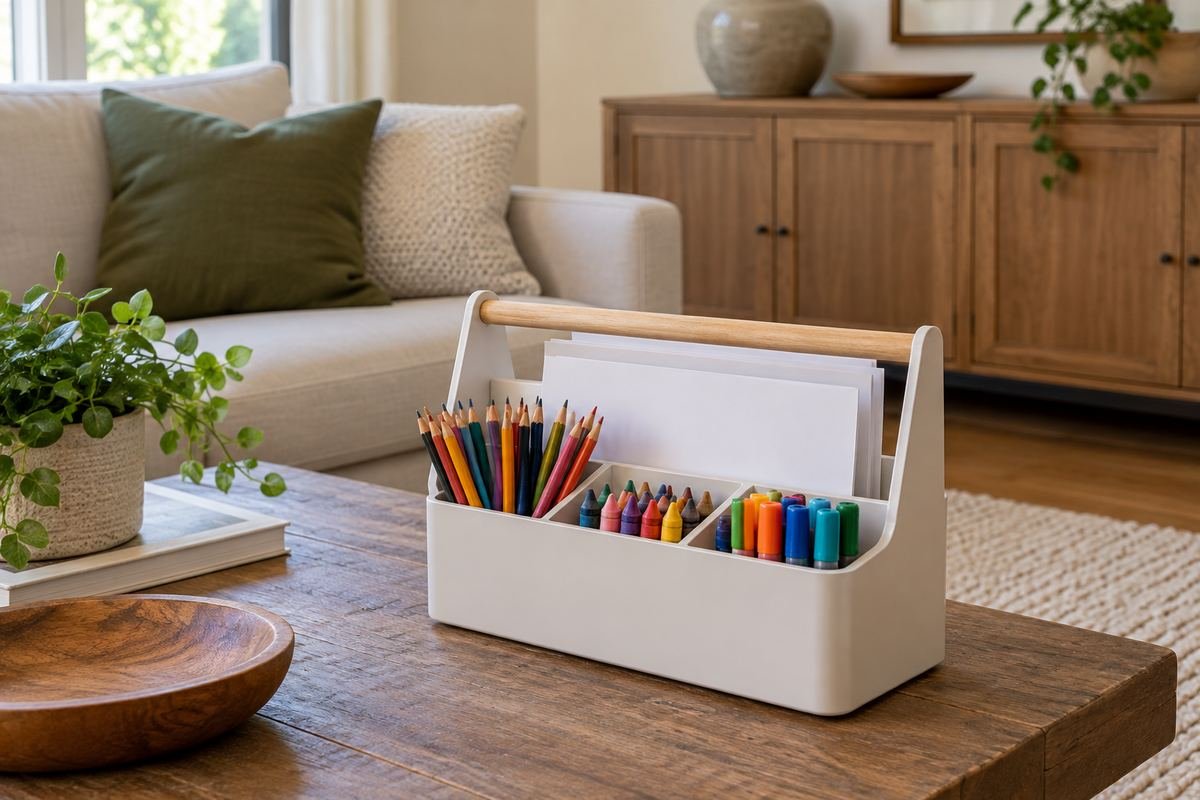
A contained drawing kit can make a shared living room table available for a short supervised activity and then return it to its ordinary use. Choose materials appropriate to the users and a suitable caddy that can hold the complete current activity. Keep the kit separate from unrelated household supplies.
Consider the cleanup sequence as well as the attractive arrangement of pencils. Include a place for unfinished paper and follow material care and age guidance. Store the caddy in its appropriate managed location afterward rather than leaving everything permanently across the coffee table.
Practical tip: Design the put-away sequence before adding more materials.
15. Use one portable basket for the daily return journey
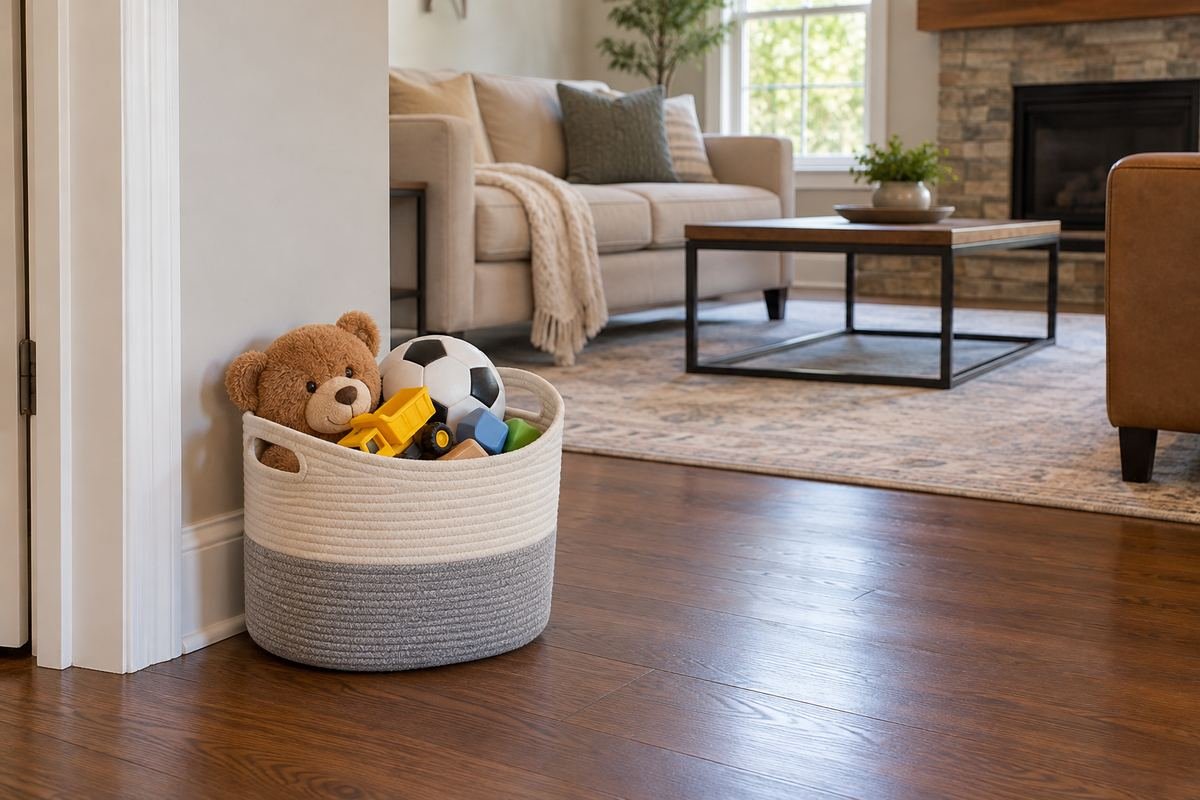
A small portable collection basket can gather toys that belong elsewhere when the living room is reset. It is a transport step rather than permanent mixed storage. Choose a comfortable manageable load and take the contents back to their actual homes soon afterward.
If the basket remains full for days, the problem is probably the return routine or the destination storage. Do not solve that by selecting a larger basket. Keep it distinct from the active play bins so everyone understands that the contents are waiting to leave the room.
Practical tip: Empty the return basket as part of the same reset.
16. Living room toy storage ideas for a shared household

A shared room can use separate broad return zones when several people play with different collections. The division might be a bin per user or one shelf per activity. Choose the structure that the household can recognize without an elaborate sorting explanation.
Keep the arrangement flexible when toys are shared. The goal is to reduce confusion, not create rigid ownership rules for every object. Use appropriate identifiers if helpful and keep the physical storage suitable for each user, including the loaded container and its location.
Practical tip: Test whether the zones make sense to the people who use them.
17. Keep a small toy rotation group outside the active display
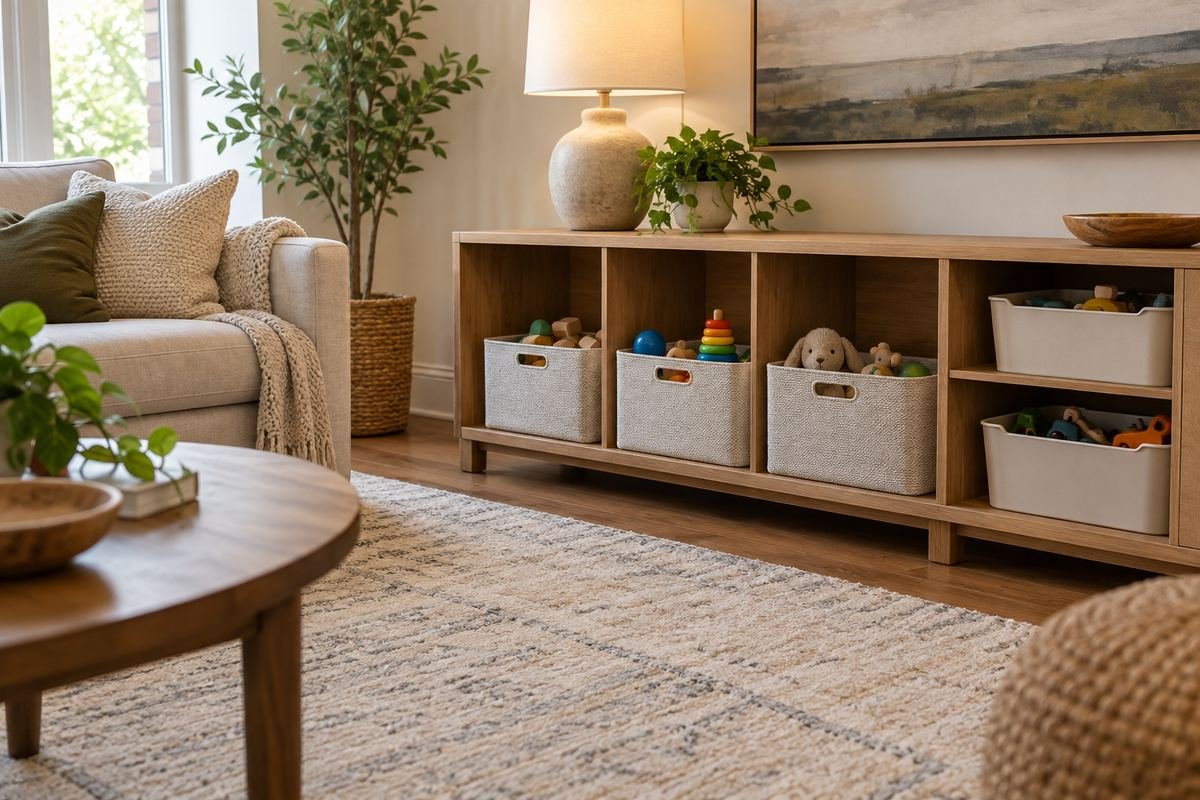
A separate reserve group can make the living room selection easier to manage when there is suitable storage elsewhere. Keep the current active toys visible and contained, then change the selection when it serves the household. There is no universal rotation schedule to follow.
Check the reserve storage conditions and toy guidance rather than putting everything into an unsuitable sealed chest. Review what is still useful when a group returns to the living room. Rotation should make everyday storage simpler, not create a second unmanaged pile behind a cabinet door.
Practical tip: Rotate a complete useful group rather than several stray pieces.
18. Reserve one shelf for oversized play pieces

Some toys do not belong in small baskets. A large play piece may need a dedicated suitable floor-level compartment that accommodates its full shape without forcing doors or bending parts. Measure the actual object and the movement needed to put it away.
Avoid parking it where it blocks a door or narrows the route around seating. If no suitable living room home exists, reconsider whether it belongs in this room. A dedicated location works better than repeatedly moving the object between three inconvenient corners.
Practical tip: Measure the complete shape in its normal stored position.
19. Separate a finished project from loose construction parts

A project that will be continued tomorrow needs a different home from loose pieces that can be mixed together. A suitable flat tray can hold the current work and return to an appropriate managed storage position. Choose the tray from the project’s actual footprint.
Agree on a practical limit so every unfinished object does not become a permanent display. Keep fragile or age-inappropriate parts managed appropriately. The value is preserving one active project while the rest of the living room can return to ordinary use.
Practical tip: Define where the tray goes when the room is reset.
20. Use a deep drawer only for a group it can reveal

A suitable drawer can contain toys discreetly, but deep storage is useful only when the contents remain easy to retrieve. Compare the usable height, opening and load guidance with the actual group. Keep the main categories visible from above instead of burying several unrelated layers.
Check the drawer’s movement and the furniture’s installation requirements. An attractive closed front does not tell you whether the internal space is appropriate. If smaller items disappear at the bottom, try a shallower removable group rather than filling the drawer to its maximum visible depth.
Practical tip: Test the fully loaded drawer through its intended movement.
21. Preserve a clear place for the play mat after use
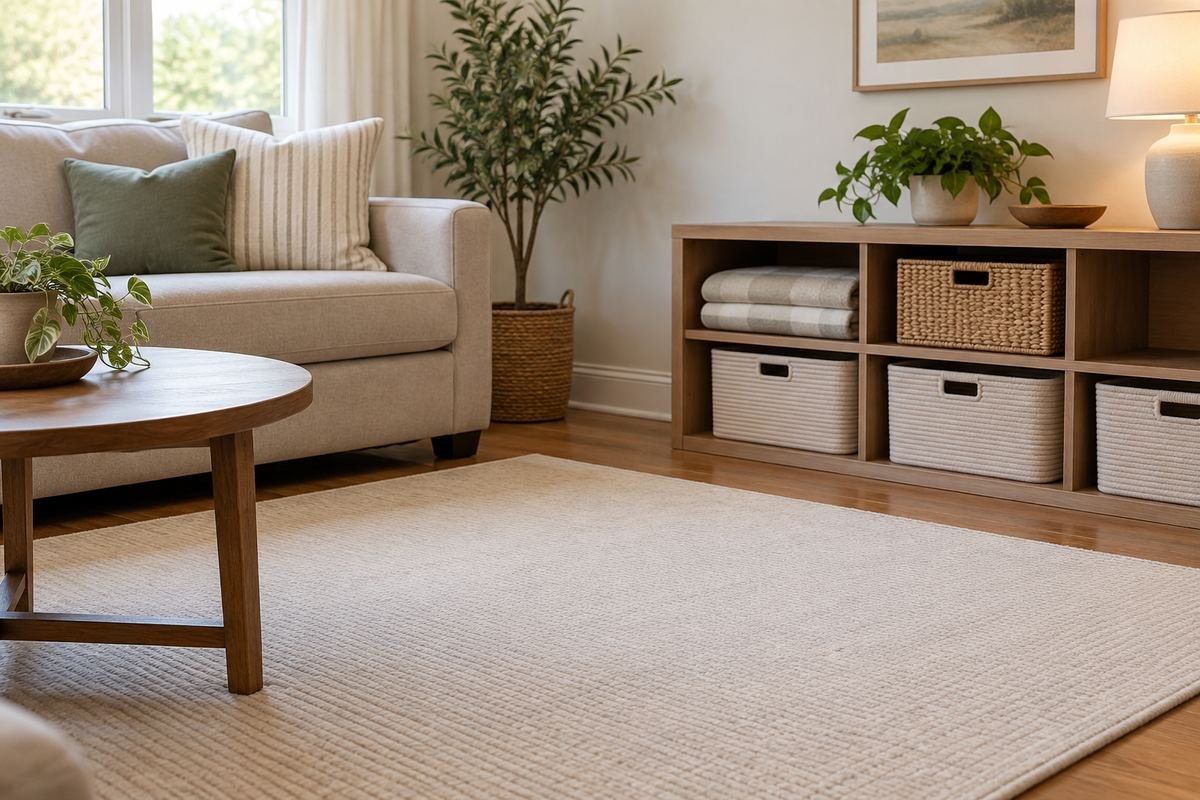
A removable play mat needs a storage plan of its own if it is normally put away. Follow its folding, rolling and care instructions, then choose a dry suitable place that accommodates the stored shape. Do not force a mat into a container that damages it or blocks a cabinet door.
Keep the mat separate from small loose pieces that could disappear during folding. A repeatable check of the play area before putting it away can make the next setup easier. Compare the stored mat location with the normal seating and walking routes.
Practical tip: Try the manufacturer’s storage method before buying a container.
22. Use an existing cabinet compartment for one complete activity
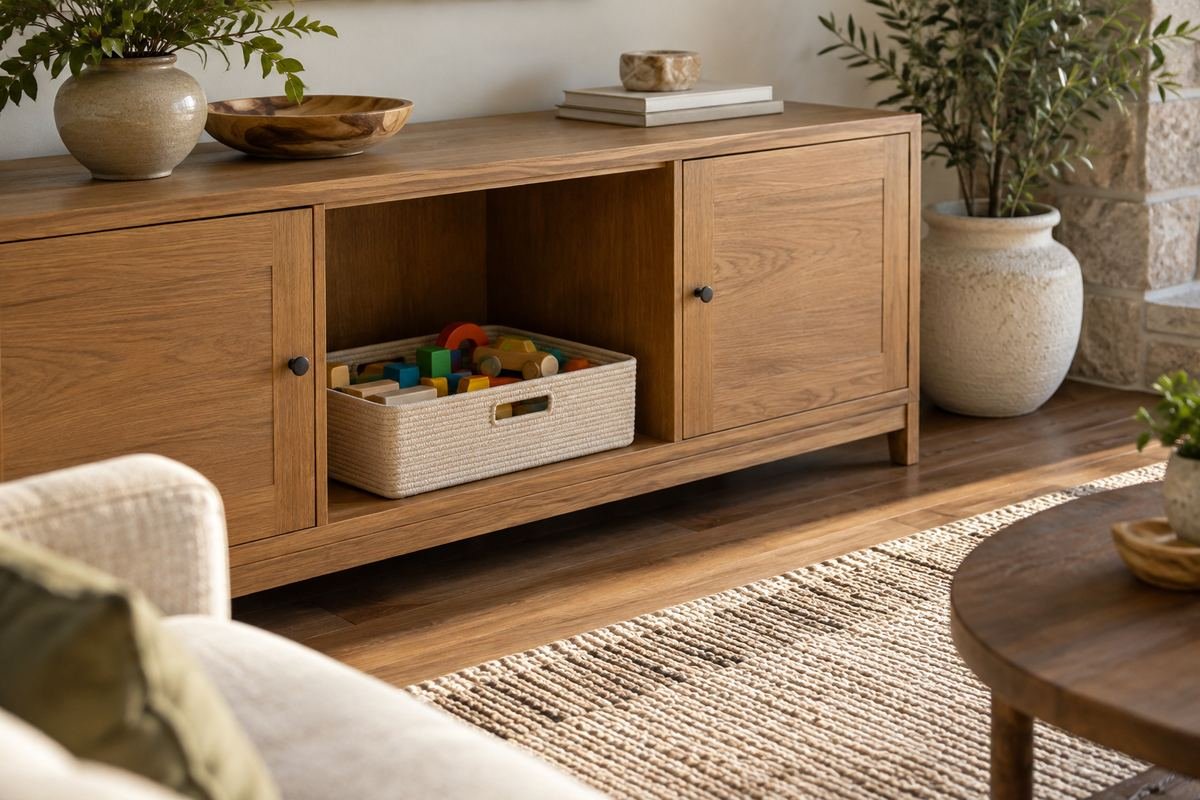
An unused compartment may provide a suitable home without adding another storage unit. Measure its opening and test one activity group before committing the space. Keep the arrangement independent from cables, devices, heat-producing equipment and other items that need their own access or ventilation.
Do not turn an active media-equipment bay into a toy bin just because it looks empty at the front. Follow the cabinet and equipment requirements. A separate unused compartment can work well when retrieving the toys does not disturb another household function.
Practical tip: Confirm the whole compartment is available for this use.
23. Make container shapes recognizable at a glance
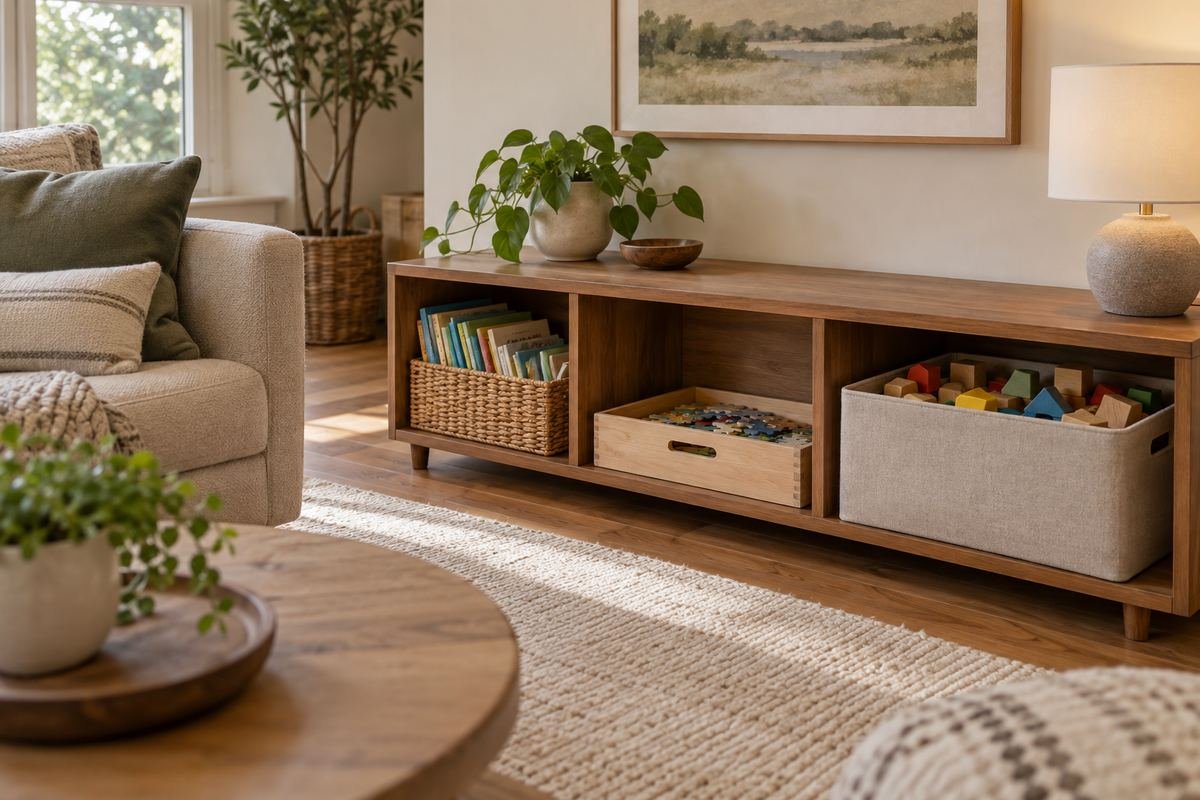
A small number of distinct container forms can help explain the storage system visually. For example, books might use a supported row, large blocks a broad bin and puzzles a flatter container. The difference should reflect a useful task rather than a collection of decorative shapes.
Keep the room coherent through a limited material or color palette if that suits the home. Do not choose a visually matching container that makes the contents harder to handle. Functionally different groups can still look settled when their placement is deliberate.
Practical tip: Let the container form reinforce the category.
24. Living room toy storage ideas for changing interests
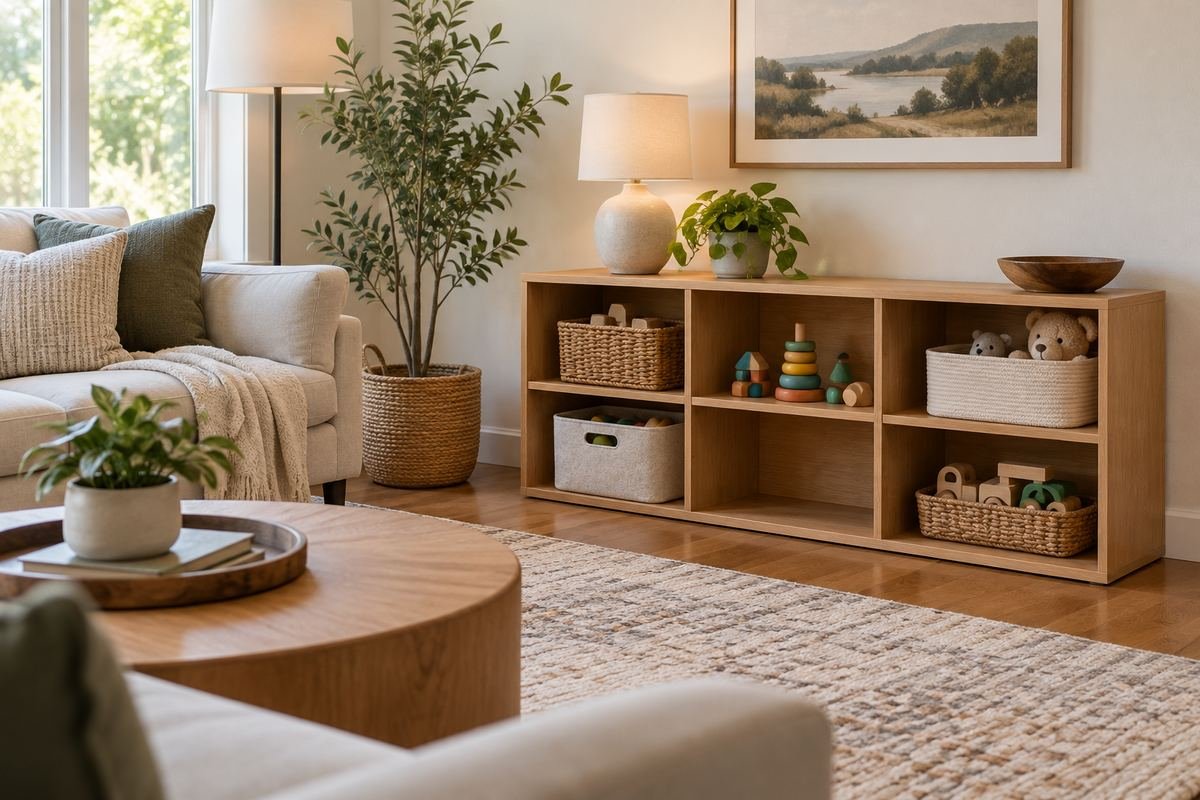
A storage unit filled to every edge has little flexibility when a new game arrives. Keep some genuinely available space rather than styling every opening with a decorative object. The exact amount depends on the household and the existing collection, not a fixed percentage.
Review the active selection when the spare capacity disappears. The answer may be to relocate an unused group rather than buy a larger unit. Available space is most useful when it can accept an actual container or game, not just a narrow decorative gap.
Practical tip: Check whether the empty space can hold a realistic future item.
25. Keep the storage route clear of the sofa conversation area
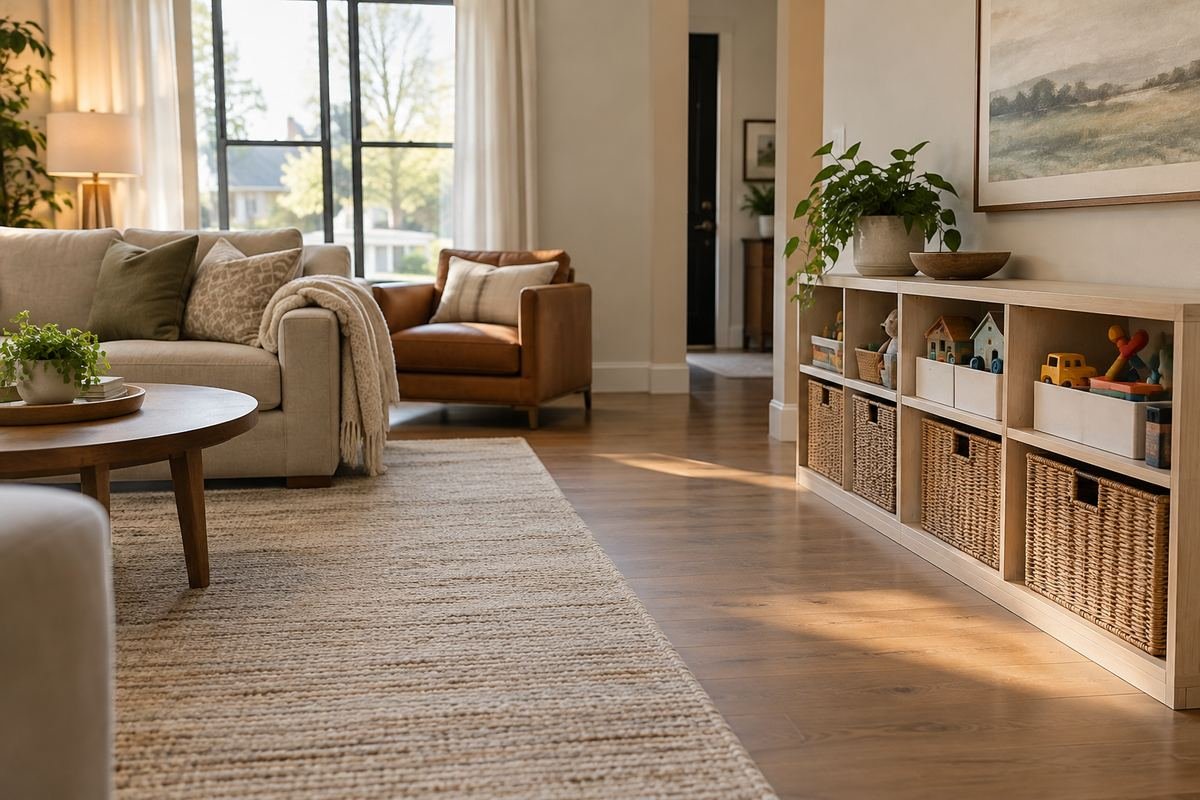
Toy storage affects the room while it is open and in use. Compare the cabinet doors, bins on the floor and person returning toys with the ordinary seating layout. A unit that fits against a wall can still conflict with the route between the sofa and chairs.
Try the arrangement during a normal family evening. If one person has to step over several containers to reach a seat, adjust the setup or reduce the number of active groups. Keep a practical return path without assuming one universal clearance suits every room.
Practical tip: Test the room with the storage open and a play group in use.
26. Finish with a reset that can happen on an ordinary day
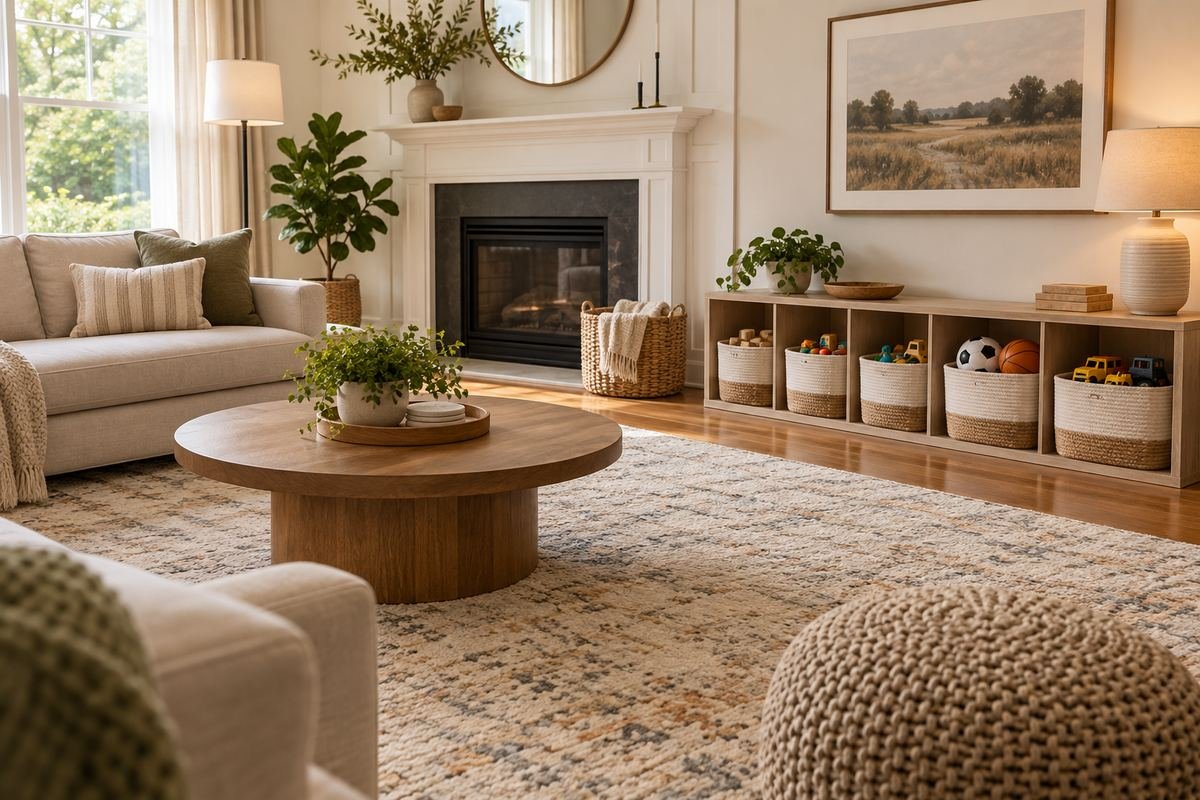
The strongest living room toy storage ideas support a short recognizable sequence: collect the active group, return it to its home and check the shared floor. Keep the steps understandable to the people taking part. A perfect system that needs a long sorting session after every use is unlikely to stay practical.
Review the arrangement after several real play sessions. Move the group that is always left out, divide the container that is too awkward and remove the category no one recognizes. Let the routine improve from observation instead of adding another layer of labels and containers automatically.
Practical tip: Change one repeated point of friction at a time.
Frequently Asked Questions
How can I hide toys without making cleanup harder?
Use a suitable cabinet with easy-to-remove contained groups. Keep the active selection limited enough that one container can be returned without unpacking the rest. Compare the opening and retrieval space with the actual toys. Concealment should follow a usable storage routine.
Are matching baskets the best option?
They can make open storage look coherent, but matching appearance does not solve an unsuitable size or heavy load. Test a container with its intended contents and choose a small number of forms that support the actual toy groups. The best arrangement may combine a few different container types.
Can an old blanket chest become toy storage?
Do not assume that it is suitable. CPSC warns about falling lids, entrapment and other hazards in storage chests. Check the exact product, recalls and applicable manufacturer guidance. Appropriate open bins avoid the falling-hinged-lid arrangement illustrated by many decorative trunks.
How many toys should stay in the living room?
There is no universal number. Keep a selection that fits the room’s available storage and can be returned during your normal routine. If the active group repeatedly overflows, reconsider the selection or its storage location before adding another piece of furniture.
Should I organize small building pieces by color?
Use the category that makes sense to the people who use and return the set. A broad type-based group may be easier to maintain than many color divisions. Keep age-inappropriate small pieces managed separately and follow the toy guidance for the children in the home.
How do I keep the room flexible as children grow?
Choose storage by useful opening sizes, removable components and the complete furniture instructions rather than a single themed appearance. Review the contents when interests change. Keep a little available capacity so a new game does not require moving every existing category.
Choose the Details That Work in Your Home
Choose living room toy storage ideas by the return task as well as the finished look. Give each active group a reachable, suitable home, keep the ordinary room routes usable and follow the furniture and toy instructions. A successful arrangement is the one your household can reset after a real afternoon of play.
For related ideas, explore living room corner ideas, sectional living room layouts, living room furniture spacing checks.
Planning References
CPSC: Anchor It furniture and TV tip-over guidance; CPSC: hazards associated with storage and toy chests; IKEA: TROFAST frame 100.914.53 dimensions, compatibility and anchoring requirement. Follow the instructions for the exact products you choose.
Optional digital guide for this topic
If you prefer a structured workbook, explore this related paid guide.