Minimalist living room ideas work best when fewer things make the room easier to use. Keep comfortable seating, useful light and the belongings that matter. Then examine which extra surfaces, displays and repeated furniture pieces make the ordinary day more complicated.
These 23 original illustrated concepts offer several versions of a simpler living room, including color, dark furniture and family storage. Use the keep-or-remove trial below to compare a modest change before buying a replacement. The aim is a room you enjoy occupying, with enough space and equipment for its actual activities.
Contents
- 1. Start minimalist living room ideas with one complete seating group
- 2. Let a patterned sofa be the detail worth keeping
- 3. Use one strong sofa color against simpler surfaces
- 4. Keep dark furniture in a deliberately simple room
- 5. Use a pale palette without replacing every wood finish
- 6. Make black and white a simple contrast
- 7. Give one large artwork an uninterrupted wall
- 8. Choose one storage piece through its real contents
- 9. Keep the arrival corner small and useful
- 10. Bound the book display to one useful area
- 11. Leave a personal object enough space to matter
- 12. Keep the central table ready for use
- 13. Try a side surface before adding a coffee table
- 14. Use one substantial textile instead of several small layers
- 15. Keep the window treatment visually straightforward
- 16. Give the reading chair one effective light source
- 17. Treat the television as a retained part of the composition
- 18. Give toys a return point close to the activity
- 19. Keep a pet’s ordinary place in the room plan
- 20. Keep flexible guest seating only when it earns its place
- 21. Simplify a rental room through movable pieces
- 22. Let adjacent activities share one quiet connection
- 23. Review the room with an evening in progress
Begin with the activity, then edit the visible room
IKEA’s clutter-free living room example pairs everyday storage with a limited display, while its flexible small-room example gives a few pieces more than one role. Those are useful prompts, rather than a required shopping list. List what happens in your room and keep each needed task supported before reducing furniture or decoration.
Choose the problem before the minimalist detail
- Too many surfaces: Check which tables are actually used and what each holds.
- Busy view: Compare one display group or repeated color at a time.
- Belongings left out: Find an accessible return point for the actual collection.
- Room feels uninviting: Keep comfortable seating, useful light and a personal detail.
- Possible purchase: Trial the footprint and record the task it will improve.
1. Start minimalist living room ideas with one complete seating group

Keep enough seating for the people who normally use the room before deciding what can go. A sofa and one chair may serve one household; another needs a different group. Compare the room while those seats are occupied, including where drinks and books rest. A visually spare room should still offer a useful place for each ordinary activity.
Count regular seats before choosing an extra decorative chair.
2. Let a patterned sofa be the detail worth keeping

A patterned sofa can stay when its comfort and condition work. Quiet the surrounding rug, cushions or wall display before assuming the sofa must be replaced by plain beige upholstery. Compare the complete pattern from the entrance. One substantial print can provide enough decorative interest when smaller competing motifs are removed.
Keep the useful sofa and edit a nearby pattern first.
3. Use one strong sofa color against simpler surfaces

Minimalist living room decor can include a strong color. Let a blue, green or rust sofa supply the main colored area while the wall and larger textile remain quieter. Choose the relationship using the actual retained upholstery. Repeating the color in every accessory may add more visual activity than the room needs.
Try removing the smallest matching accessories before changing the main color.
4. Keep dark furniture in a deliberately simple room

Dark furniture does not prevent a room from looking considered. Compare a plain background, a useful light source and the amount of surface left visible. A dark cabinet with a clear role may be more valuable than several pale replacements. Judge contrast at the times the room is used rather than assuming light-colored furniture is compulsory.
Keep the cabinet if its storage and access already work.
5. Use a pale palette without replacing every wood finish

A pale room can contain more than one retained wood finish. Compare the largest existing surfaces together, then make a modest repeat through a frame or table only if it helps. Avoid acquiring several nearly matching pieces to make an already useful room look uniform. The limited number of relationships matters more than a perfect match.
Review the floor and largest cabinet before choosing another timber finish.
6. Make black and white a simple contrast

A black table or frame can provide a clear outline against pale upholstery. Count the dark features already present, including the television and window frames. Keep one coherent relationship rather than adding a black object to every corner. Contrast is easier to judge when the ordinary equipment remains in the picture.
Compare the whole view instead of filling every light area with another dark accent.
7. Give one large artwork an uninterrupted wall

One artwork can supply the main wall detail without a surrounding collection of small frames. Test the full frame outline in relation to the furniture below it. Keep suitable mounting and the real wall in the decision. An uninterrupted area is useful when it makes a personal piece easier to see, not when it removes all expression.
Choose the work for its meaning or form before decorating the space around it.
8. Choose one storage piece through its real contents

A single cabinet can hold several categories if the compartments fit them. Measure the real games, devices or textiles and compare usable interiors before choosing the exterior. Leave appropriate room for doors and access. A plain front is only helpful when belongings can actually return to it after use.
Choose the storage capacity before judging the attractive cabinet elevation.
9. Keep the arrival corner small and useful

Keys, bags and mail can make the first visible corner feel busy. Give the recurring items a modest return point without adding a full furniture group to a small arrival area. Check how the door opens and how people move into the room. Keep the solution limited to the items that genuinely arrive there.
Review the tray after a normal week and remove unrelated stored objects.
10. Bound the book display to one useful area

A book collection can remain visible within a simpler room. Give the useful group a defined shelf and keep the surrounding table available for reading. Select the furniture through its actual capacity and stability guidance. A limited display should reflect the collection rather than require buying decorative books to fill a composition.
Keep frequently used titles convenient and store the rest deliberately.
11. Leave a personal object enough space to matter

A personal object can provide more character than a row of coordinated accessories. Try it on a surface with fewer neighboring items and compare the view from the seat. Keep its scale and stable position appropriate to that surface. This is a way to make something meaningful visible, rather than a rule about owning a fixed number of objects.
Choose one valued detail and temporarily remove its competing display.
12. Keep the central table ready for use

A central table should have room for the things used at the sofa. Reduce decorative arrangements if they must be moved every evening. Compare what actually stays on the table and what belongs in convenient storage. The clearest surface may be one with a book and cup in use, rather than a carefully arranged collection of objects.
Leave a usable area instead of planning the entire top as a display.
13. Try a side surface before adding a coffee table

A side surface may answer the task when the center is used for movement or another activity. Check reach from the occupied seat and whether someone on the other end needs a separate surface. Keep a central table if it serves several people well. Remove it only when its real use can be met more conveniently.
Trial the ordinary evening arrangement before committing to a table-free center.
14. Use one substantial textile instead of several small layers

A textured throw or one useful cushion can soften the seating without creating a pile that must be removed. Choose through the actual fabric, comfort and care information. Compare the room with the textile in use as well as folded. The amount of softness needed comes from the seat and household, not an accessory quota.
Keep the layer people use and trial putting the unused ones away.
15. Keep the window treatment visually straightforward

A plain curtain can quiet a busy window area while still serving its intended task. Choose actual privacy and light-control performance before appearance. A sheer-looking fabric in a daytime image cannot establish privacy after dark. Keep the treatment suitable for the window, household and equipment, then simplify decorative layers that serve no useful role.
Check the room at the time privacy and glare matter most.
16. Give the reading chair one effective light source

A simpler room still needs light where people read. Compare the actual fitting from the occupied seat, including controls and glare. Choose the light for the task before choosing a sculptural shape. Removing several unused lamps may be sensible, but removing the one that makes an evening activity comfortable does not improve the room.
Test the current light during a real reading session.
17. Treat the television as a retained part of the composition

A television does not need to disappear for the room to look restrained. Keep a suitable support, viewing arrangement and required equipment access. Then reduce the small objects surrounding the screen. Choose ventilation and cable details through the real equipment rather than sealing everything inside an attractive closed front.
Simplify the surrounding display while keeping the devices usable.
18. Give toys a return point close to the activity
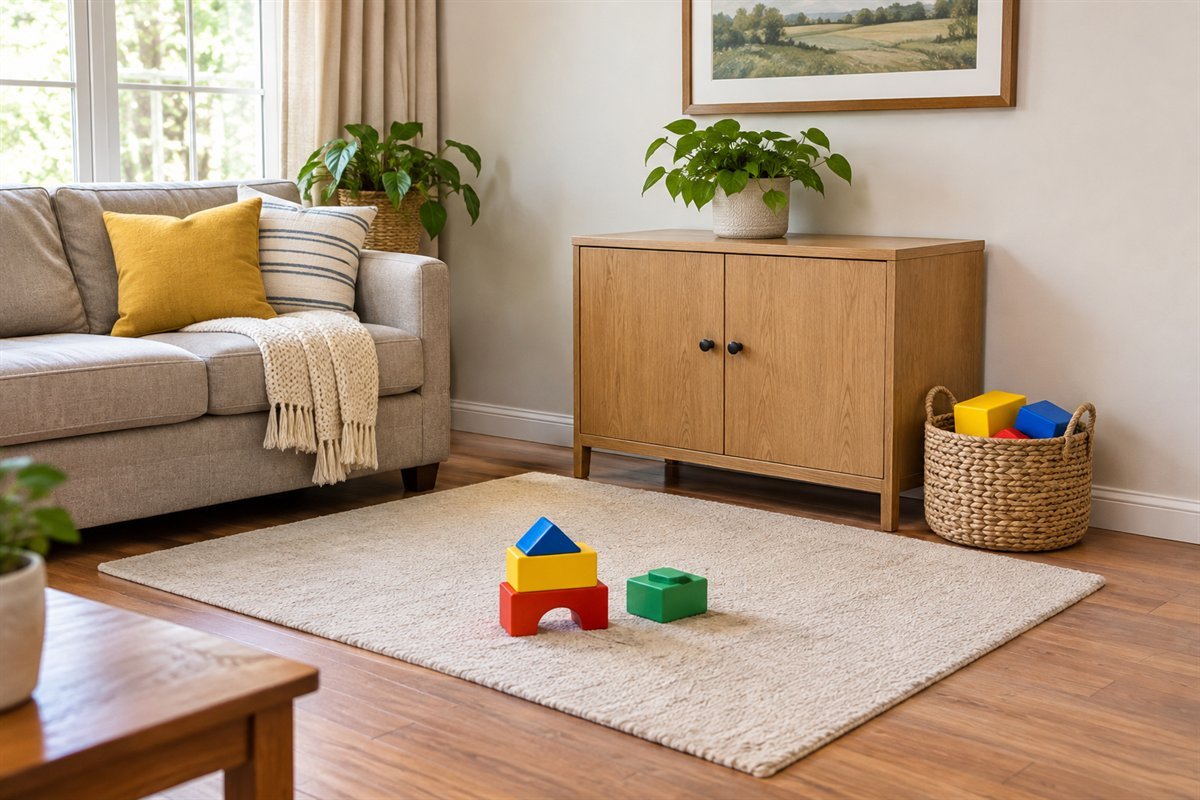
A family room can look simpler when the toys in regular use have convenient storage nearby. Keep products appropriate for the household and follow stability guidance. Compare the real collection rather than an almost-empty staged cabinet. The aim is a realistic return route after play, with enough useful space while the activity is happening.
Choose the storage around the recurring collection rather than expecting an empty room.
19. Keep a pet’s ordinary place in the room plan

A pet bed or other necessary household item belongs in the plan from the start. Give it a suitable location outside the ordinary route and choose the actual product through its intended use and care. Coordinate its appearance only after those needs are resolved. Hiding a necessary item for photographs does not simplify daily life.
Include the real bed footprint before choosing another accent chair.
20. Keep flexible guest seating only when it earns its place

An occasional seat can be useful when guests arrive, but an unused extra group can crowd a room. Record how often it is needed and compare a suitable piece that has another ordinary role. Check its actual seat rating, dimensions and comfort. A stool-shaped object should not be treated as a seat without product information.
Keep the extra piece because it supports a task, not because the corner looks unfinished.
21. Simplify a rental room through movable pieces

A rental room can change through editing displays, rearranging suitable furniture and comparing a simpler textile. Begin with reversible choices that fit the actual tenancy terms. Do not assume that removable-looking wall products are suitable for every finish or permitted. A considered arrangement of retained pieces can be a complete first step.
Use the keep-or-remove trial before planning a permanent surface change.
22. Let adjacent activities share one quiet connection

Two activity areas can relate through a wood tone or quieter textile without acquiring matching accessories everywhere. Compare both areas with chairs in use and the normal route open. Keep the most useful furniture for each activity. A repeated finish should connect the view without forcing a less convenient layout.
Choose one shared relationship before adding a decorative divider.
23. Review the room with an evening in progress

A useful minimalist room can contain an open book, a cup and a blanket while they are being used. Review what becomes inconvenient during an ordinary evening. Note whether the next change should be a better return point, a missing surface or simply fewer objects on display. Keep the room connected to its household rather than a permanently reset photograph.
Use one observed inconvenience to choose the next small adjustment.
Run an original keep-or-remove trial before buying
Choose one small area and one problem. For example, the table is difficult to use because a display covers it, or three small side pieces interrupt the route beside the sofa. Describe the problem in ordinary language before selecting a new decorative style. A broad intention such as make the room minimalist does not tell you whether any particular object should stay.
Make a short record with five fields: object or group, useful task, usual frequency of use, convenient alternative and trial observation. Keep an item’s practical role separate from its appearance. An inherited table may be visually different from the newer furniture while still being the most useful surface in the room. A matching pair of small stools may contribute little if neither is used.
Start with a recoverable change. Put one nonessential decorative group into suitable temporary storage rather than discarding it or removing needed equipment. Leave the furniture and lighting that support everyday use. Take one reference photograph from the ordinary entrance and another from the main seat. The photographs are a record of the trial, not proof that the arrangement fits or performs safely.
Use the room normally for several ordinary sessions. Include the book, remote control, craft or conversation that actually takes place. Write down what became easier and what had to be improvised. If a removed table sent drinks onto the floor, restore the useful surface or provide an appropriate alternative. An emptier picture is not an improvement when a common activity has become awkward.
Consider a hypothetical room with a comfortable gray sofa, two small side tables, a central table and three decorative trays. The household uses the central table for a board game and one side table for a reading lamp. A trial might remove two trays and temporarily relocate the unused side table. If the lamp and game remain convenient, that limited edit may answer the problem without a furniture purchase. This is an original planning example, not a measured client project or product test.
Repeat the trial only when the first observation identifies another conflict. It may turn out that useful storage, rather than fewer belongings, is the missing piece. If so, measure the actual collection and cabinet access before buying. The record should explain why the next change is needed instead of becoming a score for how little the room contains.
Keep meaningful belongings in the decision. A personal artwork, an unusual chair or a colorful textile can remain as the room’s main detail. Compare the competing display around it before removing the feature itself. Minimalist living room design can be selective and personal without requiring every household to use the same color, object count or furniture profile.
Finish with a specific decision: keep, relocate, restore or investigate a replacement. Record the useful task and the reason. Retain the real dimensions, care information and equipment guidance when an actual purchase or installation is involved. A decorative trial can identify a problem; it cannot establish load capacity, electrical suitability or the correct mounting method.
Use a visibility-and-access check for everyday storage
Divide the room’s recurring belongings by what happens to them, rather than by how attractive they look in a cabinet. Keep current reading close to the seat, the useful game where it can return conveniently and necessary device connections accessible. Compare the storage with the actual contents and the open doors or drawers, not only the closed front.
Decide which small group deserves open display and which supplies can have a quieter home. A plain cabinet can reduce the visible mixture while keeping an ordinary collection. It will not help if the compartments are too small, inconvenient or unsuitable for the items. Follow the actual furniture’s installation, load and stability information.
Review the room in three states: ready to use, actively occupied and put away. The occupied state can contain necessary objects. The useful question is whether they have a convenient place during use and a realistic place afterward. Choose a storage adjustment when the same item repeatedly ends up on the nearest clear surface.
Keep one modest maintenance habit linked to the household: return the game after playing or clear the table before a different activity. Avoid an elaborate daily reset that makes the room inconvenient. A simple room should support its users with fewer unnecessary steps, while leaving its useful furniture and personal identity intact.
Does a minimalist living room have to be beige?
No. A strong sofa color, dark cabinet or personal artwork can remain. Limit competing relationships and compare the actual room rather than following a compulsory palette.
How can I start without buying new furniture?
Choose one inconvenience and trial a recoverable edit to a nonessential display or unused piece. Keep the seating, surfaces and lighting required for ordinary use, then record what improved.
Can a minimalist living room work for a family?
It can include games, toys and everyday belongings. Plan storage around the real collection and keep a convenient return point near the activity instead of expecting the room to remain empty.
Should I remove the coffee table?
Only if its ordinary task has a suitable alternative. Compare reach, shared use and the need for central floor space while the room is occupied.
How is this different from choosing a Japandi style?
This guide focuses on editing objects and supporting daily tasks, without requiring a particular cultural influence or material palette. The keep-or-remove trial can work with many existing furniture styles.
Do these illustrations show measured furniture arrangements?
No. They are original AI-generated concepts. Verify actual footprints, comfort, care, equipment and installation information for the real room.
A practical next step
Keep what makes the room comfortable and useful, then trial the smallest edit that answers a real inconvenience. A simpler view is most rewarding when it also makes an ordinary evening easier.
Compare a Japandi influence through materials and routines. Resolve a narrow living room through its actual layout. Compare other room aesthetics around retained pieces.
Images are original AI-generated room concepts, not measured layouts or exact product reproductions. The keep-or-remove trial and gray-sofa example are original planning aids.
Sources and care references
- IKEA: concealed everyday storage and a considered display
- IKEA: a few functional pieces in a flexible small living room
Optional digital guide for this topic
If you prefer a structured workbook, explore this related paid guide.