Brown leather sofa living room ideas are most useful when they help you work with the seat you already have. Begin with its actual shade, shape and condition, then compare the surrounding wall, floor and largest furniture. A brown sofa does not require a matching brown room or a complete replacement scheme.
These 25 original concepts cover color relationships and the way the seating area works. Use the retain-and-change sequence below to choose the next useful action. The images illustrate appearances and layouts; they do not identify real leather grades, named products or tested upholstery.
Contents
- 1. Start brown leather sofa living room ideas with the actual shade
- 2. Give an espresso sofa a pale wall to stand against
- 3. Set cognac beside a muted sage wall
- 4. Compare chestnut with a soft slate-blue background
- 5. Try dusty rose with deeper brown
- 6. Use a warm gray without erasing the sofa’s warmth
- 7. Let olive create a deeper room around the brown seat
- 8. Separate a dark sofa from the floor with a quiet pale rug
- 9. Use a faded blue rug as the main patterned companion
- 10. Keep rust to one deliberate textile area
- 11. Give the sofa a lighter curtain background
- 12. Keep a blue cushion arrangement small enough to sit with
- 13. Use a cream throw as a texture contrast
- 14. Add a fabric chair instead of another matching leather piece
- 15. Use a round table to soften a straight sofa composition
- 16. Contrast the brown seat with a paler wood table
- 17. Use black metal as a limited outline
- 18. Give a reading end its own complete lamp
- 19. Let one end remain visually quiet
- 20. Choose a loveseat through the whole small room
- 21. Make the sectional’s open side work with the route
- 22. Connect an open living area without matching every chair
- 23. Keep an inherited wood cabinet with a different brown value
- 24. Use one pale artwork to give the sofa wall a clear focus
- 25. Finish by removing one unnecessary repeated brown accent
Separate the room’s appearance from the upholstery’s care
IKEA’s leather-sofa guidance identifies size, layout and color as different selection decisions. Room & Board’s care guidance also distinguishes leather types before cleaning or conditioning and cautions against direct sunlight. Use the actual sofa’s maker and material record for care decisions. A brown finish, a leather-like appearance or a generated image does not establish what cleaning method is suitable.
Choose the next step from the actual sofa and room
- A dark sofa merges with the retained floor: Compare one lighter rug or background before replacing the seat.
- The sofa is sound but every nearby surface repeats brown: Keep the useful large pieces and compare one quieter or contrasting textile.
- A chaise crosses the everyday route: Resolve the exact furniture configuration before buying accessories.
- The leather type or treatment is unknown: Find the actual manufacturer and care record before applying anything.
- A sample works in daylight but disappears at night: Compare it under the usual lamps before committing to a larger area.
1. Start brown leather sofa living room ideas with the actual shade
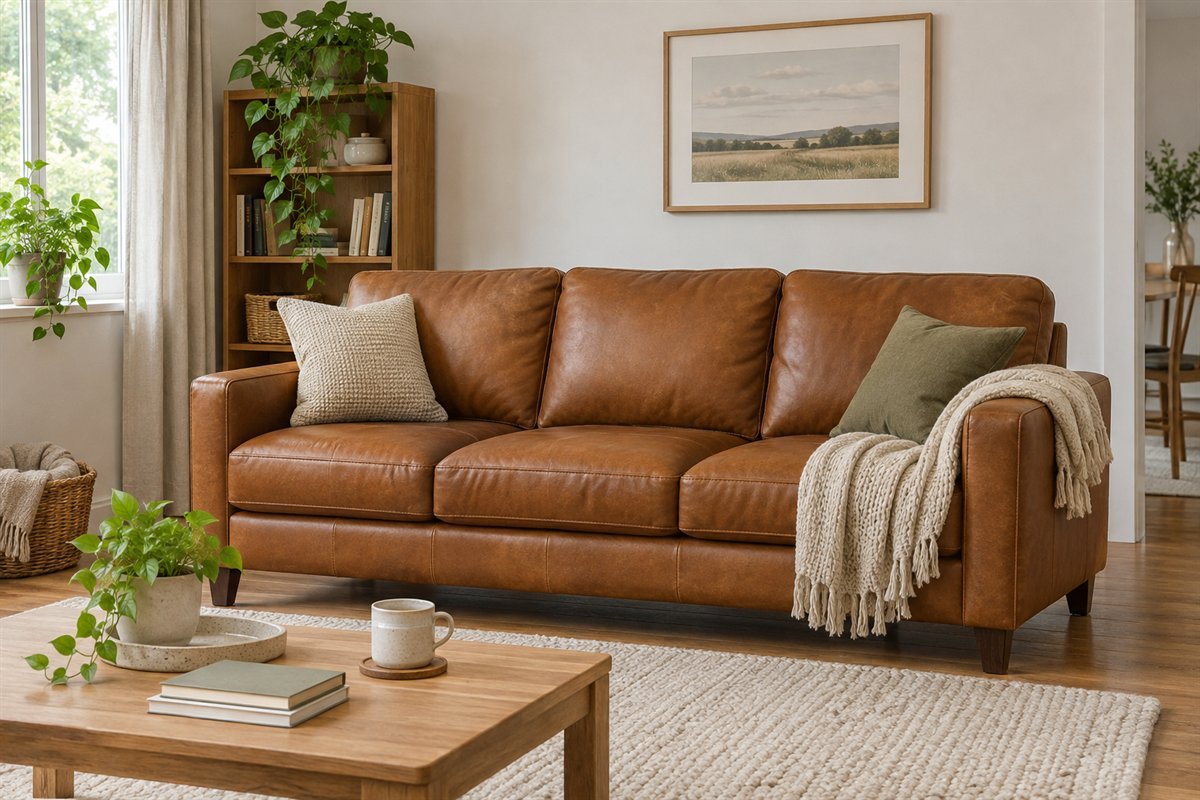
Begin with the sofa you actually own rather than a generic brown swatch. A caramel seat, red-brown chestnut and near-espresso upholstery can suggest quite different companions. Observe a less reflective area as well as the highlights so a bright photograph does not make the whole surface look lighter than it is. Keep that observation beside the room’s retained floor and largest wood piece.
Name the visible shade before comparing a wall or textile.
2. Give an espresso sofa a pale wall to stand against
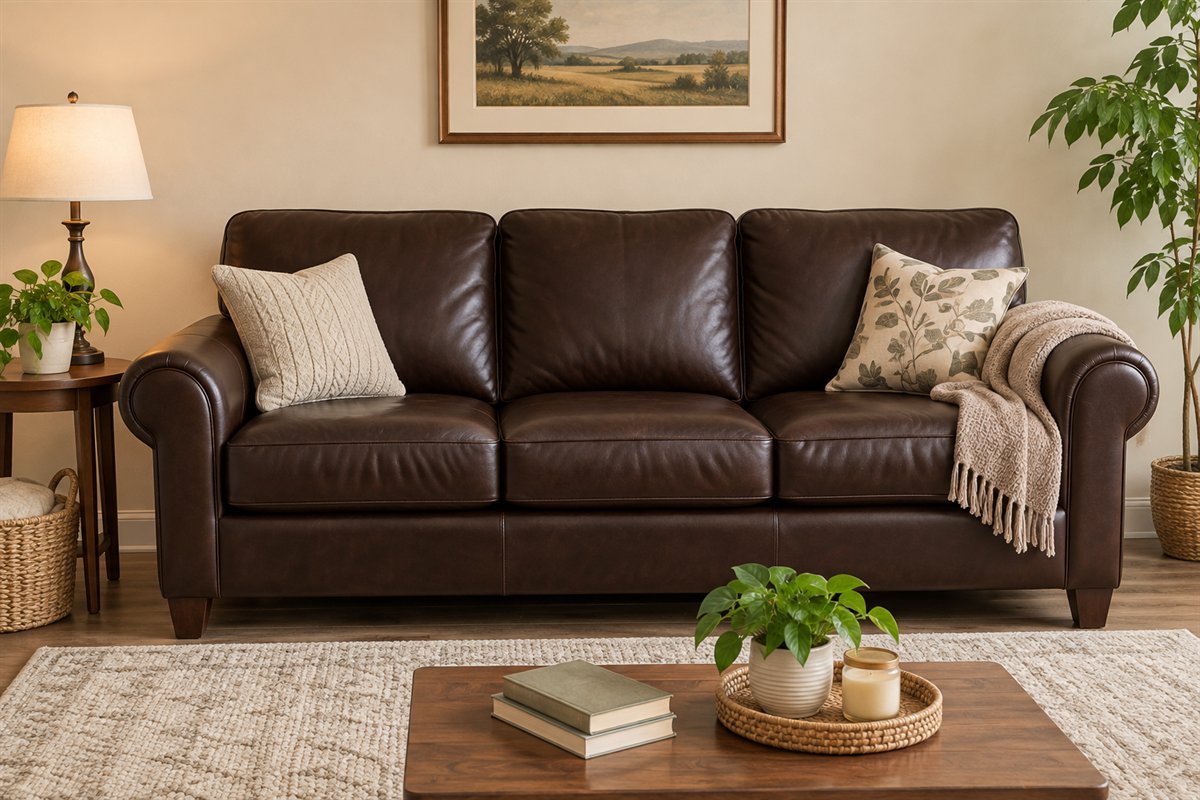
A very dark brown sofa can have a clear outline against a pale wall. Compare the wall’s warmth with the actual upholstery; a yellow cream and a quieter ivory are different choices. Keep enough detail in the sofa itself to read the arms, back and seat. A pale background is one option for contrast, not a rule that every dark sofa requires an entirely light room.
Compare the wall at the sofa’s shaded end too.
3. Set cognac beside a muted sage wall

Muted sage gives warm cognac a colored companion without making both large surfaces equally intense. Test the green beside the actual leather and floor, especially if the wood is golden or red. Keep the first rug comparison quiet so you can understand the main pairing. If the wall becomes too yellow beside the sofa, compare another green before adding more accents.
Let the wall and sofa be the first two parts of the decision.
4. Compare chestnut with a soft slate-blue background
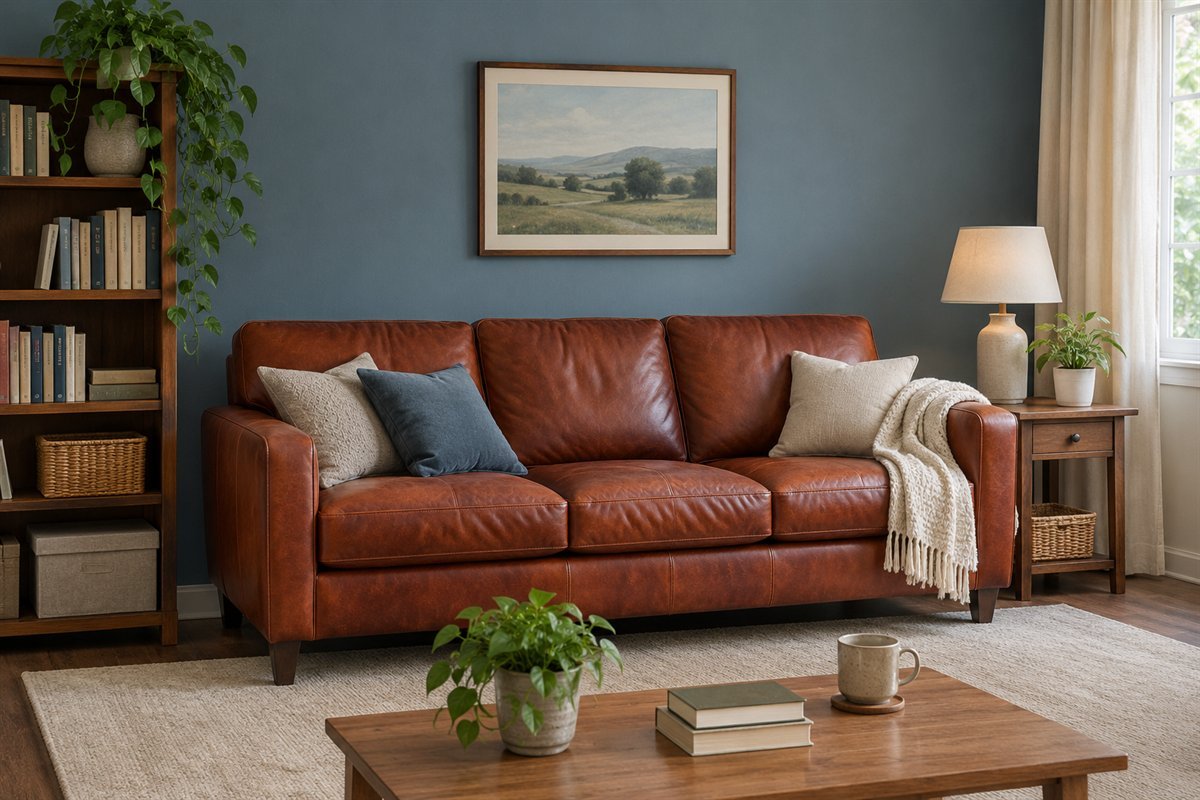
Slate blue offers a cooler setting for chestnut upholstery. The useful comparison is the depth and restraint of the blue, not a promise that any blue balances any brown. Bring a physical sample near the largest seat area and retained trim. A soft cream textile can separate the two colors without introducing another strong hue.
View the pairing under the normal evening lamps.
5. Try dusty rose with deeper brown
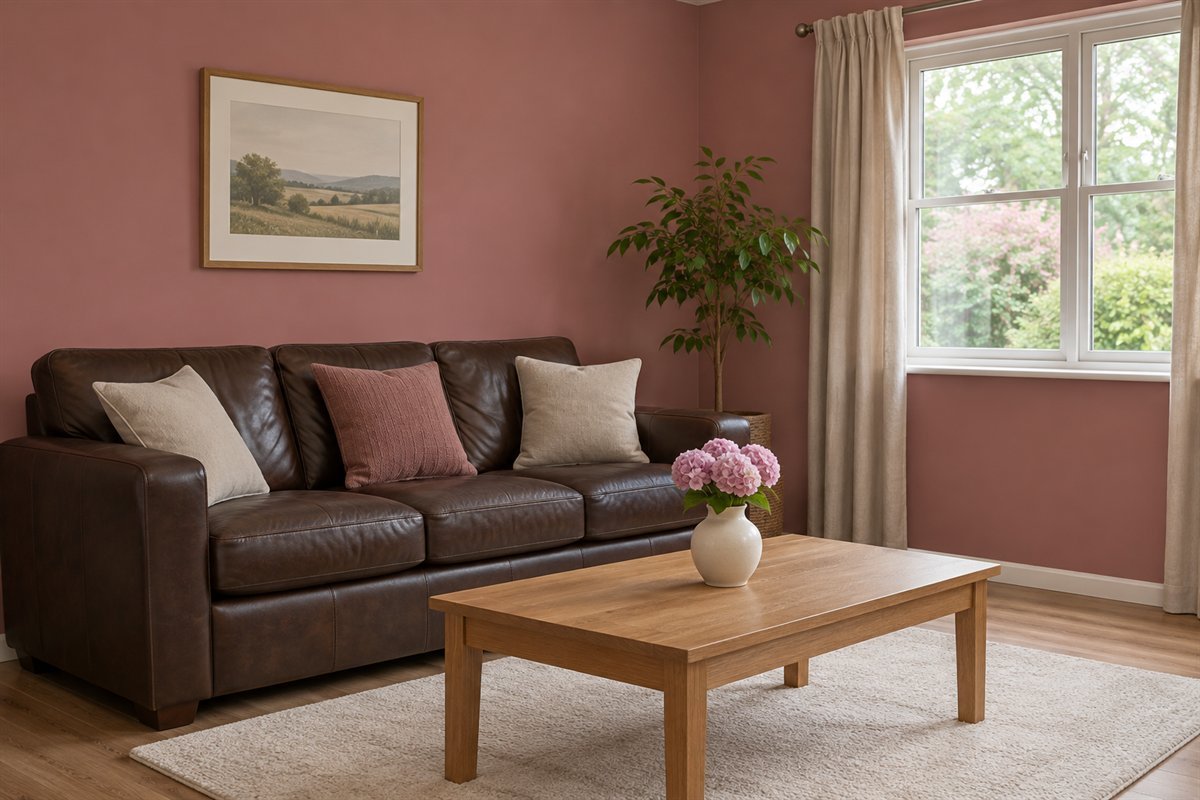
A muted rose can give deep brown a different setting from beige or white. Compare a brownish rose with a clearer pink to see which belongs with the room’s wood and upholstery. Keep the surrounding pattern limited during that comparison. The sofa can remain the weightier element while the wall introduces a softer color.
Choose through real samples rather than a screen palette.
6. Use a warm gray without erasing the sofa’s warmth
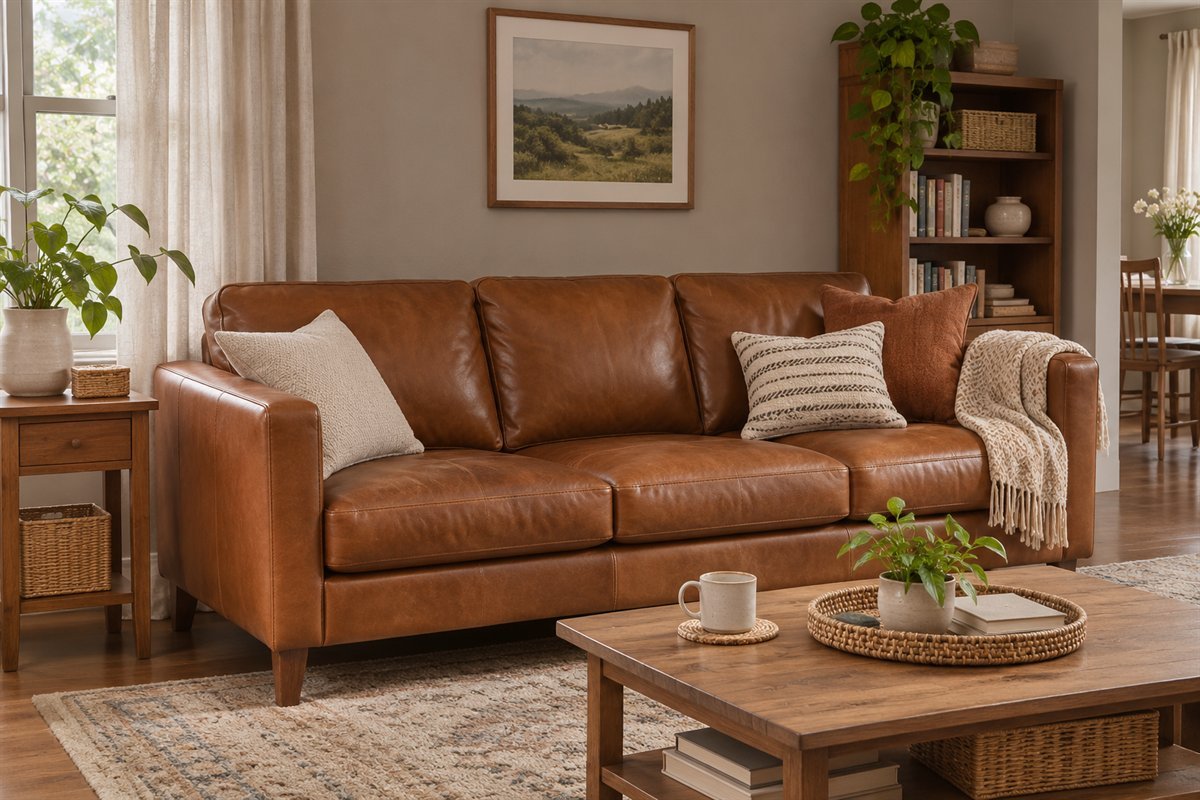
A warm gray can sit quietly behind a caramel sofa when the actual undertones agree. Do not select it only because the label says greige or neutral. Compare it where the upholstery meets the wall and where the wall meets the floor. If the room becomes a collection of unrelated near-neutrals, keep one clearer light surface instead of adding another almost-match.
Reject a candidate that works with the seat but fights the floor.
7. Let olive create a deeper room around the brown seat
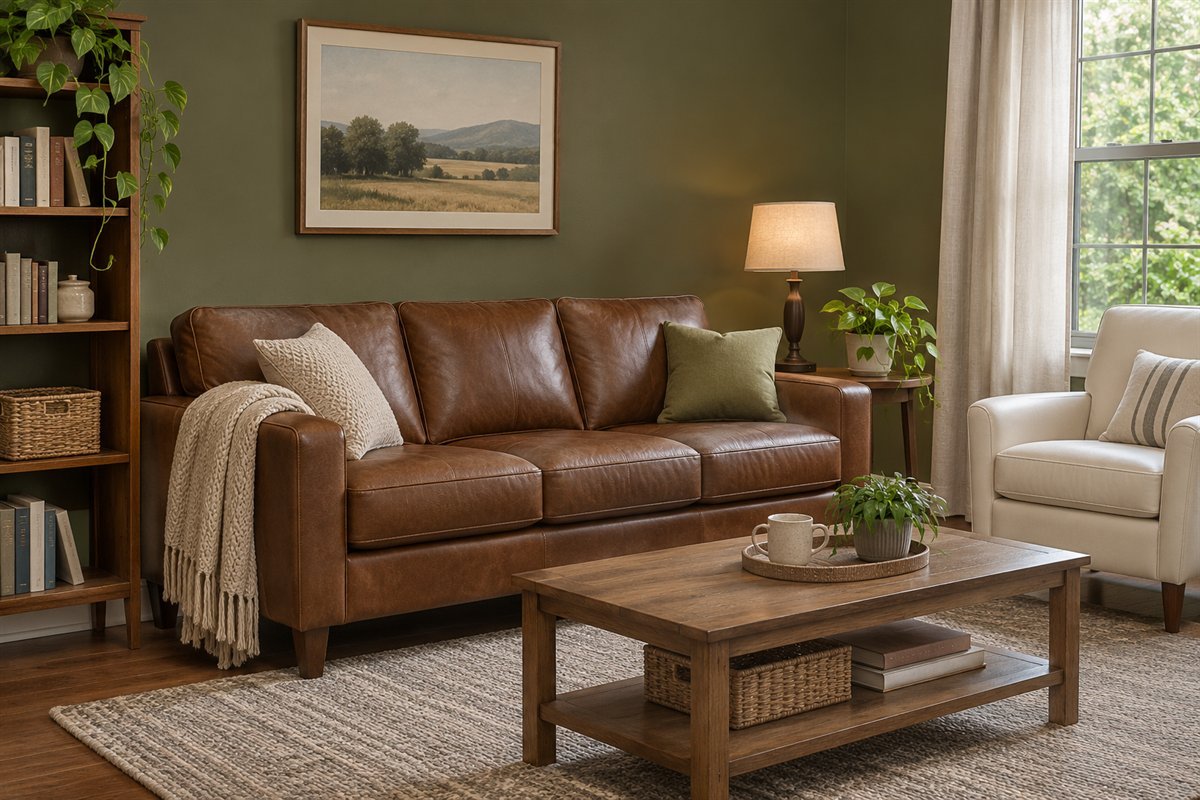
Olive can give a brown sofa a deeper setting while pale furniture or curtains keep the relationships legible. Review the occupied room after dark, when the green and brown may appear closer than expected. Keep task lighting useful independently of the palette. If both large surfaces disappear together, compare a lighter olive or a more distinct fabric companion.
Judge the deepest corner as well as the bright window side.
8. Separate a dark sofa from the floor with a quiet pale rug
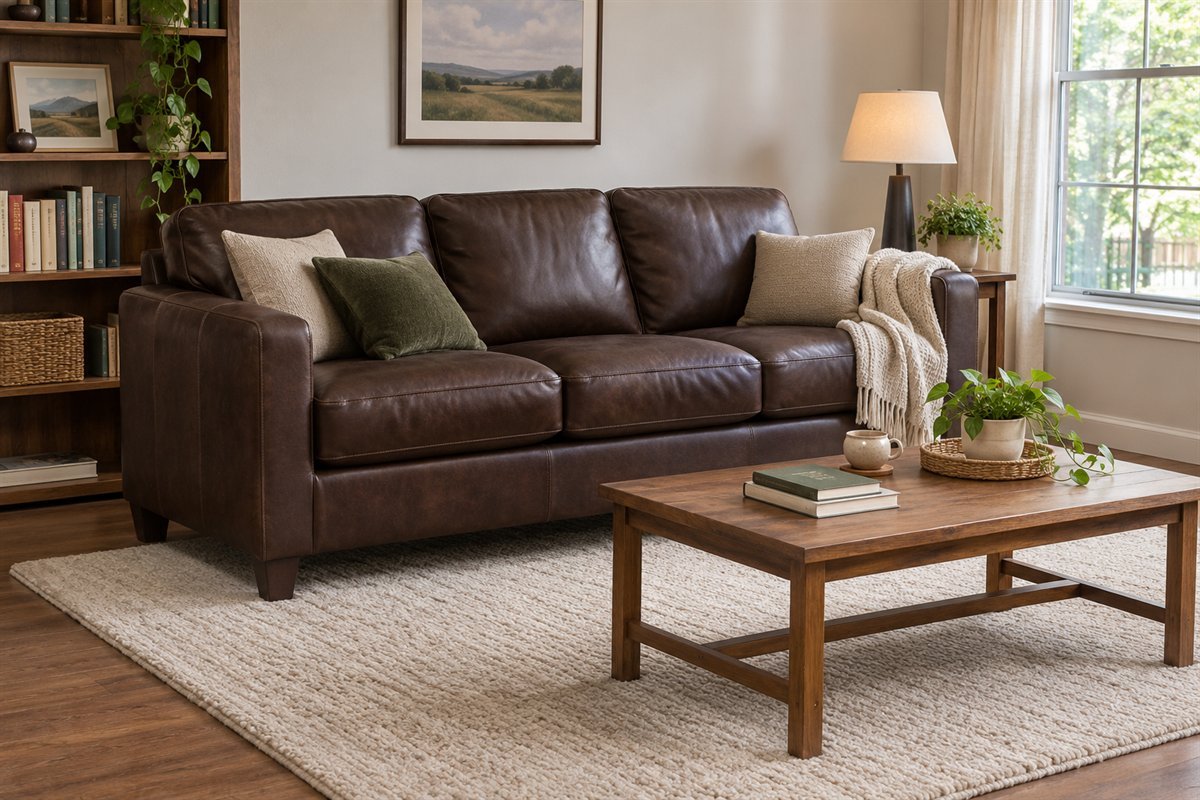
A pale rug can separate dark upholstery from a similarly dark floor. Compare the rug’s background with the sofa at normal viewing distance and choose its size through the real seating layout. Pale does not establish easy cleaning or household suitability. Read the actual rug and underlay information before using appearance as the deciding factor.
Include the occupied chair positions in the rug comparison.
9. Use a faded blue rug as the main patterned companion
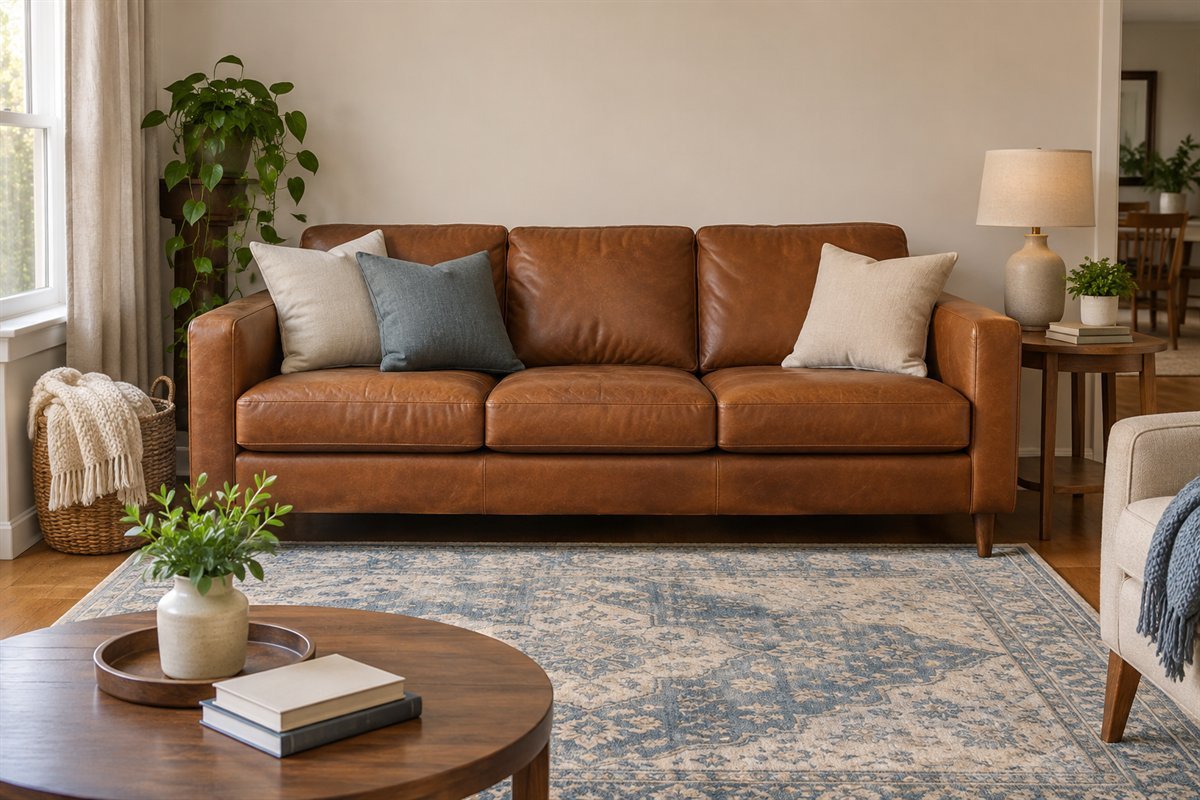
A muted blue-and-cream rug can provide a patterned field beneath brown leather. Let it lead rather than repeating strong print on every cushion and curtain. Compare the light background as carefully as the blue detail; that larger area often determines how the sofa sits in the room. Choose the real rug by its construction and care requirements separately.
Borrow one quiet rug color for a small fabric companion.
10. Keep rust to one deliberate textile area
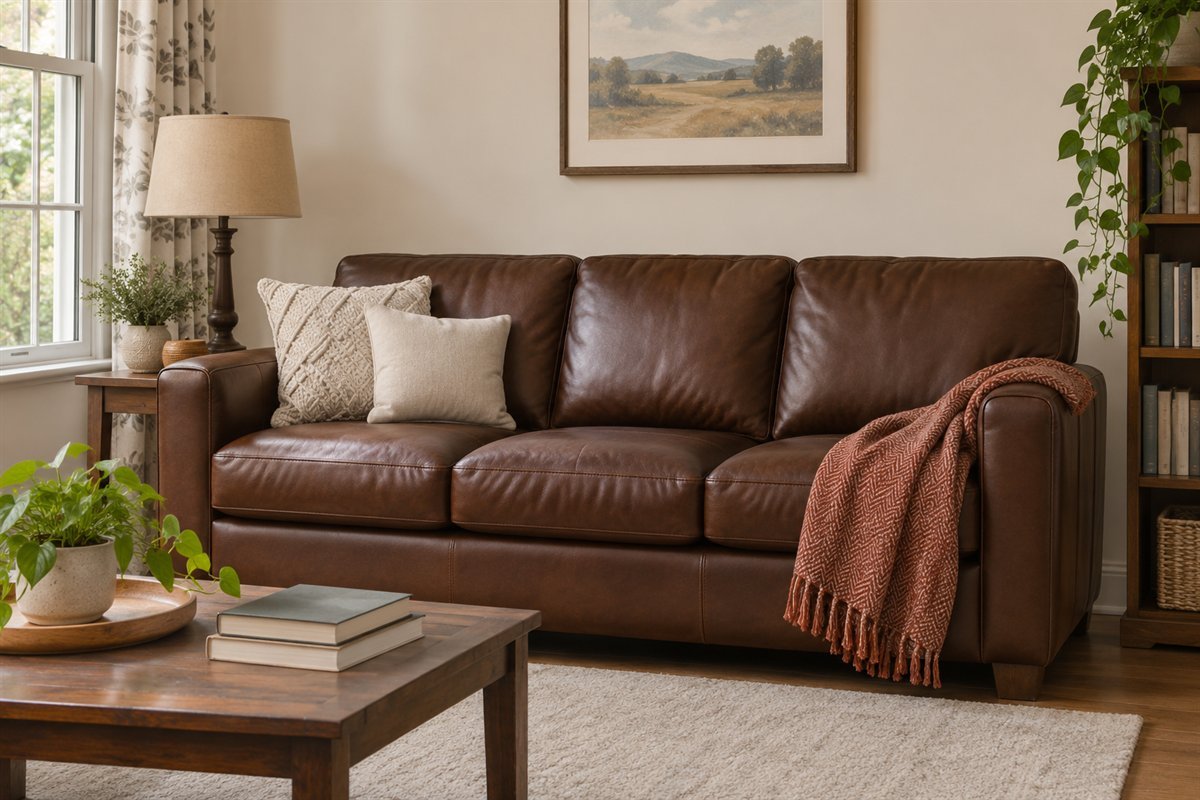
Rust can connect to warm brown without requiring the entire room to become orange and tan. Start with one clearly visible textile and compare it against the leather’s reddish or golden notes. If the colors merge, change their depth or use a quieter neutral between them. Keep this accent secondary when a large patterned rug already supplies enough warmth.
Leave a generous area of the brown upholstery visible.
11. Give the sofa a lighter curtain background

Plain light curtains can provide a different texture beside a smooth sofa. Compare their actual fabric with the upholstery and wall instead of assuming all off-whites match. Resolve privacy, operation and the sofa’s position with the real window. A decorative sheer alone does not establish protection for the upholstery or the right treatment for that exposure.
Choose the window treatment for use as well as appearance.
12. Keep a blue cushion arrangement small enough to sit with

Two small areas of dusty blue can introduce a cooler note while leaving the leather central to the room. Compare cushion depth and surface against the actual sofa, then sit in the usual positions. A styling arrangement that slides or consumes the useful seat needs changing. Keep a photograph as a visual record, but let ordinary use settle the number.
Test the occupied sofa before adding another cushion.
13. Use a cream throw as a texture contrast

A cream throw creates a soft-looking contrast without concealing the sofa you intend to keep. Try it at one end where it can be used and put away easily. Compare the real textile’s care and behavior against the actual upholstery; the image cannot establish fiber content or whether the material stays in place. The small contrast may be enough.
Choose a useful throw position rather than covering every seat.
14. Add a fabric chair instead of another matching leather piece

A fabric chair can introduce a distinct surface beside the smooth-looking sofa. Keep its scale and seating position compatible with the room’s normal conversation. The chair does not need to share the sofa’s exact era, legs or color to belong. A repeated neutral or wood tone can connect them while their upholstery remains different.
Measure the chair in its occupied position before choosing it.
15. Use a round table to soften a straight sofa composition

A round coffee table provides a different shape beside a straight sofa and rectangular rug. Compare it through the reach from the actual seats and the route around the seating group. Shape alone does not solve a crowded arrangement; a large circle can take up more useful space than expected. Keep the table only as large as the activities require.
Check reach and movement with the seats occupied.
16. Contrast the brown seat with a paler wood table
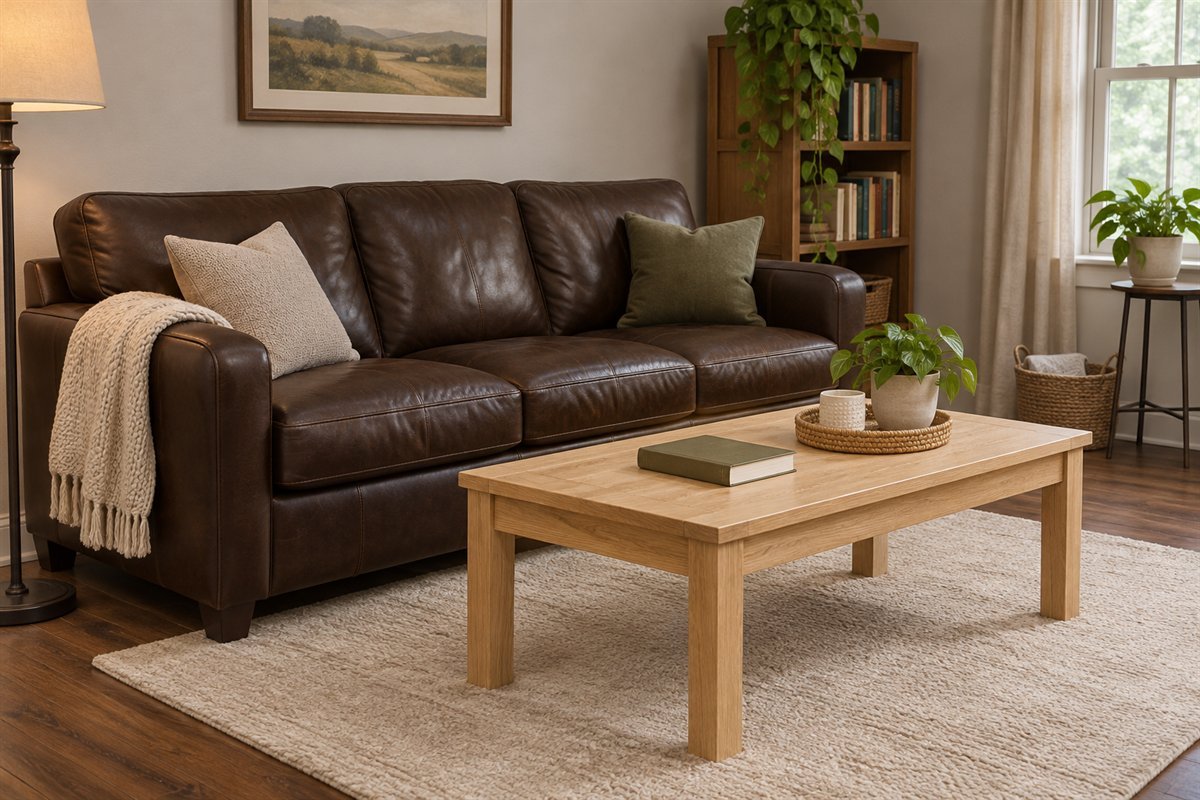
A paler wood table can keep a brown sofa from sitting among several equally dark pieces. Compare the wood’s visible warmth with the leather rather than trying to match both surfaces exactly. If the retained floor already leads, let the table be simpler. A clear difference can look more considered than several nearly identical browns selected separately.
Bring the table finish sample into the full retained palette.
17. Use black metal as a limited outline

Small black outlines can connect a warm brown sofa to existing window frames or furniture legs. Keep them on useful objects rather than adding dark accessories merely to repeat the color. If the sofa is already deep espresso, compare whether the black remains distinct. One light companion may make the whole group easier to read.
Use a necessary table or lamp to carry the darker line.
18. Give a reading end its own complete lamp
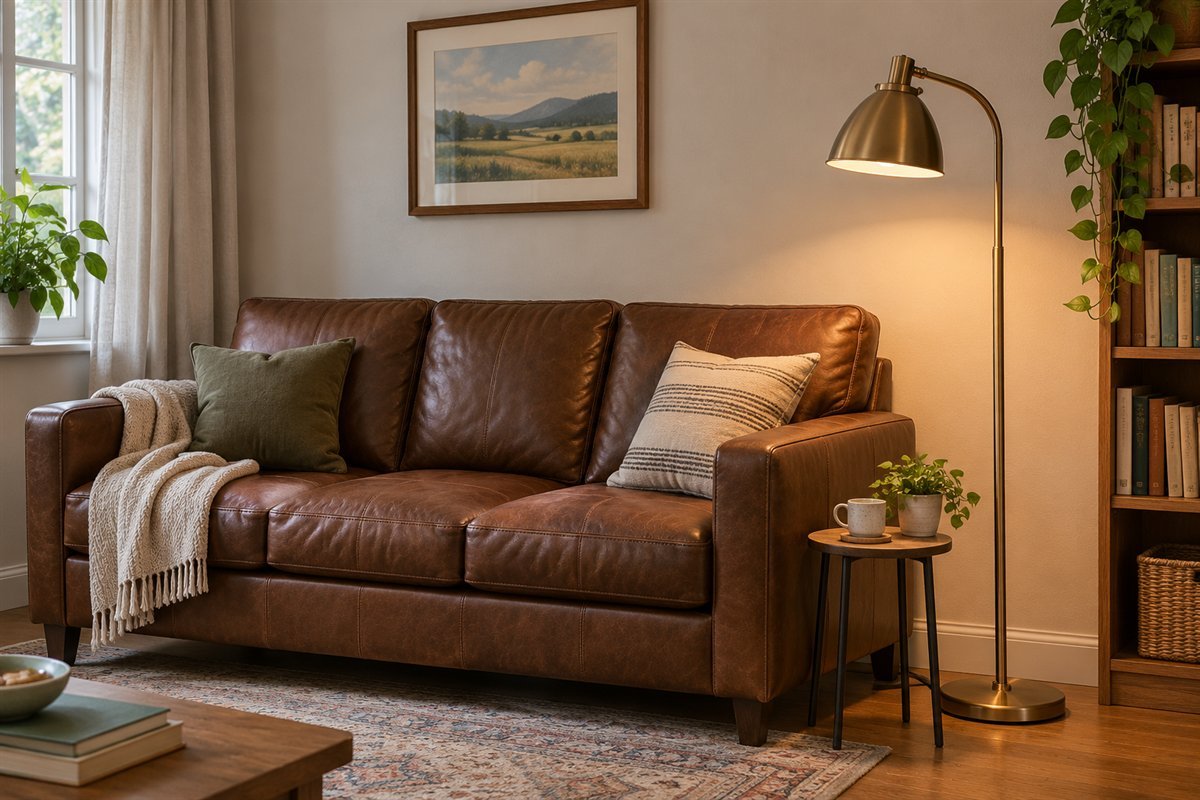
A reading lamp can complete the sofa’s everyday role while adding a separate material. Compare its light and controls from the normal seat, including whether the shade interrupts the view across the room. A warm-metal finish is an option rather than a required partner for brown. Choose the lighting function first and let the finish support the room.
Keep the actual lamp instructions and clearances part of the selection.
19. Let one end remain visually quiet
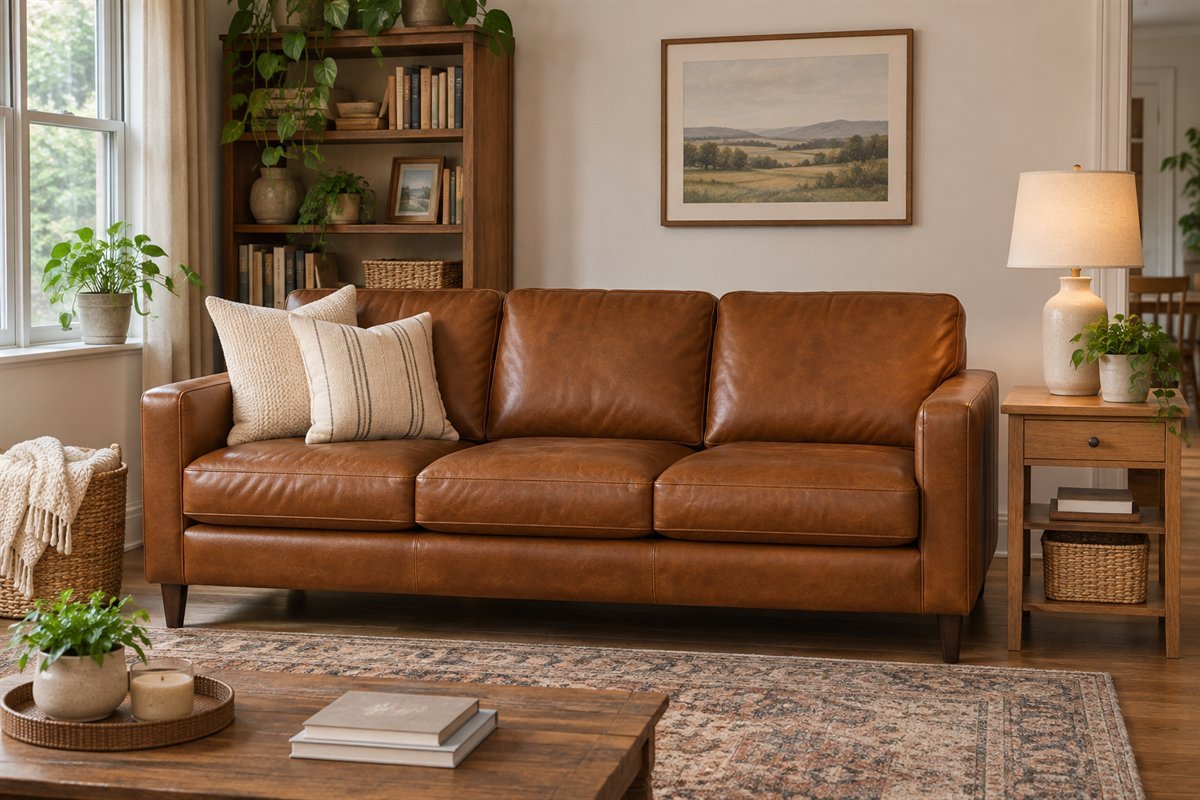
An uneven cushion group can respond to a sofa beside a window or an already busy table. Leave the other end quieter so the arrangement has a clear pause. Review the whole wall rather than treating both sofa ends as independent displays. The empty end can also be the seat that needs the least daily rearranging.
Make the asymmetry answer the room rather than an arbitrary rule.
20. Choose a loveseat through the whole small room

A compact brown loveseat can leave room for a separate chair or a useful route. Compare the complete dimensions and how the household sits rather than deciding from the front width alone. The arms and depth can use considerable space. Keep the smaller seating piece useful instead of filling the remaining floor with several extra tables.
Include door operation and ordinary movement in the layout.
21. Make the sectional’s open side work with the route

A brown sectional needs a layout decision before the textile styling begins. Compare the chaise side with the room’s entry and the places people walk most often. A left- or right-facing description is not enough without the supplier’s actual diagram. Keep the everyday lounging position and the route clear, then decide which end needs a cushion or table.
Use the exact configuration drawing for the actual room.
22. Connect an open living area without matching every chair
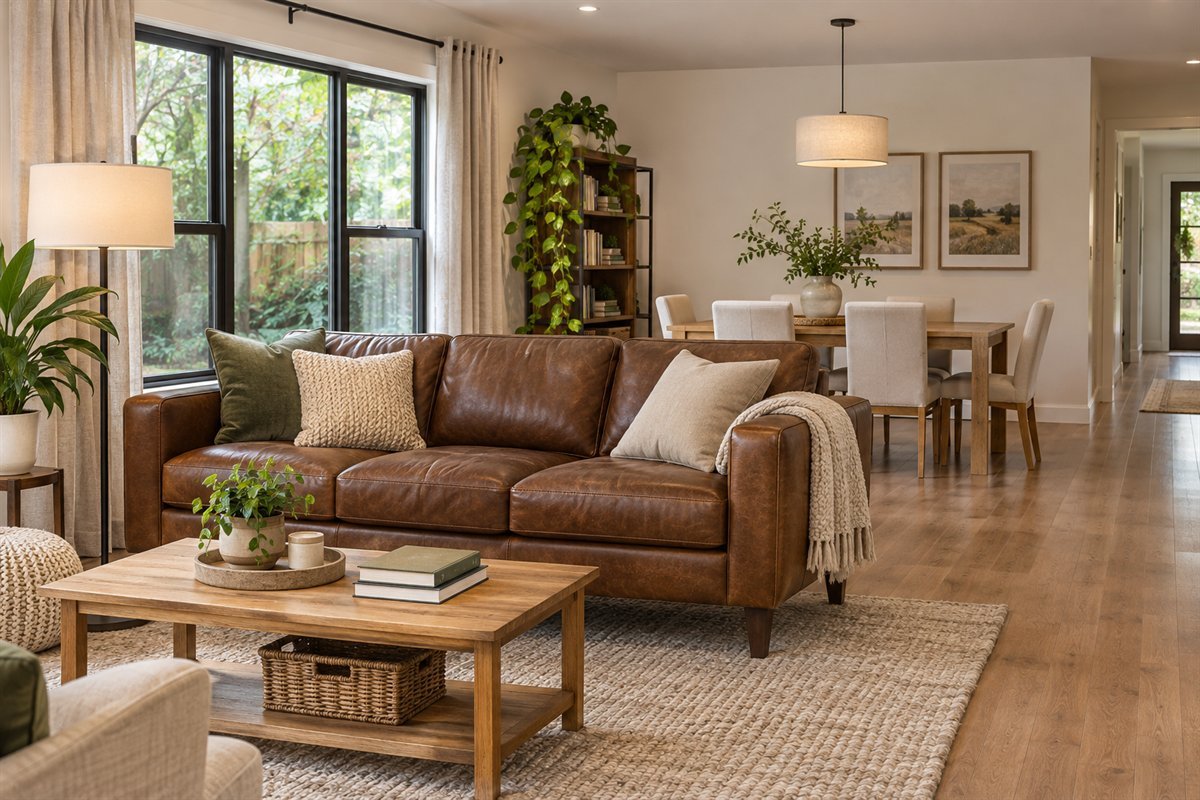
A brown sofa can belong in an open living area without making the dining chairs brown leather too. Repeat a quieter wood, neutral or small accent across the two areas and let their functions remain distinct. Check the view from the dining table as well as the sofa. The back of the sofa may be a more important surface than it is in a wall-based arrangement.
Plan the visible back and the route behind it together.
23. Keep an inherited wood cabinet with a different brown value
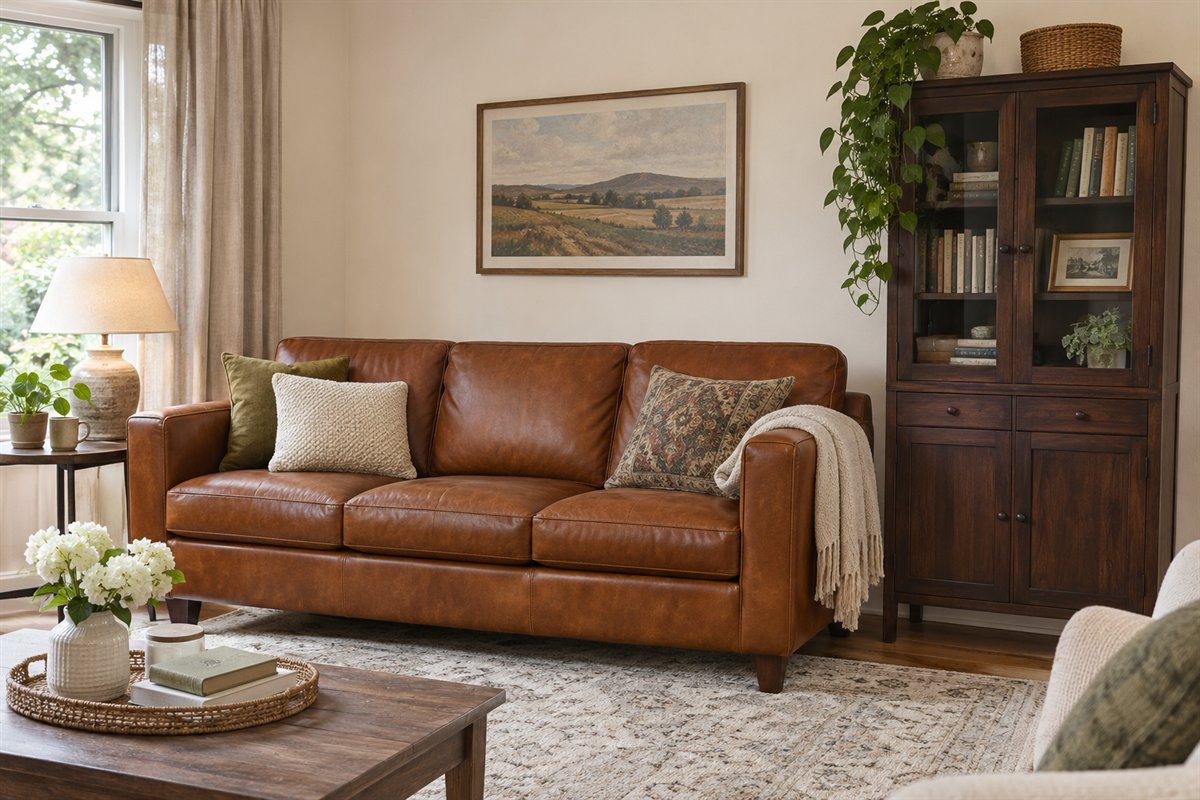
A retained cabinet can add depth without matching the sofa’s shade. Compare its value and red or golden notes beside the upholstery, then use a quieter wall or rug to separate them if needed. Keep the piece for its useful role and condition rather than replacing it only to make a matching suite. The two browns can remain visibly different.
Try the retained cabinet in the finished palette before shopping.
24. Use one pale artwork to give the sofa wall a clear focus

One light artwork can give a dark sofa wall a clear point of attention. Compare its entire background and frame with the upholstery, keeping the composition distinct at the doorway view. Use original or appropriately licensed work and resolve the real mounting separately. A picture in a concept image cannot establish the wall’s capacity or a suitable fixing.
Let one main artwork lead before adding smaller surrounding pieces.
25. Finish by removing one unnecessary repeated brown accent

The last improvement may be a subtraction. If sofa, curtains, rug and every cushion repeat the same brown, compare removing or changing one smaller layer. Keep the useful large furniture in place while judging the result. A clearer difference between two surfaces can do more than a new collection of matching accessories.
Use the retain-and-change sequence below to decide the next useful action.
Use an original retain-and-change sequence for the sofa you own
Start with a record of the real sofa. Note the maker or model if known, dimensions, configuration, visible color, current condition and the exact upholstery information you can verify. Record an unknown as unknown. A room reset is not a reason to guess a leather grade or apply a treatment to make an old seat resemble a generated concept.
Make a second list for the room’s retained pieces: flooring, the most useful cabinet, the other occupied seat, the window treatment and the largest rug. Write why each stays. A functional inherited cabinet might be retained because it stores the household’s daily items, while a damaged rug may already need a separate replacement decision. Keep condition, use and appearance as different questions.
Set out four decisions in order: retain, reduce, compare and defer. Retain the sound useful pieces. Reduce one repeated small layer that makes the whole room difficult to read. Compare a small number of real alternatives for that specific missing role. Defer unrelated purchases until the occupied room has been reviewed. The sequence is intended to prevent one new cushion from becoming a reason to replace everything around it.
For a hypothetical example, keep a sound dark chestnut sofa and a useful walnut cabinet. The existing brown curtains, dark rug and several tan pillows make the sofa difficult to distinguish from the rest of the room. First set aside surplus pillows while keeping the seats usable. Next compare a quiet pale rug candidate with the retained cabinet and floor. Leave the curtain decision open until that larger relationship is clear. This is an illustrative sequence, not a measured client project or a claim about a tested product.
Use the same two ordinary views for each comparison: the entrance and the occupied seat. Review once in available daylight and once with the lamps normally used. Record a plain observation such as the rug background separates the sofa from the floor, or the green cushion disappears at night. A short written observation makes the next decision clearer than a general score about how stylish the room feels.
Keep a purchase record with five fields: item or role, what it must work with, real sample or dimensions checked, care information and decision. A chair candidate needs more than a fabric color; it must fit its occupied location and the way people use the room. A rug candidate needs the actual seating layout and its own product information. A sample borrowed from another room is a useful trial rather than proof that a different product will perform the same way.
After the first change, use the room normally before moving to the next. Keep the sofa and floor constant while judging one new layer. If the intended improvement is already present, stop. The final room can include several different woods and upholstery types as long as their visual and practical roles are clear.
Keep the care record beside the styling plan
Room & Board’s guidance separates cleaning and conditioning by upholstery type rather than treating every brown surface alike. It also advises placement away from direct sunlight and professional help for large or persistent stains. These are reasons to locate the exact care information; they are not approval to use that brand’s named treatment on a different sofa.
Keep the actual maker’s instructions, material description and any professional advice with the sofa record. Follow the directions for that specific furniture and treatment. Do not improvise a universal conditioner, household cleaner, wet-cleaning routine or stain-removal method from a decor photograph.
Appearance decisions remain separate. A pale throw can change the visible balance while leaving a condition issue unresolved. A new wall color cannot repair worn upholstery. Resolve the real condition and care questions on their own terms, then use the room’s remaining budget and retained pieces for the decorative comparison.
What colors can go with a brown leather sofa?
Compare the actual brown with quiet ivory, muted green, slate blue, warm gray or dusty rose. These are color relationships to test, not guaranteed matches. Include the floor and largest retained wood piece in the comparison.
Does a dark brown leather sofa need white walls?
No. A pale wall is one way to create separation, but a deeper room can also work if the sofa, fabric companions and useful lighting remain distinct. Judge the occupied room in its actual light.
Should the chairs match the leather sofa?
They do not have to. A separate fabric chair can provide a different texture while a neutral, wood tone or limited accent connects the pieces. Choose the actual chair through comfort, use and room dimensions.
How can I update the room without replacing the brown sofa?
Keep useful sound furniture, reduce one unnecessary repeated layer and compare one specific wall or textile relationship at a time. The retain-and-change sequence helps keep the first improvement separate from unrelated purchases.
Can I use the same cleaner on all brown leather sofas?
No. Color does not identify upholstery type or suitable treatment. Find the actual material and manufacturer guidance before cleaning or conditioning. Unknown upholstery information should stay unknown until verified.
Do the pictures show exact products or tested leather?
No. They are original illustrated room concepts. Visible color and texture do not establish leather grade, product performance, real-world dimensions or care compatibility.
A practical next step
Keep the sofa’s real shade, configuration and material record at the center of the decisions. Change the surrounding room one useful relationship at a time, and stop when the seating area works comfortably with the pieces worth retaining.
Compare the wall color with retained furniture. Choose a small pillow arrangement for the actual seat. Plan furniture through the occupied room.
Images are original AI-generated decor concepts, not verified installations, named furniture products or evidence of leather composition. The retain-and-change sequence and hypothetical chestnut-sofa example are original planning aids.
Sources and care references
- IKEA: separating sofa size, layout and color choices
- Room & Board: leather-type care distinctions and placement
Optional digital guide for this topic
If you prefer a structured workbook, explore this related paid guide.