Christmas ornament storage ideas should make the next decorating session easier while respecting the ornaments you already own. Start with the real collection: ordinary baubles, long drops, handmade pieces and objects that need their own care instructions. A container’s advertised piece count is less useful than checking whether those particular shapes fit.
These 24 concepts focus on packing positions, a practical storage location and a reliable way to find each group again. Choose the ideas relevant to your collection rather than copying every arrangement. Original AI-generated illustrations show concepts, not tested products, certified preservation materials or a promise that a decorative box prevents damage.
Contents
- 1. Keep suitable original fitted packaging
- 2. Compare divided openings with the whole ornament
- 3. Use shallow removable trays for a visible layer
- 4. Reserve a larger position for an oversized piece
- 5. Give long drops their own shaped opening
- 6. Keep a tree topper separate when it does not fit
- 7. Separate fragile pieces from robust everyday groups
- 8. Keep heavier ornaments in independently supported positions
- 9. Give flat handmade pieces full support
- 10. Let soft fabric ornaments keep their intended shape
- 11. Pair a sentimental ornament with a separate record
- 12. Keep electronic ornament instructions with the right item
- 13. Give loose hangers a contained home
- 14. Group a room display without sacrificing individual fit
- 15. Choose color groups only when that matches your decorating
- 16. Keep a themed set traceable across several boxes
- 17. Create a tray map for a large divided collection
- 18. Use a short box address instead of vague labels
- 19. Choose visibility from the real storage conditions
- 20. Check an under-bed box through its entire movement
- 21. Reserve a closet bay for the complete case
- 22. Keep a manageable carrying unit for a small collection
- 23. Set aside uncertain pieces for advice
- 24. Finish with a contents check and an unpacking plan
Match Christmas ornament storage ideas to the actual collection
Read the care instructions before choosing packing materials. Balsam Hill’s current guide identifies reusable original packaging and containers with divisions as options, with separate accommodation for shapes that do not fit. The Canadian Conservation Institute also emphasizes careful handling of brittle glass and ceramics. Valuable, deteriorating or unusually decorated items may need item-specific advice rather than an ordinary household packing solution.
Choose the first storage decision by the ornament’s shape
- Ordinary round baubles: Compare the complete ornament with a suitable divided opening.
- Long drops or projecting details: Allow a different shaped position without forcing the piece.
- Valued keepsakes: Retain identifiable suitable housing and care information.
- A small mixed collection: Use a modest system with a clear map rather than many anonymous containers.
- Several room displays: Make the unpacking order understandable while keeping each item appropriately housed.
1. Keep suitable original fitted packaging

If an ornament came in packaging intended for reuse, inspect the complete box and insert before replacing it. Keep the item paired with its own housing rather than assuming two similar inserts are interchangeable. A damaged or compressed insert may need a different solution. Store the identifying information where it can still be read without putting adhesive onto the ornament.
Try this: Check the lid closes normally with the ornament in its intended position.
2. Compare divided openings with the whole ornament

Measure more than the round body. A hanger cap, projecting point or other detail can determine whether the whole ornament fits a compartment. Compare the useful internal dimensions with the object in the orientation its maker permits. Do not force a piece below a divider just because the box is advertised for a similar nominal size.
Try this: Check one representative ornament before assigning the rest of that group.
3. Use shallow removable trays for a visible layer

A removable tray can make a working layer visible without repeatedly reaching through a deep container. Check that the tray is intended to be lifted with its contents and has an appropriate supported landing surface. Keep it level during handling. A shallow format is useful only when each ornament’s height and protection requirements still fit.
Try this: Plan where the tray will rest while the tree is being decorated.
4. Reserve a larger position for an oversized piece

An unusually large ornament can dictate the size of an entire box if it is mixed indiscriminately with smaller ones. Give it a suitable separate opening and keep the ordinary baubles in their own compatible system. Account for its complete shape and the packing material required. A bigger empty space should still hold the piece appropriately rather than let it move freely.
Try this: List the few pieces that cannot use your normal cell pattern.
5. Give long drops their own shaped opening

A long drop needs space for its length and delicate ends. Compare a suitably shaped compartment with the actual object instead of laying it diagonally across several ordinary cells. Keep separate pieces from contacting one another, using housing appropriate for their materials and finish. Leave a clear way to lift the piece without pulling on a fragile projection.
Try this: Sketch the outline before choosing a container around the longest item.
6. Keep a tree topper separate when it does not fit

A topper may belong to the same display without belonging in the same small compartments. Use suitable packaging that accommodates its base, points and full depth. Keep its instructions and matching parts identifiable. A separate position can avoid rearranging the entire bauble collection around one awkward object every season.
Try this: Include the topper’s closed-box dimensions in the shelf plan.
7. Separate fragile pieces from robust everyday groups

Different materials and finishes can need different care. A robust everyday group should not be used as loose fill around delicate pieces. Keep the categories distinguishable and follow the instructions for the actual ornaments. The Canadian Conservation Institute notes the impact vulnerability of glass and ceramics; a familiar-looking coating does not make a brittle object unbreakable.
Try this: Identify unknown materials instead of assigning them to a robust group by appearance.
8. Keep heavier ornaments in independently supported positions

An ornament with more weight needs appropriate support through the complete container system. Avoid letting it press on another piece or assuming a soft divider carries a structural load. Check the tray, base and permitted contents together. Place the loaded container where it can be handled comfortably, with its weight clear to the person bringing it out.
Try this: Assess the complete loaded tray before selecting its return shelf.
9. Give flat handmade pieces full support

A flat handmade ornament can be lost or bent when tucked beside round baubles. Choose an appropriate flat enclosure from the piece’s actual materials and condition. Keep any surface decoration from pressing against another object. Paper, fabric, paint and adhesive combinations may require different advice, especially when the item has special value.
Try this: Record which handmade pieces need a distinct packing method before taking down the display.
10. Let soft fabric ornaments keep their intended shape

A fabric ornament may fit into a small gap but still be distorted by a tightly closed lid. Give it suitable room and keep heavier pieces in a different position. Follow its care guidance for any filling, glued decoration or projecting parts. Avoid assuming a vacuum bag or tightly rolled arrangement suits every soft object.
Try this: Compare the unpacked shape with the proposed closed-box space.
11. Pair a sentimental ornament with a separate record

A short record can preserve the story without adding a label to the ornament itself. Note the person or occasion, normal box location and any care information you want to retain. Keep sensitive family details in a private record rather than on a visible outer label. The packing still needs to suit the object, regardless of the record’s sentimental importance.
Try this: Use a simple location code that connects the record to the correct box.
12. Keep electronic ornament instructions with the right item

An electronic ornament can have model-specific shutdown, power, battery and storage instructions. Keep those instructions and compatible accessories paired with the actual item. Follow them before packing; this guide does not prescribe a universal battery-removal or electrical procedure. Do not mix similar-looking connectors simply because the ornaments belong to the same decorative theme.
Try this: Identify each matching accessory before the display is dismantled.
13. Give loose hangers a contained home

Loose hanging parts can disappear into packing material or catch on delicate decoration. Keep suitable removable parts in a contained position that is easy to identify, following the ornament’s instructions about what should remain attached. Avoid mixing unrelated tools into the same compartment. Store the kit appropriately for the household using it.
Try this: Make the hanger kit one of the first items found next season.
14. Group a room display without sacrificing individual fit

A room-based group can make decorating more straightforward when the same ornaments return to the same area. Keep each piece suitably housed within that group, and use a short contents note for pieces stored elsewhere because of size or care. Grouping by location should improve retrieval rather than pressure every object into one container.
Try this: List the exceptions on the room group’s contents card.
15. Choose color groups only when that matches your decorating

Color sorting can help when you regularly change a palette or select only part of the collection. Keep the system broad enough that you can restore it easily. Do not create a new container for every slight shade difference. Physical compatibility and care still determine the packing position, even when the color categories look tidy.
Try this: Retrieve a small coordinated selection without unpacking every group.
16. Keep a themed set traceable across several boxes

A themed set may contain pieces that need different sized housing. Use the inventory to connect them rather than forcing all items into a single standard tray. Record the number you actually own and each storage location. Keep the method simple enough to update when a piece is added, removed or given away.
Try this: Check the complete set from the record before buying a supposed missing item.
17. Create a tray map for a large divided collection

A basic tray map can help a larger collection return to a consistent arrangement. Record only the distinctions needed to identify unusual or easily confused pieces. Keep the map outside the ornament’s contact area and update it when the layout changes. A photograph can supplement the map, but it should describe the actual current arrangement.
Try this: Ask another person to locate one piece using the record.
18. Use a short box address instead of vague labels

A consistent box address can make a collection easier to find when several containers look alike. Connect that address to a simple list of contents and the normal shelf position. Use a label that can be read from the retrieval side. Avoid a complicated coding system when an ordinary descriptive name would work for a small collection.
Try this: Check which face remains visible when the box is put away.
19. Choose visibility from the real storage conditions
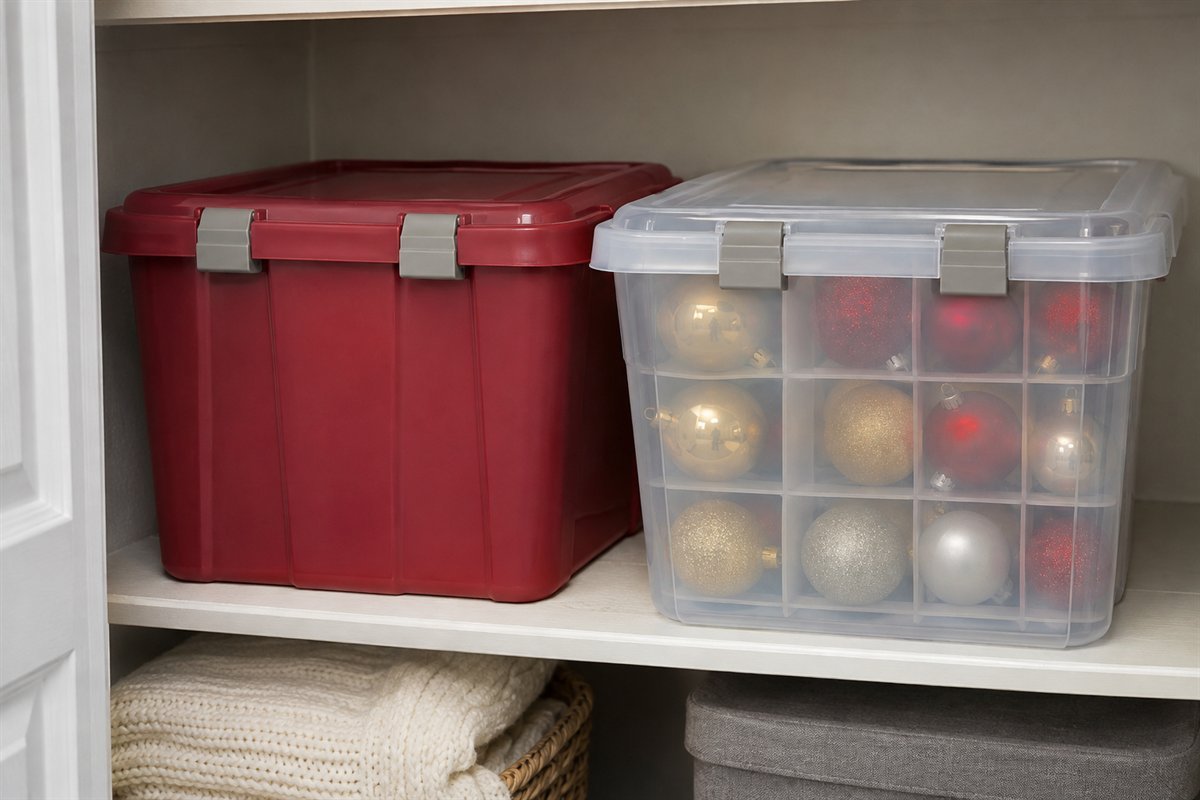
A transparent wall can help identify contents, while an opaque container may be more suitable for controlling unwanted light in a particular storage setting. Balsam Hill cautions about light exposure to colored decorations. Choose the location and housing together; visibility alone does not establish protection from heat, moisture or impact.
Try this: Inspect the actual shelf conditions instead of choosing only from the container’s appearance.
20. Check an under-bed box through its entire movement

A low box can use a suitable under-bed position when its contents and the room conditions allow. Measure the internal packing space and the smallest opening along the removal route. Include handles and the lid, then check where it can be opened on a supported surface. Do not make a fragile collection depend on squeezing a container through a tight gap.
Try this: Rehearse the movement with the actual empty case before loading it.
21. Reserve a closet bay for the complete case
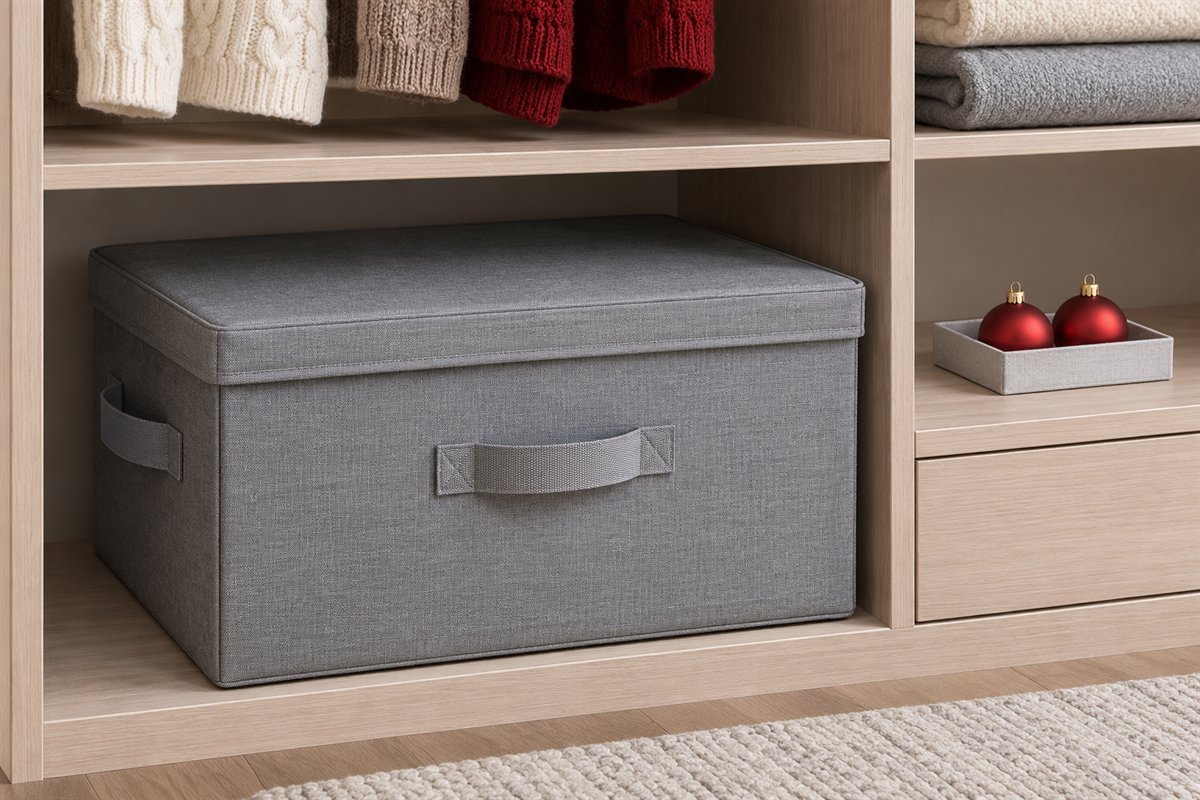
A case needs a return location that stays available after the holiday. Compare the complete stored shape with the closet opening, doors and other belongings. Keep it accessible without removing a heavy stack first. Use the furniture and container instructions for loading and any required restraint; an attractive low shelf is not a tested capacity statement.
Try this: Mark the case’s intended home on the household storage plan.
22. Keep a manageable carrying unit for a small collection

A modest collection may work better in a manageable case than in a large chest with unused capacity. Choose around actual packed dimensions, permitted loading and the way it will be carried. Several smaller compatible units can be worth comparing when a single loaded container becomes awkward. A handle’s appearance alone does not establish what it can carry.
Try this: Consider the ordinary shelf-to-decorating-table route when choosing the unit.
23. Set aside uncertain pieces for advice

A piece with an unknown finish, loose decoration or an old repair should not automatically receive the same packing treatment as the ordinary collection. Keep it identifiable and protected from unnecessary handling while seeking suitable advice. For valued glass or ceramic objects, the Canadian Conservation Institute recommends professional conservation help for repairs rather than improvised gluing.
Try this: Put the question in the record so the uncertainty is resolved before the next display.
24. Finish with a contents check and an unpacking plan

Before returning the collection to storage, check that every retained piece has an appropriate location and the contents record matches. Decide which box should come out first next season. Keep the working surface clear and return small accessories to their defined homes. Use the first repeated retrieval problem to guide an improvement instead of buying another organizer by default.
Try this: Make one current photo of the closed-box arrangement for your private reference.
An ornament-to-container fit worksheet
Start with five columns: item or group, complete dimensions, material or care information, proposed housing and normal storage address. Measure a representative selection rather than counting every object as a standard bauble. Add a separate entry for a topper, long drop or handmade piece that changes the packing requirement.
Compare useful internal dimensions after allowing for the appropriate housing materials and dividers. Check the opening and lid as well as the base. A hypothetical tray with twelve usable cells does not necessarily suit twelve items from a mixed collection: one long ornament may need a different housing position, and another may need more suitable support. This is planning arithmetic, not a tested capacity or packing specification.
Add the closed container’s outside dimensions, permitted loaded weight and retrieval route to the same sheet. Identify where it will be opened and how each removable tray is supported. Keep furniture load limits and container limits distinct. If a container is suitable for stacking, follow its exact instructions rather than transferring that assumption to another similar-looking case.
Finally, write a short unpacking order. Include the hanger kit, any electronic instructions and the location of separately housed pieces. Use a contents list only as detailed as the collection needs. A small reliable system can be more useful than an elaborate record that no longer describes the boxes on the shelf.
Are divided ornament boxes suitable for every decoration?
No. Compare the actual compartment, materials and support with each ornament and its care guidance. Long, heavy, unusually decorated or valuable pieces may need different housing.
Should I keep the original ornament boxes?
Keep suitable packaging intended for reuse when it still fits and supports its own ornament appropriately. Assess its condition instead of keeping a damaged insert simply because it is original.
Can I use these Christmas ornament storage ideas in a small home?
Begin with the retained collection and a modest compatible container system. Test its complete return location and retrieval route, including the place where it will be opened.
A practical next step
Choose Christmas ornament storage ideas from the pieces you intend to keep, then make their locations easy to understand. Appropriate housing, a manageable case and a current contents record can make the next decorating session more deliberate.
Keep wrapping paper and gift supplies in their own workable system. Plan a Christmas tree display for a small living room.
Images are original AI-generated ornament-storage concepts, not tested products, certified preservation systems or verified packing arrangements.
Sources and care references
- Balsam Hill: ornament packaging, dividers and storage conditions
- Canadian Conservation Institute: careful handling and repair advice for glass and ceramics
Optional digital guide for this topic
If you prefer a structured workbook, explore this related paid guide.