Home gym storage ideas should give each retained piece a suitable return position while leaving the room usable. A few carefully chosen holders can serve a small collection better than a large cabinet filled with mixed equipment. Start with the real weights, accessories and instructions, then plan the space needed to retrieve them.
These 25 ideas focus on household equipment storage, rather than exercise technique or structural installation. They complement a sports-kit system but address different shapes, dense loads and equipment-specific parts. Choose only the options that match the collection; the concept images do not establish product compatibility, load ratings or a verified installation.
Contents
- 1. Start with the equipment you actually retain
- 2. Reserve the full retrieval space
- 3. Use a rack made for the dumbbell set
- 4. Keep adjustable dumbbells with their intended bases
- 5. Compare horizontal and vertical dumbbell formats
- 6. Give kettlebells a suitable supported shelf
- 7. Organize plates on a compatible plate tree
- 8. Consider a horizontal plate holder for a small set
- 9. Keep change plates separate from the main stack
- 10. Choose barbell storage for the actual bar
- 11. Use rack attachments only within the system instructions
- 12. Separate band storage from band anchoring
- 13. Give small loop bands a shallow compartment
- 14. Keep jump ropes in a contained return position
- 15. Contain collars as a recognizable set
- 16. Group cable attachments in individual positions
- 17. Store a mat only after its care is complete
- 18. Keep a foam roller from becoming floor clutter
- 19. Give blocks and straps an easy visible home
- 20. Use a cart for suitable light accessories
- 21. Keep clean towels apart from used textiles
- 22. Separate care supplies from equipment storage
- 23. Keep manuals and measurements in one record
- 24. Separate equipment awaiting attention
- 25. Rehearse the complete return routine
Plan home gym storage ideas from equipment requirements
Measure the complete stored equipment and the furniture openings, then check the actual product instructions. Include retrieval space and ordinary circulation in the plan. Keep dense equipment on suitable purpose-built storage. Have floor, wall and attachment suitability assessed appropriately where required; this article does not provide a universal installation or capacity calculation.
Choose a storage format from the equipment
- Matched dumbbell pairs: Compare a purpose-built rack compatible with the complete set.
- Adjustable weights: Retain the intended bases and system instructions.
- Plates and bars: Choose storage designed for their actual dimensions and type.
- Bands and small accessories: Use appropriate relaxed storage with visible individual positions.
- Shared room: Check the parked storage and the complete route during use.
1. Start with the equipment you actually retain

Home gym storage ideas work best when they begin with a real equipment list. Gather the ordinary loose items and note which belong to a larger machine or system. Measure their stored shapes, including handles and cases. Keep the current collection within reach and make a separate decision about unused pieces before expanding the storage.
Try this: List the equipment used during a normal week.
2. Reserve the full retrieval space
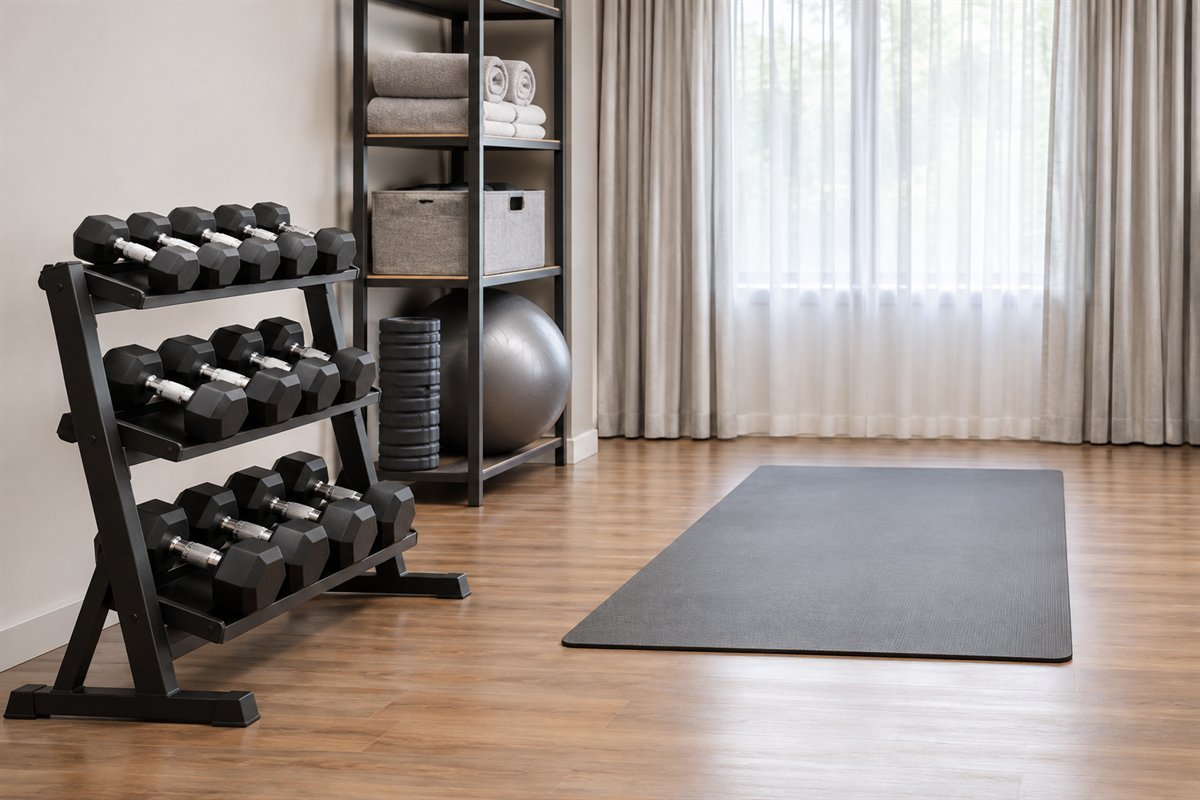
A rack occupies more space in use than its outside dimensions suggest. Allow for the movement needed to approach, grip and replace equipment, as well as the room’s ordinary route. Compare that space with the exact product instructions. A tidy photograph cannot establish a suitable exercise clearance, floor capacity or installation for your room.
Try this: Mark the storage footprint and removal movement before buying.
3. Use a rack made for the dumbbell set

A purpose-built rack can make each dumbbell pair visible without asking an ordinary bookcase to carry a dense load. Compare the rack’s permitted equipment, dimensions and loading instructions with the actual set. Rogue separates dumbbell, plate and barbell storage in its product range; those categories should not be treated as interchangeable furniture.
Try this: Confirm the exact rack and dumbbell compatibility.
4. Keep adjustable dumbbells with their intended bases

Adjustable dumbbells may depend on their particular trays or cradles for selection and return. Keep the complete system together and follow the maker’s instructions rather than transferring the weights into a decorative cubby. Check the usable approach to both handles. Keep unrelated accessories from collecting in the base or interfering with its operation.
Try this: Retain the system identity and current instructions.
5. Compare horizontal and vertical dumbbell formats

A compact vertical stand can fit a different collection from a broad horizontal rack. Compare the spacing between stored weights, the permitted sizes and the stability instructions, rather than selecting from appearance alone. Reaching a lower pair should not require moving another piece or pulling equipment into a doorway. Choose the format for the complete retained set.
Try this: Check every intended pair against the rack specification.
6. Give kettlebells a suitable supported shelf

Kettlebell handles create a different storage outline from dumbbells. Compare a shelf intended for them, with enough usable depth and room to grip the actual handles. Follow the shelf’s installation and load requirements. Do not copy a wooden console arrangement or infer a load rating from the thickness of a pictured shelf.
Try this: Measure the handle as well as the base.
7. Organize plates on a compatible plate tree

A plate tree can keep compatible plates grouped by their normal return positions. Check its intended plate types, peg spacing and loading requirements before planning the arrangement. Keep the removal route clear and follow the manufacturer’s stability guidance. Avoid leaning loose plates against a wall simply because that uses little floor area.
Try this: Compare the largest plate with neighboring pegs and walls.
8. Consider a horizontal plate holder for a small set

A horizontal holder can make a modest plate collection easy to identify. It also uses a continuous length of floor, so check the whole footprint against the room route. Follow the permitted plate and slot requirements. Leave space to retrieve a plate as intended rather than wedging the holder between furniture and a machine.
Try this: Test the layout with the room door fully open.
9. Keep change plates separate from the main stack

Small plates can disappear behind a much larger set. A compatible dedicated position makes the available pieces easier to recognize without dismantling a pile. Compare the permitted attachment and loading requirements of the exact storage system. Keep this arrangement limited to storage; a convenient-looking unused machine fitting is not automatically a storage peg.
Try this: Count the small set before assigning positions.
10. Choose barbell storage for the actual bar

Barbell holders differ in how they support and retain a bar. Compare a product intended for the particular bar dimensions and finish, and allow the full insertion and removal movement. Rogue offers floor, wall and rack-related bar storage formats, but a format’s existence does not confirm that it suits every bar or room.
Try this: Check the bar’s instructions alongside the holder’s.
11. Use rack attachments only within the system instructions
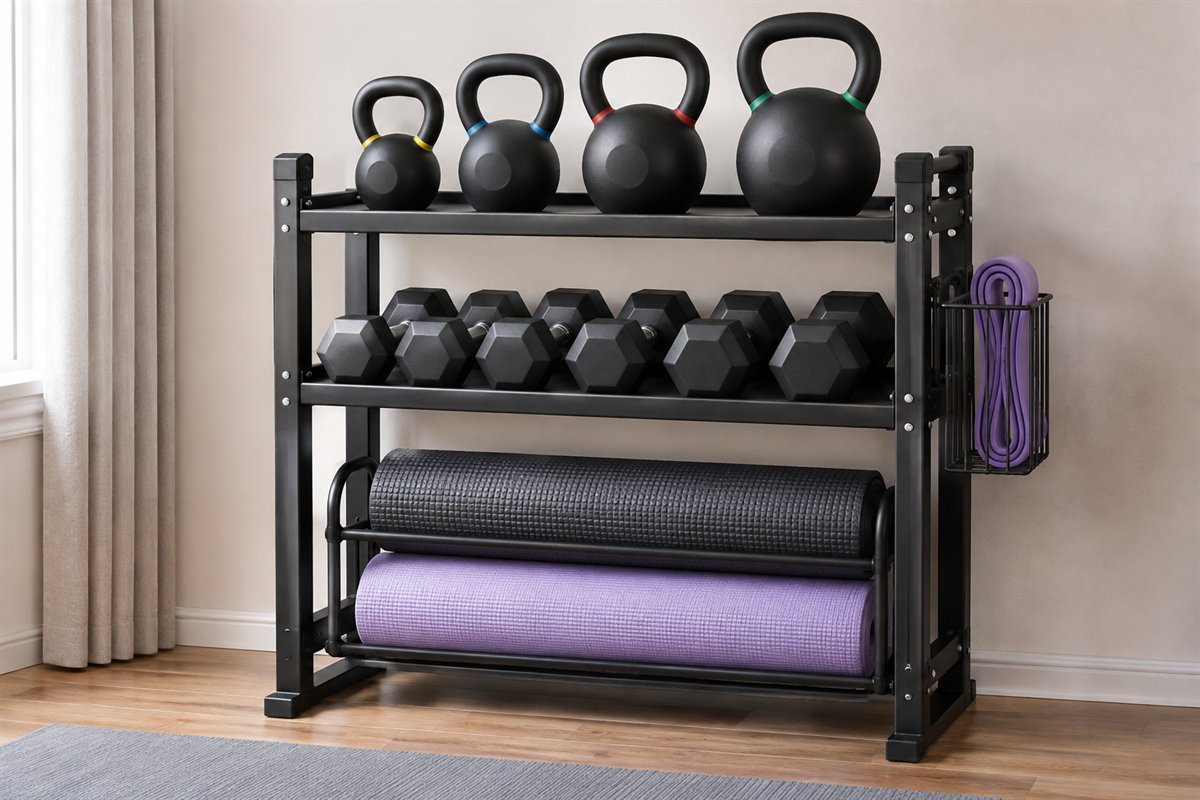
An approved storage attachment can make use of a compatible rack system. Confirm the exact model, permitted attachment position and effect on the rack’s use before planning around it. Keep exercise and adjustment areas clear. Do not assume that similar hole spacing or an attractive photograph establishes compatibility between unrelated products.
Try this: Record the actual attachment model in the equipment list.
12. Separate band storage from band anchoring

Storage hangers and exercise anchors have different jobs. Keep bands relaxed in a method allowed by their maker and inspect their condition as instructed. Rogue describes its belt-and-band hanger as lightweight accessory storage. That description does not make an ordinary hook suitable for an exercise load or every band material.
Try this: Keep the storage location distinct from any approved exercise anchor.
13. Give small loop bands a shallow compartment

Small loop bands can occupy a shallow compartment when that suits their material and care instructions. Keep them identifiable and easy to remove without tightly stretching them around a divider. Choose divisions from the actual set rather than creating a deep mixed bundle. Leave pieces awaiting a condition check outside the ready group.
Try this: Return each band in its permitted relaxed shape.
14. Keep jump ropes in a contained return position
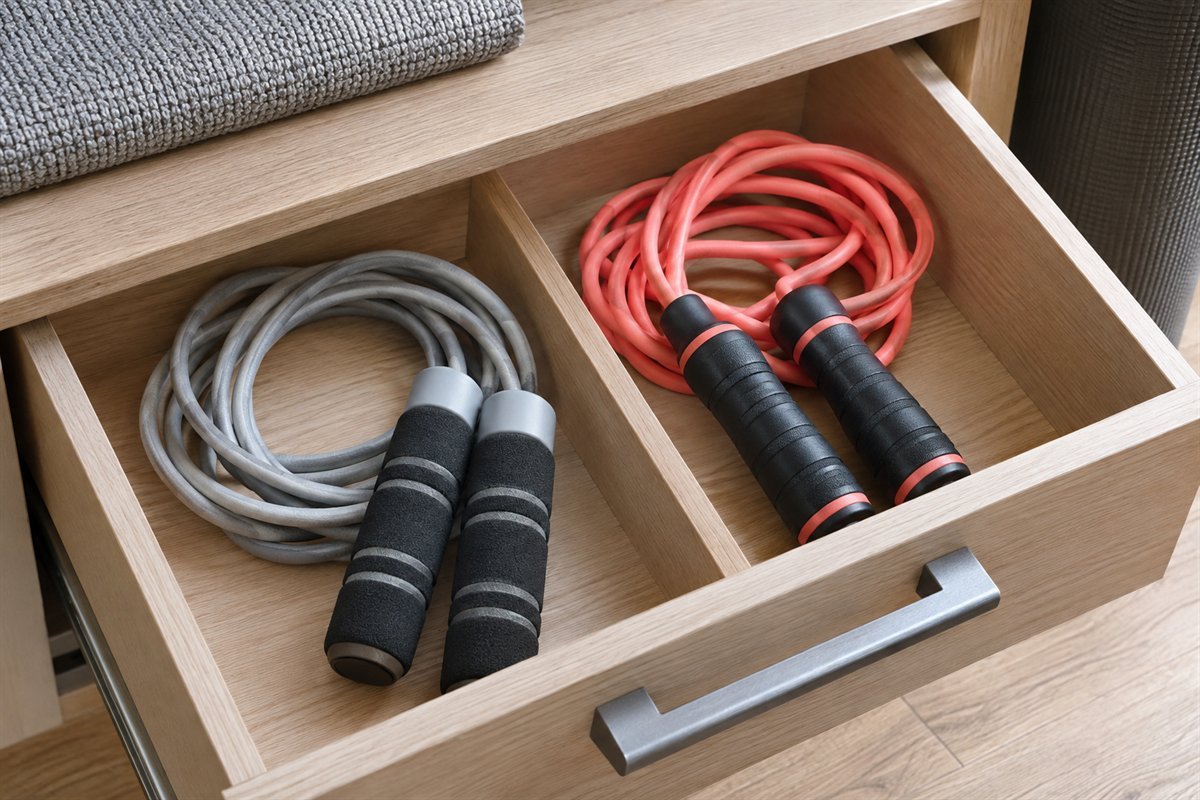
A rope and its handles can be kept together without trailing across the floor. Follow the product’s allowed coiling and care method, and give the complete shape enough room. A purpose-made hanger or a suitable drawer may work for different products. Keep the result easy to remove without pulling another accessory down.
Try this: Check that no loose length crosses the walking route.
15. Contain collars as a recognizable set

Collars and other small compatible parts need a defined home so they do not disappear among towels and bands. Keep their identity with the equipment record and use a container suited to their actual shape. Do not mix incompatible parts simply because they look alike. Make the complete set visible before the next session.
Try this: Return the paired parts together.
16. Group cable attachments in individual positions

Cable handles and removable attachments can be awkward when piled together. Give compatible pieces separate supported positions with room for their full outlines. Follow the equipment’s instructions for removal and storage, and keep loose connections contained. A storage arrangement should not require reaching behind an operating machine to retrieve the next attachment.
Try this: Match each accessory to its actual equipment system.
17. Store a mat only after its care is complete

Choose rolling, folding and storage from the exact mat’s instructions. Manduka’s GRP guidance, for example, requires full drying before rolling and storage; that is product-specific guidance rather than a rule for every material. Give the ready mat a position separate from sharp or dense gear. A closed attractive basket does not complete its care.
Try this: Read the mat instructions before choosing a holder.
18. Keep a foam roller from becoming floor clutter

A foam roller can have its own supported return position instead of resting where someone walks. Compare the full diameter and length with the opening and retain enough room to grip it. Follow its material-care requirements. Avoid squeezing it under weights or treating a roller as a stop that keeps a heavier item from moving.
Try this: Remove the longest roller without shifting another object.
19. Give blocks and straps an easy visible home

A small group of ordinary blocks and straps can stay visible in one appropriate compartment. Keep the soft item separate from sharp or dense equipment and preserve its permitted storage shape. Choose enough space for both blocks without balancing them at a shelf edge. Return only items whose required care is complete.
Try this: Check the complete set before adding more dividers.
20. Use a cart for suitable light accessories
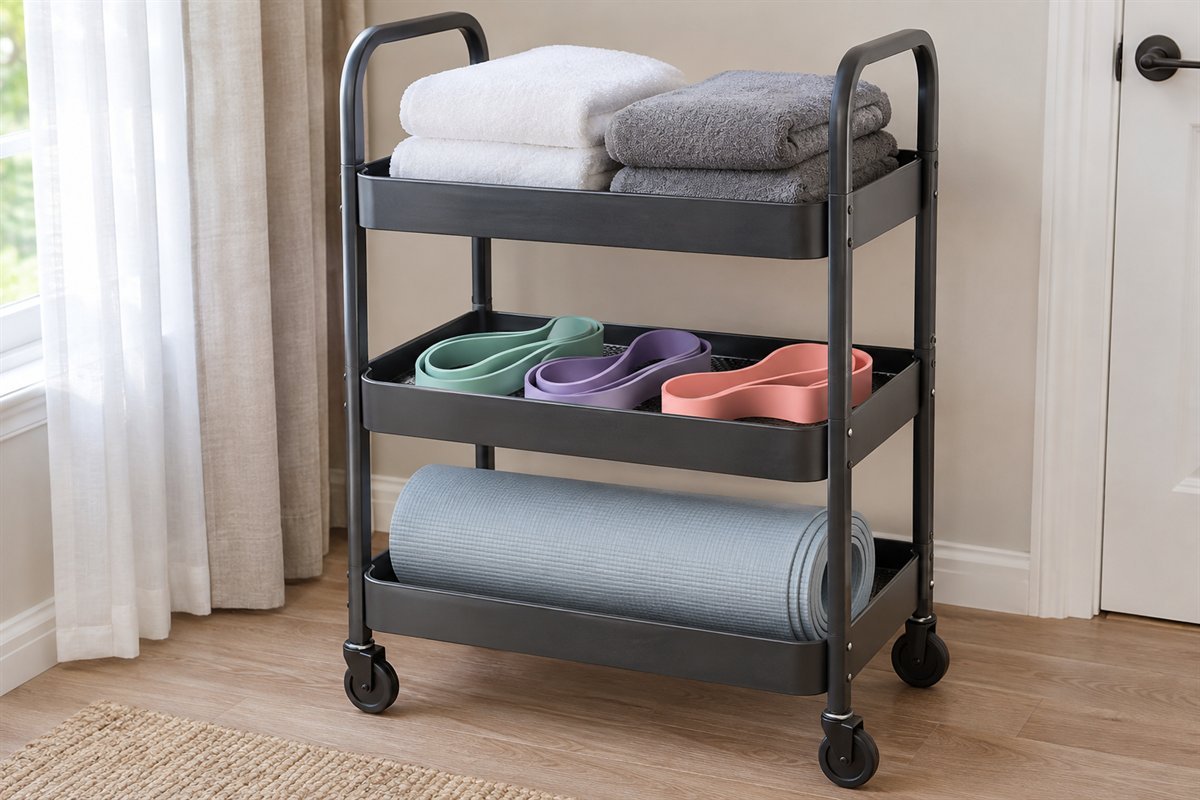
A cart can suit a limited collection of light accessories when its permitted load and storage instructions fit the contents. Keep weights and other dense equipment on storage intended for them. Check where the cart parks and how it moves through the room. Follow the cart’s wheel and stability instructions rather than assuming that locking a wheel solves every layout problem.
Try this: Keep the normal parking position out of the exercise route.
21. Keep clean towels apart from used textiles

Clean towels need a recognizable ready position, while used textiles need their own next step. Keep the accessible stack proportionate to the actual routine rather than filling the entire storage unit. Follow the textile care labels and complete the household laundry process. Keep the used-item handoff from turning into permanent overflow beside the equipment.
Try this: Give clean and used items different return locations.
22. Separate care supplies from equipment storage

Equipment-care products belong in storage appropriate to their own labels and household access needs. Keep them separate from ready textiles, small accessories and surfaces where they could spill. Retain original product identification and the equipment maker’s compatible-care instructions. Do not infer a universal cleaner or disinfection procedure from a tidy home gym image.
Try this: Record the actual approved care product with its instructions.
23. Keep manuals and measurements in one record

A short equipment record can prevent guessing when the collection changes. Record product identity, stored dimensions, intended holder, permitted loading information and the location of its instructions. Keep unknown ratings explicitly unknown. A generic storage photograph cannot establish floor capacity, wall suitability or structural attachment requirements for a particular home.
Try this: Save the exact manual before changing the layout.
24. Separate equipment awaiting attention

Give an item awaiting inspection, replacement or another decision a distinct appropriate holding location. Record the next action so it is not casually returned to the ready group. Organization does not demonstrate fitness for use, and a storage article cannot assess an unidentified mechanism or material. Follow the maker’s inspection and service guidance.
Try this: Keep the unresolved item outside the normal ready position.
25. Rehearse the complete return routine

Test the proposed storage by collecting one ordinary set and returning it afterward. Notice which pieces have no obvious home, which openings are awkward and which positions interfere with circulation. Change those specific problems before adding another organizer. Useful home gym storage ideas make the retained collection understandable in the actual room, even when a piece is being used.
Try this: Review the return routine whenever equipment changes.
A practical equipment and storage worksheet
Make one row for each equipment type: identity, retained quantity, stored shape, intended holder, required manual and next action. Add the actual permitted loading or compatibility information only when it is established by the relevant product documentation. Do not convert a shelf’s attractive appearance into a weight rating.
Measure the holder and the room together. Include doors, drawers, handles, projecting plate pegs and the movement used to retrieve a piece. A hypothetical rack that fits one wall may still obstruct the door or leave an awkward approach. This is a planning example, not a universal clearance recommendation.
Separate the storage tasks. Dense weights, light accessories, clean textiles and items awaiting care do not all need the same container. Keep the ready group distinct from unresolved equipment. The system should explain where an item goes after use as clearly as it explains where to find it before starting.
For a shared living space, rehearse the complete change between ordinary room use and the equipment arrangement. Choose a stable, intended parking place for suitable movable storage. Do not improvise mobility, hanging or folding for equipment that was not designed for it.
Finally, review the worksheet before buying another organizer. A missing return position may need a smaller category or a different holder rather than a larger collection of furniture. Keep product instructions accessible and reassess the plan whenever the equipment changes.
Can I use an ordinary bookcase for home gym weights?
Use storage intended and rated for the actual equipment. A decorative bookcase or cabinet should not be assumed suitable for dense weights from appearance or outside dimensions.
Can a band storage hook be used as an exercise anchor?
Storage and exercise anchoring have different requirements. Follow the exact equipment and anchor instructions; a lightweight accessory hanger does not establish an approved exercise attachment.
Which home gym storage ideas suit a small room?
Start with the retained collection and compare purpose-built compact formats. Include retrieval space, door movement and ordinary circulation, rather than selecting only the smallest advertised footprint.
A practical next step
Choose home gym storage ideas that fit the actual equipment and its instructions. Keep weights on suitable dedicated storage, give light accessories clear return positions and test the complete room route before expanding the system.
Organize sports kits and the departure-to-return routine.
Images are original AI-generated home equipment storage concepts, not photographs of tested racks, certified installations or verified load capacities.
Sources and care references
- Rogue Fitness: distinct storage formats for weights, bars and accessories
- Rogue Fitness: belt-and-band hanger intended for lightweight accessory storage
- Manduka: product-specific GRP mat drying and storage guidance
Optional digital guide for this topic
If you prefer a structured workbook, explore this related paid guide.