Good ironing board storage ideas account for the board you already own and the movement needed to use it. A folded board can fit into a narrow gap yet still be frustrating to retrieve when its legs catch a shelf or the room door must stay closed.
Start with the board fully folded according to its instructions. Measure its widest, tallest and deepest parts, including the feet and iron rest. Then compare where you iron with where the board will return. These 22 concepts address that storage sequence rather than treating every slim wall space as a finished solution.
Contents
- 1. Choose a home close to the actual ironing route
- 2. Give a full-size board its own tall cabinet bay
- 3. Compare a purpose-made wall holder
- 4. Match the hanger to the folded leg arrangement
- 5. Use a compatible over-door board organizer
- 6. Use an appropriate closet side wall
- 7. Build a narrow bay beside laundry cabinetry
- 8. Compare a manufacturer-designed pull-out system
- 9. Consider a complete fold-down wall product
- 10. Store a tabletop board from its intended hanger
- 11. Divide a shared utility cupboard clearly
- 12. Check a wall position behind the room door
- 13. Conceal the board in a multipurpose-room cabinet
- 14. Keep the iron's cooling position distinct
- 15. Plan a separate shelf for a steam-station base
- 16. Contain the cord after the appliance is ready for storage
- 17. Give a sleeve board a smaller dedicated position
- 18. Keep spare covers dry and easy to identify
- 19. Leave room for the hand that retrieves the board
- 20. Coordinate the visible cover with a restrained palette
- 21. Test existing storage before adding a new cabinet
- 22. Finish with a repeatable put-away sequence
Plan the folded board and the appliance separately
Check the board's folded mechanism and intended storage method, plus the holder's compatibility, wall or door requirements and rated use. A holder designed for one leg arrangement may not fit another. Keep the iron's shutdown and cooling routine separate: Rowenta's care guidance calls for unplugging and cooling before ordinary storage, while specialist heat-resistant holders have their own product conditions. A decorative basket or ordinary shelf is not an equivalent heat-resistant holder. Follow the exact appliance and storage-product instructions, and do not infer heat resistance from an image.
Choose an arrangement that fits your situation
- Full-size freestanding board: Compare a dedicated tall bay or a holder explicitly compatible with the folded frame.
- Very small shared room: Test both the stored footprint and the full operating space before choosing a compact or fold-away product.
- Steam station: Allow a separate appropriate position for the complete cooled base, hose and iron.
- Door-based organizer: Check the door, load, closure and movement against the exact product instructions.
1. Choose a home close to the actual ironing route

Observe where the board is normally carried, opened and returned. A storage position near that route can reduce the number of objects moved before the task begins. Try retrieving the folded board without rearranging baskets or opening several cupboards. If the convenient-looking position adds an awkward turn through a doorway, compare another location before purchasing hardware that commits you to it.
2. Give a full-size board its own tall cabinet bay

A tall compartment can conceal the board while making its purpose obvious. Size the usable opening from the real folded shape, including the projecting feet. Allow space to grip and lift the board without scraping the cabinet sides. Keep the bay focused instead of placing loose bags at its base, where they can interfere with the return movement after each use.
3. Compare a purpose-made wall holder

A wall holder can free useful floor area when the exact board, holder and wall are compatible. Read the complete fixing and loading instructions before choosing the location. Check which part of the folded board the holder supports and how it is released. Do not substitute decorative adhesive hooks simply because the board appears light or the wall finish looks easy to attach to.
4. Match the hanger to the folded leg arrangement

Photograph the back of the folded board and compare its frame with the storage product's stated compatibility. T-shaped and other leg designs do not necessarily sit on the same hooks. Check the balance and removal method described by the manufacturer rather than forcing the frame into an attractive accessory. A small compatibility check can prevent buying a holder that never supports the board as intended.
5. Use a compatible over-door board organizer

An over-door product may suit a door that meets its specifications and still operates properly with the load attached. Compare door thickness, top clearance and the board's movement on both sides of the doorway. Follow the product's restrictions. If it makes the door difficult to close or sends the board into neighboring furniture, choose a different position instead of accepting that conflict as the price of saving floor space.
6. Use an appropriate closet side wall

The side of a utility closet can offer a storage plane that does not consume the central shelf opening. Check the actual wall construction and the holder's requirements before fixing anything. Test the board with the closet's usual contents in place. Hanging it where it overlaps coats, vacuum attachments or the light switch can make a tidy photograph less useful during the daily routine.
7. Build a narrow bay beside laundry cabinetry

A planned tall bay can integrate the board into a larger cabinet arrangement. Resolve the folded dimensions, support and access before selecting the door finish. Keep appliance installation and service requirements outside the storage footprint. The bay should remain usable when a nearby washer door or drawer is open, rather than fitting only in the empty-room drawing with every front closed.
8. Compare a manufacturer-designed pull-out system

A pull-out ironing system is a different product choice from storing a freestanding board in a drawer. Compare its intended cabinet dimensions, supports, loading and operating instructions. Check the full extension and any rotation movement in the room. The convenience depends on having space to use and stow the complete system, not merely finding a drawer front wide enough to conceal it.
9. Consider a complete fold-down wall product

A purpose-designed fold-down board can suit a permanent ironing position when the wall, installation and room are appropriate. Compare the whole open and closed arrangement before committing. Use the manufacturer's fastening and operating guidance rather than improvising a board from a shelf and hinges. Keep the open board outside the room's essential route and give the closed front enough space to move freely.
10. Store a tabletop board from its intended hanger

A compact tabletop model may include its own hanging or folded-storage feature. Use that feature only as its instructions allow and compare the folded feet with the cabinet space. Keep the actual ironing surface requirement in mind when choosing the board. A smaller stored footprint is useful only if the product also suits the garments and approved supporting surface used during ironing.
11. Divide a shared utility cupboard clearly

A cupboard can hold several household categories without letting them spill into the board's bay. Use a defined divider or separate compartment that preserves the full retrieval path. Keep cleaning products in their own appropriate labeled storage, following their instructions. Do not rest bottles or loose tools against the board simply because the tall compartment happens to have unused space at the bottom.
12. Check a wall position behind the room door

The wall behind a door may work only if the board and holder stay clear throughout the door's normal travel. Include the handle and projecting feet in that check. Keep any required route and controls available. If the arrangement restricts opening or depends on someone remembering a special door position, compare a different storage site instead of treating hidden space as automatically usable.
13. Conceal the board in a multipurpose-room cabinet

When ironing happens in a guest room or sewing room, a dedicated closed compartment can return the space to its other role. Choose cabinetry that fits the board without displacing the room's main storage. Keep retrieval straightforward when the guest bed, desk chair or sewing table is in ordinary use. A hidden board still needs a workable route out of the cabinet.
14. Keep the iron's cooling position distinct

The board's storage location need not be the iron's immediate resting place after use. Follow the appliance's shutdown, cooling and storage guidance before moving it into ordinary cabinetry or a container. Plan the appropriate supervised cooling arrangement for the exact equipment. Do not assume a fabric-lined basket, wood shelf or decorative wall rack can hold a hot soleplate because it coordinates with the room.
15. Plan a separate shelf for a steam-station base

A steam station has a larger stored footprint than a conventional iron, and its base, hose and handle all affect access. Measure the complete unit in its permitted stored arrangement. Follow its cooling and transport instructions before putting it away. Choose a shelf and cabinet appropriate for the equipment rather than trying to force the base into the shallow space originally planned for an iron alone.
16. Contain the cord after the appliance is ready for storage

A loose cord can catch the board frame or get trapped in a closing door. Use the appliance's own cord-storage method when the unit has cooled as directed. Check that the complete stored arrangement leaves the cord undamaged and away from pinch points. Avoid wrapping it around a hot soleplate or pulling it tight simply to make the shelf look more orderly.
17. Give a sleeve board a smaller dedicated position

If the household uses a sleeve board, plan for it as a separate accessory rather than balancing it on top of the folded full-size board. Compare its actual shape with a stable shelf or intended hanging feature. Keep it easy to identify and retrieve without disturbing the main board. Retain the accessory only when it serves the garments and routine you actually use.
18. Keep spare covers dry and easy to identify

Store a clean dry replacement cover in a simple separate compartment after following its care instructions. Keep any label or model information that identifies the board it fits. Avoid stuffing the cover into the folded leg mechanism, where it interferes with opening and put-away. The accessory should support a future change, not become another object removed before every ordinary ironing session.
19. Leave room for the hand that retrieves the board

Compare the space around the part of the board you actually grip, not only the tightest possible cabinet dimensions. Try the lifting and turning movement described by the board and holder instructions. A bay can be technically wide enough yet uncomfortable to use because adjacent shelves fill the approach. Keep that grip area clear rather than filling every remaining strip with another organizer.
20. Coordinate the visible cover with a restrained palette

If the board remains visible, a replacement cover compatible with the exact model can connect it to the room's colors. Choose fit and permitted use before pattern. A simple neutral or muted textile can make the stored board feel less visually busy without concealing the mechanism. Do not add a loose decorative drape that tangles in the legs or hides the storage support.
21. Test existing storage before adding a new cabinet
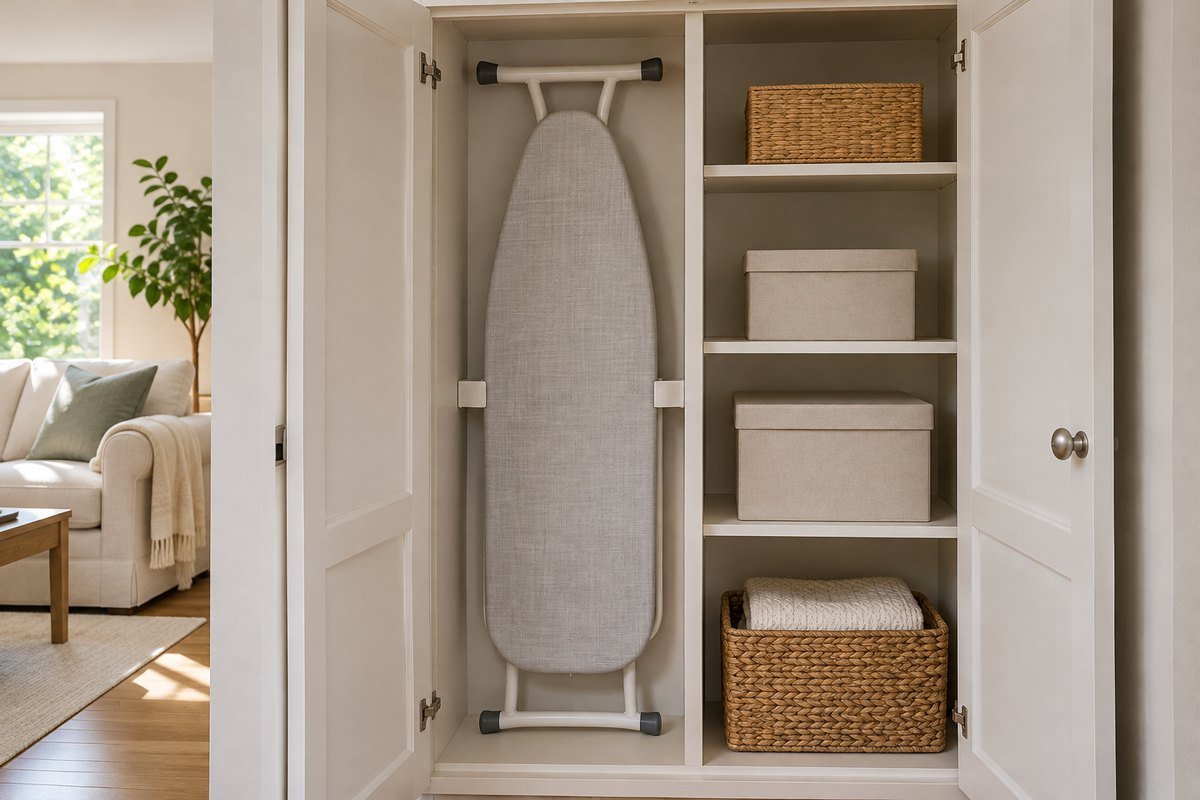
Empty a possible compartment and compare the complete folded board with the opening, internal depth and retrieval movement. Reassign a few rarely used objects if that creates a better position without new furniture. Check the actual support and intended storage method rather than leaving the board loosely wedged between objects. A useful existing space can be a better answer than another narrow cabinet in a crowded room.
22. Finish with a repeatable put-away sequence

After the board and appliance are ready to store according to their instructions, return each to its defined position and clear the route. Review the arrangement after several ordinary sessions. If the board repeatedly stays behind a door or across the room, notice the specific obstacle. Improve that grip, opening or storage location before adding more accessories around a system that remains difficult to finish.
A board-fit and access checklist
Record the folded height, widest frame width, foot projection, total depth and weight from the product information. Note the intended support point and compatible holder type. Measure the usable cabinet or door opening, handle movement and grip space. Separately record the iron or steam station's shutdown, cooling and stored-position instructions. Test the complete carry, retrieval, opening and return sequence before buying a cabinet or fixing a holder. Recheck the plan when the board or appliance changes.
A practical next step
Choose ironing board storage ideas from the board's folded shape and the household's real routine. Give the frame dependable compatible support, preserve a straightforward grip and keep appliance cooling separate from ordinary storage. A modest arrangement that resets easily can serve the room better than a tightly packed cabinet that makes every session harder to begin.
For the surrounding room, plan the separate laundry folding task. Compare laundry room shelving arrangements.
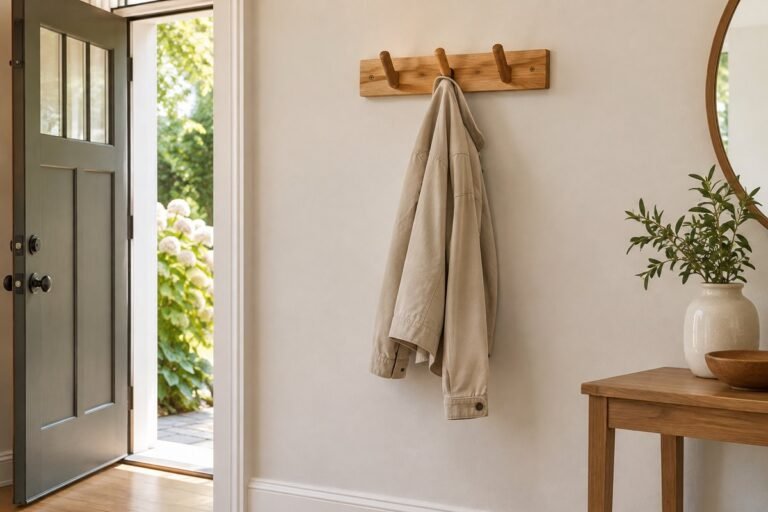
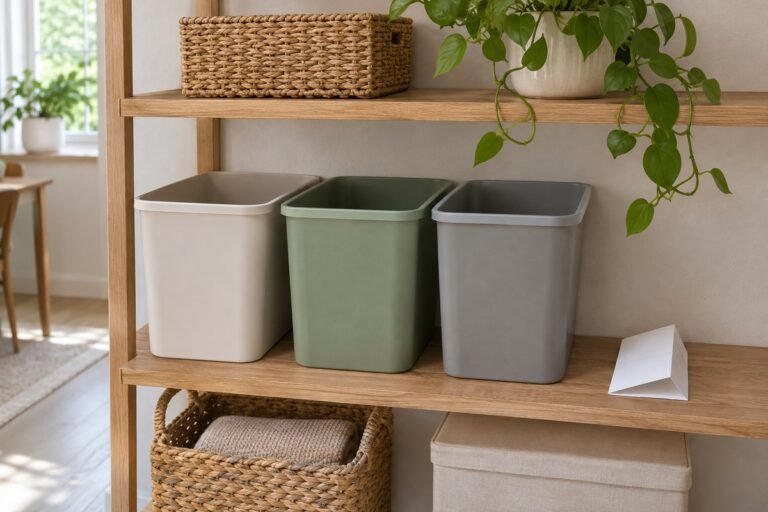
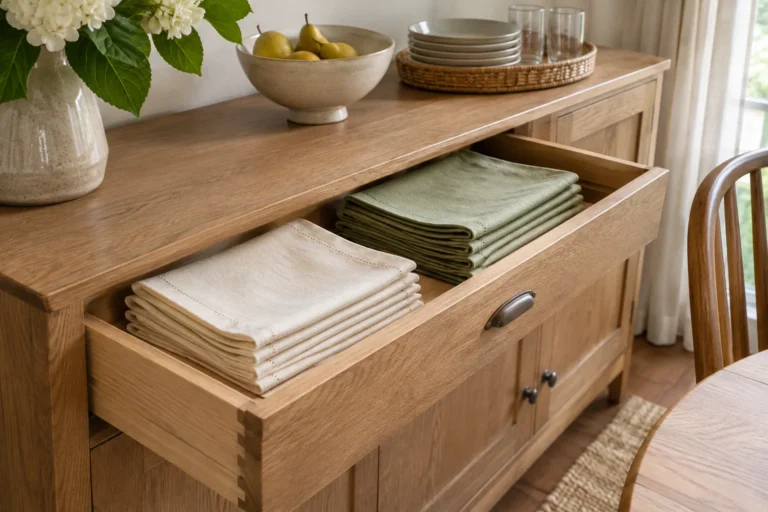
The images are original AI-generated design concepts, not photographs of tested products or verified installations.
Sources and care references
- Rowenta: iron shutdown, cooling and storage guidance
- Brabantia: a purpose-made iron and board holder with product-specific compatibility
Optional digital guide for this topic
If you prefer a structured workbook, explore this related paid guide.