
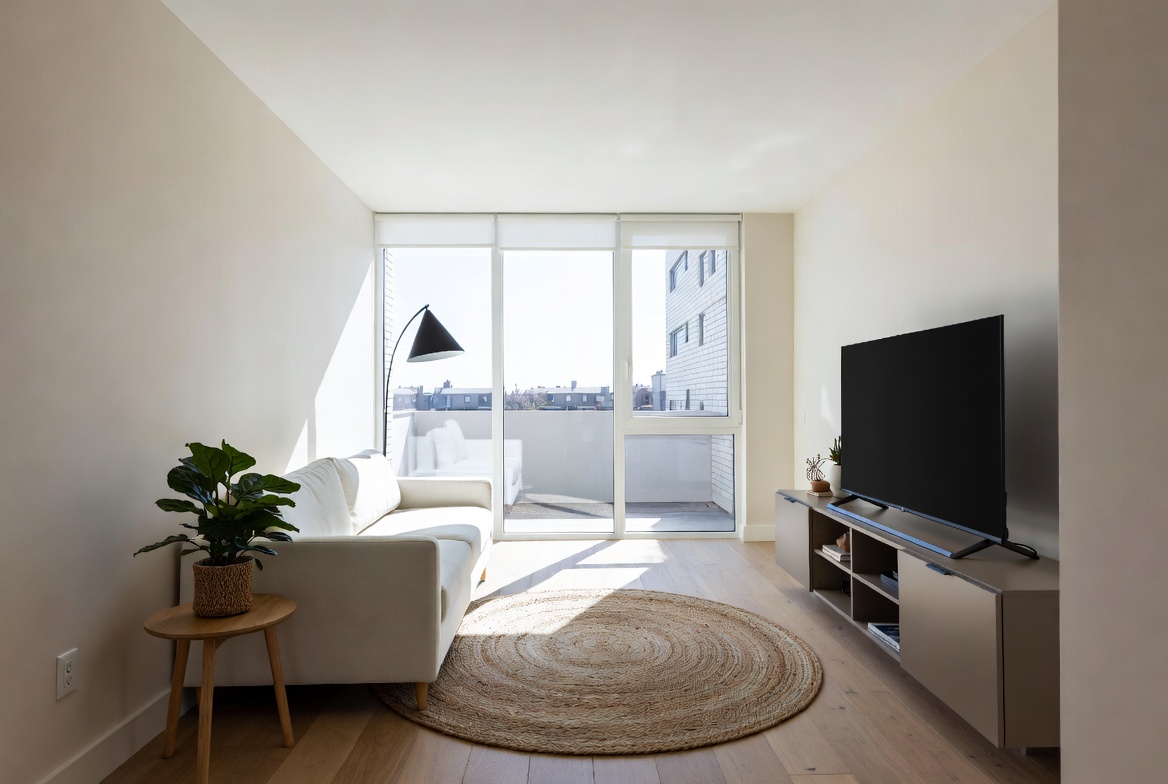
Small living rooms are one of the most common design challenges — and one of the most solvable. The right furniture choices, smart spatial tricks, and a disciplined approach to what stays and what goes can make even the smallest living room feel open, stylish, and genuinely comfortable. Here are 22 ideas that actually work.
1. Choose Light Paint Colors to Open the Space
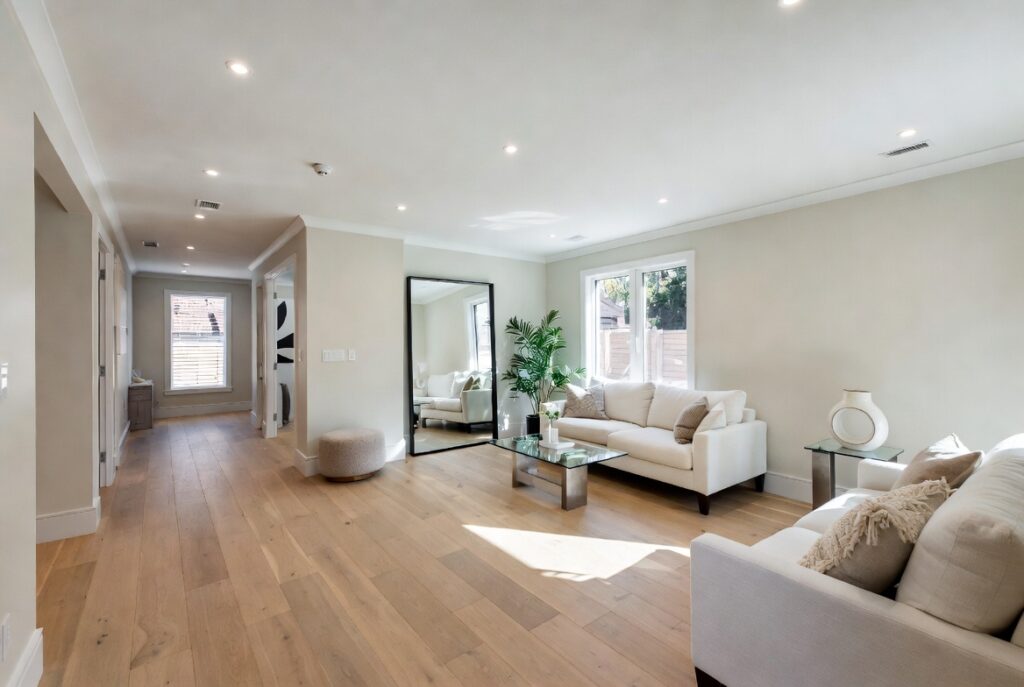
Light colors — warm white, soft cream, pale greige — reflect more light and make walls appear to recede, creating a sense of more space than the room actually has. This is the cheapest and most effective small room intervention available.
Go for warm-undertone light colors rather than cool whites — they reflect light while keeping the room feeling welcoming rather than clinical. Test a large swatch at morning and evening before committing.
Smart tip: Paint the ceiling the same color as the walls — it removes the visual “cap” that makes rooms feel lower and smaller.
Mistake to avoid: Choosing a pure, cold white — it reflects light but feels harsh and makes imperfections in walls more visible.
2. Use One Large Sofa Instead of Multiple Pieces
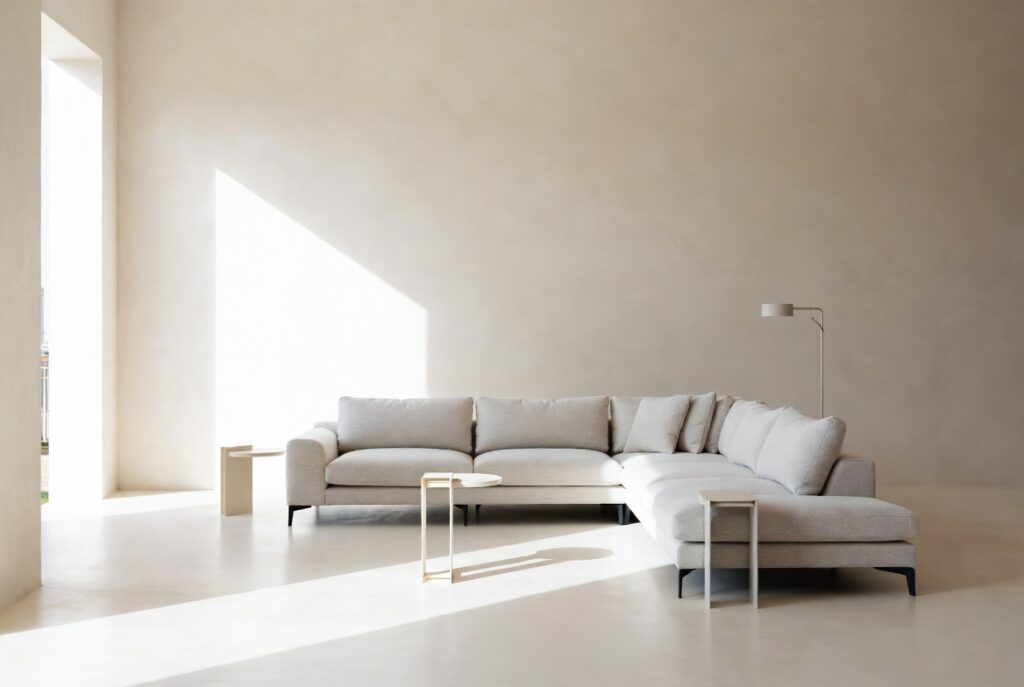
The instinct in a small room is to use small furniture — but one large sofa actually creates more perceived space than three smaller pieces. Multiple pieces fragment the visual field and multiply the number of legs, edges, and gaps that signal cramped conditions.
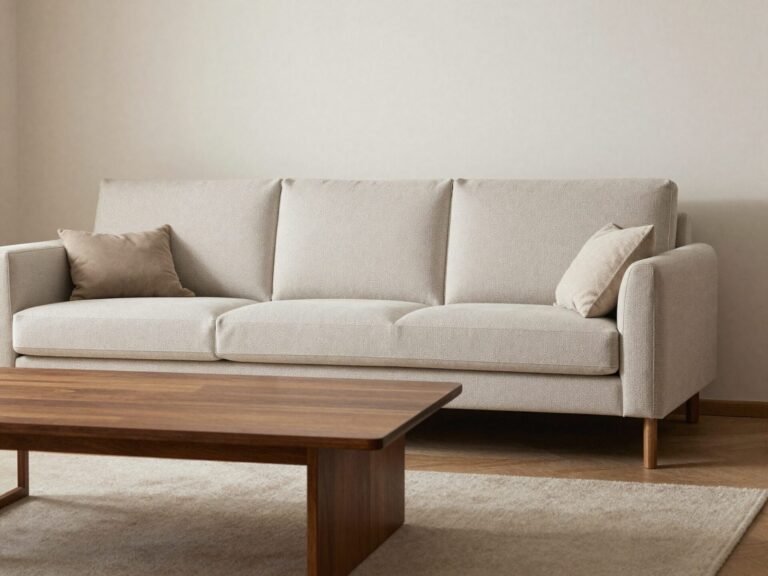
A single large sofa with clean lines, positioned against the longest wall, keeps the floor as clear as possible and gives the room one strong, clear anchor.
Smart tip: Choose a sofa in the same tone as the walls to reduce visual contrast and make it read as part of the room rather than an obstacle in it.
Mistake to avoid: Filling every wall with furniture — one strong sofa and one accent chair is almost always enough for a small living room.
3. Pick Furniture with Visible Legs
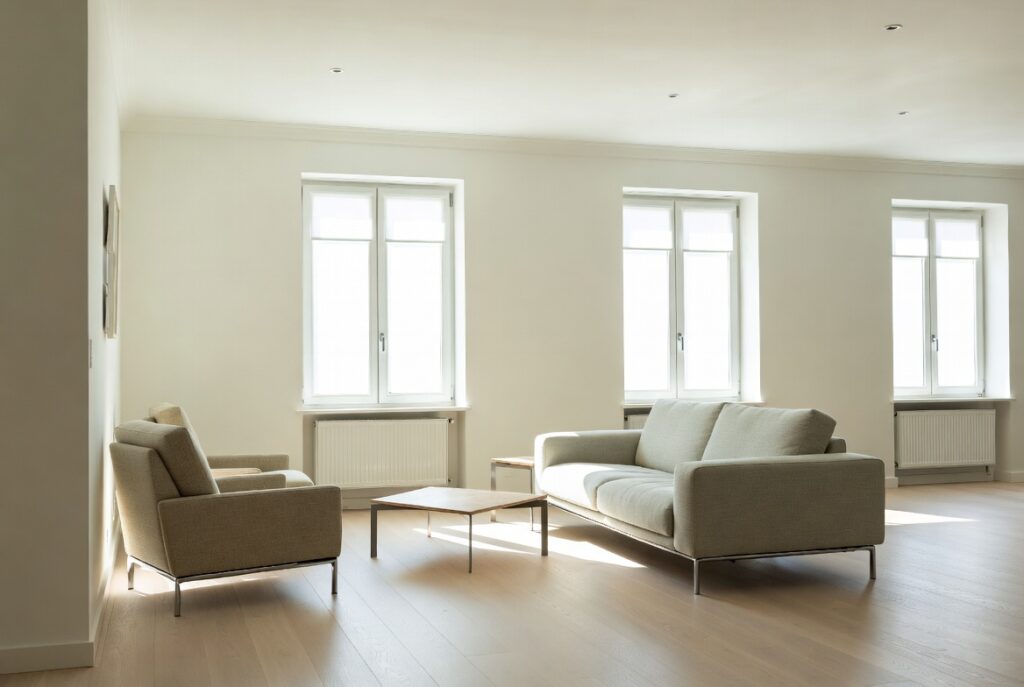
Furniture that sits directly on the floor creates visual weight and blocks the sight line at floor level — making the room feel more crowded. Furniture on legs allows the eye to see the floor beneath, which reads as continuous open space and makes the room feel significantly larger.
This applies to sofas, armchairs, side tables, and storage units. Even 10cm of visible floor beneath a sofa creates a noticeably more open feel.
Smart tip: The higher and thinner the legs, the lighter the furniture appears — tapered wooden or metal legs are ideal for small rooms.
Mistake to avoid: Using platform sofas or furniture that sits flush to the floor in a small living room — it visually reduces the available floor area significantly.
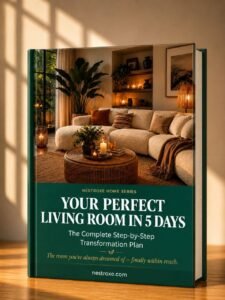
Loving These Ideas? Get the Step-by-Step Guide
Grab the full 5-day eBook and turn these ideas into a finished room.



4. Hang a Large Mirror to Double the Space
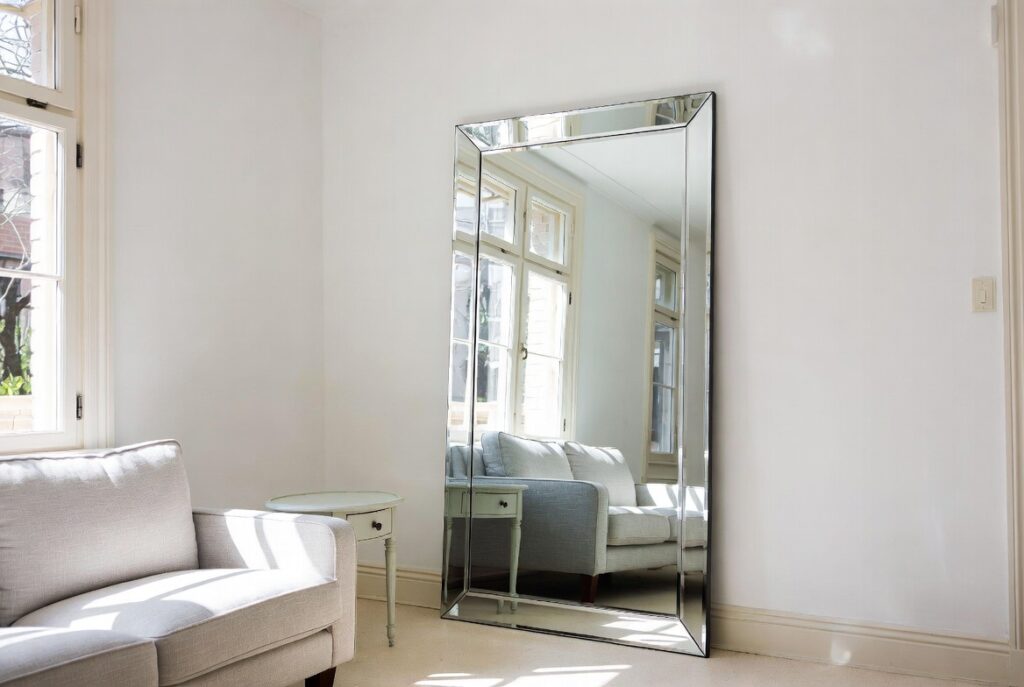
A large mirror on the wall opposite or adjacent to a window reflects both natural light and the room back into itself — literally doubling the apparent depth of the space. This is one of the oldest and most effective small room tricks available, and it costs far less than any structural change.
The mirror should be large enough to make an impact — a small mirror in a small room looks decorative but creates no spatial illusion. Aim for a mirror that occupies at least one-third of the wall it hangs on.
Smart tip: Position the mirror to reflect the most attractive part of the room — a window, a styled shelf, or a plant — so it doubles something beautiful rather than an empty wall.
Mistake to avoid: Placing a mirror directly opposite the entrance — guests see themselves the moment they enter, which can feel startling rather than welcoming.
5. Go Vertical with Tall Shelving
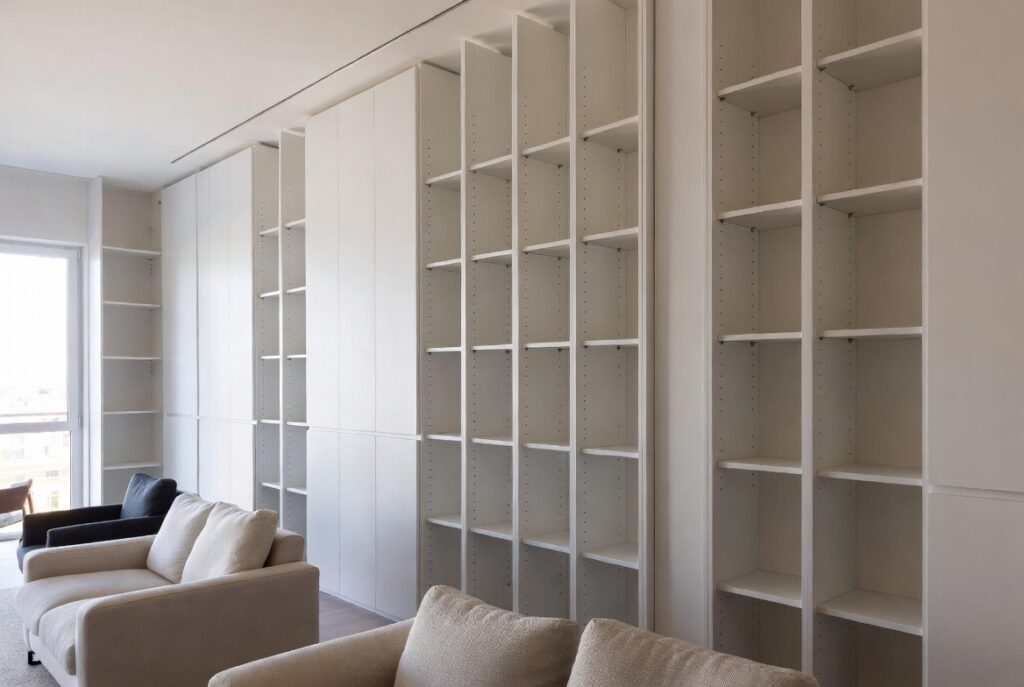
In a small room, floor space is scarce but wall space above eye level is often completely unused. Floor-to-ceiling shelving draws the eye upward, creates the impression of greater ceiling height, and provides significant storage without occupying additional floor area.
Style the upper shelves with lighter, less used items and the eye-level shelves with books, plants, and objects you want to see daily.
Smart tip: Paint built-in shelving the same color as the wall behind it — shelving that blends into the wall reads as architectural rather than as added furniture crowding the room.
Mistake to avoid: Overloading shelves with objects — in a small room, cluttered shelves make the whole room feel chaotic. Leave 30% of shelf space empty.
6. Use a Nesting Coffee Table
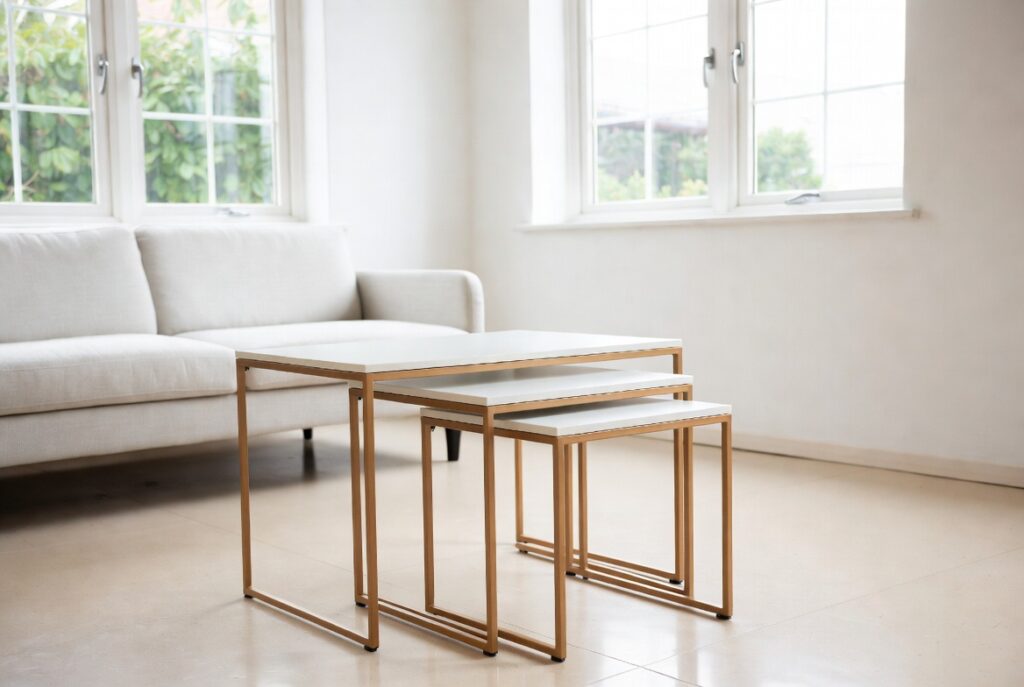
A standard coffee table occupies a fixed footprint whether you’re using it or not. Nesting tables — two or three tables of graduating sizes that slide under each other — provide the same surface area when needed and almost none when not.
They’re particularly useful for small living rooms that also function as dining or working spaces, where flexibility matters more than permanence.
Smart tip: Choose nesting tables with a round top — they’re easier to move around furniture legs and feel less rigid in a small space.
Mistake to avoid: Buying nesting tables that are too small to be practical — each surface needs to be at least 40cm across to hold a drink and a book comfortably.
7. Keep the Color Palette Simple and Consistent
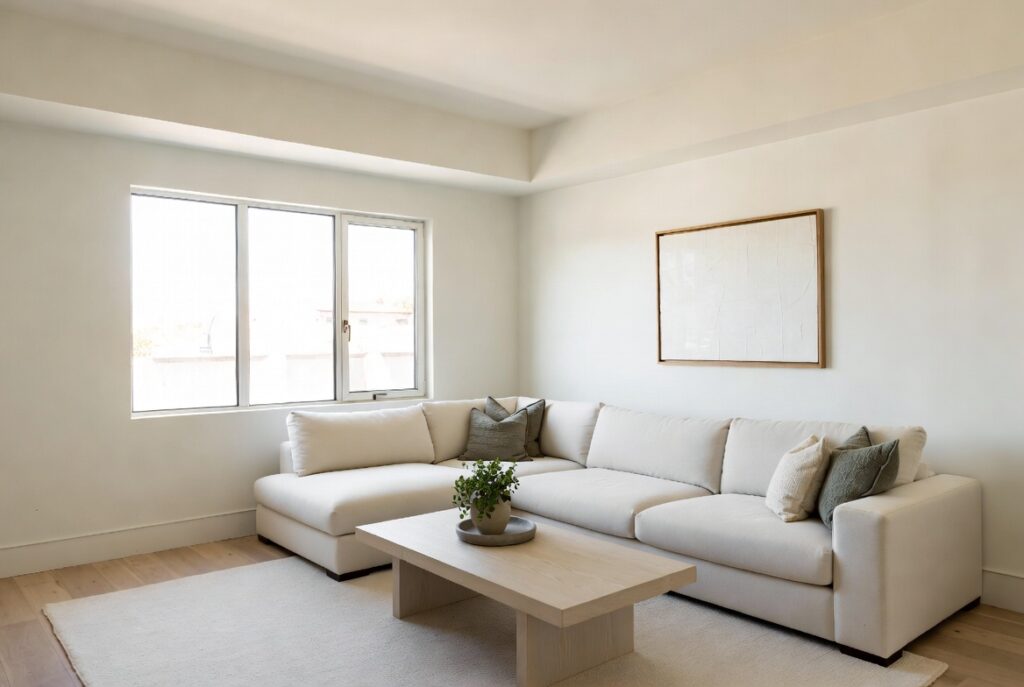
Multiple colors in a small room create visual fragmentation — the eye moves rapidly between competing hues, which makes the space feel busy and smaller. A consistent palette of two or three related tones creates a calm, cohesive backdrop that makes the room feel larger and more considered.
Choose a dominant neutral, one secondary tone, and one accent — and apply them consistently across walls, furniture, and textiles.
Smart tip: Use the same color on walls and large upholstered pieces — a sofa in the same tone as the walls reduces the visual interruption of a contrasting piece of furniture.
Mistake to avoid: Using too many accent colors — in a small room, one accent color creates interest; three create chaos.
8. Mount the TV on the Wall
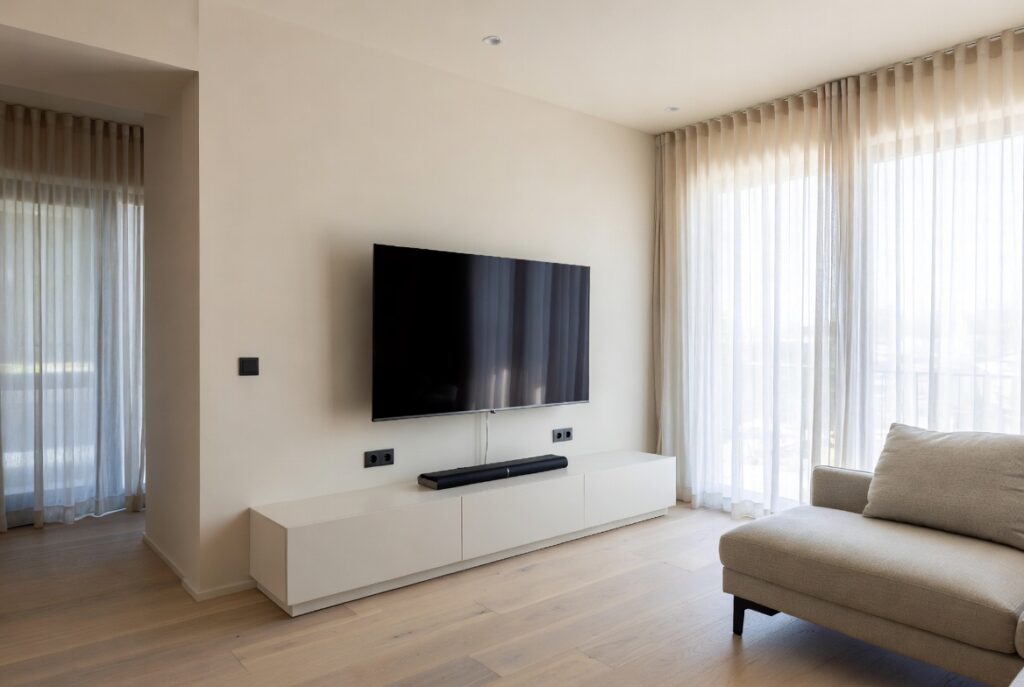
A TV on a stand requires a stand — which requires floor space and adds a piece of furniture to a room that needs as little furniture as possible. A wall-mounted TV eliminates the stand entirely, frees the floor beneath, and creates a cleaner, less cluttered visual result.
Run cables through the wall or use a cable management cover — exposed cables undermine the clean look that wall mounting is meant to create.
Smart tip: Mount the TV at seated eye level — approximately 100 to 110cm to the center of the screen — not high on the wall where it forces an uncomfortable upward viewing angle.
Mistake to avoid: Mounting the TV above the fireplace — it’s too high for comfortable viewing and forces the neck into an unnatural position for extended periods.
9. Use Curtains to Fake Bigger Windows
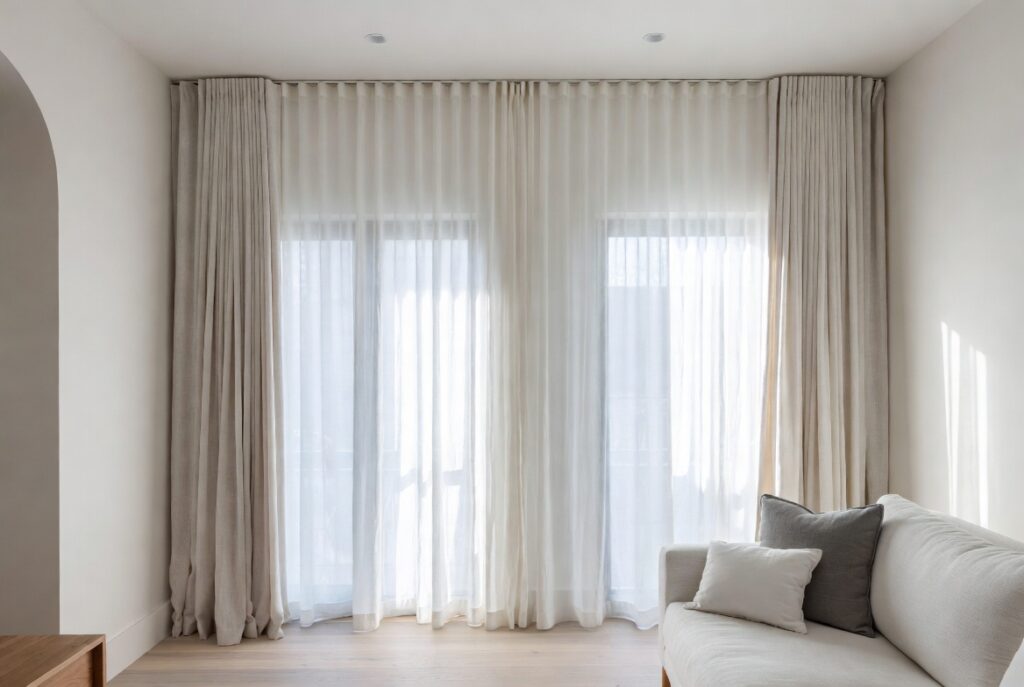
Hanging curtain rods wider than the window frame — extending 30 to 40cm beyond the window on each side — and from ceiling height to floor creates the illusion of a much larger window than actually exists. The curtains hang beside the window when open, revealing the full glass area and framing a larger apparent opening.
This also maximizes natural light — curtains that extend beyond the frame don’t block any light when open, unlike curtains hung directly on the frame.
Smart tip: Choose curtain fabric in the same tone as the walls — curtains that disappear into the wall create continuity that makes the room feel larger.
Mistake to avoid: Short curtains that hang to the windowsill — they look truncated and draw attention to the window’s actual small size.
10. Choose a Glass or Lucite Coffee Table
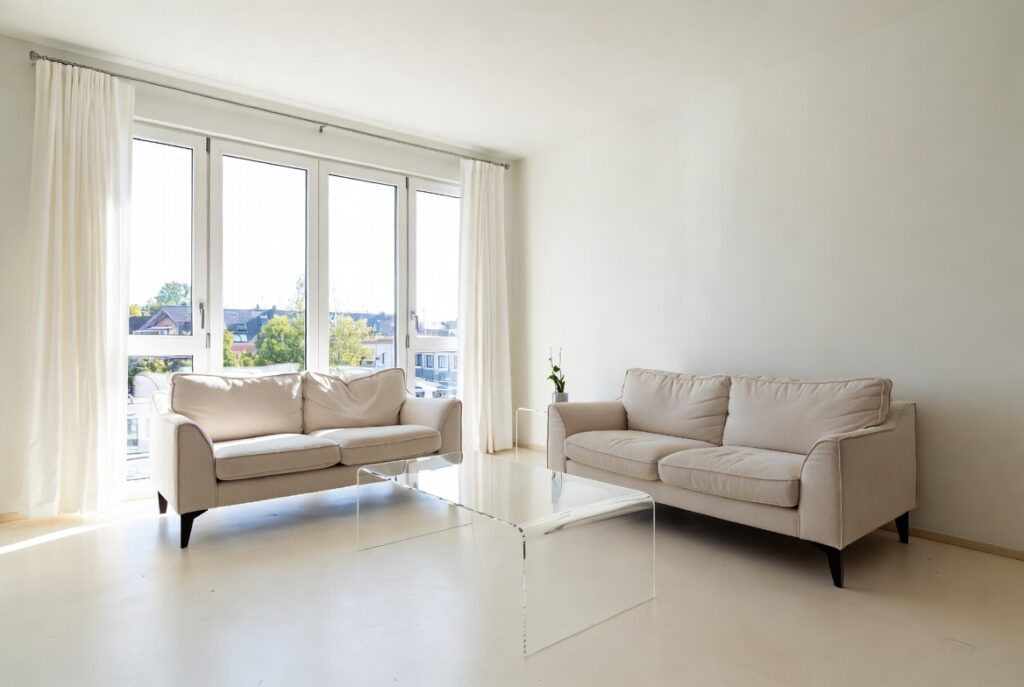
A transparent coffee table takes up zero visual space — the eye passes through it to the floor and the furniture beyond, making the center of the room feel open rather than occupied. This is one of the most effective small room tricks available and works in any style from contemporary to traditional.
Lucite (acrylic) is lighter and less fragile than glass; glass looks more substantial and reflects light. Both achieve the same spatial effect.
Smart tip: Style a glass coffee table with a tray to contain objects — without a tray, items scattered on a glass surface look messier than on a solid table.
Mistake to avoid: Using a glass table in a household with young children — the safety risk and the constant fingerprints undermine both the practicality and the visual effect.
11. Use an Ottoman as a Coffee Table
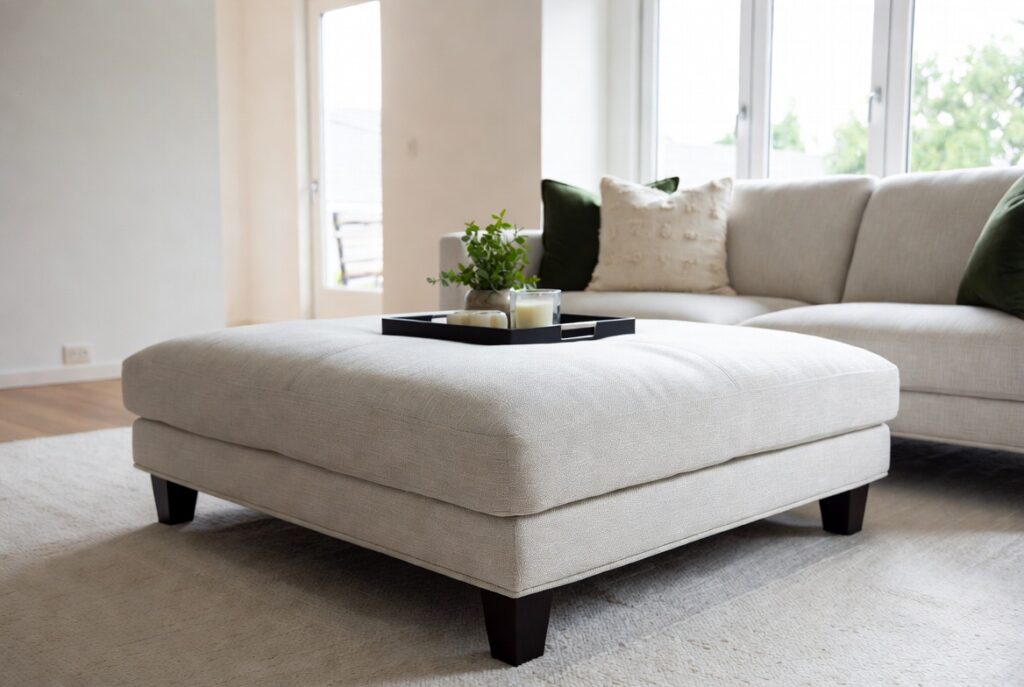
A large upholstered ottoman in place of a coffee table serves multiple functions — a footrest, extra seating when needed, a surface for a tray with drinks and books, and storage if it opens. It also softens the center of the room visually, adding texture rather than another hard-edged piece of furniture.
Choose an ottoman that is approximately the same height as the sofa cushions for comfortable use as both a footrest and a seat.
Smart tip: A round ottoman is easier to walk around than a rectangular one in a small room — fewer corners to navigate.
Mistake to avoid: Using an ottoman so large it dominates the space — it should be proportional to the sofa, not equal to it.
12. Define Zones in an Open Plan Space
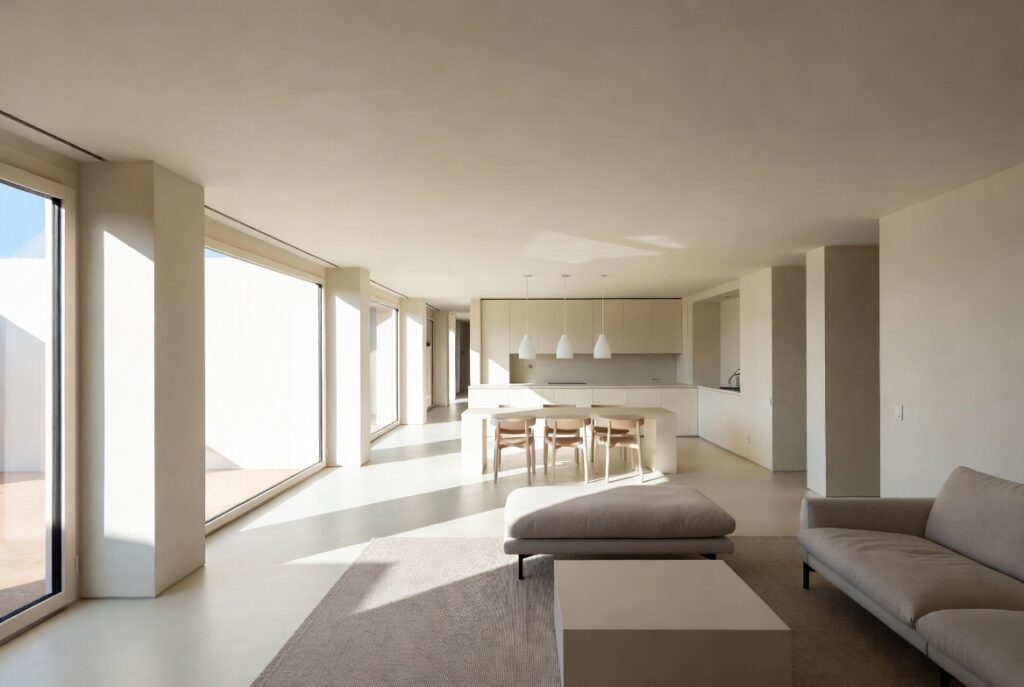
In open-plan living rooms, the lack of defined zones makes the entire space feel undefined — too large to feel intimate, too small to feel generous. A rug beneath the seating arrangement, a sofa facing away from the dining area, and a pendant light above the dining table each define their zone clearly without any physical partition.
Defined zones make an open-plan space feel like two functional rooms — more useful and more comfortable than one large, undifferentiated area.
Smart tip: The back of the sofa is the most effective zone divider available — position it facing the living area and away from the kitchen or dining zone to create an immediate spatial separation.
Mistake to avoid: Using the same flooring, lighting, and color throughout an open plan space without any zone definition — it creates a large room with no sense of destination or purpose.
13. Add Built-In Storage Around the Fireplace
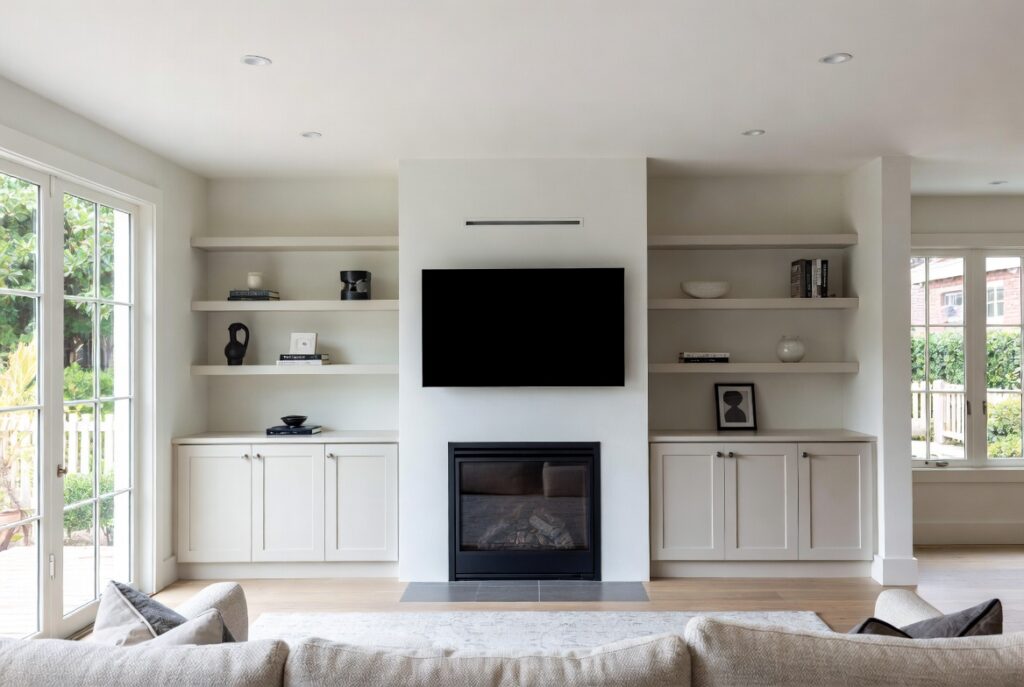
The alcoves on either side of a fireplace breast are the most underused storage opportunity in most living rooms. Built-in shelving or cabinets in these recesses use space that would otherwise be empty wall, add significant storage without encroaching on the floor plan, and create a symmetrical, architectural quality that makes the whole room look more considered.
Lower cabinets with doors hide practical storage; open upper shelves display books and objects.
Smart tip: Build the shelves to the full height of the room — stopping at a standard height leaves valuable upper wall space unused and makes the built-ins look incomplete.
Mistake to avoid: Building shelves so deep that items at the back are inaccessible — 30cm is the ideal depth for most living room shelving.
14. Use Wall Sconces Instead of Floor Lamps
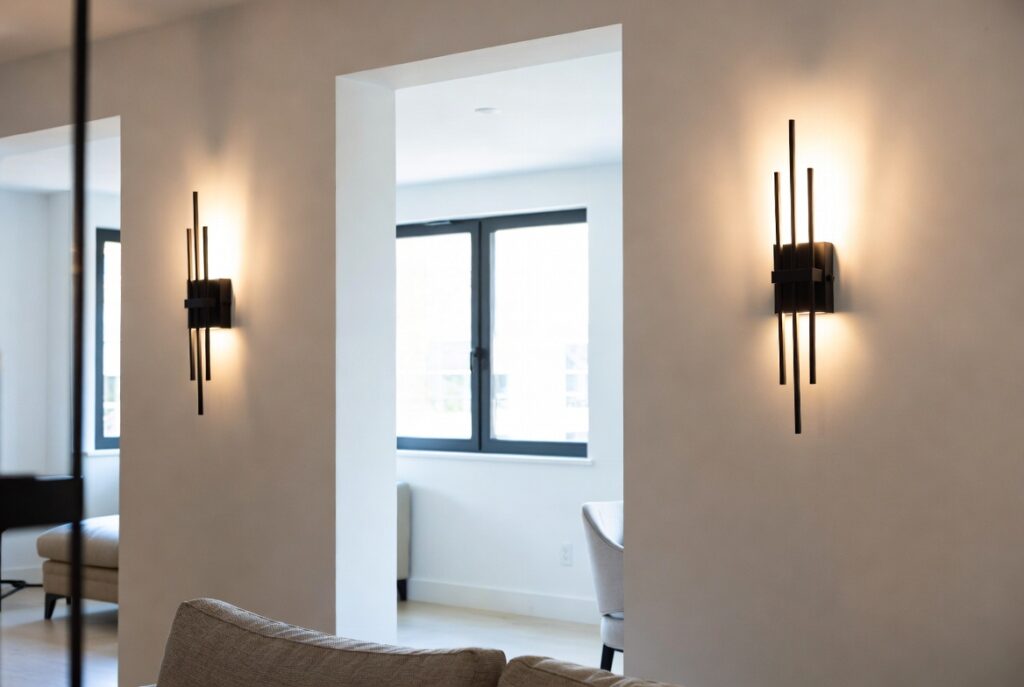
Floor lamps take up floor space — in a small living room, every square foot of floor counts. Wall-mounted sconces provide the same warm, ambient light without occupying any floor area at all. They also add an architectural quality and visual interest that freestanding lamps rarely achieve.
Install them at approximately 150 to 160cm from the floor — high enough to spread light effectively, low enough to feel intimate rather than overhead.
Smart tip: Use plug-in wall sconces rather than hardwired ones if you’re renting or want flexibility — the cord can be hidden behind furniture or in a cable cover.
Mistake to avoid: Using only overhead lighting in a small living room — it creates flat, harsh illumination that makes the space feel like an office rather than a home.
15. Choose a Sofa Bed for Dual Function
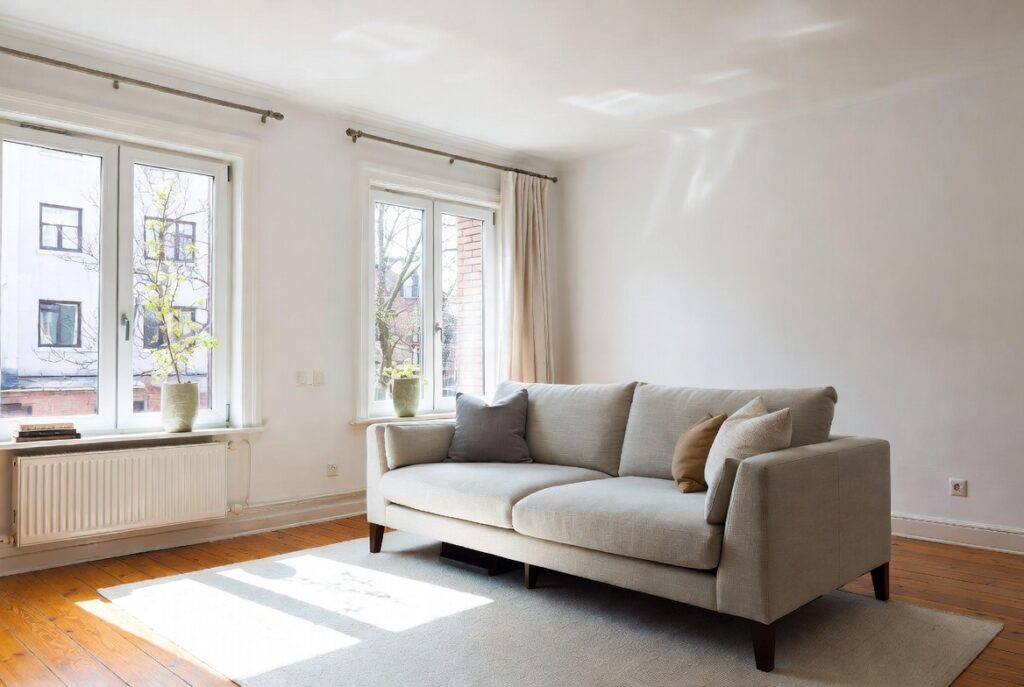
A sofa bed in a small living room adds guest sleeping capacity without a dedicated guest room — a significant practical benefit for homes where every room has to work hard. Modern sofa beds are significantly more comfortable and more stylish than their predecessors, and many are indistinguishable from a standard sofa when closed.
Choose a model where the conversion mechanism is genuinely easy to operate — a sofa bed that takes 20 minutes to convert will never actually be used as a bed.
Smart tip: Invest in a quality mattress upgrade for the sofa bed if guests will sleep on it regularly — the standard mattresses in budget sofa beds are notoriously uncomfortable.
Mistake to avoid: Choosing a sofa bed based on its sleeping size without checking its sofa dimensions — some sofa beds are too large as sofas and some too small as beds.
16. Keep Surfaces Clear and Intentional
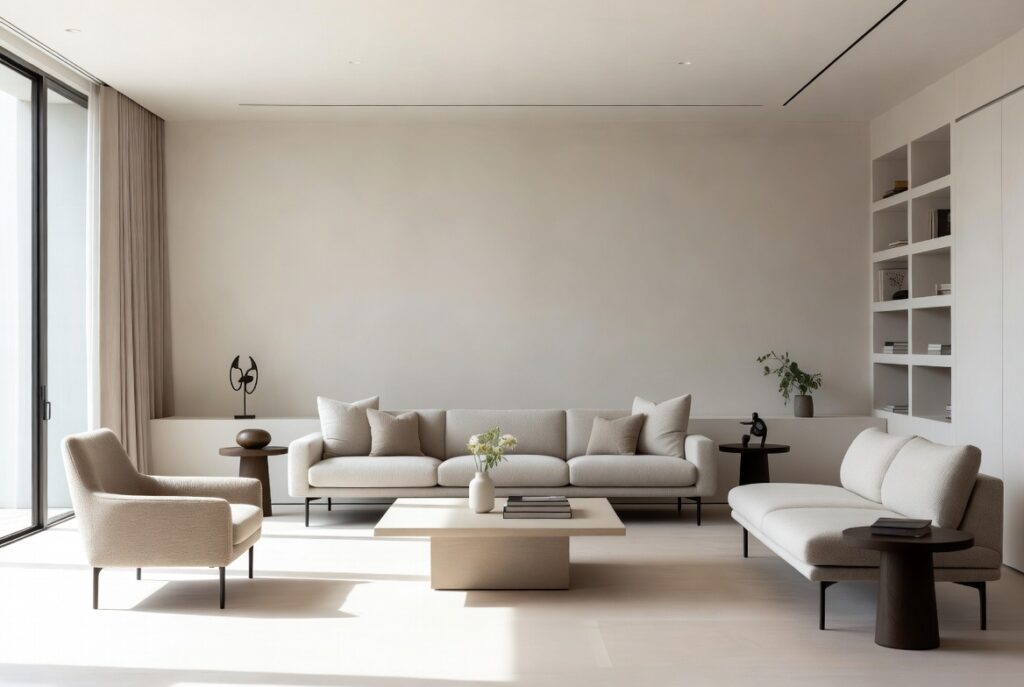
In a small room, every surface that is visible is noticed — a cluttered side table or an overloaded shelf creates a feeling of chaos that makes the whole room feel smaller and more stressful. The discipline of keeping surfaces clear — maximum three objects per surface, and each one chosen deliberately — transforms the room’s atmosphere.
Apply the rule of three: one tall element, one medium element, one small element. Remove everything else.
Smart tip: A tray on any surface immediately organizes what’s on it — items inside a tray look curated; items scattered across a surface look cluttered.
Mistake to avoid: Trying to display every decorative object you own — a small room requires more editing, not less.
17. Use a Monochromatic Color Scheme
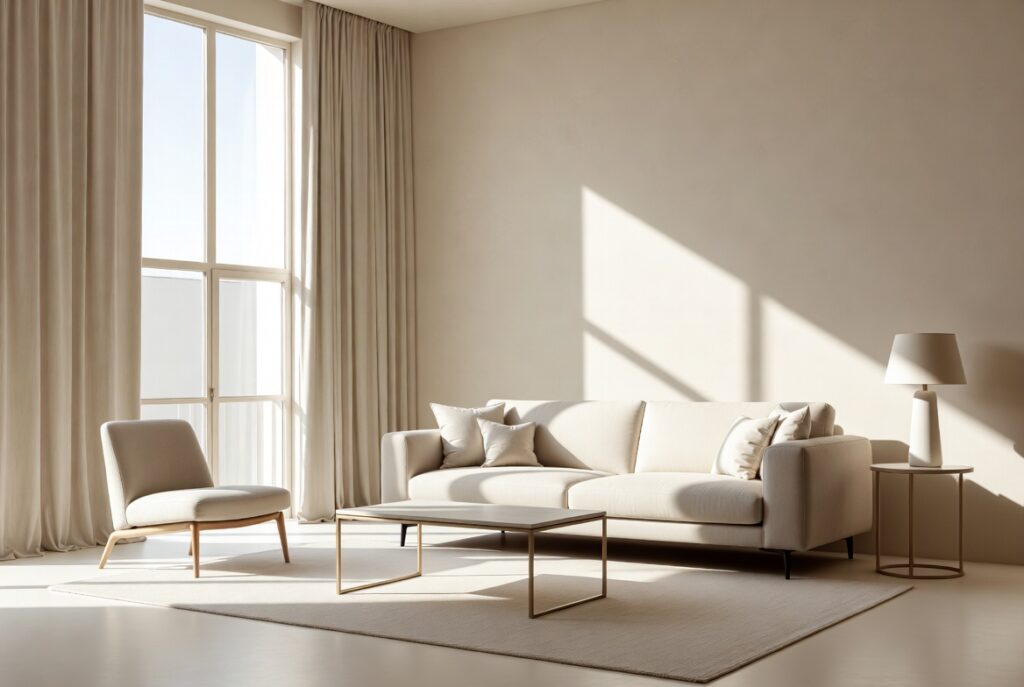
A monochromatic scheme — different tones, shades, and textures of a single color — creates the most seamless and most spacious-feeling result for a small living room. When walls, furniture, and textiles share a color family, the eye reads the room as one continuous space rather than a series of interrupting elements.
Vary the texture heavily within the single color — matte walls, velvet cushions, linen curtains, wool rug — to prevent the scheme from feeling flat.
Smart tip: Choose a warm-toned monochromatic scheme rather than a cool one — warm tones feel more welcoming, which matters more in a small room where intimacy is inevitable.
Mistake to avoid: Making the monochromatic scheme too uniform — identical tones throughout look more like a mistake than a design choice. Vary light and dark significantly.
18. Add One Statement Plant
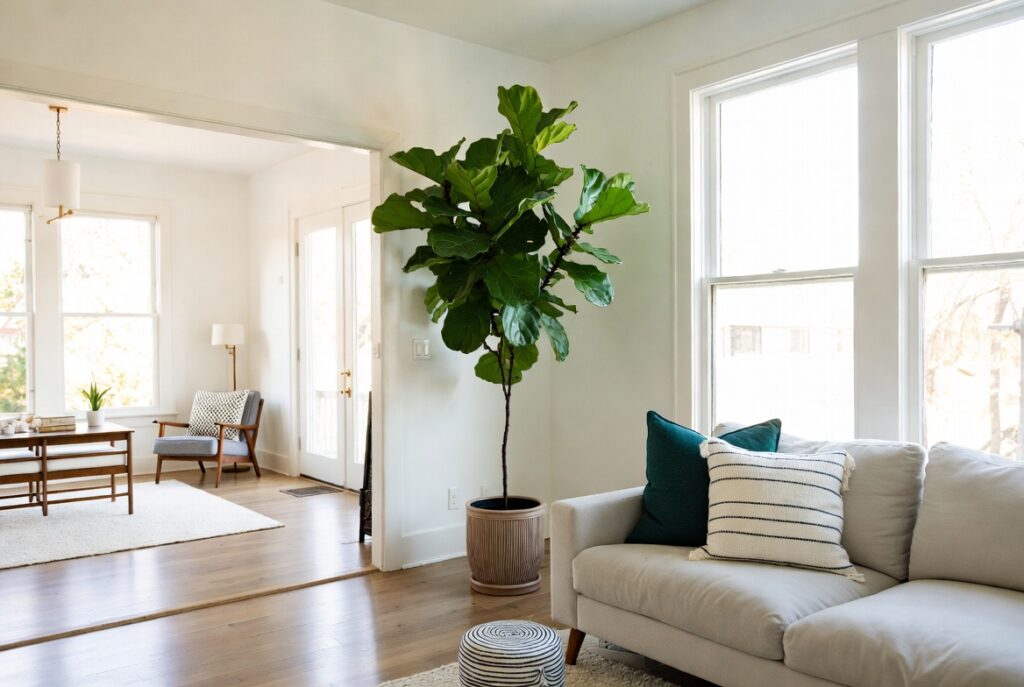
A single large plant — fiddle leaf fig, bird of paradise, or large monstera — in a small living room adds vertical interest, living color, and an organic quality that no decorative object achieves. It fills a corner beautifully without taking up meaningful floor space and creates the sense that the room is cared for.
One significant plant makes more impact than multiple small ones scattered around a small room — which creates the sense of clutter rather than the sense of nature.
Smart tip: Choose a plant with large, simple leaves rather than a bushy, multi-stemmed plant — architectural plants add structure without visual complexity.
Mistake to avoid: Placing a large plant where it blocks light or circulation — it should fill an underused corner, not obstruct a window or a pathway.
19. Use Rugs to Create Visual Boundaries
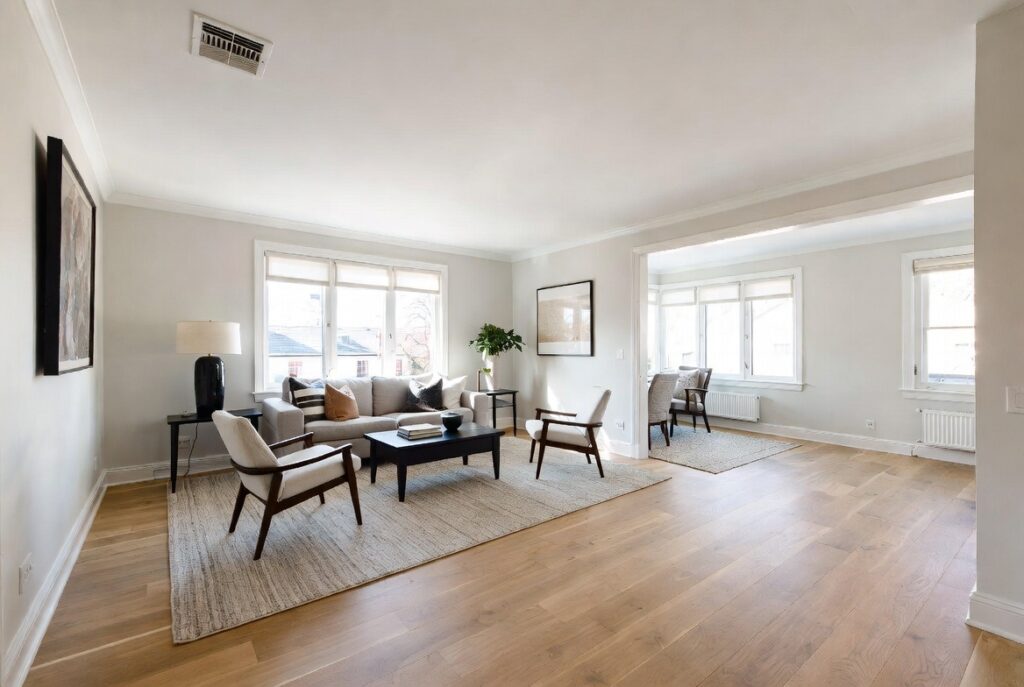
In a small open-plan living room, a rug defines the seating zone clearly and gives it a sense of enclosure that prevents the room from feeling like a corridor. The rug must be large enough to anchor all the main furniture — front legs of all seating on the rug at minimum.
A correctly sized rug makes a small room feel more spacious, not less — it creates a defined, purposeful zone that reads as a complete room rather than furniture floating in open space.
Smart tip: A rug in a similar tone to the floor reads as an extension of the floor — creating continuity. A contrasting rug clearly defines the zone but visually divides the floor.
Mistake to avoid: Using a rug that’s too small — it looks like a bath mat in the center of the room and creates exactly the floating, unanchored appearance you’re trying to avoid.
20. Try a Slim Console Behind the Sofa
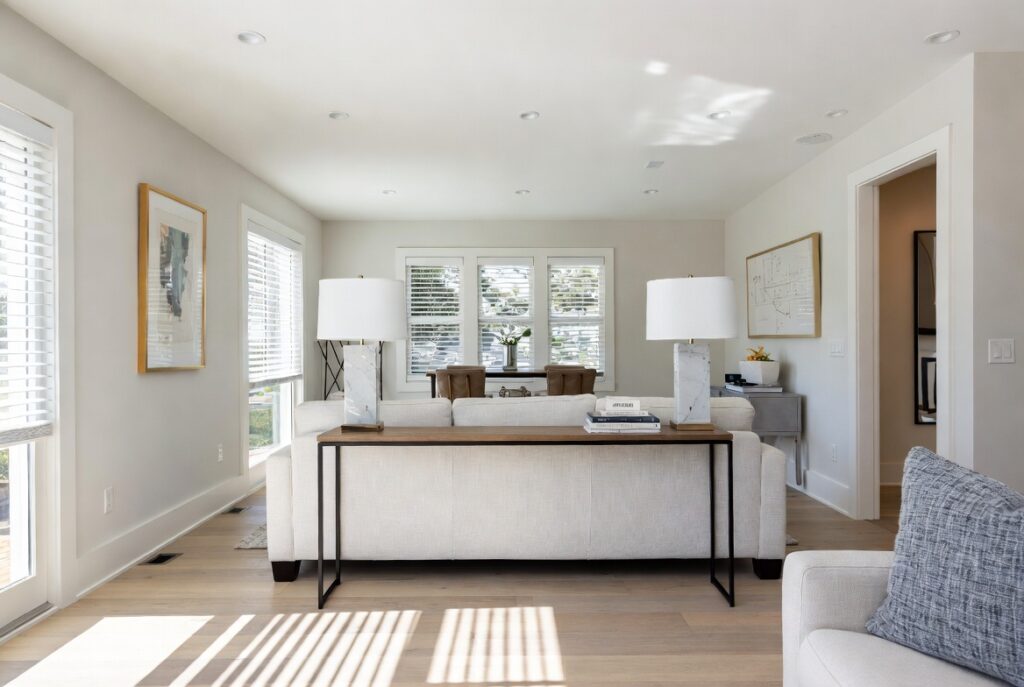
A slim console table (25 to 30cm deep) placed immediately behind the sofa serves several functions simultaneously — it visually anchors the back of a floating sofa, provides a surface for lamps and objects that add height and warmth to the room, and creates a visual boundary between the seating zone and whatever is behind it.
It looks particularly effective in open-plan spaces where the back of the sofa faces the kitchen or dining area.
Smart tip: Style the console with a lamp at one end and a plant or tall object at the other — the height variation creates visual interest at a level that is seen from both the sofa and the entrance.
Mistake to avoid: Using a console too deep for the space available — anything over 35cm risks making the sofa feel pushed too far from the room’s center.
21. Use Multipurpose Furniture Throughout
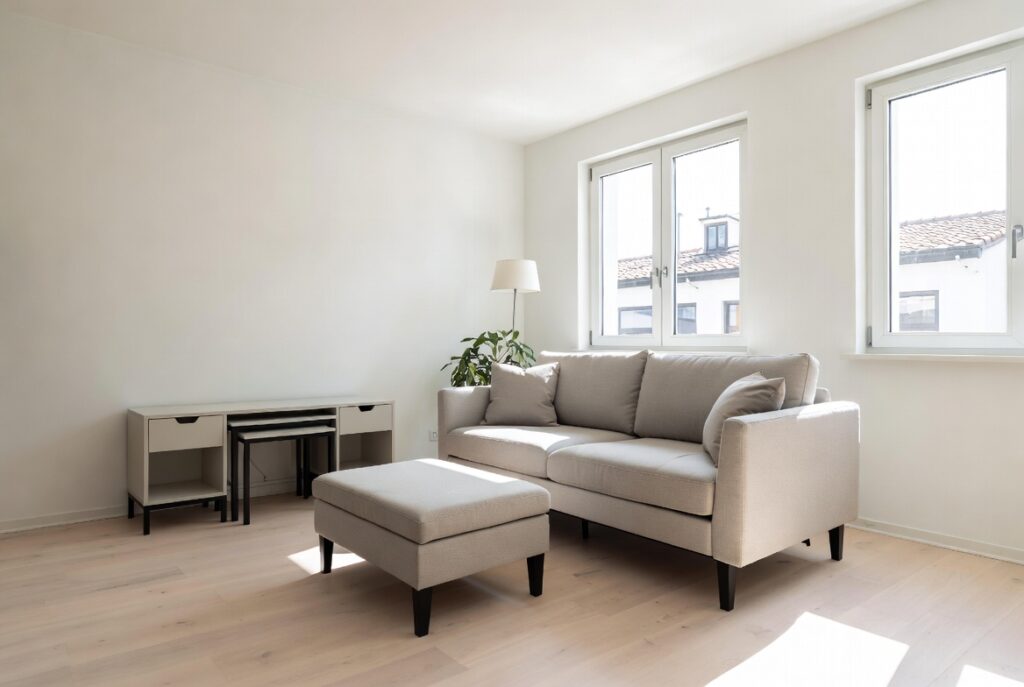
Every piece of furniture in a small living room should ideally serve more than one purpose — a storage ottoman replaces both a coffee table and a blanket chest, a sofa bed eliminates the need for a guest room, a console table doubles as a desk, a bench at the end of a sofa provides extra seating and storage.
This discipline of multipurpose thinking reduces the total number of pieces needed and keeps the floor as clear as possible.
Smart tip: Before buying any new piece of furniture for a small room, ask whether an existing piece could be repurposed to do the same job — the best small room furniture strategy is usually to have less, not more.
Mistake to avoid: Buying furniture for hypothetical uses — a guest bed that’s used twice a year is not worth the floor space it occupies every other day of the year.
22. Edit Ruthlessly — Every Piece Must Earn Its Place
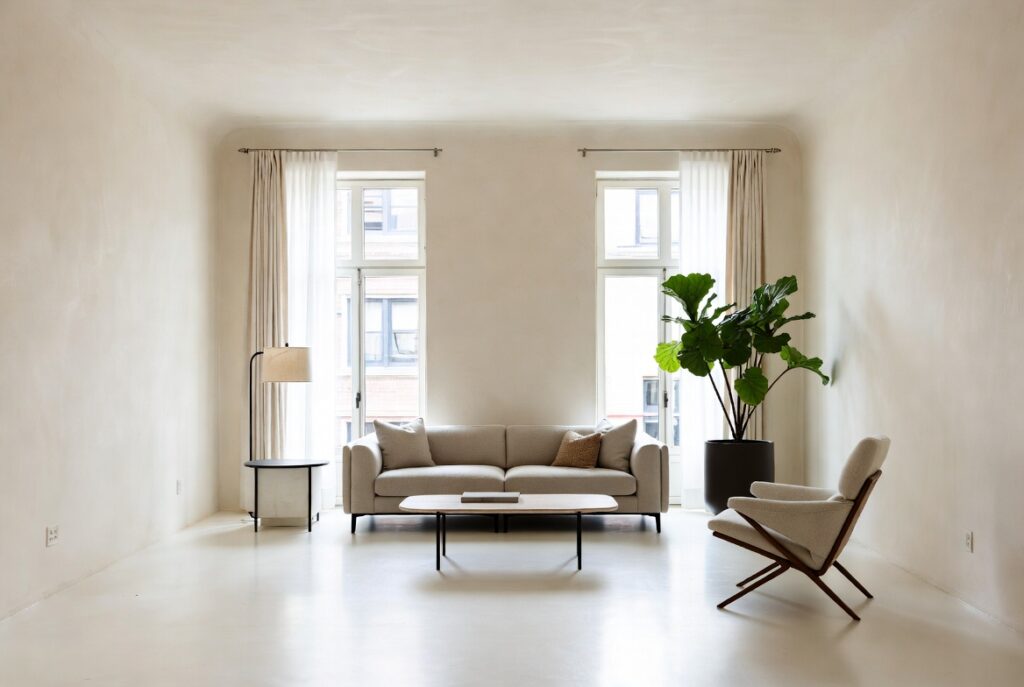
The most transformative small living room intervention is almost always removing something rather than adding it. A sofa that’s slightly too large, a side table that serves no real purpose, a decorative object that adds visual noise — removing each of these frees space, clarifies the room, and makes everything that remains look better.
Apply a strict test to every item in the room: does it serve a practical purpose, does it add genuine beauty, or does it do both? If neither — it should go.
Smart tip: Remove one piece of furniture from the room and live without it for two weeks before deciding permanently — most rooms reveal themselves as better without pieces you thought were essential.
Mistake to avoid: Keeping things out of habit or guilt — in a small room, every item that doesn’t earn its place actively makes the room worse.
Conclusion
A small living room done well is not a compromise — it is a room with clarity, intention, and every element chosen for a reason. Light colors, furniture with legs, one large mirror, tall shelving, and ruthless editing are the tools that make small rooms feel genuinely spacious. Start with what you remove, then build from there.
living room ideas for small spaces • small living room decor • tiny living room ideas • living room ideas • small space storage • home decor ideas living room • interior design • modern living room decor
Continue Your Home Transformation
Explore the full collection of step-by-step eBooks and get the guide that fits the room you're working on.

One Comment