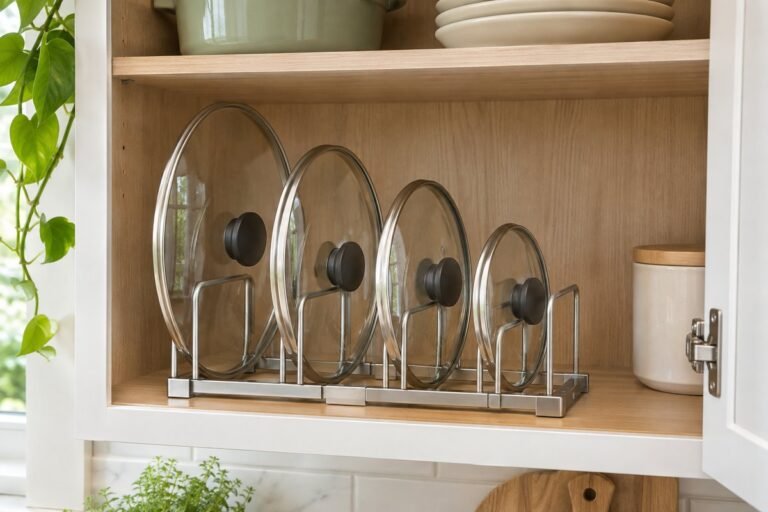
The most useful baking sheet storage ideas let you remove the pan you need without unloading an unstable pile. The answer may be a divided cabinet, a shallow drawer or a small nested set. Start with the trays already used in your kitchen and the route between storage and preparation.
These 22 concepts focus on clean, cool, dry bakeware in ordinary storage. Follow each pan's care guidance and the cabinet organizer's installation and load instructions. The illustrations show possible arrangements, not a verified fit for a particular cabinet or a reason to modify its structure.
Contents
- 1. Give everyday sheets a divided base-cabinet bay
- 2. Compare one compact freestanding organizer
- 3. Use a shallow drawer for a small flat group
- 4. Keep a compatible nesting set together
- 5. Separate a delicate finish from hard neighboring edges
- 6. Assign the largest sheet before filling the cabinet
- 7. Give small oven trays a compact separate zone
- 8. Compare an existing island compartment
- 9. Use a pantry shelf for occasional trays
- 10. Keep serving trays in a distinct neighboring section
- 11. Give cooling racks their own compatible slot
- 12. Keep muffin tins from crowding the sheet row
- 13. Leave the drawer above fully usable
- 14. Allow finger space beside rolled rims
- 15. Put the most-used sheet at the easiest approach
- 16. Use a compatible pullout only when extension helps
- 17. Keep the counter for preparation rather than permanent overflow
- 18. Review a tall cabinet from the user's reach
- 19. Store matching lids according to their own instructions
- 20. Keep a modest seasonal group together
- 21. Preserve a simple return space after cleaning
- 22. Keep the arrangement flexible after a trial period
Measure the complete tray and its removal movement
Record the longest and widest edges, rolled rim, depth and any projecting handles. Measure the cabinet's usable opening and interior, including hinges and other obstructions, then check the movement needed to lift or slide the tray out. A fitting that fits the empty cabinet may not let the largest pan pass through its opening. Consider the bakeware itself: Nordic Ware expressly describes its cited three-piece Prism set as nesting for storage, but that does not establish that every mixed collection should be nested. Keep the actual maker's material and care requirements in the decision. An organizer can separate pans; it cannot certify that an unsuitable cabinet modification is sound.
Choose an arrangement that fits your situation
- Few compatible nesting pans: Compare a modest flat stack in a suitable shallow drawer
- Mixed sheets used frequently: Compare separate supported vertical positions
- Deep cupboard: Check whether a compatible pullout improves the real approach
- Occasional bakeware: Use a reachable contained pantry group
- Protective finishes and lids: Follow each item's care and storage guidance separately
1. Give everyday sheets a divided base-cabinet bay

A purpose-made vertical divider can turn a mixed cabinet into a clear row of trays. Put the frequently used sheet in an easy-to-grip position, with enough room to lift it without scraping its neighbors. Choose a fitting intended for the cabinet and contents. Keep the group small enough that a returned tray has its own obvious place rather than being forced into the nearest gap.
2. Compare one compact freestanding organizer

A removable organizer may help a suitable existing cupboard without changing the cabinet. Check its intended use, base and complete dimensions with the actual pans in place. Keep it fully supported within the shelf. If the loaded rack shifts or the sheets cannot be removed comfortably, choose a different fitting or location instead of adding improvised restraints.
3. Use a shallow drawer for a small flat group

A shallow drawer can be a straightforward home for a limited number of flat sheets. Compare the internal height with the entire stored group and the room needed to grip a rim. Follow the drawer and bakeware requirements. Avoid turning a clear everyday drawer into a deep stack of occasional pieces that must be removed before the useful pan appears.
4. Keep a compatible nesting set together
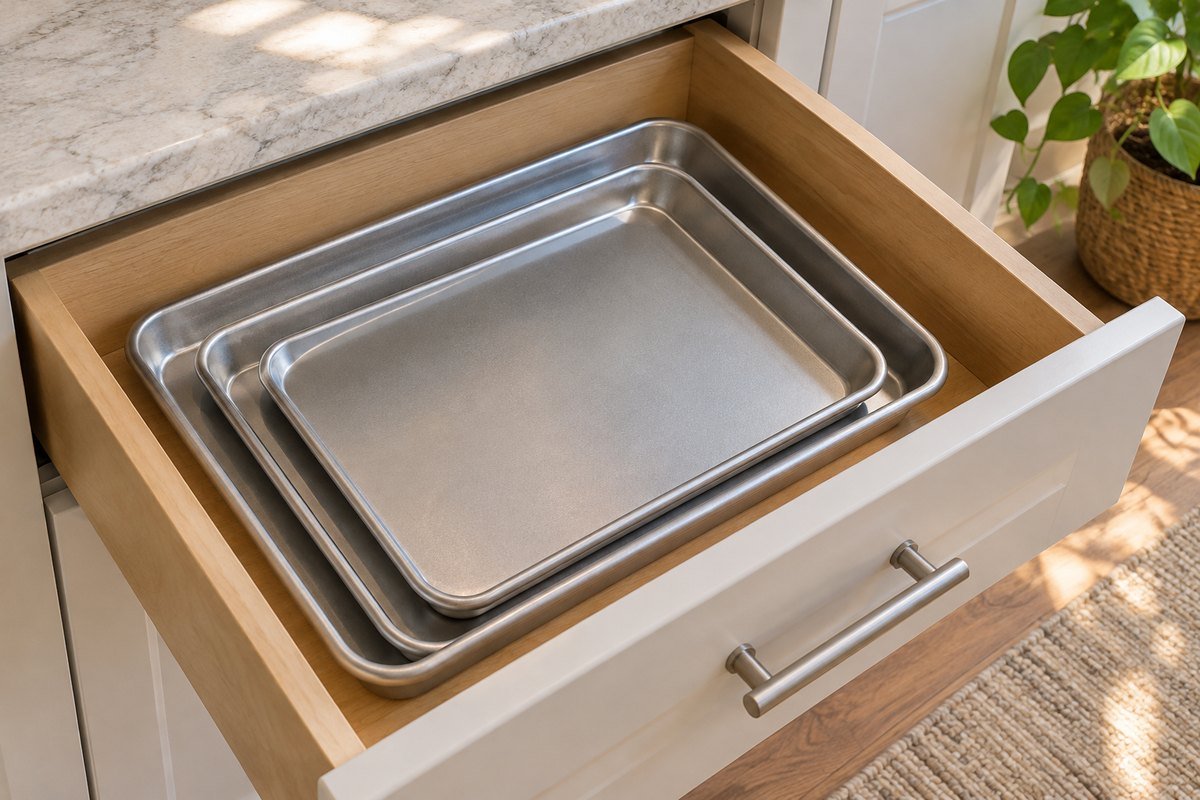
When the maker permits nesting, graduated pans can occupy one compact place. Check the actual set rather than assuming that similarly named sizes will fit together. Store them according to their care directions, and keep the nesting depth practical for removal. A compact arrangement is useful only if the frequently used pan can come out without a complicated daily rearrangement.
5. Separate a delicate finish from hard neighboring edges

A pan's finish may need a different storage method from neighboring uncoated metal. Follow its specific care guidance and use an appropriate separator or independent compartment when needed. Do not infer scratch resistance from color or appearance. Keep the protective method easy to replace after use so ordinary retrieval does not depend on a carefully staged arrangement that nobody restores.
6. Assign the largest sheet before filling the cabinet

The largest tray often determines whether a proposed storage bay is useful. Test it through the real opening and include the angle needed to remove it. Give smaller pans the remaining appropriate positions. If the large sheet fits only diagonally across other contents, a different compartment may be better than making every ordinary retrieval an awkward puzzle.
7. Give small oven trays a compact separate zone

A small tray can disappear behind larger sheets in a broad compartment. Keep the pieces used with a compact oven together in an accessible appropriately sized section. Confirm which accessory belongs to the actual appliance. Storage near it should still remain outside its operating area and required clearances, with the bakeware cool before it is put away.
8. Compare an existing island compartment

An island can suit bakeware storage when it lies along the preparation route. Check the chosen opening with seating and nearby drawers in ordinary use. A divided bay at the wrong face may be inconvenient even if its contents fit well. Keep the existing assembly intact and use only the compartment designed to hold the fitting and stored load.
9. Use a pantry shelf for occasional trays

Less frequently used sheets may suit a reachable pantry shelf when daily kitchen storage is limited. Give them a contained organizer and a clear retrieval route rather than leaning them across food packages. Keep the shelf and fitting appropriate for their combined load. Reserve the most convenient kitchen position for the tray used regularly.
10. Keep serving trays in a distinct neighboring section
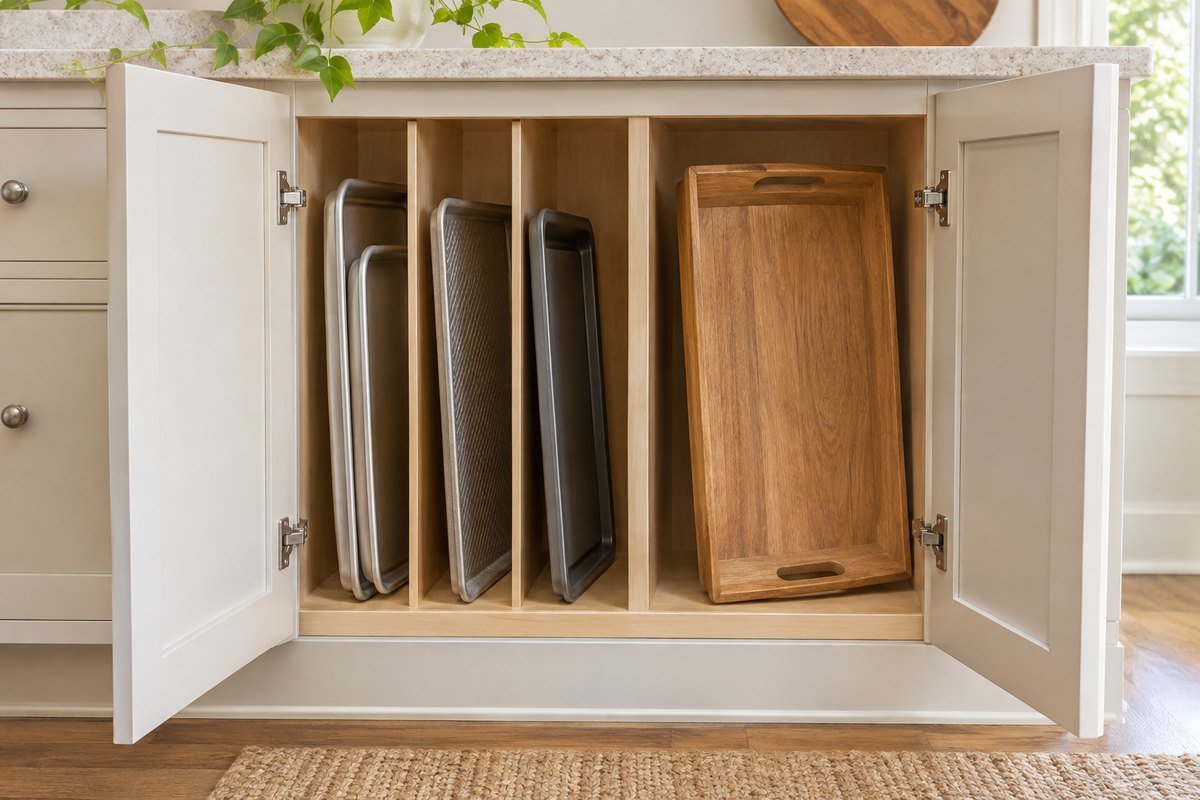
Serving trays and baking sheets can share a cabinet while retaining separate groups. Different handles, materials and retrieval routes may call for different slot widths or care. Keep the piece needed for cooking accessible without shifting decorative trays. A shared footprint should make the distinction clearer instead of turning every flat object into an undifferentiated row.
11. Give cooling racks their own compatible slot

A cooling rack can catch on a baking sheet when both are tightly crowded into one space. Compare a separate supported slot or another suitable location that keeps the related equipment nearby. Confirm which rack belongs with which pan, and follow their care guidance. A shared task zone can be useful without forcing the two objects into the same opening.
12. Keep muffin tins from crowding the sheet row
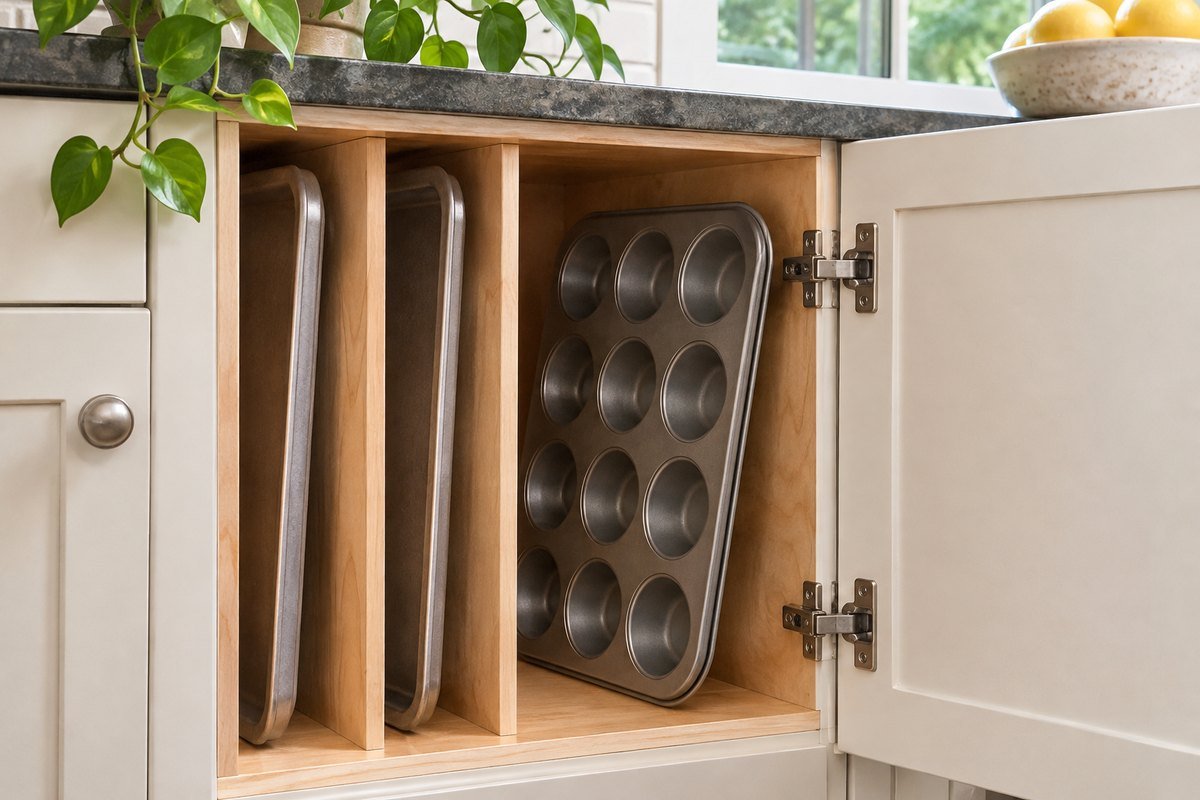
A muffin tin has a deeper profile than a flat sheet and may need a wider bay. Measure the actual shape before adding it to a tray organizer. A distinct compartment can preserve easy access to both groups. Avoid squeezing a deep tin between thin sheets simply because the cabinet is marketed as bakeware storage.
13. Leave the drawer above fully usable

A tall sheet stored upright can intrude into the moving drawer or shelf above it. Check the entire occupied arrangement with every neighboring opening in use. Choose a shorter orientation or a different cabinet if there is contact. The storage plan should preserve the cabinet's intended operation rather than depending on remembering which drawer cannot be opened.
14. Allow finger space beside rolled rims
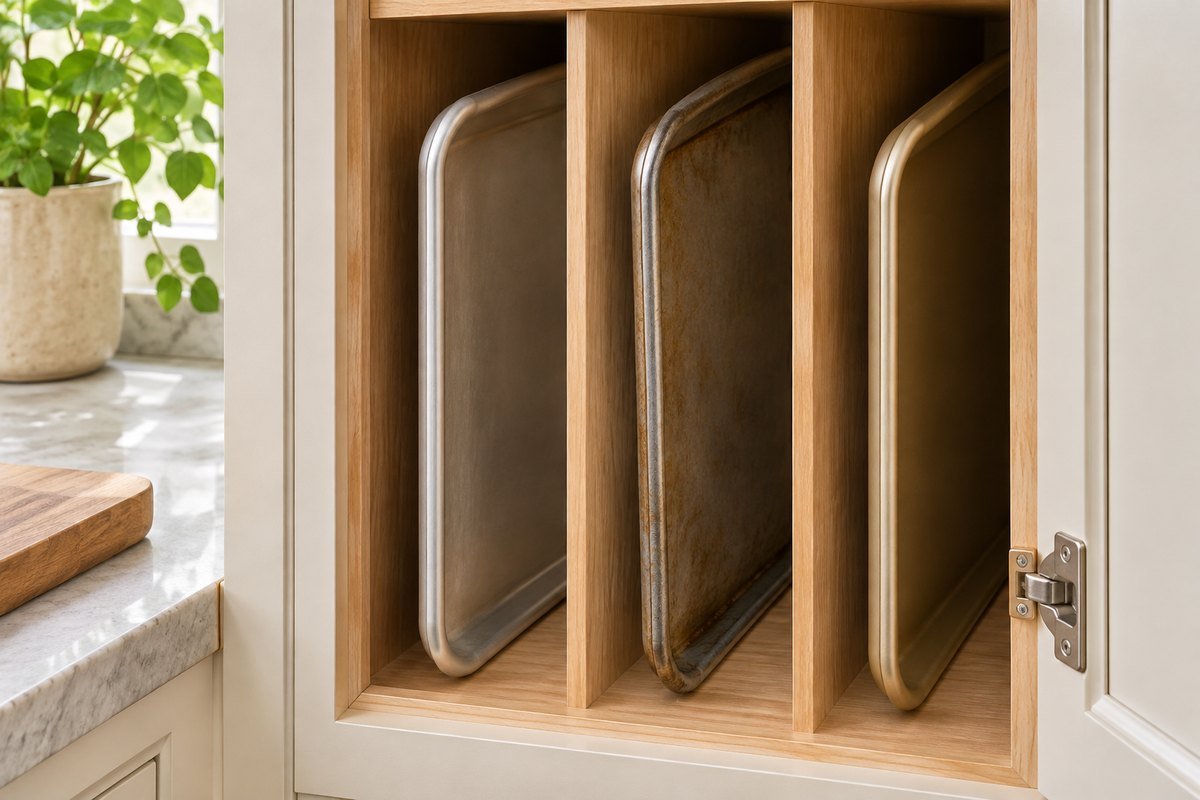
A row that looks efficient can be frustrating if there is no room to grip a tray. Use the actual rim as part of the spacing decision, and try removing the central piece without moving the others. Follow the fitting's permitted configuration. A few usable positions are better than a tightly packed arrangement that makes returning a clean sheet inconvenient.
15. Put the most-used sheet at the easiest approach

Arrange the daily tray where the user can see and reach it directly. This might be an outer slot rather than the visually centered position. Keep occasional pieces farther from the natural approach while remaining appropriately accessible. Review the choice after ordinary use; a practical order is the one the household can repeat without stopping to reorganize the whole cabinet.
16. Use a compatible pullout only when extension helps

A specified pullout can bring a suitable tray group forward from a deep cupboard. Check the clear opening, installation, travel and intended contents for the exact product. Include the open door and the person using it in the layout. A pullout that reaches into a conflicting aisle may be less useful than a simple fixed organizer elsewhere.
17. Keep the counter for preparation rather than permanent overflow

A sheet left beside the cooker may be waiting for a storage decision rather than belonging there. Assign it a proper cool-storage location and return the counter to its ordinary task. If an open arrangement is intentional, confirm that the product and placement suit the contents without interfering with appliances. Do not let an attractive rack conceal a recurring access problem.
18. Review a tall cabinet from the user's reach

A high shelf can be awkward for a broad sheet even when the object is light. Compare a reachable compartment before making overhead storage the default. Keep the removal route and the user in the decision. Rare use does not make an unstable stack or an awkward lift a good arrangement; choose a different suitable location when access is poor.
19. Store matching lids according to their own instructions

A storage lid may require different care and conditions from the metal pan it fits. Nordic Ware's cited lid guidance, for example, distinguishes plastic storage lids from oven-safe bakeware. Keep the exact matching information and use instructions available. Give a suitable lid its own clear place rather than assuming that every item associated with an oven can be stored or used identically.
20. Keep a modest seasonal group together

Occasional baking sheets and specialty trays can share a defined appropriate compartment away from the daily group. Make the collection easy to identify without putting it behind an unstable wall of other objects. Check the largest item and the shelf's limits. If the group outgrows the space, review what is actually used before buying more fittings.
21. Preserve a simple return space after cleaning
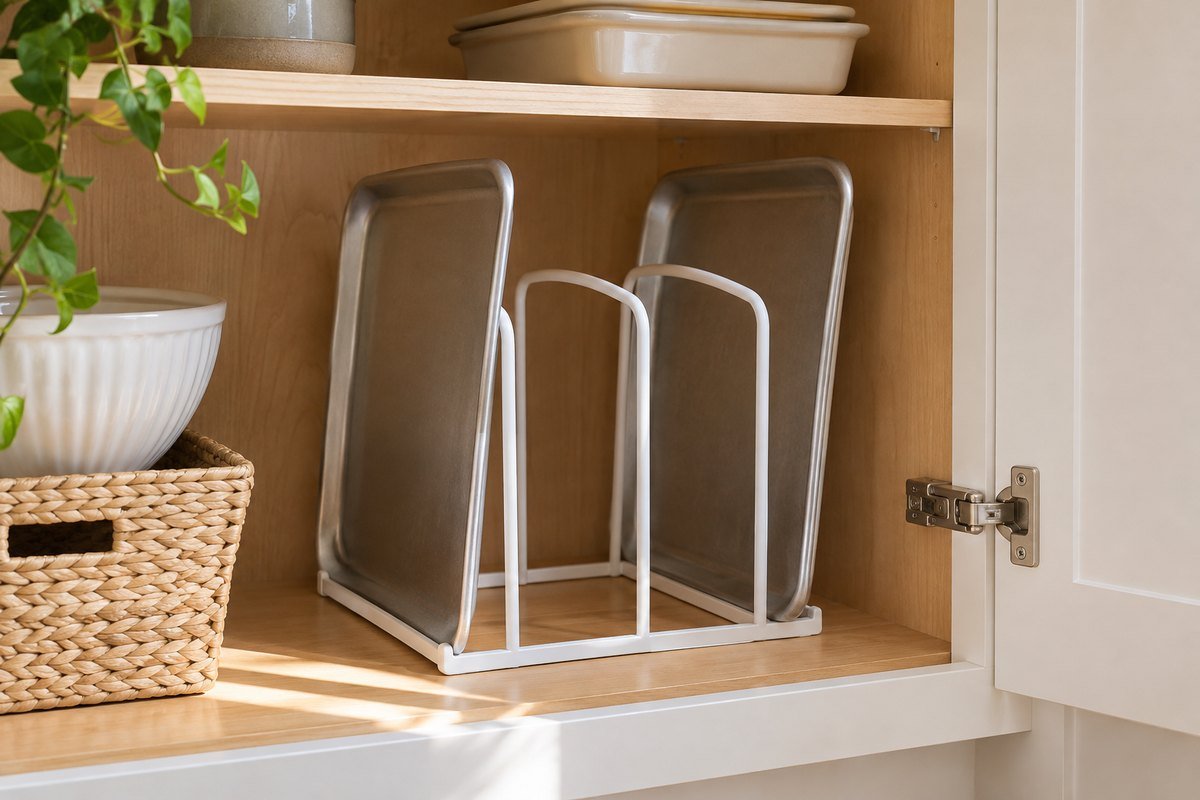
A storage slot should remain recognizable when its tray is in use. Keep unrelated tools out of the temporary gap and return the sheet only when it is ready for storage under its care instructions. A clear return place helps the arrangement survive ordinary baking. If pans repeatedly end up elsewhere, review the access and spacing before adding labels or more hardware.
22. Keep the arrangement flexible after a trial period

Review which sheet is awkward to remove, which organizer stays partly empty and which tray is rarely used. Adjust the allocation within the products' intended configuration. Keep the cabinet structure and installation requirements intact. The strongest baking sheet storage ideas often come from a smaller working collection and a clearer route rather than the maximum possible number of slots.
A tray-and-opening measurement card
List each sheet's full outside length, width, depth and projecting parts, then note frequency of use. Record the cabinet's usable opening, interior dimensions, hinges and drawer movements. Add the organizer's footprint, installation and load requirements. As a hypothetical retrieval test, a tray whose longest edge is 45 cm cannot be judged from a cabinet's 50 cm nominal description alone: the clear opening, orientation and removal angle still need checking. Lay out the actual group and perform the removal movement before purchasing. Keep the product-specific care and nesting instructions with the record.
A practical next step
Choose baking sheet storage ideas from the real tray collection, clear cabinet opening and ordinary baking route. Preserve usable grip space and a clear return place. A small arrangement that works every time is more helpful than a tightly filled cabinet that needs unpacking for each tray.
For the surrounding room, assign the surrounding kitchen island storage by task. plan a clear pantry storage arrangement.
The images are original AI-generated design concepts, not photographs of tested products or verified installations.
Sources and care references
- Nordic Ware Prism set: nesting, dimensions and model-specific care
- Nordic Ware: matching lids and separate storage-lid use instructions
Optional digital guide for this topic
If you prefer a structured workbook, explore this related paid guide.